
Introduction:
The CMC requirements 505(b)(2) NDA applicants must satisfy are the same quality standards that apply to any new drug application, but the pathway changes what those data have to prove. A full 505(b)(1) NDA rests on the sponsor’s own complete nonclinical and clinical program. A 505(b)(2) NDA lets you rely, in part, on studies you did not conduct and have no right of reference to, such as FDA’s findings for an approved product or published literature. That makes the Chemistry, Manufacturing and Controls (CMC) section the place where your product’s identity, quality and difference from the existing drug must be demonstrated.
This guide explains what makes the 505(b)(2) CMC package different, which sections reviewers examine most closely, and where development teams commonly lose time. It is written from the perspective of an analytical laboratory that supports characterization, impurity profiling and method development for regulatory submissions. It is educational and does not replace advice from your regulatory counsel or FDA’s current guidance; always confirm requirements against the latest FDA documents before you file.
Summary:
- The CMC requirements 505(b)(2) NDA sponsors face are as rigorous as those for a full NDA: the same CTD Module 3 quality standards apply.
- What changes is the evidence strategy. A 505(b)(2) NDA can rely on FDA’s prior findings or published literature for safety and efficacy, so CMC data often becomes the main proof of product differentiation.
- A bridge to the reference listed drug (RLD) is central: comparative analytical, bioavailability and bioequivalence data link your product to the existing evidence.
- Impurity control, including nitrosamines, elemental impurities and degradation products, is a frequent source of FDA questions.
- Stability, container closure and analytical method validation must be built for your specific formulation, not borrowed from the RLD.
- Early, well-characterized analytical data shortens review cycles and reduces the risk of a Complete Response Letter.
1: What Is the 505(b)(2) NDA Pathway?
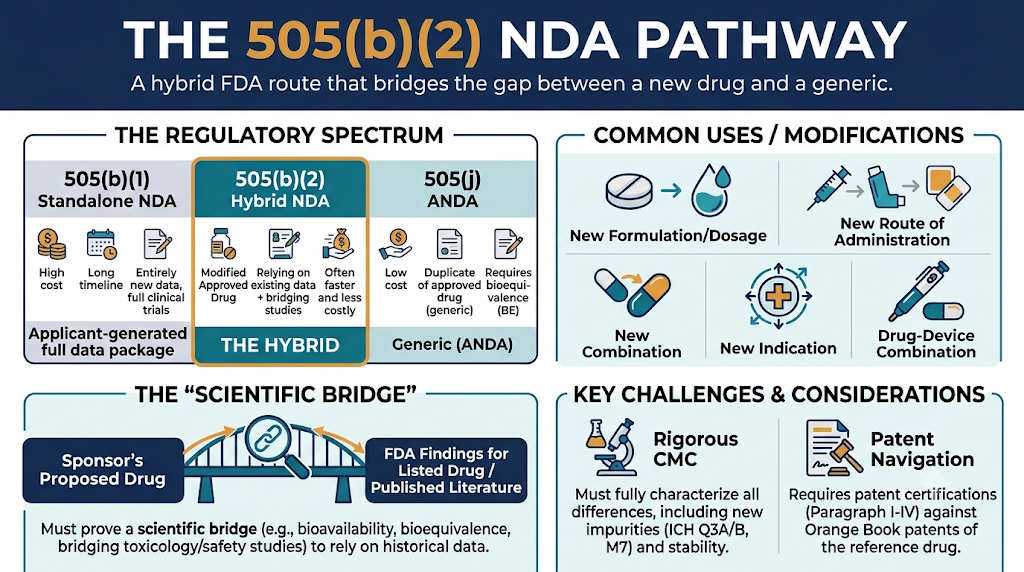
The 505(b)(2) pathway is an FDA route under section 505(b)(2) of the Federal Food, Drug, and Cosmetic Act that allows an NDA to rely on data the applicant did not generate. It sits between a full 505(b)(1) NDA and an abbreviated 505(j) ANDA. It is typically used for changes to an approved drug, such as:
- A new formulation, dosage form or strength
- A new route of administration
- A new combination of previously approved active ingredients
- A new indication or dosing regimen
- A drug-device combination or a modified-release version of an approved product
Because the pathway avoids repeating completed safety and efficacy work, development is often faster and less costly. The trade-off is that your CMC package must show exactly how your product differs from the product whose data you rely on.
A 505(b)(2) NDA remains a full NDA, not an abbreviated application (ANDA). It must satisfy applicable NDA requirements even where it relies on existing information. For contrast, see how CMC documentation at a CDMO for ANDA filings is structured. The pathway can also apply to certain new chemical entities when the statutory conditions for reliance on existing information are met.
2: How Do CMC Requirements for a 505(b)(2) NDA Differ from a Full NDA?
The CMC requirements 505(b)(2) NDA applicants meet are not lighter than those for a full NDA; they are different in emphasis. Both submissions follow the CTD Module 3 structure and the same ICH quality guidelines, but a 505(b)(2) filing centers on comparability and justification of the changes.
| CMC area | Full NDA (505(b)(1)) | 505(b)(2) NDA |
|---|---|---|
| Quality standard | Full Module 3 package | Same full Module 3 package |
| Role of CMC data | Supports a product tested in sponsor’s own pivotal trials | Often the primary evidence of difference from, and link to, the RLD |
| Bridging | Not usually required to an existing product | Comparative analytical data plus BA/BE or other bridging to the RLD or literature |
| Drug substance | Full characterization of a new molecular entity | Often a known substance, but source, polymorph and impurity profile must still be controlled |
| Formulation | Developed alongside the clinical program | Differences from the RLD must be justified and supported scientifically |
| Impurity qualification | Qualified through the sponsor’s own studies | May rely on literature or RLD data only where levels and profile are supported |
| Patent and exclusivity | Not part of CMC | Section 505(b)(2) requires patent certifications to listed drugs, which can shape the formulation strategy |
3: Core CMC Requirements for a 505(b)(2) NDA
A 505(b)(2) CMC package must document the drug substance, drug product, manufacturing process, controls and stability in Module 3 of the eCTD, consistent with 21 CFR 314.50(d)(1). The subsections below cover where reviewers focus most.
Drug Substance (CTD 3.2.S)
FDA expects the drug substance to be fully described, even when the molecule is well known. That means structure and characterization, manufacturing process, specification, reference standards, container closure and stability. For an established active ingredient, applicants often reference a Drug Master File, but they remain responsible for showing that the grade and impurity profile suit the new product. Changes in particle size, salt form or polymorphic form deserve special attention when they affect dissolution or bioavailability.
Typical drug substance documentation covers chemical name, formula and molecular weight, structural confirmation, solubility, particle size, impurity and degradation profile, manufacturing and purification process, specifications, and the proposed retest period. Analytical techniques commonly used include:
- HPLC or UHPLC for assay and related substances
- LC-MS/MS or HRMS for impurity identification
- NMR for structural confirmation and FTIR for functional group characterization
- DSC and XRPD for solid-state characterization
- Karl Fischer titration for water content
For a 505(b)(2) product, identify which API attributes are critical to the proposed modification. A move from an immediate-release tablet to a modified-release formulation, for example, may require added evaluation of particle size, solid-state properties, dissolution behavior and compatibility with the new excipient system.
Drug Product (CTD 3.2.P)
The drug product section is usually the heart of a 505(b)(2) application. It should explain:
- Formulation composition and the function of each excipient
- Pharmaceutical development and the rationale for every difference from the RLD
- Manufacturing process, in-process controls and process validation or a validation plan
- Specifications, with justification, and validated analytical procedures
- Container closure system suitability, including extractables and leachables where relevant
Quality by Design principles (ICH Q8 to Q11) help here. A clear link between critical quality attributes, critical process parameters and the clinical or bridging data makes the justification easier to follow.
Manufacturing Process and Process Controls
Manufacturing documentation must show that the proposed product can be made consistently with a controlled, reproducible process. The package should describe:
- Process flow and sequence of operations
- Equipment, processing conditions and critical process parameters (CPPs)
- In-process controls and acceptance criteria
- Batch records and relevant development data
- Scale-up considerations and process consistency
- Manufacturing sites and responsibilities
For modified formulations, parameters such as granulation conditions, mixing time, compression force, coating, drying temperature and polymer dispersion can directly affect performance. Planning scale-up and tech transfer in CMC early protects consistency between development and commercial batches, and a phase-appropriate CMC development approach lets the depth of process validation match the stage of the program.
Analytical Method Development and Validation
Analytical methods must suit the proposed product, so do not assume the RLD’s methods are sufficient. An extended-release product, for instance, may need a discriminatory dissolution method that detects meaningful changes in release behavior.
| Quality attribute | Common analytical approach |
|---|---|
| API assay | HPLC/UHPLC |
| Related substances | HPLC, LC-MS/MS |
| Unknown impurity identification | LC-HRMS, LC-MS/MS |
| Drug release | Dissolution testing |
| Content uniformity | Compendial or validated methods |
| Residual solvents | GC / headspace GC |
| Water content | Karl Fischer titration |
| Solid-state properties | XRPD, DSC |
| Degradation products | Stability-indicating HPLC or LC-MS |
Validate methods for their intended use, covering specificity, accuracy, precision, linearity, range, robustness and detection or quantitation limits as appropriate.
Bridging to the Reference Listed Drug
Bridging shows that your product is sufficiently similar to the RLD, or that any difference does not undermine reliance on prior findings. Depending on the change, the bridge can include comparative in vitro dissolution, physicochemical characterization, and in vivo bioavailability or bioequivalence studies under 21 CFR Part 320. Robust analytical data generated with validated, discriminating methods strengthens every part of this bridge.
A bridge is rarely a single study. It usually combines comparative physicochemical characterization, dissolution, formulation assessment and comparative bioavailability or pharmacokinetic data. The goal is product-specific evidence that supports your modifications, not a repeat of every study done for the original drug.
| Proposed modification | Potential supporting studies |
|---|---|
| Immediate-release to extended-release | Comparative dissolution, release kinetics, stability, appropriate PK studies |
| New tablet strength | Assay, content uniformity, dissolution, proportionality assessment |
| New oral liquid | Excipient compatibility, assay, microbial quality, stability, bioavailability assessment |
| New route of administration | Product-specific characterization, route-related quality studies, supporting nonclinical or clinical work as appropriate |
| New excipient system | Excipient characterization, compatibility, impurity assessment, stability, safety justification |
| Modified delivery system | Physicochemical characterization, release performance, device compatibility, comparative studies |
The required studies depend on how the change could affect quality, safety and effectiveness. A new oral liquid may need evaluation of precipitation, solubility, preservative effectiveness and chemical stability, while a modified-release product needs deeper dissolution and pharmacokinetic evidence. For injectable and modified-release examples, see ResolveMass’s guidance on dexamethasone injection CMC requirements, the leuprolide depot CMC strategy, the CMC strategy for complex generic injectables, and CMC services for peptide-oligonucleotide conjugates.
Impurities, Nitrosamines and Elemental Impurities
Impurity control is one of the most scrutinized areas of the CMC requirements 505(b)(2) NDA reviewers assess. Expect to address the following:
- Organic impurities and degradation products under ICH Q3A and Q3B, including identification and qualification thresholds
- Residual solvents under ICH Q3C
- Elemental impurities under ICH Q3D
- Mutagenic impurities under ICH M7
- Nitrosamine risk assessment, with confirmatory testing where risk is identified, following FDA’s guidance on controlling nitrosamine impurities in human drugs
A new excipient, process or packaging component can introduce impurities that the RLD never had, so reliance on the RLD’s profile alone is rarely sufficient. Sensitive, validated methods such as LC-MS/MS are commonly used to detect and quantify trace-level impurities.
Stability and Container Closure
Stability data must come from your product, in its proposed packaging, under ICH Q1A(R2) conditions. Data from the RLD cannot substitute for it. The stability program should support the proposed shelf life and storage statement and use stability-indicating methods that show degradation is detected and measured accurately.
The container closure system also needs product-specific evaluation. Where the formulation or packaging differs from the RLD, assess extractables and leachables in CMC to confirm that packaging components do not introduce unacceptable impurities.
4: Common CMC Pitfalls in 505(b)(2) Submissions
The most common pitfalls are weak bridging data, unjustified formulation differences and incomplete impurity assessment. Others include:
- Assuming the RLD’s specifications automatically apply to the new product
- Using analytical methods that are not validated or not stability-indicating
- Starting nitrosamine and elemental impurity assessments too late
- Underestimating differences in excipients or packaging that alter performance
- Leaving method transfer and data integrity gaps between development and commercial sites
Most of these are avoidable when analytical strategy is planned before pivotal batches are made.
5: How an Analytical Partner Supports Your 505(b)(2) CMC Package
An experienced analytical partner helps by generating the characterization, impurity and comparability data that a 505(b)(2) CMC package depends on. ResolveMass Laboratories Inc. is a Canadian analytical CRO/CDMO whose work centers on mass spectrometry-based characterization, biosimilar characterization, PLGA-based drug delivery systems and nitrosamine testing. Relevant support typically includes:
- Analytical method development and validation for assay, related substances and dissolution
- Impurity profiling and structural elucidation, including nitrosamine and trace-level testing
- Comparative characterization of your product against the RLD
- Stability testing support and stability-indicating method development
- Complex and modified-release formulations, including polymeric delivery systems
Bringing a laboratory in early lets formulation, analytical and regulatory teams align on the bridging strategy before the data is generated, rather than after FDA raises questions.
Conclusion
The CMC requirements 505(b)(2) NDA sponsors must meet match a full NDA in rigor but differ in purpose: your CMC data must prove how your product relates to, and differs from, the drug whose evidence you rely on. Strong bridging, justified formulation differences, thorough impurity control and product-specific stability data are what keep a 505(b)(2) program moving. Planning the analytical strategy early is the most reliable way to avoid review delays.
Frequently Asked Questions:
A 505(b)(2) NDA allows applicants to rely partly on existing FDA findings of safety and effectiveness or published scientific information, where legally permissible. A traditional 505(b)(1) NDA generally relies on investigations conducted by or for the applicant or for which the applicant has a right of reference.
CMC bridging establishes a scientific relationship between the proposed drug product and the listed drug or other information being relied upon. It may involve comparative dissolution, physicochemical characterization, impurity profiling, formulation assessment, and other studies needed to support the proposed modifications.
Yes. Applicants must provide appropriate stability data to support the proposed drug product’s shelf life and storage conditions. Studies may include long-term, accelerated, intermediate, photostability, and in-use stability testing, depending on the formulation and applicable requirements.
Comparative dissolution studies may be necessary when formulation, strength, dosage form, or drug-release characteristics differ from the listed drug. Their design should reflect the proposed modification and the scientific questions that need to be addressed.
Applicants may rely on publicly available information or FDA’s previous findings where legally permissible. However, confidential CMC information from another sponsor’s NDA cannot automatically be accessed or reused without an appropriate right of reference or authorization.
Companies can strengthen their submissions by developing a risk-based CMC strategy, identifying critical quality attributes early, validating analytical methods, conducting appropriate comparative studies, generating sufficient stability data, and maintaining complete CTD documentation.
Reference
- Salminen WF, Aloba O, Drew A, Marcinowicz A, Huang M. US FDA 505 (b)(2) NDA clinical, CMC and regulatory strategy concepts to expedite drug development. Drug Discovery Today. 2023 Jul 1;28(7):103618.https://www.sciencedirect.com/science/article/pii/S1359644623001344
- Salminen WF, Wiles ME, Stevens RE. Streamlining nonclinical drug development using the FDA 505 (b)(2) new drug application regulatory pathway. Drug Discovery Today. 2019 Jan 1;24(1):46-56.https://www.sciencedirect.com/science/article/pii/S135964461830120X
- Crittenden D, Gallagher R, Milans del Bosch F, Fox DM, Kleiman LB. Pathways for non-manufacturers to drive generic drug repurposing for cancer in the US. Frontiers in Pharmacology. 2024 Oct 9;15:1419772.https://www.frontiersin.org/journals/pharmacology/articles/10.3389/fphar.2024.1419772/full
- Darrow JJ, He M, Stefanini K. The 505 (b)(2) drug approval pathway. Food and Drug Law Journal. 2019 Jan 1;74(3):403-39.https://www.jstor.org/stable/26892172
- Rathee P, Tripathy S, Khatter S, Patra BP, Murthy PN, Dureja H. 505 (b)(2)-A smart pathway to differentiate from competitive, low margin environment of generics. Journal of Generic Medicines. 2021 Dec;17(4):183-94.https://journals.sagepub.com/doi/abs/10.1177/1741134320987866
- VanHeusen MA. ALIGNMENT OF REGULATORY AND LIFECYCLE MANAGEMENT STRATEGIES FOR DRUGS SUBMITTED AS NEW DRUG APPLICATIONS UNDER 505 (B)(2) OF THE FOOD, DRUG, AND COSMETIC ACT (Doctoral dissertation, Johns Hopkins University).https://jscholarship.library.jhu.edu/server/api/core/bitstreams/ef972fd2-cf35-4875-a41e-6f4c65191d54/content
About the Author