
Introduction
FDA expectations for Extractables and Leachables in CMC require pharmaceutical sponsors to demonstrate chemical compatibility through risk-based material characterization, controlled extraction studies, and validated leachables monitoring throughout product stability testing. By conducting science-based toxicological evaluations of potential chemical migrants, drug developers can ensure product safety, identity, strength, quality, and purity throughout the commercial lifecycle.
In Chemistry, Manufacturing, and Controls (CMC) regulatory filings, the evaluation of container closure systems (CCS) has evolved beyond basic physical barrier integrity to include comprehensive chemical characterization of packaging interfaces. Therapeutic formulations, particularly parenterals, biologics, inhalables, and ophthalmic solutions, frequently contain active pharmaceutical ingredients (APIs), organic co-solvents, buffers, or surfactants that may interact with packaging materials. Elastomeric stoppers, plastic resin bottles, valve gaskets, barrel lubricants, and secondary packaging inks can serve as potential chemical sources from which substances migrate into formulations during storage. Uncontrolled chemical leaching may alter formulation pH, trigger protein aggregation, degrade APIs, increase clinical toxicity, or result in regulatory review deficiencies and clinical holds. Therefore, demonstrating container-drug compatibility through comprehensive testing is an essential requirement for Investigational New Drug (IND), New Drug Application (NDA), and Biologics License Application (BLA) submissions.
Strengthen your regulatory strategy with comprehensive CMC services tailored to pharmaceutical development requirements.
Share via:
Quick Summary:
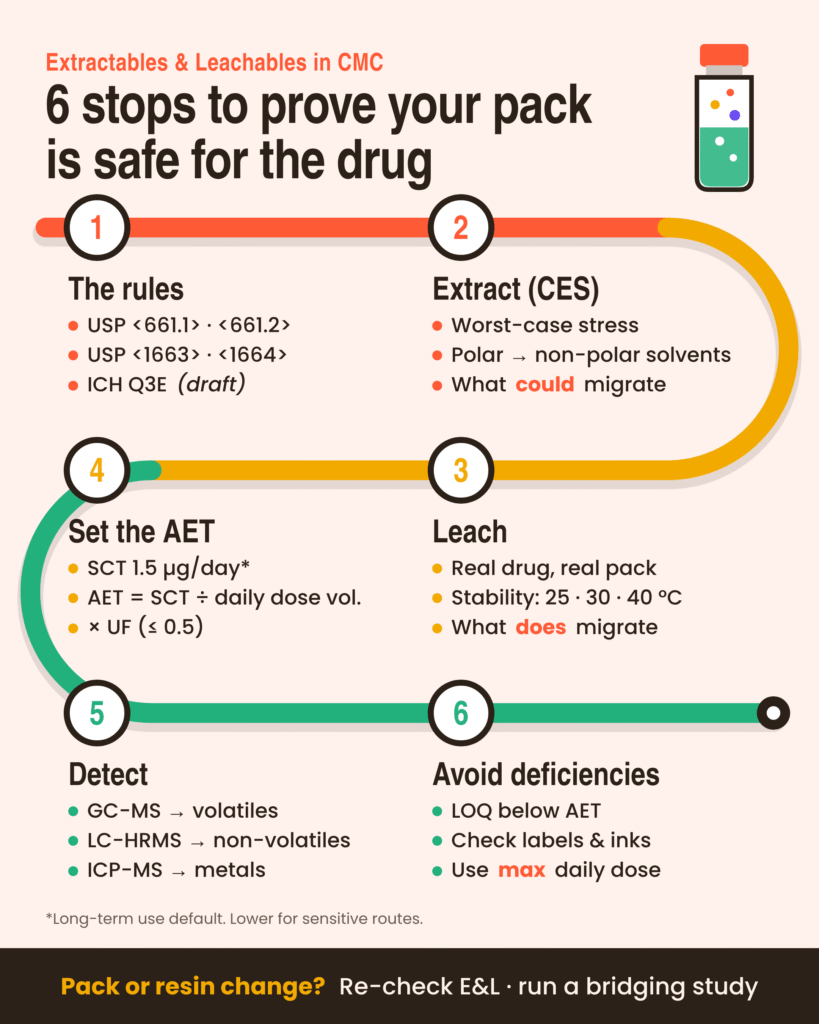
- Why E&L matters in CMC: Packaging parts such as stoppers, plastic bottles, gaskets, lubricants and label inks can release chemicals into a drug. These can change pH, cause protein aggregation, degrade the API or create safety risks. FDA expects IND, NDA and BLA filings to show the container and drug are chemically compatible.
- The rules: USP <661.1> covers plastic materials and USP <661.2> covers complete packaging systems; both are mandatory and have been official since 1 December 2025. USP <1663> (extractables) and <1664> (leachables) are guidance chapters. Draft ICH Q3E aims to harmonize E&L expectations across the US, EU and Japan, and final adoption is expected in 2027.
- Extractables vs. leachables: Controlled extraction studies use harsh conditions and polar to non-polar solvents to find what could migrate. Leachables studies test the real drug in the real pack under ICH stability conditions (25, 30 and 40 °C) to measure what does migrate.
- The AET threshold: The Analytical Evaluation Threshold is the level above which a compound must be identified and assessed for safety. It is calculated from the Safety Concern Threshold, which is commonly 1.5 µg/day for long-term use and lower for sensitive routes. The SCT is divided by the maximum daily dose, then an uncertainty factor (usually 0.5) is applied.
- Analytical tools: GC-MS finds volatile and semi-volatile compounds. LC-HRMS finds non-volatile compounds such as oligomers and slip agents. ICP-MS measures metals and other elemental impurities. Methods must be validated under ICH Q2(R2), with LOQs below the AET.
- Common FDA deficiencies:
- Methods that aren’t sensitive enough (LOQ above the AET)
- Ignoring chemicals that move from labels, inks and outer wraps through the primary container
- Calculating the AET with the average dose instead of the maximum labeled dose
- Lifecycle: Changes to suppliers, resin grades, tubing or sterilization method mean E&L must be re-checked. Having good extractables data already in hand lets sponsors run a smaller bridging study instead of repeating full stability studies.
Regulatory Compendial Frameworks for Extractables and Leachables in CMC
Regulatory frameworks governing Extractables and Leachables in CMC require sponsors to move beyond raw material screening and conduct comprehensive toxicological safety evaluations of finished packaging systems. Standard compliance requires adherence to United States Pharmacopeia (USP) compendial standards, alongside emerging internationally harmonized guidelines such as draft ICH Q3E.
The compendial testing approach is based on USP <661.1> (Plastic Materials of Construction) and USP <661.2> (Plastic Packaging Systems for Pharmaceutical Use). The historical USP chapter, which primarily relied on generalized physicochemical extraction tests, became obsolete following the implementation of transitional regulatory enforcement timelines. Under the current compendial framework, packaging materials undergo a structured, multi-tiered qualification process:
Material Characterization (USP <661.1>): Polymeric resins are assessed for identity, thermal behavior, non-specific organic extractables (such as total organic carbon), and elemental extraction profiles before being selected for container manufacturing.
Packaging System Qualification (USP <661.2>): Complete container closure systems undergo biological reactivity testing, physicochemical analysis, and formal chemical safety assessments associated with USP and USP protocols.
Extractables Guidance Framework (USP): Establishes theoretical and practical requirements for designing Controlled Extraction Studies (CES) to identify potential chemical migrants under exaggerated laboratory stress conditions.
Leachables Guidance Framework (USP): Defines procedures for detecting, monitoring, and quantifying compounds that migrate into actual drug formulations under commercial storage or accelerated aging conditions.
At the international level, the International Council for Harmonisation (ICH) draft ICH Q3E guideline (Extractables and Leachables) aims to harmonize regulatory expectations across the United States, European Union, and Japan. Draft ICH Q3E incorporates extractable and leachable risk assessments directly into Quality Risk Management (QRM) frameworks (ICH Q9) and establishes alignment with existing impurity guidelines, including ICH Q3A/B (drug substance/product impurities), ICH Q3C (residual solvents), ICH Q3D (elemental impurities), and ICH M7 (mutagenic impurities).
| Regulatory Guideline | Scope & Primary Focus | Key Methodological Requirements | Implementation & Regulatory Status |
|---|---|---|---|
| USP <661.1> | Characterization of plastic materials of construction. | Identification, thermal analysis, acidity/alkalinity, total organic carbon (TOC), and elemental extraction. | Mandatory compendial standard. |
| USP <661.2> | Qualification of complete plastic packaging systems. | Physicochemical testing, biological reactivity assessment, and chemical safety assessment linked to USP /. | Mandatory compendial standard. |
| USP Framework for extractables assessment | Controlled Extraction Studies (CES) using exaggerated solvents, thermal stress, and multi-detector screening. | Non-targeted chemical screening under exaggerated extraction conditions. | Informational benchmark standard. |
| USP Framework for drug product leachables assessment | Real-time and accelerated leachables stability monitoring, simulated-use testing, and correlation studies. | Targeted monitoring and quantification of compounds migrating into drug formulations. | Informational benchmark standard. |
| ICH Q3E | Harmonized international standard for E&L across dosage forms. | Holistic, risk-based safety management, explicit Analytical Evaluation Threshold (AET) derivations, and lifecycle control strategies. | Step 2 draft endorsed; public consultation completed. |
Sponsors must also ensure that their regulatory submissions contain adequate supporting CMC documentation, including material specifications, analytical results, and scientific justifications. Support early-stage regulatory planning with specialized IND CMC services and appropriate documentation.
Analytical Protocols: Controlled Extraction Studies (CES) vs. Leachables Stability Testing
Controlled Extraction Studies (CES) establish an extensive chemical inventory of potential migrants under exaggerated extraction conditions, whereas leachables stability studies monitor actual chemical migration into drug formulations throughout their commercial shelf life. Correlating extractable profile data with stability leachable findings enables sponsors to establish upstream quality control acceptance criteria and provide scientific justification for post-approval packaging modifications.
Controlled Extraction Studies performed under USP serve as a non-targeted discovery phase intended to extract organic and inorganic substances without degrading the primary polymer matrix. Laboratory protocols utilize solvent systems covering a wide polarity range under elevated thermal stress, reflux, or sonication conditions:
Polar Extraction Solvents: Purified water, acidic aqueous buffers (e.g., pH 2.5), or basic aqueous buffers (e.g., pH 10.5) are used to isolate hydrophilic additives, inorganic salts, and polar organic acids.
Semi-Polar Extraction Solvents: Ethanol/water mixtures, isopropyl alcohol, or ethyl acetate are employed to extract semi-volatile plasticizers, curing agents, and primary antioxidant degradation products.
Non-Polar Extraction Solvents: Hexane, heptane, or cyclohexane are used to isolate non-polar polymer oligomers, mineral oils, wax fractions, and fatty acid derivatives.
Leachables stability monitoring under USP evaluates target compounds in finished drug products stored in commercial container closure systems under ICH storage conditions (25°C/60% RH for long-term storage, 30°C/65% RH for intermediate storage, and 40°C/75% RH for accelerated storage). When direct formulation testing is complicated by substantial API mass spectral interference or matrix ion suppression, simulated-use extraction studies may be performed using placebo formulations or simplified surrogate solvents that replicate the formulation’s pH and ionic strength. These approaches can provide valid quantitative estimates of patient exposure.
| Operational Parameter | Controlled Extraction Studies (USP) | Leachables Stability Testing (USP) |
|---|---|---|
| Primary Objective | Establish a worst-case extractable inventory and identify potential migrants. | Quantify actual chemical migration into the drug product throughout its commercial shelf life. |
| Experimental Conditions | Exaggerated temperatures, extended extraction times, and aggressive solvent systems. | Real-time and accelerated storage conditions corresponding to the clinical shelf life (ICH Q1A). |
| Solvent Systems | Solvents covering polar, semi-polar, and non-polar ranges. | Commercial drug formulation or validated surrogate placebo matrix. |
| Analytical Focus | Non-targeted screening for volatile, semi-volatile, non-volatile, and inorganic entities. | Targeted quantification of verified extractables exceeding the derived final AET. |
| Regulatory Role | Supports material selection and guides analytical method development. | Provides definitive safety data for drug product release, labeling, and shelf-life approval. |
Reliable analytical procedures are essential for distinguishing actual leachables from potential extractables and ensuring that reported concentrations are scientifically defensible. Improve analytical reliability through analytical method development for IND and NDA submissions.
Mathematical Derivation of the Analytical Evaluation Threshold (AET) in Extractables and Leachables in CMC
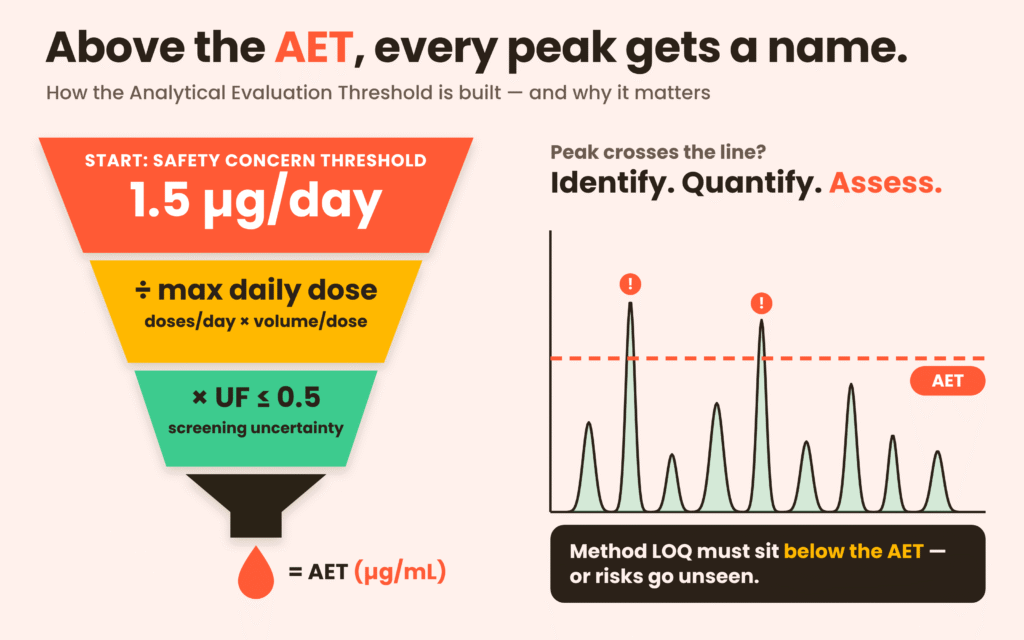
The Analytical Evaluation Threshold (AET) establishes the concentration limit at or above which an extracted or leached chemical compound must be structurally identified and evaluated for toxicological safety. Derived mathematically from the Safety Concern Threshold (SCT), the AET accounts for daily patient dosing parameters, container configurations, and analytical response variability.
The Safety Concern Threshold (SCT), recommended by the Product Quality Research Institute (PQRI) and incorporated into draft ICH Q3E, represents the absolute daily exposure level below which a leachable is considered to present negligible toxicological risk, including mutagenic and carcinogenic endpoints. For high-risk dosage forms, such as parenterals, ophthalmic solutions, and orally inhaled products, the standard SCT reference value is established at 1.5 µg/day.
To convert the absolute daily intake threshold (SCT) into an analytical reporting concentration (AET estimated in µg/mL), the dosing frequency and administration volume must be considered:
AETestimated = SCT / (Dmax × Vdose)
Where:
- SCT represents the daily exposure threshold (1.5 µg/day).
- Dmax represents the maximum labeled daily dosing frequency (doses/day).
- Vdose represents the volume administered per individual dose (mL/dose).
When extractable levels are reported on a mass-fraction basis (µg/g of component resin), the following equation is applied:
AETestimated = (SCT / Dmax) × (Ndoses / mcomponent)
Where Ndoses represents the total number of doses contained in the final packaging unit, and mcomponent represents the mass of the container component in grams.
Because non-targeted chromatographic screening relies on internal standards that may exhibit different detector response factors from those of unknown chemical migrants, an Analytical Uncertainty Factor (UF) is applied to establish the final reporting threshold (AETfinal):
AETfinal = AETestimated × (1 – UF)
Here, UF represents the statistical variation in Relative Response Factors (RRFs) across a validated analytical database. When standard database metrics are unavailable, a default value of UF = 0.50 (50% reduction) is applied.
For pediatric drug products, toxicological risk calculations require adjustments to daily dose assumptions based on pediatric body mass models. For example, a 10 kg infant model is compared with the standard 60 kg adult reference model:
SCTpediatric = 1.5 µg/day × (10 kg / 60 kg) = 0.25 µg/day
Using SCTpediatric produces a substantially lower AETfinal, thereby requiring greater sensitivity from ultra-trace analytical methods. Compounds exceeding AETfinal must undergo structural elucidation and toxicological risk assessment to establish Permissible Daily Exposure (PDE) levels. For identified non-mutagenic leachables in inhalation products, the Qualification Threshold (QT) is established at 5.0 µg/day.
An appropriate impurity control strategy is equally important when interpreting chemical characterization results and determining whether detected compounds require further qualification. Maintain regulatory compliance with effective impurity control strategies throughout pharmaceutical development.
Advanced Analytical Screening Technologies for Drug-Container Compatibility
Identifying and quantifying unknown extractables and leachables requires an orthogonal analytical screening suite capable of detecting volatile, semi-volatile, and non-volatile organic entities, as well as trace inorganic elements. Targeted leachables method validation must comply with ICH Q2(R2) standards, ensuring that analytical Limits of Quantitation (LOQ) remain below the derived AETfinal.
Non-targeted structural characterization depends on complementary analytical platforms:
Gas Chromatography-Mass Spectrometry (GC-MS): Headspace GC-MS or Thermal Desorption GC-MS is used to isolate volatile organic compounds (VOCs) with boiling points below 200°C, including residual solvents, low-molecular-weight monomers, and residual blowing agents. Direct injection GC-MS operating in Electron Ionization (EI) and Chemical Ionization (CI) modes is used to characterize semi-volatile organic compounds (SVOCs), such as phthalate plasticizers, fatty acid esters, siloxanes, and antioxidant degradation products (e.g., BHT and Irganox 1010 breakdown products).
Liquid Chromatography-High Resolution Mass Spectrometry (LC-HRMS): Ultra-high-performance LC coupled with Orbitrap or Quadrupole Time-of-Flight (Q-ToF) mass spectrometry is employed to identify non-volatile organic compounds (NVOCs). Combining Electrospray Ionization (ESI) and Atmospheric Pressure Chemical Ionization (APCI) in positive and negative modes enables the detection of heavy synthetic oligomers, photoinitiators, slip agents (e.g., erucamide), primary aromatic amines, and surfactant residues.
Inductively Coupled Plasma-Mass Spectrometry (ICP-MS): This technique measures trace elemental impurities, heavy metal catalysts (e.g., zinc, platinum, and palladium), and glass delamination markers (e.g., silicon, boron, sodium, and aluminum) in accordance with USP <661.1> and ICH Q3D requirements.
| Analytical Technique | Target Compound Class | Representative Chemical Migrants | Typical LOQ Capabilities |
|---|---|---|---|
| Headspace / TD GC-MS | Volatile Organic Compounds (VOCs). | Residual solvents, low-molecular-weight monomers, blowing agents. | 0.005 – 0.05 µg/mL. |
| Direct Injection GC-MS (EI/CI) | Semi-Volatile Organic Compounds (SVOCs). | Phthalates, plasticizers, BHT, Irganox 1010/1076 degradation products, siloxanes. | 0.01 – 0.1 µg/mL. |
| LC-ESI/APCI-HRMS (Orbitrap/Q-ToF) | Non-Volatile Organic Compounds (NVOCs). | Synthetic oligomers, photoinitiators, slip agents, fatty acid amides, surfactants. | 0.001 – 0.05 µg/mL. |
| ICP-MS / ICP-OES | Elemental Impurities & Metals. | Zinc, titanium, catalysts (Pt, Pd), glass oxides (Si, B, Al, Na). | 0.0001 – 0.001 µg/mL. |
Selecting suitable analytical platforms and validating their performance are essential for generating dependable extractables and leachables data. Address complex characterization requirements through custom analytical method development for drug discovery.
Mitigating Regulatory Deficiencies in Extractables and Leachables in CMC Submissions
FDA review deficiencies associated with Extractables and Leachables in CMC frequently result from inadequate analytical method sensitivity, uncharacterized secondary packaging permeation, and insufficient toxicological justifications. Achieving regulatory approval requires well-designed extractable-leachable correlation studies and continuous lifecycle change control.
Common regulatory objections and corresponding mitigation strategies include:
Inadequate Method Sensitivity (LOQ > AET): Submitting leachables stability studies in which analytical limits of quantitation (LOQ) exceed the calculated AETfinal leaves potential toxicological risks insufficiently characterized. Laboratories should implement pre-analytical sample enrichment techniques, such as solid-phase extraction (SPE) or liquid-liquid concentration, to reduce LOQs below AETfinal.
Omission of Secondary Packaging Migrants: Failure to assess chemical migration from label adhesives, inks, and outer wraps through semi-permeable primary plastic containers (e.g., LDPE bottles) can result in CMC deficiencies. E&L protocols should therefore include secondary packaging interaction studies conducted under worst-case thermal and humidity conditions.
Pediatric and Dosing Calculation Errors: Using average daily doses instead of maximum labeled daily doses, or failing to account for pediatric body weight adjustments, can result in excessively permissive AET derivations. Recalculating thresholds using maximum clinical exposure parameters helps address these regulatory concerns.
Sponsors should also ensure that their analytical procedures are appropriately validated and that their CMC documentation addresses potential regulatory concerns before submission. Avoid common regulatory setbacks by understanding CMC deficiencies in IND and NDA submissions.
During post-approval lifecycle management, changes involving raw material suppliers, manufacturing equipment tubing, resin grades, or sterilization methods (e.g., gamma irradiation versus autoclaving) require re-evaluation of E&L profiles under ICH Q3E guidelines. Previously established extractable profiles allow sponsors to conduct bridging extraction studies to verify profile equivalence, potentially eliminating the need to repeat complete stability trials. Technical assistance from specialized contract laboratories, such as ResolveMass Laboratories Inc., can support the development of regulatory-compliant E&L study packages.
For complex regulatory questions, sponsors may need additional analytical evidence and scientifically supported responses to address FDA review comments. Strengthen regulatory responses with effective approaches to resolving FDA CMC queries.
Conclusion
Establishing reliable drug-container compatibility through scientific evaluations of Extractables and Leachables in CMC is fundamental to obtaining regulatory approval and maintaining long-term patient safety. Compliance with compendial chapters USP <661.1>/<661.2> and international guidelines such as ICH Q3E requires an integrated approach that combines accurate AET calculations, multi-platform analytical instrumentation, and formal toxicological risk assessments. By incorporating controlled extraction data and stability leachables monitoring into quality risk management systems, pharmaceutical developers can establish scientifically defensible CMC submissions and maintain drug quality throughout the product lifecycle.
A comprehensive approach to E&L evaluation also requires appropriate stability monitoring, analytical validation, and toxicological qualification to ensure that potential chemical migrants remain within acceptable safety limits. Maintain consistent product quality through well-designed stability studies in CMC.
For expert assistance in developing scientifically sound and regulatory-compliant Extractables and Leachables study protocols, contact the analytical chemistry team at ResolveMass Laboratories Inc.: https://resolvemass.ca/contact/
Frequently Asked Questions
USP and USP establish essential compendial requirements for characterizing plastic materials and qualifying complete packaging systems used in pharmaceutical applications. These standards ensure that packaging materials undergo appropriate physicochemical characterization, elemental impurity assessment, and extraction testing. Compliance helps manufacturers establish the suitability of plastic container closure systems before incorporating them into drug production.
The AET is derived by dividing the Safety Concern Threshold (SCT), generally 1.5 µg/day for relevant high-risk applications, by the maximum daily administration volume. An Analytical Uncertainty Factor is subsequently considered to account for variations in analytical response. The resulting threshold determines which unidentified chemical compounds require structural identification and further toxicological evaluation.
The SCT establishes a daily exposure reference below which a leachable is considered to present negligible toxicological concern for specified endpoints. For parenteral and inhalation products, a reference value of 1.5 µg/day is commonly used as the starting point for relevant assessments. It provides the foundation for calculating analytical reporting thresholds and determining whether detected chemical migrants require additional investigation.
Comprehensive E&L screening requires multiple complementary analytical techniques because chemical migrants differ in volatility, molecular weight, and elemental composition. Headspace GC-MS detects volatile compounds, while Direct Injection GC-MS characterizes semi-volatile substances. LC-HRMS identifies non-volatile organic compounds, whereas ICP-MS measures trace elemental impurities and metallic contaminants.
Draft ICH Q3E aims to establish a harmonized, risk-based approach to Extractables and Leachables evaluation across major regulatory jurisdictions, including the FDA, EMA, and PMDA. It connects E&L assessments with existing impurity management guidelines, including ICH Q3A-D and ICH M7. This alignment helps pharmaceutical sponsors develop consistent regulatory strategies and reduce unnecessary duplication of testing across international submissions.
Simulated-use extraction studies examine chemical migration from packaging components using surrogate solvent systems designed to reproduce important characteristics of the actual drug formulation. These characteristics may include pH, ionic strength, and solvent polarity. Such studies are particularly useful when direct drug product analysis becomes difficult because of interference from APIs or excipients that affect analytical detection and quantification.
Secondary packaging components, including printing inks, adhesives, labels, and outer wraps, can release volatile and semi-volatile chemical substances. These compounds may pass through semi-permeable primary packaging materials, such as LDPE containers, and eventually enter the drug formulation. Evaluating these potential migration pathways is important for identifying contamination risks and maintaining product quality throughout storage.
The Analytical Uncertainty Factor (UF) compensates for differences in detector responses between unidentified chemical migrants and the internal standards used during non-targeted chromatographic analysis. It is generally established using Relative Response Factor (RRF) data from validated analytical databases. When sufficient response factor information is unavailable, a conservative default value of 0.50 may be applied to reduce the estimated AET and account for analytical uncertainty.
Any post-approval modification involving packaging components, polymer resin grades, raw material suppliers, or manufacturing equipment tubing should undergo an appropriate E&L risk assessment. Sponsors can perform bridging extraction studies to compare the chemical profiles of modified materials against previously established baseline data. Demonstrating comparable or lower extractable levels helps support change control decisions and may eliminate the need for repeating extensive stability studies.
Reference:
- Food and Drug Administration. (2026, August). Container closure systems for human drugs and biological products: Draft guidance for industry. U.S. Department of Health and Human Services. https://www.fda.gov/regulatory-information/search-fda-guidance-documents/container-closure-systems-human-drugs-and-biological-products
- International Council for Harmonisation of Technical Requirements for Pharmaceuticals for Human Use. (2025, August 1). ICH Q3E guideline for extractables and leachables (Draft version). European Medicines Agency. https://www.ema.europa.eu/en/documents/scientific-guideline/draft-ich-q3e-guideline-extractables-leachables_en.pdf
- United States Pharmacopeial Convention. (2017, May 1). 〈661.2〉 Plastic packaging systems for pharmaceutical use: Revision bulletin. USP–NF. https://www.uspnf.com/sites/default/files/usp_pdf/EN/USPNF/revisions/661.2_rb_notice.pdf
- Xu, J. (2026, April 23). A risk-based approach to extractables and leachables evaluations [PowerPoint presentation]. U.S. Food and Drug Administration, Center for Drug Evaluation and Research. https://www.fda.gov/media/194099/download
- International Council for Harmonisation of Technical Requirements for Pharmaceuticals for Human Use. (2026, June 2). ICH Association 2025 annual report. https://admin.ich.org/sites/default/files/inline-files/2025_Annual_Report_of_the_ICH_Association_0.pdf
Get In Touch With Us
About The Author