

Introduction
The development of synthetic peptide generics derived from recombinant DNA (rDNA) originator products presents important analytical and regulatory challenges. Unlike small-molecule generics, peptide drugs require detailed structural characterization to prove that the generic version truly matches the reference product. One of the most reliable analytical approaches used for this purpose is the Peptide Mapping Study of Liraglutide, which helps confirm the amino acid sequence and structural integrity of the peptide. Regulatory authorities such as the USFDA and Health Canada require comprehensive analytical evidence demonstrating molecular-level equivalence between the generic and the reference drug.
Ensure your sequences are accurate with expert oversight: Explore our Peptide Sequencing Service
A study published in the Journal of Pharmaceutical and Biomedical Analysis describes a UPLC–High Resolution Mass Spectrometry (UPLC-HRMS) workflow used to verify the structural integrity of synthetic liraglutide. By combining advanced chromatographic separation with high-resolution mass spectrometry detection, researchers generated a detailed peptide map of the molecule. This approach provides valuable insights into peptide structure and is widely used in pharmaceutical analysis to confirm peptide identity and support regulatory submissions.
This case study focuses on the Peptide Mapping Study of Liraglutide and explains the analytical strategy, experimental design, HRMS data interpretation, and its relevance in generic drug development. Peptide mapping helps verify peptide sequences through enzymatic digestion followed by mass spectrometric analysis. In the case of liraglutide generics, such studies play a critical role in demonstrating structural similarity with the reference product and generating reliable analytical data for regulatory review.
Share via:
Key Highlights
- Peptide mapping is a critical analytical technique used to confirm the amino acid sequence and structural integrity of synthetic peptide generics such as liraglutide.
- UPLC coupled with High-Resolution Mass Spectrometry (UPLC-HRMS) enables precise identification of peptide fragments and structural modifications during characterization studies.
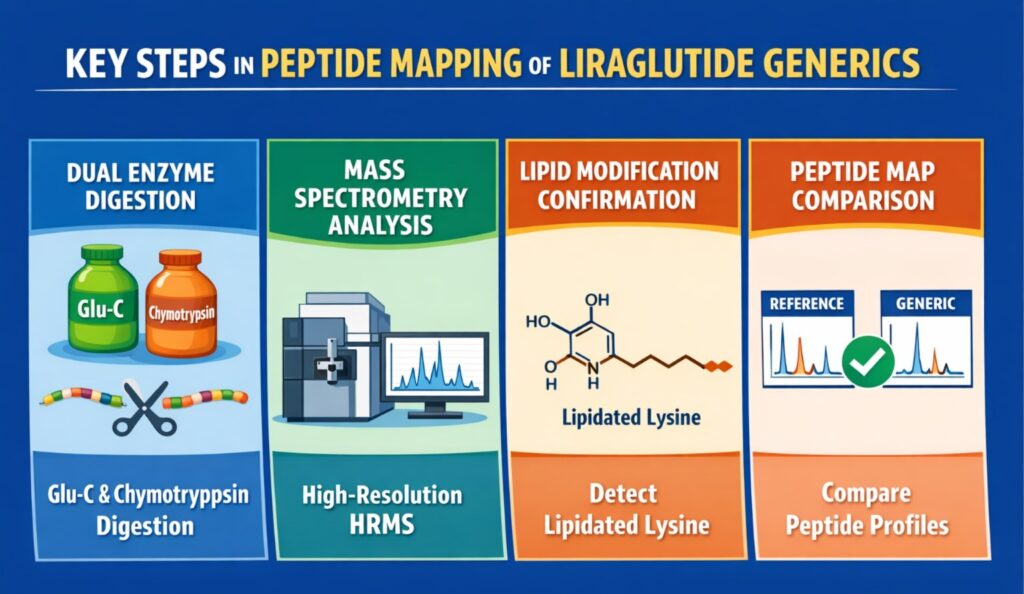
- Dual-enzyme digestion using Glu-C and chymotrypsin provides overlapping peptide fragments that ensure complete sequence coverage and reliable structural verification.
- High-accuracy mass measurements (<5 ppm error) confirm fragment identities and strengthen analytical confidence for regulatory submissions.
- HRMS fragmentation analysis confirms the key palmitoyl lipid modification on lysine, a critical structural feature that influences liraglutide’s pharmacokinetics and therapeutic activity.
- The combined analytical workflow generates strong structural evidence demonstrating molecular equivalence between synthetic liraglutide and the reference product for submissions to regulatory authorities such as the USFDA and Health Canada.
Regulatory Context for Peptide Mapping in Liraglutide Generics
Regulatory agencies are placing increasing emphasis on using multiple structural characterization techniques for complex peptide drugs. This requirement is particularly important when synthetic peptides are designed to replicate recombinant biologic products. Peptide therapeutics often contain structural modifications that influence stability, pharmacokinetics, and biological activity. Because of this, regulatory authorities require detailed molecular evidence confirming these structural features. Analytical characterization must therefore go beyond simple identity testing and include advanced structural verification methods. As a result, peptide mapping with mass spectrometry has become a key technique used in regulatory submissions for peptide generics.
Navigate the complexities of regulatory submissions: Learn about Peptide Characterization for FDA Compliance
Recent regulatory guidance highlights the need for comprehensive peptide characterization when developing generic versions of complex peptide drugs. Important frameworks include the USFDA guidance titled “ANDAs for Certain Highly Purified Synthetic Peptide Drug Products”, along with similar expectations outlined by the EMA and Health Canada. These regulatory guidelines emphasize the use of advanced analytical tools such as LC-MS peptide mapping to verify structural integrity. Authorities expect manufacturers to show that the synthetic peptide is chemically and structurally indistinguishable from the reference product. Because of this requirement, peptide mapping data are often included as core analytical evidence in regulatory submissions.
For liraglutide, which is originally produced using recombinant DNA technology, developers creating chemically synthesized versions must confirm several structural properties. These include the exact amino acid sequence of the peptide, correct post-translational modifications, verification of lipid modifications, and confirmation that no sequence variants are present. Each of these features can influence the drug’s stability and therapeutic activity. Therefore, regulators expect clear analytical proof that the synthetic product matches the reference drug. Techniques used in the Peptide Mapping Study of Liraglutide combined with high-resolution mass spectrometry provide the precision needed to meet these regulatory expectations.
Understand the specific data needs for IND and NDA filings: Peptide Characterization for IND and NDA Submissions
Analytical Objective of the Peptide Mapping Study of Liraglutide
The main analytical objective of the Peptide Mapping Study of Liraglutide was to design a reliable strategy capable of confirming the complete primary structure of the peptide. Demonstrating structural equivalence between synthetic and reference products requires highly sensitive analytical techniques that can accurately identify peptide fragments. The researchers aimed to create a workflow that could verify the peptide sequence while also detecting key structural modifications. Such analytical workflows are very important during the development of peptide generics. They provide the scientific evidence required for regulatory approval. In addition, the method needed to generate consistent and reproducible results suitable for routine quality testing.
Several analytical goals were defined for the peptide mapping workflow. First, liraglutide had to be digested into predictable peptide fragments using well-known proteolytic enzymes. After digestion, these fragments would be separated using UPLC to produce a detailed peptide map. High-resolution mass spectrometry would then measure the exact mass of each fragment with high accuracy. Fragmentation analysis would further confirm the amino acid sequence of the peptides. Together, these techniques allow scientists to perform accurate and comprehensive structural verification.
Deep dive into the methodology: Mastering Peptide Mapping in Biopharmaceuticals
Another key objective of the study was to confirm the presence of the lipid-modified lysine residue that is a defining feature of liraglutide. This lipid modification plays an important role in the pharmacokinetic behavior of the drug. Therefore, proving its presence and correct location is a regulatory requirement for generic developers. The analytical workflow was designed to clearly detect this modification within specific peptide fragments generated during digestion. By combining peptide mapping with HRMS analysis, researchers were able to confirm the structural equivalence of synthetic liraglutide with the reference product.
Experimental Design for the Peptide Mapping Study of Liraglutide
Sample Preparation
Synthetic liraglutide peptide samples were prepared at a concentration of approximately 200 µg/mL before enzymatic digestion. Proper sample preparation is important for ensuring reliable digestion and accurate analytical results. Maintaining the correct concentration helps enzymes work efficiently while preventing incomplete digestion or peptide aggregation. In peptide mapping workflows, consistent preparation also ensures stable chromatographic separation and reliable mass spectrometry detection. Such consistency is essential when generating data for regulatory submissions.
Two different proteolytic enzymes were selected to produce overlapping peptide fragments. These overlapping fragments help improve sequence coverage and provide stronger confidence in structural verification. The enzymes used in the study were Endoproteinase Glu-C and chymotrypsin. Each enzyme cuts the peptide chain at specific amino acid residues, generating predictable fragment patterns. By comparing results from different digestion strategies, researchers can confirm the entire peptide sequence more reliably.
Optimize your characterization strategy: Advanced Peptide Characterization Techniques
Using two enzymes is a widely accepted regulatory approach because it allows sequence verification through independent fragmentation patterns. Overlapping fragments generated by different proteases enable analysts to cross-check sequence regions and reduce the risk of incorrect interpretation. This strategy also improves the detection of possible sequence variants or unexpected modifications. For complex peptides such as liraglutide, multiple digestion methods provide stronger analytical evidence. Regulatory agencies therefore often recommend orthogonal digestion techniques as part of peptide characterization studies.
Enzymatic Digestion Strategy in the Peptide Mapping Study of Liraglutide
Glu-C Digestion
Glu-C digestion was expected to generate five major peptide fragments from the liraglutide sequence. This enzyme specifically cleaves peptide bonds at the C-terminal side of glutamic acid residues, producing predictable fragment patterns. Such predictable digestion is helpful for peptide mapping because it allows researchers to estimate where fragments will appear. Accurate prediction also simplifies the interpretation of mass spectrometry data. By comparing observed fragment masses with theoretical values, analysts can verify the structural accuracy of the peptide.
After digestion and LC-MS analysis, seven chromatographic peaks were observed in the peptide map. Each peak corresponded to fragments predicted from the liraglutide sequence. The presence of these peaks confirmed that enzymatic digestion was successful and matched theoretical expectations. Chromatographic separation also allowed individual fragments to be isolated before mass spectrometry analysis. This step reduces spectral complexity and improves identification accuracy.
Identify and quantify impurities effectively: Comprehensive Peptide Impurities Characterization
Mass measurements showed very high precision during the analysis. The observed mass error was below 5 ppm, which meets regulatory expectations for HRMS-based structural confirmation. Such accuracy indicates that the measured fragment masses closely matched theoretical values. High mass precision reduces uncertainty during peptide identification and strengthens the reliability of the data. In regulatory environments, maintaining strict mass accuracy is very important.
Fragments identified in the analysis included V1, V2, V3, V4, and V5. Additional combined fragments such as V2–3 and V4–5 were also detected. The presence of both individual and combined fragments confirmed that digestion was complete. Detecting multiple fragments that represent the entire sequence increases confidence in the analytical results. It also helps confirm that no unexpected sequence variants are present.
The smallest fragment, V1 (His-Ala-Glu), eluted near the solvent front at around 0.5 minutes. Small peptides often elute early in chromatographic runs and can sometimes be difficult to detect in total ion chromatograms. To overcome this challenge, researchers used extracted ion chromatogram (EIC) analysis. This method selectively monitors specific mass signals and improves detection sensitivity. As a result, even early-eluting peptide fragments could be identified accurately.
Identification of the Lipidated Lysine Modification
One of the most important structural features of liraglutide is the palmitoyl lipid modification attached to a lysine residue through a glutamate spacer. This modification significantly influences the pharmacological behavior of the drug. Lipidation improves the molecule’s ability to bind with serum albumin, which slows renal clearance and prolongs its circulation in the bloodstream. Because of this mechanism, the therapeutic peptide remains active for a longer time. Accurate identification of this modification is therefore essential during structural characterization studies.
This lipid modification provides several pharmacokinetic advantages. It allows strong albumin binding, which stabilizes the peptide in circulation. It also increases the drug’s circulatory half-life and supports the once-daily dosing regimen used in clinical therapy. Any change in this modification could potentially affect drug safety or effectiveness. Therefore, confirming this structural feature is extremely important for regulatory approval.
Compare mapping and sequencing for better results: Peptide Mapping vs. Peptide Sequencing: Key Differences
Regulatory agencies require clear analytical evidence proving the presence and location of the lipid modification. Structural verification must confirm that the palmitoyl group is correctly attached to the lysine residue via the glutamate linker. Advanced mass spectrometry methods are very useful for this purpose because they allow direct observation of the modification within peptide fragments. By studying fragmentation patterns, scientists can determine the exact modification site. Such data provide strong evidence that the synthetic peptide maintains the same structural features as the reference product.
HRMS Evidence in the Peptide Mapping Study of Liraglutide
The lipidated lysine modification was confirmed within the V4 fragment through fragmentation analysis. High-resolution mass spectrometry allowed detailed examination of fragment ions produced during peptide fragmentation. These ions provide valuable information about peptide sequence and modification patterns. By analyzing differences between ions, scientists can identify the exact location of chemical modifications. This approach is commonly used for confirming structures of modified peptides.
A key observation in the study was the mass difference between b4 and b5 ions, which was measured as 495.3673 Da. This value corresponds to the monoisotopic mass of palmitic acid linked through glutamate to lysine. Observing this mass shift provided clear evidence that the lipid modification was present. Such precise measurements are a strong indicator of structural accuracy.
Confirm molecular equivalence with sameness studies: Peptide Sequencing and Mapping for Sameness Study
The theoretical molecular formula of this modification is C27H49O5N3, with a calculated mass of 495.3672 Da. The very small difference between theoretical and experimental values demonstrates the high precision of HRMS analysis. This close match confirms the reliability of the measurements. High-precision mass spectrometry is therefore essential for identifying complex peptide modifications.
The agreement between theoretical and observed masses confirms both the presence and correct location of the lipid modification. These findings show that synthetic liraglutide retains the same structural features as the reference drug. Consequently, the data strongly support the structural integrity of the peptide.
UPLC–HRMS Method Conditions
Peptide fragments produced during digestion were analyzed using Ultra-Performance Liquid Chromatography coupled with High-Resolution Mass Spectrometry (UPLC-HRMS). This combination allows efficient separation of peptide fragments followed by highly accurate mass detection. UPLC provides high chromatographic resolution and fast analysis time, making it suitable for peptide mapping studies. When paired with HRMS detection, it enables precise identification of peptide fragments and modifications. Such systems are widely used in pharmaceutical research and quality control laboratories.
Chromatographic Conditions
Chromatographic separation was performed using two mobile phases:
| Mobile Phase | Composition |
|---|---|
| A | Water with 0.1% formic acid |
| B | Acetonitrile with 0.1% formic acid |
These solvent systems are commonly used in LC-MS peptide analysis because they provide good chromatographic performance and strong compatibility with mass spectrometry detection. Formic acid improves ionization efficiency during electrospray ionization. As a result, peptide signals become clearer and easier to detect.
Ensure the highest levels of drug purity: Professional Peptide Purity Testing Services
The injection volume used for analysis was 2 µL. Maintaining a controlled injection volume helps produce consistent chromatographic peaks and retention times. Smaller injection volumes also prevent column overloading, which can affect separation efficiency. In peptide mapping experiments, reproducible chromatographic conditions are essential for generating reliable peptide fingerprints.
These chromatographic conditions allowed efficient separation of digestion fragments while maintaining compatibility with MS detection. The system successfully separated peptides with different hydrophobicity and molecular weight. Clear separation improves fragment identification and sequence analysis. This ultimately increases the accuracy of structural verification.
Mass Spectrometry Parameters
High-resolution mass spectrometry was operated under optimized conditions to ensure accurate peptide detection. The instrument was configured with a cone voltage of approximately 30 V, which allows efficient ion transmission while minimizing unwanted fragmentation. Proper voltage settings help preserve precursor ions before fragmentation. Careful instrument tuning is essential for obtaining consistent and high-quality spectral data.
The study used MSE fragmentation acquisition, a data-independent acquisition method that alternates between low-energy and high-energy scans. This technique allows the simultaneous collection of precursor ion and fragment ion spectra during a single run. As a result, researchers can interpret peptide structures more easily. MSE acquisition also improves data completeness because it collects fragmentation data for all ions present.
LockMass calibration was used to maintain high mass accuracy throughout the experiment. LockMass introduces a reference compound with a known mass that continuously corrects measured values during data acquisition. This ensures that the instrument maintains precise mass measurement throughout the analysis. Accurate calibration is especially important in peptide mapping studies where small mass differences may indicate structural changes.
The MSE method alternates between scans detecting intact precursor ions and scans generating fragment ions for sequence analysis. This allows both mass confirmation and sequence validation in the same experiment. The integrated workflow reduces the need for additional experiments. Such efficiency is valuable when generating analytical datasets for regulatory submissions.
Chymotrypsin Digestion for Orthogonal Sequence Confirmation
To strengthen structural confirmation, liraglutide samples were also digested with chymotrypsin. This enzyme cleaves peptide bonds at different amino acid residues compared with Glu-C, producing a unique set of peptide fragments. Using multiple enzymes ensures that different regions of the peptide sequence are independently analyzed. Such orthogonal digestion strategies are widely recommended by regulatory guidelines.
Chymotrypsin digestion produced several peptide fragments that were analyzed using HRMS. Each fragment showed high mass accuracy, enabling precise identification. Observing fragments that match predicted sequences provides strong evidence that the peptide structure is correct. These results complement those obtained from Glu-C digestion and help create a complete peptide sequence map.
Identified Fragments
| Fragment | Peptide Sequence | Observed m/z | Mass Error |
|---|---|---|---|
| C1 | HAEGTF | 661.2923 | 2.6 ppm |
| C2 | TSDVSSY | 758.3182 | −2.7 ppm |
| C3 | LEGQAAK*EF | 1359.7790 | 1.5 ppm |
| C4 | IAW | 389.2176 | −1.9 ppm |
(K indicates lipidated lysine)
Mass errors below 3 ppm demonstrate the high precision of HRMS analysis. These small deviations indicate that observed masses closely match theoretical values. Such accuracy reduces the possibility of fragment misidentification. As a result, the analytical data provide strong confidence in sequence verification.
Fragment C3 again confirmed the lipidated lysine modification. Detecting this modification in fragments produced by different enzymes strengthens the reliability of the findings. Independent confirmation across multiple digestion experiments is especially valuable for regulatory submissions. It shows that the modification is consistently present and correctly positioned within the peptide.
Chromatographic Peptide Map Consistency
Total ion chromatograms generated during peptide mapping experiments showed well-separated peptide fragments. Each fragment appeared as a distinct chromatographic peak corresponding to a specific region of the peptide sequence. Clear separation allowed accurate mass measurement and reliable fragment identification. Chromatographic resolution is very important in peptide mapping because overlapping peaks can make spectral interpretation difficult.
Several patterns were observed in the chromatographic maps. Small peptide fragments typically eluted early in the run, often near the solvent front. Peptides from the central region of the sequence appeared at intermediate retention times. Larger or more hydrophobic fragments eluted later in the gradient. These predictable patterns help analysts interpret peptide maps more efficiently.
Lipid-modified fragments consistently eluted later than unmodified peptides. This behavior is caused by the increased hydrophobicity introduced by the palmitic acid chain. Hydrophobic interactions with the chromatographic column delay the elution of these peptides. Observing this retention pattern provides additional confirmation of the lipid modification.
Such chromatographic behavior is often evaluated during regulatory review of peptide mapping data. Consistent retention patterns across multiple analyses demonstrate method reliability and robustness. Regulatory reviewers may also compare peptide maps from reference and generic products to confirm structural similarity. Reproducible chromatographic fingerprints therefore strengthen the analytical evidence supporting product equivalence.
Sequence Coverage Achieved in the Peptide Mapping Study of Liraglutide
By combining both enzymatic digestion strategies, researchers achieved complete sequence coverage of the liraglutide molecule. Every region of the peptide sequence was represented by at least one identified fragment. In many cases, overlapping fragments confirmed the same sequence region. This redundancy greatly increases confidence in structural verification. Achieving complete sequence coverage is an important milestone in peptide characterization.
Overlapping fragments generated by different enzymes provide independent confirmation of the same sequence regions. This approach reduces the risk of missing structural variations or modifications. If one digestion method fails to produce a fragment, another enzyme may generate one covering that region. As a result, overall sequence verification becomes more reliable. This strategy is particularly useful for complex peptides containing functional modifications.
Regulatory reviewers usually expect comprehensive evidence showing complete peptide sequence verification. Ideally, each region of the sequence should be confirmed by multiple fragments whenever possible. This ensures that structural conclusions are supported by independent observations. Analytical redundancy improves the credibility of the data submitted for regulatory approval.
The dual-enzyme digestion strategy used in the Peptide Mapping Study of Liraglutide therefore strengthens analytical robustness. By generating overlapping fragments, researchers confirmed the entire peptide sequence with high confidence. The resulting dataset provides strong structural evidence supporting equivalence between synthetic and reference products.
Avoid common pitfalls in your submission: Addressing Peptide Sameness Study Deficiencies
Regulatory Value of the Peptide Mapping Study of Liraglutide
For companies preparing Abbreviated New Drug Applications (ANDA) or generic submissions to Health Canada, peptide mapping studies provide critical analytical evidence. These studies demonstrate that the generic peptide has the same structure as the reference drug. Structural characterization is especially important for peptide medicines because small molecular differences can affect biological activity. Regulatory agencies therefore require detailed analytical documentation confirming structural equivalence.
The analytical approach described in this study meets several key regulatory expectations. By combining chromatographic separation, enzymatic digestion, and high-resolution mass spectrometry, researchers can generate reliable structural data. Such integrated analytical strategies are widely accepted by global regulatory authorities.
1. Structural Identity Verification
High-resolution mass spectrometry confirms that the synthetic peptide sequence matches the reference product. Precise mass measurements allow accurate identification of peptide fragments. Comparing observed masses with theoretical values ensures that the amino acid sequence is correct. This process verifies that the generic product has the same molecular structure as the original drug.
2. Post-Translational Modification Confirmation
Detection of the palmitoylated lysine residue confirms that the critical lipid modification is present. This structural feature plays an important role in the pharmacokinetics of liraglutide. Without this modification, the peptide would behave differently in the body. Therefore, confirming its presence is essential for demonstrating therapeutic equivalence.
3. Analytical Orthogonality
Using both Glu-C and chymotrypsin digestion strengthens structural confirmation. Each enzyme produces different fragment patterns that collectively verify the peptide sequence. This redundancy provides multiple layers of analytical evidence. Regulatory agencies often encourage the use of orthogonal techniques when analyzing complex molecules.
4. High-Accuracy Mass Measurement
Mass errors below 5 ppm demonstrate analytical precision suitable for regulatory submissions. High mass accuracy ensures reliable fragment identification. This precision is particularly important when analyzing modified peptides. Modern HRMS instruments can consistently achieve this level of accuracy.
5. Chromatographic Peptide Fingerprint
UPLC peptide maps provide an additional identity fingerprint for product comparison. Each peptide produces a characteristic chromatographic pattern based on its sequence and chemical properties. Comparing these patterns between reference and generic products helps detect possible structural differences. Consistent peptide maps therefore support product equivalence.
Together, these analytical results form a strong dataset demonstrating biosimilarity at the primary structure level. The Peptide Mapping Study of Liraglutide provides the detailed structural evidence required for regulatory submissions.
Key Analytical Takeaways for Generic Developers
The peptide mapping workflow described in this study offers several valuable insights for analytical teams working on liraglutide generics.
1. Dual enzyme digestion improves sequence confirmation
Using multiple proteases ensures better sequence coverage across the peptide. Each enzyme produces unique fragments that help verify different regions of the sequence. Overlapping fragments also provide additional confirmation of structural accuracy. This approach reduces the risk of missing sequence variations.
2. HRMS mass accuracy below 5 ppm is essential
High-resolution mass spectrometry minimizes ambiguity in fragment identification. Accurate mass measurements help distinguish between closely related peptide fragments. Maintaining strict mass accuracy criteria ensures reliable structural conclusions.
3. Lipid modification verification must be explicit
Fragmentation spectra should clearly confirm the palmitoyl-lysine linkage in liraglutide. Identifying this modification within specific fragments provides direct structural evidence. This verification is important because the modification influences drug pharmacokinetics.
4. Fragmentation methods like MSE improve structural analysis
MSE acquisition collects precursor and fragment ion data in the same run. This simplifies data interpretation and improves peptide identification. The approach also reduces the need for additional targeted experiments.
5. Peptide map reproducibility is critical
Consistent chromatographic retention behavior provides another layer of structural evidence. Reproducible peptide maps allow reliable comparison between generic and reference products. Stable chromatographic performance is therefore essential in peptide mapping studies.
Conclusion
The Peptide Mapping Study of Liraglutide demonstrates how UPLC-HRMS-based analytical characterization can confirm the structural integrity of synthetic peptide generics derived from rDNA originator drugs. Modern analytical technologies allow scientists to examine peptide structures with very high precision. By combining chromatographic separation with high-resolution mass spectrometry, researchers can verify both peptide sequence and modification patterns.
Through a carefully designed analytical workflow involving Glu-C and chymotrypsin digestion, high-resolution LC-MS analysis, MSE-based fragmentation, accurate mass confirmation, and identification of the lipidated lysine modification, the study achieved complete structural verification of liraglutide at the peptide fragment level. Each step in the workflow contributed to confirming the equivalence between synthetic and reference products. The combination of multiple digestion strategies and precise mass measurements provided strong analytical confidence.
Make informed decisions before partnering: Peptide Testing Services: What to Know Before Outsourcing
For pharmaceutical companies developing generic peptide drugs, analytical strategies like the Peptide Mapping Study of Liraglutide provide the strong structural evidence required for regulatory submissions to the USFDA and Health Canada. Demonstrating molecular-level structural identity is essential for regulatory approval. Peptide mapping combined with high-resolution mass spectrometry remains one of the most powerful tools for achieving this objective.
Frequently Asked Questions (FAQs) – Peptide Mapping Study of Liraglutide
Peptide mapping is important because liraglutide is a complex peptide molecule with specific structural features that affect its activity. Generic manufacturers must demonstrate that their product has the same sequence and modifications as the reference drug. A Peptide Mapping Study of Liraglutide provides detailed structural evidence supporting this similarity. This information is often required by regulatory authorities before approval.
Peptide mapping typically combines enzymatic digestion, liquid chromatography, and mass spectrometry. Enzymes break the peptide into smaller fragments that can be separated using techniques like UPLC. High-resolution mass spectrometry then measures the mass of each fragment to identify the sequence. Together, these methods allow precise structural characterization of peptide drugs.
Common enzymes used in this analysis include Endoproteinase Glu-C and chymotrypsin. Each enzyme cleaves the peptide at different amino acid residues, producing unique fragment patterns. Using multiple enzymes improves sequence coverage and ensures reliable verification of the peptide structure. This dual-digestion strategy strengthens the analytical evidence for structural confirmation.
Mass spectrometry measures the exact mass of peptide fragments generated during enzymatic digestion. By comparing the measured mass values with theoretical values, scientists can identify each fragment and confirm its sequence. Fragmentation analysis can also reveal the location of structural modifications. This makes mass spectrometry a powerful tool for peptide characterization.
Liraglutide contains a lipid chain attached to a lysine residue through a glutamate linker. This modification improves the drug’s ability to bind with serum albumin, which helps extend its half-life in the body. Because this feature directly affects the drug’s pharmacokinetics, its presence must be confirmed during analytical studies. Peptide mapping and HRMS help verify this modification.
Sequence coverage refers to the percentage of the peptide sequence that is confirmed through identified fragments. Higher sequence coverage means more of the molecule has been verified during analysis. In a Peptide Mapping Study of Liraglutide, researchers aim to achieve complete sequence coverage. This ensures that every part of the peptide has been analyzed and confirmed.
Regulatory agencies require detailed structural evidence showing that a drug product matches the reference molecule. Peptide mapping generates data confirming the amino acid sequence and important modifications of the peptide. This information helps demonstrate structural equivalence between generic and reference products. As a result, it becomes a key part of regulatory documentation.
Reference:
- Kim, S. H., Kim, S. S., Kim, H. J., Park, E. J., & Na, D. H. (2025). Peptide mapping analysis of synthetic semaglutide and liraglutide for generic development of drugs originating from recombinant DNA technology. Journal of Pharmaceutical and Biomedical Analysis, 256, 116682. https://doi.org/10.1016/j.jpba.2025.116682
- Mouchahoir, T., & Schiel, J. E. (2018). Development of an LC-MS/MS peptide mapping protocol for the NISTmAb. Analytical and Bioanalytical Chemistry, 410(8), 2111–2126. https://doi.org/10.1007/s00216-018-0848-6
- Shah, B., Jiang, X. G., Chen, L., & Zhang, Z. (2014). LC-MS/MS peptide mapping with automated data processing for routine profiling of N-glycans in immunoglobulins. Journal of the American Society for Mass Spectrometry, 25(6), 999–1011. https://doi.org/10.1007/s13361-014-0858-3
- Prada, Y. A., Soler, M., Guzmán, F., Castillo, J. J., Lechuga, L. M., & Mejía-Ospino, E. (2021). Design and characterization of high-affinity synthetic peptides as bioreceptors for diagnosis of cutaneous leishmaniasis. Analytical and Bioanalytical Chemistry, 413(17), 4545–4555. https://doi.org/10.1007/s00216-021-03424-2
Get In Touch With Us
About The Author


