

Introduction
Developing long-acting injectable depot formulations for peptides like leuprolide acetate requires strong expertise in polymer science, microsphere engineering, and controlled drug delivery systems. A specialized CRO for Leuprolide Depot Development plays a major role in handling these scientific and technical challenges, starting from early formulation screening to scale-up and regulatory-ready manufacturing. The entire development process must carefully balance drug stability, polymer degradation, and release kinetics to achieve the desired therapeutic effect.
Unlike traditional injectable medicines, leuprolide acetate depot formulations use biodegradable polymer matrices, commonly PLGA, that slowly release the peptide over several weeks or even months. Achieving consistent and predictable release kinetics while maintaining peptide stability is one of the main formulation challenges. In addition, the manufacturing process must ensure that microspheres remain structurally stable during storage and administration.
Explore our comprehensive guide on long-acting formulations: Generic Drug Development Process for ANDA
Another key challenge is maintaining reproducibility during manufacturing across different development stages. Even minor changes in process conditions, polymer molecular weight, or solvent systems can affect particle size distribution and drug loading efficiency. These variations can eventually influence the drug release profile and the clinical performance of the final product.
This is where specialized CRO/CDMO partners become highly valuable. An experienced CRO for Leuprolide Depot Development offers integrated capabilities in complex depot formulation design, analytical development, and GMP-compliant manufacturing support. Their expertise allows pharmaceutical companies to move efficiently from early research to clinical development and commercial production.
Share via:
Watch the Full Video: CRO/CDMO Solutions for Complex Depot Formulations
Why Complex Depot Formulations Like Leuprolide Require Specialized CRO/CDMO Expertise
Complex depot drug delivery systems require scientific capabilities that go far beyond standard injectable formulation services. These systems must maintain controlled drug release for long durations while ensuring stability, reproducibility, and safety throughout the product lifecycle. As a result, their development demands multidisciplinary scientific knowledge and advanced analytical infrastructure.
Learn how the right partner accelerates your timeline: How a CDMO Accelerates Generic Drug Development in the US and Canada
A specialized CRO for Leuprolide Depot Development combines expertise in peptide chemistry, polymer degradation kinetics, microsphere manufacturing, and regulatory science. Each of these scientific areas contributes to achieving stable drug encapsulation and predictable release behavior. Without coordinated knowledge across these disciplines, developing reliable long-acting formulations becomes extremely difficult.
Another reason specialized CRO support is essential is the sensitivity of peptide drugs. Peptides can degrade through hydrolysis, oxidation, or aggregation during manufacturing and storage. CRO scientists design protective formulation strategies and optimized processing conditions that help maintain peptide integrity throughout development.
Understand the nuances of peptide manufacturing: Specialized Peptide CDMO Services
In addition, regulatory requirements for long-acting injectable products are becoming stricter. Detailed analytical characterization and release testing are required to demonstrate product quality, consistency, and safety. CRO/CDMO organizations help companies meet these expectations by using validated analytical methods and well-documented development workflows.
Key Technical Challenges in Leuprolide Depot Formulations
| Challenge | Description | CRO/CDMO Solution |
|---|---|---|
| Burst Release | Initial rapid drug release from microspheres | Polymer selection & optimized encapsulation |
| Peptide Instability | Hydrolysis and aggregation during manufacturing | Controlled solvent systems & stabilizers |
| Particle Size Distribution | Impacts release kinetics and injectability | Microencapsulation process optimization |
| Residual Solvents | Organic solvents used in microsphere formation | Advanced drying and purification methods |
| Scale-Up Variability | Lab-scale vs commercial manufacturing differences | Process modeling and scale-up engineering |
According to research on PLGA-based long-acting injectables, maintaining controlled drug release requires careful control of polymer composition, molecular weight, and particle morphology.¹ These factors influence how quickly the polymer breaks down and how the drug diffuses from the microspheres. Optimizing these parameters is essential for maintaining stable therapeutic drug levels throughout the dosing period.
Another challenge is ensuring uniform microsphere formation during manufacturing. Inconsistent particle formation may cause variability in drug loading and release rates. CRO teams use advanced formulation tools and process modeling to maintain consistent particle characteristics across production batches.
Deep dive into the specific hurdles of leuprolide acetate: Leuprolide Depot Analytical Challenges
The Role of a CRO for Leuprolide Depot Development in Microsphere Engineering
The most important component of leuprolide depot products is the polymer-based microsphere delivery system. These microspheres act as carriers that hold the peptide drug and release it gradually as the polymer matrix degrades. Proper microsphere design directly affects the stability, injectability, and release profile of the final formulation.
A specialized CRO for Leuprolide Depot Development focuses on optimizing microsphere formulation to control both drug release and peptide stability. This work involves adjusting polymer ratios, solvent systems, and encapsulation parameters. Careful optimization helps achieve a consistent release profile while reducing degradation of the active peptide.
Master the development steps for this complex molecule: How to Develop Generic Leuprolide Depot
Microsphere engineering also requires evaluating particle morphology and internal structure. These features determine how water enters the polymer matrix and how the peptide diffuses outward. Advanced imaging tools such as scanning electron microscopy allow researchers to study microsphere surface characteristics and structural integrity.
CRO teams also perform detailed in-vitro release studies to predict how the depot formulation will behave inside the body. These studies guide formulation adjustments and help identify factors that influence long-term drug release.
Key Formulation Parameters in CRO for Leuprolide Depot Development
1. Polymer Selection
Commonly used polymers include:
- PLGA (poly-lactic-co-glycolic acid)
- PLA (poly-lactic acid)
These biodegradable polymers slowly break down in the body and allow sustained drug release for 1–6 months. The ratio of lactic acid to glycolic acid in PLGA strongly influences polymer degradation rate and therefore the duration of drug release.
Polymer molecular weight is also important. Higher molecular weight polymers usually degrade more slowly and provide longer release duration. Scientists working in a CRO for Leuprolide Depot Development carefully evaluate multiple polymer grades to select the most suitable material for the desired treatment duration.
2. Drug Loading Optimization
Drug loading directly influences:
- release kinetics
- polymer degradation rate
- stability of peptide drugs
Incorrect drug loading may lead to dose dumping or incomplete drug release. Achieving optimal loading requires balancing polymer concentration, solvent systems, and encapsulation efficiency. CRO scientists conduct multiple formulation experiments to identify the most stable drug-to-polymer ratio.
Another factor affecting drug loading is the interaction between the peptide and polymer matrix. These interactions influence how evenly the drug distributes inside the microspheres. Optimizing formulation conditions ensures consistent encapsulation and predictable drug release.
Find specialized support for your depot project: Leuprolide Depot Generic Drug Development Services
3. Microsphere Morphology
Important physical properties include:
- particle size
- porosity
- surface morphology
These characteristics strongly influence diffusion-controlled drug release. Smaller particles often release drug faster because of higher surface area, while larger particles can provide longer release duration. Porosity inside the microspheres also determines how easily water enters the polymer structure.
Advanced tools like scanning electron microscopy (SEM) help visualize microsphere morphology. Using these techniques, a CRO for Leuprolide Depot Development can refine formulation conditions to achieve the desired release profile.
Research on PLGA-based leuprolide depot systems shows that optimized microsphere structures can produce near zero-order release profiles, which help maintain stable drug levels without large concentration fluctuations.²
Process Development in CRO for Leuprolide Depot Development
Scaling a depot formulation from laboratory research to clinical manufacturing is one of the most complex stages of drug development. Moving from small-scale experiments to large-scale production can introduce variability that affects particle size, encapsulation efficiency, and drug release behavior.
A specialized CRO for Leuprolide Depot Development helps establish robust and reproducible manufacturing processes. These processes must maintain consistent microsphere properties while meeting regulatory requirements for pharmaceutical production. CRO/CDMO teams design optimized process parameters and monitoring strategies to ensure batch-to-batch consistency.
Another critical factor is equipment selection and process engineering. Different manufacturing technologies can influence microsphere formation and polymer behavior. CRO experts analyze these technologies and select the most suitable approach for large-scale production.
Extensive validation and optimization studies are conducted to ensure reliable manufacturing. These studies identify critical process parameters that must be tightly controlled during commercial production.
Typical Microsphere Manufacturing Techniques
| Technique | Description | Key Benefit |
|---|---|---|
| Solvent Evaporation | Drug-polymer solution emulsified then solvent removed | Widely used for PLGA depots |
| Phase Separation | Polymer precipitated to encapsulate peptide | Improved drug loading |
| Spray Drying | Rapid particle formation from solution | Controlled particle size |
| Microfluidics | Precision particle engineering | Highly uniform microspheres |
Each method requires careful control of:
- solvent systems
- emulsification parameters
- polymer concentration
- temperature conditions
Even small variations in these parameters can influence release kinetics and product performance. CRO teams perform detailed process optimization to ensure stable microsphere formation and reproducible drug delivery.
Analytical Characterization in CRO for Leuprolide Depot Development
Complex depot systems require advanced analytical testing to fully understand product performance. These analytical tools help scientists evaluate microsphere structure, drug distribution, and polymer degradation behavior. Comprehensive characterization ensures consistent therapeutic results.
A well-equipped CRO for Leuprolide Depot Development offers extensive analytical capabilities that support formulation research as well as regulatory submissions. Reliable analytical data also helps identify formulation issues early in the development process.
Review the testing protocols necessary for success: Analytical Requirements for ANDA Generic Drugs
Analytical characterization is also important for quality control and stability monitoring. By evaluating product attributes during development, CRO teams ensure that depot formulations remain stable and effective throughout their shelf life.
Critical Analytical Tests
Microsphere Characterization
- Particle size analysis
- Surface morphology (SEM imaging)
- Drug loading and encapsulation efficiency
These tests confirm whether microspheres meet the design requirements. Consistent particle size distribution is especially important because it directly affects drug release behavior.
Peptide Stability Testing
- Degradation studies
- Aggregation monitoring
- Chemical impurity profiling
Peptides can degrade through multiple pathways during formulation and storage. Stability testing ensures the active ingredient remains chemically stable and therapeutically effective.
Release Kinetics Studies
- In-vitro release profiling
- IVIVC modeling
- Polymer degradation kinetics
These studies evaluate how the drug releases over time and help predict clinical performance. Reliable in-vitro testing methods are essential for monitoring product consistency during development.
Navigate the regulatory landscape for generic submissions: Requirements for ANDA Submission in Generic Drugs
Addressing Generic Development Challenges with a CRO for Leuprolide Depot Development
Developing generic long-acting injectable depots is particularly challenging because both the drug and the delivery system must match the reference product. Unlike traditional generics, depot formulations require detailed characterization of polymer behavior and microsphere structure.
A knowledgeable CRO for Leuprolide Depot Development helps pharmaceutical companies manage the regulatory requirements associated with generic depot products. Their experience in polymer characterization and release testing allows them to design studies that demonstrate product comparability.
Generic developers must replicate microsphere structure and polymer performance similar to the reference product. Achieving this similarity requires strict control over manufacturing parameters and detailed analytical comparisons. CRO teams conduct structural studies and release profile analyses to support regulatory submissions.
Regulatory agencies often emphasize the need for IVIVC data and extensive analytical characterization when evaluating PLGA depot generics.³ These studies confirm that the generic formulation releases the drug in a manner comparable to the original product.
Integrated CRO/CDMO Models for Depot Formulation Development
Modern pharmaceutical development increasingly relies on integrated CRO/CDMO partnerships that support the entire product lifecycle. These collaborations allow companies to access specialized expertise without building expensive internal infrastructure.
A full-service CRO for Leuprolide Depot Development can support multiple stages of development, from early research to clinical supply manufacturing. These organizations provide coordinated scientific support, helping sponsors move their programs forward more efficiently.
Integrated partnerships also improve communication between formulation scientists and manufacturing engineers. This collaboration ensures that the final commercial process accurately reflects the optimized formulation developed during early research.
End-to-End Development Services
- Pre-formulation studies
- Polymer screening
- Microsphere formulation development
- Analytical method development
- Stability studies
- Scale-up manufacturing
- Clinical supply production
These services create a clear pathway from discovery to commercialization. CRO/CDMO teams work closely with pharmaceutical companies to refine formulation strategies and meet regulatory milestones.
Benefits of Integrated Partnerships
- Faster development timelines
- Reduced technology transfer risks
- Improved reproducibility
- Simplified regulatory documentation
By centralizing development activities within a single organization, companies can minimize delays and maintain consistent product quality throughout the development process.
Key Expertise Required from a CRO for Leuprolide Depot Development
Not all contract research organizations have the multidisciplinary expertise required for peptide depot formulation development. These complex systems require specialized knowledge across several scientific and engineering fields.
An ideal CRO for Leuprolide Depot Development should provide strong capabilities in formulation science, analytical chemistry, and manufacturing engineering. Their teams should also understand regulatory expectations for long-acting injectable therapies.
Core Scientific Expertise
- Polymer chemistry and degradation kinetics
- Peptide formulation science
- Controlled release systems
- Microsphere manufacturing technologies
Technical Infrastructure
- Particle engineering laboratories
- Advanced analytical instrumentation
- Stability testing facilities
- GMP-compliant manufacturing capabilities
Regulatory Experience
- Long-acting injectable product submissions
- Generic drug equivalence studies
- Analytical comparability assessments
Such expertise helps ensure efficient development, regulatory compliance, and reliable product performance.
Future Innovations in Leuprolide Depot Formulation Development
New technologies are transforming how depot drug delivery systems are designed and manufactured. Advances in materials science and particle engineering now allow researchers to control microsphere structure with greater precision.
An innovative CRO for Leuprolide Depot Development may explore technologies such as microfluidic particle engineering, which allows precise control of microsphere size and structure. This approach produces highly uniform particles and improves batch consistency.
Another promising advancement is continuous manufacturing technology. Instead of producing microspheres in separate batches, this system enables steady production with improved scalability and reduced variability.
Researchers are also developing advanced polymer blends that provide better control of drug release kinetics. These materials may enable next-generation depot formulations with longer therapeutic duration and improved stability.
Conclusion
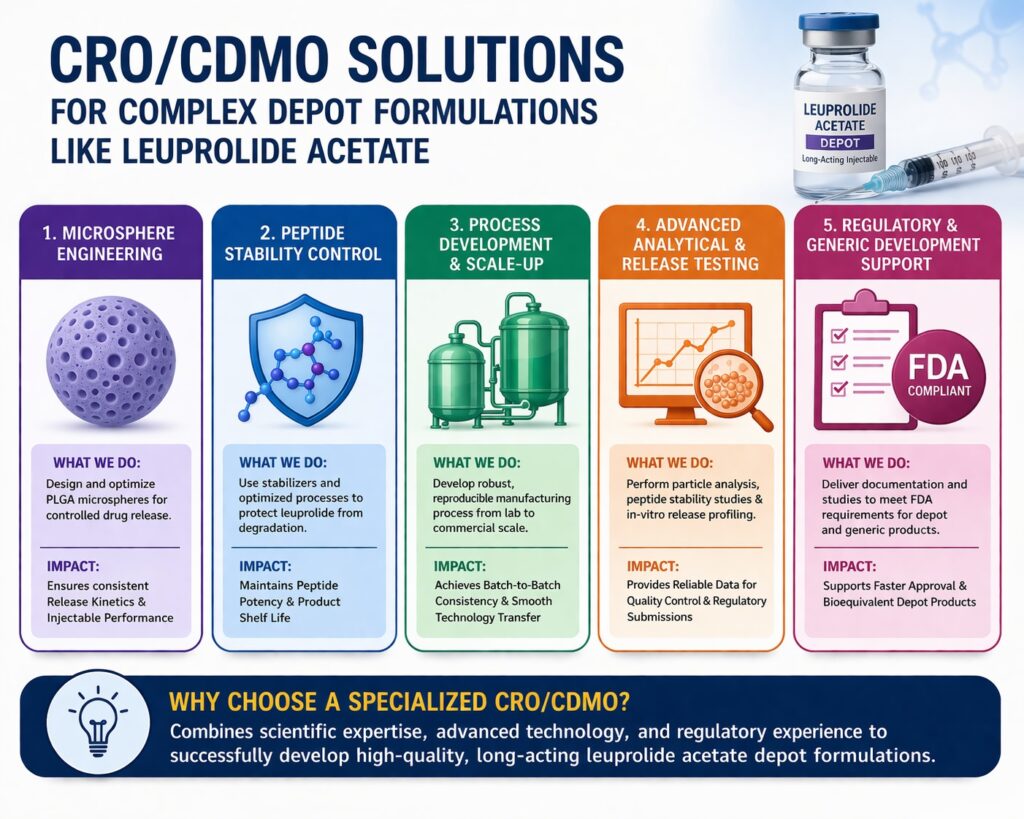
Developing long-acting peptide depot formulations such as leuprolide acetate requires advanced formulation science, strong analytical capabilities, and scalable manufacturing expertise. Polymer-based microsphere systems are complex and must be carefully optimized at every stage of development.
A specialized CRO for Leuprolide Depot Development offers the multidisciplinary expertise required to address challenges related to microsphere engineering, peptide stability, release kinetics, and regulatory approval. Their support helps ensure that depot formulations meet both scientific standards and regulatory expectations.
By working with experienced CRO/CDMO partners, pharmaceutical companies can reduce technical risks and improve development efficiency. These collaborations also accelerate the path to market for complex long-acting injectable therapies.
Assess your development strategy today: CRO vs. In-House ANDA Development
For organizations seeking expert support in advanced drug delivery and complex injectable formulations, partnering with a trusted CRO for Leuprolide Depot Development can play a key role in the success of long-acting therapeutic programs.
Contact the team to discuss your project: Contact us
Reference:
- Sethi, R., & Sanfilippo, N. (2009). Six-month depot formulation of leuprorelin acetate in the treatment of prostate cancer. Clinical Interventions in Aging, 4, 259–267. https://doi.org/10.2147/CIA.S4885
- U.S. Food and Drug Administration. (2012). Lupron (leuprolide acetate) injection label (NDA 020011, S-040). https://www.accessdata.fda.gov/drugsatfda_docs/label/2012/020011s040lbl.pdf
- Swayzer, D. V., & Gerriets, V. (2023). Leuprolide. In StatPearls. StatPearls Publishing. https://www.ncbi.nlm.nih.gov/books/NBK551662/
Get In Touch With Us
About The Author


