


Introduction:
Dexamethasone Injection Stability is one of the most important technical and regulatory challenges in developing dexamethasone injectable formulations. Because dexamethasone is a highly sensitive corticosteroid, even small variations in formulation, pH, or storage conditions can significantly affect its stability, potency, and safety profile.
At ResolveMass Laboratories Inc., extensive experience in injectable formulation support and dexamethasone impurities analysis has shown that stability is not just a regulatory requirement—it is the foundation of product quality and patient safety.
This article explains the major stability challenges in dexamethasone injection formulations, the scientific reasons behind them, and how pharmaceutical companies can overcome these challenges effectively.
Share via:
Summary:
- Dexamethasone Injection Stability is one of the most critical factors in developing safe and regulatory-compliant injectable formulations.
- Stability problems mainly arise from pH sensitivity, oxidation, hydrolysis, light exposure, and packaging interactions.
- Even small formulation changes (buffer type, polymer systems like PLGA, or excipients) can significantly impact long-term stability.
- Advanced analytical techniques such as LC-MS, forced degradation studies, and dexamethasone injection analytical methods are essential for reliable stability evaluation.
- Working with a specialized CRO such as ResolveMass Laboratories Inc. ensures accurate stability studies, impurity control, and faster regulatory acceptance. If you are developing a complex product, explore our dexamethasone injectable CRO support services.
1: What Is Dexamethasone Injection Stability and Why Is It Important?
Dexamethasone Injection Stability refers to the ability of the formulation to maintain its chemical integrity, potency, and safety throughout its entire shelf life. If stability is not properly controlled, the injection may gradually lose effectiveness or form harmful degradation products that can impact both product quality and patient safety.
Because degradation products are a major regulatory concern, performing early-stage dexamethasone impurities analysis is essential to ensure long-term stability and product safety.
Why Stability Matters in Dexamethasone Injections
Stability is not just a regulatory requirement—it is a critical quality parameter for injectable formulations. Proper stability ensures that the product remains safe, effective, and compliant from manufacturing to patient use.
Key reasons why stability is essential:
- Ensures the drug potency remains within regulatory specifications
- Prevents the formation of unknown and potentially harmful impurities
- Supports successful regulatory approval and compliance
- Improves shelf life and long-term storage reliability
- Reduces the risk of product recalls and batch failures
Because injectable formulations are administered directly into the bloodstream, the stability requirements are significantly stricter compared to oral dosage forms. Even small chemical changes in the formulation can lead to serious regulatory and safety concerns.
2: Major Stability Challenges in Dexamethasone Injection Formulations
The primary challenges in Dexamethasone Injection Stability arise from chemical degradation, formulation sensitivity, and packaging-related interactions. Because dexamethasone is a chemically sensitive corticosteroid, even minor variations in formulation conditions can significantly impact long-term stability and regulatory compliance.
These stability issues become even more critical when developing generic products, which is why companies involved in dexamethasone injection generic development must pay special attention to degradation pathways and impurity formation.
Below are the most common stability issues observed during injectable formulation development.
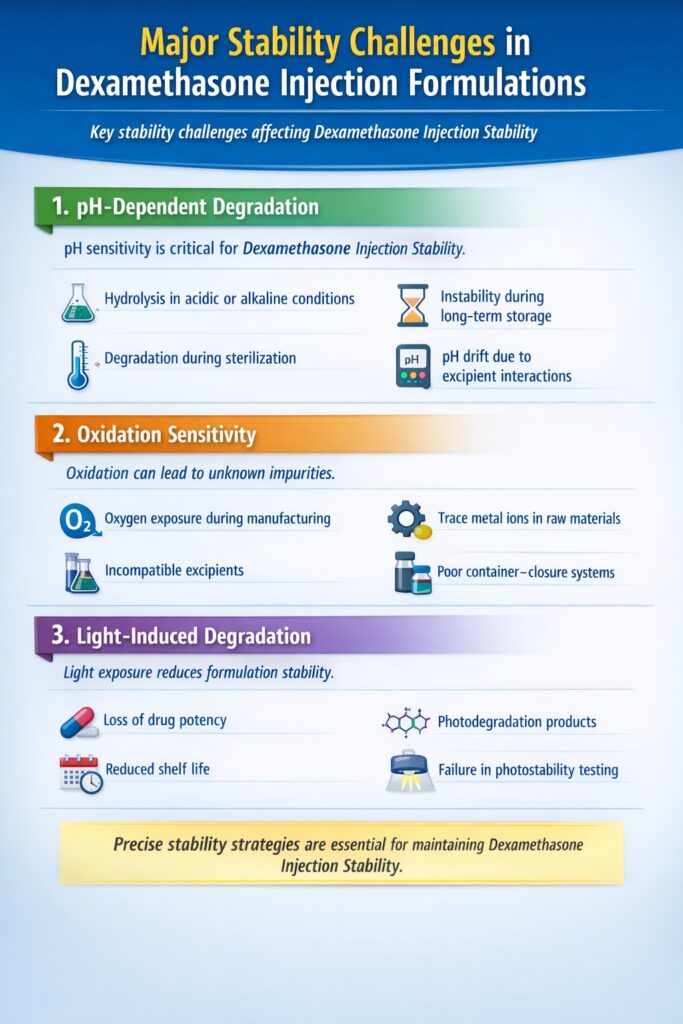
1. pH-Dependent Degradation
pH sensitivity is one of the most critical factors affecting Dexamethasone Injection Stability. Even small changes in pH can accelerate chemical degradation and reduce product shelf life.
Key stability concerns related to pH:
- Hydrolysis at highly acidic or highly alkaline conditions
- Gradual instability during long-term storage
- Degradation during sterilization or heat exposure
- pH drift over time due to excipient interactions
Many generic developers underestimate the importance of buffer optimization, which often leads to unexpected stability failures during long-term stability studies.
2. Oxidation Sensitivity
Oxidation is another major factor that directly impacts Dexamethasone Injection Stability. If oxidation is not properly controlled, the formulation may generate unknown degradation products that can create serious regulatory challenges.
Common causes of oxidation include:
- Exposure to oxygen during manufacturing or filling
- Presence of trace metal ions in raw materials
- Use of incompatible excipients
- Improper container–closure systems
- Lack of antioxidants in the formulation
When oxidation occurs, it frequently results in unknown impurities, which can delay regulatory approval and require additional analytical investigations.
3. Light-Induced Degradation
Dexamethasone is also highly sensitive to light, particularly UV exposure, which can significantly reduce formulation stability.
Typical consequences of light-induced degradation:
- Loss of drug potency
- Formation of photodegradation products
- Reduced shelf life
- Failure in photostability studies
For this reason, stability programs must always include photostability testing, although this step is often overlooked during early-stage formulation development.
3: Formulation Factors Affecting Dexamethasone Injection Stability
Formulation design is the most critical factor influencing Dexamethasone Injection Stability. Even minor changes in excipients, buffer composition, or solvent system can significantly alter the stability profile and lead to unexpected degradation during long-term storage.
The stability profile can vary significantly depending on the form of the drug used, especially when comparing dexamethasone phosphate vs acetate in injectable formulations. Understanding this difference is essential before finalizing the formulation strategy.
In addition, formulation scientists working with dexamethasone sodium phosphate formulation must carefully evaluate pH stability, oxidation sensitivity, and excipient compatibility to ensure long-term product stability.
Below are the key formulation elements that directly impact stability.
Critical Formulation Factors
1. Buffer Selection
Buffer composition and pH control play a major role in preventing hydrolysis. An improperly selected buffer system can accelerate degradation and reduce shelf life.
2. Solvent System
The choice of solvent affects solubility, pH stability, and oxidation sensitivity. Incompatible solvent systems often lead to instability during long-term storage.
3. Antioxidants
Antioxidants help prevent oxidation-related degradation. However, selecting the wrong antioxidant or incorrect concentration may cause additional impurities.
4. Chelating Agents
Trace metal ions can catalyze degradation reactions. Chelating agents are often required to improve long-term Dexamethasone Injection Stability.
5. Excipients Compatibility
Excipients that appear stable individually may react with dexamethasone in solution. Compatibility studies are therefore essential before finalizing the formulation.
6. Polymer Systems (Such as PLGA)
When polymer-based delivery systems are used, stability becomes more complex because both the drug and the polymer must remain stable over time.
Table: Key Factors That Impact Dexamethasone Injection Stability
| Factor | Impact on Stability | Risk Level |
|---|---|---|
| pH level | Controls hydrolysis rate | Very High |
| Oxygen exposure | Causes oxidation | High |
| Light exposure | Causes photodegradation | High |
| Excipients compatibility | May generate impurities | High |
| Temperature | Accelerates degradation reactions | Very High |
| Packaging material | Can interact with formulation | Medium–High |
4: Stability Challenges in PLGA-Based Dexamethasone Injection Formulations
Dexamethasone Injection Stability becomes significantly more complex when polymer systems such as PLGA (poly-lactic-co-glycolic acid) are used in the formulation. Unlike conventional injectable solutions, PLGA-based formulations are drug-polymer delivery systems, which means both the active pharmaceutical ingredient and the polymer matrix must remain stable throughout the product shelf life.
PLGA-based systems are significantly more complex than standard injectable formulations. In these cases, advanced dexamethasone injection analytical methods are required to distinguish drug degradation products from polymer-related impurities.
Because of this complexity, companies often rely on a specialized dexamethasone injectable CRO to perform stability-indicating method development and impurity identification.
Because of this dual-stability requirement, these formulations present several unique challenges during development and stability studies.
Major Stability Challenges in PLGA-Based Formulations
1. Polymer Degradation Over Time
PLGA undergoes gradual hydrolysis during storage, which can change the release profile of dexamethasone and affect long-term product performance.
2. Drug–Polymer Interaction
Interactions between dexamethasone and the polymer matrix may lead to unexpected degradation pathways that are not typically observed in conventional injectable formulations.
3. Moisture Sensitivity
PLGA-based systems are highly sensitive to moisture. Even small amounts of moisture can accelerate polymer breakdown and reduce formulation stability.
4. Difficulty in Impurity Identification
When degradation occurs, it may originate from either the drug, the polymer, or the interaction between the two. This makes impurity identification more complex and requires advanced analytical techniques such as LC-MS.
5. Complex Stability-Indicating Analytical Methods
Traditional analytical methods are often not sufficient for polymer-based injectables. Stability-indicating methods must be carefully developed to distinguish drug degradation products from polymer-related impurities.
Because both the drug and the polymer must remain stable simultaneously, long-term Dexamethasone Injection Stability studies for PLGA-based formulations are far more complex than standard injectable formulations and typically require specialized analytical expertise and detailed impurity profiling.
5: Why Stability-Indicating Analytical Methods Are Critical
Without stability-indicating analytical methods, Dexamethasone Injection Stability cannot be evaluated accurately. A formulation may appear stable in conventional testing, but hidden degradation products or trace impurities can still develop over time and create serious regulatory concerns.
Advanced techniques such as LC-MS play a major role in dexamethasone impurities analysis because they help identify unknown degradation products and confirm impurity structures during stability studies.
Companies working on dexamethasone injection generic development particularly benefit from these analytical techniques because regulatory agencies require extremely tight impurity control.
Limitations of Traditional Analytical Methods
Conventional HPLC methods are often designed only to measure the active drug concentration. However, they may fail to detect several critical stability issues, such as:
- Unknown degradation products
- Trace-level impurities
- Structural changes in the dexamethasone molecule
- Co-eluting impurities that are not visible in standard chromatographic methods
- Early-stage degradation pathways that appear only under stress conditions
Because injectable formulations require extremely tight impurity control, relying only on traditional HPLC methods can lead to inaccurate stability conclusions.
Advanced Analytical Tools Required for Reliable Stability Evaluation
To ensure accurate evaluation of Dexamethasone Injection Stability, advanced analytical techniques are essential. These tools help identify degradation pathways early and prevent regulatory delays later in development.
Key analytical approaches include:
- LC-MS for impurity identification and structural confirmation
- Forced degradation studies to understand degradation pathways
- Stability-indicating HPLC method development
- Structural elucidation techniques for unknown impurities
- High-sensitivity analytical methods for trace impurity detection
How Specialized Analytical Expertise Makes a Difference
At ResolveMass Laboratories Inc., extensive experience in impurity profiling and stability-indicating method development helps pharmaceutical companies identify stability issues early in the development process—before they become major regulatory challenges.
This scientific, data-driven approach not only improves Dexamethasone Injection Stability but also reduces development risk, shortens timelines, and supports successful regulatory submission.
6: Common Stability Failures Observed During Development
Many pharmaceutical companies experience repeated stability failures because the complexity of Dexamethasone Injection Stability is often underestimated during early formulation development. Stability issues may not appear in initial laboratory studies but become evident during long-term stability testing or regulatory evaluation.
These failures frequently occur when stability studies are conducted without proper dexamethasone injection analytical methods or without detailed impurity profiling.
Below are the most common stability failures observed in dexamethasone injectable development.
Most Frequent Stability Issues
- Unexpected impurity formation during long-term stability
Impurities that are not visible during initial testing may appear after 3–6 months of storage, especially under long-term stability conditions. - pH drift over time
Even when the formulation starts within the correct pH range, gradual pH changes during storage can accelerate degradation and reduce product shelf life. - Stability failures after scale-up
Formulations that appear stable at laboratory scale may fail during pilot or commercial-scale manufacturing due to differences in processing conditions. - Inconsistent results between accelerated and long-term stability studies
In some cases, accelerated stability data may look acceptable, while long-term stability studies reveal degradation problems. This often indicates incomplete understanding of degradation pathways. - Unknown degradation products detected during regulatory review
Regulatory agencies frequently identify unknown impurities that were not fully characterized during development, which can lead to additional analytical work and submission delays.
These stability challenges not only delay product approval but also significantly increase development costs. A scientifically driven stability strategy and early impurity identification are essential to ensure reliable Dexamethasone Injection Stability and successful regulatory submission.
7: How to Improve Dexamethasone Injection Stability
Improving Dexamethasone Injection Stability requires a scientific and data-driven approach rather than trial-and-error formulation development. Stability problems are usually predictable when degradation pathways, formulation factors, and analytical methods are evaluated early in development.
One of the most effective ways to reduce stability failures is by conducting early dexamethasone impurities analysis and developing robust analytical methods before finalizing the formulation.
Companies that are actively working on dexamethasone injection generic development can significantly reduce regulatory risk by implementing advanced stability strategies early in development.
Below are practical strategies that consistently improve long-term stability.
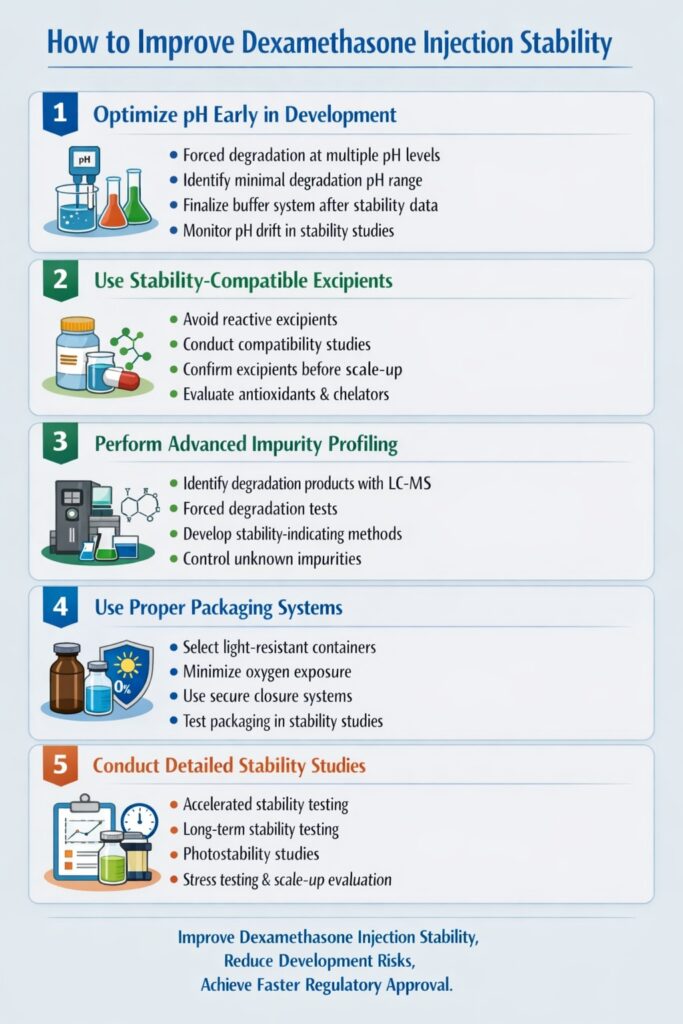
1. Optimize pH Early in Development
pH optimization is one of the most effective ways to improve formulation stability. Even small pH changes can significantly affect hydrolysis and long-term degradation.
Practical approach:
- Conduct forced degradation studies at multiple pH levels
- Identify the pH range where degradation is minimal
- Finalize the buffer system only after stability data is confirmed
- Monitor pH drift during accelerated stability studies
2. Use Stability-Compatible Excipients
Not all excipients that work in conventional formulations are suitable for dexamethasone injections. Incompatible excipients can accelerate oxidation or generate unknown impurities.
Best practices:
- Avoid reactive excipients that may interact with dexamethasone
- Perform detailed excipient compatibility studies
- Confirm compatibility before scale-up or stability studies
- Evaluate antioxidant and chelating agent requirements
3. Perform Advanced Impurity Profiling
Understanding degradation pathways early in development significantly reduces stability failures later in the project.
Recommended approach:
- Identify degradation products using LC-MS
- Perform forced degradation studies under multiple stress conditions
- Develop stability-indicating analytical methods
- Control unknown impurities before regulatory submission
4. Use Proper Packaging Systems
Packaging plays a major role in improving Dexamethasone Injection Stability, especially for light- and oxygen-sensitive formulations.
Key considerations:
- Select light-resistant containers
- Minimize oxygen exposure during filling
- Use compatible container–closure systems
- Evaluate packaging during stability studies
5. Conduct Detailed Stability Studies
A strong stability strategy helps identify problems early and prevents regulatory delays.
Essential stability studies include:
- Accelerated stability testing
- Long-term stability testing
- Photostability studies
- Stress testing under extreme conditions
- Stability evaluation after scale-up
By following these strategies, pharmaceutical companies can significantly improve Dexamethasone Injection Stability, reduce development risks, and achieve faster regulatory approval.
8: Role of a Specialized CRO in Ensuring Dexamethasone Injection Stability
Working with a specialized CRO significantly improves the success rate of Dexamethasone Injection Stability studies, especially for complex injectable formulations. Stability challenges often appear late in development, and without expert analytical support, they can delay regulatory approval and increase overall development costs.
ResolveMass Laboratories Inc. provides advanced support through dexamethasone injectable CRO services, including impurity profiling, stability-indicating method development, and unknown impurity identification.
These services are especially valuable for companies working on dexamethasone sodium phosphate formulation or other complex injectable products where stability challenges are more severe.
A CRO with deep experience in injectable stability studies can help identify degradation risks early and build a scientifically strong stability strategy from the beginning.
How ResolveMass Laboratories Inc. Supports Stability Studies
ResolveMass Laboratories Inc. provides advanced analytical support specifically designed to improve Dexamethasone Injection Stability and reduce regulatory risks for pharmaceutical companies.
Key areas of support include:
- Stability-indicating method development
- Impurity profiling using advanced LC-MS techniques
- Forced degradation studies to understand degradation pathways
- Identification and structural elucidation of unknown impurities
- Development of regulatory-ready analytical documentation
- Stability support during formulation development and scale-up
Why Early CRO Involvement Makes a Difference
Many stability failures occur only after long-term stability studies have already started. At that stage, fixing formulation problems becomes expensive and time-consuming.
Working with an experienced CRO early in development helps to:
- Identify degradation pathways before stability failures occur
- Improve long-term Dexamethasone Injection Stability
- Reduce the risk of unexpected impurities
- Shorten development timelines
- Improve the chances of successful regulatory submission
A scientifically driven stability strategy supported by a specialized CRO not only improves product quality but also helps pharmaceutical companies move from development to approval more efficiently and with greater confidence.
9: Why Stability Is More Critical for Injectable Corticosteroids
Dexamethasone Injection Stability is more critical than many other drug products because corticosteroids are chemically sensitive molecules. Even minor changes in formulation conditions can lead to degradation, impurity formation, and reduced product shelf life, making stability studies far more demanding compared to many conventional injectables.
Understanding the difference between dexamethasone phosphate vs acetate is particularly important here because each form has a different stability profile, which directly impacts formulation strategy and long-term storage stability.
Key Reasons Stability Is More Critical
- Highly reactive functional groups
Corticosteroids such as dexamethasone contain functional groups that are more prone to chemical reactions, especially under stress conditions such as heat, light, or pH variation. - Susceptibility to hydrolysis
Dexamethasone can undergo hydrolysis under acidic or alkaline conditions, which can reduce drug potency and lead to degradation products during long-term storage. - Sensitivity to light and oxygen
Exposure to light and oxygen can accelerate oxidation and photodegradation, both of which significantly impact Dexamethasone Injection Stability. - Strict regulatory requirements for injectables
Because injectable formulations are administered directly into the bloodstream, regulatory agencies impose much stricter stability and impurity limits compared to oral dosage forms. - Very low impurity limits
Even trace levels of degradation products can result in regulatory concerns. This makes impurity identification and stability-indicating methods essential during development.
Because of these factors, pharmaceutical companies must adopt a scientifically driven and stability-focused formulation strategy rather than relying on standard development approaches. A deeper understanding of degradation pathways, formulation compatibility, and analytical methods is essential to ensure long-term Dexamethasone Injection Stability and successful regulatory approval.
10: Future Trends in Dexamethasone Injection Stability Studies
The future of Dexamethasone Injection Stability will be driven by advanced analytical technologies and predictive stability tools. As injectable formulations become more complex, pharmaceutical companies are increasingly adopting innovative approaches to predict degradation, improve stability, and reduce development timelines.
Modern stability programs are increasingly combining AI-based prediction with advanced dexamethasone injection analytical methods to improve accuracy and reduce development timelines.
Companies that adopt these advanced approaches early will have a major advantage in dexamethasone injection generic development and regulatory submissions.
Emerging Trends Transforming Stability Studies
- AI-based stability prediction
Artificial intelligence and data-driven modeling are now being used to predict degradation pathways before long-term stability studies are completed. This helps companies optimize formulations faster and reduce trial-and-error development. - High-resolution mass spectrometry (HRMS)
Advanced mass spectrometry techniques are enabling faster identification of unknown impurities and degradation products, significantly improving Dexamethasone Injection Stability studies. - Advanced forced degradation strategies
Modern forced degradation approaches are more targeted and scientifically driven. These strategies help identify degradation mechanisms early and improve the reliability of stability-indicating methods. - Polymer-based injectable stability modeling
With the growing use of polymer-based systems such as PLGA, stability modeling is becoming more sophisticated. These tools help predict polymer degradation and drug–polymer interactions more accurately. - Faster stability-indicating method development
New analytical technologies and automation tools are making it possible to develop stability-indicating methods more quickly while maintaining high accuracy and regulatory compliance.
These emerging technologies are helping pharmaceutical companies reduce development timelines, improve formulation stability, and strengthen regulatory submissions, making the future of Dexamethasone Injection Stability studies more efficient, reliable, and scientifically advanced.
Conclusion:
Dexamethasone Injection Stability is one of the most challenging aspects of developing dexamethasone injectable formulations. From pH sensitivity and oxidation to polymer interactions and impurity formation, multiple factors can affect stability and delay product approval.
A scientifically driven approach that includes stability-indicating methods, dexamethasone impurities analysis, and expert analytical support is essential for success.
With extensive expertise in injectable stability challenges, ResolveMass Laboratories Inc. helps pharmaceutical companies overcome stability issues faster and more efficiently.
Frequently Asked Questions:
Dexamethasone Injection Stability refers to the ability of the injectable formulation to maintain its potency, chemical integrity, and safety throughout its shelf life. Proper stability ensures the drug remains effective and free from harmful degradation products during storage and use.
Dexamethasone Injection Stability is critical because injectable drugs are administered directly into the bloodstream. Any degradation or impurity formation can affect drug safety, efficacy, and regulatory compliance.
Key reasons include:
-Maintaining drug potency
-Preventing harmful degradation products
-Meeting regulatory requirements
-Ensuring long shelf life
-Protecting patient safety
Several formulation and environmental factors can impact stability, including:
-pH of the formulation
-Oxidation due to oxygen exposure
-Light exposure and photodegradation
-Temperature during storage
-Excipient compatibility
-Packaging material and container–closure systems
Proper control of these factors is essential to maintain long-term stability.
pH plays a major role in controlling hydrolysis reactions in dexamethasone formulations. If the pH moves outside the optimal range, degradation reactions may accelerate, reducing the drug’s shelf life and potency.
Therefore, buffer optimization is a critical step during formulation development.
Oxidation can lead to the formation of degradation products and unknown impurities in the formulation. Common sources of oxidation include oxygen exposure during manufacturing, trace metal ions in raw materials, and incompatible excipients.
To prevent oxidation, formulators often use antioxidants, chelating agents, and oxygen-controlled manufacturing processes.
Advanced analytical techniques are used to evaluate stability and identify degradation products, including:
-LC-MS for impurity identification
-Stability-indicating HPLC methods
-Forced degradation studies
-Structural elucidation techniques
These tools help identify degradation pathways and ensure regulatory compliance.
Reference
- Buga I, Uzoma JI, Reindel K, Rashid K, Diep T, McCartan P, Zhao F. Physical and chemical stability of dexamethasone sodium phosphate in intravenous admixtures used to prevent chemotherapy-induced nausea and vomiting. Hospital Pharmacy. 2021 Aug;56(4):215-20.https://journals.sagepub.com/doi/abs/10.1177/0018578719888912
- Chen Q, Zielinski D, Chen J, Koski A, Werst D, Nowak S. A validated, stability-indicating HPLC method for the determination of dexamethasone related substances on dexamethasone-coated drug-eluting stents. Journal of pharmaceutical and biomedical analysis. 2008 Nov 4;48(3):732-8.https://www.sciencedirect.com/science/article/pii/S0731708508003853
- Linxweiler H, Reichhold J, Krämer I. 3PC-039 Preparation and stability of ready-to-administer dexamethasone dihydrogen phosphate 8 mg/ml/0.02% hyaluronic acid intratympanal injection solution.https://ejhp.bmj.com/content/32/Suppl_1/A35.2.abstract
- Binson G, Venisse N, Bacle A, Beuzit K, Dupuis A. Preparation and physico-chemical stability of dexamethasone oral suspension. Pharmaceutical Technology in Hospital Pharmacy. 2017 Dec 1;2(4):193-201.https://www.degruyterbrill.com/document/doi/10.1515/pthp-2017-0029/html?srsltid=AfmBOopITQlMZ_eObd0HhZqrwQK23UNvYGZBn_fZ1oyfE1X6fOuBSjk8
- Madamsetty VS, Mohammadinejad R, Uzieliene I, Nabavi N, Dehshahri A, Garcia-Couce J, Tavakol S, Moghassemi S, Dadashzadeh A, Makvandi P, Pardakhty A. Dexamethasone: insights into pharmacological aspects, therapeutic mechanisms, and delivery systems. ACS biomaterials science & engineering. 2022 Apr 19;8(5):1763-90.https://pubs.acs.org/doi/abs/10.1021/acsbiomaterials.2c00026
About the Author


