

Introduction
The Accuracy and Precision Requirements for a Validated Bioanalytical Method define the quantitative performance limits that analytical assays must meet to ensure reliable measurement of drug concentrations in biological matrices for regulatory submissions. According to harmonized international standards, bioanalytical assays are expected to demonstrate that both systematic bias and random variability remain within specified acceptance limits across multiple validation runs containing predefined quality control samples. Compliance with these quantitative requirements is essential for nonclinical toxicokinetic (TK), pharmacokinetic (PK), bioequivalence (BE), and clinical trial studies that are assessed by regulatory authorities worldwide. Contract research organizations such as ResolveMass Laboratories Inc. apply these requirements to mass spectrometry and ligand-binding platforms to provide analytical support throughout drug development programs.
Align your regulatory strategy from the ground up—explore how to build an effective Bioanalytical Strategy in Drug Development.
Share via:
Quick Summary:
- ICH M10 harmonizes global bioanalytical validation requirements for chromatographic assays and ligand-binding assays (LBAs), supporting reliable data for PK, BE, TK, and clinical studies.
- Chromatographic assays require accuracy within ±15% and precision ≤15% CV at standard QC levels; at LLOQ, limits expand to ±20%.
- LBAs allow ±20% accuracy and ≤20% CV at standard QC levels, with ±25% limits at LLOQ and ULOQ. Total Error must be ≤30% at standard levels and ≤40% at boundaries.
- QC samples must cover the validated range. Chromatographic methods use 4 levels, while LBAs use 5 levels, including ULOQ QC.
- Validation requires multiple independent runs, assessment of intra-run and inter-run precision, and statistical analysis such as one-way ANOVA.
- Cross-validation, ISR, matrix selectivity, and dilution linearity confirm that methods remain reliable across laboratories, authentic study samples, biological matrices, and diluted samples.
- Overall: Meeting accuracy and precision requirements ensures consistent, reproducible, and regulator-ready bioanalytical data for drug development and approval.
Core Regulatory Frameworks Governing Accuracy and Precision Requirements for a Validated Bioanalytical Method
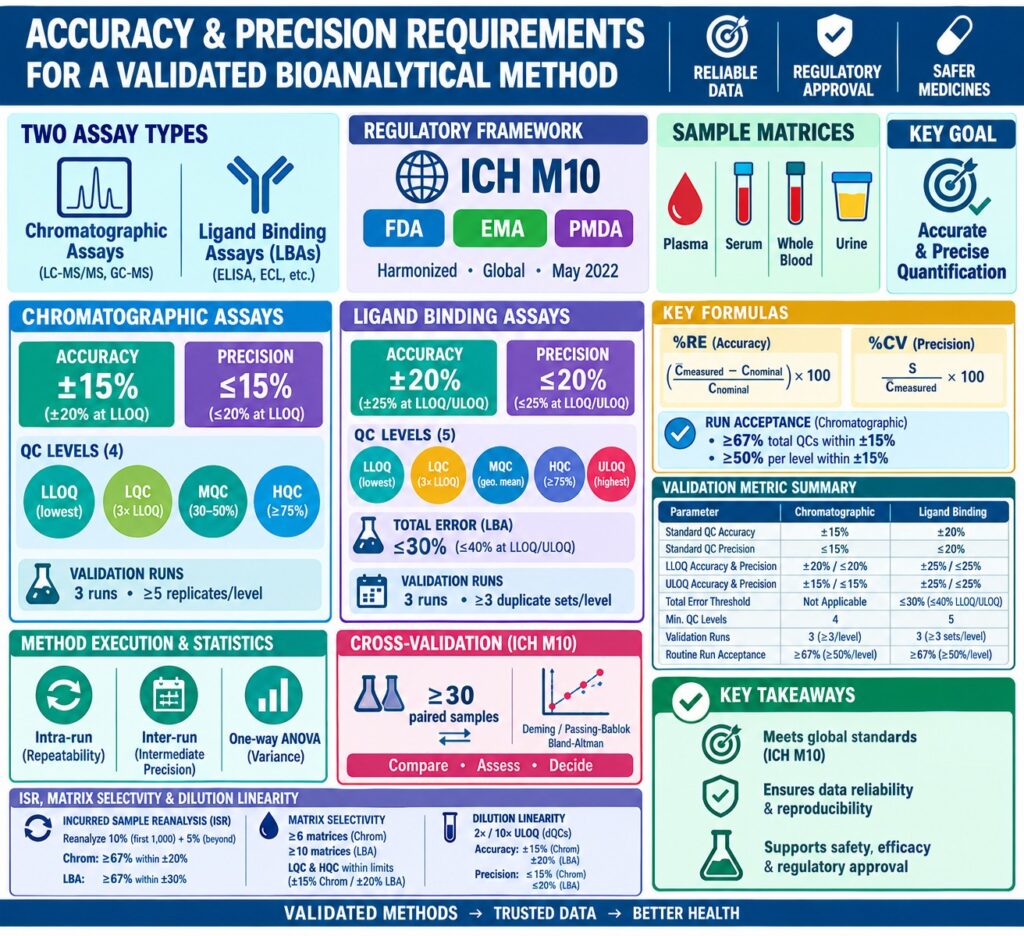
The regulatory expectations for bioanalytical accuracy and precision have been globally aligned through the International Council for Harmonisation (ICH) M10 guideline, which establishes consistent validation requirements for agencies including the FDA, EMA, and PMDA. These requirements define specific quantitative acceptance criteria for chromatographic assays and ligand-binding assays, recognizing the fundamental physical and analytical differences between these two types of methodologies.
Adopted in May 2022, the ICH M10 guideline brought together earlier regional regulatory guidance, including the FDA 2018 Bioanalytical Method Validation Guidance for Industry and the EMA 2011 guidelines, into a harmonized international framework. Under this framework, complete method validation is required when a primary biological matrix, such as plasma, serum, whole blood, or urine, is used to generate data that supports regulatory drug approval, safety assessments, efficacy evaluations, or labeling decisions.
Ensure complete regulatory alignment across jurisdictions with our overview on ICH M10 Bioanalytical Method Validation Guidelines
or read our breakdown of EMA vs. FDA Bioanalytical Method Validation Differences.
The regulatory framework divides bioanalytical platforms into two primary methodological categories:
Chromatographic Assays: Methods such as Liquid Chromatography-Tandem Mass Spectrometry (LC-MS/MS) and Gas Chromatography-Mass Spectrometry (GC-MS) determine analyte concentrations through physical separation and measurement based on mass-to-charge ratios (m/z).
Ligand Binding Assays (LBAs): Methods including Enzyme-Linked Immunosorbent Assay (ELISA), Electrochemiluminescence (ECL), and microfluidic immunoassays quantify large molecules through non-covalent macromolecular binding interactions.
Because LBAs generally produce non-linear response curves and rely on complex biological reagents, regulatory authorities use platform-specific acceptance criteria that account for the greater analytical variability inherently associated with these assays.
Chromatographic Assays: Accuracy and Precision Requirements for a Validated Bioanalytical Method
For chromatographic assays, accuracy is required to remain within ±15% of the nominal concentration, while precision must demonstrate a coefficient of variation (%CV) of ≤15% across the standard quality control levels. At the lower limit of quantification, the acceptance limits are expanded to ±20% for bias and ≤20% for %CV.
Validation of a chromatographic method involves assessment of both intra-run (within-run) and inter-run (between-run) accuracy and precision. These evaluations must be performed across a minimum of three independent analytical runs conducted over at least two different operating days.
Avoid costly regulatory delays by learning how to prevent and manage a Bioanalytical Method Validation Failure.
Quality Control Concentration Levels
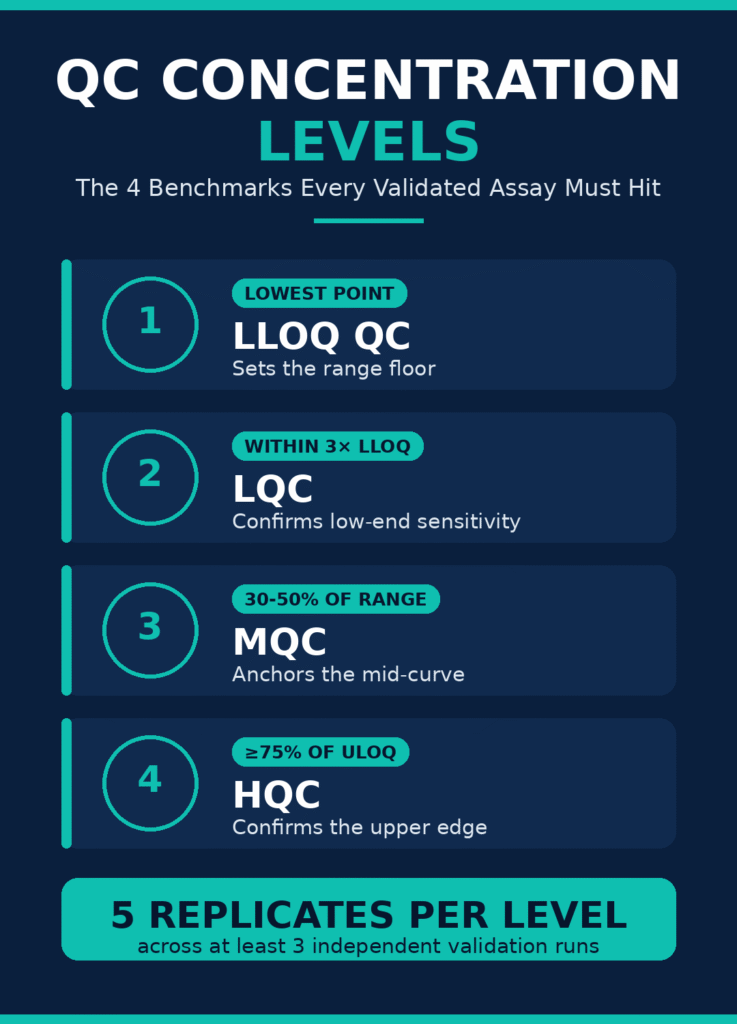
To demonstrate accuracy and precision throughout the intended calibration range, Quality Control (QC) samples must be prepared in the authentic biological matrix at four principal concentration levels:
Lower Limit of Quantification (LLOQ QC): Prepared at the lowest concentration included within the validated dynamic range and used to demonstrate adequate baseline signal-to-noise performance and quantitative sensitivity.
Low Quality Control (LQC): Prepared at a concentration within three times (3×) the LLOQ.
Medium Quality Control (MQC): Prepared at a concentration corresponding to between 30% and 50% of the validated calibration range.
High Quality Control (HQC): Prepared at or above 75% of the Upper Limit of Quantification (ULOQ).
Each validation run must include at least five replicates at every QC concentration level. Nominal accuracy is determined using the percentage relative error (%RE):
Accuracy (%RE) = ((C̄measured − Cnominal) / Cnominal) × 100
Precision is expressed as the percentage coefficient of variation (%CV):
Precision (%CV) = (S / C̄measured) × 100
In these equations, C̄measured denotes the mean measured analyte concentration, Cnominal represents the theoretical target concentration, and S corresponds to the sample standard deviation.
Run Acceptance Criteria for Routine Sample Analysis
During routine analysis of study samples, analytical batches are evaluated according to the performance of bracketed QC samples placed throughout the analytical sequence. A chromatographic analytical run is considered valid when at least 67% (2/3) of all evaluated QC samples are within ±15% of their theoretical nominal concentrations. In addition, at least 50% of the QC samples at each individual concentration level must satisfy this acceptance criterion.
Mitigate risk across your study workflows by identifying and correcting Common Bioanalytical Mistakes.
Ligand Binding Assays: Accuracy and Precision Requirements for a Validated Bioanalytical Method
Ligand Binding Assays require accuracy to remain within ±20% relative error and precision to remain at ≤20% %CV for standard QC levels. At the lower and upper limits of quantification, the allowable ranges are expanded to ±25% for accuracy and ≤25% %CV for precision.
LBAs commonly use sigmoidal calibration models, including four-parameter and five-parameter logistic regressions. Analytical variability generally increases toward the upper and lower asymptotic regions of these curves. To account for this characteristic, regulatory guidelines require five separate QC concentration levels across three independent validation runs:
LLOQ QC: Prepared at the lowest validated quantitation limit.
Low QC (LQC): Prepared within three times (3×) the LLOQ.
Medium QC (MQC): Prepared approximately around the geometric mean of the calibration curve.
High QC (HQC): Prepared at or above 75% of the ULOQ.
ULOQ QC: Prepared at the highest concentration defining the validated dynamic range.
Total Error Criteria
Beyond the separate evaluation of systematic bias and random variability, ICH M10 applies a Total Error parameter to LBAs to establish an overall limit for analytical uncertainty. Total Error incorporates both systematic error (%RE) and random error (%CV):
Total Error = |%RE| + %CV
For standard LQC, MQC, and HQC concentrations, Total Error must not exceed 30%. At the LLOQ and ULOQ boundaries, a Total Error of up to 40% is permitted.
Validation Metric
| Validation Metric | Chromatographic Assays (LC-MS/MS, GC-MS) | Ligand Binding Assays (ELISA, ECL, Gyros) |
|---|---|---|
| Standard QC Accuracy (%RE) | Within ±15% of nominal value | Within ±20% of nominal value |
| Standard QC Precision (%CV) | ≤15% | ≤20% |
| LLOQ Accuracy & Precision | Bias within ±20%; %CV ≤20% | Bias within ±25%; %CV ≤25% |
| ULOQ Accuracy & Precision | Bias within ±15%; %CV ≤15% | Bias within ±25%; %CV ≤25% |
| Total Error Threshold | Not Applicable | ≤30% (≤40% at LLOQ / ULOQ) |
| Minimum Required QC Levels | 4 levels (LLOQ, LQC, MQC, HQC) | 5 levels (LLOQ, LQC, MQC, HQC, ULOQ) |
| Validation Run Requirements | 3 runs, ≥5 replicates per level | 3 runs, ≥3 duplicate sets per level |
| Routine Run Acceptance | ≥67% total QCs, ≥50% per level within ±15% | ≥67% total QCs, ≥50% per level within ±20% |
Methodological Execution and Statistical Assessment in Bioanalytical Validation
Effective execution of bioanalytical validation requires a clear distinction between intra-run repeatability and inter-run intermediate precision. These parameters are assessed across multiple operating days using structured statistical approaches, including one-way Analysis of Variance (ANOVA).
Intra-run precision measures repeatability when the assay is performed under consistent operating conditions within one continuous analytical batch. Inter-run precision, by comparison, evaluates intermediate variability arising from differences in operating days, instrument configurations, and analyst execution. Inter-run variance is determined by combining replicate measurements from all accepted validation runs and estimating between-group variance components through one-way Analysis of Variance (ANOVA).
Ensure seamless assay transitions between labs and phases by implementing a robust Bioanalytical Method Transfer process.
Regulatory Evolution of Cross-Validation
The ICH M10 guideline updated the approach to cross-validation, which is used when analytical data generated by different laboratories, analytical platforms, or method versions need to be compared. The guideline moved away from the use of arbitrary percentage-based pass/fail cutoffs.
Under ICH M10, cross-validation involves the analysis of a minimum of 30 paired study samples or spiked matrix controls using both analytical methods or at both sites. The resulting data are assessed to characterize systematic and proportional bias through statistical regression approaches such as Deming regression, Passing-Bablok regression, or Bland-Altman agreement plots. This statistical approach helps determine whether differences in analytical performance between laboratories are sufficiently significant to influence the interpretation of clinical or toxicokinetic data.
Incurred Sample Reanalysis, Matrix Selectivity, and Dilution Linearity
Incurred sample reanalysis, matrix selectivity, and dilution linearity are important evaluations used to establish whether a bioanalytical method maintains acceptable accuracy and precision when applied to authentic biological specimens and appropriately diluted samples.
Incurred Sample Reanalysis (ISR)
Spiked matrix QCs may not fully represent the behavior of actual study specimens because authentic samples can exhibit characteristics such as metabolite protein binding or back-conversion. Incurred Sample Reanalysis (ISR) therefore evaluates real study samples to verify that the analytical method continues to provide reliable accuracy and precision during clinical and nonclinical studies.
ISR requires reanalysis of 10% of the first 1,000 study samples, together with 5% of any study samples beyond the initial 1,000, using separate analytical runs. The percentage difference between the repeat measurement and the original measurement is determined using the following equation:
%Difference = ((Repeat Value − Original Value) / Mean of Original and Repeat Values) × 100
To satisfy ISR acceptance requirements:
Chromatographic Assays: At least 67% (2/3) of the reanalyzed samples must have a percentage difference within ±20%.
Ligand Binding Assays: At least 67% (2/3) of the reanalyzed samples must have a percentage difference within ±30%.
Deepen your study compliance by learning more about managing Incurred Sample Reanalysis (ISR) in Bioanalytical Studies.
Dilution Linearity and Over-the-Curve Samples
When the measured concentration of a study sample is above the validated ULOQ, the sample must be diluted using blank biological matrix before extraction or analysis. Dilution linearity studies are conducted to demonstrate that the dilution process does not introduce unacceptable analytical bias or negatively affect precision.
Dilution QCs (dQCs) are prepared by spiking samples above the ULOQ, such as at 2× or 10× ULOQ, and then diluting them using validated matrix dilution factors across at least three independent validation runs. Mean accuracy must remain within ±15% for chromatographic assays and ±20% for LBAs. Precision must remain at or below 15% %CV for chromatographic assays and 20% for LBAs.
Matrix Selectivity and Interference Evaluation
Endogenous components within biological matrices, including phospholipids, hemolyzed red blood cells, and hyperlipidemic plasma, may affect ionization efficiency in LC-MS/MS assays or contribute to non-specific binding in ligand-binding assays. ICH M10 requires selectivity assessment using at least six individual matrix sources for chromatographic methods and ten individual matrix sources for LBAs.
Validation protocols must additionally consider special matrix conditions, including hemolyzed samples containing ≥2% lysed whole blood and lipemic samples containing elevated triglyceride concentrations. Accuracy at the LQC and HQC levels must remain within the established acceptance limits, specifically ±15% for chromatographic methods and ±20% for LBAs, to support reliable quantification in compromised patient samples.
Address complex bioanalytical matrix challenges by exploring specialized Tissue and CSF Bioanalytical Services.
Conclusion
Compliance with the Accuracy and Precision Requirements for a Validated Bioanalytical Method is essential for generating dependable analytical evidence to support regulatory approval of drug candidates across global pharmaceutical markets. By establishing quantitative performance limits, including the ±15% bias criterion for chromatographic assays and Total Error requirements for ligand-binding assays, the ICH M10 guideline promotes consistency, reliability, and reproducibility in bioanalytical data used for safety and efficacy assessments. Developing comprehensive validation strategies, performing appropriate statistical analyses, and confirming the performance of methods with incurred samples enable laboratories to generate robust analytical data for important regulatory submissions.
For bioanalytical support, method development, and regulatory-compliant assay validation, consult the analytical specialists through the ResolveMass Contact Page.
Frequently Asked Questions
For chromatographic methods, standard QC samples must demonstrate accuracy within ±15% of the nominal concentration and precision of ≤15% %CV at the LQC, MQC, and HQC levels. At the Lower Limit of Quantification (LLOQ), the allowable accuracy range is ±20%, while precision must remain at or below 20% %CV.
Ligand Binding Assays generally permit broader acceptance limits because of the variability associated with biological reagents and non-linear assay responses. Standard QCs require ±20% accuracy and ≤20% %CV, while LLOQ and ULOQ levels allow ±25% for both criteria. LBAs must also meet the applicable Total Error requirement.
Chromatographic methods require four QC levels: LLOQ, LQC, MQC, and HQC, with at least five replicates at each level across three independent validation runs. Ligand Binding Assays use five levels: LLOQ, LQC, MQC, HQC, and ULOQ. These are evaluated across three validation runs with at least three duplicate sets per level.
A routine analytical run is considered acceptable when at least 67% (2/3) of the evaluated QC samples meet the applicable accuracy limits. For chromatographic methods, the limit is ±15%, whereas LBAs use ±20%. In addition, at least 50% of QCs at every individual concentration level must satisfy the respective acceptance criterion.
Incurred Sample Reanalysis (ISR) confirms that a validated bioanalytical method continues to perform reliably when applied to authentic study samples. Unlike spiked QC samples, incurred samples can contain biological components, metabolites, and other factors that may affect assay performance. ISR therefore provides additional evidence of accuracy and precision during actual studies.
For chromatographic assays, at least 67% of the reanalyzed study samples must have a percentage difference within ±20% based on the original and repeat measurements. For Ligand Binding Assays, at least 67% of the samples must fall within ±30%. These criteria help demonstrate consistent assay performance in authentic study specimens.
The ICH M10 approach to cross-validation emphasizes statistical evaluation rather than relying on fixed percentage-based pass/fail limits. A minimum of 30 paired study samples or spiked matrix controls are evaluated across the methods or facilities being compared. Deming regression, Passing-Bablok regression, and Bland-Altman plots may be used to assess systematic and proportional bias.
Total Error is a combined measure used for Ligand Binding Assays to account for both systematic bias and random analytical variation. It is calculated by adding the absolute percentage relative error (|%RE|) to the percentage coefficient of variation (%CV). The acceptance limit is ≤30% for standard QC levels and ≤40% at the LLOQ and ULOQ.
Partial validation is performed when changes are introduced to an already validated bioanalytical method that could affect its performance. Examples include transferring the method to another facility, modifying sample extraction, changing matrix anticoagulants, extending the calibration range, or introducing additional biological matrices or species. The extent of validation depends on the nature and potential impact of the modification.
Reference:
- Edmison, A. (2023, February 24). ICH M10: Bioanalytical method validation and study sample analysis [Presentation]. U.S. Food and Drug Administration. https://www.fda.gov/media/167335/download
- European Medicines Agency. (2019, March 14). Draft ICH guideline M10 on bioanalytical method validation—Step 2b. https://www.ema.europa.eu/en/documents/scientific-guideline/draft-ich-guideline-m10-bioanalytical-method-validation-step-2b_en.pdf
- Fjording, M. S., Goodman, J., & Briscoe, C. (2024). Cross-validation of pharmacokinetic assays post-ICH M10 is not a pass/fail criterion. Bioanalysis, 17(1), 1–5. https://doi.org/10.1080/17576180.2024.2418284
- International Council for Harmonisation of Technical Requirements for Pharmaceuticals for Human Use. (2022, May 24). ICH harmonised guideline: Bioanalytical method validation and study sample analysis (M10). https://database.ich.org/sites/default/files/M10_Guideline_Step4_2022_0524.pdf
- U.S. Food and Drug Administration. (2018, May 24). Bioanalytical method validation: Guidance for industry. FDA
- Mundry, R., & Fischer, J. (2013). Use of statistical tests in nonhuman primate research: A review of the literature. American Journal of Primatology, 75(9), 889–896. https://doi.org/10.1002/ajp.22150
Get In Touch With Us
About The Author


