

Introduction
The formation of an acidic microenvironment during the degradation of poly(lactic-co-glycolic acid) (PLGA) matrices represents one of the most significant chemical challenges affecting the long-term stability and biological activity of encapsulated peptide and protein therapeutics. A localized reduction in the internal pH accelerates the hydrolytic degradation of the polymer while simultaneously promoting several detrimental biomolecular degradation pathways, including covalent acylation, deamidation, and structural aggregation.
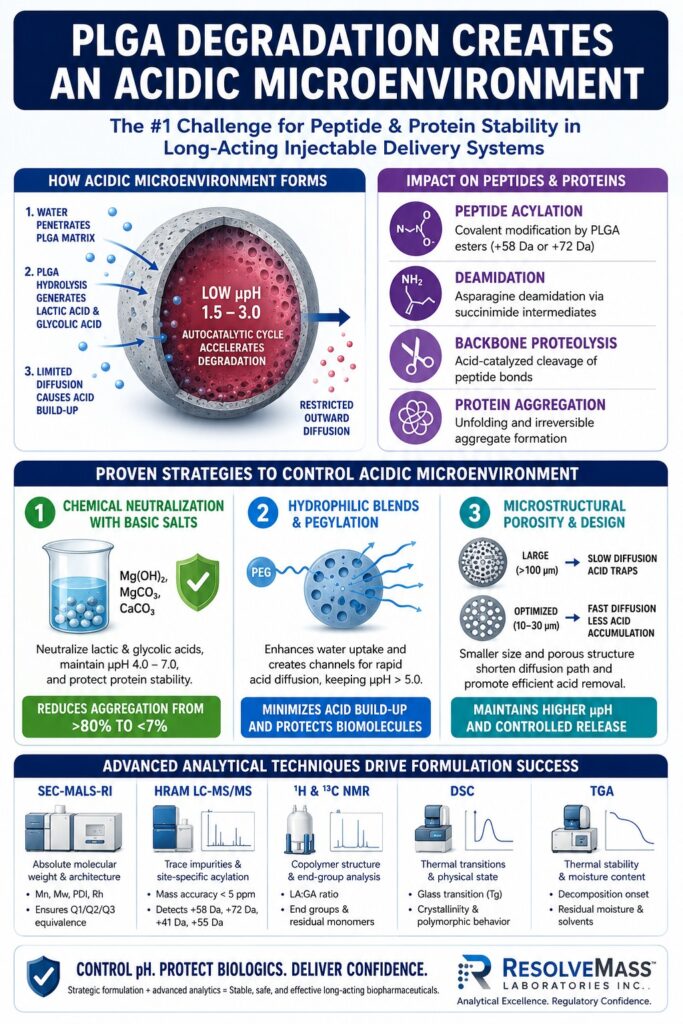
PLGA has become one of the most widely utilized biomaterials for controlled-release drug delivery because of its excellent biocompatibility and its predictable degradation into the non-toxic monomers lactic acid and glycolic acid, both of which are naturally metabolized through the Krebs cycle. Although these characteristics make PLGA highly attractive for pharmaceutical applications, the physical processes associated with bulk erosion create a chemically stressful environment for encapsulated biopharmaceuticals. As water diffuses into the amorphous polymer matrix, hydrolytic cleavage of the ester bonds begins. Since PLGA primarily undergoes degradation through a bulk erosion mechanism, acidic carboxyl end groups are generated uniformly throughout the matrix. In long-acting injectable (LAI) depot formulations, including microspheres and implants, the outward diffusion of these newly formed acidic monomers and oligomers is significantly restricted by the hydrophobic nature of the polymer matrix. Consequently, the imbalance between continuous acid generation and limited acid diffusion causes a substantial decrease in the microenvironmental pH (μpH) within the internal pore network of the delivery system, with measured values frequently ranging between 1.5 and 3.0.
Learn more about the crucial differences between bulk erosion vs. surface erosion in PLGA and how they impact drug release.
For pharmaceutical developers, controlling this localized acidification is essential for achieving successful clinical translation. ResolveMass Laboratories Inc., operating as a Canadian contract research organization (CRO) and contract development and manufacturing organization (CDMO) with a Health Canada Drug Establishment Licence, USFDA registration, and an ISO 9001:2015-certified Quality Management System, offers advanced analytical characterization capabilities to evaluate these complex polymer-protein interactions and support evidence-based formulation development. By utilizing absolute molecular weight determination, high-resolution mass spectrometry, and advanced thermal analysis, formulation scientists can systematically investigate matrix acidification and implement strategies that preserve the potency, structural integrity, and safety of therapeutic macromolecules.
Discover the advanced techniques required for the characterization of long-acting biologics to ensure product stability and efficacy.
Share via:
Article Summary:
- PLGA degradation generates an acidic microenvironment as lactic and glycolic acids accumulate inside the polymer matrix. Because these acidic by-products diffuse out slowly, the internal pH can drop dramatically, accelerating polymer breakdown through an autocatalytic process.
- The acidic environment compromises peptide and protein stability by triggering multiple degradation pathways, including peptide acylation, deamidation, backbone cleavage, and irreversible protein aggregation. These changes can reduce biological activity and increase the risk of immunogenicity.
- Polymer characteristics strongly influence acidification. Factors such as the lactic acid-to-glycolic acid ratio, molecular weight, end-group chemistry, particle size, and glass transition temperature determine water uptake, degradation rate, and the severity of internal pH reduction.
- Formulation strategies can effectively minimize acid-induced damage. Incorporating buffering excipients such as magnesium hydroxide or calcium carbonate helps neutralize acidic degradation products, while hydrophilic polymers and PEG-based blends improve water transport and facilitate acid diffusion out of the matrix.
- Optimizing microsphere architecture improves formulation performance. Reducing particle size and engineering interconnected porous structures shorten diffusion pathways, limiting acid accumulation and promoting a more controlled drug release profile.
- Advanced analytical techniques are essential for formulation characterization. Technologies including SEC-MALS-RI, HRAM LC-MS/MS, NMR spectroscopy, DSC, and TGA provide comprehensive information on polymer properties, degradation behavior, thermal stability, and peptide modifications throughout product development.
- Effective control of the acidic microenvironment is critical for successful long-acting injectable formulations. Combining optimized polymer design, targeted stabilization strategies, and robust analytical characterization helps preserve therapeutic integrity, improve product quality, and support regulatory compliance.
How Does the Acidic Microenvironment from Degradation Initiate and Propagate?
The acidic microenvironment generated during PLGA degradation begins when water molecules hydrolyze the ester linkages within the polymer backbone, producing carboxylic acid-terminated oligomers and monomers. Owing to restricted diffusion within the polymer matrix, these acidic degradation products accumulate inside the internal pore structure. The localized build-up of lactic acid and glycolic acid lowers the internal pH to values that may reach as low as 1.5, creating a self-perpetuating autocatalytic cycle that continuously accelerates ester bond cleavage.
The hydrolysis kinetics of PLGA are fundamentally influenced by the concentrations of water, ester linkages, and hydrogen ions. Under physiological conditions, water gradually penetrates the amorphous regions of the polymer, initiating random hydrolytic cleavage along the ester backbone. As this reaction progresses, shorter polymer chains are generated, and the concentration of terminal carboxylic acid groups (−COOH) increases. These terminal groups dissociate, releasing hydrogen ions (H⁺) into the localized aqueous microenvironment. Because the hydrolysis of aliphatic polyesters is acid-catalyzed, the increasing concentration of protons directly enhances the rate of additional ester bond cleavage. This positive feedback mechanism is referred to as autocatalysis.
Compare the PLGA, PLA, and PCL degradation rates to better understand how different polymers respond to hydrolysis and autocatalysis.
In larger polymeric matrices, including microspheres with diameters greater than 50 µm and solid implant systems, pronounced diffusion gradients develop. Acidic monomers produced near the outer surface readily diffuse into the surrounding buffered release medium, whereas those generated within the interior remain trapped inside the polymer matrix. As a result, the internal core undergoes substantially faster hydrolytic degradation than the external regions, transforming the degradation profile from relatively homogeneous bulk erosion into a highly heterogeneous “inside-out” erosion process.
Delve into the common challenges in PLGA microsphere development and learn how internal degradation gradients impact formulation success.
Both the physical and chemical transformations occurring during PLGA degradation are strongly influenced by the initial characteristics of the polymer, including the lactic acid-to-glycolic acid ratio, molecular weight, and end-group chemistry. For instance, PLGA 50:50 possesses a relatively higher glycolide content, increasing its hydrophilicity and promoting faster water uptake compared with PLGA 75:25 or PLGA 85:15. This enhanced water absorption accelerates ester bond hydrolysis and results in a more rapid decrease in the internal μpH. Furthermore, the polymer’s glass transition temperature (Tg), which generally falls between 40°C and 60°C, plays a critical role in determining degradation behavior. When PLGA is stored or incubated at temperatures approaching or exceeding its Tg, the polymer transitions from a rigid glassy state to a more flexible rubbery state. This increased chain mobility significantly enhances water diffusion throughout the matrix and further accelerates hydrolytic degradation.
| PLGA Grade | Lactic:Glycolic Ratio | End-Group Type | Hydrophilicity & Water Uptake | Typical Degradation Timeline | Acidification Susceptibility |
|---|---|---|---|---|---|
| PLGA 50:50 (Acid-Terminated) | 50:50 | Free Carboxyl (−COOH) | Very high; rapid water absorption | 3–4 weeks | Extremely high; rapid acid accumulation and accelerated autocatalysis |
| PLGA 50:50 (Ester-Capped) | 50:50 | Alkyl Esterified | Moderate; controlled water ingress | 1–2 months | High; delayed onset of autocatalytic cleavage |
| PLGA 65:35 (Acid-Terminated) | 65:35 | Free Carboxyl (−COOH) | Moderate to high | 6–8 weeks | Moderate to high; sustained acid release |
| PLGA 75:25 (Ester-Capped) | 75:25 | Alkyl Esterified | Low to moderate | 4–6 months | Low to moderate; highly controlled erosion |
| PLGA 85:15 (Ester-Capped) | 85:15 | Alkyl Esterified | Very low | More than 6 months | Very low; minimal early acid accumulation |
What Chemical and Physical Instabilities Are Triggered by the Acidic Microenvironment from Degradation?
The acidic microenvironment created during PLGA degradation initiates several chemical and physical instability pathways, including covalent peptide acylation, acid-catalyzed deamidation of asparagine residues, peptide backbone proteolysis, and irreversible protein aggregation. Collectively, these degradation mechanisms compromise the primary, secondary, and tertiary structures of biopharmaceutical molecules, ultimately reducing therapeutic efficacy while increasing the potential risk of immunogenicity.
Discover practical solutions in our guide on encapsulating hydrophilic vs. hydrophobic APIs in PLGA to overcome common instability hurdles.
How the Acidic Microenvironment from Degradation Drives Peptide Acylation
Peptide acylation occurs through the nucleophilic attack of peptide amino or hydroxyl groups on the electrophilic carbonyl carbons present within the PLGA ester backbone. This reaction is strongly influenced by the localized microclimate pH. As water continues to penetrate the polymer matrix and hydrolysis advances, the accumulation of acidic oligomers generates a chemically and electrostatically complex environment that alters peptide reactivity and promotes covalent modification.
The mechanism of peptide acylation proceeds through several sequential stages:
- Water Infiltration and Carboxyl Generation: Hydrolysis of PLGA ester bonds generates short oligomeric chains terminated with carboxylic acid groups. Under localized pH conditions, these terminal groups acquire a negative charge.
- Electrostatic Sorption: Positively charged (protonated) peptide molecules are electrostatically attracted to the negatively charged, deprotonated carboxylic acid end groups generated during PLGA degradation. This adsorption process represents a critical preliminary step by concentrating peptide molecules at the polymer-water interface.
- Nucleophilic Attack (Aminolysis): Primary amine groups located at the peptide N-terminus or within lysine side chains attack the electrophilic ester carbonyl groups of the polyester backbone, initiating cleavage of the polymer chain.
- Covalent Adduct Formation: Continued hydrolytic degradation of the polymer leaves the peptide covalently linked to either a glycolyl moiety, producing a +58.005 Da mass shift, or a lactyl moiety, producing a +72.021 Da mass shift.
Peptide-NH₂ + [PLGA Ester Core] → Peptide-NH-CO-R (Acylated Peptide) + PLGA-OH
For peptides that do not possess highly nucleophilic primary amines, such as the gonadotropin-releasing hormone agonist goserelin, acylation may still occur through the guanidine group of arginine residues. In this mechanism, the guanidine group performs a nucleophilic attack on the carbonyl groups within the PLGA backbone. This reaction is subsequently followed by the spontaneous elimination of ammonia (NH₃), resulting in the formation of stable cyclized derivatives. These products include:
- 2-Oxazolin-4-one, a glycolic acid-derived adduct that produces a +41 Da mass shift.
- 5-Methyl-2-oxazolin-4-one, a lactic acid-derived adduct that produces a +55 Da mass shift.
Because PLGA is composed of chiral D- and L-lactide units, the resulting acylation products exist as diastereomers. Although these diastereomeric species exhibit identical mass-to-charge (m/z) values and fragmentation patterns, they frequently separate into distinct chromatographic peaks during reversed-phase HPLC analysis due to differences in their stereochemical configurations.
Deamidation and Backbone Proteolysis Pathways
Deamidation of asparagine (Asn) residues is promoted by undissociated glycolic acid within the degrading PLGA matrix, where it functions as an efficient proton-transfer mediator that facilitates the formation of cyclic succinimide intermediates. At the same time, direct acid-catalyzed hydrolysis of the peptide backbone cleaves amide bonds, producing peptide fragments that result in a complete loss of therapeutic activity.
Within the highly acidic environment generated during PLGA degradation, deamidation may proceed through either a direct hydrolytic mechanism or an intramolecular catalytic rearrangement. Quantum chemical modeling together with experimental investigations has demonstrated that glycolic acid (GA) in its undissociated form (CH₂(OH)COOH), which predominates at pH values below its pKa of 3.83, serves as a highly efficient proton-transfer catalyst. Undissociated glycolic acid associates with the asparagine residue through a cyclic hydrogen-bonded complex, enabling proton transfer that promotes the nucleophilic attack of the peptide backbone amide nitrogen on the side-chain carbonyl carbon of the Asn residue. This reaction rapidly generates a tetrahedral intermediate, which subsequently undergoes ammonia elimination to form a cyclic succinimide intermediate. Under conditions of pronounced localized acidity, direct hydrolysis of peptide bonds also occurs, leading to peptide backbone proteolysis and the generation of multiple degradation fragments. Accurate characterization of these degradation products requires high-resolution liquid chromatography-mass spectrometry (LC-MS/MS).
Conformational Unfolding and Irreversible Physical Aggregation
The physical instability and aggregation of encapsulated proteins begin with exposure to hydrophobic polymer-water interfaces during the formulation process and are further intensified by acid-induced disruption of their native conformational structures. As tertiary and quaternary structural organization is lost, hydrophobic regions that are normally buried within the protein become exposed. This exposure promotes hydrophobic interactions, protein unfolding, and the formation of irreversible covalent as well as non-covalent aggregates.
Dive deeper into optimizing your PLGA depot formulation to prevent irreversible protein unfolding and aggregation.
Unlike relatively small peptide molecules, proteins possess highly complex secondary, tertiary, and, in many cases, quaternary structures that are stabilized by a delicate balance of non-covalent interactions, including hydrogen bonding, hydrophobic interactions, and electrostatic forces. Throughout the degradation of the PLGA matrix, these macromolecules are subjected to multiple physical and chemical stresses. During the initial manufacturing stage, exposure to organic-aqueous interfaces, such as dichloromethane-water systems, can initiate partial protein unfolding. After encapsulation, the gradual decline in local microenvironmental pH to highly acidic levels disrupts the salt bridges and electrostatic interactions responsible for maintaining the native protein conformation. As these stabilizing interactions are lost, proteins undergo denaturation. Under the highly concentrated conditions within the degrading matrix, the unfolded protein molecules associate with one another to form insoluble aggregates that remain entrapped inside the polymer. This phenomenon largely explains the incomplete release of proteins frequently observed in PLGA-based delivery systems.
What Mitigation Strategies Successfully Control the Acidic Microenvironment from Degradation?
The most effective strategies for mitigating the acidic microenvironment generated during PLGA degradation include incorporating basic salt excipients, utilizing hydrophilic polymer blends, and optimizing the microstructural porosity of the delivery system. Together, these approaches neutralize excess hydrogen ions while facilitating the outward diffusion of acidic degradation products before they accumulate to damaging concentrations.
Chemical Neutralization via Divalent Basic Salts
Divalent basic salts, including magnesium hydroxide (Mg(OH)₂), magnesium carbonate (MgCO₃), and calcium carbonate (CaCO₃), effectively neutralize the lactic acid and glycolic acid generated within the water-filled pores of the degrading PLGA matrix. These sparingly soluble alkaline compounds gradually dissolve as the local pH decreases, functioning as internal buffering agents that maintain a more favorable microclimate pH throughout the degradation process.
The incorporation of these basic additives interrupts the autocatalytic degradation of the polyester backbone, thereby preserving the structural integrity of the formulation and maintaining the biological activity of pH-sensitive therapeutic molecules. Magnesium hydroxide neutralizes the free carboxylic acids produced during hydrolytic chain scission by forming highly soluble magnesium carboxylate salts along with water according to the following reaction:
Mg(OH)₂ + 2R-COOH → Mg(R-COO)₂ + 2H₂O
This neutralization mechanism prevents the internal μpH from declining into the highly acidic range that promotes protein degradation, allowing the microclimate pH to remain relatively stable between 4.0 and 7.0 for as long as four weeks of incubation. Studies have demonstrated that incorporating magnesium hydroxide (Mg(OH)₂) at concentrations ranging from 3% to 10% substantially decreases the aggregation of encapsulated model proteins, including bovine serum albumin (BSA), reducing aggregation levels from greater than 80% to below 7% after four weeks of incubation. Moreover, the buffering capacity of magnesium hydroxide enhances the stability of highly sensitive therapeutic proteins, including tissue plasminogen activator (t-PA) and bone morphogenetic protein-2 (BMP-2), enabling nearly complete recovery of their biologically active forms.
Careful selection of the appropriate basic excipient remains essential during formulation development. Highly soluble alkaline compounds may promote excessive osmotic water uptake, polymer swelling, and an undesirable initial burst release of the encapsulated therapeutic. In contrast, relatively insoluble buffering agents, such as Mg(OH)₂ and MgCO₃, dissolve gradually and provide a more sustained, controlled buffering effect that effectively moderates the acidic microenvironment throughout the degradation period.
Uncover the critical steps and excipient selection strategies required to develop a stable PLGA long-acting injectable formulation.
Hydrophilic Blends, PEGylation, and Hydrophilic Backbones
Incorporating hydrophilic polymers such as poly(ethylene glycol) (PEG) or employing block copolymers such as mPEG-PLGA enhances water absorption and swelling within the polymer matrix. This increased hydration promotes the formation of an interconnected network of water-filled channels, enabling acidic degradation products to diffuse rapidly out of the matrix. By facilitating this outward diffusion, the accumulation of acidic oligomers is minimized, helping maintain the internal microclimate pH above 5.0.
The incorporation of hydrophilic PEG segments significantly modifies both the physical architecture and hydration behavior of the polymer matrix. PEG enhances water uptake while promoting matrix swelling, resulting in the rapid development of interconnected aqueous channels throughout the microspheres. These channels function as efficient transport pathways that allow lactic acid and glycolic acid monomers and oligomers generated during degradation to diffuse into the surrounding release medium before they accumulate within the matrix and substantially lower the local pH.
A highly effective alternative strategy involves the use of poly(D,L-lactide-co-hydroxymethyl glycolide) (PLHMGA), a polymer that contains hydrophilic hydroxyl groups incorporated directly into its backbone. PLHMGA microspheres exhibit superior water uptake and controlled bioerosion while avoiding the formation of the highly acidic internal core typically associated with conventional PLGA formulations. Consequently, PLHMGA effectively suppresses peptide acylation and significantly reduces lysozyme aggregation, thereby improving protein stability throughout the release period.
Microstructural Porosity and Geometrical Design
Engineering the internal pore structure and overall geometry of PLGA microspheres decreases the diffusion distance that water-soluble degradation products must travel before escaping the matrix. By reducing particle size or employing advanced manufacturing approaches that generate highly porous, interconnected internal structures, formulation scientists can substantially reduce the diffusional resistance encountered by acidic oligomers, thereby minimizing localized acid accumulation.
The physical dimensions of PLGA microspheres play a decisive role in determining the rate at which acidic degradation products accumulate internally. In relatively large microspheres, such as those exceeding 100 µm in diameter, the extended diffusion pathway between the particle core and surface restricts the outward transport of acidic degradation products. As a consequence, these acids become trapped within the interior of the matrix, accelerating hydrolysis at the core while producing a pronounced reduction in μpH. Reducing particle size to an optimal range of approximately 10 to 30 µm significantly shortens this diffusion pathway and promotes more efficient removal of acidic species. Likewise, advanced double-emulsion processing techniques can be optimized to generate highly interconnected porous internal morphologies that further facilitate diffusion. The incorporation of pore-forming agents or the application of microfluidic fabrication technologies enables precise control over internal pore architecture. Furthermore, lowering the initial polymer concentration within the organic phase during microsphere fabrication reduces the density of the solidified polymer matrix, decreases diffusional resistance, and helps maintain a higher and more physiologically favorable microenvironmental pH.
Learn how optimizing surfactants and emulsifiers in PLGA microsphere fabrication can drastically improve internal pore architecture and diffusion pathways.
How Are Advanced Analytical Techniques Deployed to Characterize the Formulations?
Advanced analytical techniques play an essential role in characterizing PLGA formulations by providing precise physical, thermal, and chemical measurements that verify molecular integrity, identify trace impurities, and demonstrate Q1/Q2/Q3 regulatory equivalence. The integration of absolute molecular weight determination, high-resolution mass spectrometry, and nuclear magnetic resonance enables comprehensive evaluation of degradation kinetics while ensuring consistent product quality across manufacturing batches.
A comprehensive analytical strategy combines detailed polymer characterization with molecular-level assessment of protein stability. Conventional gel permeation chromatography (GPC), when calibrated using linear polystyrene standards, frequently introduces substantial measurement inaccuracies, with reported errors reaching as high as 70% in determining the true molecular weight of PLGA copolymers because of differences in hydrodynamic volume. To eliminate these limitations, advanced analytical laboratories employ Size-Exclusion Chromatography coupled with Multi-Angle Light Scattering and Refractive Index detection (SEC-MALS-RI). This technique provides absolute molecular weight measurements without relying on external calibration standards and accurately determines:
- Number-average molecular weight (Mn)
- Weight-average molecular weight (Mw)
- Polydispersity Index (PDI = Mw/Mn)
- Hydrodynamic radius (Rh) and polymer branching architecture
These absolute molecular parameters are essential for demonstrating both qualitative and quantitative Q1/Q2 sameness, ensuring that generic formulations remain within the stringent 5% variability limits established relative to the reference listed drug (RLD).
Need regulatory support? Read about our detailed Q1/Q2 polymer equivalence assessment services to secure compliance for your complex generic formulations.
For the characterization of trace chemical impurities and the identification of site-specific peptide acylation, high-resolution mass spectrometry (HRAM) combined with ultra-high-performance liquid chromatography (UHPLC-MS/MS) represents an indispensable analytical platform. To minimize artificial peptide degradation during sample preparation, laboratories employ a single-step organic precipitation procedure. In this approach, microspheres are dissolved in a solvent mixture containing tetrahydrofuran (THF) and acetonitrile (ACN), followed by the addition of a salt-containing aqueous buffer that selectively precipitates the PLGA polymer while preserving intact and acylated peptide species within the supernatant for direct analysis.
High-resolution Orbitrap mass spectrometers operating with mass accuracies below 5 ppm effectively resolve overlapping isotopic distributions among closely related degradation products. Subsequent tandem mass spectrometry (MS/MS), utilizing either collision-induced dissociation (CID) or higher-energy collisional dissociation (HCD), fragments the peptide backbone into characteristic b-ion and y-ion series. Monitoring diagnostic mass shifts, including +58.005 Da for glycolic acid-derived adducts, +72.021 Da for lactic acid-derived adducts, and the corresponding cyclized arginine modifications of +41 Da and +55 Da, enables precise identification of the amino acid residues undergoing acylation.
Nuclear Magnetic Resonance (NMR) spectroscopy, including both ¹H and ¹³C NMR, provides complementary structural characterization by accurately determining the copolymer’s lactide-to-glycolide molar ratio, identifying end-group chemistry, whether acid-terminated or ester-capped, and quantifying residual monomer content. Thermal behavior and storage stability are evaluated using Differential Scanning Calorimetry (DSC), which measures the glass transition temperature (Tg), whereas Thermogravimetric Analysis (TGA) is employed to assess thermal decomposition behavior together with residual moisture and volatile content.
As a leading analytical partner, ResolveMass Laboratories Inc. operates a state-of-the-art facility specifically designed to deliver sophisticated, regulatory-compliant analytical testing packages. By combining extensive expertise in mass spectrometry, nuclear magnetic resonance, and polymer physics with a comprehensive quality management system, ResolveMass supports biopharmaceutical developers throughout every stage of formulation development, process scale-up, validation, and regulatory submission.
Understand the importance of controlling the PLGA PDI in pharmaceutical development and its direct impact on molecular weight distribution and release kinetics.
| Analytical Method | Specific Purpose in PLGA-Peptide Characterization | Key Parameters Monitored and Measured | Impact on Formulation Development and Quality |
|---|---|---|---|
| SEC-MALS-RI | Absolute molecular weight distribution and polymer architecture analysis | Mn, Mw, Polydispersity Index (PDI), Hydrodynamic radius (Rh) | Eliminates calibration-related errors while ensuring batch-to-batch consistency and Q1/Q2/Q3 equivalence |
| HRAM LC-MS/MS | Trace impurity profiling and site-specific peptide acylation analysis | Intact molecular mass, b-ion and y-ion fragments, diagnostic mass shifts (+58 Da, +72 Da) | Identifies precise degradation sites and verifies impurity concentrations down to the 0.1% threshold |
| ¹H and ¹³C NMR | Copolymer identification and structural verification | Lactide-to-glycolide (LA:GA) molar ratio, end-group chemistry, residual monomer content | Confirms polymer composition and end-group characteristics that directly influence degradation kinetics |
| DSC | Thermal transition analysis and physical state characterization | Glass transition temperature (Tg), polymer crystallinity, polymorphic transitions | Predicts storage stability, physical aging behavior, and performance during processing and sterilization |
| TGA | Thermal stability assessment and volatile content determination | Thermal decomposition onset, residual moisture, residual organic solvents | Controls moisture-related degradation risks and prevents storage-induced polymer hydrolysis |
Conclusion: Strategic Control of the Acidic Microenvironment from Degradation
Successfully controlling the acidic microenvironment generated during PLGA degradation represents a critical requirement for ensuring the long-term stability, safety, and therapeutic effectiveness of long-acting parenteral peptide and protein formulations. Through thoughtful polymer selection, incorporation of appropriate buffering agents, and precise formulation engineering, developers can effectively suppress autocatalytic degradation while preserving the structural and biological integrity of encapsulated biopharmaceuticals.
The localized decline in microclimate pH within degrading PLGA matrices remains one of the most significant barriers to developing robust long-acting injectable biopharmaceutical products. The resulting chemical and physical degradation pathways, including aminolysis-mediated peptide acylation, acid-catalyzed deamidation, peptide backbone proteolysis, and irreversible protein aggregation, can severely compromise therapeutic activity while increasing the risk of adverse clinical outcomes, including immunogenicity. Through carefully designed formulation strategies, such as the incorporation of sparingly soluble basic salts, hydrophilic PEG-based polymer blends, and advanced engineering of internal particle porosity, formulation scientists can effectively neutralize localized acidity while maintaining controlled matrix erosion.
Because each of these stabilization strategies directly influences polymer structure, degradation kinetics, and drug release behavior, their successful implementation depends upon comprehensive and highly accurate analytical characterization. Collaborating with a specialized and highly accredited contract research organization such as ResolveMass Laboratories Inc. provides developers with access to advanced analytical capabilities, including absolute molecular weight determination using SEC-MALS-RI, high-resolution mass spectrometry (LC-MS/MS), and detailed structural characterization by NMR spectroscopy. These technologies are essential for meeting the rigorous regulatory expectations established by Health Canada, the USFDA, and the European Medicines Agency (EMA). Through precise control and characterization of the microenvironment within degrading polyester delivery systems, the next generation of transformative macromolecular therapeutics can progress confidently from laboratory research to successful clinical commercialization.
Ensure regulatory success by demonstrating rigorous PLGA polymer sameness for ANDA submissions with ResolveMass Laboratories Inc.’s advanced analytical platforms.
Please contact the expert scientific team at ResolveMass Laboratories Inc. to schedule a direct technical consultation or request a quote for advanced characterization and synthesis support: Contact us
Frequently Asked Questions
Peptide acylation occurs through an aminolysis reaction in which nucleophilic amine groups present on peptide molecules attack the electrophilic carbonyl groups of the PLGA polymer backbone. This reaction leads to the formation of stable covalent peptide-polymer conjugates that permanently modify the therapeutic molecule. Depending on whether the attached group originates from glycolic acid or lactic acid, characteristic mass increases of +58 Da or +72 Da are observed during mass spectrometric analysis. These modifications can reduce biological activity and alter the stability of peptide therapeutics.
As PLGA degrades, glycolic acid accumulates within the polymer matrix and lowers the local microenvironmental pH. Undissociated glycolic acid functions as an efficient proton-transfer mediator, facilitating the formation of cyclic hydrogen-bonded intermediates around asparagine residues. This environment accelerates intramolecular nucleophilic reactions that produce cyclic succinimide intermediates, ultimately leading to peptide deamidation. Such chemical modifications may compromise protein stability, biological function, and therapeutic effectiveness.
Acid-terminated PLGA contains free terminal carboxylic acid groups that readily attract water and promote faster hydrolytic degradation. As hydrolysis progresses, acidic degradation products accumulate more rapidly, resulting in an earlier and more pronounced decrease in microenvironmental pH. Ester-capped PLGA, on the other hand, has its terminal carboxyl groups chemically blocked, reducing water uptake and delaying degradation. Consequently, ester-capped formulations generally provide slower acid generation and improved stability for encapsulated therapeutics.
Blending poly(ethylene glycol) (PEG) with PLGA increases the hydrophilicity of the polymer matrix and enhances water absorption throughout the formulation. The increased hydration promotes swelling and creates interconnected aqueous channels that facilitate the diffusion of lactic acid and glycolic acid degradation products out of the matrix. Because these acidic species are removed more efficiently, they are less likely to accumulate within the polymer, helping maintain a higher internal microclimate pH and reducing acid-induced degradation of encapsulated biomolecules.
SEC-MALS-RI provides absolute molecular weight measurements by directly analyzing light scattering properties rather than relying on calibration against polymer standards. Conventional GPC-RI estimates molecular weight by comparing sample behavior with linear polystyrene standards, which often do not accurately represent PLGA because of differences in hydrodynamic properties. As a result, GPC-RI can produce substantial measurement errors. SEC-MALS-RI delivers more reliable molecular weight data, making it the preferred analytical technique for regulatory equivalence studies and formulation characterization.
Basic salts, including magnesium hydroxide, gradually dissolve within the aqueous pores of the degrading polymer matrix as acidity increases. These compounds react with the accumulating carboxylic acids to produce neutral magnesium carboxylate salts and water, effectively consuming excess hydrogen ions. By reducing proton concentration, the salts suppress the acid-catalyzed hydrolysis of ester bonds and interrupt the autocatalytic degradation cycle. This buffering action helps preserve polymer integrity while protecting sensitive peptide and protein therapeutics.
Sucrose can increase water uptake within the polymer matrix through osmotic effects, but it does not possess any intrinsic acid-neutralizing capability. As a result, acidic degradation products continue to accumulate, allowing the microenvironmental pH to decline. Magnesium hydroxide, in contrast, actively neutralizes these acidic species by functioning as an internal buffering agent. This chemical buffering effect significantly improves the stability of acid-sensitive proteins and reduces aggregation and degradation during storage and release.
Arginine residues can undergo acylation even in peptides that lack highly reactive primary amine groups. Following nucleophilic attack on the PLGA carbonyl groups, the reaction proceeds through spontaneous ammonia loss, producing stable cyclized derivatives. These reaction products generate characteristic mass shifts of +41 Da for glycolic acid-derived adducts and +55 Da for lactic acid-derived adducts. These diagnostic mass changes are valuable markers for identifying arginine modification during high-resolution mass spectrometric analysis.
The glass transition temperature (Tg) marks the point at which PLGA changes from a rigid glassy material to a more flexible rubbery state. When storage or processing temperatures approach or exceed the Tg, polymer chain mobility increases substantially, allowing water to penetrate the matrix more rapidly. This enhanced water diffusion accelerates ester bond hydrolysis and promotes faster accumulation of acidic degradation products. Consequently, maintaining storage temperatures below the Tg is important for preserving formulation stability and minimizing acid-induced degradation.
Reference:
- Omidian, H., & Wilson, R. L. (2025). PLGA implants for controlled drug delivery and regenerative medicine: Advances, challenges, and clinical potential. Pharmaceutics, 18(5), 631. https://doi.org/10.3390/ph18050631
- Houchin, M. L., Neuenswander, S. A., & Topp, E. M. (2007). Effect of excipients on PLGA film degradation and the stability of an incorporated peptide. Journal of Controlled Release, 117(3), 413–420. https://doi.org/10.1016/j.jconrel.2006.11.023
- Lee, J. W., Park, J. H., Yu, G. W., You, J. W., Han, M. J., Kang, M. J., & Ho, M. J. (2025). Sustained-release intra-articular drug delivery: PLGA systems in clinical context and evolving strategies. Pharmaceutics, 17(10), 1350. https://doi.org/10.3390/pharmaceutics17101350
- Houchin, M. L., Heppert, K., & Topp, E. M. (2006). Deamidation, acylation and proteolysis of a model peptide in PLGA films. Journal of Controlled Release, 112(1), 111–119. https://doi.org/10.1016/j.jconrel.2006.01.018
- Liu, Y., Ghassemi, A. H., Hennink, W. E., & Schwendeman, S. P. (2012). The microclimate pH in poly(D,L-lactide-co-hydroxymethyl glycolide) microspheres during biodegradation. Biomaterials, 33(30), 7584–7593. https://doi.org/10.1016/j.biomaterials.2012.06.013
- Diana, J. N., Tao, Y., Du, Q., Wang, M., Kumar, C. U., Wu, F., & Jin, T. (2020). PLGA microspheres of hGH of preserved native state prepared using a self-regulated process. Pharmaceutics, 12(7), 683. https://doi.org/10.3390/pharmaceutics12070683
Get In Touch With Us
About The Author


