Introduction:
Cyclodextrin-Based Dendrimers Over Traditional Drug Delivery Systems represent a transformative advancement in pharmaceutical formulation science. These hybrid nanostructures combine the inclusion complex capabilities of cyclodextrins with the highly branched architecture of dendrimers, enabling superior drug delivery performance compared to conventional systems.
Traditional drug delivery systems—such as tablets, capsules, and simple lipid-based carriers—often face limitations like poor solubility, lack of targeting, and systemic side effects. Cyclodextrin-based dendrimers address these challenges through engineered precision, making them highly attractive in modern drug development pipelines.
Share via:
Summary:
- Cyclodextrin-based dendrimers significantly enhance drug solubility, stability, and bioavailability.
- They offer precise drug targeting, reducing systemic toxicity.
- Compared to traditional systems, they provide controlled and sustained drug release.
- Their biocompatibility and low toxicity make them ideal for advanced therapeutics.
- They enable multifunctional drug delivery, including co-delivery and imaging applications.
- Increasingly relevant in oncology, peptide therapeutics, and complex formulations.
1: What are Cyclodextrin-Based Dendrimers?
Cyclodextrin-based dendrimers are nanoscale macromolecules that integrate cyclodextrin units into a highly branched dendritic structure, enabling both drug encapsulation and surface functionalization in a single system. This dual-function design makes them highly effective for advanced drug delivery applications.
Key Characteristics:
1. Cyclodextrin Cavities for Drug Encapsulation
- Cyclodextrins possess hydrophobic inner cavities that can host poorly soluble drug molecules.
- This inclusion complex formation significantly improves drug solubility and stability.
2. Dendritic Branches for Surface Modification
- The dendrimer framework provides multiple functional groups on the surface.
- These can be tailored for:
- Targeted delivery (ligand attachment)
- Increased circulation time (PEGylation)
- Charge and solubility adjustments
3. High Drug-Loading Capacity
- The combination of internal cavities and external functional sites allows:
- Encapsulation of multiple drug molecules
- Conjugation of drugs on the surface
- This results in higher payload efficiency than traditional carriers.
4. Controlled Architecture for Predictable Behavior
- Dendrimers are synthesized in a stepwise, highly controlled manner, ensuring:
- Uniform size and shape
- Reproducible performance
- Predictable pharmacokinetics
Why they are unique
Cyclodextrin-based dendrimers combine host–guest chemistry (from cyclodextrins) with nanocarrier engineering (from dendrimers). This hybrid design enables capabilities that standalone systems cannot achieve, such as:
- Simultaneous drug encapsulation and targeted delivery
- Enhanced stability and controlled release
- Multifunctional applications in drug delivery, imaging, and diagnostics
These systems combine host-guest chemistry with nanocarrier engineering, offering advantages not achievable with standalone cyclodextrins or dendrimers.
2: Limitations of Traditional Drug Delivery Systems
Traditional drug delivery systems often fail to provide optimal therapeutic outcomes due to poor solubility, lack of targeting, and uncontrolled drug release. These limitations directly impact drug efficacy, safety, and patient compliance.
| Limitation | Impact on Drug Performance |
|---|---|
| Poor solubility | Reduced bioavailability and inconsistent absorption |
| Lack of targeting | Increased systemic toxicity and off-target effects |
| Rapid drug degradation | Short half-life and frequent dosing requirements |
| Burst release | Inefficient therapeutic effect and potential toxicity spikes |
| Limited loading capacity | Higher dosing needed, increasing risk of side effects |
Why these Limitations Matter
- Many modern drug candidates are poorly water-soluble, leading to low absorption.
- Non-specific distribution causes damage to healthy tissues, especially in oncology therapies.
- Instability in biological environments results in loss of drug activity before reaching the target.
- Conventional systems cannot precisely control release, leading to suboptimal therapeutic windows.
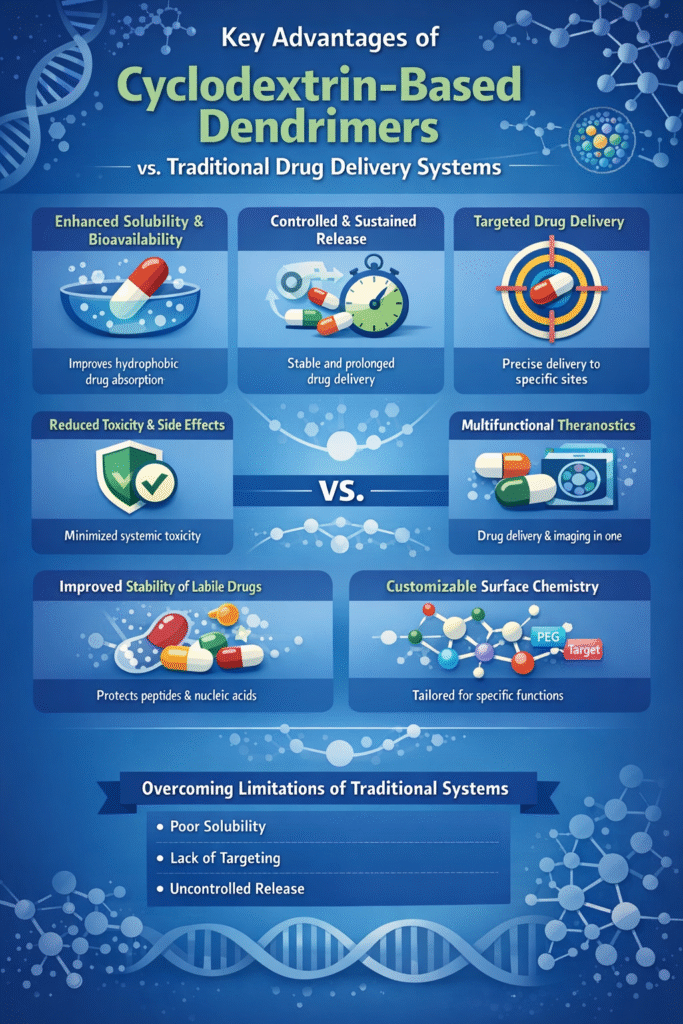
3: Key Advantages of Cyclodextrin-Based Dendrimers VS Traditional Systems
Cyclodextrin-based dendrimers outperform traditional drug delivery systems by enhancing solubility, enabling targeted delivery, and providing controlled release with improved safety and efficacy. Below are the most critical advantages explained clearly for rapid understanding.
1. Enhanced Drug Solubility and Bioavailability
Cyclodextrin cavities improve the solubility of poorly water-soluble drugs through inclusion complex formation.
Why it matters:
- Enables delivery of hydrophobic drugs
- Improves oral and injectable formulations
- Enhances therapeutic efficacy
2. Controlled and Sustained Drug Release
These dendrimers allow fine-tuned drug release profiles through structural engineering.
Advantages:
- Reduced dosing frequency
- Stable plasma drug levels
- Improved patient compliance
3. Targeted Drug Delivery
Surface functionalization enables site-specific targeting, such as tumor tissues or specific cells.
Mechanisms include:
- Ligand-receptor interactions
- pH-sensitive release
- Enzyme-triggered delivery
Result:
Higher drug concentration at target site with minimal off-target effects.
4. Reduced Toxicity and Side Effects
Cyclodextrin-based dendrimers minimize systemic exposure by encapsulating drugs and releasing them selectively.
Benefits:
- Lower cytotoxicity
- Reduced adverse reactions
- Improved safety profile
5. High Drug Loading Capacity
Their branched architecture provides multiple binding sites for drug molecules.
Compared to traditional systems:
- Higher payload per carrier
- Efficient delivery of combination therapies
- Reduced formulation volume
6. Multifunctionality (Theranostics)
These systems can simultaneously support:
- Drug delivery
- Imaging agents
- Diagnostic markers
This enables theranostic applications, particularly in oncology and precision medicine.
7. Improved Stability of Labile Drugs
Sensitive molecules such as peptides, proteins, and nucleic acids benefit from enhanced stability.
Protection against:
- Enzymatic degradation
- Hydrolysis
- Oxidation
8. Customizable Surface Chemistry
Dendrimers allow precise surface modification for:
- PEGylation (increased circulation time)
- Targeting ligands
- Charge modulation
This flexibility is not achievable in traditional delivery systems.
4: Comparison: Cyclodextrin-Based Dendrimers VS Traditional Systems
Cyclodextrin-based dendrimers offer superior performance across key drug delivery parameters compared to traditional systems, particularly in solubility, targeting, and controlled release.
| Feature | Cyclodextrin-Based Dendrimers | Traditional Drug Delivery Systems |
|---|---|---|
| Drug Solubility | Excellent | Limited |
| Targeting Ability | High (site-specific delivery) | Minimal (non-specific distribution) |
| Release Control | Precise and tunable | Poor and often uncontrolled |
| Drug Loading | High (multiple binding sites) | Low to Moderate |
| Stability | Enhanced (protects labile drugs) | Limited (prone to degradation) |
| Toxicity | Low (reduced systemic exposure) | Higher risk of side effects |
| Functionalization | Highly customizable | Limited modification options |
Key Insight
Cyclodextrin-based dendrimers clearly outperform traditional systems by providing engineered precision, multifunctionality, and improved safety profiles—making them highly suitable for modern and complex therapeutics.
Why this Comparison matters
- Traditional systems are often one-dimensional, focusing only on drug delivery without control or targeting.
- Cyclodextrin-based dendrimers are multi-functional nanocarriers, designed to solve multiple formulation challenges simultaneously.
- This makes them especially valuable in oncology, biologics, and advanced drug formulations.
5: Applications in Modern Pharmaceuticals
Cyclodextrin-based dendrimers are widely used in modern pharmaceuticals due to their ability to enhance drug delivery, targeting, and stability across multiple therapeutic areas. Their multifunctional design makes them especially valuable for complex and high-precision treatments.
1. Oncology
Cyclodextrin-based dendrimers enable targeted delivery of anticancer drugs, improving efficacy while minimizing toxicity.
Key benefits:
- Targeted chemotherapy delivery directly to tumor tissues
- Reduced systemic toxicity and side effects
- Enhanced accumulation of drugs at the tumor site
Impact:
Improves therapeutic outcomes while reducing damage to healthy cells.
2. Peptide and Protein Delivery
These systems protect sensitive biomolecules from degradation, ensuring effective delivery.
Key benefits:
- Protection from enzymatic degradation in biological environments
- Enhanced bioavailability of peptides and proteins
- Improved stability during circulation
Impact:
Enables efficient delivery of biologics that are otherwise difficult to administer.
3. Gene Therapy
Cyclodextrin-based dendrimers act as effective carriers for genetic material such as DNA and RNA.
Key benefits:
- Efficient delivery of nucleic acids into target cells
- Improved transfection efficiency
- Protection of genetic material from degradation
Impact:
Supports advanced therapies for genetic disorders and personalized medicine.
4. CNS Drug Delivery
They facilitate drug transport across the blood-brain barrier, a major challenge in neuropharmacology.
Key benefits:
- Enhanced penetration into the central nervous system
- Controlled release of neuroactive drugs
- Targeted delivery to brain tissues
Impact:
Opens new possibilities for treating neurological disorders such as Alzheimer’s and Parkinson’s disease.
5. Antimicrobial Therapy
Cyclodextrin-based dendrimers improve the effectiveness of antimicrobial agents.
Key benefits:
- Enhanced penetration into microbial cells and biofilms
- Increased drug efficacy against resistant strains
- Reduced likelihood of resistance development
Impact:
Strengthens treatment strategies against infections and antimicrobial resistance.
Final Insight
The diverse applications of cyclodextrin-based dendrimers demonstrate their versatility as next-generation drug delivery platforms, capable of addressing some of the most critical challenges in modern pharmaceutical development.
6: Regulatory and Development Considerations
Cyclodextrin-based dendrimers require rigorous regulatory and analytical evaluation to ensure safety, efficacy, and manufacturing consistency before clinical application. Although highly promising, their complexity demands a structured development approach aligned with global regulatory standards.
- Comprehensive physicochemical characterization
- Toxicological evaluation
- Scalable manufacturing processes
- Regulatory compliance (ICH, FDA guidelines)
Role of Advanced Analytical Techniques
Advanced analytical tools are critical for confirming identity, purity, and structural integrity.
Key techniques include:
- LC-MS (Liquid Chromatography–Mass Spectrometry)
→ Drug profiling and impurity detection - HRMS (High-Resolution Mass Spectrometry)
→ Precise molecular characterization - Peptide Mapping
→ Structural confirmation of complex biologics and conjugates
Advanced analytical techniques such as LC-MS, HRMS, and peptide mapping play a crucial role in ensuring quality and safety.
7: Future Perspectives
Cyclodextrin-based dendrimers are expected to:
- Drive personalized medicine
- Enable smart drug delivery systems
- Support AI-driven formulation design
- Expand into biologics and complex therapeutics
Their integration with nanotechnology and advanced analytics positions them as a cornerstone of next-generation pharmaceuticals.
Conclusion:
The advantages of Cyclodextrin-Based Dendrimers Over Traditional Drug Delivery Systems are clear and impactful. From enhanced solubility and targeted delivery to reduced toxicity and multifunctionality, these advanced nanocarriers overcome many limitations of conventional systems.
As pharmaceutical innovation continues to evolve, cyclodextrin-based dendrimers offer a powerful platform for improving therapeutic outcomes, particularly in complex and high-value drug development areas.
Frequently Asked Questions:
They improve drug delivery by enhancing solubility, enabling controlled release, and allowing targeted delivery to specific tissues. This leads to higher therapeutic effectiveness and reduced side effects compared to conventional delivery methods.
They outperform traditional systems because they offer:
-Better drug solubility and bioavailability
-Precise targeting capability
-Controlled and sustained release
-Lower toxicity and improved safety
Traditional systems lack this level of precision and multifunctionality.
Yes, they are generally considered biocompatible and low in toxicity when properly designed. However, like all advanced drug delivery systems, they require thorough toxicological evaluation and regulatory testing before clinical use.
They can deliver a wide range of therapeutic agents, including:
-Small molecule drugs
-Peptides and proteins
-Nucleic acids (DNA/RNA)
-Hydrophobic and poorly soluble drugs
They are widely used in:
-Oncology (targeted cancer therapy)
-Gene therapy
-Peptide and protein delivery
-CNS drug delivery (brain targeting)
-Antimicrobial treatments
Reference
- Topuz F, Uyar T. Recent advances in cyclodextrin‐based nanoscale drug delivery systems. Wiley Interdisciplinary Reviews: Nanomedicine and Nanobiotechnology. 2024 Nov;16(6):e1995.https://wires.onlinelibrary.wiley.com/doi/abs/10.1002/wnan.1995
- Vyas A, Saraf S, Saraf S. Cyclodextrin based novel drug delivery systems. Journal of inclusion phenomena and macrocyclic chemistry. 2008 Oct;62(1):23-42.https://link.springer.com/article/10.1007/s10847-008-9456-y
- Zhang D, Lv P, Zhou C, Zhao Y, Liao X, Yang B. Cyclodextrin-based delivery systems for cancer treatment. Materials Science and Engineering: C. 2019 Mar 1;96:872-86.https://www.sciencedirect.com/science/article/pii/S0928493118309470
- Mellet CO, Fernández JM, Benito JM. Cyclodextrin-based gene delivery systems. Chemical Society Reviews. 2011;40(3):1586-608.https://pubs.rsc.org/en/content/articlehtml/2011/cs/c0cs00019a
- Gadade DD, Pekamwar SS. Cyclodextrin based nanoparticles for drug delivery and theranostics. Advanced pharmaceutical bulletin. 2020 Feb 18;10(2):166.https://pmc.ncbi.nlm.nih.gov/articles/PMC7191229/