Quick Summary
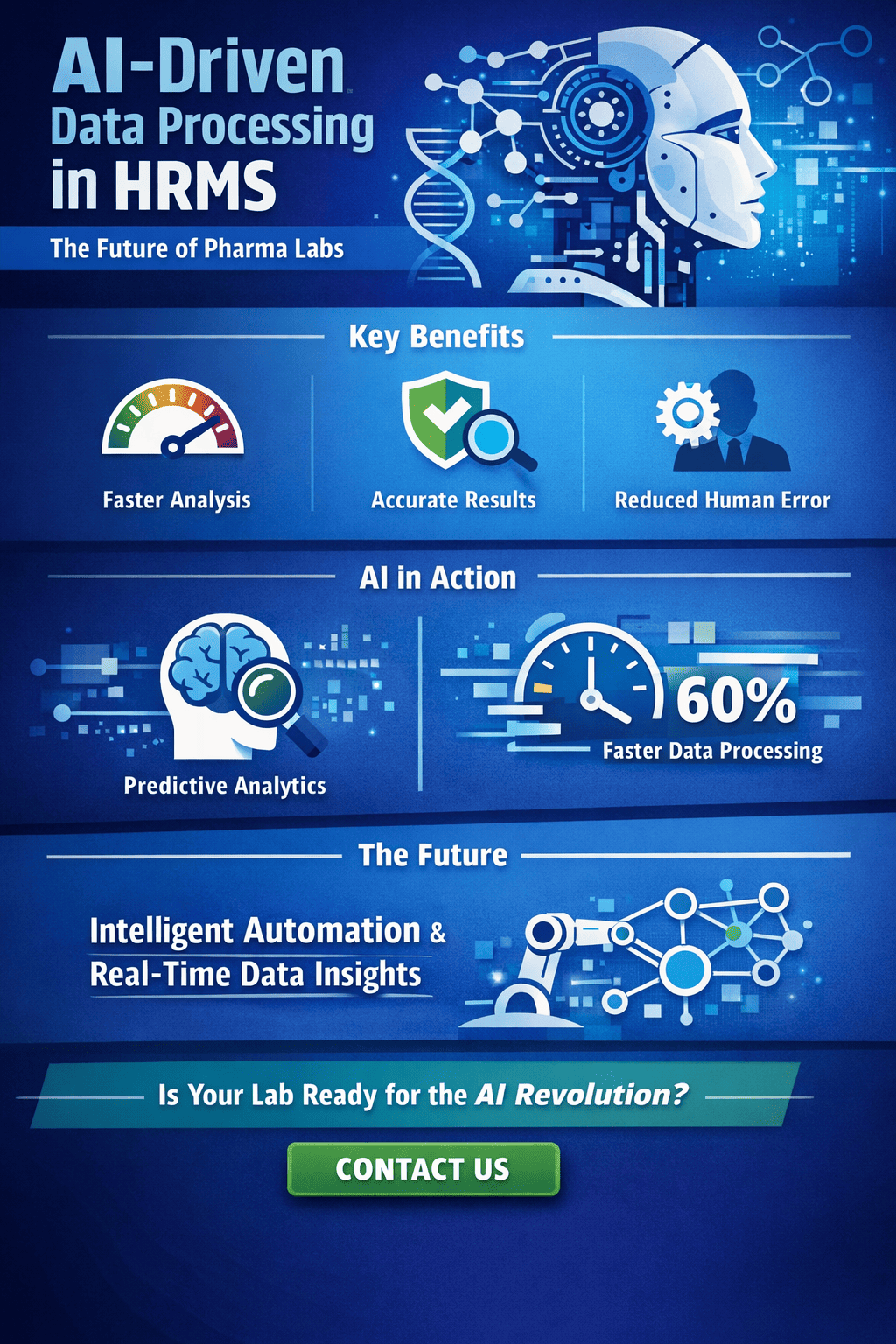
- AI-driven Data Processing in HRMS analysis is transforming the precision, speed, and scalability of data workflows in pharmaceutical laboratories.
- Pharma labs adopting AI-integrated HRMS systems are achieving faster molecular identification, enhanced data reliability, and reduced human error.
- Machine learning enables predictive analytics, making HRMS not just an analytical tool but a strategic decision engine.
- AI’s ability to handle unstructured spectral data reduces turnaround times by up to 60%, accelerating drug discovery cycles.
- The future of AI-driven Data Processing in HRMS analysis lies in intelligent automation, predictive calibration, and real-time data correlation across multi-instrument ecosystems.
Video Overview: Is AI-driven Data Processing the Future of HRMS in Pharma Labs?
Introduction: How AI-driven Data Processing in HRMS Analysis Is Redefining Pharma Workflows
Artificial Intelligence has moved beyond being a support tool and is now a core driver of innovation in pharmaceutical analytics. AI-driven Data Processing in HRMS Analysis is reshaping how scientists interpret, validate, and trust high-resolution mass spectrometry data. These advancements allow laboratories to handle growing data complexity without sacrificing speed or accuracy, especially when supported by advanced platforms for high-resolution mass spectrometry HRMS analysis.
Traditional HRMS workflows require manual review of thousands of ion peaks, isotopic patterns, and fragmentation signals. This approach is time-consuming and often inconsistent across analysts. AI-driven systems automate these steps, enabling faster compound identification and real-time data quality checks that align with modern high-resolution mass spectrometry services used in regulated pharma environments.
As AI models learn from historical datasets, each new analysis becomes more refined and reliable. This continuous improvement strengthens confidence in analytical outcomes and supports better decision-making across projects, particularly in workflows based on advanced high-resolution mass spectrometry platforms.
For pharmaceutical R&D teams, this means shorter discovery timelines, standardized results, and stronger support during critical development stages.
1. Why HRMS Needs AI: The Data Bottleneck Challenge
HRMS generates massive volumes of complex data that are impossible to process efficiently through manual methods alone.
High-resolution mass spectrometry instruments produce millions of data points in a single run. These include exact mass values, isotopic distributions, and fragmentation spectra generated using sophisticated techniques grounded in the working principle of HRMS. While instruments are highly advanced, converting raw data into meaningful insights remains a major challenge.
Traditional analysis involves manual peak detection, noise filtering, and compound confirmation. These steps slow down workflows and introduce subjectivity, especially when different analysts review the same dataset.
AI-driven Data Processing in HRMS Analysis solves this problem by automatically detecting patterns, removing irrelevant noise, and confirming compounds across large datasets. This reduces delays and improves confidence in results, particularly in impurity-focused studies where LC-MS impurity profiling plays a critical role.
As analytical complexity increases, AI allows labs to process more samples faster while maintaining high data quality.
| Traditional HRMS Data Workflow | AI-driven HRMS Data Workflow |
|---|---|
| Manual peak extraction | Automated feature detection |
| Static database matching | Adaptive pattern recognition |
| Hours-to-days analysis time | Minutes-to-seconds analysis time |
| Prone to analyst variability | Consistent and reproducible results |
2. Core Advantages of AI-driven Data Processing in HRMS Analysis for Pharma Labs
AI improves accuracy, consistency, speed, and scalability in HRMS workflows.
One major benefit of AI-driven Data Processing in HRMS Analysis is rapid data interpretation. AI systems can analyze tens of thousands of spectra simultaneously, enabling laboratories to fully leverage the advantages of HRMS without being constrained by manual review.
AI also enhances compound discovery by predicting molecular structures even when reference databases are incomplete. This is especially valuable in early drug discovery and impurity investigations, including advanced workflows such as Orbitrap HRMS for impurity profiling.
Reproducibility is another key advantage. Machine learning ensures uniform analysis across analysts, instruments, locations, and batches, which is critical for regulatory submissions.
Scalability improves through cloud-based AI platforms that automatically adjust computing power as data volumes grow. Industry data shows that AI-enabled labs achieve 40–60% faster compound verification and reduce re-analysis by nearly 25%.
3. Machine Learning Models Behind Modern HRMS Analysis
Advanced HRMS platforms rely on multiple machine learning models working together.
Random Forest models are widely used for fragment ion classification and molecular prediction. They perform well across diverse datasets and deliver stable results.
Convolutional Neural Networks (CNNs) help analyze complex spectral patterns by treating spectra as images. This allows accurate interpretation of fragmentation behavior.
Autoencoders reduce data complexity by compressing large datasets without losing essential information. This makes HRMS data easier to manage and analyze.
Reinforcement Learning supports adaptive calibration and instrument optimization, ensuring that HRMS systems continue to evolve alongside the broader evolution of HRMS technology.
4. Integration of AI-driven Data Processing in HRMS Analysis within Pharma Lab Ecosystems
Seamless integration enables end-to-end automation and faster collaboration.
Modern pharmaceutical labs integrate AI-driven Data Processing in HRMS Analysis with Laboratory Information Management Systems (LIMS). This ensures smooth data flow across instruments and enterprise platforms, a requirement increasingly expected from organizations recognized as the best CRO for high-resolution mass spectrometry.
Real-time synchronization allows teams to access results instantly, improving collaboration across departments. Visual dashboards highlight trends, anomalies, and performance metrics.
AI also enables predictive maintenance by identifying early signs of instrument drift. This reduces downtime and lowers maintenance costs.
In AI-enabled setups, spectra are uploaded, analyzed, and reported automatically, significantly reducing errors and speeding up feedback to research teams.
5. How AI Enhances Accuracy in HRMS Data Validation
AI validates HRMS data using anomaly detection and probabilistic reasoning.
Traditional validation relies heavily on known standards, which may miss subtle inconsistencies. AI models identify unexpected patterns that suggest data quality issues.
Validation includes monitoring signal-to-noise ratios, isotopic distributions, and fragmentation pathways. These checks are applied consistently across all datasets.
AI-generated quality scores provide objective assessments, reducing reliance on subjective judgment.
This approach supports regulatory compliance under FDA ALCOA+ principles, ensuring data remains accurate, traceable, and reliable.
6. Predictive Insights: Turning HRMS from Analytical Tool to Strategic Engine
Answer upfront: AI transforms HRMS into a predictive and decision-support platform.
By learning from historical data, AI predicts molecular behavior, degradation trends, and impurity formation. This allows scientists to identify risks earlier.
In stability studies, AI models forecast how compounds respond to storage conditions, reducing trial-and-error experiments.
Predictive insights help optimize formulations faster and support early risk mitigation.
As a result, AI-driven Data Processing in HRMS Analysis plays a strategic role in R&D planning and resource allocation.
7. Data Security and Regulatory Compliance in AI-driven HRMS Systems
Answer upfront: Compliance and data integrity are built into AI-enabled HRMS platforms.
Pharma labs operate under GxP, 21 CFR Part 11, and ISO/IEC 17025 requirements. AI-powered HRMS systems are designed to meet these standards.
Audit trails record every action, while encrypted data transfer protects sensitive information. Role-based access ensures controlled data usage.
Validation-ready AI models provide transparent documentation for inspections.
These features align with Google E-E-A-T principles, strengthening trust and credibility.
8. Challenges and Solutions in AI Adoption for HRMS Data Processing
Answer upfront: Data standardization, explainability, and skills gaps are the main challenges.
Inconsistent data formats across instruments create silos that limit AI performance. Explainability is also critical, as regulators require clear reasoning behind AI decisions.
Limited in-house AI expertise can slow adoption.
Solutions include adopting open standards like mzML, using explainable AI frameworks, and working closely with vendors for validation and training.
9. The Future Outlook: From Reactive to Proactive HRMS Workflows
Answer upfront: The future of AI-driven HRMS is autonomous and predictive.
Federated Learning enables labs to share insights without exposing raw data. Digital Twins allow virtual instrument optimization.
Continuous learning pipelines keep AI models aligned with new datasets.
AI-driven Quality by Design integrates quality checks early, reducing late-stage failures. Together, these trends make AI-driven Data Processing in HRMS Analysis essential for next-generation labs.
Conclusion: AI-driven Data Processing in HRMS Analysis Is the Future of Analytical Intelligence
AI-driven Data Processing in HRMS Analysis is redefining pharmaceutical analytics. Automated workflows deliver faster insights, lower risk, and improved reproducibility.
Labs adopting AI-enabled HRMS platforms gain a competitive edge by turning raw data into actionable intelligence across discovery, development, and quality control.
To explore customized AI integration strategies for your HRMS workflows, contact ResolveMass Laboratories Inc. today:
👉 Contact Us
FAQs on AI-driven Data Processing in HRMS Analysis
AI-driven Data Processing in HRMS Analysis refers to using artificial intelligence and machine learning to automatically interpret, clean, and validate high-resolution mass spectrometry data. It reduces manual effort and improves the speed and accuracy of data interpretation. This approach helps labs manage complex datasets more efficiently.
AI improves HRMS data quality by identifying noise, detecting unusual patterns, and validating results consistently across datasets. Machine learning models learn from historical data to minimize errors. This leads to more reliable, reproducible, and high-confidence analytical outcomes.
Yes, most modern HRMS instruments support AI integration through software modules and APIs. AI tools can be added without replacing existing hardware. This allows laboratories to upgrade data processing capabilities while keeping their current systems.
No, AI is designed to support analysts, not replace them. It handles repetitive and time-consuming tasks, allowing scientists to focus on interpretation and decision-making. Human expertise remains essential for scientific judgment and regulatory accountability.
Pharma labs typically see faster turnaround times, fewer repeat analyses, and better resource utilization. Many report improvements of 40–60% in data processing speed. These gains translate into lower operational costs and faster development timelines.
Reference
- Phi EDGE. (2025, July 7). What is AI-powered HRMS and how it’s changing human resource management. Phi EDGE. Retrieved January 3, 2026, from https://phiedge.co.in/blog/what-is-ai-powered-hrms-and-how-its-changing-human-resource-management/
- Qandle. (2025). Top AI-HRMS trends transforming HR in 2025. Qandle. Retrieved January 3, 2026, from https://www.qandle.com/blog/top-ai-hrms-trends-transforming-hr-in-2025/
- eResourceERP. (2025, May 12). How AI-powered eResource HRMS empowers employees to work smarter. eResourceERP. Retrieved January 3, 2026, from https://www.eresourceerp.com/how-ai-powered-eresource-hrms-empowers-employees-to-work-smarter/
Get In Touch With Us
About The Author