

Introduction:
Analytical characterization of peptide-oligonucleotide conjugates becomes significantly more complex once a molecule moves from a single-linker design to a multi-linker architecture, where two or more attachment chemistries are used to join a targeting peptide to a therapeutic oligonucleotide. Unlike conventional small molecules, these conjugates combine two chemically complex biomolecular components with one or more linkers, and their performance depends not only on the peptide and oligonucleotide sequences but also on linker identity, conjugation site, conjugation efficiency, and overall molecular architecture. This case study walks through how ResolveMass Laboratories approached the analytical characterization of a multi-linker peptide-oligonucleotide conjugate (POC) for a sponsor developing a receptor-targeted oligonucleotide therapeutic, and what the resulting data revealed about conjugation efficiency, purity, and stability.
POCs are being investigated for applications such as targeted delivery, nucleic-acid therapeutics, gene modulation, and receptor-mediated drug delivery — including specialized applications such as peptide-oligonucleotide conjugates in CNS drug delivery, where a targeting peptide is used to help an oligonucleotide payload cross a biological barrier it could not cross alone. Because a POC pairs an oligonucleotide backbone with a targeting peptide, it is also worth distinguishing this modality from a plain antisense oligonucleotide, which lacks the peptide-mediated targeting and uptake advantages a conjugate is designed to provide. POCs sit at the intersection of peptide chemistry and oligonucleotide chemistry, and multi-linker designs add a third layer of complexity: the linkers themselves. Each linker introduces its own degradation chemistry, its own potential for incomplete reaction, and its own contribution to the overall impurity profile. Treating a multi-linker POC as “just a bioconjugate” and reusing a single-linker characterization plan is one of the most common causes of delayed IND filings in this space.
Summary:
- Multi-linker peptide-oligonucleotide conjugates (POCs) combine two chemically distinct molecules joined through more than one linker, which multiplies the number of possible structural variants and analytical failure points.
- A single technique cannot characterize a multi-linker POC; a fit-for-purpose orthogonal strategy combining LC-MS/HRMS, RP-HPLC, ion-exchange chromatography, peptide mapping, oligonucleotide sequencing, and forced degradation is required for full characterization.
- Conjugation efficiency, positional isomer control, and linker stability are the three most common sources of batch failure in POC development.
- Sample preparation, mass deconvolution, and method validation (per ICH Q2(R2)/Q14) are foundational steps that are easy to under-resource but directly determine data quality.
- Analytical characterization of peptide-oligonucleotide conjugates should begin during early process development, not at release testing, to avoid costly redesign late in the program.
- ResolveMass Laboratories combines USFDA-registered facilities, orthogonal analytical platforms, and hands-on bioconjugate experience to support sponsors through IND-enabling characterization packages.
1: Understanding Multi-Linker Peptide-Oligonucleotide Conjugates
A multi-linker POC is a conjugate in which the peptide and oligonucleotide components are joined through two or more distinct linker chemistries — for example, a cleavable disulfide linker paired with a stable amide or click-chemistry linkage — rather than a single homogeneous attachment point.
What Structural Components Make Up a Multi-Linker POC?
A multi-linker conjugate is generally built from a peptide domain, an oligonucleotide domain, a primary linker, a secondary linker or spacer, the conjugation chemistry itself, and any terminal modifications. A simplified representation is: Peptide — Linker 1 — Spacer/Linker 2 — Oligonucleotide, with additional modifications sometimes present at the peptide terminus, oligonucleotide terminus, or specific amino-acid or nucleotide positions. Advances in next-generation oligonucleotide chemistries — including novel backbone and sugar modifications — are increasingly used alongside multi-linker designs to further improve nuclease resistance and target engagement, which adds yet another variable the analytical package must account for.
Why Do Developers Use Multiple Linkers?
Sponsors typically move to multi-linker designs to independently tune two properties that a single linker cannot deliver at once: intracellular release kinetics and in-circulation stability. A cleavable linker enables payload release once the conjugate reaches its target compartment, while a second, more stable linkage anchors the targeting peptide so it survives systemic circulation. This design choice is closely tied to how the conjugate is expected to behave once it reaches a cell — a topic covered in more depth in our discussion of how peptide-oligonucleotide conjugates enter cells.
2: What Makes Multi-Linker Designs Analytically Challenging?
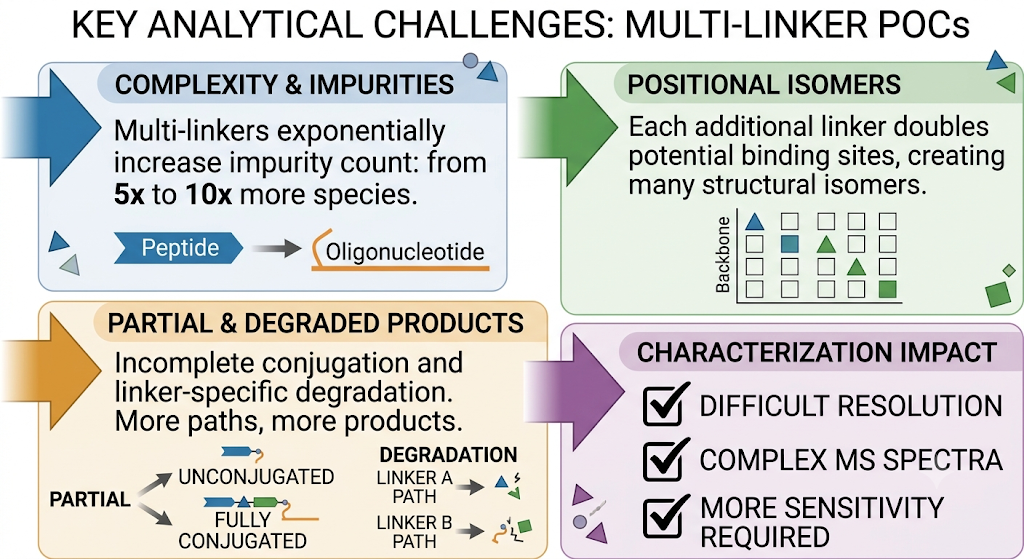
Each additional linker multiplies the number of possible conjugation regiochemistries, partial-reaction products, and degradation pathways that must be distinguished from the target molecule. In practice, this means a multi-linker POC can generate five to ten times more closely related impurities than a single-linker conjugate of similar size.
| Challenge | Potential Analytical Impact |
|---|---|
| Multiple linker structures | Difficult-to-resolve molecular variants |
| Multiple conjugation sites | Positional isomers and partially conjugated species |
| Large molecular mass | Complex MS spectra and charge-state distributions |
| Peptide modifications | Oxidation, deamidation, truncation, or sequence variants |
| Oligonucleotide impurities | Shortmers, longmers, and modified sequence species |
| Linker degradation | New molecular species and altered chromatographic profiles |
| Low-level impurities | Requires sensitive analytical methods |
| Multiple charge states | Complicates intact-mass interpretation |
- Positional isomers: the same linkers attached at different sites on the peptide or oligonucleotide backbone.
- Partial conjugation: molecules where only one of the two linkers has reacted.
- Linker-specific degradation: disulfide exchange, hydrolysis, or click-chemistry byproducts that differ by linker type.
- Mass overlap: closely related species that can co-elute or share near-identical mass, requiring high-resolution orthogonal separation.
3: Case Study Background: The Conjugate Under Investigation
The sponsor’s multi-linker POC combined a receptor-targeting peptide with a short antisense oligonucleotide, joined through a cleavable disulfide linker on one terminus and a stable triazole (click-chemistry) linkage on the other. The program had reached late preclinical development, and the sponsor needed a comprehensive analytical characterization package to support process validation and IND-enabling studies. Conjugation had been produced under a partially automated synthesis workflow, and questions about batch-to-batch consistency were part of what prompted a closer look — a challenge addressed in more detail in our piece on automation in peptide-oligonucleotide conjugate synthesis.
The core question driving the study was straightforward: could the manufacturing process reproducibly deliver a conjugate with the intended 1:1 peptide-to-oligonucleotide stoichiometry, both linkers correctly attached, and impurity levels within an acceptable range across multiple batches? Answering that question required a multi-technique analytical strategy rather than any single assay.
Analytical Characterization Strategy
ResolveMass built the characterization plan around four objectives: confirm structure and linker connectivity, quantify conjugation efficiency and stoichiometry, profile purity and impurities, and assess stability under stress conditions. The table below summarizes the technique-to-objective mapping used across the program.
| Analytical Objective | Primary Technique(s) | What It Confirms |
|---|---|---|
| Primary sequence & linker connectivity | LC-MS/HRMS, LC-MS/MS (peptide mapping + intact mass) | Correct peptide sequence, oligonucleotide sequence, and linker attachment sites |
| Conjugation efficiency & stoichiometry | RP-HPLC / IP-RP-HPLC, intact mass spectrometry | Ratio of peptide to oligonucleotide per conjugate molecule |
| Purity & related substances | RP-HPLC, IEX-HPLC, CE-SDS | Unconjugated peptide, unconjugated oligonucleotide, positional isomers |
| Higher-order structure | CD spectroscopy, DSC | Secondary structure integrity and thermal stability of each domain |
| Degradation pathways | Forced degradation + LC-MS/MS | Hydrolysis, oxidation, and linker-cleavage susceptibility |
| Residual impurities | ICP-MS, HPLC for process-related impurities | Elemental impurities and synthesis by-products |
| Bioanalytical performance | LC-MS/MS with hybrid IA/LC-MS workflows | Plasma/tissue stability and quantifiable exposure |
Sample Preparation and Initial Assessment
Before any instrumental analysis, sample preparation itself was evaluated because conjugated biomolecules can be sensitive to pH, ionic strength, temperature, adsorption, and solvent composition. The initial assessment covered solubility, concentration verification, buffer compatibility, recovery, dilution stability, freeze-thaw behavior, and potential adsorption to laboratory surfaces. Inappropriate sample preparation can create artifacts that are easily misread as product-related impurities, so a controlled sample-preparation procedure was treated as a core part of the overall method — not a preliminary formality.
Structural Confirmation and Linker Mapping via LC-MS/HRMS
Intact mass spectrometry combined with peptide mapping confirmed the molecular weight of the fully conjugated species and verified that both the disulfide and triazole linkers were attached at the intended sites. LC-MS/MS fragmentation data distinguished correctly conjugated material from partially reacted intermediates that differed by only one linker attachment.
Because large biomolecular conjugates generate multiple charge states, the observed charge-state envelope had to be deconvoluted to estimate the corresponding neutral molecular mass, answering a fundamental question: does the measured intact mass correspond to the expected peptide + oligonucleotide + linker architecture? Intact mass alone, however, could not pinpoint the exact linker location or distinguish every structural isomer — which is why orthogonal peptide- and oligonucleotide-level sequence work remained essential. Our overview of peptide-oligonucleotide conjugate sequence confirmation strategies covers this workflow in more depth, including enzymatic digestion followed by LC-MS/MS to confirm conjugation-site-specific peptide fragments.
Conjugation Efficiency and Stoichiometry
Ion-pair reversed-phase HPLC (IP-RP-HPLC), cross-referenced against intact mass data, quantified the proportion of conjugate carrying both linkers versus material with only one linker reacted. This orthogonal pairing was essential because HPLC alone could not resolve every positional isomer, and mass spectrometry alone could not always separate co-eluting species with similar mass but different retention behavior.
Purity, Impurity Profiling, and Purification Considerations
RP-HPLC and ion-exchange HPLC (IEX-HPLC) separated the conjugate from unconjugated peptide, unconjugated oligonucleotide, and positional isomers, while CE-SDS provided an orthogonal, charge- and size-based purity check. Because oligonucleotides carry substantial charge from their phosphate backbone, ion-exchange chromatography was particularly valuable for resolving charge-related variants and truncated sequence species that RP-HPLC alone would miss. These same separation principles guided the downstream process, and the methods used for analytical resolution closely mirrored the purification techniques for peptide-oligonucleotide conjugates applied earlier in the manufacturing workflow to isolate the target conjugate from process-related impurities.
Degradation Pathways and Storage Stability
Forced degradation studies — heat, light, oxidative, and hydrolytic stress — mapped which linker degraded first under each condition, information that directly informed the sponsor’s proposed storage conditions and container-closure strategy. These findings fed directly into broader recommendations on peptide-oligonucleotide conjugate storage, stability, and handling, and ultimately into formulation decisions supported through dedicated POC drug product formulation services.
Bioanalytical and Stability Assessment
A hybrid immunoaffinity–LC-MS/MS bioanalytical method was developed to track the intact conjugate, the cleaved active payload, and key degradation products in plasma matrices, supporting both the stability program and the eventual pharmacokinetic studies planned for IND-enabling work.
4: Key Findings from the Case Study
The multi-technique approach identified three findings that a single-assay strategy would likely have missed entirely.
- Conjugation efficiency varied by linker: the triazole linkage reacted to greater than 98% completion, while the disulfide linkage showed batch-to-batch variability between 88–95%, pointing to a specific process step requiring tighter control.
- A previously uncharacterized positional isomer, differing only in the site of disulfide attachment, was resolved by IP-RP-HPLC and confirmed by MS/MS fragmentation — a species that co-eluted with the target conjugate on standard RP-HPLC alone.
- Forced degradation confirmed the disulfide linker as the primary stability-limiting element, directly shaping the sponsor’s recommended storage temperature and formulation buffer pH range.
Together, these findings allowed the sponsor to adjust the conjugation process, tighten in-process controls around the disulfide coupling step, and finalize a stability-indicating analytical package ahead of IND-enabling toxicology studies.
5: Analytical Control Strategy for Multi-Linker Conjugates
A successful analytical program connects each critical quality attribute with an appropriate analytical method rather than leaving any attribute without a defined testing strategy.
| Quality Attribute | Recommended Analytical Approach |
|---|---|
| Identity | LC-MS/HRMS |
| Intact molecular mass | HRMS |
| Peptide sequence | Peptide mapping, LC-MS/MS |
| Oligonucleotide sequence | LC-MS/HRMS and sequence-related analysis |
| Linker identity | HRMS/MS |
| Linker integrity | LC-MS/MS |
| Conjugation site | Peptide/oligonucleotide mapping |
| Purity | RP-HPLC |
| Charge variants | Ion-exchange chromatography |
| Size variants | SEC or appropriate size-based technique |
| Degradation products | Stability-indicating LC-MS/HPLC |
| Process-related impurities | Targeted chromatographic and MS methods |
6: Regulatory and Quality Considerations
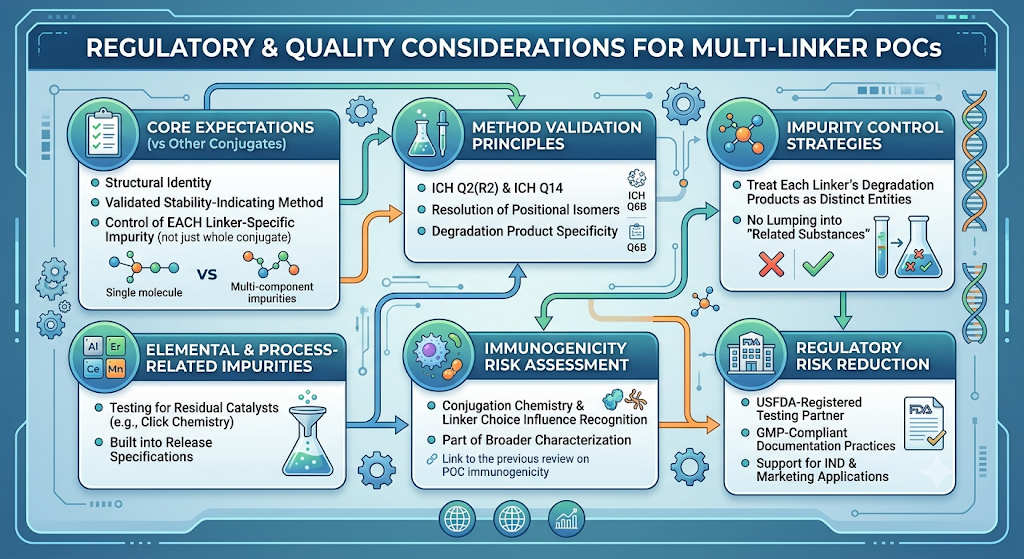
Regulatory agencies evaluate multi-linker POCs against the same fundamental expectations applied to other complex conjugates: demonstrated structural identity, a validated stability-indicating method, and control strategies for every linker-specific impurity, not just the conjugate as a whole.
- Method validation should follow ICH Q2(R2) and ICH Q14 principles, with specificity data demonstrating resolution of each known positional isomer and degradation product; ICH Q6B may also provide relevant principles depending on the product type and regulatory pathway.
- Impurity qualification and control strategies should treat each linker’s degradation products as distinct entities rather than lumping them into a single “related substances” category.
- Elemental and process-related impurity testing (e.g., residual catalysts from click chemistry) should be built into the release specification from the outset.
- Immunogenicity risk should be assessed as part of the broader characterization program, since conjugation chemistry and linker choice can influence immune recognition — a consideration explored further in our review of immunogenicity of peptide-oligonucleotide conjugates.
- A USFDA-registered testing partner with GMP-compliant documentation practices reduces regulatory risk when the characterization package is submitted as part of an IND or subsequent marketing application.
7: Why Partner with ResolveMass for POC Analytical Characterization
ResolveMass Laboratories Inc. is a USFDA-registered Canadian CRO/CDMO with direct, hands-on experience developing orthogonal analytical strategies for peptide-oligonucleotide conjugates, including multi-linker architectures like the one described in this case study.
- Integrated analytical platforms spanning LC-MS/HRMS, LC-MS/MS, HPLC (RP, IEX, IP-RP), CE-SDS, CD spectroscopy, DSC, and ICP-MS under one roof.
- Demonstrated experience distinguishing linker-specific degradation pathways and positional isomers in complex bioconjugates.
- Stability-indicating and bioanalytical method development aligned with ICH Q2(R2)/Q14 and current regulatory expectations for novel modalities.
- GMP-compliant, USFDA-registered facilities supporting both preclinical characterization and IND-enabling data packages.
Sponsors developing peptide-oligonucleotide conjugates, multi-linker or otherwise, can reach out to the ResolveMass team to discuss a tailored analytical characterization strategy for their specific conjugate design.
Conclusion:
This case study illustrates why analytical characterization of peptide-oligonucleotide conjugates cannot rely on a single method, particularly once a molecule moves to a multi-linker design. Orthogonal techniques — mass spectrometry, multiple HPLC modes, CE-SDS, spectroscopic and thermal analysis, and forced degradation — were each necessary to resolve conjugation efficiency, positional isomers, and linker-specific stability liabilities that would otherwise have gone undetected until much later in development. The strongest analytical package is one in which independent, complementary techniques all point to the same structural conclusion.
Frequently Asked Questions:
High-resolution mass spectrometry (HRMS) provides accurate molecular-mass information that helps confirm the expected composition of a peptide-oligonucleotide conjugate. It can distinguish closely related species and support the identification of linker incorporation, conjugation stoichiometry, modified forms, and degradation products. For multi-linker conjugates, HRMS is particularly useful for investigating molecular heterogeneity that may not be fully resolved by conventional analytical techniques.
Conjugation sites are typically investigated using enzymatic or chemical digestion followed by LC-MS/MS analysis. Fragmentation can generate peptide- or oligonucleotide-containing fragments that retain the linker, providing evidence for the location of conjugation. Comparison of experimental fragment masses with theoretical structures helps confirm whether the linker is attached at the intended site. The specific approach depends on the conjugation chemistry and molecular architecture.
Orthogonal characterization is important because no single analytical technique can comprehensively characterize a multi-linker peptide-oligonucleotide conjugate. Different methods investigate different molecular properties—for example, HRMS evaluates molecular mass, RP-HPLC assesses chromatographic purity, ion-exchange chromatography examines charge-related variants, and LC-MS/MS provides structural information. Combining these independent results provides stronger evidence for identity, purity, conjugation, and structural integrity.
Linkers are characterized by assessing their identity, molecular mass, integrity, attachment, and potential degradation products using techniques such as LC-MS, HRMS, and LC-MS/MS. Fragmentation studies can provide evidence of linker incorporation and attachment to the intended component. For multi-linker conjugates, the analysis may also investigate incomplete linker occupancy, linker cleavage, hydrolysis, oxidation, or other linker-related variants.
The oligonucleotide component can be characterized using LC-MS/HRMS, ion-exchange chromatography, and other fit-for-purpose oligonucleotide analytical methods. These techniques can evaluate full-length product, shortmer and longmer species, sequence-related variants, nucleotide modifications, and degradation products. Combining chromatographic separation with mass spectrometry provides complementary information about both the purity and structural integrity of the oligonucleotide portion.
Reference
- Venkatesan N, Kim BH. Peptide conjugates of oligonucleotides: synthesis and applications. Chemical reviews. 2006 Sep 13;106(9):3712-61.https://pubs.acs.org/doi/full/10.1021/cr0502448
- Naganuma M, Tsuji G, Amiya M, Hirai R, Higuchi Y, Hata N, Nozawa S, Watanabe D, Nakajima T, Demizu Y. High-Resolution HPLC for Separating Peptide–Oligonucleotide Conjugates. ACS omega. 2025 Apr 30;10(20):20578.https://pmc.ncbi.nlm.nih.gov/articles/PMC12120573/
- Soukchareun S, Tregear GW, Haralambidis J. Preparation and characterization of antisense oligonucleotide-peptide hybrids containing viral fusion peptides. Bioconjugate chemistry. 1995 Jan 1;6(1):43-53.https://pubs.acs.org/doi/abs/10.1021/bc00031a004
- Jensen ON, Kulkarni S, Aldrich JV, Barofsky DF. Characterization of peptide-oligonucleotide heteroconjugates by mass spectrometry. Nucleic acids research. 1996 Oct 1;24(19):3866-72.https://academic.oup.com/nar/article-abstract/24/19/3866/2384795
- Peyrottes S, Mestre B, Burlina F, Gait MJ. The synthesis of peptide-oligonucleotide conjugates by a fragment coupling approach. Tetrahedron. 1998 Oct 8;54(41):12513-22.https://www.sciencedirect.com/science/article/pii/S0040402098007315
About the Author


