

Introduction
Analytical Method Development for Generic Drugs is one of the most important scientific and regulatory steps in the ANDA pathway. The decision to outsource to a CRO or build internal laboratory capabilities can directly impact approval timelines, inspection outcomes, and long-term product control. This choice affects not only technical execution but also regulatory strategy and commercial success.
In competitive generic markets, speed matters. First-to-file advantages and rapid approvals often determine profitability. Even small delays in method validation, impurity profiling, or method transfer can lead to missed opportunities and reduced revenue. Companies must therefore design analytical operations that support both compliance and speed.
Explore our specialized services: Analytical Method Development and Validation Services
This article provides a structured and practical comparison of Analytical Method Development for Generic Drugs: CRO vs In-House Lab. It reviews cost structures, regulatory risk, scalability, expertise, data integrity, and lifecycle considerations. The objective is to support a strategy-driven decision rather than one based only on short-term cost.
Summary: CRO vs In-House for Analytical Method Development for Generic Drugs
- Outsourcing to a CRO offers scalability, regulatory exposure, and access to advanced instrumentation but may introduce communication gaps and method transfer risks.
- In-house laboratories provide greater control, faster iteration cycles, and stronger intellectual property protection but require significant capital investment and sustained technical leadership.
- The decision depends on portfolio size, regulatory geography, molecule complexity, ANDA timelines, and internal analytical maturity.
- Hybrid models are increasingly adopted for Analytical Method Development for Generic Drugs, combining internal oversight with CRO execution.
- Risk mitigation, data integrity compliance (ALCOA+), and inspection readiness are decisive factors—not just cost.
Analytical Method Development for Generic Drugs: CRO vs In-House Lab – Strategic Overview
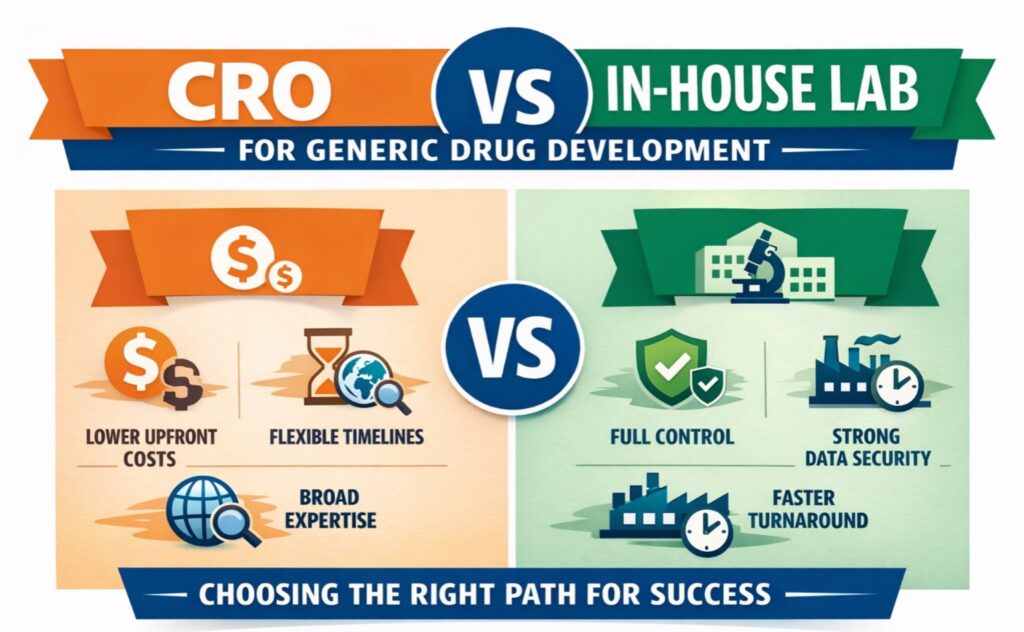
The main difference is simple. CROs provide outsourced expertise and infrastructure when needed, while in-house laboratories offer direct control and retention of internal knowledge. Each approach serves different business models and growth stages.
For generic pharmaceutical companies, the decision usually depends on several operational and regulatory factors:
- ANDA submission pipeline volume
- Complexity of dosage forms (injectables, ophthalmics, complex generics)
- Stability program capacity
- Impurity profiling requirements
- Global regulatory targets (USFDA, Health Canada, EMA, MHRA, TGA)
Learn more about the benefits of outsourcing: Strategic Advantages of Outsourcing Generic Projects to CROs
Companies must also consider expansion plans, inspection frequency, and post-approval lifecycle management. Analytical strategy should support both immediate submissions and future regulatory changes.
Below is a structured comparison.
| Factor | CRO | In-House Lab |
|---|---|---|
| Capital Investment | Low upfront | High (equipment + facility) |
| Regulatory Exposure | High (multi-client inspections) | Depends on company history |
| Scalability | Flexible | Limited by infrastructure |
| IP Control | Shared risk | Full internal control |
| Turnaround Speed | May vary | Faster iteration cycles |
| Data Integrity Oversight | Vendor-dependent | Direct supervision |
| Method Transfer Risk | High | Minimal |
| Long-Term Cost | Variable | Lower per project (high volume) |
Analytical Method Development for Generic Drugs: Cost Comparison (CRO vs In-House)
In simple terms, CROs reduce initial capital investment but may become expensive over time. In-house laboratories require higher upfront spending, but they become cost-effective when supported by a consistent ANDA pipeline.
CRO Cost Structure
CRO pricing generally includes:
- Method development fees
- Validation packages
- Stability method setup
- Forced degradation studies
- Transfer protocols
- Project management charges
- Repeat testing due to OOS/OOT
In addition to base pricing, indirect costs may arise. These can include change orders, additional robustness testing, extended project timelines, and sponsor audits. Delays caused by rework or clarification often increase total project costs.
Find the right partner for your pipeline: Best CRO for Pharma Generic Projects
In-House Cost Structure
Major expenses include:
- LC-MS/MS, HPLC, UPLC, GC systems
- Stability chambers
- Qualified analysts and QA oversight
- LIMS and data integrity systems
- Annual calibration and maintenance
- Ongoing training and audit readiness
Although the setup cost is high, per-project expenses decrease as laboratory utilization increases. Internal scheduling flexibility reduces dependency on external timelines. Over time, internal expertise improves efficiency and reduces repeat work.
Cost Breakpoint Insight:
Companies filing more than 8–12 ANDAs annually often gain financial benefits by internalizing Analytical Method Development for Generic Drugs. Higher volume justifies infrastructure investment and lowers per-method costs.
Analytical Method Development for Generic Drugs: Regulatory Risk Considerations
Regulatory compliance is a major deciding factor. Inspection outcomes at the analytical level can directly influence ANDA approval.
CRO Regulatory Considerations
CROs face frequent multi-client inspections, which increases scrutiny. Any regulatory observation may impact multiple sponsors. Even when development is outsourced, the sponsor remains fully responsible for submitted data.
Common regulatory concerns include:
- Incomplete forced degradation
- Poor impurity separation
- Weak robustness evaluation
- Inconsistent system suitability criteria
Data integrity findings at CRO facilities may delay approvals. Method transfer gaps are also common contributors to inspection observations.
Ensure compliance with specialized testing: Nitrosamine Testing for Generic Drugs
In-House Regulatory Considerations
Advantages include:
- Direct QA oversight
- Immediate CAPA implementation
- Better alignment with development strategy
- Easier lifecycle method updates
Internal control supports consistent documentation and stronger scientific justification. However, companies should conduct periodic third-party audits to stay aligned with evolving regulatory expectations.
For Analytical Method Development for Generic Drugs, regulatory defensibility often improves when strong internal analytical leadership is present.
Analytical Method Development for Generic Drugs: Method Transfer Complexity
Method transfer is one of the highest-risk stages when development is outsourced. Even validated methods can face variability when executed at a different site.
Common transfer risks include:
- Column variability
- Instrument differences
- Analyst interpretation differences
- Sample preparation variability
- Stability-indicating specificity issues
In-house laboratories reduce formal transfer risk when development and commercial testing occur in the same facility. However, CROs may offer broader regulatory exposure. Clear protocols and predefined acceptance criteria are essential for successful transfer.
Analytical Method Development for Generic Drugs: Technical Depth & Expertise
CROs often have exposure to diverse dosage forms and international regulations. Their experience across multiple projects allows benchmarking and broad technical knowledge.
CRO expertise may include:
- High-throughput ANDA portfolios
- Nitrosamine analysis
- Genotoxic impurity testing
- Elemental impurity analysis (ICH Q3D)
- Complex dissolution studies
In contrast, in-house teams offer deep molecule-specific understanding. They allow faster troubleshooting and better coordination with formulation scientists. Continuous collaboration improves robustness, especially for complex generics such as liposomes, inhalation products, and depot injectables.
Strong internal collaboration often strengthens Analytical Method Development for Generic Drugs, particularly for complex molecules.
See our full range of development support: CRO Services for Generic Drug Development
Analytical Method Development for Generic Drugs: Data Integrity & Digital Compliance
Data integrity is essential for modern regulatory approvals. Agencies increasingly focus on electronic systems, audit trails, and governance practices.
Critical elements include:
- ALCOA+ principles
- Audit trail review
- Secure electronic raw data
- Controlled method versioning
- Validated LIMS systems
CRO risks may involve shared systems and limited sponsor visibility into raw audit trails. In contrast, in-house laboratories provide direct IT control and real-time deviation management. Strong digital governance improves inspection readiness and reduces compliance risks.
Analytical Method Development for Generic Drugs: Speed to Market
Speed directly impacts profitability in the generic industry. Even short delays can reduce competitive advantage.
CRO timelines depend on project queue, staffing, and multi-client prioritization. In-house timelines depend on staffing levels, equipment availability, and decision-making speed. Faster optimization cycles during forced degradation and impurity separation often occur internally due to immediate access to resources.
Short feedback loops help accelerate submission readiness and reduce development delays.
When CRO Makes Strategic Sense for Analytical Method Development for Generic Drugs
Outsourcing is beneficial when:
- Entering new therapeutic areas
- Filing a limited number of ANDAs
- Handling rare or specialized dosage forms
- Requiring advanced instruments (HRMS, ICP-MS)
- Expanding temporarily without capital investment
CRO partnerships also help manage peak workloads without permanent expansion. This flexibility is valuable for small and mid-sized companies.
Access advanced identification techniques: CRO for Unknown Impurity Identification
When In-House Lab Is Strategically Superior
Internal development is preferable when:
- Filing high-volume ANDAs
- Managing complex impurity profiles
- Requiring rapid reformulation support
- Protecting proprietary methods
- Preparing for frequent inspections
In-house capability supports long-term lifecycle management, including post-approval changes and specification updates. Strategic control often outweighs the initial investment.
Hybrid Model: The Emerging Standard in Analytical Method Development for Generic Drugs
Many companies now use hybrid structures:
- Core method development internally
- Validation outsourced
- Specialized impurity testing externally
- Lifecycle management internally
This approach reduces transfer risks and data integrity gaps while maintaining flexibility. A well-managed hybrid model keeps critical data activities under sponsor control while leveraging CRO capacity for specialized tasks.
Learn about specialized safety testing: Extractables and Leachables Testing Services
Risk-Based Decision Framework
Before choosing between CRO and in-house for Analytical Method Development for Generic Drugs, evaluate:
- Annual ANDA volume
- Product complexity
- QA maturity
- Inspection history
- 3–5 year financial outlook
- IP sensitivity
- Stability capacity
- Regulatory expansion plans
A structured assessment matrix helps quantify risks and align decisions with long-term strategy.
Final Verdict: CRO vs In-House for Analytical Method Development for Generic Drugs
There is no universal solution. The best structure for Analytical Method Development for Generic Drugs depends on company maturity, regulatory goals, and portfolio size.
Early-stage companies often benefit from CRO support due to lower capital investment. Established manufacturers usually gain strategic advantages through strong in-house capabilities. Hybrid models frequently offer the most balanced and risk-controlled approach.
Ultimately, regulatory defensibility, scientific rigor, and lifecycle sustainability should guide the final decision—not cost alone.
Partner With Analytical Experts
If you are evaluating your strategy for Analytical Method Development for Generic Drugs, work with experienced analytical professionals who understand ANDA requirements, impurity challenges, and inspection readiness expectations. A proactive analytical strategy improves submission quality and reduces regulatory risk.
Connect with experts today:
👉 https://resolvemass.ca/contact/
Frequently Asked Questions (FAQs)
Outsourcing can lower initial investment because there is no need to purchase equipment or build laboratory infrastructure. However, for companies with a steady pipeline of ANDA filings, long-term outsourcing costs may add up. The overall cost-effectiveness depends on project volume, complexity, and duration.
Yes, method transfer is generally required if commercial testing will be performed at a different site. This process confirms that the receiving laboratory can reproduce the method accurately. A well-planned transfer reduces variability and supports regulatory acceptance.
A hybrid model combines internal oversight with external execution for selected tasks. This structure allows companies to maintain control over critical data while benefiting from CRO scalability. When properly managed, it balances compliance, speed, and cost efficiency.
One of the main risks is difficulty during method transfer, especially if documentation or robustness studies are not thorough. Limited visibility into raw data and audit trails can also create compliance concerns. Strong governance and regular communication help reduce these risks.
In-house laboratories provide direct control over electronic systems, audit trails, and standard operating procedures. This allows faster investigation of deviations and better compliance monitoring. With CROs, oversight depends on the vendor’s systems and transparency.
CROs may have broad exposure to different dosage forms and regulatory requirements. This experience can be helpful for technically challenging projects. However, active sponsor involvement remains critical to ensure alignment with product-specific goals.
The most important consideration is long-term regulatory defensibility and lifecycle control. Companies should prioritize compliance strength and scientific quality over short-term cost savings. A sustainable analytical strategy supports both approvals and future product changes.
Reference:
- Department of Pharmaceuticals, Ministry of Chemicals and Fertilizers, Government of India. (2023, August). Study on CRO sector in India. https://pharma-dept.gov.in/sites/default/files/CRO%20Market%20Report_High%20Resolution.pdf
- Shih, M.-S. (2015). Roles of contract research organizations in translational medicine. Journal of Orthopaedic Translation, 3(2), 85–88. https://pmc.ncbi.nlm.nih.gov/articles/PMC5982352/
Get In Touch With Us
About The Author


