

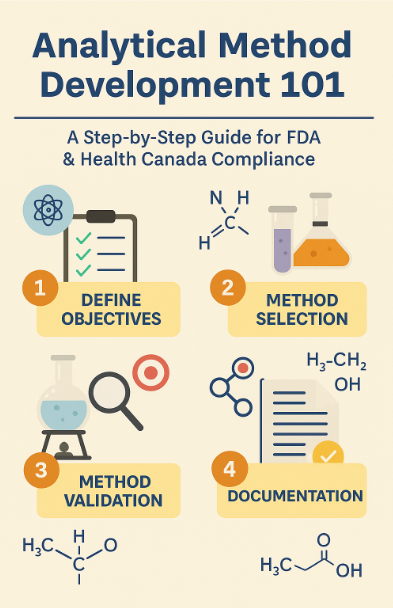
Introduction: Why Analytical Method Development Matters for FDA & Health Canada
Analytical method development is one of the most important steps in drug development and regulatory filing. Whether you’re submitting your application to the FDA in the United States or Health Canada, your analytical methods must be accurate, reliable, and validated. These methods confirm the quality, identity, strength, and purity of your pharmaceutical product.
At ResolveMass Laboratories Inc., we specialize in Analytical Method Development in Montreal, Canada and United States (US) for both small molecules and biologics. Our team supports pharmaceutical and biotech companies with method design, validation, transfer, and documentation that meet ICH and regulatory standards.
👉 Explore Analytical Method Development Services
What Is Analytical Method Development?
Analytical method development is the process of designing lab-based tests that can accurately measure key properties of a drug substance or drug product. These include:
- Assay (active ingredient content)
- Impurity profiling
- Dissolution testing
- Identification and quantification
- Content uniformity
Once the method is developed, it must be validated to ensure it works consistently across different labs and instruments. This process is critical for FDA and Health Canada approval.
Step-by-Step Guide to Analytical Method Development
Step 1: Understanding the Drug Profile
The first step is to understand the nature of the drug, its solubility, stability, pKa, and chemical behavior. Knowing this helps determine the analytical technique to use—like HPLC, GC, LC-MS, UV, or NMR.
Step 2: Selecting the Right Technique
Depending on the target analyte, we choose the most suitable method:
- HPLC for quantifying active pharmaceutical ingredients
- LC-MS for detecting low-level impurities or degradation products
- UV-spectroscopy for simpler formulations
- NMR for structure confirmation (Check our NMR Services)
Step 3: Method Development and Optimization
In this phase, we work on:
- Mobile phase and solvent selection
- Column type and particle size
- Detector settings and wavelengths
- Flow rate and run time
We optimize all variables to get sharp, reproducible peaks and accurate results.
Step 4: Method Validation
Validation is done according to ICH Q2(R1) and includes the following parameters:
- Accuracy
- Precision
- Specificity
- Linearity
- Range
- Limit of Detection (LOD)
- Limit of Quantitation (LOQ)
- Robustness
We provide full validation reports ready for submission to FDA or Health Canada.
Step 5: Method Transfer or Verification
If the method is developed at ResolveMass, we help transfer it to your QC lab or manufacturing partner. We also perform verification if the method is adopted from literature or pharmacopeial sources.
📍 We specialize in Analytical Method Development in Montreal, Canada and United States (US), offering complete support from development to regulatory documentation.
Why Regulatory Authorities Care So Much
FDA and Health Canada want proof that your methods are reliable and reproducible. Poor analytical methods can lead to:
- Rejected filings (ANDA/NDA)
- Data deficiency letters
- Delays in approval
With ResolveMass, your methods are:
- Designed by experts
- Aligned with ICH and regulatory guidelines
- Backed by validated data
Case Study: Method Development for a Nasal Spray ANDA Submission
Client: Canadian generic company
Goal: Develop a stability-indicating HPLC method for a steroidal nasal spray formulation
Method Used:
- Reversed-phase HPLC
- UV detection at 254 nm
- Gradient elution with acetonitrile and buffer
Validation Highlights:
- Linearity: r² = 0.9992 (0.5–150 µg/mL)
- Precision: RSD < 1.5%
- LOD: 0.15 µg/mL
Outcome:
- Full method report submitted in ANDA
- Accepted by FDA with zero deficiencies
- Method transferred successfully to client’s in-house QC lab
Common Challenges We Help You Solve
- Mixed peak separation
- Less sensitivity in impurity detection
- Matrix interference
- Data reproducibility issues
With 10+ years of method development experience, ResolveMass ensures your methods are robust and regulatory ready
Conclusion
Analytical method development is not just a technical task—it is the foundation of your regulatory success. ResolveMass Laboratories provides expert-level Analytical Method Development in Montreal Canada and United States (US) with full regulatory alignment and technical reliability. Whether you’re developing methods for a new IND, ANDA, or Health Canada CTA, we make sure you’re submission-ready.
✅ Submit your method development inquiry
✅ Schedule a discovery call with our scientists
✅ Start your project with our analytical chemistry lab
Need expert support for your FDA or Health Canada filing? ResolveMass Laboratories Inc. is here to help with expert-level Analytical Method Development in Montreal, Canada and United States (US). Contact our team today via our contact form, or call us directly for consultation. We typically respond within 24 hours.
📍 Location: Montreal, Quebec, Canada
📧 Email: info@resolvemass.ca
🌐 Contact Page: https://resolvemass.ca/contact/
✅ References
- ICH Q2(R1) – Validation of Analytical Procedures: Text and Methodology. https://www.ich.org/page/quality-guidelines
- FDA Guidance: Analytical Procedures and Methods Validation for Drugs and Biologics. https://www.fda.gov/media/87801/download
- Health Canada: Guidance for Industry – Quality (Chemistry and Manufacturing) Guidance: New Drug Submissions. https://www.canada.ca/en/health-canada/services/drugs-health-products/drug-products/applications-submissions/guidance-documents.html
Cross-Border Drug Development: One Testing Lab for Both FDA and Health Canada Submissions
Introduction: Sponsors developing a drug for the North American market almost always end up filing…
Disulfide Bond Mapping Service for Biosimilars: LC-MS Approaches and Regulatory Compliance
Introduction Establishing structural equivalence through a specialized Disulfide Bond Mapping Service for Biosimilars is critical…

Peptide API Scale-Up: From Milligram Discovery Batches to Kilogram GMP Production
Introduction Peptide API Scale-Up requires translating laboratory solid-phase synthesis into scalable, robust, and compliant current…
Immunogenicity of Peptide-Oligonucleotide Conjugates: Risk Factors, Assessment, and Mitigation Strategies
Introduction The immunogenicity of peptide-oligonucleotide conjugates is a multifaceted biological phenomenon resulting from the synergistic…
Elemental Impurities (ICH Q3D) and Residual Solvents (ICH Q3C) Testing for Synthetic Peptide APIs
Introduction: Elemental Impurities and Residual Solvents Testing for Synthetic Peptide APIs has become one of…
Peptide Drug Formulation Challenges: Lyophilization, Prefilled Syringes, and Injectable Stability
Introduction Peptide drug formulation challenges encompass the complex chemical and physical degradation risks that biological…


