

Introduction
Analytical Method Transfer Between CDMO Sites is a formal and documented process used to qualify a receiving Contract Development and Manufacturing Organization (CDMO) laboratory to perform an established and validated test procedure with comparable accuracy, precision, and reliability. Primarily governed by United States Pharmacopeia (USP) General Chapter Transfer of Analytical Procedures, this technical transition ensures that the critical quality attributes (CQAs) of drug substances and drug products remain under stringent control when analytical testing activities are moved between facilities within global supply chains.
As biopharmaceutical sponsors expand their global manufacturing networks, establish commercial dual-sourcing strategies, or move development programs from one contract partner to another, preserving analytical method performance becomes critical. Minor differences in analytical instrumentation, local ambient humidity, stationary phase column chemistry lots, or analyst sample preparation practices may create systematic bias or unexpected variability. A structured transfer framework based on Quality by Design (QbD) principles and appropriate statistical evaluation helps minimize the risk of batch release delays, Out-of-Specification (OOS) investigations, and regulatory non-compliance.
Explore peptide analytical testing capabilities for method development, characterization, and quality assessment.
Learn more about Peptide Analytical Testing Services
Share via:
Quick Summary:
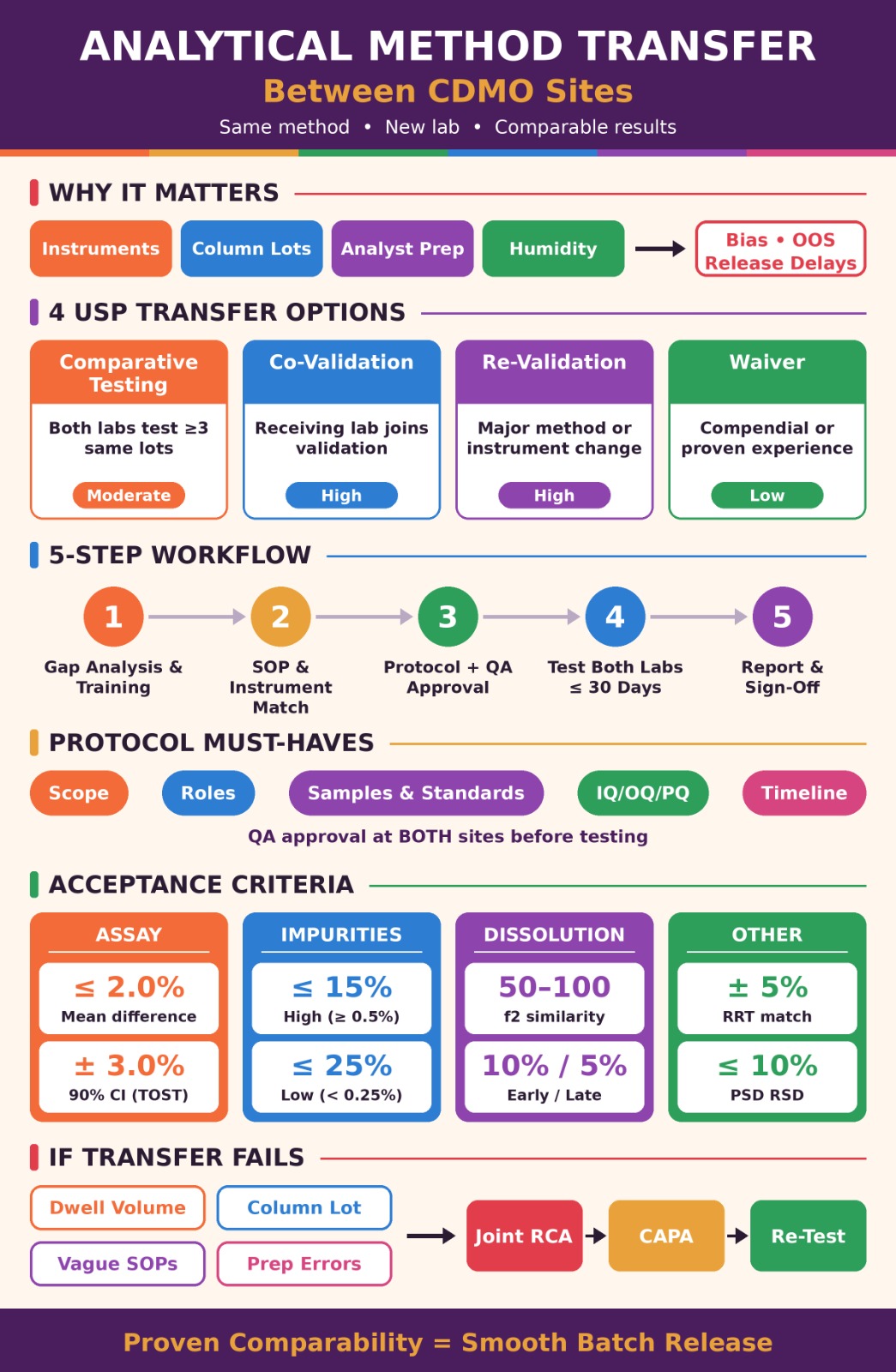
- What it is: a formal, documented process that qualifies a receiving CDMO lab to run an already-validated method. The receiving lab must match the original lab’s accuracy, precision and reliability. It is governed mainly by USP <1224>.
- Why it matters: small differences between sites can cause bias, OOS results, batch release delays and compliance problems. Examples are instruments, column lots, humidity and how analysts prepare samples.
- Four USP transfer options:
- Comparative testing: both labs test at least 3 identical lots.
- Co-validation: the receiving lab takes part in the original validation.
- Re-validation: used for major method or instrument changes.
- Transfer waiver: used for compendial methods, proven prior experience, or relocated staff, backed by a risk-based justification.
- The protocol comes first: QA at both sites must approve it before testing, as cGMP requires. It defines the scope, roles, sample and standard handling, IQ/OQ/PQ status, and a testing window of no more than 30 days.
- Five-step workflow: gap analysis and training, then SOP and instrument alignment, then protocol approval, then parallel testing, then the final report and sign-off.
- Acceptance criteria are predefined and statistical:
- Assay: mean difference ≤2.0%, and the TOST 90% CI within ±3.0%.
- Impurities: ≤15% relative difference for high levels and ≤20–25% for low levels.
- Retention: RRT within ±5%.
- Dissolution: f2 between 50 and 100.
- Particle size: PSD RSD ≤10%.
- Handling failures: a joint investigation looks for root causes such as dwell volume differences, column lot variation, vague SOPs or sample prep errors. This is followed by CAPA, re-testing under an approved protocol amendment, and full documentation for the audit trail.
Regulatory Framework and USP Transfer Options
USP General Chapter Transfer of Analytical Procedures describes four recognized mechanisms for transferring analytical procedures between laboratories: Comparative Testing, Co-Validation, Re-Validation, and Transfer Waivers. Choosing the appropriate transfer pathway requires a risk-based assessment that considers method complexity, drug product matrix risk, regulatory filing stage, and the receiving unit’s previous technical experience with the applicable analytical procedure.
Comparative Testing Approach in Analytical Method Transfer Between CDMO Sites
Comparative testing involves both the transferring unit (TU) and receiving unit (RU) analyzing homogeneous samples obtained from identical product lots according to predefined statistical acceptance criteria. This approach is commonly used to transfer validated analytical methods between independent operating facilities while demonstrating that the receiving laboratory can generate results comparable to those produced by the transferring laboratory.
Comparative studies generally involve the analysis of at least three independent and homogeneous sample lots. These lots should represent target commercial specifications or may contain samples spiked with known impurity levels to assess linearity, accuracy, and recovery across the intended operational range. Replicate preparations performed at both testing sites provide sufficient statistical information to assess inter-laboratory variability and establish analytical comparability.
Need support for impurity characterization and analytical control during method transfer?
Explore Impurity Control Strategies Under ICH Q3A
Co-Validation and Re-Validation Paradigms
Co-validation involves the receiving unit directly participating in the primary method validation study together with the transferring unit. By including receiving unit analysts in the assessment of intermediate precision parameters, including inter-analyst, day-to-day, and inter-laboratory variability, the receiving facility can be qualified when the validation study is completed in accordance with ICH Q2(R2) guidelines.
Re-validation is appropriate when substantial modifications are introduced to the analytical method during the transfer process or when the receiving facility uses significantly different instrument platforms. Depending on the extent and impact of the operational changes, the receiving unit may perform either a full or partial validation protocol to independently establish the suitability of the analytical procedure.
Science-Based Justification for Transfer Waivers
A transfer waiver represents a formally documented decision to omit experimental transfer testing based on a comprehensive technical risk assessment. Regulatory acceptance of a waiver requires adequate justification demonstrating that the receiving unit has extensive prior experience with identical matrices or compendial methods, or that qualified transferring personnel are physically relocated to the receiving facility.
When compendial pharmacopeial monographs (USP/EP/JP) are implemented without modification, a transfer waiver may be justified when appropriate. In such cases, the receiving laboratory performs a verification study in accordance with USP Verification of Compendial Procedures rather than conducting a complete comparative transfer. Post-approval change management protocols (PACMPs) established under ICH Q12 may also define pre-approved waiver strategies for analytical operations considered to present low transfer risk.
| Transfer Mechanism | Primary Application | Key Protocol Requirements | Resource Intensity |
|---|---|---|---|
| Comparative Testing | Standard transfer of established, validated methods between commercial sites. | Pre-approved protocol, homogeneous lot analysis (≥ 3 lots), and statistical equivalence criteria. | Moderate |
| Co-Validation | Early-stage development or pre-planned multi-site commercial launches. | Joint validation protocol assessing inter-laboratory intermediate precision per ICH Q2(R2). | High (Upfront) |
| Re-Validation | Major platform changes, hardware shifts, or procedure modifications. | Partial or full validation study executed independently at the receiving site. | High |
| Transfer Waiver | Compendial procedures, identical matrix experience, or personnel relocation. | Detailed technical justification, risk assessment, and verification under USP Verification of Compendial Procedures. | Low |
Protocol Architecture and Master Transfer Plan
An Analytical Method Transfer Protocol is a formally established quality document that defines the experimental design, operational responsibilities, and predetermined pass/fail criteria before analytical testing begins. Prior approval of the protocol by Quality Assurance (QA) units at both the transferring and receiving sites is an essential cGMP requirement under 21 CFR Part 211.
Learn more about CMC documentation requirements for ANDA programs.
Explore CMC Documentation at a CDMO for ANDA
Core Structural Requirements
- Objective and Technical Scope: Defines the specific analytical test methods, such as assay, related substances, dissolution, and residual solvents, together with the target drug product formulations included in the transfer.
- Roles and Responsibilities: Clearly establishes the responsibilities of each participating unit. The transferring unit provides validated standard operating procedures (SOPs), reference standards, and technical training, while the receiving unit provides qualified instruments, calibrated systems, and appropriately trained analysts.
- Sample and Reference Standard Management: Specifies sample lot numbers, batch histories, storage requirements, and precautions related to light and moisture sensitivity to maintain sample integrity during transportation between facilities.
- Instrument Qualification and Calibration: Requires all equipment used at the receiving facility, including HPLC/UHPLC systems, dissolution baths, and spectrophotometers, to have active Installation/Operational/Performance Qualifications (IQ/OQ/PQ) and current calibration records.
- Execution Timelines: Establishes defined testing windows and requires comparative analysis at both laboratories to be completed within a maximum of 30 working days to reduce potential risks associated with sample degradation.
Operational Transfer Execution Workflow
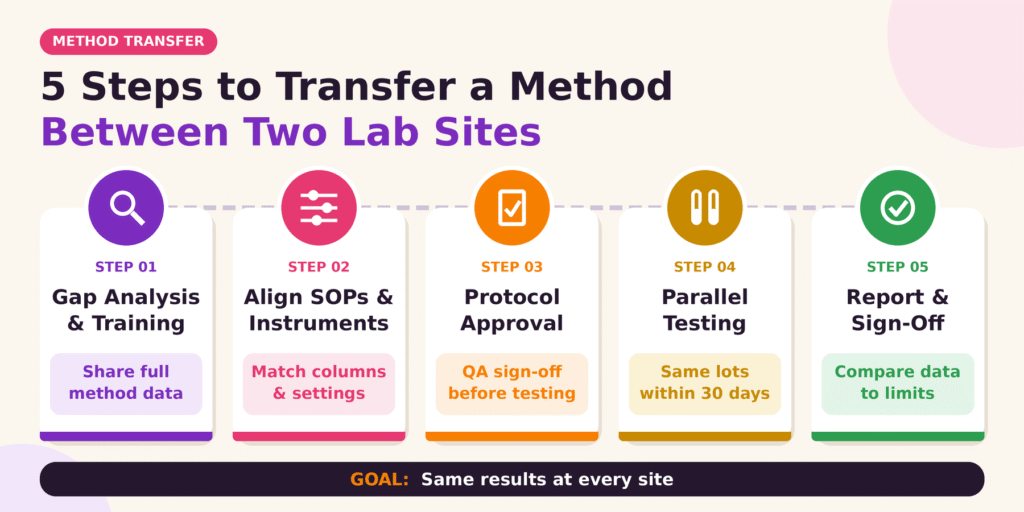
The technical lifecycle of an analytical method transfer consists of five sequential phases designed to control analytical variability and reduce operational delays:
- Pre-Transfer Gap Analysis and Technical Training: The transferring unit provides a complete analytical package containing validation reports, historical system suitability data, and relevant potential failure mode analyses. Technical training sessions are conducted either virtually or through on-site analyst exchanges to ensure consistency in manual sample preparation practices.
- SOP Harmonization and Instrument Alignment: The receiving unit prepares local SOPs that correspond to the master analytical method. Technical teams assess equipment equivalency, including column dimensions, detector settings, and system dwell volumes.
- Protocol Authoring and Quality Approval: Key stakeholders prepare and approve the transfer protocol before execution. The protocol specifies sample quantities, replicate strategies, statistical acceptance limits, and other critical testing requirements.
- Experimental Testing Execution: Both laboratories perform sample testing concurrently or within the approved 30-day window using qualified reference standards and identical batch lots.
- Data Evaluation, Report Generation, and Sign-Off: The receiving unit compiles the generated raw data, evaluates statistical parameters against the predefined protocol limits, investigates minor anomalies, and prepares a final Method Transfer Report documenting and certifying laboratory qualification.
Statistical Acceptance Criteria for Analytical Method Transfer Between CDMO Sites
Statistical acceptance criteria for analytical method transfer establish quantitative limits for the bias and variability that can be permitted between transferring and receiving testing facilities. These limits should be scientifically justified using historical validation data, process capability metrics, and the critical quality attribute (CQA) specifications applicable to the drug product.
Assay and Active Ingredient Content Uniformity
For quantitative drug substance and drug product content assays, acceptance criteria assess both accuracy, represented by mean agreement, and precision, represented by variability, between the transferring and receiving sites.
- Absolute Mean Difference (ΔX̄): The absolute difference between the mean assay result generated by the transferring unit (X̄TU) and the receiving unit (X̄RU) typically should not exceed 1.5% to 2.0%.
ΔX̄ = |X̄RU − X̄TU| ≤ 2.0%
- Pooled Relative Standard Deviation (RSDpooled): Combines repeatability data from both testing sites to determine whether total intermediate precision remains within acceptable operational limits:
SDpooled = √[((nTU − 1)sTU2 + (nRU − 1)sRU2) / (nTU + nRU − 2)]
- Equivalence Testing via Two One-Sided Tests (TOST): Advanced comparative transfers may use TOST to demonstrate that the 90% confidence interval for the difference between site means remains entirely within predefined equivalence limits (−θ, +θ), which are typically established at ±3.0% for finished dosage assays.
Impurity Profiling and Residual Solvents
Acceptance criteria for chromatographic impurity methods must account for the greater relative variability that can occur at low analyte concentrations. Data assessment is generally limited to impurities detected above the limit of quantitation (LOQ) or 0.10% w/w.
- High-Level Impurities (≥ 0.5% w/w): The mean relative difference between the two sites should not exceed ±15%, with a combined RSD ≤ 10%.
- Low-Level Impurities (< 0.10% to 0.25% w/w): The mean relative difference between sites should generally remain within ±20% to ±25%.
- Qualitative Chromatographic Alignment: The receiving unit should reproduce the elution profile, reporting threshold, and relative retention times observed by the transferring unit, with RRT maintained within ±5%, thereby supporting consistent specified impurity identification.
For peptide programs, assess potential nitrosamine risks as part of broader impurity and analytical control strategies.
Explore Nitrosamine Risk Assessment for Peptide APIs
Dissolution Profile Comparison
Dissolution method transfers assess release kinetics at multiple time points and use mathematical profile comparison techniques to evaluate similarity between the results generated at the two laboratories.
- f2 Similarity Factor: The calculated f2 factor comparing the mean dissolution curves generated by the transferring and receiving units should fall between 50 and 100.
- Stage-Wise Absolute Mean Difference: At early time points, defined as less than 50% dissolved or less than 85% dissolved, absolute mean differences should not exceed 10%. At later time points, where more than 85% is dissolved, absolute mean differences should not exceed 5%.
| Test Category | Parameter / Metric | Predefined Acceptance Criteria | Statistical Method / Basis |
|---|---|---|---|
| Finished Product Assay | Mean Bias (ΔX̄) | ≤ 1.5% to 2.0% Absolute Difference of Site Means | Difference of Site Means |
| Finished Product Assay | Inter-Lab Precision | Pooled RSD ≤ 2.0%; 90% CI within ±3.0% | Two One-Sided Tests (TOST) |
| High Impurities (≥ 0.5%) | Mean Relative Bias | ≤ 15% Relative Difference | Relative Mean Comparison |
| Low Impurities (< 0.25%) | Mean Relative Bias | ≤ 20% to 25% Relative Difference | Relative Mean Comparison |
| Dissolution Testing | Curve Equivalence | f2 Similarity Factor between 50 and 100 | Model-Independent Fit Factor |
| Dissolution Testing | Stage-Wise Difference | ≤ 10% (Early Points); ≤ 5% (Late Points) | Absolute Mean Difference |
| Particle Size Distribution | Median Size D(v, 0.5) | RSD ≤ 10% overall between laboratories | Inter-Laboratory Precision |
Root Cause Analysis and Investigation Protocols for Transfer Failures
Analytical method transfer failures initiate mandatory inter-site Out-of-Specification (OOS) and deviation investigations intended to identify systemic, environmental, or operational root causes. Resolving analytical transfer anomalies requires a structured diagnostic approach that distinguishes analyst-related errors from inherent differences between instrument platforms.
Instrumental and Hardware Discrepancies
Differences in chromatographic results may frequently originate from physical variations in liquid chromatography pump design. Differences in gradient delay volume (dwell volume) between low-pressure mixing and high-pressure mixing LC systems can produce retention time shifts and changes in peak resolution, particularly for closely eluting impurities. Contemporary transfer protocols address dwell volume differences by defining gradient delay compensation adjustments or specifying exact instrument model families.
Variations between column chemistry lots can also contribute to analytical transfer failures. Differences in residual silanol activity, carbon loading, or end-capping density among column manufacturing batches may alter stationary phase selectivity. Consequently, method transfer protocols should identify column part numbers, inner diameters, and acceptable batch ranges to maintain consistency.
Operational and Procedural Disparities
Ambiguities within standard operating procedures are an important source of inter-laboratory bias. Poorly defined sample preparation instructions, such as using the phrase “shake vigorously” without specifying shaker speed and duration for a volumetric flask, may introduce extraction variability. Filter paper membrane binding, errors in pH meter temperature compensation, and evaporation of organic components from mobile phases during sonication may likewise introduce systematic analytical errors.
Review analytical considerations associated with sterile fill-finish operations for peptide injectables.
Explore Sterile Fill-Finish Services for Peptide Injectables
Failure Resolution and CAPA Execution
When comparative testing does not meet predefined acceptance criteria, a joint investigation team consisting of quality assurance and analytical specialists from both CDMO sites should conduct a formal root cause analysis. The investigation should examine raw data, instrument integration parameters, baseline stability, reagent lot numbers, and other relevant analytical variables.
When the investigation establishes that an isolated analyst error or instrument malfunction occurred at the receiving site, the initial test set may be invalidated when supported by documented scientific justification. Corrective and Preventive Actions (CAPA), such as improving SOP instructions or re-calibrating instruments, should then be implemented, followed by re-testing under a formally approved protocol amendment. All invalid data, chromatograms, and failure investigations should be retained with the final Method Transfer Report to ensure a complete cGMP audit trail.
Learn more about analytical assessment of extractables and leachables for peptide injectable products.
Explore Extractables and Leachables Testing for Peptide Injectables
Conclusion
Successful Analytical Method Transfer Between CDMO Sites depends on the integration of robust USP Transfer of Analytical Procedures protocol design, scientifically justified statistical acceptance criteria, and effective technical communication between participating laboratories. Establishing documented analytical comparability supports batch release continuity, helps protect patient safety, and reduces regulatory compliance risks across multi-site manufacturing networks.
Explore GMP manufacturing support for peptide APIs and associated quality requirements.
Learn more about GMP Peptide API Manufacturing Services
ResolveMass Laboratories Inc. provides analytical development, validation, and multi-site transfer services designed to support complex pharmaceutical and biopharmaceutical development programs. To consult with technical specialists or discuss customized method transfer protocols, contact the team directly through ResolveMass Contact Us.
Frequently Asked Questions (FAQs)
Analytical method validation, as described under ICH Q2(R2), establishes that an analytical procedure is suitable for its intended purpose by assessing characteristics such as linearity, accuracy, and specificity. Analytical method transfer, in contrast, determines whether a receiving laboratory can successfully perform an already validated procedure. The focus is on demonstrating comparable accuracy, precision, and procedural performance between laboratories.
Comparative testing is generally appropriate when an established and validated analytical method is being moved to another facility for activities such as routine commercial release or stability testing. It is particularly applicable when both laboratories can analyze homogeneous sample lots under predefined conditions. Statistical comparison is then used to demonstrate comparability between the transferring unit and receiving unit.
Two One-Sided Tests (TOST) is a statistical approach used to determine whether the difference between results from the transferring unit and receiving unit remains within predefined equivalence limits. Rather than simply assessing whether a statistically significant difference exists, TOST evaluates whether the observed difference is sufficiently small to meet the established equivalence criteria.
A transfer waiver may be considered when the receiving laboratory has established experience performing the same analytical procedure on an identical or comparable product matrix. It may also apply when qualified personnel from the transferring site relocate to the receiving facility. Unmodified compendial pharmacopeial procedures may also support a waiver when appropriate verification requirements are fulfilled.
Acceptance criteria for low-level impurities should account for the increased relative variability associated with measurements near the reporting threshold and limit of quantitation (LOQ). Therefore, wider relative acceptance limits may be scientifically justified at very low impurity concentrations. The criteria should be established using method performance data, validation history, and the applicable specification levels.
Comparative sample testing between the transferring and receiving facilities should ideally be completed within 30 working days. Maintaining a defined testing window helps limit the effects of sample aging, environmental degradation, and changes in reagent or material lots. A controlled timeline therefore supports the reliability of inter-laboratory comparisons.
When predefined transfer acceptance criteria are not met, the participating CDMO quality units should initiate a documented investigation and root cause analysis. The assessment should examine analytical data, instruments, reagents, sample preparation, and other potential sources of variability. Any subsequent re-testing should be performed under an appropriately approved protocol amendment with documented corrective and preventive actions (CAPA), when required.
Co-validation allows the receiving laboratory to participate in the primary analytical method validation study from the beginning. This approach enables inter-laboratory intermediate precision and other relevant performance characteristics to be assessed during the same validation exercise. As a result, the receiving site can be qualified as part of the overall method validation process.
Gradient delay volume, also known as dwell volume, determines how long a mobile phase gradient takes to travel from the mixing point to the column inlet. Differences between HPLC pump configurations can therefore cause retention time shifts and changes in chromatographic selectivity. Addressing dwell volume differences during transfer helps maintain comparable chromatographic performance between CDMO laboratories.
Reference:
- Weusten, J., Kim, J. Y., Giacoletti, K., Vázquez, J., & De los Santos, P. (2024). A Bayesian approach for evaluating equivalence over multiple groups, and comparison with frequentist TOST. Journal of Applied Statistics, 51(12), 2382–2401. https://doi.org/10.1080/02664763.2023.2297150
- Zhong, J., Lee, K., & Tsong, Y. (2008). Statistical assessment of analytical method transfer. Journal of Biopharmaceutical Statistics, 18(5), 1005–1012. https://doi.org/10.1080/10543400802287347
- Kurata, H., Ishino, T., Ohshima, Y., & Yohda, M. (2022). CDMOs play a critical role in the biopharmaceutical ecosystem. Frontiers in Bioengineering and Biotechnology, 10, 841420. https://doi.org/10.3389/fbioe.2022.841420
- Zhang, L. (2024). The effects of transforming the CDMO strategy on the business performance of Porton based on financial statement analysis. In Proceedings of the 7th International Conference on Economic Management and Green Development (pp. 224–234). Springer. https://doi.org/10.1007/978-981-97-0523-8_20
Get In Touch With Us
About The Author


