

Introduction:
Analytical Strategies for Sameness Study are fundamental in demonstrating that a generic drug is equivalent to its Reference Listed Drug (RLD). Regulatory agencies require strong analytical evidence to confirm that both products share the same identity, purity, and performance characteristics. For a deeper regulatory perspective, explore peptide sameness study for ANDA.
In modern pharmaceutical development, especially for complex molecules and peptide-based APIs, proving sameness demands a multi-dimensional analytical approach supported by high-resolution instrumentation and regulatory expertise. Learn more about sameness evaluation in ANDA and active ingredient sameness in ANDA.
Summary:
- Sameness between generic drugs and RLD is proven through comprehensive analytical comparison
- Analytical Strategies for Sameness Study rely on structural, physicochemical, and impurity evaluation
- Orthogonal techniques ensure high confidence in results
- Regulatory success depends on data integrity and scientific justification
- Advanced tools like LC-MS, HRMS, and NMR are essential
Watch the Full Video on “Why FDA Rejects Complex Generics: 5 API Sameness Deficiencies“
1: What Are Analytical Strategies to Prove Sameness Between Generic and RLD?
Analytical strategies to prove sameness between a generic drug and its Reference Listed Drug (RLD) are structured, science-driven approaches used to demonstrate equivalence across all critical quality attributes (CQAs). These strategies rely on advanced analytical techniques and comparative data to establish that both products are fundamentally the same in terms of quality, safety, and performance.
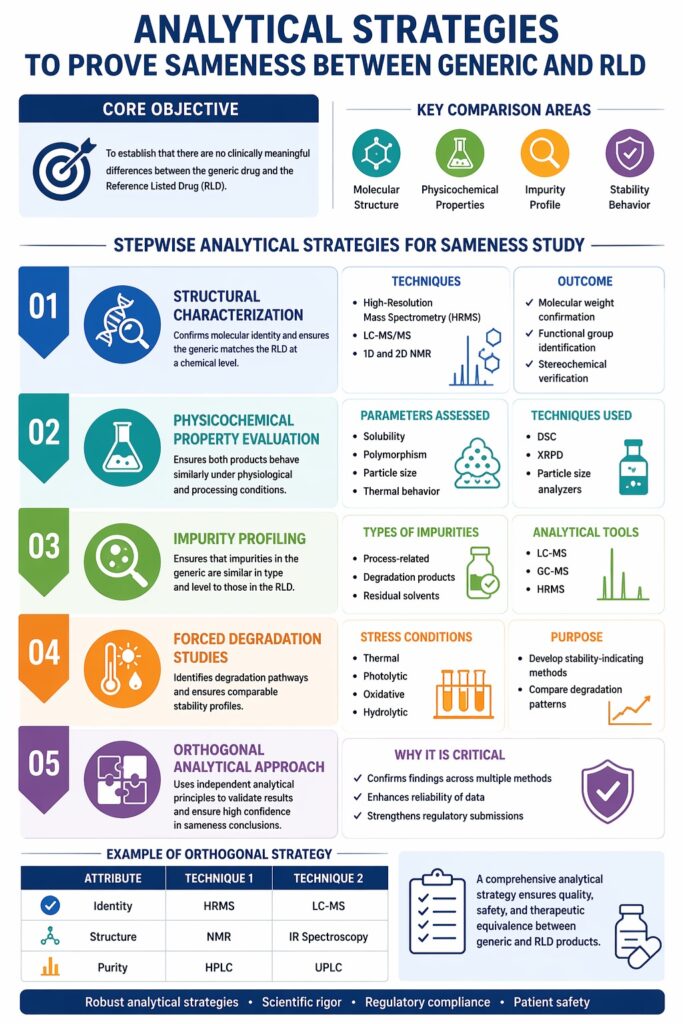
Core Objective
The primary goal is to confirm that there are no clinically meaningful differences between the generic product and the RLD. This ensures that the generic will perform identically in patients, meeting regulatory expectations for approval under ANDA pathways.
Key Comparison Areas
To establish sameness, a comprehensive evaluation is performed across multiple dimensions:
- Molecular Structure
Verification of chemical identity, including molecular weight, stereochemistry, and sequence (for peptides) - Physicochemical Properties
Assessment of solubility, polymorphic form, particle size, pKa, and thermal behavior - Impurity Profile
Identification and quantification of process-related impurities, degradation products, and residual solvents - Stability Behavior
Comparison of degradation pathways and stability under various stress conditions
2: Stepwise Analytical Strategies for Sameness Study
A well-defined, stepwise approach is essential for successfully implementing Analytical Strategies for Sameness Study. Each step is designed to evaluate critical quality attributes (CQAs) using scientifically robust and regulatory-accepted methodologies.
2.1 Structural Characterization
Structural characterization confirms that the generic API is chemically identical to the RLD at the molecular level. It forms the foundation of any sameness assessment.
Techniques
- High-Resolution Mass Spectrometry (HRMS)
- LC-MS/MS
- 1D and 2D NMR (e.g., COSY, HSQC, HMBC)
Outcome
- Molecular weight confirmation
- Functional group identification
- Stereochemical and conformational verification
2.2 Physicochemical Property Evaluation
Physicochemical comparison ensures that the generic and RLD exhibit similar behavior under physiological and manufacturing conditions.
Parameters Assessed
- Solubility and dissolution characteristics
- Polymorphic form and crystallinity
- Particle size distribution
- Thermal properties
Techniques Used
- Differential Scanning Calorimetry (DSC)
- X-ray Powder Diffraction (XRPD)
- Laser diffraction / particle size analyzers
2.3 Impurity Profiling
Impurity profiling ensures that the type, level, and nature of impurities in the generic product are comparable to the RLD. This is critical for safety and regulatory compliance.
For peptide-based drugs, see peptide sameness study deficiencies.
Types of Impurities
- Process-related impurities
- Degradation products
- Residual solvents
Analytical Tools
- LC-MS
- GC-MS
- High-Resolution Mass Spectrometry (HRMS)
2.4 Forced Degradation Studies
Forced degradation studies evaluate the stability profile and degradation pathways of both the generic and RLD under stress conditions.
Stress Conditions
- Thermal stress
- Photolytic exposure
- Oxidative conditions
- Hydrolytic environments
Purpose
- Development of stability-indicating analytical methods
- Identification of degradation products
- Comparative assessment of degradation pathways
2.5 Orthogonal Analytical Approach
An orthogonal approach uses multiple independent analytical techniques to confirm results, ensuring high confidence in sameness conclusions.
Why It Is Critical
- Confirms findings across different scientific principles
- Minimizes analytical bias
- Enhances reliability and reproducibility
- Strengthens regulatory submissions
Example of Orthogonal Strategy
| Attribute | Technique 1 | Technique 2 |
|---|---|---|
| Identity | HRMS | LC-MS |
| Structure | NMR | IR Spectroscopy |
| Purity | HPLC | UPLC |
3: Advanced Analytical Techniques in Sameness Studies
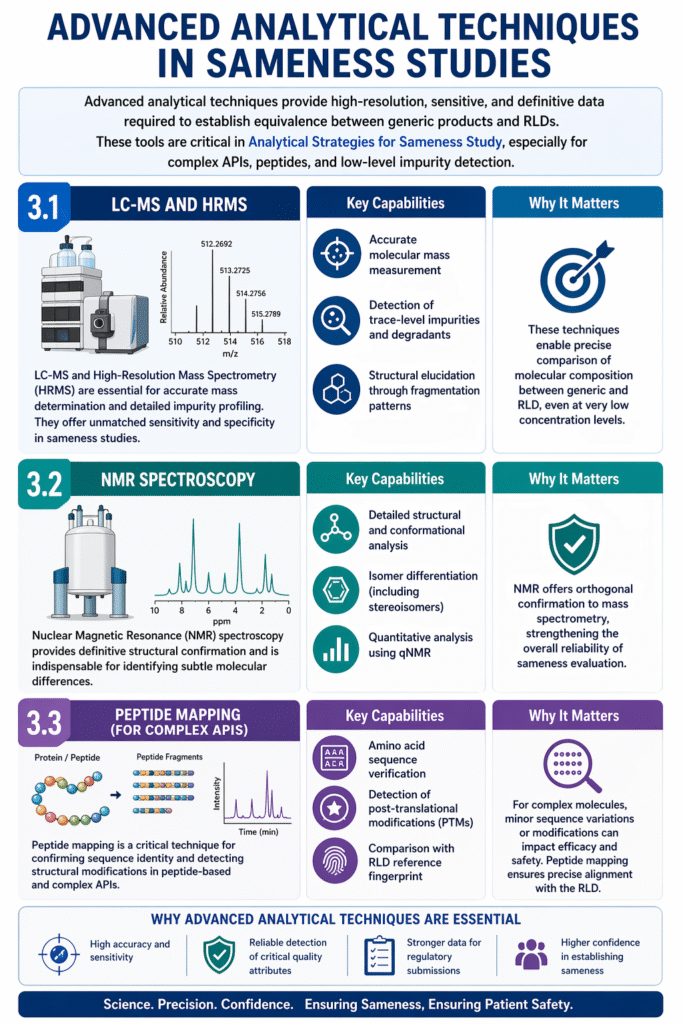
Advanced analytical techniques provide high-resolution, sensitive, and definitive data required to establish equivalence between generic products and RLDs. These tools are critical in Analytical Strategies for Sameness Study, especially for complex APIs, peptides, and low-level impurity detection.
For regulatory alignment, refer to FDA peptide sameness study requirements.
3.1 LC-MS and HRMS
LC-MS and High-Resolution Mass Spectrometry (HRMS) are essential for accurate mass determination and detailed impurity profiling. They offer unmatched sensitivity and specificity in sameness studies.
Key Capabilities
- Accurate molecular mass measurement
- Detection of trace-level impurities and degradants
- Structural elucidation through fragmentation patterns
Why It Matters
These techniques enable precise comparison of molecular composition between generic and RLD, even at very low concentration levels.
3.2 NMR Spectroscopy
Nuclear Magnetic Resonance (NMR) spectroscopy provides definitive structural confirmation and is indispensable for identifying subtle molecular differences.
Key Capabilities
- Detailed structural and conformational analysis
- Isomer differentiation (including stereoisomers)
- Quantitative analysis using qNMR
Why It Matters
NMR offers orthogonal confirmation to mass spectrometry, strengthening the overall reliability of sameness evaluation.
3.3 Peptide Mapping (For Complex APIs)
Peptide mapping is a critical technique for confirming sequence identity and detecting structural modifications in peptide-based and complex APIs.
Explore real-world applications:
ANDA-focused examples:
- https://resolvemass.ca/liraglutide-sameness-study-for-anda-submission/
- https://resolvemass.ca/octreotide-sameness-study-for-anda-submission/
Key Capabilities
- Amino acid sequence verification
- Detection of post-translational modifications (PTMs)
- Comparison with RLD reference fingerprint
Why It Matters
For complex molecules, minor sequence variations or modifications can impact efficacy and safety. Peptide mapping ensures precise alignment with the RLD.
4: Challenges in Proving Sameness
Proving sameness between a generic drug and its Reference Listed Drug (RLD) is scientifically complex and often constrained by analytical and practical limitations. Addressing these challenges effectively is critical for the success of any Analytical Strategies for Sameness Study.
To overcome these, specialized services are often required:
Common Challenges
Several technical and regulatory hurdles can impact the accuracy and completeness of sameness evaluation:
- Limited Availability of RLD Samples
Access to sufficient quantities of RLD API for comprehensive analysis can be restricted, limiting comparative studies. - Detection of Trace-Level Impurities
Impurities present at very low concentrations require highly sensitive instrumentation and advanced detection techniques. - Complexity of Peptide and Synthetic APIs
Structural complexity, including sequence variability and higher-order structures, makes characterization more challenging. - Isomer Differentiation
Differentiating between stereoisomers or positional isomers is difficult but essential, as even minor variations can impact efficacy and safety.
Mitigation Strategies
A robust analytical framework combined with advanced technologies can effectively overcome these challenges.
- Use High-Resolution Instrumentation
Employ techniques such as HRMS and advanced NMR for accurate and sensitive analysis. - Develop Highly Sensitive and Selective Methods
Optimize analytical methods to detect and quantify trace-level impurities with high specificity. - Perform Forced Degradation Studies
Generate and identify potential degradation products to better understand impurity profiles and stability. - Apply Orthogonal Analytical Techniques
Use multiple independent methods to confirm findings and ensure reliability of results.
5: Regulatory Expectations
Regulatory authorities require robust, reproducible, and scientifically justified analytical data to demonstrate sameness between generic drugs and Reference Listed Drugs (RLDs). Compliance with these expectations is essential for successful ANDA approval and is a critical component of Analytical Strategies for Sameness Study.
Key Requirements
To meet regulatory standards, the following elements must be thoroughly addressed:
- Validated Analytical Methods
All analytical procedures must be fully validated as per ICH guidelines to ensure accuracy, precision, specificity, sensitivity, and reproducibility. - Comprehensive Impurity Profiling
Detailed identification, qualification, and quantification of impurities must be performed, including process-related impurities and degradation products. - Justification of Any Observed Differences
Any deviations between the generic and RLD must be scientifically justified with supporting data and risk assessment demonstrating no impact on safety or efficacy. - Full Documentation and Data Integrity
Complete, transparent, and traceable documentation is required, ensuring compliance with regulatory standards such as ALCOA+ principles (Attributable, Legible, Contemporaneous, Original, Accurate).
Regulatory Perspective
Regulators focus not only on the analytical results but also on the scientific rationale, consistency of data, and overall risk assessment strategy. A well-documented and methodologically sound approach significantly increases the likelihood of approval.
6: Best Practices for Analytical Strategies for Sameness Study
Implementing best practices ensures that Analytical Strategies for Sameness Study are scientifically robust, regulatory-compliant, and capable of withstanding stringent review. A disciplined and well-structured approach significantly improves the success rate of demonstrating equivalence between generic products and RLDs.
Key Best Practices
- Adopt a Risk-Based Approach Focusing on Critical Quality Attributes (CQAs)
Prioritize attributes that directly impact product safety, efficacy, and performance, ensuring efficient allocation of analytical resources. - Use Orthogonal Techniques for Confirmation
Apply multiple independent analytical methods to validate results and eliminate uncertainty, strengthening the overall data package. - Ensure Complete Method Validation
Validate all analytical methods in accordance with ICH guidelines to ensure accuracy, precision, specificity, robustness, and reproducibility. - Maintain High Standards of Data Integrity
Follow ALCOA+ principles to ensure that all data generated is reliable, traceable, and audit-ready. - Align Strategies with Regulatory Guidelines
Design and execute analytical studies in line with global regulatory expectations (e.g., ICH, FDA) to facilitate smooth approval pathways.
Conclusion:
Analytical Strategies for Sameness Study are essential for demonstrating equivalence between generic drugs and RLDs. A well-structured approach—combining structural characterization, impurity profiling, physicochemical comparison, and orthogonal validation—ensures regulatory acceptance and product success.
By leveraging advanced analytical technologies and scientific expertise, pharmaceutical companies can confidently establish sameness and accelerate ANDA approval.
Frequently Asked Questions:
Analytical Strategies for Sameness Study are systematic, science-based approaches used to compare a generic drug with its Reference Listed Drug (RLD). These strategies evaluate critical quality attributes such as structure, purity, and performance. Advanced analytical techniques are applied to generate reliable comparative data. The goal is to ensure both products are fundamentally equivalent. This is essential for regulatory approval under ANDA pathways.
Sameness is crucial because it ensures that the generic drug performs identically to the RLD in terms of safety and efficacy. Regulatory authorities require proof that there are no clinically meaningful differences. Without demonstrating sameness, approval cannot be granted. It also builds confidence in therapeutic equivalence. Ultimately, it protects patient safety and treatment outcomes.
A combination of advanced analytical techniques is used to establish sameness. These include LC-MS, HRMS, NMR spectroscopy, GC-MS, and XRPD. Each technique provides unique insights into structure, impurities, and physicochemical properties. For complex APIs, peptide mapping is also employed. Using multiple techniques ensures a comprehensive and reliable evaluation.
Impurity profiling is essential to ensure that impurities in the generic drug are comparable to those in the RLD. It involves identifying and quantifying process-related impurities and degradation products. Even trace-level impurities must be evaluated for safety. Regulatory agencies closely examine impurity data. Proper profiling ensures compliance and minimizes risk.
Orthogonal techniques use different scientific principles to analyze the same attribute. This helps confirm results and reduces analytical bias. For example, mass spectrometry and NMR may both validate structural identity. Using multiple independent methods increases confidence in the findings. It also strengthens regulatory submissions and data reliability.
Proving sameness can be challenging due to the complexity of APIs and analytical limitations. Detecting trace-level impurities requires highly sensitive instrumentation. Limited access to RLD samples can restrict comparison studies. Isomer differentiation and structural complexity add further difficulty. These challenges require advanced techniques and expert interpretation.
NMR spectroscopy provides detailed insights into molecular structure and conformation. It helps confirm chemical identity and detect subtle differences. NMR is particularly useful for differentiating isomers. It also supports quantitative analysis through qNMR. As an orthogonal technique, it enhances the reliability of results.
Reference
- Sanduria S. RLD: Paving the way for US generic drug approvals. Journal of Generic Medicines. 2026 Mar;22(1):4-12.https://journals.sagepub.com/doi/abs/10.1177/17411343251405140
- Ranjan R. Development of Complex Generics and Similar Biological Products: An Industrial Perspective of Reverse Engineering. AAPS PharmSciTech. 2025 Mar 26;26(4):95.https://link.springer.com/article/10.1208/s12249-025-03087-7
- Burdick R, Coffey T, Gutka H, Gratzl G, Conlon HD, Huang CT, Boyne M, Kuehne H. Statistical approaches to assess biosimilarity from analytical data. The AAPS journal. 2017 Jan;19(1):4-14.https://link.springer.com/article/10.1208/s12248-016-9968-0
- Patil S, Kumar S, Rao DM, Rewatkar K. Current regulatory framework and challenges for the approval of complex generics in the US and the EU. Current Indian Science. 2024 Jan;2(1):E2210299X269535.https://www.benthamdirect.com/content/journals/cis/10.2174/012210299X269535231203164108
- Chang RK, Raw A, Lionberger R, Yu L. Generic development of topical dermatologic products: formulation development, process development, and testing of topical dermatologic products. The AAPS journal. 2013 Jan;15(1):41-52.https://link.springer.com/article/10.1208/s12248-012-9411-0
About the Author


