


Introduction: Why Demonstrating Peptide Sameness Is Analytically Challenging
Establishing “sameness” for a traditional small-molecule generic drug generally involves confirming chemical identity, purity, and crystalline form. In contrast, peptides present a significantly greater analytical challenge, requiring a far more comprehensive characterization strategy. As a result, the analytical techniques used to establish peptide sameness must be capable of addressing this added complexity.
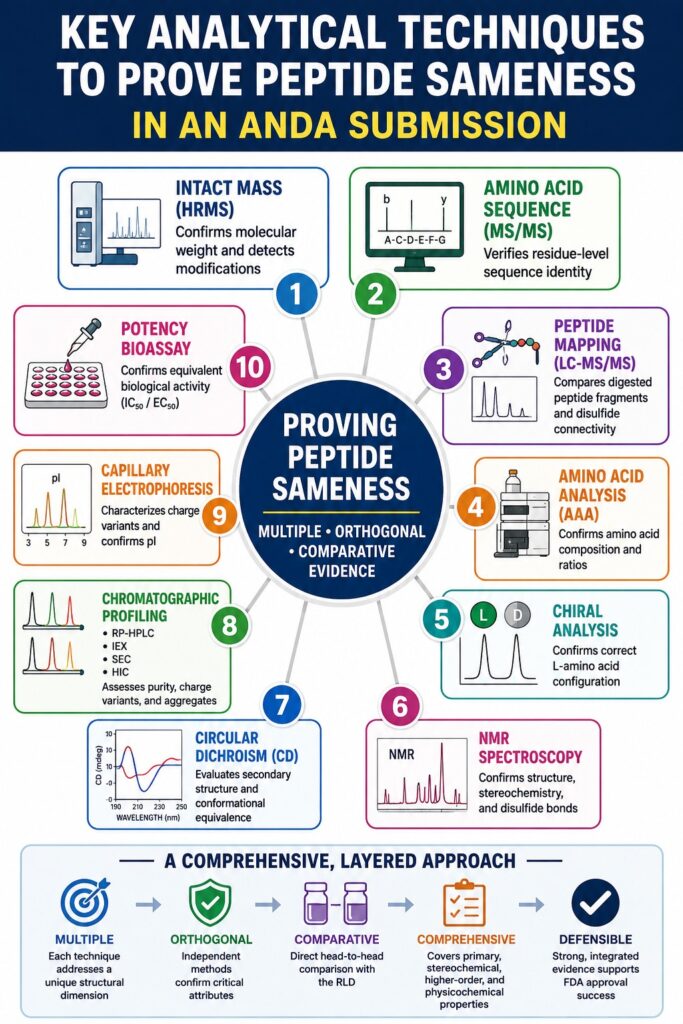
The FDA considers the active ingredient in a peptide ANDA to be “the same” as the reference listed drug (RLD) only when an applicant can demonstrate structural identity across multiple critical dimensions. These dimensions include the primary amino acid sequence, stereochemical configuration, disulfide bond arrangement, post-translational or synthetic modifications, higher-order conformation, and physicochemical characteristics. Under 21 CFR 314.94(a)(5)(ii), as further clarified in the FDA’s 2017 guidance, ANDAs for Certain Highly Purified Synthetic Peptide Drug Products That Refer to Listed Drugs of rDNA Origin, demonstrating sameness requires substantially more than a single chromatographic comparison or spectral match.
This article outlines the analytical techniques required to support peptide sameness, explains the unique regulatory purpose of each method, and highlights the deficiencies that most frequently lead to FDA information requests and review delays.
Share via:
Article Summary:
- Demonstrating peptide sameness for an ANDA is significantly more complex than for traditional small-molecule generics because the FDA expects evidence of equivalence across multiple structural and physicochemical attributes.
- FDA reviewers assess peptide sameness using a comprehensive framework that includes primary sequence, stereochemistry, disulfide bond connectivity, higher-order structure, impurity profile, and biological activity.
- High-resolution mass spectrometry (HRMS), tandem MS/MS, peptide mapping, and amino acid analysis are critical techniques for confirming molecular identity, sequence accuracy, and structural modifications.
- Chiral analysis, NMR spectroscopy, and circular dichroism (CD) provide essential evidence of stereochemical integrity and higher-order structural equivalence between the generic peptide and the reference listed drug (RLD).
- Orthogonal chromatographic methods, capillary electrophoresis, and charge-variant profiling help evaluate purity, aggregation, degradation products, and physicochemical comparability.
- Functional bioassays complement analytical characterization by demonstrating that structural similarity translates into comparable biological performance and potency.
- Successful peptide ANDA submissions rely on a comprehensive, comparative, and orthogonal analytical strategy, while common deficiencies include inadequate peptide mapping, missing chiral data, insufficient higher-order structure characterization, and lack of direct comparison with the RLD.
The FDA’s Regulatory Framework for Peptide Sameness
The FDA requires ANDA applicants to demonstrate sameness across primary, secondary, and tertiary structural levels rather than relying solely on molecular weight equivalence. This expectation serves as the foundation for selecting and implementing analytical techniques within a peptide characterization package.
Key regulatory references include:
- 21 CFR 314.94(a)(5) — Defines the concept of a “same active ingredient” for ANDA submissions.
- FDA Guidance (2017): ANDAs for Certain Highly Purified Synthetic Peptide Drug Products That Refer to Listed Drugs of rDNA Origin.
- FDA Guidance (2019): ANDAs: Pharmaceutical Solid Polymorphism — Chemistry, Manufacturing, and Controls Information (relevant for solid-state peptide characterization).
- ICH Q6B: Specifications: Test Procedures and Acceptance Criteria for Biotechnological/Biological Products — Frequently referenced when developing structural characterization strategies.
- USP General Chapters:
- <1050.1> Biotechnology-derived articles — amino acids.
- <1055> Biotechnology-derived articles — peptide mapping.
Although the FDA does not prescribe a mandatory analytical testing panel, agency deficiency letters and Complete Response Letters (CRLs) consistently demonstrate that submissions relying on only one or two structural characterization methods are often considered inadequate. Applicants that fail to provide sufficient orthogonal evidence frequently receive Refuse-to-File (RTF) actions or additional information requests.
Core Analytical Techniques for Peptide Sameness in ANDA Submissions
1. Intact Mass Measurement by High-Resolution Mass Spectrometry (HRMS)
High-resolution mass spectrometry (HRMS) provides one of the most definitive methods for confirming molecular formula and molecular weight. It is typically among the first analytical techniques employed during peptide characterization. Instruments such as Orbitrap FT-MS, Q-TOF, and FT-ICR systems can achieve sub-ppm mass accuracy, allowing analysts to distinguish between isobaric peptide variants and identify subtle structural modifications.
Key applications of HRMS within a peptide sameness package include:
- Confirmation of average or monoisotopic molecular mass consistent with the RLD.
- Detection of oxidation (+16 Da), deamidation (+1 Da), acetylation (+42 Da), and truncation variants.
- Verification of disulfide bond numbers through differential alkylation mass-shift analysis.
- Identification of sequence variants associated with synthesis-related impurities.
Regulatory Note: Intact mass analysis alone does not establish peptide sequence identity. FDA reviewers routinely identify deficiencies in submissions that depend exclusively on intact mass measurements without accompanying sequence-specific fragmentation data.
2. Amino Acid Sequence Confirmation by Tandem Mass Spectrometry (MS/MS)
Tandem mass spectrometry (MS/MS), particularly when performed using data-dependent acquisition (DDA) or targeted MS/MS workflows, provides residue-level sequence verification through analysis of b-ion and y-ion fragmentation patterns. This technique remains the gold standard for confirming that each amino acid residue corresponds precisely to the sequence of the RLD.
For peptides containing 30 residues or fewer, sequence coverage should generally exceed 95%. For larger peptides, complementary fragmentation approaches such as electron transfer dissociation (ETD) or electron capture dissociation (ECD) are often required to resolve regions containing proline residues and disulfide-linked segments where collision-induced dissociation (CID) may provide incomplete fragmentation.
Critical outputs include:
- Comprehensive b-ion and y-ion series coverage throughout the sequence.
- Confirmation of N-terminal and C-terminal amino acid residues.
- Localization of post-translational modifications (PTMs), N-terminal acetylation, and C-terminal amidation.
- Differentiation of leucine and isoleucine residues through high-resolution mass spectrometry at resolving power greater than 100,000 or through orthogonal Edman sequencing data.
3. Peptide Mapping (LC-MS/MS Following Enzymatic Digestion)
Peptide mapping is widely regarded as the most information-rich structural characterization technique used in peptide sameness assessments. This method simultaneously confirms sequence identity, structural modifications, and disulfide connectivity at the peptide-fragment level. The process involves enzymatic digestion of the peptide using site-specific proteases such as trypsin, Glu-C, or Lys-C, followed by reverse-phase HPLC separation and MS/MS identification of the resulting fragments.
A comprehensive peptide mapping strategy should incorporate:
- At least two complementary proteolytic enzymes to provide overlapping sequence coverage and resolve ambiguous regions.
- Reduced and non-reduced digestion conditions to characterize disulfide bond arrangements.
- Direct comparison of peptide maps generated from the generic API and the RLD, including retention time overlays and fragment mass matching.
- Quantitative assessment of all detected variants and reporting of their relative abundance.
| Mapping Component | Purpose |
|---|---|
| Tryptic Digest (Reduced) | Primary sequence coverage and free cysteine mapping |
| Glu-C or Lys-C Digest (Non-Reduced) | Orthogonal sequence coverage and disulfide bond confirmation |
| RLD Head-to-Head Comparison | Demonstrates chromatographic and spectral equivalence |
| Variant Quantification | Establishes comparability of modification levels |
4. Amino Acid Analysis (AAA)
Amino acid analysis (AAA) provides quantitative molar composition data and serves as an important orthogonal confirmation of peptide sequence composition. The technique confirms the relative abundance of each amino acid residue and is generally performed through complete acid hydrolysis (6N HCl, 110°C, 24 hours), followed by derivatization and subsequent analysis using HPLC or ion-exchange chromatography with post-column ninhydrin or fluorescence detection.
FDA reviewers place significant value on AAA because it provides information independent of mass spectrometry-based methods. The technique verifies both the presence and relative ratios of amino acids, including residues that may exhibit poor ionization during electrospray ionization. It can also reveal unusual or non-standard amino acids when hydrolysate profiles differ from theoretical expectations.
A notable limitation is that tryptophan is degraded under conventional acid hydrolysis conditions. Therefore, alkaline hydrolysis or methanesulfonic acid hydrolysis is required when quantification of tryptophan-containing peptides is necessary.
5. Chiral Analysis to Confirm L-Amino Acid Configuration
Verification that all amino acid residues possess the correct L-configuration, or the intended D-configuration when specified, is a mandatory aspect of peptide sameness assessment. This requirement is frequently overlooked in ANDA submissions despite its regulatory significance. Racemization during solid-phase peptide synthesis (SPPS) represents a recognized manufacturing risk, particularly for cysteine, histidine, and serine residues.
Two commonly used analytical approaches include:
Marfey’s Reagent Analysis (LC-MS)
Following complete acid hydrolysis, derivatization with 1-fluoro-2,4-dinitrophenyl-5-L-alanine amide (FDAA) generates diastereomeric derivatives that can be separated and quantified using reverse-phase HPLC-MS. This method offers exceptional selectivity and sensitivity.
Chiral GC or Chiral HPLC Following Derivatization
These techniques are commonly employed as orthogonal confirmation methods, particularly for amino acid residues that exhibit an elevated risk of epimerization.
Regulatory Context: FDA guidance specifically identifies stereochemical equivalence as an essential component of demonstrating a “same active ingredient.” The absence of chiral characterization data remains one of the most common reasons for FDA information requests in peptide ANDA reviews.
6. Nuclear Magnetic Resonance (NMR) Spectroscopy
For peptides containing approximately 50 residues or fewer, one-dimensional and two-dimensional NMR techniques, including ¹H, ¹H-¹H COSY, TOCSY, and NOESY experiments, provide sequence-specific confirmation of backbone and side-chain proton connectivity. NMR is particularly valuable for verifying:
- The presence and stereochemical configuration of specific residues, including proline cis/trans isomerism.
- Disulfide bond arrangements through NOE correlations.
- The absence of unexpected structural polymorphism.
- Solution-state conformational characteristics relevant to higher-order structure.
For larger or more structurally complex peptides, isotopically labeled ¹³C and ¹⁵N NMR approaches are increasingly utilized. Nevertheless, these methods typically serve as supplemental characterization tools rather than primary analytical techniques in most ANDA submissions.
NMR data packages should include spectra obtained from both the generic product and the RLD reference standard, along with direct spectral overlay comparisons.
7. Circular Dichroism (CD) Spectroscopy
Circular dichroism (CD) spectroscopy is the principal analytical technique used to evaluate peptide secondary structure in solution. The method provides insight into the relative proportions of alpha-helices, beta-sheets, beta-turns, and random coil structures, making it a critical component of higher-order structural (HOS) characterization.
Far-UV CD spectroscopy (190–250 nm) evaluates backbone secondary structure, while near-UV CD spectroscopy (250–320 nm) provides information regarding tertiary structure through aromatic side-chain environments.
A comprehensive CD characterization package should include:
- Spectra collected under conditions that closely replicate the RLD formulation, including buffer composition, pH, and temperature.
- Spectral deconvolution analyses using tools such as CDSSTR or Dichroweb to estimate secondary structure content.
- Thermal denaturation profiles and melting temperature (Tm) comparisons to assess thermodynamic equivalence.
- Direct overlay comparisons of CD spectra obtained from the generic product and the RLD.
8. Reverse-Phase HPLC and Orthogonal Chromatographic Profiling
Reverse-phase HPLC (RP-HPLC) remains the cornerstone analytical method for assessing peptide purity and identity. However, its effectiveness is substantially enhanced when combined with orthogonal chromatographic techniques. A single chromatographic method is insufficient to establish peptide sameness.
FDA expectations generally include:
- RP-HPLC (C18 or C8): Purity evaluation and direct retention-time comparison with the RLD.
- Ion-Exchange Chromatography (IEX): Characterization of charge variants, including deamidated species, oxidized forms, and sequence variants.
- Size-Exclusion Chromatography (SEC): Detection of aggregates, oligomers, and degradation products.
- Hydrophobic Interaction Chromatography (HIC): Orthogonal separation based on hydrophobic interactions.
| Chromatographic Method | Primary Output |
| RP-HPLC (C18) | Purity, main peak identity, hydrophobic impurities |
| IEX (CEX or AEX) | Charge variants, deamidation, sequence variants |
| SEC | Aggregates, oligomers, degradation products |
| HIC | Oxidized variants and conformational variants |
9. Capillary Electrophoresis (CE)
Capillary electrophoresis (CE), particularly capillary zone electrophoresis (CZE) and capillary isoelectric focusing (cIEF), provides highly sensitive charge-based separation and serves as an important complement to chromatographic purity methods.
CZE separates analytes according to their charge-to-mass ratio with exceptional resolution, allowing the detection of single deamidation events and single-residue variants that may co-elute during RP-HPLC analysis. Meanwhile, cIEF determines the isoelectric point (pI) of the peptide, which should correspond to both the theoretical value and the experimentally determined pI of the RLD.
A robust cIEF package should include:
- Whole-column imaging (icIEF) for pI determination.
- Characterization of acidic, main, and basic charge variants.
- Direct pI comparison against the RLD reference standard.
10. Potency and Functional Bioassay
A functional or receptor-based bioassay provides evidence that analytically demonstrated structural sameness translates into equivalent biological activity. Although not considered a direct structural characterization method, the FDA generally expects inclusion of a biologically relevant potency assay, often consistent with the assay used in establishing RLD specifications.
For peptide hormones and receptor agonists or antagonists, suitable approaches include cell-based assays measuring receptor binding affinity (IC₅₀) or downstream signaling responses (EC₅₀). The generic peptide should satisfy the same acceptance criteria established for the RLD.
How These Techniques Integrate into a Regulatory Submission Package
No individual analytical technique can independently establish peptide sameness. Instead, FDA reviewers evaluate the cumulative and orthogonal weight of evidence generated across all relevant structural dimensions.
The framework of a comprehensive analytical package is generally structured as follows:
Primary Structure
- Sequence: MS/MS, Peptide Mapping, AAA, and Edman sequencing where appropriate.
- Stereochemistry: Marfey’s analysis and Chiral HPLC.
- Modifications: HRMS and Peptide Mapping.
Higher-Order Structure
- Secondary Structure: CD and FTIR.
- Tertiary Structure: Near-UV CD and NMR NOE analyses.
- Disulfide Connectivity: Peptide Mapping and Raman spectroscopy.
Physicochemical Properties
- Purity and Identity: RP-HPLC, CE, IEX, and SEC.
- Charge Characteristics and pI: cIEF and CZE.
Functional Equivalence
- Bioassays including receptor-binding studies and cell-based EC₅₀/IC₅₀ assays.
Each analytical layer addresses a unique aspect of peptide sameness. Even a submission containing exceptional mass spectrometry data may still be considered deficient if it lacks supporting evidence for chirality or higher-order structural equivalence.
Common Deficiencies That Lead to FDA Information Requests or Refuse-to-File Actions
Analysis of FDA Complete Response Letters and Refuse-to-File communications involving peptide ANDAs reveals several recurring deficiencies:
- Absence of chiral characterization data, including Marfey’s analysis or chiral HPLC studies.
- Incomplete peptide mapping strategies relying on a single enzyme and providing less than 80% sequence coverage.
- Failure to provide higher-order structural characterization data, such as CD spectroscopy or NMR analysis.
- Dependence on a single chromatographic method without orthogonal support from IEX or SEC.
- Lack of direct head-to-head comparisons between the generic product and the RLD reference standard.
- Insufficient characterization of disulfide bond connectivity, relying solely on intact mass measurements without non-reduced peptide mapping.
- Omission of cIEF or CZE charge-variant profiling studies.
- Inadequate impurity characterization, particularly when peaks exceeding reporting thresholds remain structurally unidentified.
Conclusion: Building a Defensible Analytical Package for Peptide Sameness
Demonstrating peptide sameness in an ANDA submission represents one of the most analytically demanding challenges in pharmaceutical development. The analytical techniques required for peptide sameness span multiple scientific disciplines, including mass spectrometry, chromatography, spectroscopy, electrophoresis, and bioassay. Each technique contributes unique information regarding structural identity that cannot be fully obtained through any other method.
The strongest and most defensible submissions consistently share three defining characteristics. First, they are orthogonal, meaning each analytical method independently confirms critical structural attributes. Second, they are comparative, with every technique incorporating direct head-to-head evaluation against the RLD reference standard. Third, they are comprehensive, ensuring that all structural dimensions, including stereochemistry and higher-order structure, are thoroughly addressed.
Regulatory teams that view peptide sameness primarily as a mass spectrometry exercise frequently encounter deficiency letters and additional information requests. In contrast, organizations that approach peptide sameness as a multidimensional demonstration of structural equivalence, with mass spectrometry serving as only one component of a broader analytical strategy, are far more likely to develop submission packages capable of supporting successful approvals.
If you are developing a peptide ANDA or seeking to strengthen an existing characterization strategy, our team is prepared to assist.
Contact ResolveMass Laboratories
Frequently Asked Questions (FAQs)
For a peptide ANDA, the FDA’s concept of “sameness” extends far beyond matching molecular weight or achieving similar purity profiles. The generic peptide must demonstrate equivalence to the reference listed drug (RLD) in amino acid sequence, stereochemical arrangement, disulfide bond connectivity, structural modifications, higher-order conformation, and key physicochemical attributes. The agency evaluates all of these elements collectively when determining whether the active ingredient can be considered the same as the RLD.
No, intact mass analysis by itself cannot establish peptide sameness. While high-resolution mass spectrometry can accurately confirm molecular weight and detect certain modifications, it does not provide complete information about amino acid sequence, stereochemistry, disulfide connectivity, or higher-order structure. FDA reviewers expect intact mass data to be supported by additional orthogonal techniques that collectively verify the peptide’s complete structural identity.
In most cases, the FDA expects peptide mapping studies to include at least two complementary proteolytic enzymes, such as trypsin and Glu-C or Lys-C. Using multiple enzymes creates overlapping sequence coverage and helps resolve regions that may remain ambiguous when only one digestion strategy is used. This approach strengthens confidence in sequence verification and improves characterization of modifications and disulfide-linked regions.
Not every peptide ANDA requires extensive NMR characterization, but the technique becomes increasingly important when structural questions cannot be fully addressed through mass spectrometry alone. NMR is particularly valuable for peptides with complex conformations, cyclic structures, extensive disulfide bonding, or proline cis/trans isomerism. In such situations, NMR provides critical information regarding stereochemistry and molecular conformation that other analytical methods may not adequately capture.
Circular dichroism (CD) spectroscopy is used to demonstrate that the generic peptide exhibits a secondary and tertiary structural profile comparable to that of the RLD. The technique evaluates higher-order structural characteristics, including alpha-helices, beta-sheets, and other conformational features present in solution. By comparing CD spectra between products, applicants can provide evidence that both molecules adopt similar structural arrangements under equivalent conditions.
Chiral analysis confirms that amino acid residues possess the correct stereochemical configuration, which is a critical requirement for establishing peptide sameness. Techniques such as Marfey’s reagent LC-MS are commonly used to identify and quantify potential epimerization. During solid-phase peptide synthesis, residues including cysteine (Cys), histidine (His), serine (Ser), aspartic acid (Asp), and phenylalanine (Phe) are particularly susceptible to racemization, making their evaluation especially important.
Cation-exchange chromatography (CEX) and capillary zone electrophoresis (CZE) are both used to assess charge heterogeneity, but they separate molecules through different mechanisms. CEX relies on interactions between analytes and an ion-exchange stationary phase, making it highly effective for quantifying charge variants. In contrast, CZE separates species according to their charge-to-mass ratio in free solution, often resolving variants that may not be distinguished chromatographically. Together, these techniques provide complementary and highly informative charge profiling data.
Using the same or a contemporaneous RLD lot for both structural characterization and functional testing is generally considered the most robust scientific approach. This strategy helps ensure consistency across analytical and biological comparisons while reducing variability introduced by lot-to-lot differences. Regulatory reviewers may raise concerns when different RLD lots are used across studies, particularly if those differences could affect interpretation of the overall comparability assessment.
Reference:
- U.S. Food and Drug Administration. (2017). ANDAs for Certain Highly Purified Synthetic Peptide Drug Products That Refer to Listed Drugs of rDNA Origin — Guidance for Industry. FDA. https://www.fda.gov/media/102504/download
- International Council for Harmonisation. (1999). ICH Q6B: Specifications: Test Procedures and Acceptance Criteria for Biotechnological/Biological Products. ICH. https://www.ich.org/page/quality-guidelines
- Marfey, P. (1984). Determination of D-amino acids. II. Use of a bifunctional reagent, 1,5-difluoro-2,4-dinitrobenzene. Carlsberg Research Communications, 49(6), 591–596. https://doi.org/10.1007/BF02908688
- Berkowitz, S. A., Engen, J. R., Mazzeo, J. R., & Jones, G. B. (2012). Analytical tools for characterizing biopharmaceuticals and the implications for biosimilars. Nature Reviews Drug Discovery, 11(7), 527–540. https://doi.org/10.1038/nrd3746
- Hensel, M., Steurer, R., Siegl, J., Brynda, J., Hanč, P., & Kopecky, V. (2011). Simultaneous determination of peptide conformation and conjugate structure. PLoS ONE, 6(7), e21370. https://doi.org/10.1371/journal.pone.0021370
- Wang, W., Singh, S., Zeng, D. L., King, K., & Nema, S. (2007). Antibody structure, instability, and formulation. Journal of Pharmaceutical Sciences, 96(1), 1–26. https://doi.org/10.1002/jps.20727
Get In Touch With Us
About The Author


