

Introduction:
Anti-Drug Antibody (ADA) Assay Development Services play a critical role in evaluating the immunogenicity of biologic therapies. As biologics become increasingly complex, regulatory agencies require robust ADA testing strategies to assess immune responses that may affect drug safety, efficacy, pharmacokinetics, and patient outcomes.
Biologic therapies such as monoclonal antibodies, antibody-drug conjugates, fusion proteins, peptides, and biosimilars can trigger immune reactions in patients. These immune responses may lead to the production of anti-drug antibodies that neutralize therapeutic effects or alter drug exposure. Therefore, accurate ADA assay development and validation are essential throughout preclinical and clinical development.
ResolveMass Laboratories Inc. supports pharmaceutical and biotechnology companies with advanced immunogenicity testing solutions designed to meet regulatory expectations and accelerate biologic development programs.
Summary:
- Anti-drug antibody (ADA) assays detect immune responses generated against biologic drugs.
- ADA testing is critical for monoclonal antibodies, peptides, fusion proteins, biosimilars, gene therapies, and other biologics.
- Robust ADA assay development supports regulatory compliance with FDA, EMA, and ICH guidelines.
- Sensitive and drug-tolerant assays help identify neutralizing and binding antibodies accurately.
- Validation ensures assay reliability, reproducibility, specificity, and sensitivity.
- ResolveMass Laboratories Inc. provides advanced bioanalytical expertise for immunogenicity assessment and biologic characterization.
1: What Are Anti-Drug Antibody (ADA) Assays?
Anti-drug antibody (ADA) assays are specialized analytical methods used to detect antibodies produced by the immune system against therapeutic biologic drugs. These assays help determine whether a biologic therapy triggers an unwanted immune response that could affect drug safety, efficacy, or pharmacokinetics.
ADA assays are a critical part of immunogenicity assessment during the development of biologic therapies and biosimilars. Regulatory agencies such as the FDA and EMA require comprehensive ADA testing to evaluate the potential clinical impact of immune responses.
ADA Assays Are Commonly Used For
- Monoclonal antibodies
- Biosimilars
- Peptide therapeutics
- Fusion proteins
- Cell and gene therapies
- Vaccines
- Recombinant proteins
Primary Goals of ADA Testing
| Objective | Purpose |
|---|---|
| Detect binding antibodies | Identify immune responses against biologic therapies |
| Assess neutralizing antibodies | Determine whether antibodies reduce drug activity |
| Monitor immunogenicity | Evaluate potential patient safety risks |
| Support regulatory submissions | Meet FDA, EMA, and global regulatory requirements |
| Evaluate pharmacokinetic (PK) impact | Assess changes in drug exposure and clearance |
Effective ADA assay development helps pharmaceutical and biotechnology companies better understand immunogenicity risks and ensure the successful development of safe and effective biologic therapies.
2: Why Is ADA Testing Important for Biologic Therapies?
ADA testing is important because immune responses against biologic drugs can negatively affect both treatment effectiveness and patient safety. Comprehensive anti-drug antibody (ADA) testing helps pharmaceutical companies identify immunogenicity risks early and meet global regulatory requirements during biologic development.
Biologic therapies such as monoclonal antibodies, fusion proteins, recombinant proteins, and biosimilars have the potential to trigger immune system reactions. When patients develop anti-drug antibodies, these antibodies may interfere with the therapeutic drug’s activity, alter drug exposure, or cause adverse clinical effects.
Regulatory agencies including the FDA and EMA require immunogenicity assessments to evaluate the clinical impact of ADA formation throughout preclinical and clinical studies.
Potential Consequences of Anti-Drug Antibodies
- Reduced therapeutic efficacy
- Altered pharmacokinetics (PK)
- Increased drug clearance
- Hypersensitivity reactions
- Cross-reactivity with endogenous proteins
- Loss of clinical response
How ADA Responses Affect Biologic Therapies
| Immunogenicity Impact | Potential Clinical Outcome |
|---|---|
| Neutralizing antibody formation | Reduced drug activity and efficacy |
| Accelerated drug clearance | Lower therapeutic exposure |
| Immune complex formation | Increased safety concerns |
| Cross-reactive antibodies | Potential effects on endogenous proteins |
| Persistent ADA response | Long-term treatment complications |
For biosimilars, ADA testing becomes even more critical because immunogenicity comparability must be demonstrated against the reference biologic product. Sensitive and well-validated ADA assays help ensure that biosimilars show no clinically meaningful differences in immune response profiles.
Comprehensive ADA testing ultimately supports safer biologic therapies, improved patient outcomes, and successful regulatory submissions.
3: Key Components of ADA Assay Development
Successful anti-drug antibody (ADA) assay development requires selecting the appropriate analytical platform, optimizing assay conditions, and establishing strong sensitivity, specificity, and drug tolerance. A well-designed ADA testing strategy helps ensure accurate immunogenicity assessment for biologic therapies throughout preclinical and clinical development.
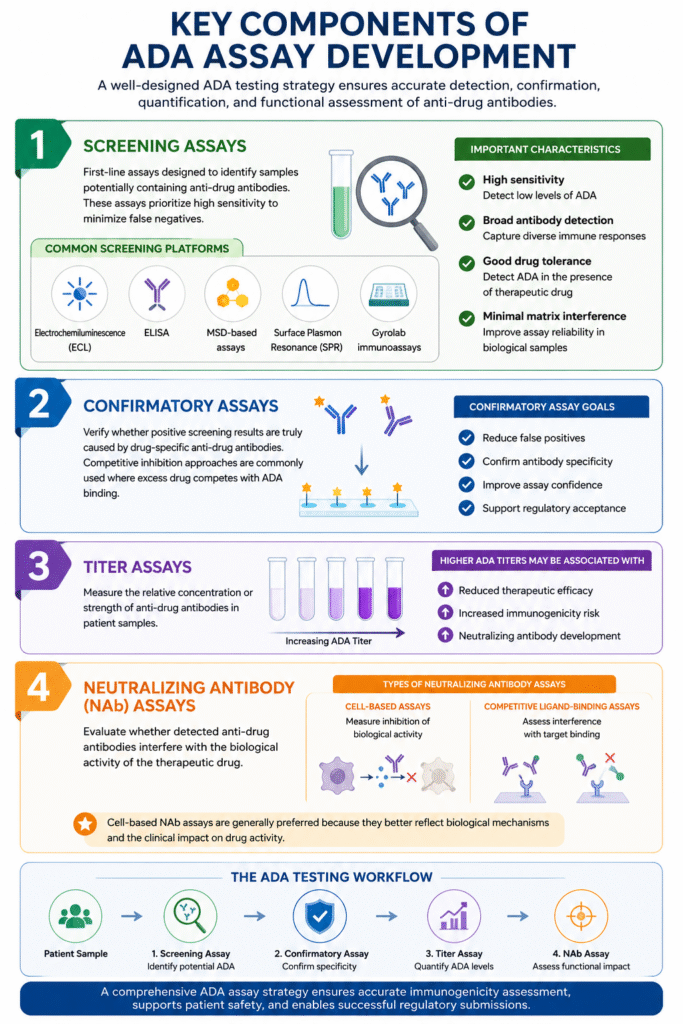
The core components of ADA assay development typically include screening assays, confirmatory assays, titer assays, and neutralizing antibody (NAb) assays.
1. Screening Assays
Screening assays are the first step in ADA testing and are designed to identify samples that may contain anti-drug antibodies. These assays prioritize high sensitivity to minimize the risk of false-negative results.
Because screening assays evaluate large numbers of samples, they must be robust, reproducible, and capable of detecting a broad range of antibody responses.
Common Screening Platforms
- Electrochemiluminescence (ECL)
- ELISA
- MSD-based assays
- Surface plasmon resonance (SPR)
- Gyrolab immunoassays
Important Characteristics of Screening Assays
| Characteristic | Importance |
|---|---|
| High sensitivity | Detect low levels of ADA |
| Broad antibody detection | Capture diverse immune responses |
| Good drug tolerance | Detect ADA in the presence of therapeutic drug |
| Minimal matrix interference | Improve assay reliability in biological samples |
Modern ECL and MSD-based platforms are widely preferred because they offer excellent sensitivity, dynamic range, and improved drug tolerance for biologic therapies.
2. Confirmatory Assays
Confirmatory assays are used to verify whether positive screening results are truly caused by drug-specific anti-drug antibodies. These assays improve testing accuracy by reducing false-positive responses.
Competitive inhibition approaches are commonly used in confirmatory testing. In this method, excess therapeutic drug competes with ADA binding, helping confirm assay specificity.
Confirmatory Assay Goals
- Reduce false positives
- Confirm antibody specificity
- Improve assay confidence
- Support regulatory acceptance
A properly validated confirmatory assay is essential for regulatory submissions and reliable immunogenicity assessment.
3. Titer Assays
Titer assays measure the relative concentration or strength of anti-drug antibodies present in patient samples. These assays provide additional insight into the magnitude and persistence of immune responses.
Higher ADA titers may correlate with greater clinical impact, particularly when persistent antibodies are present.
Higher ADA Titers May Be Associated With
- Reduced therapeutic efficacy
- Increased immunogenicity risk
- Neutralizing antibody development
Titer analysis is especially important during longitudinal clinical studies where immune responses are monitored over time.
4. Neutralizing Antibody (NAb) Assays
Neutralizing antibody (NAb) assays evaluate whether detected anti-drug antibodies interfere with the biological activity of the therapeutic drug. These assays are critical because neutralizing antibodies may directly reduce treatment effectiveness.
Types of Neutralizing Antibody Assays
| Assay Type | Description |
|---|---|
| Cell-based assays | Measure inhibition of biological activity |
| Competitive ligand-binding assays | Assess interference with target binding |
Cell-based NAb assays are generally preferred because they more accurately reflect the drug’s biological mechanism of action under physiological conditions.
Neutralizing antibody assessment is particularly important for biologics where functional inhibition can significantly impact clinical outcomes and patient response.
4: Critical Parameters in ADA Assay Validation
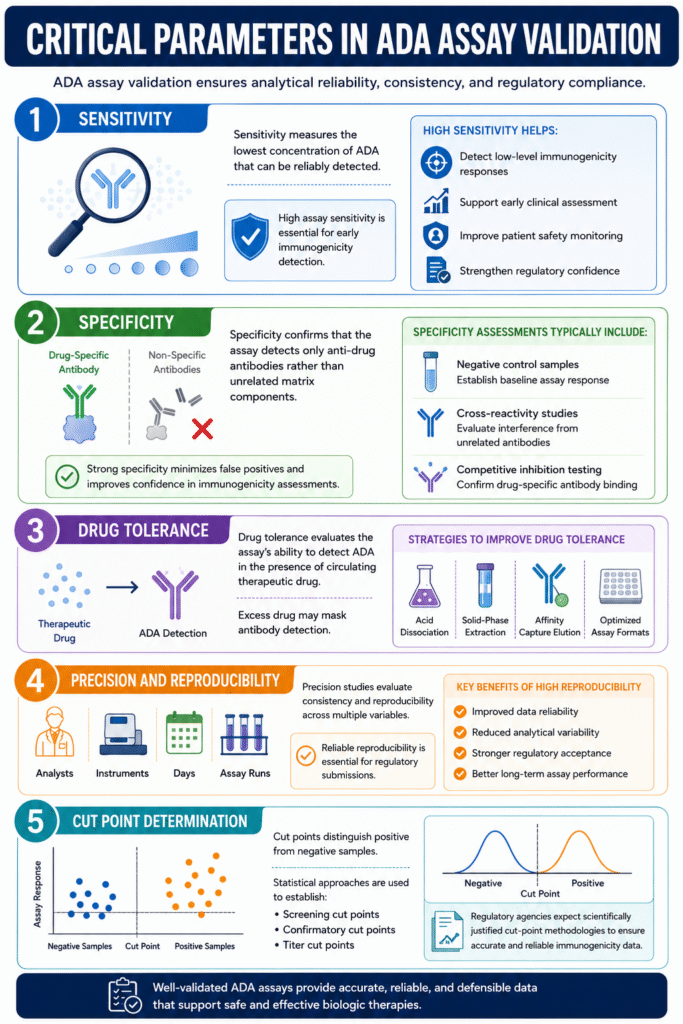
ADA assay validation is essential for ensuring analytical reliability, reproducibility, and regulatory compliance during biologic drug development. Proper validation helps confirm that anti-drug antibody assays consistently generate accurate and scientifically reliable results across different studies and sample conditions.
Regulatory agencies such as the FDA and EMA expect validated ADA assays that demonstrate sensitivity, specificity, precision, and robust statistical performance.
1. Sensitivity
Sensitivity measures the lowest concentration of anti-drug antibodies (ADA) that can be reliably detected by the assay. High assay sensitivity is critical for identifying early immune responses and minimizing false-negative results.
Sensitive ADA assays help:
- Detect low-level immunogenicity responses
- Support early clinical assessment
- Improve patient safety monitoring
- Strengthen regulatory confidence
Highly sensitive platforms such as electrochemiluminescence (ECL) are commonly used to improve low-level ADA detection.
2. Specificity
Specificity confirms that the assay accurately detects anti-drug antibodies rather than unrelated matrix components or nonspecific interactions.
A highly specific assay minimizes false-positive results and improves confidence in immunogenicity assessments.
Specificity Assessments Typically Include
- Negative control samples
- Cross-reactivity studies
- Competitive inhibition testing
Importance of Specificity in ADA Assays
| Validation Parameter | Purpose |
|---|---|
| Negative controls | Establish baseline assay response |
| Cross-reactivity testing | Evaluate interference from unrelated antibodies |
| Competitive inhibition | Confirm drug-specific antibody binding |
Strong specificity is particularly important for complex biologics and biosimilar comparability studies.
3. Drug Tolerance
Drug tolerance evaluates the assay’s ability to detect ADA in the presence of circulating therapeutic drug. This is one of the most technically challenging aspects of ADA assay development because excess drug can interfere with antibody detection by masking ADA signals.
Improving drug tolerance is essential for accurate immunogenicity assessment in patients receiving repeated or high-dose biologic therapies.
Strategies to Improve Drug Tolerance
- Acid dissociation
- Solid-phase extraction
- Affinity capture elution
- Optimized assay formats
Advanced ADA assay platforms are specifically designed to improve detection sensitivity while maintaining high drug tolerance.
4. Precision and Reproducibility
Precision studies evaluate the consistency and reproducibility of assay performance across multiple variables. Reliable reproducibility is critical for generating trustworthy immunogenicity data and supporting regulatory submissions.
Precision Studies Commonly Evaluate
- Analysts
- Instruments
- Days
- Assay runs
Key Benefits of High Reproducibility
- Improved data reliability
- Reduced analytical variability
- Stronger regulatory acceptance
- Better long-term assay performance
Consistent assay performance across laboratories and study phases is essential for clinical immunogenicity programs.
5. Cut Point Determination
Cut points are statistically established thresholds used to distinguish positive samples from negative samples in ADA testing.
Accurate cut-point determination is essential because it directly impacts assay sensitivity, specificity, and overall interpretation of immunogenicity data.
Types of Cut Points
| Cut Point Type | Purpose |
|---|---|
| Screening cut point | Identify potentially positive samples |
| Confirmatory cut point | Confirm drug-specific antibody responses |
| Titer cut point | Determine antibody concentration levels |
Regulatory agencies expect scientifically justified statistical methodologies for cut-point establishment, including appropriate population selection and robust data analysis procedures.
Well-designed cut-point strategies improve assay accuracy and ensure confidence in immunogenicity assessment results.
5: Challenges in ADA Assay Development
ADA assay development can be technically challenging due to the complexity of biologic drugs and immune responses.
1. High Drug Interference
Residual drug in patient samples may interfere with ADA detection.
This challenge is especially significant in:
- High-dose biologics
- Long half-life monoclonal antibodies
- Frequent dosing regimens
2. Matrix Effects
Human serum contains endogenous substances that may impact assay performance.
Potential interferents include:
- Rheumatoid factors
- Complement proteins
- Soluble targets
- Heterophilic antibodies
3. Diverse ADA Responses
Anti-drug antibodies vary widely among patients in:
- Affinity
- Isotype
- Specificity
- Kinetics
Therefore, assay methods must accommodate broad immune variability.
4. Lack of Standardized Positive Controls
Generating representative positive control antibodies can be difficult for novel biologics.
High-quality positive controls are essential for:
- Sensitivity evaluation
- Validation studies
- Long-term assay consistency
6: Technologies Used in Modern ADA Assay Development
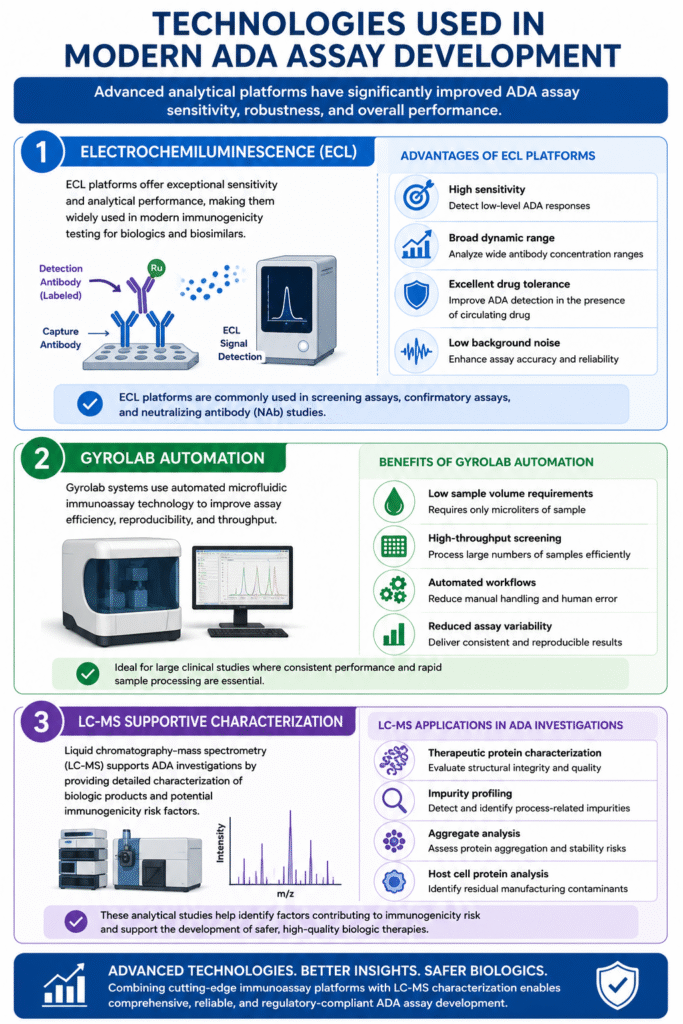
Modern anti-drug antibody (ADA) assay development relies on advanced analytical technologies that improve assay sensitivity, specificity, robustness, and throughput. These platforms help biopharmaceutical companies perform accurate immunogenicity assessments while meeting evolving regulatory expectations for biologic therapies and biosimilars.
Advanced ADA assay technologies also improve drug tolerance, reduce assay variability, and support reliable detection of low-level immune responses.
1. Electrochemiluminescence (ECL)
Electrochemiluminescence (ECL) is one of the most widely used technologies in modern ADA assay development because of its exceptional sensitivity and analytical performance.
ECL-based platforms are particularly effective for detecting low concentrations of anti-drug antibodies in complex biological matrices.
Advantages of ECL Platforms
| Feature | Benefit |
|---|---|
| High sensitivity | Detect low-level ADA responses |
| Broad dynamic range | Analyze wide antibody concentration ranges |
| Excellent drug tolerance | Improve ADA detection in the presence of circulating drug |
| Low background noise | Enhance assay accuracy and reliability |
ECL platforms are commonly used in screening assays, confirmatory assays, and neutralizing antibody studies for biologics and biosimilars.
2. Gyrolab Automation
Gyrolab systems use automated microfluidic immunoassay technology to improve assay efficiency and reproducibility.
These platforms are increasingly used in high-throughput immunogenicity testing environments because they reduce manual handling and minimize assay variability.
Benefits of Gyrolab Automation
- Low sample volume requirements
- High-throughput screening capability
- Automated workflows
- Reduced assay variability
Gyrolab technology is particularly valuable for large clinical studies where consistent assay performance and rapid sample processing are essential.
3. LC-MS Supportive Characterization
Liquid chromatography–mass spectrometry (LC-MS) plays an important supportive role in ADA investigations by helping characterize biologic products and identify factors that may contribute to immunogenicity risk.
Mass spectrometry-based characterization provides detailed structural and impurity information that complements immunogenicity testing strategies.
LC-MS Applications in ADA Investigations
| LC-MS Analysis | Purpose |
|---|---|
| Therapeutic protein characterization | Evaluate structural integrity |
| Impurity profiling | Detect process-related impurities |
| Aggregate analysis | Assess protein aggregation risks |
| Host cell protein analysis | Identify residual manufacturing contaminants |
These analytical studies help scientists better understand potential immunogenicity triggers and improve biologic product quality.
7: ADA Assay Development for Biosimilars
Biosimilar immunogenicity assessment requires direct comparison against the reference product.
Comparative ADA studies evaluate:
- Incidence of ADA formation
- Neutralizing antibody responses
- Clinical impact
- Safety profiles
Sensitive comparative assays are essential for demonstrating biosimilarity.
Related analytical strategies may also involve:
- Biosimilar bioanalysis
- Peptide mapping
- Native mass spectrometry
- Comparability assessments
8: Why Choose ResolveMass Laboratories Inc.?
ResolveMass Laboratories Inc. provides specialized expertise in biologic characterization and immunogenicity testing support.
Key advantages include:
- Extensive biologics analytical expertise
- Advanced mass spectrometry capabilities
- Customized ADA assay strategies
- Regulatory-focused validation support
- High-sensitivity analytical workflows
- Support for biosimilars and novel biologics
The laboratory’s integrated analytical approach helps clients address complex immunogenicity challenges efficiently.
Conclusion:
Reliable Anti-Drug Antibody (ADA) Assay Development Services are essential for ensuring the safety, efficacy, and regulatory success of biologic therapies. As biologics continue to evolve, advanced ADA assay development and validation strategies are increasingly important for accurate immunogenicity assessment.
From screening assays and confirmatory testing to neutralizing antibody evaluation and regulatory validation, comprehensive ADA testing supports every stage of biologic development. By combining scientific expertise, advanced analytical technologies, and regulatory understanding, ResolveMass Laboratories Inc. helps pharmaceutical and biotechnology companies navigate the complexities of immunogenicity testing with confidence.
Frequently Asked Questions:
ADA assays are important because biologic therapies can trigger unwanted immune responses in patients. Anti-drug antibodies may reduce treatment effectiveness, alter drug exposure, or increase the risk of adverse reactions. Immunogenicity testing helps pharmaceutical companies evaluate patient safety and therapeutic performance. Regulatory agencies such as the FDA and EMA require comprehensive ADA assessments for biologic products. Reliable ADA testing supports successful clinical development and regulatory approval.
ADA testing is commonly performed for monoclonal antibodies, biosimilars, recombinant proteins, fusion proteins, peptide therapeutics, vaccines, and gene therapies. These biologics may stimulate immune responses due to their complex molecular structures. Immunogenicity assessment helps determine whether anti-drug antibodies develop during treatment. ADA testing is especially important for chronic therapies administered repeatedly over time. Proper evaluation helps ensure biologic safety and efficacy.
Binding antibodies attach to the therapeutic biologic but do not always affect its function. Neutralizing antibodies, however, directly interfere with the biologic’s mechanism of action and may reduce therapeutic efficacy. Neutralizing antibodies are often considered more clinically significant because they can block drug activity completely. Both types of antibodies are evaluated during immunogenicity assessment. Specialized neutralizing antibody assays are used to measure functional inhibition.
ADA assay development generally includes screening assays, confirmatory assays, titer assays, and neutralizing antibody assays. Screening assays identify potentially positive samples, while confirmatory assays verify drug-specific antibody responses. Titer assays measure antibody levels, and neutralizing assays evaluate functional impact on drug activity. Validation studies are then performed to confirm assay reliability and reproducibility. Each stage is critical for accurate immunogenicity assessment.
ADA assay validation is guided by recommendations from the FDA, EMA, and ICH. These agencies require scientifically validated immunogenicity testing methods for biologic therapies and biosimilars. Validation parameters typically include sensitivity, specificity, precision, drug tolerance, and cut-point determination. Regulatory expectations also emphasize risk-based immunogenicity assessment strategies. Proper validation is essential for successful IND, BLA, and biosimilar submissions.
Cell-based neutralizing antibody assays are preferred because they better reflect the biologic drug’s actual mechanism of action in physiological systems. These assays measure whether anti-drug antibodies inhibit therapeutic activity in living cells. They provide more clinically relevant immunogenicity information compared to non-cell-based methods. Regulatory agencies often favor cell-based assays when feasible. These assays are especially important for complex biologic therapies.
ADA testing is critical for biosimilars because developers must demonstrate immunogenicity comparability with the reference product. Regulatory agencies require evidence showing no clinically meaningful differences in immune responses. Sensitive ADA assays help evaluate binding antibodies, neutralizing antibodies, and overall immunogenicity profiles. Comparative testing also supports biosimilar safety and efficacy assessments. Reliable ADA data are essential for biosimilar regulatory approval.
Reference
- Myler H, Pedras-Vasconcelos J, Phillips K, Hottenstein CS, Chamberlain P, Devanaryan V, Gleason C, Goodman J, Manning MS, Purushothama S, Richards S. Anti-drug Antibody Validation Testing and Reporting Harmonization: ADA Harmonization. The AAPS Journal. 2021 Dec 1;24(1):4.https://link.springer.com/article/10.1208/s12248-021-00649-y
- Partridge MA, Purushothama S, Elango C, Lu Y. Emerging technologies and generic assays for the detection of anti‐drug antibodies. Journal of immunology research. 2016;2016(1):6262383.https://onlinelibrary.wiley.com/doi/abs/10.1155/2016/6262383
- Pizano-Martinez O, Mendieta-Condado E, Vázquez-Del Mercado M, Martínez-García EA, Chavarria-Avila E, Ortuño-Sahagún D, Márquez-Aguirre AL. Anti-drug antibodies in the biological therapy of autoimmune rheumatic diseases. Journal of clinical medicine. 2023 May 4;12(9):3271.https://www.mdpi.com/2077-0383/12/9/3271
- Ishii-Watabe A, Shibata H, Nishimura K, Hosogi J, Aoyama M, Nishimiya K, Saito Y. Immunogenicity of therapeutic protein products: current considerations for anti-drug antibody assay in Japan. Bioanalysis. 2018 Jan 1;10(2):95-105.https://www.tandfonline.com/doi/abs/10.4155/bio-2017-0186
- Suzuki T, Tada M, Ishii-Watabe A. Development of anti-drug monoclonal antibody panels against adalimumab and infliximab. Biologicals. 2020 Jan 1;63:39-47.https://www.sciencedirect.com/science/article/pii/S1045105619301344
About the Author


