


Introduction: The Strategic Role of Benzene-d6 in OLED Research
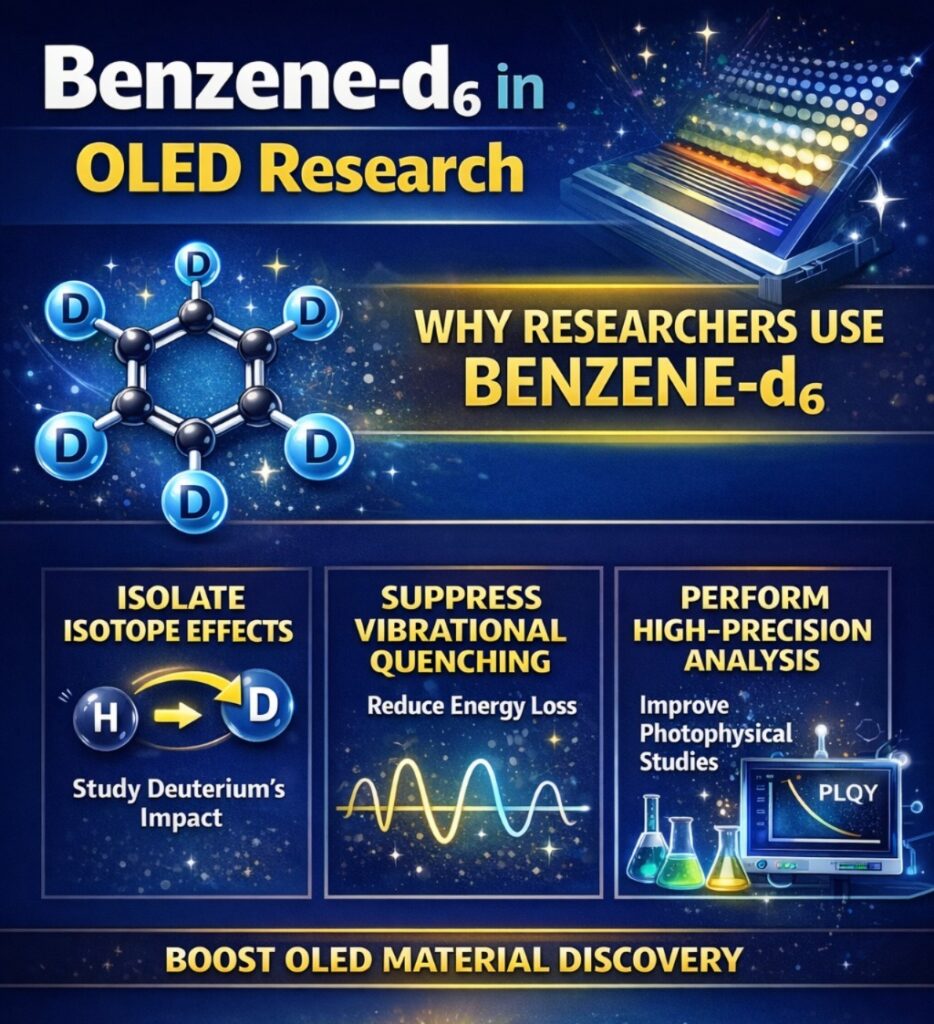
Benzene-d6 in OLED Research is more than just a deuterated solvent. It acts as a scientific tool for studying isotope effects, reducing vibrational quenching, and refining photophysical evaluation of next-generation OLED materials. Instead of being a passive liquid, it becomes an active part of the experimental design. Many researchers treat it as a controlled variable in mechanistic studies.
In high-performance organic light-emitting diode (OLED) development, small improvements in efficiency and lifetime often depend on subtle molecular behavior. The deuterium isotope effect can influence excited-state decay, bond strength, and triplet stability. Even small differences in vibrational energy can change non-radiative decay rates. Understanding these effects helps scientists fine-tune emitter molecules at the atomic level.
Deuterated benzene (C₆D₆), commonly called benzene-d6, plays a central role in guiding emitter optimization before device fabrication. It is especially important in phosphorescent and thermally activated delayed fluorescence (TADF) systems. In these materials, non-radiative losses often limit performance more than radiative processes. A controlled solvent environment makes it easier to identify and reduce these losses step by step.
Discover how isotopic engineering is reshaping the industry: Isotope Effect in OLED Materials: A Comprehensive Guide
Benzene-d6 in OLED Research: Why Isotopic Substitution Matters
Benzene-d6 in OLED Research is used to evaluate how replacing hydrogen with deuterium affects vibrational energy transfer and non-radiative decay. Isotopic substitution changes atomic mass without significantly changing chemical structure. This allows researchers to study vibrational effects separately from electronic effects. As a result, specific decay pathways can be isolated and measured.
The Core Scientific Reason
Replacing hydrogen (¹H) with deuterium (²H) increases vibrational mass, which:
- Lowers vibrational frequencies
- Reduces high-energy C–H oscillations
- Suppresses internal conversion
- Decreases non-radiative decay rates
In many OLED emitters, especially phosphorescent iridium complexes and other organometallic systems, vibrational coupling between excited states and C–H bonds leads to energy loss. When studied in benzene-d6, this coupling is reduced. Researchers can then observe intrinsic excited-state properties more clearly. This helps quantify how much vibrational quenching affects overall device efficiency.
Studying materials in benzene-d6 allows researchers to:
- Measure isotope-related changes in photoluminescence quantum yield (PLQY)
- Evaluate triplet lifetime extension
- Identify vibrational quenching mechanisms
This controlled solvent platform helps determine whether targeted molecular deuteration will improve device performance. It supports data-driven material engineering and reduces uncertainty during long development cycles.
Explore our specialized solutions for advanced electronics: Deuterated Reagents for Electronics and High-Tech Applications
How Benzene-d6 in OLED Research Improves Photophysical Characterization
Benzene-d6 in OLED Research supports high-resolution NMR and photophysical studies without interference from solvent proton signals. Clean measurement conditions are essential when analyzing complex emitter structures. Even small spectral overlaps can cause misinterpretation. Deuterated solvents significantly reduce these risks.
1. High-Precision NMR Structural Validation
OLED emitters often include:
- Cyclometalated iridium complexes
- Ruthenium organometallic systems
- Boron-doped π-conjugated frameworks
- Nanographene derivatives
Using benzene-d6 provides:
- Clear ¹H NMR spectra
- Accurate conformational analysis
- Monitoring of aggregation behavior
- Hydrogen/deuterium exchange tracking
For complex emitters, structural errors can delay commercialization and reduce reproducibility. Deuterated solvents remove background proton signals and improve clarity. This is especially important when confirming ligand substitution patterns. Reliable structural validation supports confident scale-up.
Ensure accurate results with industry-standard solvents: Deuterated Standards and Solvents for NMR Spectroscopy
2. Investigation of Aggregation-Induced Quenching (AIQ)
In early-stage solution studies, researchers evaluate whether materials:
- Aggregate in non-polar environments
- Form excimers
- Exhibit triplet–triplet annihilation
Benzene-d6 is useful because:
- It mimics non-polar device-like environments
- It supports variable temperature NMR experiments
- It allows monitoring of intermolecular interactions without proton interference
Aggregation directly impacts thin-film efficiency and color stability. Detecting these effects early reduces development time. Controlled solvent experiments help predict real device behavior.
Find the right supplier for your OLED research needs: Deuterated Benzene-d6 Supplier for OLED and Specialized Research
Benzene-d6 in OLED Research and the Kinetic Isotope Effect (KIE)
Benzene-d6 in OLED Research is widely used to measure kinetic isotope effects that influence degradation rates and excited-state stability. KIE studies help clarify reaction pathways that are difficult to observe directly. They reveal whether vibrational energy or bond cleavage drives material breakdown. This knowledge guides smarter molecular design.
Why KIE Matters in OLED Stability
OLED degradation often involves:
- C–H bond cleavage
- Triplet-polaron interactions
- Excited-state bond rupture
- Radical formation pathways
When hydrogen is replaced by deuterium:
- Bond dissociation energy increases
- Reaction rates slow down
- Thermal degradation pathways may shift
These changes allow researchers to measure the impact of vibrational energy on instability. Slower degradation in deuterated systems often confirms vibrationally driven mechanisms. This insight supports targeted stabilization strategies.
Learn why specific deuterated molecules enhance performance: Why Benzene-d6 Improves Stability in OLED Devices
Practical Research Applications
| Research Objective | Role of Benzene-d6 |
|---|---|
| Measure isotope-dependent decay rates | Provides deuterated environment |
| Validate H/D exchange in synthesis | Acts as deuterium source |
| Study excited-state internal conversion | Reduces vibrational coupling |
| Evaluate photodegradation kinetics | Enables comparative isotope studies |
Scientists frequently compare results in benzene (C₆H₆) and benzene-d6 (C₆D₆). Differences in emission and lifetime directly reflect vibrational energy effects. These comparisons strengthen mechanistic understanding and support patent development.
Benzene-d6 in OLED Research for Phosphorescent Emitters
Benzene-d6 in OLED Research is especially valuable for phosphorescent organometallic complexes, where triplet lifetime strongly affects efficiency. These systems are highly sensitive to vibrational relaxation. Even small environmental changes can influence decay measurements. Deuterated solvents provide a stable reference point.
Phosphorescent emitters depend on:
- Heavy-metal spin–orbit coupling
- Efficient triplet harvesting
- Suppressed non-radiative decay
In solvents with C–H bonds, vibrational coupling can increase non-radiative triplet decay. Benzene-d6 reduces this interaction and allows more accurate measurement of intrinsic radiative decay constants. This helps separate solvent effects from true molecular design factors. For iridium-based emitters, such precision is critical.
Browse our full inventory of high-purity deuterated chemicals: Availability of All the Deuterated Chemicals for Research and Industry
Benzene-d6 in OLED Research for Deuterated Material Development
Benzene-d6 in OLED Research supports the design of partially or fully deuterated OLED emitters aimed at improving operational lifetime. Deuterated materials are gaining attention as a stability enhancement strategy. Early solvent testing helps predict benefits before large-scale synthesis begins. This approach lowers both cost and development risk.
Deuterated OLED materials are promising because:
- Deuteration strengthens chemical bonds
- Reduced vibrational coupling lowers non-radiative decay
- Improved thermal stability extends device lifetime
Testing in benzene-d6 simulates deuterium-rich conditions. Researchers can model vibrational suppression and estimate potential efficiency gains. These early insights guide investment in solid-state material development.
Access premium aromatic compounds for your OLED stack: Deuterated Aromatic Compounds for OLED Manufacturing
How Benzene-d6 in OLED Research Supports AI-Driven Materials Discovery
Modern OLED research increasingly uses:
- Machine learning tools
- Predictive photophysical simulations
- Data-driven lifetime modeling
Benzene-d6 enables generation of:
- Clean spectroscopic datasets
- Reliable excited-state decay constants
- Controlled isotope comparison results
High-quality data improve algorithm training and predictive accuracy. As AI becomes central to material screening, precise solvent-controlled measurements become even more valuable. Benzene-d6 in OLED Research strengthens both experimental and computational workflows.
Safety, Purity, and Analytical Standards in Benzene-d6 for OLED Research
Because OLED photophysics is highly sensitive, benzene-d6 must meet strict quality standards:
- ≥99.8% isotopic purity
- Minimal residual proton content
- Low moisture levels
- Stabilizer-free composition
Impurities can:
- Distort emission spectra
- Shorten measured triplet lifetimes
- Introduce artificial quenching
- Reduce reproducibility
Consistent batch quality is essential for dependable results. Even trace proton contamination can affect sensitive measurements. Reliable sourcing ensures comparability across research laboratories.
Verify your material quality with advanced analytical services: Analytical Characterization of Deuterated Compounds
Conclusion: Why Benzene-d6 in OLED Research Is a Strategic Scientific Tool
Benzene-d6 in OLED Research is a precision analytical solvent that supports isotope-effect studies, improves photophysical accuracy, and helps develop longer-lasting OLED materials. Its value lies in enabling controlled experimentation rather than direct device use. By reducing vibrational interference, it provides clarity in mechanistic investigations. This clarity drives informed molecular design.
Its broader contributions include:
- Quantitative kinetic isotope effect analysis
- Suppression of vibrational quenching
- Accurate excited-state characterization
- Validation of deuterated emitter strategies
- Support for predictive OLED material modeling
As OLED technology advances toward higher efficiency and longer operational lifetimes, benzene-d6 remains an essential research-grade solvent worldwide. Careful solvent selection continues to influence the future of emitter innovation.
Ready to start your next research project? Buy Deuterated Benzene-d6 for OLED Applications Today
Frequently Asked Questions (FAQs)
Benzene-d6 is preferred because it provides a non-polar environment that closely resembles many OLED material systems. At the same time, it minimizes proton-related vibrational interference, which improves measurement accuracy. This balance makes it highly suitable for detailed photophysical and mechanistic studies.
Benzene-d6 does not directly enhance the performance of a finished OLED device. Instead, it is used during the research phase to better understand material behavior. The improved data obtained with this solvent helps scientists design more efficient and stable emitters before fabrication.
Because benzene-d6 reduces vibrational coupling from C–H bonds, it limits non-radiative energy loss in solution studies. This allows researchers to measure intrinsic triplet lifetimes with greater precision. The results are more reliable and reflect the true properties of the emitter.
Yes, replacing hydrogen with deuterium can cause small shifts in emission spectra and changes in excited-state lifetimes. These differences occur because vibrational energies are altered. Such observations help researchers understand how energy is lost within the molecule.
For advanced OLED research, benzene-d6 should typically have isotopic purity of at least 99.8% and very low moisture content. High purity reduces unwanted background signals and measurement errors. Consistent solvent quality is important for reproducible results.
Yes, benzene-d6 is commonly used in thermally activated delayed fluorescence (TADF) studies. It supports accurate analysis of delayed emission and excited-state dynamics. By reducing vibrational interference, it improves the clarity of kinetic measurements.
Benzene-d6 does not prevent degradation in actual OLED devices. However, it helps researchers study degradation pathways under controlled conditions. This information supports the design of more stable materials in future device development.
Reference
- Kopf, S., Bourriquen, F., Li, W., … & Morandi, B. (2022). Recent developments for the deuterium and tritium labeling of organic molecules. Chemical Reviews, 122(6), 6634-6713. https://doi.org/10.1021/acs.chemrev.1c00795
- Munir, R., Zahoor, A. F., Khan, S. G., Hussain, S. M., Noreen, R., Mansha, A., Hafeez, F., Irfan, A., & Ahmad, M. (2025, August 21). Total syntheses of deuterated drugs: A comprehensive review. Top Current Chemistry (Cham), 383(3), 31. https://doi.org/10.1007/s41061-025-00515-x
Get In Touch With Us
About The Author


