
Introduction
Selecting the Best CDMO in Canada requires a thorough evaluation of several critical factors, including the exact-site scope of the Health Canada Drug Establishment Licence (DEL), verified ALCOA+ data integrity systems, modality-specific technical expertise, and the complete contractual cost structure. These considerations should take priority over headline batch pricing. Industry outsourcing analyses indicate that transferring a manufacturing process generally takes 4 to 24 months, depending on its complexity. For complex biologics, the process may extend to a year or longer when site qualification, analytical comparability, and regulatory filing updates are taken into account. Consequently, the initial selection of a CDMO partner can significantly influence the clinical development pathway and long-term commercial trajectory of a pharmaceutical program.
Canada provides a competitive domestic outsourcing environment supported by a well-established life sciences sector. According to Invest in Canada, the country’s ecosystem includes more than 3,800 life sciences companies, 220,000 specialized professionals, and over 3.2 billion in annual R&D investment. Canada also demonstrates G7-leading clinical trial productivity and has the lowest G7 operating costs for biotechnology, clinical trials, and product testing. Major life sciences clusters in Montreal, Toronto, and Vancouver benefit from sustained federal and provincial investments in biomanufacturing infrastructure and development initiatives. However, a PharmaSource outsourcing whitepaper reports that 50% of technology transfers encounter quality-related problems, primarily because of undocumented process knowledge. Procurement analyses also identify facility-fit mismatches and coordination difficulties between different vendors as recurring sources of project delays. Successfully navigating Canadian pharmaceutical outsourcing therefore requires a structured, evidence-based evaluation process rather than relying on general capability comparisons or promotional claims.
Explore the Canadian vs. US peptide CDMO comparison to understand the differences that may influence outsourcing decisions.
Share via:
Quick Summary:
- Facility evidence over price: Choosing a CDMO in Canada should start with checking the exact site’s Health Canada DEL, data integrity and modality expertise, not the batch quote. Tech transfer can take 4–24 months, and longer for complex biologics, so the choice of partner shapes the whole program.
- Regulatory checks are site-specific: Confirm that the DEL covers the exact building, activities and product category under the right guide: GUI-0001 for drug products, GUI-0104 for APIs, and not GUI-0158, which covers natural health products. Then review DHPID results and, for US filings, the site’s FDA inspection history. Canada’s MRAs help across borders, but they don’t remove importer testing duties, and a serious finding at one site can spread risk across markets.
- Data integrity and quality governance: Auditors should verify unique logins, audit-trail reviews, controlled paper records, and full Phase I/II OOS investigations rather than “human error” conclusions. The Quality Agreement should be separate from (or severable from) the MSA.
- Technical fit and single-site integration: Pick a partner with proven experience in your exact modality and dosage form. Having synthesis, formulation, characterization and GMP release testing at one site cuts down on re-validations and hand-offs between vendors, which matters especially for peptides, polymers and controlled-release products.
- Capacity and people: CDMOs running at over 85–90% utilization have little room to scale. Facility growth in Canada has outpaced the supply of experienced GMP staff, so meet the assigned team and ask for a continuity plan.
- Total cost of ownership: Compare five layers: service fees, capacity and cancellation terms, IP ownership, regulatory user fees, and tariff or geopolitical exposure. Take-or-pay clauses alone can raise the effective cost per batch sharply, so negotiate resale credits. Match the contract model to how well the scope is defined: FFS for fixed scope, FTE for iterative R&D, and capped T&M for exploratory work.
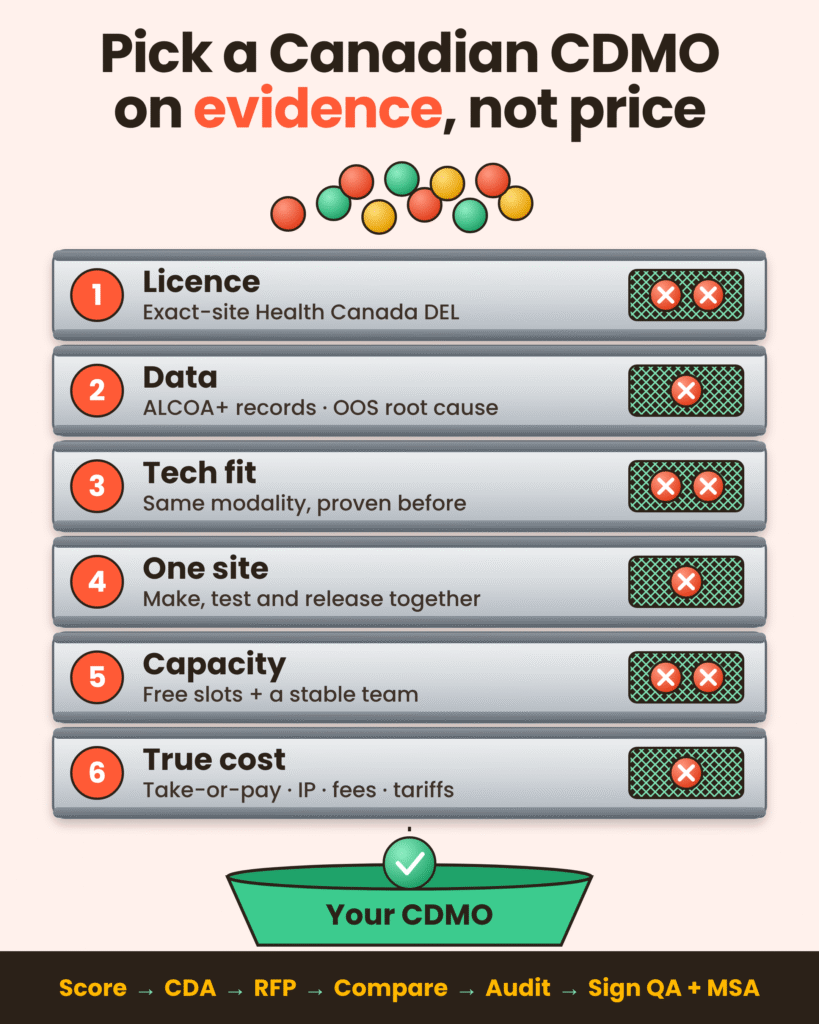
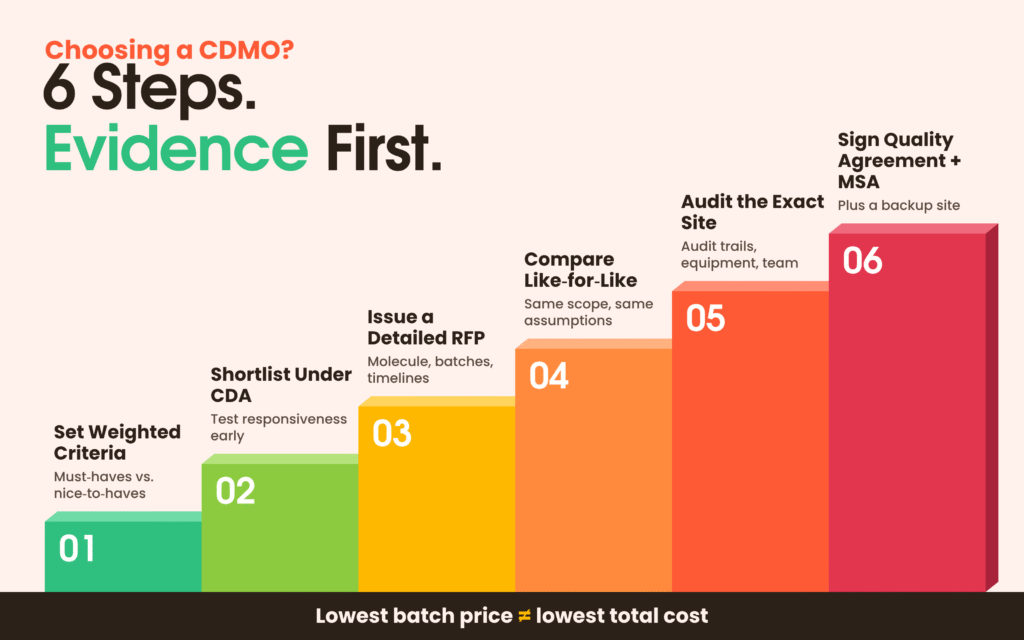
- Structured selection workflow: Score the candidates, sign CDAs, issue a detailed RFP, compare proposals like-for-like, audit the exact site, and then sign the Quality Agreement and MSA. For critical products, qualify a backup site early.
How to Evaluate the Best CDMO in Canada Across Regulatory and Quality Systems
Identifying the Best CDMO in Canada for a particular molecule requires a detailed assessment of the exact physical facility’s Health Canada DEL coverage, historical inspection outcomes recorded in the Drug and Health Products Inspections Database (DHPID), and U.S. FDA inspection records before reviewing pricing proposals or finalizing a Request for Proposal (RFP) shortlist. A company’s overall reputation cannot replace facility-specific regulatory verification because regulatory authorities inspect and issue observations against individual physical establishments rather than corporate organizations as a whole.
In Canada, pharmaceutical manufacturing, testing, packaging, and importation activities are regulated under Part C, Division 2 of the Food and Drug Regulations. According to Section C.02.003, no party may sell a drug, and no fabricator may use an active pharmaceutical ingredient (API) in drug fabrication, unless all applicable stages of fabrication, packaging/labelling, testing, and storage comply with Good Manufacturing Practices (GMP). When assessing a Canadian manufacturing contractor, sponsors must confirm that its DEL actively covers the specific licensable activities required for their program. These activities may include fabricating, packaging/labelling, testing, importing, distributing, or wholesaling. Verification must also extend to the relevant product category, whether pharmaceutical small molecules, Schedule D biologicals, Schedule C radiopharmaceuticals, or controlled substances.
Another essential consideration is ensuring that the outsourced activities fall under the appropriate Health Canada guidance document:
- GUI-0001 (Good Manufacturing Practices Guide for Drug Products): This guidance governs finished dosage forms, biologicals, radiopharmaceuticals, sterile API sterilization and aseptic processing, and physical dosage-form manufacturing activities, including granulation, coating, and heterogeneous API blending.
- GUI-0104 (GMP Guidelines for Active Pharmaceutical Ingredients): Implemented in February 2022, this framework applies to non-sterile APIs and intermediates, including milling and micronizing, up to the stage immediately before sterilization. For APIs intended for clinical trials, the applicable controls must be proportionate to the development stage and aligned with ICH Q7.
- GUI-0158 (GMP Guide for Natural Health Products): This guidance applies exclusively to natural health products. It must not be considered equivalent to pharmaceutical DEL compliance requirements established under GUI-0001 or GUI-0104.
Beyond domestic licensing requirements, Canadian CDMOs provide additional cross-border regulatory advantages through Health Canada’s Mutual Recognition Agreements (MRAs), administered by the Regulatory Operations and Enforcement Branch (ROEB). Canada maintains pharmaceutical MRAs with the European Union, including mutual recognition of extra-jurisdictional GMP inspections under CETA since April 1, 2021, as well as with the EEA-EFTA states, the United Kingdom, Australia, and Switzerland. The bilateral agreement with Switzerland was expanded on January 31, 2025, to include APIs, stable human blood/plasma products, and extra-jurisdictional certificates. Australia’s Therapeutic Goods Administration (TGA) also implemented an arrangement on March 1, 2024, that provides abbreviated GMP clearance without compliance verification fees when sponsors submit Health Canada third-country inspection evidence for API manufacturers, contract testing laboratories, and contract sterilisers. Additionally, Health Canada participates in the Pharmaceutical Inspection Co-operation Scheme (PIC/S) and collaborates with partner regulatory authorities, including the TGA, through the Access Consortium.
Sponsors must nevertheless understand two important limitations when using MRA pathways. First, extra-jurisdictional GMP recognition under the EU and Swiss MRAs does not remove the obligations of Canadian importers under Section C.02.019 for finished-product testing of dosage forms imported from third-country facilities. Furthermore, the EU MRA continues to exclude APIs and advanced therapy medicinal products under temporary exclusions. Second, as regulatory compliance analyses emphasize, MRAs do not eliminate the possibility of direct regulatory inspections or reduce established compliance expectations. Instead, because participating regulatory agencies exchange inspection findings, a serious GMP or data integrity deficiency at one manufacturing facility can quickly develop into a commercial risk across multiple jurisdictions. If the regulatory filing strategy includes the United States, sponsors should also examine the exact facility’s FDA Establishment Identifier (FEI) record for Form 483 observations, Warning Letters, and five-year NAI/VAI/OAI classifications. This is particularly relevant considering a May 2024 White & Case analysis cited in DrugPatentWatch, which reported that approximately 2,000 pharmaceutical manufacturing plants were awaiting post-pandemic FDA inspections, including more than 340 facilities in India and China.
| Verification Domain | Governing Standard or Database | Mandatory Pass/Fail Gate Criteria and Red Flags |
|---|---|---|
| Site Licence & Scope | Health Canada DEL & DHPID | Confirm active DEL listings and DHPID inspection outcomes for the exact facility address, drug category, and licensable activity under GUI-0001 or GUI-0104. Reject facilities offering only NHP compliance under GUI-0158 for prescription pharmaceutical products. |
| Foreign & Cross-Border Status | FDA FEI Database / Foreign Building Annex | Examine the last three Form 483s and corresponding written responses. Verify continuous submission of updated GMP evidence before NERBY deadlines for foreign API/product annexes. |
| Premises & Contamination Control | FDR C.02.004–005; GUI-0001; GUI-0119 | Confirm appropriate physical segregation of R&D laboratories, non-production areas, and high-potency containment HVAC systems. Reject facilities without sufficient cross-contamination prevention measures. |
| Quality Control Authority | FDR C.02.015; ICH Q8–Q11 | Regulatory consulting analyses identify Section C.02.015 quality control deficiencies as Health Canada’s largest deficiency area. Confirm that the facility maintains independent QA release authority. |
| Stability & Release Testing | FDR C.02.019; GUI-0001; ICH Stability | Verify qualified in-house stability programs, validated release methods, and clearly documented contractual responsibilities for finished-product testing. |
Data Integrity, Quality Agreements, and OOS Governance
A compliant Canadian CDMO protects the integrity of regulatory submissions through tamper-resistant electronic audit trails, documented Phase I and Phase II Out-of-Specification (OOS) investigations, and a clearly defined, severable technical Quality Agreement. Under GUI-0001 data integrity expectations, introduced through Health Canada’s 2017 draft updates, together with FDA 21 CFR Part 11 and ALCOA+ standards, regulatory inspectors pay close attention to laboratory data governance and electronic record management. As Canadian GMP compliance guidance explains, disabling audit trails or allowing shared user accounts within Chromatography Data Systems (CDS) or Laboratory Information Management Systems (LIMS) can result in immediate Non-Compliant (NC) inspection ratings.
During an on-site or desktop quality audit, sponsors should evaluate potential partners against four essential operational controls:
- System Access and Electronic Records: Confirm that every analyst uses a unique login and that laboratory personnel and IT administrators have clearly separated access privileges. Review validated backup procedures and documented Standard Operating Procedures (SOPs) governing periodic audit-trail reviews. These controls help ensure that electronic records remain attributable, traceable, and protected against unauthorized modifications.
- Paper Originals and Raw Data: Examine how paper printouts, laboratory notebooks, and analytical spreadsheets are maintained, controlled, and retained. The objective is to ensure that original records remain complete and accessible and cannot be selectively discarded, altered, or backdated. Proper documentation and record-retention practices are essential for maintaining the reliability of analytical results.
- OOS and Deviation Closure Discipline: Evaluate investigation closure timelines, recurring deviation trends, and the effectiveness of corrective and preventive actions. Classifying analytical failures as simple instances of “human error” without performing formal Phase I and Phase II root-cause investigations and integrating findings into the CAPA system represents a recurring critical inspection concern. Sponsors should confirm that the CDMO follows a scientifically justified investigation process before concluding any OOS event.
- Severable Quality Agreement Architecture: In accordance with FDA guidance cited in DrugPatentWatch, ensure that the Quality Agreement is maintained separately from, or is severable from, the Master Services Agreement (MSA). It should explicitly define responsibilities for change control, materials management, and OOS escalation while prohibiting unauthorized subcontracting. Commercial provisions, including pricing, delivery schedules, confidentiality, and liability limitations, should remain outside the technical Quality Agreement.
Review impurity control strategies under ICH Q3A for additional information on this aspect of pharmaceutical quality management.
Assessing Technical Fit, Modality Specialization, and Capacity Headroom
Selecting an appropriate manufacturing partner requires matching the physicochemical complexity of the molecule, clinical development phase, and anticipated production volumes with a facility that has demonstrated repeatable experience in the specific technology. Broad service portfolios and promotional capability statements are not sufficient evidence of technical suitability. Early-stage pharmaceutical sponsors frequently encounter outsourcing challenges when they engage a pure Contract Manufacturing Organization (CMO) before their formulation or manufacturing process is sufficiently developed for transfer. Similar problems arise when analytical method development and process scale-up are assigned to separate vendors without adequate technical coordination.
Read about the differences between peptide drugs and small-molecule drugs when assessing modality-specific development and manufacturing requirements.
| Partner Model | Core Deliverable | Optimal Lifecycle Window | Typical Pricing Structure | Switching Friction & Strategic Risk |
|---|---|---|---|---|
| CRO | Preclinical/clinical trial data, bioanalysis, and IND/NDA evidence under GCP/GLP | Discovery through Phase III and post-market studies | Full-service unit pricing, FSP, or fixed fee | Generally straightforward to switch between studies; does not provide GMP drug product manufacturing. |
| CMO | Commercial or late-stage clinical API/drug product manufactured using a sponsor-supplied process | Phase III registration batches and commercial supply | Per-batch fees, per-unit pricing, or cost-plus | Significant transfer risk when the client’s formulation or process has not achieved commercial maturity. |
| CDMO | Developed formulation, validated methods, technology transfer, and GMP clinical/commercial supply | Pre-formulation and Phase I through commercial launch | Work packages, FTE, FFS, milestones, or per-batch pricing | Switching requires re-validation and comparability activities, which may take 12 months or longer for biologics. |
| Integrated CRDMO / CDMO+CRO | Connected early research, CMC development, bioanalysis, and GMP supply | Discovery through clinical proof-of-concept and scale-up | Combines CRO study/unit fees with CDMO FTE, milestone, and batch pricing | Concentrates IP, data, and supply risks with one provider, making clearly defined exit provisions essential. |
During technical qualification, sponsors should ask how many client programs the facility has successfully executed using the same dosage form, containment class, and molecular modality required for their project. Previous experience with conventional oral solid dosage forms or standard monoclonal antibodies does not automatically establish expertise in high-potency APIs (HPAPIs), modified-release Wurster coatings, biodegradable polymer matrices, or complex peptide and oligonucleotide therapeutics. Equally important is confirming that process development chemists collaborate directly with GMP quality and CMC regulatory personnel from the beginning of the project. This coordination helps prevent non-scalable unit operations, unsuitable manufacturing approaches, or unqualified raw-material suppliers from becoming embedded in clinical manufacturing batches.
Verifying Single-Site Integration When Shortlisting the Best CDMO in Canada
When evaluating the Best CDMO in Canada for complex small molecules, peptides, or controlled-release formulations, sponsors should verify whether synthesis, formulation development, analytical characterization, and GMP release testing are genuinely integrated at a single physical site. Such integration can reduce technology-transfer failures by limiting the need for repeated method validations, inter-site material transportation, and unnecessary coordination between separate development and testing vendors. Multi-site outsourcing arrangements can also introduce delays of several months because technical knowledge and process context must repeatedly be communicated between different teams.
For specialized modalities, including GLP-1 peptide analogues (semaglutide, liraglutide, and tirzepatide), peptide-oligonucleotide conjugates, PLGA/PLA/PCL and PEG-copolymer drug-delivery systems, trace nitrosamine/NDSRI impurity assessments, and Extractables & Leachables (E&L) safety programs, sponsors may benefit from considering specialized, scientist-led Canadian facilities. High-volume generalist manufacturing plants may prioritize larger commercial programs, potentially placing smaller clinical projects at risk of schedule displacement.
ResolveMass Laboratories Inc., for example, operates from a single integrated facility in Laval, Québec, bringing together custom organic and polymer synthesis, formulation development, high-resolution mass spectrometry and quantitative NMR characterization, bioanalytical LC-MS/MS, and Health Canada GMP-licensed analytical release testing. Its regulatory credentials include Drug Establishment Licence 3-002945-A, US FDA Establishment ID 3042696771, and an ISO 9001:2015-certified Quality Management System. Maintaining these four technical disciplines within one facility supports analytical continuity from IND/ANDA method development through GMP release testing. This integrated approach can also reduce the operational complexity associated with transferring analytical knowledge and maintaining consistent characterization standards throughout the development lifecycle.
Sponsors evaluating Canadian peptide manufacturing partners can examine the specific capabilities and development support offered by a peptide CDMO in Canada when considering an integrated outsourcing arrangement.
Evaluating Utilization Rates, Batch Success Metrics, and Canadian Workforce Continuity
Operational reliability within Canada’s pharmaceutical outsourcing sector depends not only on analytical instrumentation and manufacturing infrastructure but also on available facility capacity and the retention of experienced GMP personnel. PharmaSource’s outsourcing whitepaper cautions that CDMOs operating at utilization rates above 85% to 90% generally have limited capacity for additional commercial scale-up activities without 12 to 18 months of capital investment and preparation time. Similarly, Cytiva’s bioprocessing insights highlight that specialized manufacturing bottlenecks, such as viral vector production suites, have created waiting periods ranging from 6 months to 2 years for some sponsors.
Before awarding a manufacturing contract, sponsors should examine measurable execution indicators, workforce stability, and the continuity of assigned project teams. In cell therapy and advanced biologics manufacturing, for instance, ElevateBio reports that industry first-time-right manufacturing rates typically remain around 85% to 90%, whereas leading organizations consistently achieve rates above 95%. Across Canada’s expanding life sciences sector, federal and provincial investments continue to strengthen manufacturing infrastructure. These initiatives include federal commitments such as the 127 million announced in 2026 for life sciences programs, alongside investments in Ontario, Quebec, and British Columbia.
However, Agilus Work Solutions observes that the expansion of facility infrastructure has progressed faster than the availability of experienced GMP production supervisors, validation engineers, and QA specialists. Because specialized cleanroom expertise and regulated manufacturing competence require substantial training and practical experience, sponsors should not assume that newly expanded facilities automatically have sufficient qualified personnel. Instead, they should request direct discussions with the scientists and project leads assigned to their programs, clarify their rights to conduct person-in-plant observations, and verify how competing client requirements for equipment and production resources are prioritized. A documented backup project-manager continuity plan should also be included to protect the program against unexpected staffing changes or personnel departures.
Explore peptide CDMO scale-up services to understand the considerations involved in moving peptide processes toward larger-scale production.
Structuring CDMO Pricing Models, Contracts, and Total Cost of Ownership
Comparing CDMO proposals exclusively on the basis of quoted batch prices or hourly rates can conceal important contractual obligations, regulatory pass-through expenses, and commercial variables that influence the overall cost of a pharmaceutical development program. Industry benchmarking cited by Corstrate indicates that North American CDMO quotations for comparable cell-therapy technology transfers and GMP manufacturing campaigns can range from approximately 1.5 million to nearly 4 million. These differences are primarily associated with variations in technical approaches and project requirements rather than labor costs alone.
To minimize unexpected financial exposure during later development stages, sponsors should evaluate every proposal across the five commercial layers identified in DrugPatentWatch’s CDMO pricing framework:
- Direct Service Fees: Review the proposed batch pricing, Full-Time Equivalent (FTE) labor rates, and fixed project fees. Each quotation should clearly identify the activities, deliverables, and resources included in the stated price.
- Capacity Commitments and Cancellation Formulas: Examine non-refundable reservation deposits, take-or-pay minimums, and cancellation penalties. In a DrugPatentWatch contract modeling scenario involving 12 reserved manufacturing slots, where the sponsor uses only 7 at a baseline batch price of 2.0 million, a strict take-or-pay provision increases the effective cost per utilized batch by 71.4%, bringing it to 3.43 million. However, negotiating a resale credit when 3 of the 5 unused slots are resold reduces the additional cost to 28.6%, or 2.57 million per batch. This arrangement generates savings of 6.0 million without requiring any change to the originally quoted batch price.
- Platform IP and Improvement Ownership: Clearly establish ownership and licensing provisions for cell lines, platform technologies, royalties, annual per-product fees, and process improvements. Contracts should distinguish foreground intellectual property generated during the project from background intellectual property that already belongs to the CDMO or sponsor.
- Regulatory User-Fee Pass-Throughs: Contractual agreements must explicitly allocate responsibility for application fees and facility-related regulatory charges. Under U.S. generic regulatory pathways governed by GDUFA, FY2026 Drug Master File fees of 102,584 and ANDA fees of 358,247 apply alongside relevant facility fees. For FY2027, foreign CMO facilities are subject to fees of 70,208, compared with 55,208 for U.S. domestic CMOs, representing a 15,000 (27.2%) difference. In Canada, importer DEL fees also vary according to the authorized activity scope and the number of foreign buildings listed on the licence.
- Geopolitical and Tariff Exposure: A PharmaSource industry whitepaper reports that 76% of surveyed manufacturers identify trade uncertainty as their primary concern. As a result, pharmaceutical sponsors should evaluate potential 25% API tariffs, Biosecure Act exposure, and broader geopolitical risks when comparing domestic and international manufacturing arrangements. Geographic proximity within Canada or North America may provide additional supply-chain advantages, depending on the program’s sourcing requirements.
Review the considerations involved in choosing United States or overseas peptide CDMOs when evaluating international outsourcing arrangements.
Selecting the Appropriate CDMO Contracting Model
Selecting the appropriate Layer 1 billing mechanism depends on how clearly the technical requirements, project scope, and expected deliverables have been established.
| Contracting Model | Billing Structure | Best-Fit Program Scope | Primary Advantage | Key Risk & Negotiation Guardrail |
|---|---|---|---|---|
| Fee-for-Service (FFS) | A fixed overall price for clearly defined deliverables. | Validated method transfers, routine stability pulls, or finalized GMP batches. | Offers predictable budgeting when technical parameters and deliverables are fully established. | Scope modifications may trigger formal change orders and additional charges. Define technical assumptions and deliverables precisely before execution. |
| Full-Time Equivalent (FTE) | Dedicated scientists are billed at an agreed monthly or annual rate. | Complex route scouting, peptide/polymer optimization, and iterative early R&D. | Avoids repeated quotation delays and supports continuous technical learning throughout development. | Potential skill-mix mismatches or overstaffing can increase costs. Establish monthly durations, milestone-based exit options, and clear sponsor ownership of surplus output and IP. |
| Time and Materials (T&M) | Actual working hours are billed alongside pass-through material expenses. | Undefined or exploratory troubleshooting activities where the required effort cannot be accurately estimated in advance. | Provides flexibility without requiring a rigid commitment to predefined deliverables. | Transfers most efficiency and scope-related risks to the sponsor. Negotiate expenditure caps and milestone-based reviews to prevent uncontrolled spending. |
Review custom peptide synthesis services when defining the scope of specialized peptide work.
Step-by-Step Selection Workflow: From Weighted Scoring to Tech Transfer
Implementing a structured procurement and qualification process helps prevent subjective vendor selection, identifies technical scope gaps at an early stage, and establishes an auditable qualification record that can support regulatory submissions and future inspections.
1. Translate CMC Requirements Into Weighted Criteria
Begin by separating mandatory qualification requirements from additional preferences. Non-negotiable requirements may include active Health Canada DEL coverage, appropriate sterile containment capabilities, and validated analytical testing systems. Additional preferences may include geographic proximity, sustainability performance, or broader service availability. Develop a quantitative scorecard covering Technical Fit, Quality/Regulatory History, Cost, Schedule, and Cultural Alignment. Assign appropriate weightings to each category based on the molecule’s development stage and program requirements.
Review GMP peptide API manufacturing services when identifying the technical requirements relevant to peptide manufacturing.
2. Shortlist Candidates and Test Responsiveness Under CDA
Approach CDMOs that have relevant experience with the required molecular modality and manufacturing processes. Before sharing confidential technical information, execute mutual Confidential Disclosure Agreements (CDAs). During the CDA negotiation process, evaluate each candidate’s legal responsiveness, communication practices, and willingness to address technical questions. The speed and quality of these initial interactions can provide an early indication of how effectively the organization may manage a long-term development partnership.
Sponsors considering U.S.-based providers can separately examine the capabilities and operating considerations associated with a peptide CDMO in the United States before finalizing their shortlist.
3. Issue a Granular, Standardized RFP
Prepare a detailed Request for Proposal that describes the molecule’s attributes, manufacturing process, target batch sizes, analytical method requirements, and applicable regulatory jurisdictions. Include clearly defined technology-transfer deliverables, realistic project timelines, and payment milestones. The proposed schedule should account for raw-material procurement, packaging component availability, equipment qualification, and other dependencies that could affect manufacturing readiness.
See the considerations for CMC documentation at a CDMO for ANDA projects when defining documentation requirements.
4. Normalize Proposals Like-for-Like
Organize structured proposal review meetings to ensure that all shortlisted CDMOs have interpreted the project requirements consistently. Reconcile differences in assumptions concerning analytical method validation, reference standards, stability pulls, and regulatory pass-through expenses. This step allows sponsors to compare proposals using consistent technical and commercial criteria rather than relying on headline pricing that may exclude important project activities.
5. Conduct On-Site Technical and Quality Audits
Perform detailed technical and quality audits at the exact facility designated for the sponsor’s manufacturing batches. Evaluate electronic audit trails, qualified material suppliers, equipment calibration records, and the technical capabilities of the assigned bench team. Verify that the CDMO follows transparent deviation reporting and escalation procedures and that its manufacturing infrastructure can support the proposed process throughout the intended development and production stages.
Review sterile fill-finish services for peptide injectables when evaluating these specialized manufacturing requirements.
6. Execute Dual-Track Agreements and Supply Contingency
Finalize a severable Quality Agreement alongside an MSA that clearly establishes intellectual property ownership, FTE commitments, cancellation provisions, and mandatory change notifications. Define technical responsibilities and quality-related escalation procedures before project execution. For commercially critical products, consider qualifying a secondary manufacturing site in advance rather than waiting for a supply disruption to occur. This approach strengthens supply continuity and provides greater flexibility if the primary manufacturing partner experiences operational or regulatory difficulties.
Conclusion
Choosing the Best CDMO in Canada requires treating facility-specific regulatory compliance, integrated technical capabilities, and full-lifecycle contractual economics as interconnected strategic and engineering considerations rather than approaching vendor selection as a simple comparison of manufacturing prices. By first verifying Health Canada DEL coverage and ALCOA+ data integrity controls, confirming demonstrated manufacturing experience with the exact molecular modality, and negotiating balanced FTE or batch commitments with appropriate exit and resale provisions, pharmaceutical sponsors can substantially reduce the likelihood of expensive technology-transfer delays and unexpected commercial challenges.
Whether the objective is to advance a complex peptide therapeutic, develop a polymer-based drug-delivery system, or establish a reliable manufacturing pathway for a regulated commercial product, selecting a partner through documented operational evidence and measurable qualification criteria can make Canadian pharmaceutical outsourcing a more dependable route to clinical development and commercial supply.
If your R&D or CMC team is assessing specialized organic or polymer synthesis, peptide characterization, nitrosamine or E&L safety programs, or Health Canada GMP-licensed analytical release testing in Canada, connect with our scientific specialists to discuss your project requirements and technical objectives.
Contact ResolveMass Laboratories Inc.
Frequently Asked Questions
According to a CAPRA regulatory industry briefing, facilities should submit their DEL applications at least 250 days before they intend to begin GMP-regulated activities. Health Canada aims to conduct the initial inspection by approximately day 190 after receiving the application, which generally corresponds to 3 to 4 months after submission. The remaining timeline includes approximately 30 days for report finalization and another 30 days for the facility to submit its response.
GUI-0001 establishes GMP requirements for finished dosage forms, biologicals, radiopharmaceuticals, sterile APIs, and physical processing activities such as granulation and coating. In comparison, GUI-0104, introduced in February 2022, addresses non-sterile APIs and intermediates through the stage immediately before sterilization. For clinical-trial API manufacturing, sponsors should also ensure that the quality controls are appropriate for the development stage and consistent with ICH Q7.
No. Mutual Recognition Agreements help participating regulatory authorities avoid unnecessary duplication of routine GMP inspections through the exchange of inspection evidence and Certificates of Compliance (CoC). However, agencies such as the FDA and European regulators retain the authority to inspect facilities whenever regulatory risks or specific application requirements justify an inspection. Canadian importers must also continue meeting Section C.02.019 finished-product testing requirements for applicable third-country imports, while significant compliance deficiencies can affect regulatory confidence across multiple jurisdictions.
A CRO is generally appropriate when a sponsor requires preclinical toxicology, bioanalytical investigations, or clinical trial support under GLP/GCP requirements. A CMO is better suited to programs with established formulations and manufacturing processes that primarily need GMP production capacity. A CDMO or integrated CDMO/CRO is more appropriate when the project requires formulation development, analytical method validation, process optimization, and coordinated progression toward clinical or commercial manufacturing.
Pharmaceutical technology transfers generally require 4 to 24 months, depending on process complexity, analytical requirements, and the receiving facility’s capabilities. Complex biologics may require a year or longer because of additional site qualification, analytical comparability, and regulatory activities. According to a PharmaSource industry whitepaper, approximately 50% of technology transfers experience quality-related problems, often because essential process knowledge is undocumented or communication between development and manufacturing teams is inadequate.
A CDMO Quality Agreement should clearly allocate cGMP responsibilities between the sponsor and service provider, including QA release authority, equipment and facility controls, supplier qualification, data integrity, OOS investigations, deviation management, and change control. It should also establish procedures for escalating quality concerns and controlling third-party subcontracting. Commercial matters such as pricing, delivery schedules, confidentiality provisions, and liability limitations should remain within the Master Services Agreement (MSA), with the Quality Agreement maintained as a separate or severable document.
The most suitable pricing arrangement depends on how clearly the project scope and technical requirements have been established. FFS is generally more appropriate for predefined activities such as analytical testing, routine stability studies, and finalized GMP batches, where deliverables can be agreed upon in advance. For evolving formulations, complex peptides, and synthetic chemistry optimization, an FTE model offers greater flexibility by providing dedicated scientific resources. Sponsors should negotiate defined engagement periods, milestone-based exit options, and clear ownership of project-generated outputs and intellectual property.
Regulatory inspectors closely examine practices that could compromise the accuracy, completeness, and traceability of laboratory records. Common high-risk deficiencies include shared analyst accounts, excessive IT administrator privileges, disabled or inadequately reviewed audit trails, uncontrolled analytical spreadsheets, and missing or improperly modified original records. Unjustified attribution of OOS results to “human error” without documented Phase I and Phase II investigations and appropriate CAPA implementation can also lead to significant inspection findings and Non-Compliant ratings.
Facility utilization above 85% to 90% may indicate limited capacity for accommodating additional manufacturing programs or increasing commercial production volumes. A PharmaSource industry whitepaper suggests that heavily utilized facilities may require 12 to 18 months of additional capital investment and equipment qualification before supporting further expansion. For specialized manufacturing operations, particularly viral vector production, Cytiva has highlighted capacity constraints that have resulted in sponsor waiting periods ranging from 6 months to 2 years.
Reference:
- Invest in Canada. (n.d.). Biomanufacturing and life sciences in Canada. https://www.investcanada.ca/industries/biomanufacturing-life-sciences
- Innovation, Science and Economic Development Canada. (n.d.). Canada’s biomanufacturing and life sciences strategy. Government of Canada. https://ised-isde.canada.ca/site/ised/en/programs-and-initiatives/health-emergency-readiness-canada/overview-canadas-biomanufacturing-and-life-sciences-strategy/canadas-biomanufacturing-and-life-sciences-strategy
- Innovation, Science and Economic Development Canada. (n.d.). Overview of Canada’s biomanufacturing and life sciences strategy. Government of Canada. https://ised-isde.canada.ca/site/ised/en/programs-and-initiatives/health-emergency-readiness-canada/overview-canadas-biomanufacturing-and-life-sciences-strategy
- Health Canada. (n.d.). Good manufacturing practices (GMP) guidelines (GUI-0001). Government of Canada. https://www.canada.ca/en/health-canada/services/drugs-health-products/compliance-enforcement/good-manufacturing-practices/guidance-documents/gmp-guidelines-0001/document.html
- Health Canada. (2022, February 10). Good manufacturing practices guidelines for active pharmaceutical ingredients (GUI-0104). Government of Canada. https://www.canada.ca/en/health-canada/services/drugs-health-products/compliance-enforcement/information-health-product/drugs/guidelines-active-pharmaceutical-ingredients-0104/document.html
- Health Canada. (n.d.). Acronyms, glossary and references: Guide for natural health products (GUI-0158). Government of Canada. https://www.canada.ca/en/health-canada/services/drugs-health-products/compliance-enforcement/good-manufacturing-practices/guidance-documents/guide-natural-health-products-0158/acronyms-glossary-references.html
- Health Canada. (n.d.). International Council for Harmonisation (ICH): Guidelines. Government of Canada. https://www.canada.ca/en/health-canada/services/drugs-health-products/drug-products/applications-submissions/guidance-documents/international-council-harmonisation/guidelines.html
Get In Touch With Us
About The Author