

Introduction:
A Bioanalytical CRO for AI drug discovery plays a critical role in transforming AI-generated hypotheses into validated, regulatory-ready drug candidates. While artificial intelligence accelerates target identification and molecule design, it relies entirely on accurate experimental data to refine predictive models.
AI can suggest thousands of potential molecules—but without reliable bioanalytical validation, those predictions lack real-world relevance. This is where ResolveMass Laboratories Inc. bridges the gap between computational innovation and laboratory-proven outcomes, delivering bioanalytical services in drug development tailored for AI-driven pipelines.
Share via:
Summary:
- Bioanalytical CRO for AI drug discovery bridges computational predictions with real-world biological validation.
- AI identifies targets and molecules; bioanalytical CROs confirm potency, PK/PD, safety, and biomarker relevance.
- High-resolution mass spectrometry, ligand-binding assays, and high-sensitivity bioanalysis enable data-rich validation.
- Regulatory-aligned bioanalysis ensures IND and NDA readiness through regulated bioanalytical services.
- Early integration of AI models with virtual bioanalytical strategy reduces attrition, timelines, and cost.
- ResolveMass Laboratories Inc. delivers AI-compatible, regulatory-grade bioanalytical laboratory services for modern drug discovery programs.
1: What Does a Bioanalytical CRO for AI Drug Discovery Actually Do?
A Bioanalytical CRO for AI drug discovery transforms AI-generated molecule predictions into experimentally validated, regulatory-ready data packages. It verifies whether a computationally promising compound truly works in biological systems — and whether it is safe and viable enough to move toward IND-enabling bioanalytical studies.
Artificial intelligence can identify high-probability targets and design optimized molecular structures. However, drug development decisions cannot be made on predictions alone. Regulatory agencies such as the U.S. Food and Drug Administration and Health Canada require robust, reproducible laboratory evidence before clinical progression.
A bioanalytical CRO provides that evidence.
Core Functions of a Bioanalytical CRO for AI Drug Discovery
In practical terms, this includes:
- Quantifying drug concentrations using LC-MS/MS bioanalytical services and advanced bioanalytical quantification workflows.
- Characterizing metabolites through LC-MS/MS bioanalysis of xenobiotics.
- Performing PK/PD studies supported by PK/PD bioanalysis and PK-TK bioanalysis.
- Supporting biomarker analysis through biomarker bioanalytical services and advanced proteomics bioanalytical services.
- Ensuring compliance through validated bioanalytical method validation and quality bioanalysis.
- Robust validation ensures robust bioanalytical data that regulators and AI systems can trust.
Bridging AI Predictions to Biological Reality
AI may predict that Compound X binds strongly to Target Y based on molecular modeling and training datasets. A Bioanalytical CRO for AI drug discovery answers the critical downstream questions:
- Does Compound X reach systemic circulation?
- Is it metabolically stable?
- Does it maintain sufficient exposure over time?
- Does it modulate the intended biomarker?
- Are there unexpected metabolites or off-target effects?
- Is the exposure–response relationship strong enough to justify progression?
Only experimental bioanalytical data can confirm these parameters.
Why This Validation Layer Is Essential
Without this bioanalytical validation:
- AI-generated compounds remain theoretical.
- PK/PD relationships remain unknown.
- Safety signals may go undetected.
- Regulatory submissions cannot proceed.
A Bioanalytical CRO for AI drug discovery provides the quantitative backbone that enables confident decision-making. By integrating advanced analytical chemistry, biological assay development, and regulatory expertise, these organizations convert machine learning outputs into actionable development milestones.
In the AI era of drug discovery, computational speed must be matched with analytical precision. Bioanalytical CROs ensure that innovation moves forward on a foundation of scientifically defensible data.
2: Why AI-Driven Drug Discovery Still Requires Experimental Validation
AI systems depend on high-quality experimental data. That is why a Bioanalytical CRO for AI drug discovery is essential: it delivers structured datasets aligned with data integrity in bioanalytical studies principles.
Even the most sophisticated deep learning and generative models rely on training datasets derived from experimental measurements. If those datasets are inconsistent, biased, or poorly validated, predictive performance deteriorates. That is why a Bioanalytical CRO for AI drug discovery is essential: it provides accurate, reproducible biological data that strengthens both regulatory submissions and machine learning models.
Regulatory agencies such as the U.S. Food and Drug Administration and Health Canada require experimentally verified pharmacokinetic and safety data — not algorithmic probability scores. Therefore, experimental validation is not just scientifically necessary; it is a regulatory requirement.
AI Models Generate Hypotheses — Not Biological Proof
Artificial intelligence platforms can:
- Predict target–ligand binding affinity
- Model molecular interactions
- Suggest optimized chemical modifications
- Rank candidate compounds
However, AI cannot independently confirm:
- Whether the molecule remains stable in plasma
- Whether it is rapidly metabolized
- Whether it triggers immune responses
- Whether predicted exposure levels occur in vivo
Only validated bioanalytical testing can answer these questions.
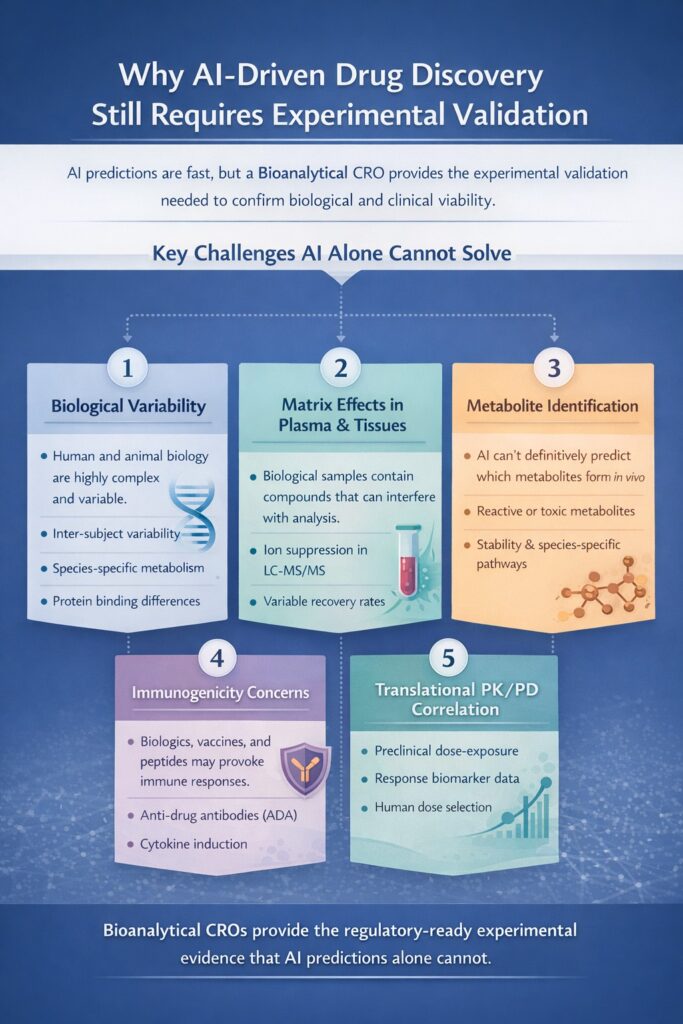
Key Challenges AI Alone Cannot Solve
Below are the most critical limitations of AI-only approaches — and where a Bioanalytical CRO for AI drug discovery becomes indispensable.
1. Biological Variability
Human and animal biological systems are inherently variable. Genetic differences, enzyme polymorphisms, and disease states influence drug behavior.
AI models typically train on historical datasets. But real biological systems introduce:
- Inter-subject variability
- Species-specific metabolism
- Protein binding differences
- Variations in clearance rates
Bioanalytical testing quantifies these differences under controlled experimental conditions.
2. Matrix Effects in Plasma and Tissues
Biological matrices such as plasma, serum, and tissue homogenates contain proteins, lipids, and endogenous compounds that can interfere with detection.
Matrix effects are a major challenge in LC-MS/MS workflows. Learn more about bioanalytical matrix effects and how controlled validation prevents analytical variability.
Matrix effects can:
- Suppress or enhance ionization in LC-MS/MS
- Alter apparent drug concentration
- Introduce variability across sample batches
A Bioanalytical CRO for AI drug discovery validates methods to control and quantify these matrix effects, ensuring accurate drug concentration measurements.
3. Metabolite Identification
AI can predict possible metabolic pathways using in silico tools, but it cannot definitively confirm which metabolites form in vivo.
In silico tools cannot replace experimental profiling through bioanalytical method development and solutions addressing challenges in bioanalytical method development.
Experimental metabolite profiling reveals:
- Major and minor metabolic pathways
- Reactive or toxic metabolites
- Species differences in metabolism
- Stability and degradation products
Metabolite identification is critical for safety evaluation and regulatory approval.
4. Immunogenicity Concerns
For peptides, biologics, and novel molecular constructs, immunogenicity risk cannot be reliably predicted by algorithms alone.
Complex therapeutics such as biologics and cell therapies require specialized cell and gene therapy bioanalysis and antibody-drug conjugate bioanalytical services.
Experimental assays assess:
- Anti-drug antibody (ADA) formation
- Neutralizing antibody response
- Cytokine release
- Immune activation markers
These factors directly influence safety and long-term therapeutic viability.
5. Translational PK/PD Correlation
One of the most complex aspects of drug development is translating preclinical exposure to human clinical response.
Validated clinical bioanalytical services and toxicokinetic bioanalysis inform human dose prediction and regulatory progression.
AI may estimate pharmacokinetic behavior, but translational modeling requires real data from:
- Preclinical animal studies
- Dose-escalation experiments
- Biomarker-driven response curves
A Bioanalytical CRO for AI drug discovery generates validated PK/PD datasets that inform translational modeling and first-in-human dose selection.
3: How a Bioanalytical CRO for AI Drug Discovery Enhances Model Accuracy
A Bioanalytical CRO for AI drug discovery enhances predictive models through high-quality, structured datasets generated via rapid bioanalytical method development and scalable high-throughput bioanalysis platforms.
The integration of AI and laboratory systems is further explored in AI in bioanalysis.
Artificial intelligence systems improve through iteration. However, their learning quality depends entirely on the precision, reproducibility, and integrity of the input data. Bioanalytical CROs provide experimentally validated datasets that reduce noise, eliminate false positives, and strengthen predictive confidence across drug discovery pipelines.
The Feedback Loop Between AI and Bioanalysis
AI and bioanalysis operate in a cyclical, data-driven partnership. Below is a simplified overview of how a Bioanalytical CRO for AI drug discovery improves each phase of development:
| AI Phase | Bioanalytical Contribution | Outcome |
|---|---|---|
| Target Identification | Biomarker validation | Confirms biological relevance of predicted target |
| Hit Identification | Binding & potency assays | Prioritizes true actives and eliminates weak candidates |
| Lead Optimization | PK/PD profiling | Selects candidates with optimal exposure-response balance |
| Preclinical Testing | GLP-compliant bioanalysis | Generates IND-ready, regulatory-grade datasets |
Each iteration strengthens both the computational model and the development decision framework.
4: The Role of Biomarker Quantification in AI Drug Discovery
Biomarkers translate molecular predictions into measurable biological responses.
Multiplex biomarker testing via biomarker bioanalytical services ensures measurable biological confirmation of AI predictions.
For oligonucleotide therapeutics, LC-MS bioanalysis for oligonucleotides supports emerging AI-designed modalities.
AI may suggest pathway modulation, but biomarker quantification confirms whether:
- The pathway is actually engaged
- The magnitude of modulation is clinically meaningful
- Off-target effects are occurring
A Bioanalytical CRO for AI drug discovery provides:
- Multiplex biomarker assays
- Ultra-sensitive detection methods
- Cross-species translational analysis
- Longitudinal sample stability validation
This ensures AI-generated candidates are not only theoretically promising but biologically effective.
5: Regulatory Alignment: Why It Matters Early
Regulatory strategy must be integrated from the earliest stages of AI-driven programs.
AI-generated compounds will ultimately require submission to agencies such as the U.S. Food and Drug Administration and Health Canada. Bioanalytical data must meet global regulatory expectations, including:
- Method validation (accuracy, precision, selectivity, sensitivity)
- Stability studies
- Matrix effect evaluation
- Audit-ready documentation
A specialized Bioanalytical CRO for AI drug discovery ensures:
- Data integrity
- Traceability
- Compliance with GLP and regulatory guidance
Regulatory readiness requires:
- Bioanalytical stability testing
- GLP-compliant bioanalytical CRO services for PK and TK
- Comprehensive bioanalytical services for IND/NDA submissions
Understanding discovery vs regulated bioanalysis helps AI innovators plan early-stage strategy.
Early regulatory alignment prevents costly rework during IND submissions.
6: How ResolveMass Laboratories Inc. Supports AI-Driven Drug Discovery
ResolveMass Laboratories Inc. combines advanced mass spectrometry expertise with regulatory-focused bioanalysis to support AI-native pharmaceutical innovators.
ResolveMass delivers comprehensive bioanalytical CRO support through scalable bioanalytical services and advanced advanced bioanalytical strategies for complex drug modalities.
We also support biosimilar bioanalysis and complex translational programs.
Core Capabilities
- LC-MS/MS quantitative bioanalysis
- Peptide and complex molecule characterization
- Metabolite profiling
- PK/PD analysis
- Biomarker quantification
- IND-enabling bioanalytical support
Why Experience Matters
AI-generated molecules often include:
- Non-classical scaffolds
- Modified peptides
- Macrocycles
- Hybrid biologic-small molecule constructs
These require sophisticated analytical method development. Our scientific team has extensive experience handling complex molecular entities, ensuring robust assay validation and reproducibility.
7: How a Bioanalytical CRO for AI Drug Discovery Reduces Development Risk
A Bioanalytical CRO for AI drug discovery minimizes attrition by identifying failures early.
Risk Reduction Areas
- Early exposure confirmation
- Rapid metabolite identification
- Toxicokinetic correlation
- Immunogenicity detection
- Stability profiling
Sponsors can outsource bioanalysis for biotech startups or leverage bioanalytical services outsourcing for pharma to minimize risk and cost.
Explore bioanalytical testing services cost and cost-effective bioanalytical services for strategic planning.
By integrating bioanalysis into early AI screening phases, sponsors avoid advancing non-viable candidates into costly animal or clinical studies.
8: Data Integrity and Trust in the AI Era
Trustworthy data is foundational for both regulators and machine learning systems.
High standards in bioanalytical method transfer and proactive mitigation of common bioanalytical mistakes ensure defensible datasets.
Effective managing bioanalytical CRO projects further strengthens collaboration.
ResolveMass Laboratories Inc. follows strict:
- SOP-driven laboratory workflows
- Controlled sample tracking systems
- Calibrated instrumentation maintenance
- Full audit-trail documentation
This ensures that AI training datasets are reproducible and defensible.
Authoritative bioanalysis strengthens both regulatory confidence and algorithm performance.
9: Emerging Trends: AI and Bioanalysis Convergence
The next phase of drug discovery will see deeper integration between AI platforms and laboratory data systems.
Future-ready organizations rely on outsourced bioanalysis for drug development combined with structured digital integration.
ResolveMass continues to evolve its resolvemass bioanalytical services overview to support AI-native drug developers.
Emerging Integrations
- Automated sample preparation
- Real-time data upload to AI engines
- Predictive PK modeling informed by live bioanalytical data
- Cloud-based data harmonization
A forward-thinking Bioanalytical CRO for AI drug discovery must operate at the intersection of data science and laboratory excellence.
ResolveMass Laboratories Inc. is structured to support this convergence with scalable analytical workflows and data-compatible output formats.
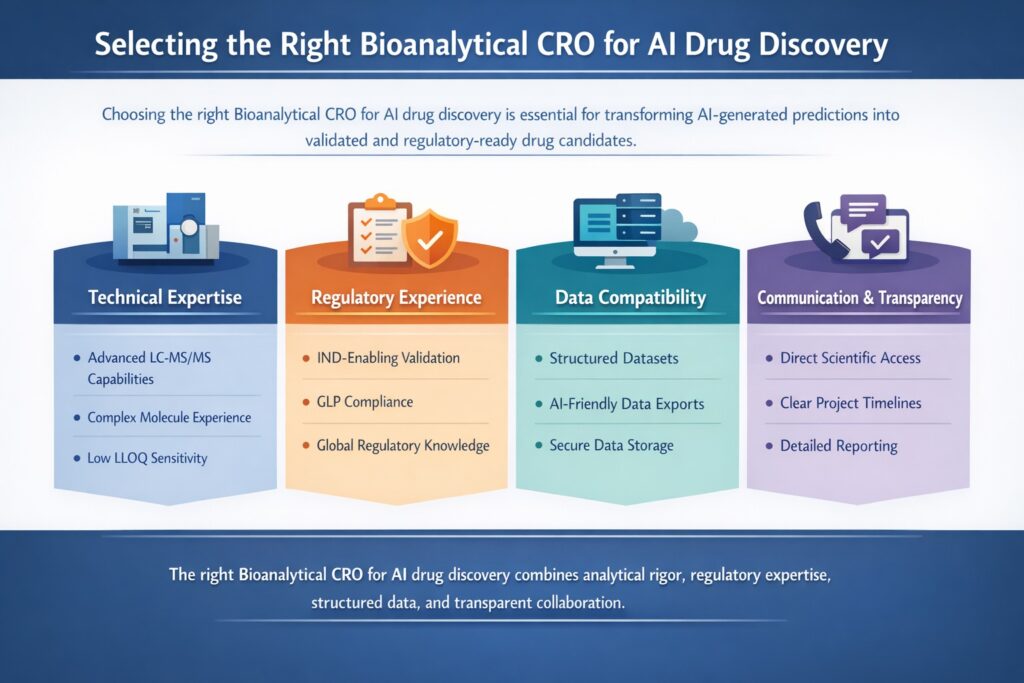
10: Selecting the Right Bioanalytical CRO for AI Drug Discovery
Choosing the right Bioanalytical CRO for AI drug discovery directly impacts model accuracy, regulatory success, and development timelines. The ideal partner must combine deep analytical expertise, regulatory experience, structured data delivery, and transparent scientific collaboration.
AI-generated molecules often involve unconventional chemistries, novel scaffolds, or modified peptides. Without a technically advanced and regulatory-aligned bioanalytical partner, even the most promising computational candidates may fail to progress.
For startups, explore affordable bioanalytical services for biotech startups and bioanalytical outsourcing models.
Understanding why bioanalysis is important reinforces the strategic role of laboratory validation in AI pipelines.
Below are the key evaluation criteria sponsors should consider.
1. Technical Expertise
A Bioanalytical CRO for AI drug discovery must demonstrate advanced analytical capabilities that match the complexity of AI-designed molecules.
What to Look For:
- Advanced LC-MS/MS capabilities
High-resolution systems with strong selectivity and sensitivity for complex biological matrices. - Complex molecule experience
Proven track record handling peptides, macrocycles, modified biologics, and hybrid constructs. - Low LLOQ sensitivity
Ability to detect ultra-low drug concentrations to support early PK and dose-escalation studies.
Why It Matters
AI platforms may optimize binding affinity in silico, but subtle chemical modifications can dramatically affect stability and detectability in vivo. High-performance mass spectrometry ensures precise quantification and metabolite profiling, minimizing analytical blind spots.
2. Regulatory Experience
Regulatory readiness should not be an afterthought. A qualified Bioanalytical CRO for AI drug discovery integrates compliance from the earliest assay development stages.
Essential Regulatory Capabilities:
- IND-enabling method validation
Full validation for accuracy, precision, selectivity, sensitivity, and stability. - Global regulatory familiarity
Understanding expectations from agencies such as the U.S. Food and Drug Administration and Health Canada. - GLP compliance
Documented SOPs, audit trails, instrument calibration records, and data integrity controls.
Why It Matters
AI-generated compounds must ultimately pass regulatory scrutiny. Early alignment with submission requirements prevents costly rework and delays during IND preparation.
3. Data Compatibility
AI-driven drug discovery depends on structured, machine-readable data.
A modern Bioanalytical CRO for AI drug discovery must deliver outputs that seamlessly integrate with modeling pipelines.
Key Data Considerations:
- Structured datasets
Harmonized, standardized reporting formats. - AI-friendly data exports
Clean, organized datasets suitable for model retraining and predictive refinement. - Secure data storage
Controlled access systems and encrypted data management.
Why It Matters
Poorly structured datasets can degrade algorithm performance. High-quality bioanalytical data enhances model retraining accuracy and improves decision-making across iterative cycles.
4. Communication & Transparency
Scientific collaboration is critical in AI-enabled programs, where rapid iteration and data interpretation are constant.
Indicators of a Strong Partner:
- Direct scientific access
Open communication with bioanalytical scientists—not just project managers. - Clear project timelines
Defined milestones aligned with AI iteration cycles. - Detailed reporting
Comprehensive analytical reports with interpretive insights.
Why It Matters
AI-driven programs evolve quickly. Transparent communication ensures that experimental findings are interpreted accurately and integrated efficiently into computational workflows.
Comparative Evaluation Checklist
| Evaluation Area | Questions to Ask |
|---|---|
| Technical Depth | Do they have high-resolution LC-MS/MS and experience with complex molecules? |
| Sensitivity | Can they achieve the LLOQ required for early PK studies? |
| Regulatory Readiness | Are methods validated for IND submission? |
| Data Integration | Are datasets structured for AI compatibility? |
| Collaboration | Is direct access to scientists available? |
Conclusion:
A Bioanalytical CRO for AI drug discovery is not optional—it is essential. AI accelerates hypothesis generation, but bioanalysis transforms those hypotheses into validated, regulatory-ready drug candidates.
From biomarker quantification and PK profiling to GLP-compliant method validation, bioanalytical CROs ensure that AI-driven innovation translates into clinical success. ResolveMass Laboratories Inc. stands at this intersection—delivering precision bioanalysis tailored for the next generation of AI-powered pharmaceutical development.
Organizations investing in AI-driven drug discovery must equally invest in robust experimental validation. The synergy between computational intelligence and laboratory excellence defines the future of drug development.
Frequently Asked Questions:
Translational PK/PD modeling requires experimentally measured exposure-response relationships across species. AI can estimate trends, but only validated bioanalytical datasets from preclinical and clinical studies can accurately guide first-in-human dose selection.
Key evaluation criteria include:
-Advanced LC-MS/MS capabilities
-Experience with complex molecules (peptides, biologics, ADCs)
-Low LLOQ sensitivity
-GLP compliance and regulatory experience
-Structured, AI-compatible datasets
-Transparent communication and scientific access
AI can identify structural features associated with immunogenicity risk, but it cannot definitively predict immune response in humans or animals. Experimental assays are required to measure anti-drug antibody formation, cytokine release, and immune activation markers.
A Bioanalytical CRO supports IND-enabling studies by:
-Developing and validating GLP-compliant analytical methods
-Conducting toxicokinetic and pharmacokinetic studies
-Generating stability and metabolite data
-Ensuring data integrity and regulatory documentation
This data forms part of the Investigational New Drug submission package required for clinical trial approval.
Reference
- Fahimeh Mirakhori and Sarfaraz K. Niazi. Harnessing the AI/ML in Drug and Biological Products Discovery and Development: The Regulatory Perspective.https://www.mdpi.com/1424-8247/18/1/47
- Venugopal Tamraparani. AI Driven Biomarker Discovery in Clinical Mass Spectrometry.https://urfjournals.org/open-access/ai-driven-biomarker-discovery-in-clinical-mass-spectrometry.pdf
- Rohankumar Patel and Ankur Patel. Emerging analytical tools for biopharmaceuticals: A critical review of cutting-edge technologies.https://www.researchgate.net/profile/Ankur-Patel-40/publication/389287593_Emerging_analytical_tools_for_biopharmaceuticals_A_critical_review_of_cutting-edge_technologies/links/67bf32a1461fb56424ea3dda/Emerging-analytical-tools-for-biopharmaceuticals-A-critical-review-of-cutting-edge-technologies.pdf
- Olivia Seifert. The role of digital data management in today’s collaborative drug discovery approach.https://www.tandfonline.com/doi/full/10.4155/bio-2023-0008
- Haiou Cao , Enwa Felix Oghenemaro. Advancing clinical biochemistry: addressing gaps and driving future innovations.https://www.frontiersin.org/journals/medicine/articles/10.3389/fmed.2025.1521126/full?utm_source=cha
- Scott Summerfield, Roger Hayes, Meina Liang, Afshin Safavi, Dominic Warrino, Lina Luo. The Business of Bioanalysis: New Technology Integration into Bioanalytical Workflows.https://www.tandfonline.com/doi/full/10.4155/bio-2018-0269
About the Author


