

Introduction:
The journey from drug discovery to human clinical trials is complex, expensive, and highly regulated. One of the most critical steps in this process is the transition to first-in-human (FIH) studies, where a new therapeutic candidate is tested in humans for the first time. At this stage, accurate measurement of drug exposure, metabolites, and biomarkers becomes essential for safety and efficacy evaluation.
A Bioanalytical CRO for first-in-human studies plays a vital role in generating reliable pharmacokinetic (PK) and pharmacodynamic (PD) data required to support these early clinical trials. Through specialized bioanalytical services in drug development and advanced analytical technologies, CRO partners help pharmaceutical companies move safely from discovery into clinical development.
Companies often rely on experienced providers such as ResolveMass Laboratories Inc., which offers comprehensive bioanalytical CRO services and integrated bioanalytical laboratory services to support early clinical programs.
This article explores the critical role of bioanalytical CROs in supporting the transition from drug discovery to first-in-human studies and how specialized laboratories such as ResolveMass Laboratories Inc. contribute to successful early-phase drug development.
Share via:
Summary:
- First-in-human (FIH) studies represent the transition from preclinical research to human trials.
- A Bioanalytical CRO for first-in-human studies ensures accurate measurement of drugs, metabolites, and biomarkers.
- Reliable clinical bioanalytical services support dose selection, safety evaluation, and regulatory submissions.
- Advanced platforms such as LC-MS/MS bioanalytical services enable highly sensitive drug detection.
- CRO partnerships accelerate timelines through high-throughput bioanalysis and regulatory-ready workflows.
- Bioanalytical CROs bridge the gap between discovery, IND-enabling bioanalytical studies, and early clinical trials.
1: What Are First-in-Human Studies?
First-in-human studies are Phase 1 clinical trials where a drug candidate is administered to humans for the first time to evaluate safety, tolerability, pharmacokinetics, and pharmacodynamics.
These studies represent a major milestone in drug development because they translate preclinical findings into clinical evidence.
Organizations performing these trials rely on validated regulated bioanalytical services and reliable bioanalytical quantification methods to ensure accurate measurement of drug concentrations.
Key Objectives of First-in-Human Studies
| Objective | Description |
|---|---|
| Safety Evaluation | Assess the safety and tolerability of the investigational drug |
| Dose Escalation | Identify the appropriate dose range for further studies |
| Pharmacokinetics | Understand how the drug is absorbed, distributed, metabolized, and eliminated |
| Pharmacodynamics | Evaluate the biological effects of the drug |
| Biomarker Analysis | Identify indicators of drug response or target engagement |
These analyses are typically supported by biomarker bioanalytical services and specialized PK-PD bioanalysis.
To achieve these objectives, highly sensitive and validated analytical methods are required to measure drug concentrations in biological matrices such as plasma, serum, urine, or tissues.
This is where a Bioanalytical CRO for first-in-human studies becomes indispensable.
2: Why Bioanalytical Data Is Critical Before First-in-Human Trials
Reliable bioanalytical data provides the scientific foundation for determining whether a drug candidate can safely progress into human trials.
Before entering FIH studies, developers must understand the pharmacokinetics and metabolism of drug candidates using toxicokinetic bioanalysis and preclinical exposure data.
Regulatory agencies require validated methods supported by bioanalytical method validation to support IND submissions.
Key Bioanalytical Requirements
- Accurate quantification of drugs and metabolites
- Detection at very low concentrations (ng/mL or pg/mL levels)
- Reproducible analytical methods
- Compliance with regulatory guidelines
- Validation according to FDA and EMA standards
These requirements are often supported by quality bioanalysis and strict data integrity in bioanalytical studies.
A specialized Bioanalytical CRO for first-in-human studies ensures these requirements are met while maintaining data integrity and regulatory compliance.
3: The Role of a Bioanalytical CRO for First-in-Human Studies
A Bioanalytical CRO for first-in-human studies plays a critical role in early clinical development by generating accurate analytical data needed to evaluate drug safety, pharmacokinetics (PK), and biomarker responses. This data helps drug developers make informed decisions before and during Phase 1 clinical trials.
Bioanalytical CROs bring specialized expertise, advanced instrumentation such as LC-MS/MS, and validated analytical workflows to analyze biological samples collected during both preclinical and early clinical studies. Their work ensures that drug concentration data and biomarker measurements are reliable, reproducible, and compliant with regulatory expectations.
These organizations provide specialized bioanalytical services and expertise to analyze biological samples collected during preclinical and clinical trials.
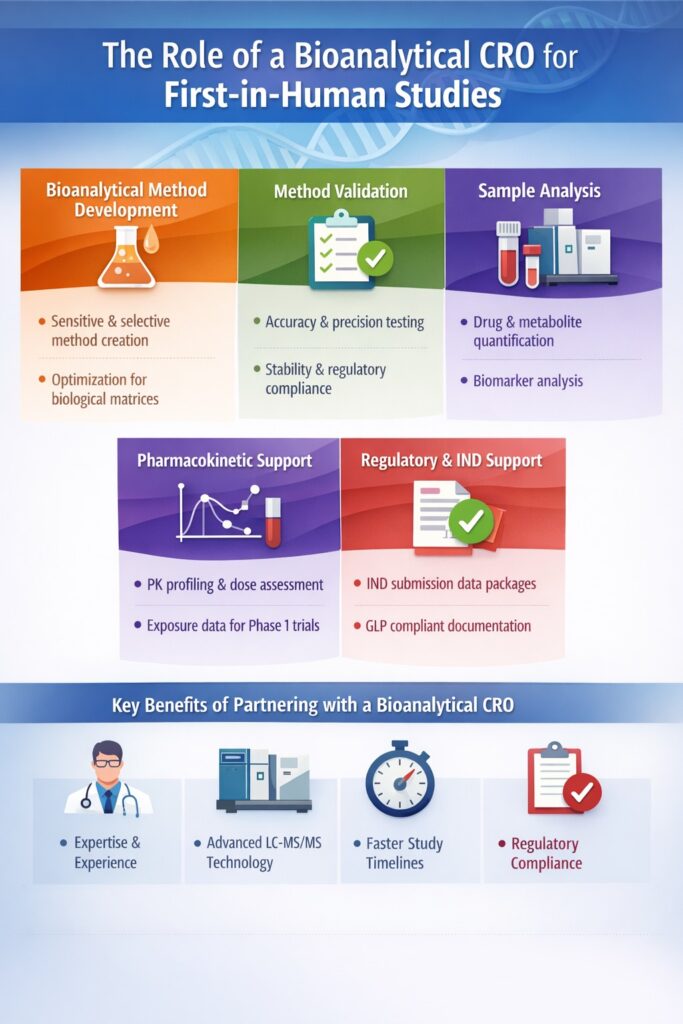
Key Services Provided by a Bioanalytical CRO for First-in-Human Studies
1. Bioanalytical Method Development
Developing robust analytical methods is the foundation of reliable bioanalysis. CROs design sensitive and selective assays using advanced platforms such as rapid bioanalytical method development workflows.
Key activities include:
- Development of sensitive and selective analytical methods
- Optimization of methods for complex biological matrices such as plasma, serum, and urine
- Selection of appropriate internal standards and extraction techniques
- Optimization of chromatography and mass spectrometry parameters
These workflows build upon best practices in bioanalytical method development.
These optimized methods ensure accurate quantification of drugs during first-in-human trials.
2. Bioanalytical Method Validation
Before being used in regulated studies, analytical methods must be validated according to global regulatory guidelines.
Typical validation parameters include:
- Accuracy and precision testing
- Sensitivity and lower limit of quantification (LLOQ)
- Stability studies across multiple conditions
- Selectivity and matrix effect evaluation
- Compliance with FDA, EMA, and ICH bioanalytical method validation guidelines
These procedures follow global regulatory guidance and are often integrated with bioanalytical stability testing protocols.
This validation ensures that the analytical results used to support clinical decisions are scientifically reliable.
3. Sample Analysis
Once validated, analytical methods are applied to biological samples using advanced high-sensitivity bioanalysis techniques.
Core sample analysis services include:
- Quantification of drug concentrations in plasma or serum
- Measurement of drug metabolites
- Biomarker analysis to evaluate drug response
- High-throughput analysis for large clinical sample sets
These measurements provide the critical exposure data needed for pharmacokinetic evaluation.
Many laboratories leverage LC-MS/MS bioanalysis of xenobiotics for accurate exposure measurement.
4. Pharmacokinetic (PK) Support
A Bioanalytical CRO for first-in-human studies generates critical exposure data using PK-TK bioanalysis workflows.
Key PK support activities include:
- Generation of concentration-time profiles
- Determination of pharmacokinetic parameters such as Cmax, Tmax, and half-life
- Dose exposure assessment across different dose levels
- Support for dose escalation decisions in Phase 1 trials
This information helps clinical teams determine safe and effective dose ranges.
5. Regulatory and IND Submission Support
Bioanalytical CROs also provide regulatory-ready documentation through bioanalytical services for IND and NDA submissions.
Regulatory support typically includes:
- Preparation of bioanalytical data packages for Investigational New Drug (IND) submissions
- Documentation supporting regulatory audits and inspections
- Compliance with Good Laboratory Practice (GLP) and regulatory bioanalytical guidelines
- Data traceability and audit-ready documentation
Strong regulatory support reduces risks during regulatory review.
Strategic Value of Outsourcing Bioanalysis
Outsourcing to a Bioanalytical CRO for first-in-human studies allows pharmaceutical companies to accelerate drug development through bioanalytical outsourcing strategies.
Key benefits include:
- Access to specialized bioanalytical expertise
- Advanced LC-MS/MS instrumentation without capital investment
- Faster method development and study timelines
- Regulatory-compliant data generation
- Scalable analytical capacity for clinical studies
Companies increasingly adopt outsourced bioanalysis for drug development and bioanalytical CRO partnerships to streamline development programs.
By partnering with a trusted CRO, companies can accelerate their transition from discovery to first-in-human trials while maintaining scientific rigor and regulatory compliance.
4: Technologies Used by Bioanalytical CROs
Modern bioanalytical CROs rely on advanced analytical technologies to detect drugs and biomarkers at extremely low concentrations.
Common Analytical Platforms
| Technology | Application |
|---|---|
| LC-MS/MS | Quantification of small molecules and metabolites |
| High-Resolution Mass Spectrometry | Structural characterization |
| Ligand Binding Assays | Detection of biologics |
| Hybrid LC-MS Bioanalysis | Oligonucleotide and peptide analysis |
These platforms support specialized applications such as:
- LC-MS bioanalysis for oligonucleotides
- cell and gene therapy bioanalysis
- antibody-drug conjugate bioanalytical services
Among these technologies, liquid chromatography–tandem mass spectrometry (LC-MS/MS) is considered the gold standard for early clinical bioanalysis due to its sensitivity, specificity, and robustness.
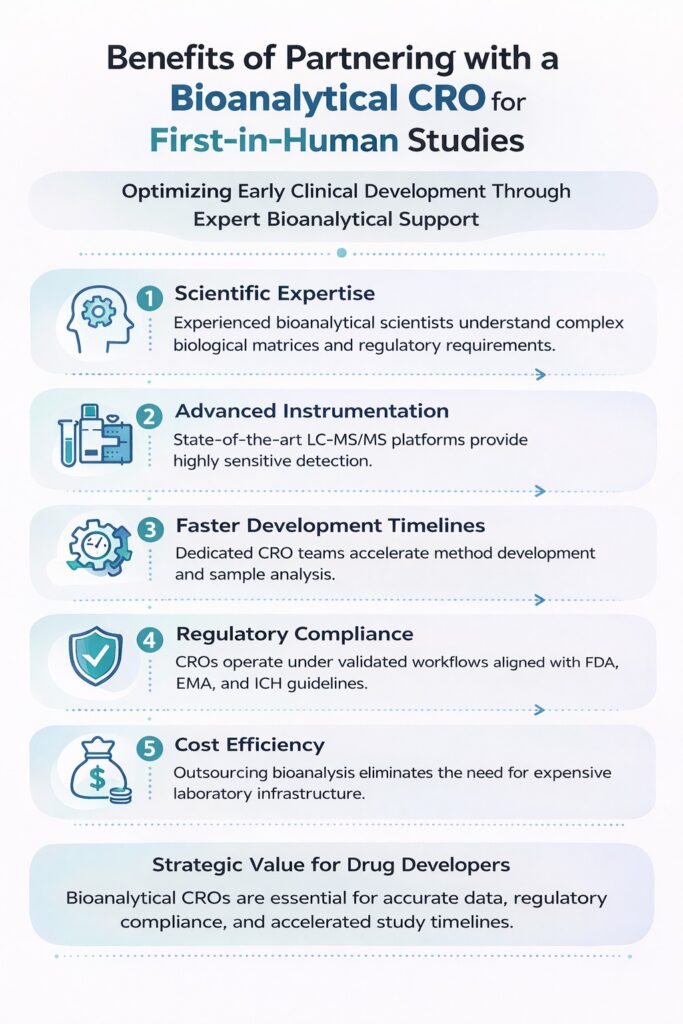
5: Benefits of Partnering with a Bioanalytical CRO for First-in-Human Studies
Partnering with a Bioanalytical CRO for first-in-human studies significantly improves the efficiency, accuracy, and regulatory readiness of early clinical development programs. By leveraging specialized expertise and advanced analytical technologies, pharmaceutical and biotechnology companies can generate reliable bioanalytical data required for safe and successful first-in-human trials.
Key Advantages
1. Scientific Expertise
Experienced bioanalytical scientists possess deep knowledge of complex biological matrices such as plasma, serum, urine, and tissues. They also understand global regulatory expectations and apply best practices in bioanalytical method development, validation, and sample analysis to ensure reliable and reproducible results. Experienced teams provide specialized expertise in robust bioanalytical data generation and complex matrix analysis.
2. Advanced Instrumentation
Leading bioanalytical CROs operate state-of-the-art LC-MS/MS platforms and other advanced analytical technologies capable of detecting drugs, metabolites, and biomarkers at extremely low concentrations. This level of sensitivity is essential for accurately evaluating pharmacokinetics and drug exposure in early clinical trials.
3. Faster Development Timelines
A specialized Bioanalytical CRO for first-in-human studies has dedicated teams, established workflows, and optimized analytical processes that significantly accelerate method development, validation, and sample analysis. This helps sponsors move quickly from preclinical studies to first-in-human trials while maintaining high data quality. Workflows such as high-throughput bioanalysis accelerate sample analysis.
4. Regulatory Compliance
Bioanalytical CROs operate under validated quality systems aligned with FDA, EMA, and ICH regulatory guidelines. Their experience in regulatory documentation, data integrity, and audit readiness ensures that bioanalytical data can confidently support Investigational New Drug (IND) submissions and early clinical trial approvals .Strict adherence to GLP ensures regulated bioanalytical services.
5. Cost Efficiency
Building and maintaining an in-house bioanalytical laboratory requires significant investment in instrumentation, infrastructure, and specialized personnel. Outsourcing to a Bioanalytical CRO for first-in-human studies eliminates these capital costs while providing immediate access to high-end analytical capabilities. Sponsors benefit from cost-effective bioanalytical services and scalable outsourcing models.
Strategic Value for Drug Developers
These advantages make partnerships with a Bioanalytical CRO for first-in-human studies an essential strategy for pharmaceutical and biotechnology companies aiming to accelerate early clinical development. By ensuring accurate bioanalytical data, regulatory compliance, and faster study timelines, CROs help drug developers successfully transition from discovery to human clinical trials.
6: How ResolveMass Laboratories Inc. Supports First-in-Human Studies
ResolveMass Laboratories Inc. provides specialized bioanalytical services designed to support drug development from discovery through first-in-human trials.
ResolveMass Laboratories provides comprehensive solutions through integrated bioanalytical CRO services for PK and TK.
With a focus on high-sensitivity mass spectrometry and regulatory compliance, ResolveMass offers reliable bioanalytical solutions tailored to the needs of pharmaceutical and biotechnology companies.
Key Capabilities
- Advanced LC-MS/MS bioanalysis
- Bioanalytical method development and validation
- Pharmacokinetic and pharmacodynamic analysis
- Biomarker quantification
- Oligonucleotide bioanalysis
- Regulatory-compliant data generation
ResolveMass combines scientific expertise, advanced instrumentation, and rigorous quality systems to deliver accurate and reproducible bioanalytical results.
These services are supported by advanced bioanalytical strategies for complex drug modalities and integrated chemistry and bioanalytical CRO platforms.
This makes ResolveMass a trusted Bioanalytical CRO for first-in-human studies supporting innovative drug development programs worldwide.
7: Challenges in First-in-Human Bioanalysis
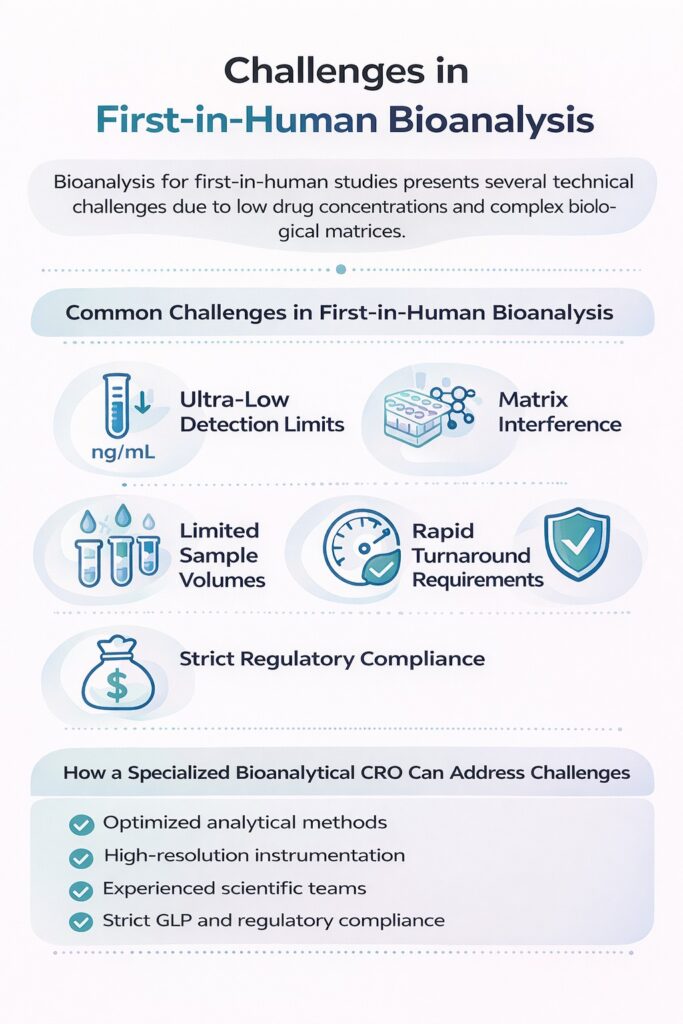
Bioanalysis in first-in-human (FIH) studies is particularly challenging because drug concentrations are often extremely low and biological samples contain complex matrices that can interfere with accurate measurement. Reliable bioanalytical data is essential during early clinical trials to ensure proper safety assessment, pharmacokinetic analysis, and regulatory compliance.
A Bioanalytical CRO for first-in-human studies plays an important role in overcoming these challenges by applying advanced analytical technologies, optimized workflows, and experienced scientific expertise.
Key issues often arise from bioanalytical matrix effects and limitations in sample volume.
Common Challenges in First-in-Human Bioanalysis
1. Ultra-Low Detection Limits
In first-in-human trials, the administered dose is typically very small to ensure participant safety. As a result, drug concentrations in plasma or serum may be present at very low levels (ng/mL or even pg/mL).
Key issues include:
- Difficulty detecting trace amounts of drugs or metabolites
- Requirement for highly sensitive analytical techniques
- Need for optimized sample preparation methods
To address this, bioanalytical laboratories use high-sensitivity LC-MS/MS platforms capable of detecting extremely low analyte concentrations with high accuracy.
2. Matrix Interference
Biological samples such as plasma, serum, urine, or tissues contain proteins, salts, lipids, and endogenous compounds that can interfere with analytical detection.
Challenges caused by matrix effects include:
- Signal suppression or enhancement in mass spectrometry
- Reduced method accuracy and reproducibility
- Increased analytical variability
Experienced bioanalytical teams mitigate these issues through carefully optimized sample extraction methods and validated analytical procedures.
3. Limited Sample Volumes
In early clinical trials, especially during dose-escalation studies, only small volumes of biological samples may be available for analysis.
This creates several challenges:
- Limited opportunity for repeat analysis
- Need for highly efficient extraction techniques
- Requirement for sensitive analytical methods using minimal sample volumes
Advanced analytical methods developed by a Bioanalytical CRO for first-in-human studies allow reliable quantification even from very small sample volumes.
4. Rapid Turnaround Requirements
Early clinical trials often require fast analytical turnaround times to support real-time decision making during dose escalation and safety monitoring.
Common demands include:
- Rapid sample processing
- Fast data generation for pharmacokinetic analysis
- Immediate reporting for clinical teams
Dedicated CRO laboratories typically use automated sample preparation systems and high-throughput LC-MS/MS workflows to accelerate analysis without compromising data quality.
5. Strict Regulatory Compliance
Bioanalytical data used in clinical trials must comply with global regulatory guidelines, including FDA, EMA, and ICH bioanalytical method validation requirements.
Regulatory expectations include:
- Fully validated analytical methods
- Complete documentation and traceability
- Data integrity and audit readiness
- Compliance with Good Laboratory Practice (GLP)
A specialized Bioanalytical CRO for first-in-human studies ensures that all analytical procedures and data reporting meet regulatory standards, reducing the risk of delays during regulatory review.
How Bioanalytical CROs Overcome These Challenges
Experienced bioanalytical CROs apply several strategies to address these complexities:
- Development of highly sensitive LC-MS/MS methods
- Implementation of robust sample preparation techniques
- Use of high-resolution analytical instrumentation
- Deployment of experienced bioanalytical scientists
- Maintenance of regulatory-compliant quality systems
By combining scientific expertise with advanced analytical capabilities, a Bioanalytical CRO for first-in-human studies enables reliable data generation that supports safe and successful early clinical development.
8: The Future of Bioanalytical CROs in Early Clinical Development
Bioanalytical CROs are becoming increasingly important as drug development becomes more complex and precision medicine advances.
Emerging therapeutic modalities such as:
- RNA therapeutics
- Gene therapies
- Antibody-drug conjugates
- Oligonucleotide therapeutics
require advanced analytical approaches and specialized expertise.
Advanced analytical solutions such as proteomics bioanalytical services and AI-enabled platforms like AI in bioanalysis are shaping the future of clinical bioanalysis.
As a result, the demand for experienced Bioanalytical CRO for first-in-human studies partners is expected to grow significantly.
CROs with expertise in advanced mass spectrometry and biomarker analysis will play a crucial role in accelerating early clinical research.
Conclusion
The transition from drug discovery to first-in-human trials represents one of the most critical stages in pharmaceutical development. Reliable bioanalytical data is essential to evaluate safety, determine dosing strategies, and support regulatory submissions.
A specialized Bioanalytical CRO for first-in-human studies provides the scientific expertise, analytical technologies, and regulatory knowledge required to generate high-quality bioanalytical data for early clinical trials.
By partnering with experienced organizations such as ResolveMass Laboratories Inc., pharmaceutical and biotechnology companies can confidently navigate the complex path from discovery to human testing while maintaining data integrity, regulatory compliance, and accelerated development timelines.
Frequently Asked Questions:
A Bioanalytical CRO for first-in-human studies measures drug concentrations and biomarkers in clinical samples to determine pharmacokinetics (PK), pharmacodynamics (PD), safety, and dose selection. These analytical results help researchers evaluate how a new drug behaves in the human body.
Bioanalytical method validation is the process of demonstrating that an analytical method is reliable, accurate, precise, and reproducible for measuring a drug or biomarker in biological samples. Regulatory agencies require validated methods before clinical sample analysis can begin.
Common challenges include:
-Detecting drugs at extremely low concentrations
-Matrix interference from biological samples
-Limited sample volumes in clinical trials
-Strict regulatory requirements for analytical validation
Advanced analytical methods and experienced CRO teams help overcome these challenges.
Bioanalytical CROs accelerate drug development by providing high-throughput sample analysis, validated analytical methods, regulatory-ready data, and expert scientific support. These capabilities help pharmaceutical companies move efficiently from discovery to clinical trials.
Reference
- John S. Kendrick & Colin Webber. One small step in time, one giant leap for DMPK kind – a CRO perspective of the evolving core discipline of drug development.https://www.tandfonline.com/doi/abs/10.1080/00498254.2022.2124389
- Roger Hayes. Bioanalytical Outsourcing: Transitioning from Pharma to Cro.https://www.tandfonline.com/doi/full/10.4155/bio-2017-4996
- When Is It Appropriate to Outsource Bioanalysis Work to a CRO?.https://www.biopharminternational.com/view/when-is-it-appropriate-to-outsource-bioanalysis-work-to-a-cro-
- Roles of LC-MS Bioanalysis in Drug Discovery, Development, and Therapeutic Drug Monitoring.https://onlinelibrary.wiley.com/doi/abs/10.1002/9781118671276.ch1
- Design and Conduct Considerations for First-in-Human Trials.https://ascpt.onlinelibrary.wiley.com/doi/full/10.1111/cts.12582
About the Author


