


Introduction
Bioanalytical CRO services for Phase I First-in-Human studies provide the quantitative bioanalytical infrastructure necessary to validate drug concentration assays, establish human safety profiles, and meet international regulatory expectations before clinical trial participants are dosed. First-in-Human (FIH) clinical trials mark a critical transition in drug development, during which novel therapeutic candidates progress from Good Laboratory Practice (GLP) nonclinical safety evaluations to administration in human subjects. Selecting high-quality Bioanalytical CRO Services for Phase I First-in-Human Studies helps ensure that bioanalytical method validation (BMV) is performed in accordance with harmonized standards, including the International Council for Harmonisation (ICH) M10 guideline, well before the first clinical cohort receives its initial dose. ResolveMass Laboratories Inc. provides highly sensitive chromatographic and ligand-binding assay workflows designed to address matrix-related risks, meet demanding turnaround timelines, and support regulatory submissions to health authorities across multiple global jurisdictions.
Explore how our end-to-end bioanalytical partnerships support your drug development journey from nonclinical testing through early-phase clinical trials:🔗 Explore Bioanalytical CRO Partnerships
The bioanalytical strategy supporting an early-phase clinical trial forms the foundation for numerous critical clinical decisions, including starting-dose safety margins, Single Ascending Dose (SAD) progression, and Multiple Ascending Dose (MAD) regimens. Obtaining reliable pharmacokinetic (PK) and pharmacodynamic (PD) data requires rigorous compliance with international validation criteria, appropriately validated sample collection procedures, and advanced analytical instrumentation. By developing and establishing robust bioanalytical methods before clinical trial initiation, sponsors can reduce the likelihood of sample batch rejection, unexplained pharmacokinetic variability, or regulatory delays during pivotal investigational new drug (IND) reviews.
Learn more about our specialized bioanalytical support tailored specifically for FIH clinical trials:🔗 Discover FIH Bioanalytical Solutions
Share via:
Quick Summary:
- Phase I bioanalytical CRO services provide validated assays and reliable PK/PD data needed to support First-in-Human (FIH) trials, dose selection, safety decisions, and regulatory submissions.
- ICH M10 is the key international framework for bioanalytical method validation, supported by requirements from FDA, EMA, Health Canada, and PMDA for global regulatory acceptance.
- Method validation must establish critical parameters such as selectivity, sensitivity, linearity, accuracy, precision, matrix effects, dilution integrity, and analyte stability before human dosing begins.
- Full validation vs. Context-of-Use (CoU): Human plasma/serum assays supporting regulatory decisions generally require full validation, while exploratory biomarkers, rare matrices, and internal studies may use fit-for-purpose approaches.
- SAD/MAD studies require rapid bioanalysis, with efficient cold-chain logistics, validated UHPLC-MS/MS or ligand-binding assays, PK calculations, and typically 48–72-hour data delivery to support Safety Review Committee decisions.
- ISR and dynamic-range management help confirm assay reproducibility across real clinical samples and accommodate the large concentration changes that can occur during dose escalation.
- Advanced technologies—including UHPLC-MS/MS, ligand-binding assays, surrogate matrices, AI, and automation— can improve sensitivity, throughput, and data quality while maintaining data integrity, ICH M10 compliance, regulatory readiness, and participant safety.
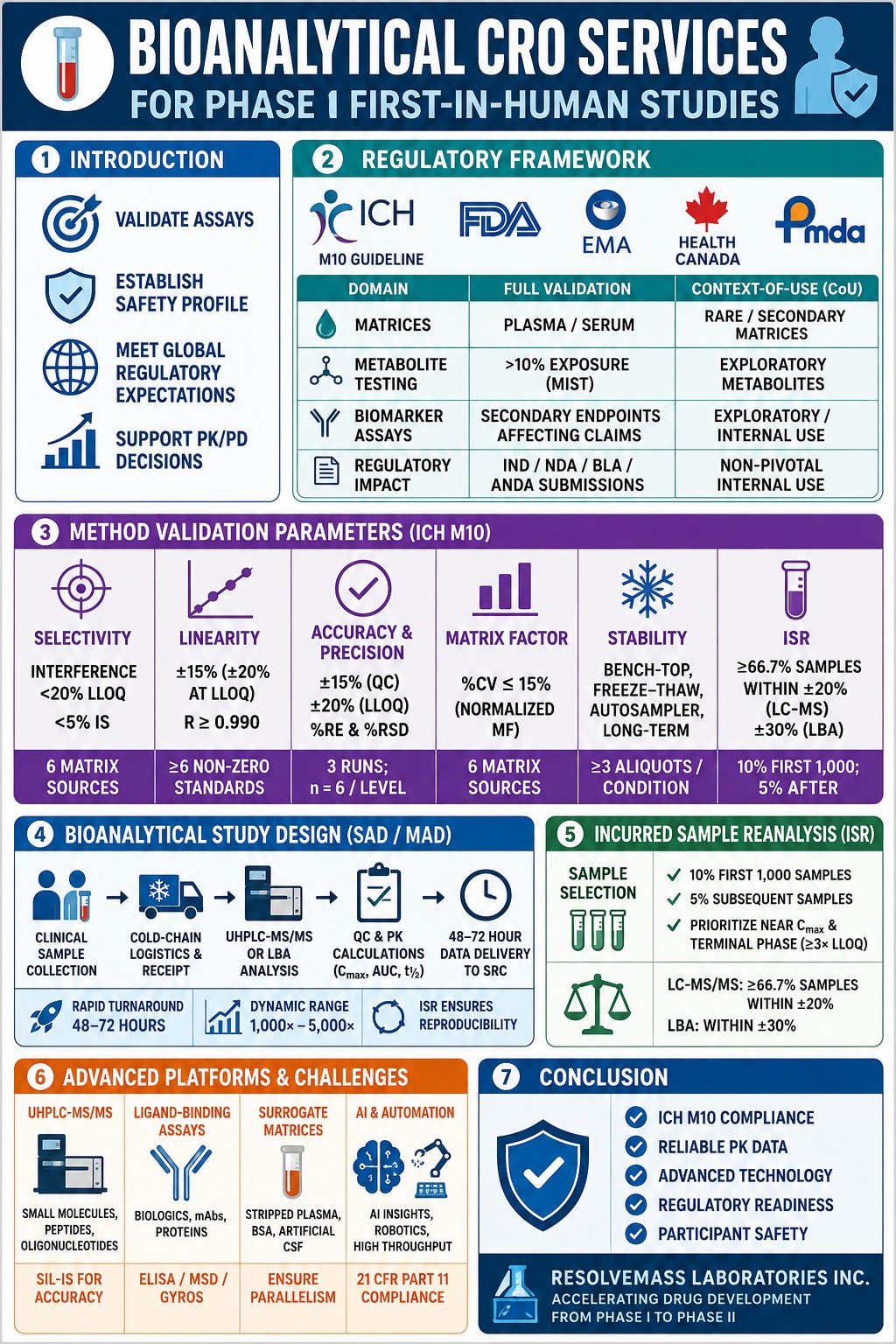
Regulatory Frameworks Governing Bioanalytical CRO Services for Phase I First-in-Human Studies
Regulatory compliance for Phase I bioanalysis is primarily based on the harmonized International Council for Harmonisation (ICH) M10 guideline, complemented by regional requirements issued by the FDA, EMA, Health Canada, and PMDA to facilitate acceptance of bioanalytical data in global regulatory submissions. The formal implementation of the ICH M10 guideline in 2022 established a common international framework for bioanalytical method validation and study sample analysis supporting nonclinical toxicokinetic (TK) and clinical pharmacokinetic studies. This harmonized approach facilitates multi-region clinical development by defining consistent expectations for chromatographic assays, such as UHPLC-MS/MS, and ligand-binding assays (LBAs), including ELISA and MSD.
| Regulatory Domain | Full Validation Requirement | Context-of-Use (CoU) / Fit-for-Purpose |
|---|---|---|
| Primary Matrices | Human plasma and serum used for clinical PK, safety assessments, and dose-selection decisions. | Rare or secondary matrices, such as tissue homogenates, tears, and CSF. |
| Metabolite Testing | Active or major metabolites exceeding 10% of total drug exposure under Metabolites in Safety Testing (MIST) considerations. | Early exploratory metabolite identification and internal trend profiling. |
| Biomarker Assays | Secondary pharmacodynamic endpoints that directly influence primary efficacy claims. | Exploratory biomarkers, mechanistic investigations, and assays intended for internal decision-making. |
| Regulatory Impact | Required for formal IND, NDA, BLA, and ANDA regulatory submissions. | Appropriate for non-pivotal internal sponsor evaluations. |
Read our in-depth breakdown of the ICH M10 guidelines and how they standardise bioanalytical method validation across regions:🔗 Read the ICH M10 Guidance Overview
Full Method Validation vs. Context-of-Use Approaches
Comprehensive bioanalytical method validation is scientifically and regulatorily necessary for biological matrices, most commonly human plasma and serum, when the resulting concentration data are used to support regulatory conclusions, establish safety limits, or guide dose-selection decisions. However, ICH M10 recognizes that different bioanalytical measurements can carry different levels of regulatory significance. A Context-of-Use (CoU) strategy allows sponsors to apply more streamlined, fit-for-purpose validation approaches for exploratory endpoints, tissue homogenates, or internal decision-making studies when appropriate. The scientific rationale for the selected approach should be clearly established and documented within the analytical plan to demonstrate that the method is suitable for its intended purpose.
Compare regional regulatory expectations and learn how FDA and EMA guidelines differ in key validation parameters: 🔗 Compare EMA vs. FDA Method Validation
Metabolite Quantification Under MIST Principles
Metabolite assessment during Phase I studies should be consistent with Metabolites in Safety Testing (MIST) principles described in ICH M3(R2) and ICH M10. Bioanalytical assays used to quantify human metabolites require comprehensive validation when a metabolite demonstrates pharmacological activity, contributes substantially to overall drug exposure, or presents a potential safety concern. For early exploratory metabolite profiling, sponsors can use tiered validation strategies while human plasma data are being generated to determine whether metabolite exposure exceeds 10% of total circulating drug-related material.
Method Validation Parameters and Technical Criteria Under ICH M10
Bioanalytical method validation under ICH M10 involves comprehensive experimental assessment of selectivity, sensitivity, linearity, accuracy, precision, matrix effect, dilution integrity, and analyte stability across multiple analytical runs. The method validation process must be appropriately completed and documented before the first human subject receives a dose in a Phase I clinical study. This ensures that the analytical procedure is sufficiently characterized and capable of producing reliable data throughout the clinical investigation.
Selectivity and Specificity
Selectivity demonstrates that the analytical method can accurately quantify the target analyte without significant interference from endogenous components of the biological matrix, structurally related compounds, or concomitantly administered medications. Evaluation is performed using at least six independent, non-pooled biological matrix sources. Peak responses occurring at the analyte retention time should not exceed 20% of the Lower Limit of Quantification (LLOQ) response, while interference associated with the internal standard (IS) should remain below 5%. Establishing adequate selectivity is particularly important in human plasma and serum because endogenous constituents can potentially interfere with analyte detection and compromise quantitative accuracy.
Sensitivity, Linearity, and Calibration Range
Sensitivity is primarily characterized by the LLOQ, which represents the lowest concentration of analyte that can be quantified with acceptable accuracy and precision under the established analytical conditions. Calibration curves should contain a minimum of six non-zero standard concentrations and should be evaluated using an appropriate weighting and regression model, commonly $1/x^2$ weighted linear regression. The back-calculated concentrations of calibration standards should generally remain within ±15% of their nominal concentrations, with an expanded acceptance allowance of ±20% at the LLOQ. An appropriately selected calibration range is essential for accurately quantifying clinical samples across the expected concentration profile.
Accuracy and Precision Criteria
Intra-day and inter-day accuracy, expressed as percent relative error (%RE), and precision, expressed as percent relative standard deviation (%RSD), are evaluated using Quality Control (QC) samples representing four concentration levels: LLOQ, Low QC (LQC), Medium QC (MQC), and High QC (HQC). Replicate measurements (n ≥ 6) should be performed across three independent analytical runs to adequately characterize method performance. Mean accuracy and precision should remain within ±15% for LQC, MQC, and HQC samples and within ±20% for LLOQ samples. These criteria help demonstrate that the method can consistently generate reliable quantitative results throughout the validated concentration range.
Identify common causes behind method validation failures and discover strategies to mitigate assay risks early:🔗 Learn How to Avoid Method Validation Failures
Matrix Factor and Ion Suppression
Matrix-effect assessment determines whether co-eluting endogenous components, including lipids, salts, proteins, and other matrix constituents, cause ion suppression or ion enhancement during mass spectrometric analysis. The Matrix Factor (MF) is calculated by comparing the analyte response obtained from post-extraction matrix-spiked samples with the corresponding response obtained from pure solvent solutions:
$$MF = \frac{\text{Peak Area Ratio of Analyte / IS in Post-Extraction Spiked Matrix}}{\text{Peak Area Ratio of Analyte / IS in Solvent Solution}}$$
The IS-normalized Matrix Factor should be evaluated using six distinct individual matrix sources. The coefficient of variation (%CV) across the evaluated matrix sources should not exceed 15%. Characterizing matrix effects is particularly important for LC-MS/MS methods because variable ion suppression or enhancement can adversely affect assay accuracy, precision, and reproducibility.
Examine root causes and technical solutions for matrix effects in complex LC-MS/MS bioanalysis:🔗 Explore LC-MS/MS Matrix Effect Solutions
Analyte Stability Protocols
Stability studies establish that the target analyte remains adequately stable under conditions representative of clinical sample collection, transportation, processing, and long-term storage. Validation protocols should evaluate bulk QC samples using at least three aliquots under relevant conditions, including bench-top conditions at room temperature or under chilled conditions, freeze-thaw conditions involving ≥3 cycles, post-preparative auto-sampler storage, and long-term frozen storage. Long-term stability evaluations commonly include storage at -20 °C and -80 °C, depending on the expected clinical sample storage conditions. These studies are necessary to confirm that changes in analyte concentration are not caused by inappropriate handling or storage conditions.
Review guidelines for evaluating benchtop, freeze-thaw, and long-term storage stability in clinical matrix testing:🔗 Review Stability Testing Practices
| Validation Parameter | ICH M10 Quantitative Criteria | Minimum Sample / Batch Requirement |
|---|---|---|
| Selectivity | Interference <20% of LLOQ response; <5% of IS response | 6 individual, non-pooled matrix sources |
| Calibration Linearity | Back-calculated standards within ±15% (±20% at LLOQ); R ≥ 0.990 | ≥ 6 non-zero standards per analytical run |
| Accuracy & Precision | QC levels: ±15%; LLOQ: ±20% for %RE and %RSD | 3 independent runs; n = 6 replicates per QC level |
| Normalized Matrix Factor | %CV ≤ 15% across independent matrix sources | Low QC and High QC evaluated in 6 matrix sources |
| Dilution Integrity | Accuracy and precision within ±15% of nominal target | 6 replicates diluted above Upper Limit of Quantification (ULOQ) |
| Incurred Sample Reanalysis | ≥ 66.7% of samples within ±20% of initial/repeat mean (LC-MS) | 10% of first 1,000 samples; 5% of subsequent samples |
Bioanalytical Study Design Strategies for Phase I SAD and MAD Dose Escalation
Bioanalytical study design for Single Ascending Dose (SAD) and Multiple Ascending Dose (MAD) trials emphasizes rapid analytical turnaround for Safety Review Committees, appropriately extended calibration ranges, and systematic execution of Incurred Sample Reanalysis. Phase I FIH clinical trials require responsive sample-processing workflows that can provide reliable data within predefined timelines and support safe dose-escalation decisions. The analytical strategy must therefore be integrated with clinical operations from sample collection through data delivery.
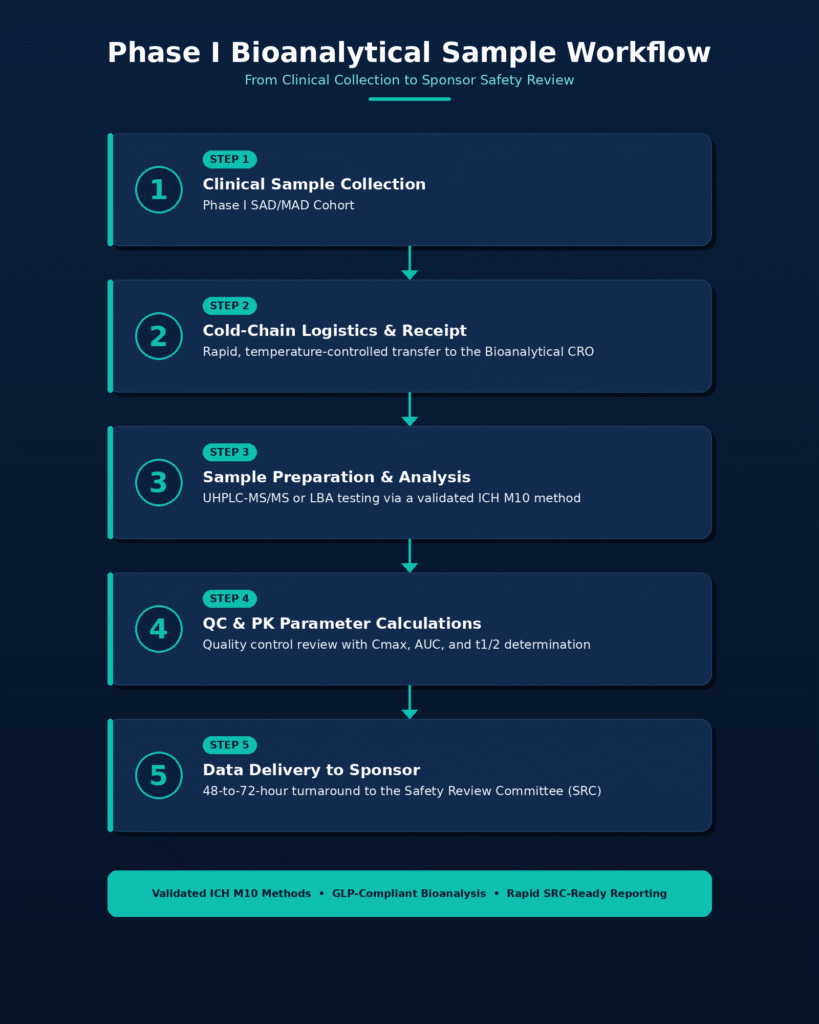
Rapid Turnaround Bioanalysis for Safety Review Committees
During dose-escalation studies, Safety Review Committees (SRCs) depend on preliminary pharmacokinetic parameters, including maximum concentration (Cmax), area under the curve (AUC), and terminal half-life (t1/2), to determine whether observed drug exposure remains within anticipated safety margins before authorizing progression to the next dose cohort. Contract research organizations must therefore have the operational capacity to receive and process clinical samples efficiently, perform analytical runs under validated conditions, review analytical data, and deliver appropriately audited PK concentration files within 48 to 72 hours of sample receipt. Maintaining this accelerated workflow is critical because delays in bioanalytical data availability can directly affect dose-escalation timelines and clinical decision-making.
Discover how specialized Phase I bioanalytical support accelerates timeline milestones for FDA Fast-Track candidates:🔗 See Phase I Fast-Track Bioanalytical Support
Dynamic Range Management Across Ascending Cohorts
Because starting doses in FIH trials are generally conservative and are derived from nonclinical safety information, including NOAEL values, initial plasma concentrations may be extremely low and may require picogram-per-milliliter LLOQ sensitivity. As dose escalation advances into MAD cohorts, however, plasma drug concentrations and steady-state exposure can increase substantially. Analytical methods must therefore provide a sufficiently broad linear dynamic calibration range, such as 1,000-fold to 5,000-fold, to reduce the need for frequent manual sample dilution while maintaining validated dilution integrity. Dilution integrity may need to be established for samples reaching 10-fold or 50-fold above the ULOQ, depending on the anticipated clinical exposure range and assay requirements.
Incurred Sample Reanalysis (ISR) Execution
Incurred Sample Reanalysis (ISR) is used to evaluate assay reproducibility in authentic human biological samples containing real clinical sample characteristics, including circulating metabolites, protein-binding variations, or therapeutic co-medications that may not be represented in synthetic validation QCs. ISR provides an important confirmation that the validated bioanalytical method continues to produce consistent results when applied to actual study samples generated during clinical development.
- Sample Selection Criteria: Regulatory expectations generally involve reanalysis of 10% of the first 1,000 clinical study samples and 5% of subsequent samples. Sample-selection approaches may prioritize specimens collected near Cmax and during the terminal elimination phase, with selected samples preferably having concentrations at least 3-fold higher than the LLOQ.
- Statistical Acceptance Thresholds: For LC-MS/MS chromatographic assays, the concentration difference between the initial and repeat measurements should be ≤20% for at least two-thirds (66.7%) of the reanalyzed samples:
$$% \text{Difference} = \frac{\vert{}\text{Repeat Concentration} – \text{Initial Concentration}\vert{}}{\text{Mean of Initial and Repeat Concentrations}} \times 100 \le 20%$$
For ligand-binding assays, the corresponding acceptance criterion is generally expanded to ≤30%.
Dive into best practices for sample selection, statistical evaluation, and ISR execution in clinical bioanalysis:🔗 Understand Incurred Sample Reanalysis Protocols
Advanced Analytical Platforms and Complex Bioanalytical Challenges
Phase I bioanalytical testing commonly relies on liquid chromatography-tandem mass spectrometry (LC-MS/MS) and ligand-binding assays (LBAs) to address analytical challenges involving non-specific binding, endogenous matrix interferences, and limited or rare biological matrices. Selection of the appropriate analytical technology depends on several factors, including the molecular characteristics of the therapeutic candidate, required analytical sensitivity, expected concentration range, and complexity of the biological matrix. A technology platform that is appropriate for one therapeutic modality may not provide equivalent performance for another, making platform selection an important component of early bioanalytical strategy.
UHPLC-MS/MS vs. Ligand-Binding Assay Selection
Small molecules, synthetic peptides, and oligonucleotide therapeutics are commonly quantified using Ultra-High Performance Liquid Chromatography coupled with Tandem Mass Spectrometry (UHPLC-MS/MS). The use of Stable-Isotope Labeled Internal Standards (SIL-IS), including d4-, d5-, or 13C-analogs, is important for correcting variability associated with extraction recovery and matrix-induced ion suppression. Large-molecule biologics, monoclonal antibodies, and recombinant proteins are frequently analyzed using LBAs, including ELISA, Meso Scale Discovery (MSD), and Gyros platforms, or through hybrid immunoaffinity LC-MS/MS approaches. The final platform selection should reflect the molecular structure, expected clinical concentration, matrix characteristics, and intended Context-of-Use.
Explore dedicated bioanalytical strategies designed specifically for oligonucleotide therapeutics:🔗 Explore Oligonucleotide Bioanalytical Services
Surrogate Matrix Validation for Endogenous Analytes
Quantification of drug candidates or endogenous biomarkers that are naturally present in human plasma can create substantial analytical challenges because an analyte-free biological matrix may not be readily available. Bioanalytical CROs may address this limitation through surrogate matrix approaches, including stripped human plasma, bovine serum albumin (BSA) in phosphate-buffered saline, or artificial cerebrospinal fluid (CSF). Alternatively, surrogate analyte strategies may use stable-isotope labeled target molecules to facilitate assay development and validation. During method development, the relationship between calibration curves prepared in the surrogate matrix and QC samples prepared in authentic biological matrix should be adequately investigated. Demonstrating appropriate parallelism and comparable analytical behavior is important for establishing that the surrogate approach provides a scientifically justified representation of the intended clinical matrix.
Learn how specialized tissue homogenates and CSF assays overcome unique matrix handling challenges:🔗 Learn About Tissue & CSF Bioanalytical Services
AI Integration and Automated Bioanalysis
Modern bioanalytical CROs are increasingly incorporating artificial intelligence (AI), machine-learning technologies, and automated liquid-handling robotics into analytical workflows. Machine-learning algorithms can assist with automated peak integration, identification of chromatographic anomalies, assessment of analytical patterns, and prediction of potential matrix effects. Automated systems can also improve laboratory throughput and reduce manual intervention in repetitive sample-processing activities. However, implementation of these technologies must remain consistent with applicable data integrity requirements, including 21 CFR Part 11 requirements for electronic records and electronic signatures, as well as appropriate controls for computerized systems and analytical data.
Conclusion
Strict adherence to ICH M10 validation expectations and carefully optimized bioanalytical study designs is essential for generating reliable pharmacokinetic data during early-phase clinical development. Successfully progressing a candidate drug through First-in-Human clinical trials requires an integrated combination of advanced bioanalytical technologies, comprehensive regulatory knowledge, appropriately validated analytical methods, and tightly controlled sample logistics. Selecting high-performance Bioanalytical CRO Services for Phase I First-in-Human Studies can reduce analytical and operational risks, facilitate regulatory readiness across global jurisdictions, and help safeguard clinical trial participant safety. ResolveMass Laboratories Inc. provides specialized bioanalytical method validation and early-phase clinical trial support designed to help accelerate promising drug candidates toward a successful Phase II transition.
Plan ahead for pivotal phases by reviewing our bioanalytical capabilities for Phase II and Phase III clinical studies: 🔗 Discover Phase II & Phase III Bioanalytical Support
To consult with experts regarding your upcoming Phase I bioanalytical study design, visit the ResolveMass Laboratories Inc. contact page.
Frequently Asked Questions (FAQs)
For an FIH study, the bioanalytical method should be fully validated and appropriately documented before the first participant receives the investigational product. Validation demonstrates that the analytical procedure is suitable for its intended purpose and can consistently produce accurate and precise results. The completed validation documentation also provides essential evidence for regulatory and clinical study oversight.
Under ICH M10, accuracy and precision for Quality Control samples at the Low, Medium, and High QC levels should generally remain within ±15% of the nominal value. At the Lower Limit of Quantification (LLOQ), the acceptance range is expanded to ±20%. These criteria help demonstrate that the assay provides reproducible and quantitatively reliable results.
Incurred Sample Reanalysis (ISR) involves reanalyzing a defined proportion of authentic clinical samples to confirm the reproducibility of the bioanalytical method. Typically, 10% of the first 1,000 samples and 5% of subsequent samples are selected for ISR. For LC-MS/MS assays, at least 66.7% of the reanalyzed samples should fall within a 20% difference between the initial and repeat results, while ligand-binding assays generally use a 30% criterion.
Stable-Isotope Labeled Internal Standards (SIL-IS) help compensate for variability introduced during sample extraction, preparation, and mass spectrometric detection. Because they closely resemble the target analyte in their chemical and chromatographic behavior, they can track analytical losses and matrix-related effects throughout the workflow. This improves the reliability, consistency, and quantitative performance of LC-MS/MS assays.
A metabolite may require a fully validated bioanalytical method when it has pharmacological activity, contributes meaningfully to drug-related exposure, or creates a potential safety concern. MIST principles are also relevant when a metabolite represents more than 10% of total drug-related exposure in human plasma. The extent of validation should ultimately reflect the metabolite’s clinical relevance and intended regulatory use.
When an analyte is naturally present in the intended biological matrix, a suitable surrogate matrix may be used to facilitate calibration and method development. The analytical performance of the surrogate system is assessed against Quality Control samples prepared in authentic biological matrix. Demonstrating appropriate parallelism and comparable analytical behavior helps establish that the surrogate matrix is suitable for the intended assay application.
Full validation is a comprehensive approach used when bioanalytical data are intended to support important regulatory, safety, or pharmacokinetic conclusions. A Context-of-Use (CoU) or fit-for-purpose strategy is more tailored and focuses only on the performance characteristics necessary for the intended application. This approach may be appropriate for exploratory biomarkers, specialized matrices, or studies used primarily for internal decision-making.
Bioanalytical CROs support Safety Review Committees (SRCs) by prioritizing rapid sample processing, validated analytical testing, quality review, and timely PK data delivery. For Phase I dose-escalation studies, analytical results may need to be generated within predefined accelerated timelines, commonly 48 to 72 hours after sample receipt. These data help investigators evaluate drug exposure before deciding whether to advance to the next dose cohort.
Cross-validation between laboratories or analytical platforms uses statistical approaches that assess agreement, bias, and comparability between datasets. Bland-Altman analysis can identify systematic differences, while Deming regression can evaluate the relationship between two measurement procedures when both may contain analytical error. ISR results and predefined acceptance criteria can provide additional evidence that the methods generate sufficiently comparable clinical sample results.
Reference:
- Fluhler, E., Vazvaei, F., Singhal, P., Vinck, P., Li, W., Bhatt, J., de Boer, T., Chaudhary, A., Tangiuchi, M., Rezende, V., & Zhong, D. (2014). Repeat analysis and incurred sample reanalysis: Recommendation for best practices and harmonization from the Global Bioanalysis Consortium Harmonization Team. The AAPS Journal, 16(6), 1167–1174. https://doi.org/10.1208/s12248-014-9644-1
- Gu, M., Gehman, A., Nifong, B., Mayer, A. P., Li, V., Birchler, M., Wang, K., & Tang, H. (2025). From guidelines to implementation: A case study on applying ICH M10 for bioanalytical assay cross-validation. The AAPS Journal, 27(2), 54. https://doi.org/10.1208/s12248-025-01038-5
- Yadav, M., & Shrivastav, P. S. (2011). Incurred sample reanalysis (ISR): A decisive tool in bioanalytical research. Bioanalysis, 3(9), 1007–1024. https://doi.org/10.4155/bio.11.76
Get In Touch With Us
About The Author


