


Introduction:
When evaluating a contract research organization (CRO) for your drug development program, one of the first practical questions you should ask is: how many samples can this lab realistically process per day? Bioanalytical sample throughput is a critical performance indicator that directly impacts study timelines, costs, and data quality.
At ResolveMass Laboratories Inc., a Health Canada-compliant bioanalytical CRO based in Canada, we are frequently asked this question by pharmaceutical sponsors, biotech startups, and clinical research teams. The honest answer is: it depends — but in a very precise, science-driven way.
This article breaks down the real-world factors that govern daily sample processing capacity, what clients should realistically expect from a high-performance CRO, and how ResolveMass Laboratories delivers exceptional throughput without sacrificing regulatory compliance or data integrity.
Summary:
- A bioanalytical CRO typically processes 50–500+ samples per day, depending on analytical method, automation level, and matrix complexity.
- LC-MS/MS remains the gold standard for high-throughput bioanalytical work, enabling labs like ResolveMass to run 200–400+ samples/day on a single instrument.
- Key throughput factors include: sample preparation method, number of instruments, automation, staff expertise, and regulatory compliance requirements (GLP/GCP).
- Bioanalytical sample throughput is not just about speed — accuracy, reproducibility, and regulatory documentation are equally critical.
- ResolveMass Laboratories Inc. operates with full GLP compliance and advanced LC-MS/MS platforms, providing fast turnaround without compromising data integrity.
- Choosing a CRO with transparent throughput capacity and regulatory expertise protects your drug development timeline and budget.
1: What Is Bioanalytical Sample Throughput?
Bioanalytical sample throughput refers to the number of biological samples — plasma, urine, blood, tissue homogenates, or cerebrospinal fluid (CSF) — that a laboratory can prepare, analyze, and report on within a single working day.
Throughput is not simply a function of instrument speed. It encompasses the full analytical pipeline:
- Sample receipt and accessioning
- Protein precipitation, liquid-liquid extraction (LLE), or solid-phase extraction (SPE)
- Internal standard addition and sample preparation
- Chromatographic separation (typically HPLC or UHPLC)
- Mass spectrometric detection and quantification (LC-MS/MS)
- Data review and audit-trail documentation
- Reporting and QC sign-off
Each stage introduces a time cost, and optimizing the entire pipeline is where expert CROs like ResolveMass Laboratories Inc. make a meaningful difference.
2: Bioanalytical Sample Throughput: Realistic Daily Numbers
A well-equipped bioanalytical CRO can process between 50 and 500+ samples per day, per instrument, depending on method complexity and automation level. Here is a breakdown of what different scenarios look like in practice:
| Scenario | Method Type | Samples/Day (per instrument) | Key Limiting Factor |
|---|---|---|---|
| Simple PK study, single analyte | LC-MS/MS (isocratic) | 300–500+ | Injection cycle time |
| Multi-analyte method (2–5 compounds) | LC-MS/MS (gradient) | 150–300 | Chromatographic run time |
| Complex matrix (tissue, CSF) | LC-MS/MS + SPE | 80–180 | Sample prep complexity |
| Immunoassay (ELISA/MSD) | Plate-based assay | 90–192 (1–2 plates) | Plate reader throughput & incubation time |
| Microsampling (DBS, DPS) | LC-MS/MS + micro-extraction | 100–250 | Extraction efficiency & volume |
| Fully automated (robotics) | LC-MS/MS + Tecan/Hamilton | 400–700+ | Robotic arm throughput |
Note: These figures reflect a single analytical instrument running one method. Labs with multiple instruments and parallel sample preparation can multiply throughput significantly.
3: Key Factors That Determine Bioanalytical Sample Throughput
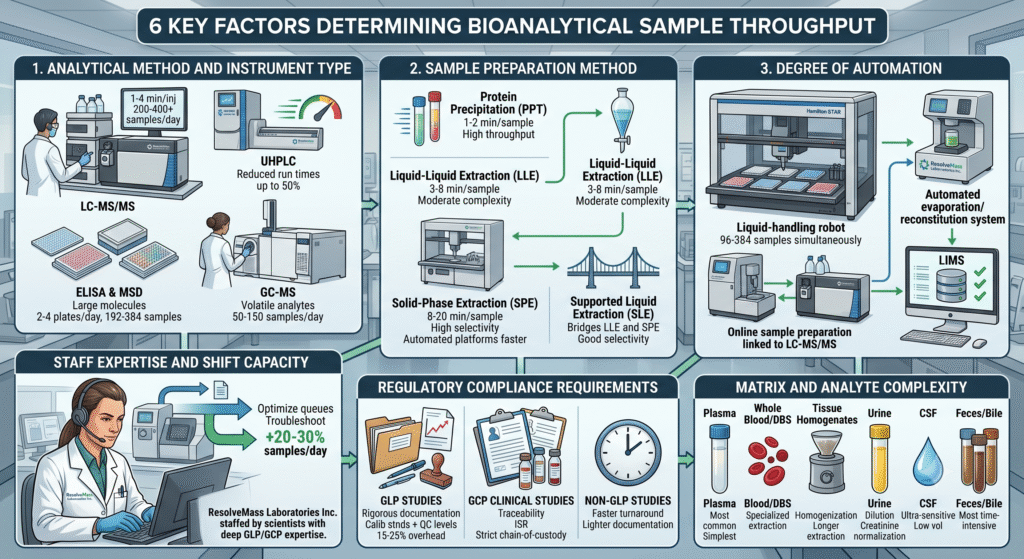
No two bioanalytical studies are identical. The following factors most significantly influence how many samples a CRO can realistically process in a single day:
1. Analytical Method and Instrument Type
The choice of detection platform is the single largest driver of throughput capacity.
- LC-MS/MS (Liquid Chromatography-Tandem Mass Spectrometry): The industry benchmark. Run times of 1–4 minutes per injection allow for 200–400+ samples/day per instrument. ResolveMass uses high-sensitivity triple quadrupole MS platforms for maximum throughput at low LLOQ.
- UHPLC: Ultra-high-performance LC reduces run times by up to 50% compared to conventional HPLC, dramatically increasing samples per day.
- ELISA & MSD: Plate-based immunoassays are excellent for large molecules (biologics, ADCs) and typically process 2–4 plates/day, translating to 192–384 samples.
- GC-MS: Used for volatile analytes. Longer run times typically limit throughput to 50–150 samples/day.
2. Sample Preparation Method
Sample preparation is almost always the rate-limiting step — not the instrument itself.
- Protein Precipitation (PPT): Fastest method, 1–2 minutes per sample. Enables the highest throughputs.
- Liquid-Liquid Extraction (LLE): Moderate complexity, 3–8 minutes/sample. Excellent selectivity at moderate throughput.
- Solid-Phase Extraction (SPE): Highest selectivity, 8–20 minutes/sample or significantly faster with automated SPE platforms (e.g., positive pressure manifolds, online SPE).
- Supported Liquid Extraction (SLE): Bridges LLE and SPE — good selectivity with faster processing than traditional LLE.
3. Degree of Automation
Automation is the most impactful lever for scaling bioanalytical sample throughput without compromising reproducibility.
- Liquid-handling robots (Hamilton STAR, Tecan EVO) can process 96–384 samples simultaneously in a single plate
- Automated evaporation and reconstitution systems eliminate manual bottlenecks
- Online sample preparation coupled directly to LC-MS/MS eliminates manual extraction entirely
- LIMS (Laboratory Information Management Systems) reduce documentation time and transcription errors
ResolveMass Laboratories Inc. employs semi-automated and full-automation workflows tailored to study volume, ensuring maximum throughput at validated accuracy levels.
4. Staff Expertise and Shift Capacity
Experienced bioanalytical scientists make a measurable difference. A skilled analyst can optimize injection queues, troubleshoot instrument issues in real time, and process 20–30% more samples per day compared to less experienced personnel, simply through efficient workflow management and proactive QC monitoring.
ResolveMass Laboratories is staffed by scientists with deep expertise in regulated bioanalysis under GLP and GCP frameworks, ensuring consistent, high-quality output every day.
5. Regulatory Compliance Requirements
Regulated studies (GLP toxicokinetics, GCP clinical trials) require more rigorous documentation, calibration standards, quality controls, and system suitability testing, which consume capacity:
- GLP studies: Typically include 6–8 calibration standards + 3–4 QC levels per analytical run. This overhead can represent 15–25% of total injection slots.
- GCP clinical studies: Require additional traceability, incurred sample reanalysis (ISR), and strict chain-of-custody documentation.
- Non-GLP studies: Allow faster turnaround with lighter documentation burden — ideal for early-stage discovery work where speed is the priority.
6. Matrix and Analyte Complexity
Plasma is the most common and typically simplest matrix. More challenging matrices reduce throughput:
- Whole blood and blood cards (DBS) require specialized extraction
- Tissue homogenates require homogenization and longer extraction times
- Urine often requires dilution optimization and creatinine normalization
- CSF (cerebrospinal fluid) demands ultra-sensitive methods due to low sample volumes
- Feces and bile matrices are the most time-intensive
4: How Multiple Instruments and Parallel Workflows Scale Throughput
A single LC-MS/MS system is powerful, but a facility’s total bioanalytical sample throughput is determined by how many instruments run in parallel — and how well workflows are orchestrated.
Consider this scenario at ResolveMass Laboratories:
| Instruments Running | Method | Samples/Day/Instrument | Total Daily Capacity |
|---|---|---|---|
| 1x LC-MS/MS | Standard PK (plasma, PPT) | 350 | 350 samples |
| 2x LC-MS/MS | Standard PK (plasma, PPT) | 350 | 700 samples |
| 3x LC-MS/MS (mixed methods) | PK + tissue + urine | 250 (avg) | 750 samples |
| 3x LC-MS/MS + robotic prep | PK + automated SPE | 450 (avg) | 1,350+ samples |
This is why choosing a CRO purely on a single “samples per day” number is misleading. The meaningful question is: does the CRO have the instrument capacity, qualified staff, and validated methods to meet your specific project’s demands on time?
5: What Pharmaceutical Sponsors Should Ask About Throughput
When evaluating a bioanalytical CRO for a project, throughput conversations should go beyond a single number. Ask these critical questions:
- What is your current instrument availability and booking lead time for my study start date?
- How many instruments do you have dedicated to the method type my study requires?
- What is your sample preparation automation capability?
- What percentage of your daily capacity is reserved for QC standards and calibration curves in regulated studies?
- What is your typical turnaround time from sample receipt to data delivery?
- What contingency plan exists if an instrument goes down mid-study?
- Are your methods fully validated per FDA/EMA bioanalytical method validation guidance?
At ResolveMass Laboratories Inc., we provide transparent capacity assessments at project initiation and dedicated project managers who communicate throughput status in real time, so sponsors are never left guessing.
6: The ResolveMass Laboratories Approach to High-Throughput Bioanalysis
ResolveMass Laboratories Inc. was founded with a singular mission: to provide the pharmaceutical and biotech industry with bioanalytical services that combine scientific rigor with operational efficiency. Our approach to bioanalytical sample throughput is built on three pillars:
Pillar 1: Method Optimization from Day One
Before a single study sample enters our facility, our scientists optimize the analytical method for throughput without compromising sensitivity or selectivity. This includes selecting the fastest chromatographic conditions that still meet ICH and FDA/EMA guidelines, and choosing the sample preparation method that balances clean extracts with speed.
Pillar 2: Right-Sized Automation
We match automation to study volume. Small discovery programs benefit from semi-automated workflows with flexible turnaround. Large GLP tox studies with thousands of samples activate our high-throughput automated pipelines, delivering maximum samples per day with full audit-trail compliance.
Pillar 3: Regulatory Compliance Built Into Every Run
Throughput means nothing if data doesn’t survive regulatory scrutiny. Every analytical run at ResolveMass meets FDA 2018 Bioanalytical Method Validation Guidance, EMA BMV guidelines, and ICH M10 standards. Our LIMS system captures every action, every analyst, and every deviation — ensuring complete traceability from sample receipt to final report.
7: Bioanalytical Sample Throughput vs. Data Quality: The False Trade-Off
Speed and quality are not mutually exclusive in bioanalysis — but this balance requires deliberate system design. Here is how ResolveMass ensures both:
- Duplicate QC injections: Confirm instrument performance throughout every batch.
- System suitability criteria: Defined before each run to catch instrument drift before it affects data.
- Inter-batch reproducibility targets: Ensure data quality is consistent across days, instruments, and analysts.
- Incurred Sample Reanalysis (ISR): Mandated in GCP studies to demonstrate method reproducibility with actual study samples.
- Daily instrument maintenance logs: Preventive maintenance scheduling ensures maximum uptime and protects throughput continuity.
Sponsors who choose ResolveMass Laboratories Inc. gain not just throughput — they gain confidence that every data point will stand up to regulatory agency review.
8: Turnaround Time: Translating Throughput Into Project Timelines
Bioanalytical sample throughput directly governs study timelines, and project delays in drug development are extraordinarily costly. Consider:
- Phase I Clinical Study: A typical PK study with 200–400 samples can be completed in 2–5 business days at full throughput at ResolveMass.
- GLP Toxicokinetics Study: 500–2,000 samples are common. With optimized throughput at 300–400 samples/day, reports are delivered in 5–10 business days post-sample receipt.
- Discovery PK Screening: Rapid turnaround programs (cassette dosing, n-in-1) can deliver data within 24–48 hours of sample receipt when scheduled in advance.
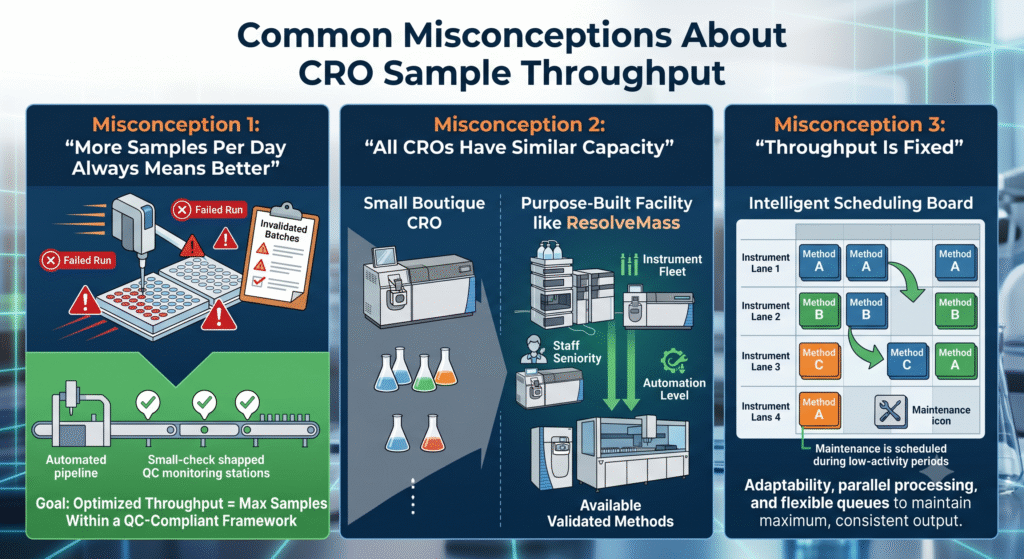
9: Common Misconceptions About CRO Sample Throughput
Misconception 1: “More Samples Per Day Always Means Better”
Throughput maximization without QC management leads to failed runs, invalidated batches, and costly repeat analyses. The goal is optimized throughput — maximum samples per day within a QC-compliant framework.
Misconception 2: “All CROs Have Similar Capacity”
CRO capacity varies enormously based on instrument fleet, staff seniority, automation level, and available validated methods. A boutique CRO with 2 instruments and limited validated methods cannot compete with a purpose-built facility like ResolveMass that maintains dedicated platform capacity across multiple analytical technologies.
Misconception 3: “Throughput Is Fixed”
Experienced CROs dynamically manage throughput by running multiple methods in parallel on different instruments, scheduling maintenance strategically, and adjusting run queues to maintain consistent output even during complex studies.
Conclusion:
Bioanalytical sample throughput is one of the most practical and consequential metrics when selecting a CRO partner for pharmaceutical development. A realistic, well-managed CRO can process 50 to 500+ samples per instrument per day, with multi-instrument facilities reaching thousands of samples daily.
The right answer for your program depends on your matrix, analyte, regulatory requirements, and timeline. What matters most is partnering with a CRO that understands these variables deeply and has the infrastructure, expertise, and regulatory track record to deliver high bioanalytical sample throughput without compromising the data integrity that drug development depends on.
ResolveMass Laboratories Inc. is committed to transparency, scientific excellence, and operational efficiency — giving our clients the throughput capacity they need, backed by the regulatory compliance their programs demand.
Frequently Asked Questions:
The number of samples a bioanalytical CRO can process varies significantly depending on its infrastructure and workflow. Smaller laboratories may handle a few hundred samples daily, while large, highly automated CROs can process several thousand or even more than 10,000 samples per day. Factors such as assay complexity, staffing levels, and instrument availability influence capacity. Sponsors should evaluate both throughput and turnaround time when selecting a CRO. The highest capacity does not always guarantee the fastest project completion.
Several factors influence Bioanalytical Sample Throughput, including sample preparation requirements, analytical techniques, laboratory automation, and available instrumentation. Complex extraction methods generally reduce throughput compared to simpler workflows. Staffing expertise and project management also play important roles in maintaining efficiency. Regulatory documentation and quality assurance reviews can affect processing speed as well. Together, these factors determine a laboratory’s true operational capacity.
Not necessarily. While a laboratory with high throughput can process larger sample volumes, turnaround times depend on additional factors such as study scheduling, sample arrival patterns, and data review requirements. Large clinical studies may still require weeks for completion despite high daily processing capacity. Quality assurance and regulatory compliance activities also add time to the workflow. Sponsors should discuss expected timelines directly with the CRO before starting a project.
Sample preparation frequently requires multiple manual or semi-automated steps before analysis can begin. Techniques such as liquid-liquid extraction, solid-phase extraction, and immunocapture workflows can be labor-intensive and time-consuming. These procedures often determine how many samples can move through the laboratory each day. Even with advanced analytical instruments, inefficient preparation workflows can limit overall throughput. Optimizing sample preparation is therefore critical for improving laboratory efficiency.
Regulatory agencies require bioanalytical laboratories to follow strict guidelines for method validation, quality control, documentation, and data integrity. These activities add important review and verification steps to the workflow. Although compliance requirements may increase processing time, they ensure the reliability and reproducibility of study results. Regulatory expectations cannot be sacrificed for speed. A high-quality CRO will balance throughput with full compliance to applicable guidelines.
Sponsors should assess a CRO’s instrumentation, automation capabilities, scientific expertise, quality systems, and historical performance. Asking about average turnaround times, peak-volume handling, and quality assurance processes can provide valuable insights. It is also important to evaluate experience with similar study types and analytes. A laboratory’s ability to maintain data quality at high sample volumes is a critical consideration. The best CRO combines capacity, expertise, and regulatory compliance.
High throughput should not compromise data quality when supported by proper systems and controls. Leading CROs use validated methods, automated workflows, robust quality control programs, and independent quality assurance oversight to maintain reliability. Regular instrument qualification and data review procedures further ensure accuracy. Problems typically arise only when capacity exceeds operational capabilities. A well-managed laboratory can achieve both high throughput and excellent data quality.
Different studies require different analytical approaches, which directly affect processing capacity. Routine pharmacokinetic and bioequivalence studies often support higher throughput because methods are generally well established. In contrast, biomarker analysis, biologics testing, and immunogenicity studies may require more complex workflows and longer assay times. Sample volume, analyte characteristics, and sensitivity requirements also play a role. Consequently, throughput varies from one project to another.
Reference
- Lowes S. Outsourcing in bioanalysis: a CRO perspective. Bioanalysis. 2017 Aug 1;9(15):1161-4.https://www.tandfonline.com/doi/abs/10.4155/bio-2017-4994
- Lavelle A, Brunner L. When Is It Appropriate to Outsource Bioanalysis Work to a CRO?. BioPharm Int. 2022 Jun 1;35(6).https://www.biopharminternational.com/view/when-is-it-appropriate-to-outsource-bioanalysis-work-to-a-cro-
- Spooner N, Cape S, Hayes R, Kaur S, Kolman J, Lowes S, Summerfield S, Wilson A, Woolf E. Issues facing the bioanalytical community: summary of round table discussions.https://www.tandfonline.com/doi/full/10.4155/bio-2016-4993
- Patel S, Huang Q, Jian W, Edom R, Weng N. Overview: Fundamentals of a Bioanalytical Laboratory. Handbook of LC‐MS Bioanalysis: Best Practices, Experimental Protocols, and Regulations. 2013 Sep 16:15-27.https://onlinelibrary.wiley.com/doi/abs/10.1002/9781118671276.ch2
- Spooner N, Anderson M, Dillen L, Ferrari L, Hilhorst M, Lam Z, Michi M, Munday J, Smeraglia J, Summerfield S, Zimmer D. The changing world of bioanalysis: summary of panel discussions.https://www.tandfonline.com/doi/full/10.4155/bio-2017-4993
About the Author


