


Introduction:
In modern drug development, Bioanalytical services for Rapid Proof-of-Concept play a critical role in determining whether a new drug candidate has the potential to move forward in clinical development. These services provide precise quantitative data on drug concentration, metabolites, and biomarkers in biological samples, enabling scientists to assess pharmacokinetics (PK), pharmacodynamics (PD), and early efficacy signals.
Comprehensive bioanalytical services are essential for generating reliable early-stage data that supports critical development decisions. Learn more about specialized offerings in bioanalytical services and the full ResolveMass bioanalytical services overview.
Rapid proof-of-concept (PoC) studies are designed to answer a simple but critical question: Does the drug candidate demonstrate the expected biological effect in vivo?
Without reliable bioanalytical data, answering this question becomes difficult and risky.
Specialized CROs like ResolveMass Laboratories Inc. provide advanced analytical capabilities, experienced scientists, and validated workflows to ensure that proof-of-concept studies generate accurate and actionable results quickly.
Share via:
Summary:
- Bioanalytical services for Rapid Proof-of-Concept enable pharmaceutical and biotech companies to quickly validate whether a drug candidate shows biological activity in early development.
- These services provide accurate measurement of drugs, metabolites, and biomarkers in biological matrices such as plasma, serum, and tissues.
- Early bioanalytical insights help reduce R&D risks, accelerate decision making, and minimize development costs.
- Advanced technologies like LC-MS/MS, HRMS, ligand binding assays, and biomarker quantification are essential for reliable proof-of-concept studies.
- CROs with specialized expertise, such as ResolveMass Laboratories Inc., support rapid study execution with validated methods and regulatory-ready data.
Organizations often rely on bioanalytical CRO services for drug discovery and outsourced bioanalysis services to accelerate development timelines.
1: What Are Bioanalytical Services for Rapid Proof-of-Concept?
Bioanalytical services for Rapid Proof-of-Concept are specialized analytical workflows used to measure drug molecules, metabolites, and biomarkers in biological samples during early-stage drug development.
These services are a key component of bioanalytical services in drug development and help determine:
- Drug exposure levels in biological systems
- Pharmacokinetic behavior of the drug
- Target engagement and pharmacodynamic effects
- Biomarker responses indicating therapeutic activity
Advanced techniques such as LC-MS/MS bioanalytical services and high sensitivity bioanalysis enable accurate quantification even at extremely low concentrations.
Typical Samples Analyzed
Bioanalytical laboratories analyze a variety of biological matrices including:
- Plasma
- Serum
- Whole blood
- Urine
- Tissue homogenates
- Cerebrospinal fluid (CSF)
Accurate analysis of these samples provides early evidence that a drug candidate is working as expected, enabling faster go/no-go decisions.
2: Why Bioanalytical Services for Rapid Proof-of-Concept Are Critical in Early Drug Development
Bioanalytical services for Rapid Proof-of-Concept accelerate early drug development by providing quantitative data that validates biological activity and drug exposure.
Understanding why bioanalysis is important is critical because without reliable data researchers cannot confidently evaluate whether a drug candidate demonstrates:
- Adequate systemic exposure
- Target engagement
- Dose-response relationship
- Biomarker modulation
Modern drug development programs increasingly rely on bioanalytical outsourcing and cost-effective bioanalytical services to accelerate early research.
Key Benefits
- Faster Decision Making
Early data helps research teams decide whether to continue development. - Reduced Development Costs
Eliminating non-viable drug candidates early saves millions in R&D expenses. Many biotech startups rely on affordable bioanalytical services for biotech startups to support early studies. - Optimized Dose Selection
Bioanalytical data helps determine the most effective dosing strategies using PK/PD bioanalysis. - Improved Study Design
PK/PD insights allow refinement of preclinical and clinical study protocols.
3: Core Components of Bioanalytical Services for Rapid Proof-of-Concept
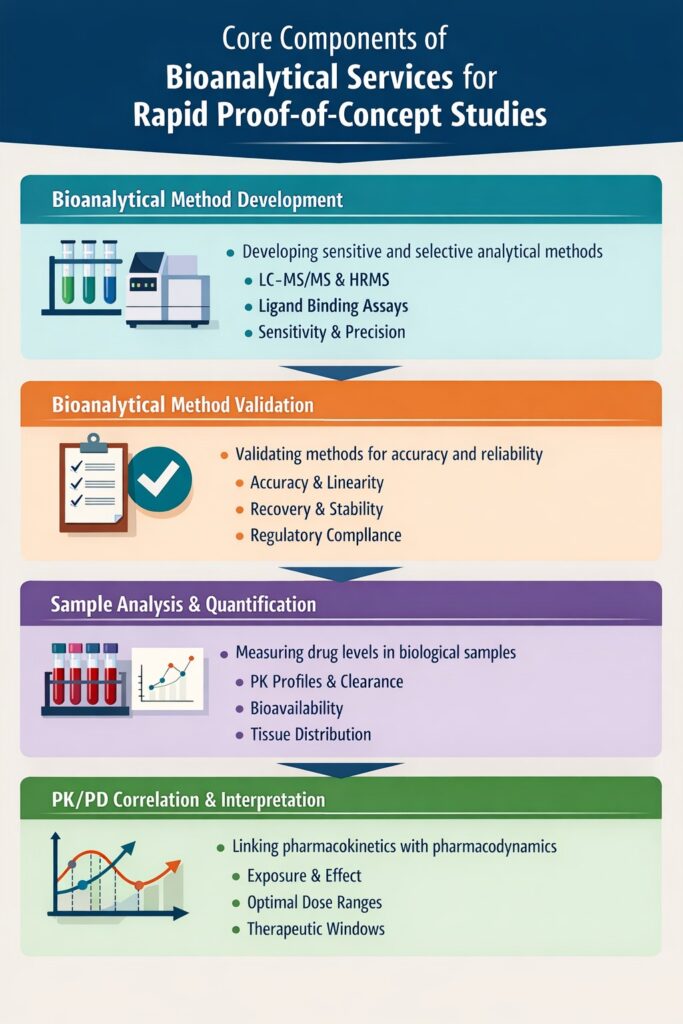
Bioanalytical services for Rapid Proof-of-Concept involve a structured workflow that includes method development, validation, sample analysis, and PK/PD data interpretation. These steps ensure that early drug development studies generate reliable, high-quality data that supports rapid scientific decision-making.
These activities are commonly conducted by specialized bioanalytical laboratory services and regulated bioanalytical services providers.
1. Bioanalytical Method Development
Bioanalytical method development establishes sensitive and selective analytical methods capable of accurately measuring drug molecules and metabolites in biological matrices. This is the first and most critical step in Bioanalytical services for Rapid Proof-of-Concept, as early-stage compounds are often present at very low concentrations.
During method development, scientists optimize analytical conditions to ensure reliable detection and quantification of the target analyte.
This process typically involves bioanalytical method development and addressing challenges such as bioanalytical matrix effects.
Key considerations include:
- Sensitivity – Ability to detect very low drug concentrations
- Selectivity – Ensuring the method differentiates the analyte from biological matrix components
- Accuracy – Obtaining results close to the true concentration
- Precision – Consistency of results across multiple measurements
- Matrix effects – Minimizing interference from biological matrices such as plasma or serum
Common analytical techniques used include:
- LC-MS/MS (Liquid Chromatography–Tandem Mass Spectrometry)
- High-Resolution Mass Spectrometry (HRMS)
- Ligand Binding Assays (LBA) for large molecules and biologics
For complex molecules, specialized workflows such as LC-MS bioanalysis for oligonucleotides and proteomics bioanalytical services may be required.
A well-developed method ensures that Bioanalytical services for Rapid Proof-of-Concept studies produce sensitive and reproducible analytical results.
2. Bioanalytical Method Validation
Bioanalytical method validation confirms that the developed analytical method consistently produces accurate and reliable results under defined conditions. This step ensures that data generated during Bioanalytical services for Rapid Proof-of-Concept studies can be trusted for scientific and regulatory decision-making.
This process follows regulatory guidance and often involves bioanalytical method validation to ensure reproducibility.
Validation is conducted according to internationally recognized regulatory guidelines.
Key validation parameters include:
- Accuracy – Agreement between measured and actual concentrations
- Precision – Reproducibility across repeated measurements
- Linearity – Ability of the method to produce results proportional to analyte concentration
- Recovery – Efficiency of analyte extraction from biological matrices
- Stability – Stability of the analyte under different storage and processing conditions
Robust validation ensures quality bioanalysis and supports generation of robust bioanalytical data required for regulatory submissions.
Regulatory authorities such as the U.S. FDA and EMA require validated bioanalytical methods for drug development studies to ensure data integrity and reproducibility.
3. Sample Analysis and Quantification
Sample analysis is the stage where biological samples collected from proof-of-concept studies are analyzed using validated bioanalytical methods.
During Bioanalytical services for Rapid Proof-of-Concept, biological samples such as plasma, serum, urine, or tissues are processed and analyzed to quantify drug concentrations.
Accurate bioanalytical quantification allows researchers to determine:
- Drug concentration vs. time profiles
- Drug clearance rates
- Bioavailability
- Tissue distribution
High-throughput studies may rely on high-throughput bioanalysis and LC-MS/MS bioanalysis of xenobiotics.
The generated data allows researchers to understand how the drug behaves within a biological system and whether exposure levels are sufficient to produce the desired therapeutic effect.
4. Pharmacokinetic and Pharmacodynamic Correlation
The final component of Bioanalytical services for Rapid Proof-of-Concept is interpreting pharmacokinetic (PK) and pharmacodynamic (PD) relationships.
PK/PD analysis integrates drug concentration data with biological responses to determine whether the drug is achieving its intended therapeutic effect.
Advanced PK/TK bioanalysis helps determine:
- Whether drug exposure correlates with biological activity
- Optimal dose ranges for further studies
- Therapeutic windows that balance efficacy and safety
This analysis is critical for IND-enabling bioanalytical studies and bioanalytical services for IND/NDA submissions.
Understanding PK/PD relationships is essential for guiding dose selection and designing subsequent preclinical or clinical trials.
4: Technologies Used in Bioanalytical Services for Rapid Proof-of-Concept
Advanced analytical technologies enable highly sensitive detection of drugs and biomarkers during proof-of-concept studies.
| Technology | Purpose | Advantages |
|---|---|---|
| LC-MS/MS | Drug quantification | High sensitivity and specificity |
| HRMS | Structural confirmation | Accurate mass detection |
| Ligand Binding Assays | Protein drug analysis | High selectivity |
| Biomarker Assays | PD assessment | Enables efficacy evaluation |
Specialized studies may also require biomarker bioanalytical services and cell and gene therapy bioanalysis.
These technologies ensure that Bioanalytical services for Rapid Proof-of-Concept generate robust and reproducible data.
5: Challenges in Bioanalytical Services for Rapid Proof-of-Concept
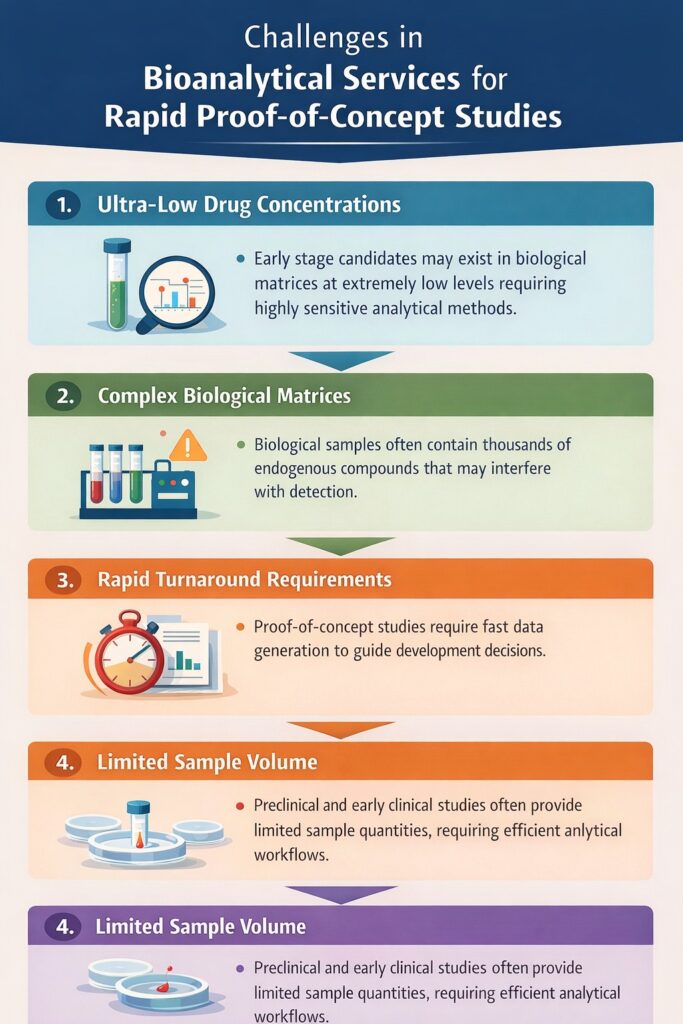
Bioanalytical services for Rapid Proof-of-Concept studies often face technical and operational challenges due to the complexity of biological samples and the need for highly sensitive analytical methods. Addressing these challenges is essential to generate reliable and actionable data during early-stage drug development.
1. Ultra-Low Drug Concentrations
One of the primary challenges in Bioanalytical for Rapid Proof-of-Concept is detecting drug candidates at extremely low concentrations in biological samples.
Sensitive detection methods such as rapid bioanalytical method development and high-sensitivity bioanalysis are required.
During early development stages, drug exposure levels can be very low, often requiring analytical methods capable of detecting compounds at picogram or nanogram levels. To achieve this level of sensitivity, advanced techniques such as LC-MS/MS and high-resolution mass spectrometry are commonly used.
Highly optimized sample preparation and instrument calibration are essential to ensure accurate quantification at these low concentrations.
2. Complex Biological Matrices
Biological matrices such as plasma, serum, and tissues contain thousands of endogenous compounds that can interfere with analytical measurements.
These endogenous substances may cause:
- Matrix interference
- Ion suppression in mass spectrometry
- Reduced analytical sensitivity
- False positive or inaccurate results
To overcome this challenge, scientists implement optimized sample cleanup techniques, selective extraction methods, and robust analytical validation protocols.
3. Rapid Turnaround Requirements
Rapid proof of concept studies require fast data generation to support critical drug development decisions.
Sponsors increasingly rely on bioanalytical CRO partners to accelerate study timelines.
Pharmaceutical and biotechnology companies often rely on early bioanalytical results to determine whether a drug candidate should progress to the next stage of development. As a result, Bioanalytical services for Rapid Proof-of-Concept must deliver high-quality data within tight timelines.
Efficient laboratory workflows, automated sample preparation systems, and experienced analytical teams help ensure timely data delivery.
4. Limited Sample Volume
Another challenge in Bioanalytical for Rapid Proof of Concept is the limited volume of biological samples available for analysis.
Preclinical studies and early clinical trials often provide small sample quantities, especially when dealing with rare biological matrices or pediatric studies. This requires highly efficient analytical methods capable of delivering accurate results from minimal sample volumes.
Advanced analytical techniques and micro-sampling approaches allow laboratories to maximize data output while conserving valuable samples.
6: How ResolveMass Supports Bioanalytical Services for Rapid Proof-of-Concept
ResolveMass Laboratories Inc. provides specialized Bioanalytical for Rapid Proof-of-Concept designed to support pharmaceutical and biotech companies in accelerating early-stage development.
These services are integrated with advanced bioanalytical strategies for complex drug modalities and antibody drug conjugate bioanalytical services.
Expertise and Capabilities
ResolveMass offers:
- Advanced LC-MS/MS bioanalysis
- Peptide and complex molecule characterization
- Biomarker quantification
- Method development and validation
- High-sensitivity detection workflows
Why Sponsors Choose ResolveMass
Key advantages include:
- Experienced bioanalytical scientists
- State-of-the-art mass spectrometry platforms
- Fast turnaround times
- Regulatory-compliant workflows
- Customized analytical strategies
The team also supports emerging areas such as AI in bioanalysis and bioanalytical CRO for AI drug discovery.
These capabilities allow sponsors to generate reliable proof-of-concept data faster, helping accelerate development timelines.
7: Best Practices for Successful Bioanalytical Services for Rapid Proof-of-Concept
To maximize the value of proof of concept studies, several best practices should be followed.
Early CRO Collaboration
Engaging a bioanalytical CRO early helps optimize study design and analytical methods.
Robust Method Development
Methods must be sensitive enough to detect the drug at expected exposure levels.
Avoid common pitfalls highlighted in common bioanalytical mistakes.
Integrated PK/PD Analysis
Combining pharmacokinetic and pharmacodynamic data provides deeper insights into drug behavior.
Maintaining data integrity in bioanalytical studies is essential for regulatory acceptance.
Quality and Compliance
Adhering to regulatory guidelines ensures that generated data supports future regulatory submissions.
8: Future Trends in Bioanalytical Services for Rapid Proof-of-Concept
The field of bioanalysis continues to evolve with new technologies and analytical approaches.
Emerging trends include:
- Ultra-high sensitivity mass spectrometry
- AI-assisted data analysis
- Multiplex biomarker assays
- Micro-sampling techniques
- Automated sample preparation workflows
These innovations will further enhance Bioanalytical for Rapid Proof-of-Concept, enabling faster and more reliable drug development decisions.
Conclusion
Bioanalytical services for Rapid Proof of Concept are essential for evaluating whether a drug candidate demonstrates the expected biological activity during early-stage development. By providing accurate quantitative data on drug exposure, metabolism, and biomarker response, these services enable pharmaceutical companies to make informed decisions quickly.
Partnering with experienced CROs like ResolveMass Laboratories Inc. ensures that proof-of-concept studies are supported by advanced analytical technologies, validated methods, and expert scientists. With reliable bioanalytical data, sponsors can confidently progress promising drug candidates while minimizing development risks.
Frequently Asked Questions:
Bioanalytical services for Rapid Proof-of-Concept are specialized laboratory analyses that measure drug concentrations in biological samples to quickly determine whether a drug candidate demonstrates the expected biological activity in early development studies.
Bioanalytical services for Rapid Proof-of-Concept help pharmaceutical companies quickly evaluate drug exposure, pharmacokinetics, and biological effects. This early data enables faster decision-making and helps identify promising drug candidates before expensive late-stage trials.
Common analytical techniques include:
-LC-MS/MS (Liquid Chromatography–Tandem Mass Spectrometry)
-High-resolution mass spectrometry
-Ligand Binding Assays (LBA)
-Hybrid immunoassay-MS methods
These technologies provide the high sensitivity required to detect drugs at very low concentrations.
Typical biological samples analyzed include:
-Plasma
-Serum
-Urine
-Tissue samples
-Cerebrospinal fluid (CSF)
These samples help researchers understand how the drug behaves in the body.
Bioanalytical services for Rapid Proof-of-Concept must follow regulatory bioanalytical method validation guidelines issued by agencies such as:
-FDA Bioanalytical Method Validation Guidance
-EMA Bioanalytical Method Validation Guideline
-ICH M10 Guideline
These ensure data integrity, accuracy, and reliability.
Common challenges include:
-Detecting ultra-low drug concentrations
-Matrix interference from complex biological samples
-Limited sample volumes
-Need for rapid turnaround times
Advanced LC-MS/MS platforms and experienced analytical teams help overcome these challenges.
Reference
- Maria J. Gonzalez-Moa. Proof-of-Concept Rapid Diagnostic Test for Onchocerciasis: Exploring Peptide Biomarkers and the Use of Gold Nanoshells as Reporter Nanoparticles.https://pubs.acs.org/doi/full/10.1021/acsinfecdis.8b00031
- Kalpana M. Merchant. A Proposed Roadmap for Parkinson’s Disease Proof of Concept Clinical Trials Investigating Compounds Targeting Alpha-Synuclein.https://journals.sagepub.com/doi/full/10.3233/JPD-181471
- Roadmap to the Bioanalytical Testing of COVID-19: From Sample Collection to Disease Surveillance.https://pubs.acs.org/doi/abs/10.1021/acssensors.0c01377
- Kyra J Cowan, Ulrich Kunz, Peter Blattmann, Pratiksha Gulati, Richard Hughes, Lene Andersen. A European Bioanalysis Forum recommendation for requiring a context-of-use statement for successful development and validation of biomarker assays.http://tandfonline.com/doi/full/10.1080/17576180.2024.2376436#abstract
- Pharmacokinetics and Pharmacodynamics of Inhaled GLP-1 (MKC253): Proof-of-Concept Studies in Healthy Normal Volunteers and in Patients With Type 2 Diabetes.https://ascpt.onlinelibrary.wiley.com/doi/abs/10.1038/clpt.2010.85
About the Author


