

Introduction:
Biocompatibility of Cyclodextrin-Based Dendrimers plays a major role in the development of safe and effective nanomedicine systems. These advanced nanocarriers are increasingly explored in pharmaceutical research because they offer controlled drug delivery, enhanced solubility, targeted transport, and improved therapeutic outcomes.
Cyclodextrin-based dendrimers combine two powerful technologies:
- Cyclodextrins, which improve drug inclusion and solubility
- Dendrimers, which provide highly branched and tunable nanoscale structures
However, despite their advantages, ensuring biological safety remains essential before clinical application. Factors such as surface charge, molecular generation, structural composition, and biodegradability can directly influence interactions with cells, tissues, blood components, and the immune system.
This article explains the major aspects affecting biocompatibility, analytical evaluation methods, toxicity considerations, regulatory expectations, and future perspectives for cyclodextrin-based dendrimers in pharmaceutical applications.
Summary:
- Biocompatibility of Cyclodextrin-Based Dendrimers is a critical factor in determining their safety and effectiveness for pharmaceutical and biomedical applications.
- Cyclodextrin dendrimers combine the drug-encapsulation ability of cyclodextrins with the controlled architecture of dendrimers, making them promising nanocarriers.
- Surface chemistry, dendrimer generation, particle size, and charge significantly influence toxicity and biological interactions.
- Properly engineered cyclodextrin-based dendrimers can improve drug solubility, targeted delivery, and therapeutic performance while minimizing adverse effects.
- Regulatory authorities require extensive biocompatibility evaluation, including cytotoxicity, hemocompatibility, immunogenicity, and biodegradability testing.
- Advanced analytical characterization and safety studies help ensure successful clinical translation and regulatory compliance.
1: What Are Cyclodextrin-Based Dendrimers?
Cyclodextrin-based dendrimers are nanoscale branched polymers that incorporate cyclodextrin units within their structure. These systems are designed to enhance drug delivery performance while maintaining controlled molecular architecture.
Key Structural Components
| Component | Function |
|---|---|
| Cyclodextrin core | Drug inclusion and solubility enhancement |
| Branched dendritic arms | High loading capacity |
| Surface functional groups | Targeting and biological interaction control |
| Internal cavities | Encapsulation of hydrophobic compounds |
These multifunctional systems are widely investigated for:
- Oral drug delivery
- Injectable formulations
- Gene delivery
- Cancer therapy
- Imaging applications
- Controlled-release formulations
2: Why Is Biocompatibility Important?
Biocompatibility is essential because it determines whether a material can safely interact with biological systems while performing its intended therapeutic function. In pharmaceutical nanotechnology, a carrier system must not only deliver drugs effectively but also avoid causing harmful effects to cells, tissues, blood components, or the immune system.
For cyclodextrin-based dendrimers, strong biocompatibility is critical to ensuring both patient safety and successful clinical performance.
Key Reasons Why Biocompatibility Matters
- Reduces cellular toxicity by minimizing damage to healthy cells and tissues.
- Avoids unwanted immune reactions that may trigger inflammation or hypersensitivity responses.
- Prevents hemolysis and other adverse interactions with blood components during systemic administration.
- Improves systemic safety by reducing off-target effects and long-term accumulation risks.
- Supports long-term therapeutic applications for chronic treatments and repeated dosing.
- Facilitates regulatory approval by meeting safety expectations established by FDA, EMA, ICH, and ISO guidelines.
In nanomedicine development, efficacy alone is not sufficient. Even highly advanced drug delivery systems may fail during preclinical or clinical stages if they demonstrate poor biological compatibility. Therefore, optimizing the biocompatibility of cyclodextrin-based dendrimers is a fundamental step in developing safe, effective, and clinically translatable pharmaceutical formulations.
3: Major Factors Affecting Biocompatibility of Cyclodextrin-Based Dendrimers
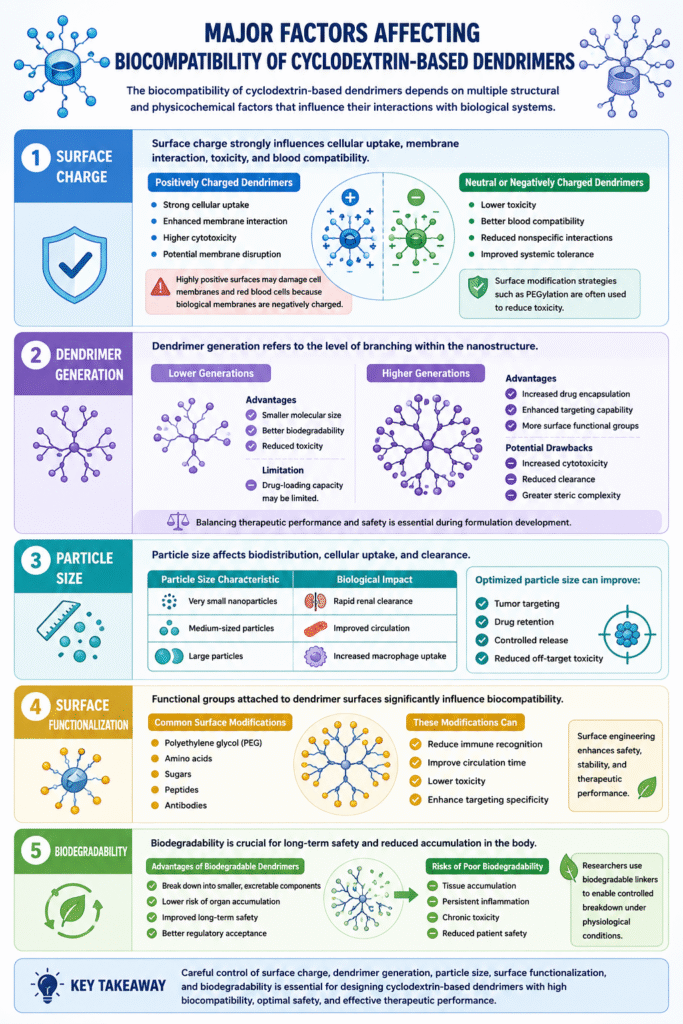
The biocompatibility of cyclodextrin-based dendrimers depends on several structural and physicochemical properties that influence how these nanocarriers interact with cells, tissues, blood components, and the immune system. Careful optimization of these parameters is essential for developing safe and effective pharmaceutical formulations.
1. Surface Charge
Surface charge is one of the most important factors affecting the biological behavior of cyclodextrin-based dendrimers. It strongly influences cellular uptake, membrane interaction, blood compatibility, and toxicity.
Positively Charged Dendrimers
Cationic dendrimers often show:
- Strong cellular uptake
- Enhanced membrane interaction
- Higher cytotoxicity
- Potential membrane disruption
Highly positive surfaces may damage cell membranes and red blood cells because biological membranes are negatively charged.
Neutral or Negatively Charged Dendrimers
These systems generally demonstrate:
- Lower toxicity
- Better blood compatibility
- Reduced nonspecific interactions
- Improved systemic tolerance
Surface modification strategies such as PEGylation are often used to reduce toxicity.
2. Dendrimer Generation
Dendrimer generation refers to the number of branching layers present within the dendritic structure. Higher generations possess more complex architectures and greater surface functionality.
Lower Generations
Advantages include:
- Smaller molecular size
- Better biodegradability
- Reduced toxicity
However, drug-loading capacity may be limited.
Higher Generations
Advantages include:
- Increased drug encapsulation
- Enhanced targeting capability
- More surface functional groups
Potential drawbacks include:
- Increased cytotoxicity
- Reduced clearance
- Greater steric complexity
Balancing therapeutic performance and safety is essential during formulation development.
3. Particle Size
Particle size directly affects the pharmacokinetics, biodistribution, cellular internalization, and clearance behavior of cyclodextrin-based dendrimers.
| Particle Size Characteristic | Biological Impact |
|---|---|
| Very small nanoparticles | Rapid renal clearance |
| Medium-sized particles | Improved circulation |
| Large particles | Increased macrophage uptake |
Optimized particle size can improve:
- Tumor targeting
- Drug retention
- Controlled release
- Reduced off-target toxicity
4. Surface Functionalization
Surface functionalization involves attaching specific molecules or chemical groups to the dendrimer surface to improve biological performance and targeting ability.
Common Surface Modifications
- Polyethylene glycol (PEG)
- Amino acids
- Sugars
- Peptides
- Antibodies
These modifications can:
- Reduce immune recognition
- Improve circulation time
- Lower toxicity
- Enhance targeting specificity
5. Biodegradability
Biodegradability is a critical safety factor for nanocarrier systems intended for clinical use.
Biodegradable cyclodextrin-based dendrimers can break down into smaller, excretable components after drug delivery, reducing long-term accumulation within tissues.
Advantages of Biodegradable Dendrimers
- Improved long-term safety
- Reduced tissue accumulation
- Better systemic clearance
- Lower chronic toxicity risk
- Enhanced regulatory acceptance
Risks of Poor Biodegradability
Non-degradable or slowly degradable materials may lead to:
- Organ accumulation
- Persistent inflammation
- Chronic toxicity
- Reduced patient safety
To improve biodegradability, researchers often incorporate:
- Ester linkages
- Peptide bonds
- Enzyme-sensitive linkers
- Hydrolysable spacers
These biodegradable linkers enable controlled breakdown under physiological conditions.
4: Cytotoxicity Evaluation of Cyclodextrin-Based Dendrimers
Cytotoxicity testing evaluates how dendrimers affect living cells.
Common Cytotoxicity Assays
| Assay | Purpose |
|---|---|
| MTT assay | Cell viability assessment |
| LDH assay | Membrane integrity evaluation |
| Flow cytometry | Apoptosis and necrosis detection |
| Live/dead staining | Cellular health visualization |
Key Findings from Studies
Many studies report that:
- Surface-modified dendrimers exhibit lower toxicity
- Neutral dendrimers are safer than highly cationic systems
- Toxicity increases with higher concentration and exposure duration
Biocompatibility depends heavily on formulation optimization.
5: Hemocompatibility Considerations
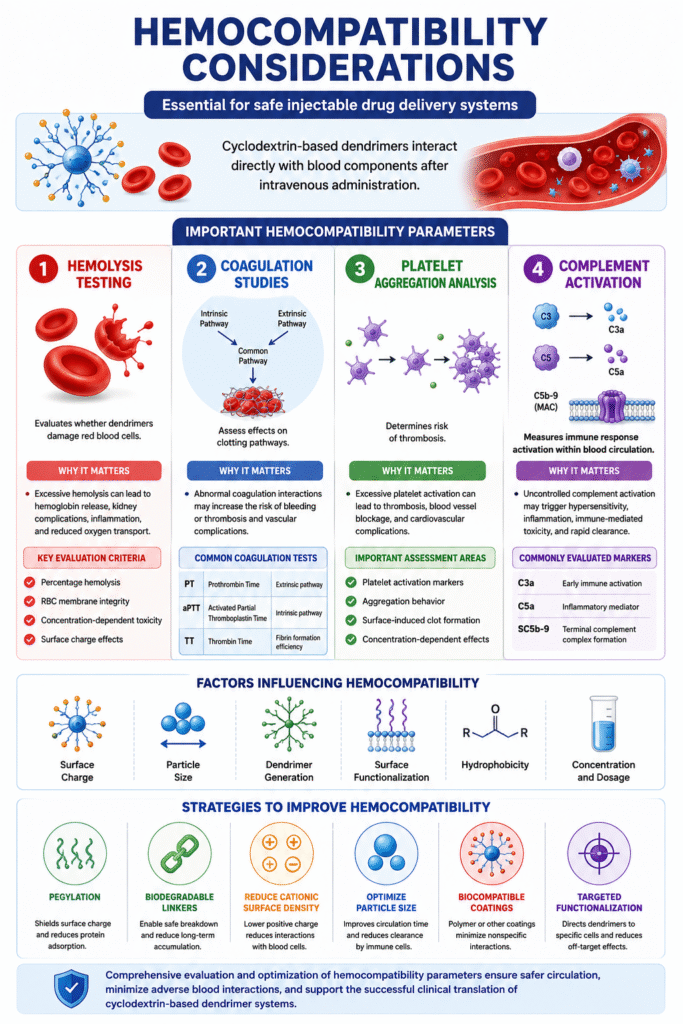
Hemocompatibility is a critical requirement for injectable nanocarrier systems because these materials come into direct contact with blood components following intravenous administration. For cyclodextrin-based dendrimers, good hemocompatibility is essential to ensure safe circulation, minimize adverse blood interactions, and improve overall systemic safety.
Since dendrimers can interact with red blood cells, plasma proteins, platelets, and immune mediators, comprehensive hemocompatibility evaluation is necessary during pharmaceutical development.
Important Hemocompatibility Parameters:
1. Hemolysis Testing
Hemolysis studies evaluate whether dendrimers damage or rupture red blood cells (RBCs).
Why It Matters
Excessive hemolysis can release hemoglobin into circulation, potentially causing:
- Tissue damage
- Kidney complications
- Inflammatory responses
- Reduced oxygen transport capacity
Key Evaluation Criteria
Researchers typically assess:
- Percentage hemolysis
- RBC membrane integrity
- Concentration-dependent toxicity
- Surface charge effects
Highly cationic dendrimers are often associated with increased hemolytic activity because positively charged surfaces strongly interact with negatively charged RBC membranes.
2. Coagulation Studies
Coagulation assays determine whether dendrimers interfere with normal blood clotting mechanisms.
Why It Matters
Abnormal coagulation interactions may increase the risk of:
- Excessive bleeding
- Thrombus formation
- Vascular complications
- Altered clotting pathways
Common Coagulation Parameters
| Coagulation Test | Purpose |
|---|---|
| Prothrombin Time (PT) | Evaluates extrinsic clotting pathway |
| Activated Partial Thromboplastin Time (aPTT) | Assesses intrinsic clotting pathway |
| Thrombin Time (TT) | Measures fibrin formation efficiency |
Maintaining normal coagulation profiles is essential for safe intravenous administration.
3. Platelet Aggregation Analysis
Platelet aggregation studies assess whether dendrimers activate or aggregate platelets within blood circulation.
Why It Matters
Excessive platelet activation can contribute to:
- Thrombosis
- Blood vessel blockage
- Cardiovascular complications
- Reduced circulation efficiency
Important Assessment Areas
Researchers evaluate:
- Platelet activation markers
- Aggregation behavior
- Surface-induced clot formation
- Concentration-dependent effects
Surface-engineered dendrimers generally show lower platelet activation and improved hemocompatibility.
4. Complement Activation
Complement activation studies determine whether dendrimers stimulate the complement system, a key component of innate immunity.
Why It Matters
Uncontrolled complement activation may trigger:
- Hypersensitivity reactions
- Inflammation
- Immune-mediated toxicity
- Rapid nanoparticle clearance
Commonly Evaluated Markers
| Complement Marker | Biological Significance |
|---|---|
| C3a | Early immune activation |
| C5a | Inflammatory response mediator |
| SC5b-9 | Terminal complement complex formation |
Reducing complement activation is essential for improving circulation time and minimizing immune-related adverse effects.
6: Analytical Characterization Supporting Biocompatibility
Comprehensive analytical characterization is critical for ensuring product quality and biological safety.
Important Characterization Parameters
| Parameter | Analytical Technique |
|---|---|
| Particle size | Dynamic Light Scattering (DLS) |
| Surface charge | Zeta potential analysis |
| Morphology | TEM / SEM |
| Molecular weight | GPC |
| Drug loading | HPLC / LC-MS |
| Structural confirmation | FTIR / NMR |
Reliable analytical testing supports:
- Batch consistency
- Safety evaluation
- Regulatory submissions
- Product optimization
7: Regulatory Expectations for Biocompatibility Studies
Regulatory agencies require extensive safety evaluation for nanocarrier systems.
Key Regulatory Considerations
Authorities generally expect assessment of:
- Cytotoxicity
- Genotoxicity
- Hemocompatibility
- Immunotoxicity
- Biodistribution
- Biodegradation
- Long-term toxicity
Guidance from organizations such as:
- FDA
- EMA
- ICH
- ISO 10993
helps establish standardized testing strategies.
8: Applications Benefiting from Improved Biocompatibility
1. Cancer Drug Delivery
Biocompatible cyclodextrin dendrimers can improve:
- Tumor targeting
- Drug accumulation
- Reduced systemic toxicity
2. Gene Delivery
Modified dendrimers can safely transport:
- DNA
- siRNA
- mRNA
while minimizing cellular damage.
3. Oral Drug Delivery
Cyclodextrin dendrimers enhance:
- Solubility
- Stability
- Absorption of poorly soluble drugs
4. Imaging and Diagnostics
Biocompatible nanocarriers support safer imaging agent delivery for diagnostic applications.
9: Challenges in Achieving Optimal Biocompatibility
Although cyclodextrin-based dendrimers offer significant advantages for drug delivery and nanomedicine applications, achieving optimal biocompatibility remains a major scientific and regulatory challenge. Their complex nanoscale architecture, diverse surface chemistry, and biological interactions require extensive optimization to ensure both therapeutic efficacy and patient safety.
Researchers must carefully balance formulation performance with toxicity control, manufacturability, and regulatory compliance before successful clinical translation can occur.
Major Challenges:
1. Structural Complexity
Cyclodextrin-based dendrimers possess highly branched and multifunctional structures, making their design and characterization inherently complex.
Why This Is Challenging
Small structural variations can significantly affect:
- Cellular uptake
- Toxicity
- Drug loading
- Biodistribution
- Immune interactions
- Stability
Key Difficulties
- Precise control of branching architecture
- Surface functional group consistency
- Reproducible synthesis
- Structural heterogeneity
- Complex analytical characterization
Advanced analytical tools such as NMR, FTIR, DLS, TEM, and LC-MS are often required to fully characterize these nanocarrier systems.
2. Toxicity Optimization
One of the biggest challenges is balancing therapeutic efficiency with biological safety.
The Core Problem
Features that improve drug delivery performance may also increase toxicity.
For example:
| Beneficial Property | Potential Risk |
|---|---|
| Positive surface charge | Membrane disruption |
| Higher dendrimer generation | Increased cytotoxicity |
| Strong cellular uptake | Higher inflammatory response |
| Prolonged circulation | Tissue accumulation |
Important Considerations
Researchers must optimize:
- Surface charge density
- Particle size
- Drug loading levels
- Surface functionalization
- Biodegradability
Achieving the ideal balance between efficacy and safety remains a central challenge in nanomedicine development.
3. Manufacturing Scalability
Producing cyclodextrin-based dendrimers at laboratory scale is feasible, but large-scale manufacturing introduces substantial technical difficulties.
Major Manufacturing Challenges
- Multi-step synthesis procedures
- Batch-to-batch variability
- High production costs
- Purification complexity
- Process reproducibility
- Quality control consistency
Scale-Up Concerns
Industrial-scale production must maintain:
- Uniform particle size
- Consistent surface chemistry
- Stable drug loading
- Controlled purity profiles
Scalable and cost-effective manufacturing methods are essential for commercial development and clinical adoption.
4. Regulatory Uncertainty
Regulatory evaluation of nanomedicine products remains an evolving area.
Because cyclodextrin-based dendrimers possess unique nanoscale properties, conventional pharmaceutical guidelines may not fully address their biological behavior and safety considerations.
Regulatory Challenges Include
- Lack of standardized nanotoxicity protocols
- Variable international regulatory expectations
- Limited nanomedicine-specific guidance
- Complex characterization requirements
- Uncertainty in long-term safety evaluation
Regulatory Agencies Involved
- FDA
- EMA
- ICH
- ISO
Regulators continue developing frameworks for evaluating advanced nanocarrier systems, but harmonized global standards are still emerging.
5. Long-Term Safety Data
Long-term biological effects remain insufficiently understood for many dendrimer systems.
Why Long-Term Data Matters
Chronic exposure may lead to:
- Tissue accumulation
- Persistent inflammation
- Delayed toxicity
- Immune complications
- Organ-specific adverse effects
Current Limitations
Many studies focus primarily on:
- Short-term cytotoxicity
- Acute toxicity
- In vitro evaluation
However, additional data is needed regarding:
- Long-term biodistribution
- Chronic administration
- Metabolism and degradation
- Excretion pathways
- Clinical safety outcomes
Comprehensive long-term studies are critical for supporting widespread clinical acceptance.
10: Future Perspectives
Research continues to improve the Biocompatibility of Cyclodextrin-Based Dendrimers through advanced engineering approaches.
Emerging Strategies
- Stimuli-responsive dendrimers
- Biodegradable architectures
- Precision surface functionalization
- AI-assisted nanocarrier design
- Personalized nanomedicine platforms
Future developments are expected to improve:
- Clinical translation
- Therapeutic efficacy
- Patient safety
- Regulatory acceptance
Conclusion:
Biocompatibility of Cyclodextrin-Based Dendrimers is one of the most important determinants of their success in pharmaceutical and biomedical applications. These sophisticated nanocarriers offer substantial advantages for drug delivery, including improved solubility, targeted transport, and controlled release.
However, biological safety must be carefully optimized through appropriate control of surface charge, particle size, dendrimer generation, biodegradability, and surface functionality. Comprehensive analytical characterization and regulatory-compliant safety testing are essential to ensure successful product development.
As nanomedicine research advances, cyclodextrin-based dendrimers are expected to play an increasingly important role in safer and more effective therapeutic systems.
Frequently Asked Questions:
Cyclodextrin-based dendrimers may show toxicity depending on their structure and surface chemistry. Positively charged and higher-generation dendrimers often exhibit greater cytotoxicity. However, surface modifications such as PEGylation can significantly reduce harmful effects. Toxicity also depends on dosage, exposure duration, and administration route. Carefully engineered dendrimers can achieve improved safety profiles for pharmaceutical applications.
Surface charge strongly affects how dendrimers interact with biological membranes and blood components. Positively charged dendrimers usually show better cellular uptake but may damage cell membranes. Neutral or negatively charged systems generally demonstrate lower toxicity and improved blood compatibility. Excessive positive charge can also increase hemolysis and immune activation. Surface engineering strategies help optimize safety and therapeutic performance.
Safety testing involves multiple biological and analytical evaluations. Common studies include cytotoxicity assays, hemolysis testing, coagulation analysis, and immune response assessment. Researchers also study biodistribution, biodegradation, and long-term toxicity. Advanced analytical techniques help characterize particle size, surface charge, and structural stability. These evaluations support regulatory compliance and clinical development.
Yes, cyclodextrin dendrimers can improve cancer therapy by enhancing tumor targeting and drug accumulation. They help reduce systemic toxicity associated with conventional chemotherapy. Controlled drug release improves therapeutic efficiency while minimizing side effects. Surface-functionalized dendrimers can selectively target cancer cells. Their nanoscale size also supports improved penetration into tumor tissues.
Some cyclodextrin dendrimers are specifically designed to be biodegradable. They contain hydrolysable or enzyme-sensitive linkers that break down under physiological conditions. Biodegradable systems reduce long-term tissue accumulation and toxicity risks. Improved biodegradability also enhances systemic clearance from the body. This property is important for achieving better long-term safety and regulatory acceptance.
Reference
- Topuz F, Uyar T. Recent advances in cyclodextrin‐based nanoscale drug delivery systems. Wiley Interdisciplinary Reviews: Nanomedicine and Nanobiotechnology. 2024 Nov;16(6):e1995.https://wires.onlinelibrary.wiley.com/doi/abs/10.1002/wnan.1995
- Gidwani B, Vyas A. A comprehensive review on cyclodextrin‐based carriers for delivery of chemotherapeutic cytotoxic anticancer drugs. BioMed research international. 2015;2015(1):198268.https://onlinelibrary.wiley.com/doi/abs/10.1155/2015/198268
- Namazi H, Heydari A. Synthesis of β‐cyclodextrin‐based dendrimer as a novel encapsulation agent. Polymer international. 2014 Aug;63(8):1447-55.https://scijournals.onlinelibrary.wiley.com/doi/abs/10.1002/pi.4637
- Kost B, Brzeziński M, Socka M, Baśko M, Biela T. Biocompatible polymers combined with cyclodextrins: Fascinating materials for drug delivery applications. Molecules. 2020 Jul 28;25(15):3404.https://www.mdpi.com/1420-3049/25/15/3404
- Soh WW, Li J. Cyclodextrin‐Based Pseudocopolymers and Their Biomedical Applications for Drug and Gene Delivery. Small. 2025 Sep;21(36):e01304.https://onlinelibrary.wiley.com/doi/abs/10.1002/smll.202501304
- Mellet CO, Fernández JM, Benito JM. Cyclodextrin-based gene delivery systems. Chemical Society Reviews. 2011;40(3):1586-608.https://pubs.rsc.org/en/content/articlehtml/2011/cs/c0cs00019a

