

Introduction
Biomarker bioanalytical services CRO partnerships have become indispensable in modern pharmaceutical development, providing the specialized expertise and infrastructure needed to validate and quantify biological markers throughout the drug development lifecycle. Through advanced biomarker bioanalytical services delivered by an experienced bioanalytical CRO, sponsors can generate reliable data to support go/no-go decisions, demonstrate proof of concept, and enable regulatory submissions with confidence.
In today’s competitive drug development landscape, many pharmaceutical and biotechnology companies rely on outsourced bioanalytical services to access validated analytical platforms, regulatory expertise, and scalable laboratory capacity. Selecting a CRO with comprehensive biomarker bioanalytical capabilities can significantly influence timelines, data quality, and regulatory outcomes.
Summary
This comprehensive guide explores the complete scope of biomarker bioanalytical services CRO providers deliver to pharmaceutical and biotechnology companies:
- Complete service spectrum: From assay development through sample analysis and regulatory reporting
- Quality assurance: GLP compliance, method validation, and regulatory alignment essential for drug development
- Technology capabilities: Advanced LC-MS/MS, immunoassay platforms, and emerging biomarker methodologies
- Project lifecycle support: Pre-clinical through late-phase clinical trial biomarker analysis
- Regulatory expertise: Documentation, submission-ready packages, and audit readiness
- Timeline expectations: Realistic project milestones from method development to final reporting
- Partnership benefits: How the right CRO accelerates drug development programs
1: What Are Biomarker Bioanalytical Services?
Biomarker bioanalytical services involve the quantitative measurement and characterization of biological markers in matrices such as plasma, serum, tissue, urine, and CSF to support drug development programs. These services are central to understanding pharmacological response, safety, and efficacy, clearly demonstrating why bioanalysis is important throughout development.
A specialized CRO delivers biomarker bioanalytical services for FDA and Health Canada by applying validated methods, compliant workflows, and regulatory-ready documentation.
Core Components of Biomarker Services
A comprehensive biomarker bioanalytical services CRO provides:
- Assay development and optimization for novel and established biomarkers
- Method validation according to regulatory guidelines (FDA, EMA, ICH)
- Sample analysis with appropriate quality control measures
- Data analysis and interpretation with statistical support
- Regulatory documentation for submissions and audits
2: Complete Biomarker Bioanalytical Services CRO Capabilities
An experienced CRO supports bioanalytical services in drug development by offering integrated solutions that reduce risk and accelerate timelines. Many sponsors choose bioanalytical services outsourcing for pharma to gain access to regulatory-compliant infrastructure and specialized expertise.
1. Assay Development and Method Optimization
Reliable biomarker analysis begins with robust assay development. CRO scientists design fit-for-purpose methods tailored to exploratory, proof-of-concept, or pivotal clinical studies using established bioanalytical method development approaches.
This process proactively addresses common challenges in bioanalytical method development, including complex matrices and bioanalytical matrix effects.
Key capabilities include:
- Literature review and feasibility assessment
- Selection of appropriate analytical platforms (LC-MS/MS, ELISA, ECL, flow cytometry)
- Matrix selection and optimization
- Sensitivity and specificity determination
- Initial validation parameter assessment
Timeline expectations: Assay development typically requires 6-12 weeks depending on biomarker complexity and availability of reference standards.
2. Method Validation Services
Method validation ensures assays produce reproducible and accurate data suitable for regulatory use. CROs perform validations under regulated bioanalytical services frameworks aligned with FDA, EMA, and ICH guidelines.
| Validation Type | Purpose | Typical Timeline |
|---|---|---|
| Full Validation | Regulatory submission studies | 8-12 weeks |
| Partial Validation | Modified validated methods | 4-6 weeks |
| Cross-Validation | Method transfer or comparison | 2-4 weeks |
| Fit-for-Purpose | Exploratory biomarker studies | 3-6 weeks |
Validation parameters assessed:
- Accuracy and precision (intra- and inter-assay)
- Selectivity and specificity
- Sensitivity (LLOQ and ULOQ)
- Linearity and range
- Stability under various conditions
- Dilution integrity
- Parallelism (for ligand-binding assays)
3. Sample Analysis and Study Support
Validated methods are applied to study samples using clinical bioanalytical services and fully controlled bioanalytical laboratory services.
High sample volumes are efficiently managed through high-throughput bioanalysis workflows that ensure data integrity and rapid turnaround.
Sample analysis services include:
- Sample receipt, storage, and chain of custody management
- Analysis according to validated methods
- Quality control sample preparation and evaluation
- Real-time data review and trending
- Investigation of out-of-specification results
- Repeat analysis when necessary
4. Regulatory Compliance and Documentation
A trusted biomarker bioanalytical services CRO maintains comprehensive documentation systems that support regulatory submissions and withstand agency audits.
Documentation deliverables:
- Standard Operating Procedures (SOPs)
- Validation protocols and reports
- Study protocols and amendments
- Analytical run documentation
- Quality control documentation
- Final study reports with integrated data tables
- Regulatory submission-ready packages
3: Advanced Technology Platforms for Biomarker Analysis
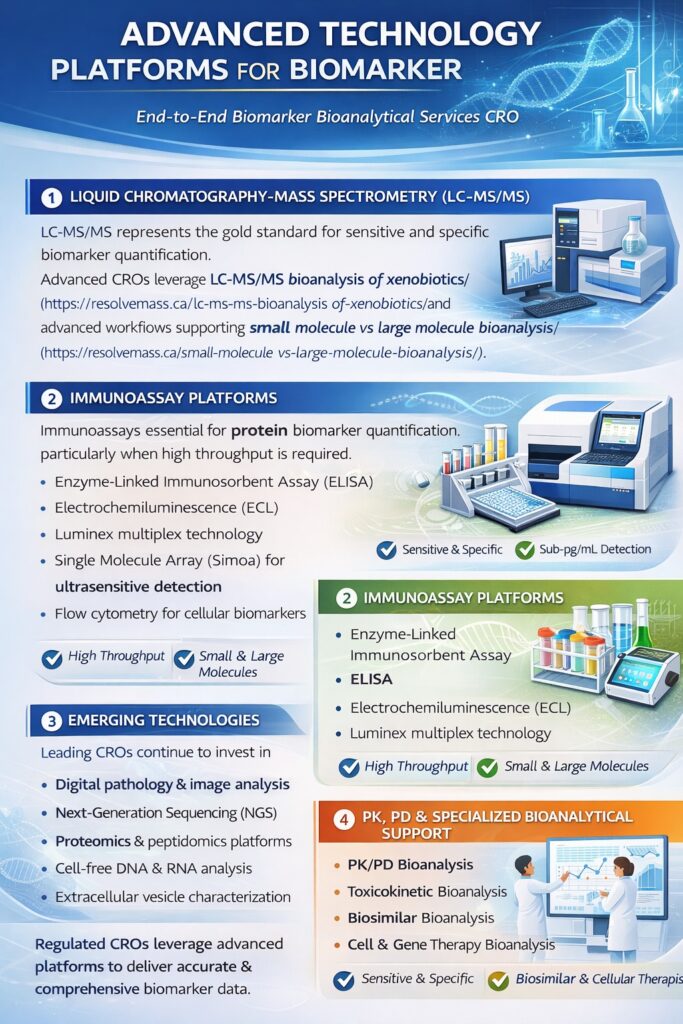
1. Liquid Chromatography-Mass Spectrometry (LC-MS/MS)
LC-MS/MS represents the gold standard for small molecule and protein biomarker quantification, offering exceptional sensitivity, specificity, and multiplexing capabilities. Advanced CROs leverage high-resolution mass spectrometry and multiple reaction monitoring (MRM) to achieve sub-pg/mL detection limits.
LC-MS/MS remains a gold standard for biomarker quantification due to its sensitivity and specificity. CROs apply LC-MS/MS bioanalysis of xenobiotics and advanced workflows supporting small molecule vs large molecule bioanalysis , including LC-MS for large molecules.
Applications:
- Small molecule metabolites and intermediates
- Protein biomarkers via peptide quantification
- Post-translational modification analysis
- Metabolomics and lipidomics profiling
2. Immunoassay Platforms
Immunoassays remain essential for protein biomarker quantification, particularly when high throughput is required. Modern biomarker bioanalytical services CRO facilities utilize multiple platforms to match analytical needs with optimal technology.
Immunoassays such as ELISA, ECL, Luminex, and SIMOA complement mass spectrometry and enable small and large molecule quantification across diverse biomarker classes.
Platform options:
- Enzyme-Linked Immunosorbent Assay (ELISA)
- Electrochemiluminescence (ECL)
- Luminex multiplex technology
- Single Molecule Array (Simoa) for ultrasensitive detection
- Flow cytometry for cellular biomarkers
3. Emerging Technologies
Leading CROs continually invest in emerging technologies to address complex biomarker challenges:
- Digital pathology and image analysis for tissue biomarkers
- Next-generation sequencing for genomic biomarkers
- Proteomics and peptidomics platforms
- Cell-free DNA and RNA analysis
- Extracellular vesicle characterization
4. PK, PD, and Specialized Bioanalytical Support
Biomarker programs often integrate PK/PD bioanalysis and toxicokinetic bioanalysis to link exposure with biological response.
Advanced programs also require biosimilar bioanalysis and cell and gene therapy bioanalysis.
5. Regulatory Compliance and Global Submissions
A trusted biomarker bioanalytical services CRO supports bioanalytical services for IND and NDA submissions and maintains readiness for audits across bioanalytical services in North America.
6. Cost, Accessibility, and Strategic Fit
Sponsors assess CRO partnerships based on transparency and scalability. Resources addressing bioanalytical testing services cost and affordable bioanalytical services for biotech startups help align expectations early.
4: Quality Assurance and Regulatory Standards
GLP Compliance
Good Laboratory Practice (GLP) compliance ensures studies meet regulatory requirements for non-clinical safety studies. A reputable biomarker bioanalytical services CRO maintains GLP compliance for applicable studies while offering flexibility for exploratory research.
GLP requirements include:
- Qualified personnel and training programs
- Validated equipment and facilities
- Quality assurance unit oversight
- Standard operating procedures
- Raw data integrity and traceability
- Study director responsibility
- Archive and retention systems
GCLP for Clinical Samples
Good Clinical Laboratory Practice (GCLP) principles guide biomarker analysis of clinical trial samples, ensuring data quality and regulatory acceptability.
ISO Certification
Many CROs maintain ISO 17025 accreditation, demonstrating technical competence and quality management system compliance.
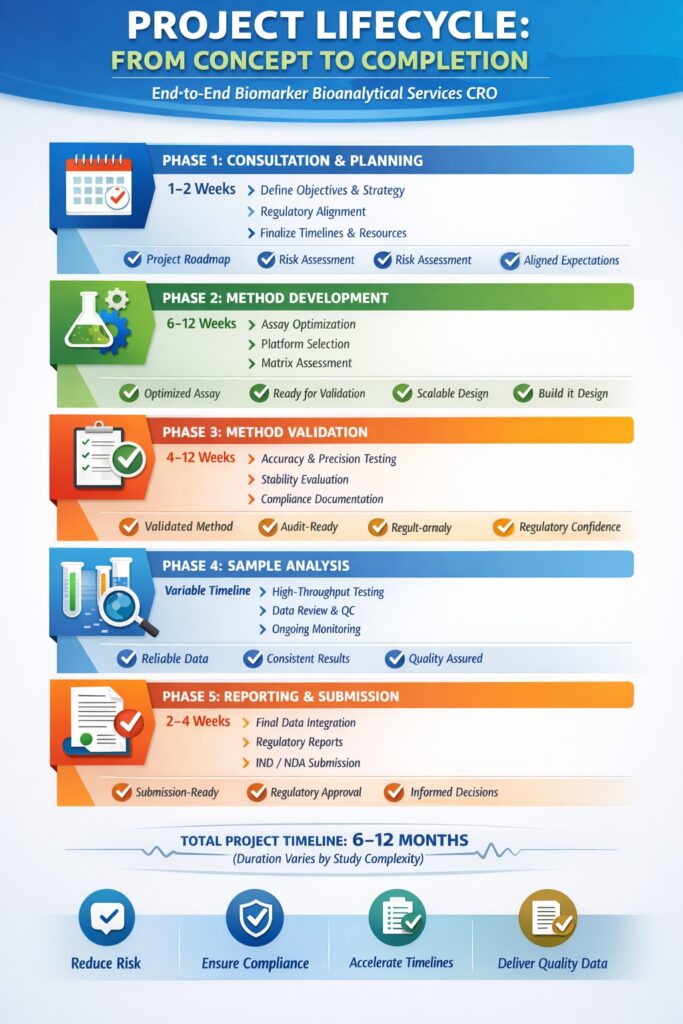
5: Project Lifecycle: From Concept to Completion
Phase 1: Consultation and Planning (1-2 weeks)
The CRO partnership begins with detailed consultation to understand study objectives, biomarker rationale, and project requirements. This phase establishes success criteria, timelines, and resource allocation.
Phase 2: Method Development (6-12 weeks)
Assay development proceeds with regular communication and milestone reviews. The CRO optimizes sensitivity, specificity, and throughput while considering matrix effects and stability.
Phase 3: Method Validation (4-12 weeks)
Validation experiments follow regulatory guideline requirements, with validation reports documenting all parameters and acceptance criteria.
Phase 4: Sample Analysis (Variable)
Sample analysis duration depends on study size, with typical turnaround times ranging from days to months for large clinical trials. Real-time data review ensures quality throughout the analysis period.
Phase 5: Reporting and Submission (2-4 weeks)
Final reports integrate all study data with statistical analysis, quality control summaries, and regulatory documentation ready for submission.
6: Selecting the Right Biomarker Bioanalytical Services CRO
Critical Evaluation Criteria
When selecting a CRO partner for biomarker analysis, sponsors should evaluate:
Technical capabilities:
- Relevant experience with similar biomarkers and matrices
- Available technology platforms and instrumentation
- Method development and validation expertise
- Scientific advisory support
Quality and compliance:
- Regulatory inspection history
- Quality management systems
- Data integrity practices
- Documentation standards
Project management:
- Communication protocols and responsiveness
- Timeline adherence
- Flexibility for protocol amendments
- Transparent pricing models
Scientific expertise:
- Published research and presentations
- Staff qualifications and experience
- Collaboration on data interpretation
- Strategic input for program development
Partnership Benefits
A strong biomarker bioanalytical services CRO partnership delivers:
- Accelerated program timelines through parallel development activities
- Risk mitigation via validated methods and quality systems
- Cost efficiency compared to internal capability building
- Regulatory expertise and submission support
- Flexibility to scale capacity with program needs
- Access to emerging technologies and methodologies
7: Industry Trends and Future Directions
The biomarker analysis landscape continues evolving with several key trends:
Multiplex and high-content biomarker panels: Moving beyond single biomarker measurement to comprehensive biological profiling that captures complex disease mechanisms and drug responses.
Artificial intelligence and machine learning: Integration of AI for data analysis, pattern recognition, and predictive modeling to extract maximum value from biomarker data.
Point-of-care and decentralized testing: Development of biomarker assays suitable for decentralized clinical trials and patient-centric study designs.
Precision medicine applications: Biomarker-driven patient stratification and companion diagnostics to enable targeted therapeutic interventions.
Real-world evidence generation: Expansion of biomarker analysis beyond traditional clinical trials to support real-world data collection and post-market surveillance.
8: Expectations for Sponsors Working with a Biomarker Bioanalytical Services CRO
Realistic Timeline Expectations
Sponsors should plan for comprehensive biomarker programs with these typical timelines:
- Assay feasibility and development: 2-3 months
- Full method validation: 2-3 months
- Regulatory documentation preparation: 2-4 weeks
- Sample analysis: Variable based on sample volume
- Final reporting: 2-4 weeks post-analysis completion
Total program duration from initiation to final report delivery typically ranges from 6-12 months for complex biomarker projects.
Communication and Transparency
Effective CRO partnerships feature:
- Regular project status meetings and updates
- Proactive communication of issues or deviations
- Scientific collaboration on data interpretation
- Transparent discussion of challenges and solutions
- Responsive support for sponsor questions
Cost Considerations
Biomarker bioanalytical services investment includes:
- Method development and optimization
- Validation experiments and documentation
- Sample analysis costs (per sample)
- Quality control materials and reference standards
- Project management and scientific oversight
- Regulatory documentation preparation
Sponsors should request detailed proposals that itemize costs and identify potential variables affecting total investment.
Conclusion
Partnering with an experienced biomarker bioanalytical services CRO represents a strategic investment that can significantly accelerate drug development programs while ensuring regulatory compliance and data quality. The comprehensive capabilities described in this article—from advanced analytical platforms to regulatory expertise—demonstrate the value that specialized CROs bring to pharmaceutical and biotechnology sponsors.
Success in biomarker analysis requires more than technical capability; it demands a true partnership approach where the CRO functions as an extension of the sponsor’s development team. By understanding the full scope of biomarker bioanalytical services CRO offerings and setting appropriate expectations for timelines, deliverables, and collaboration, sponsors can maximize the value of these critical partnerships and advance their therapeutic programs with confidence.
The evolution of biomarker science continues to create new opportunities for therapeutic innovation. Working with a CRO that combines cutting-edge technology, regulatory expertise, and genuine partnership commitment positions sponsors for success in today’s competitive drug development environment.
Frequently Asked Questions:
End-to-end biomarker bioanalytical services mean managing the complete biomarker lifecycle, including assay development, validation, sample analysis, data reporting, and regulatory submission support within a single CRO.
Sponsors should engage a Biomarker Bioanalytical Services CRO as early as preclinical development to ensure assay suitability, regulatory alignment, and continuity of biomarker data into clinical studies.
A Biomarker Bioanalytical Services CRO typically analyzes pharmacodynamic, safety, efficacy, target engagement, and disease-specific biomarkers across biological matrices such as plasma, serum, tissue, and CSF.
Common platforms include LC-MS/MS for small molecules and peptides, ELISA and MSD for protein biomarkers, SIMOA for ultra-low concentration biomarkers, and multiplex immunoassays for pathway analysis.
A Biomarker Bioanalytical Services CRO should follow GLP, GCLP, FDA Bioanalytical Method Validation guidance, and applicable Health Canada and EMA regulatory requirements.
Reference
- Jan Welink,Yuanxin Xu,Eric Yang,Amanda Wilson,Neil Henderson,Lina Luo.2018 White Paper on Recent Issues in Bioanalysis: ‘A Global Bioanalytical Community Perspective on Last Decade of Incurred Samples Reanalysis (ISR)’ (Part 1 – Small Molecule Regulated Bioanalysis, Small Molecule Biomarkers, Peptides & Oligonucleotide Bioanalysis).https://www.tandfonline.com/doi/full/10.4155/bio-2018-0268
- How to Choose the Best CRO for High Resolution Mass Spectrometry Services.https://resolvemass.ca/best-cro-for-high-resolution-mass-spectrometry/
- Scott Summerfield,Roger Hayes,Meina Liang,Afshin Safavi,Dominic Warrino,Lina Luo.The Business of Bioanalysis: New Technology Integration into Bioanalytical Workflows.https://www.tandfonline.com/doi/full/10.4155/bio-2018-0269
- PK/PD and Bioanalytical Considerations of AAV-Based Gene Therapies: an IQ Consortium Industry Position Paper.https://link.springer.com/article/10.1208/s12248-023-00842-1
- 2023 White Paper on Recent Issues in Bioanalysis: Deuterated Drugs; LNP; Tumor/FFPE Biopsy; Targeted Proteomics; Small Molecule Covalent Inhibitors; Chiral Bioanalysis; Remote Regulatory Assessments; Sample Reconciliation/Chain of Custody (PART 1A – Recommendations on Mass Spectrometry, Chromatography, Sample Preparation Latest Developments, Challenges, and Solutions and BMV/Regulated Bioanalysis PART 1B – Regulatory Agencies’ Inputs on Regulated Bioanalysis/BMV, Biomarkers/IVD/CDx/BAV, Immunogenicity, Gene & Cell Therapy and Vaccine).https://www.tandfonline.com/doi/full/10.1080/17576180.2024.2347153
About the Author


