

Introduction:
Biomarker Discovery is the process of identifying measurable biological indicators that signal normal or pathological processes or responses to therapeutic interventions. In modern pharmaceutical R&D, biomarker discovery is not just supportive—it is foundational to precision medicine, enabling targeted therapies and improved clinical outcomes.
At ResolveMass Laboratories Inc., biomarker discovery is approached with a combination of deep scientific expertise, advanced analytical platforms, and regulatory-focused methodologies to ensure meaningful and actionable insights.
Summary:
- Biomarker Discovery enables early disease detection, patient stratification, and personalized treatment strategies.
- It plays a critical role in drug development, improving success rates and reducing costs.
- Advanced technologies like omics platforms, AI, and high-throughput screening are accelerating discoveries.
- Regulatory acceptance depends on robust validation, reproducibility, and data quality.
- Partnering with experienced CRO/CDMO organizations ensures scientific rigor and regulatory readiness.
1: What is Biomarker Discovery?
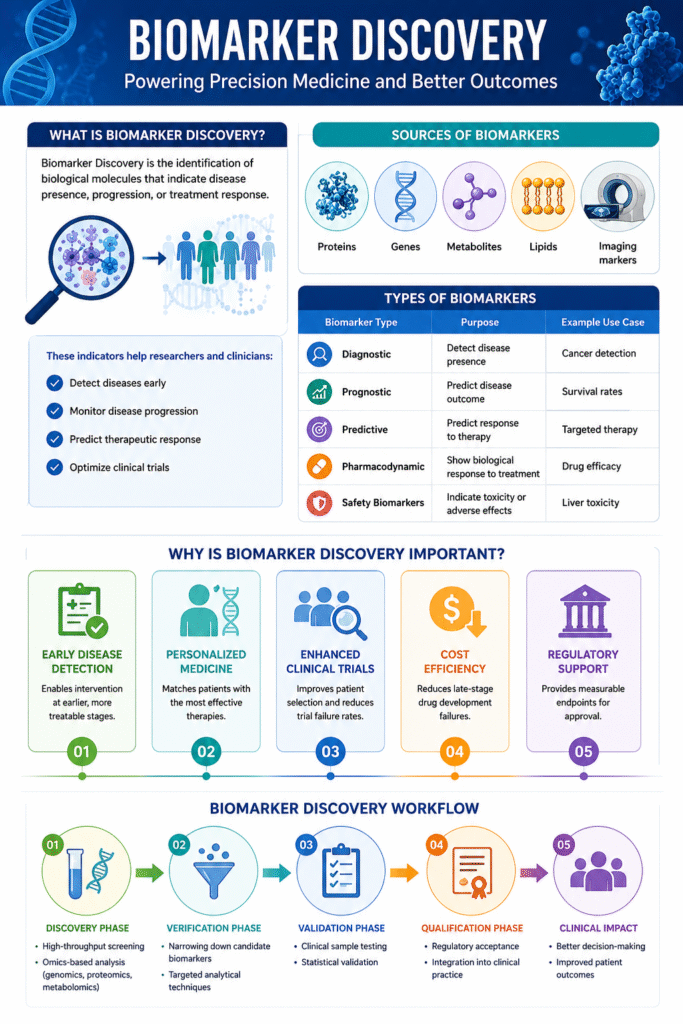
Biomarker Discovery is the process of identifying biological molecules that signal disease presence, progression, or response to treatment. These measurable indicators are essential tools in modern healthcare and pharmaceutical research, enabling more precise and data-driven decision-making.
Types of Biomarkers
Biomarkers can originate from various biological sources, including:
- Proteins – Reflect functional changes in cells and tissues
- Genes – Indicate genetic mutations or expression patterns
- Metabolites – Reveal metabolic state and biochemical activity
- Lipids – Provide insights into cellular structure and disease pathways
- Imaging markers – Visual indicators observed through advanced imaging techniques
Why Biomarkers Matter
These indicators play a crucial role in both clinical and research settings by helping to:
- Detect diseases early – Allowing timely intervention and improved outcomes
- Monitor disease progression – Tracking how a condition evolves over time
- Predict therapeutic response – Identifying which patients will benefit from specific treatments
- Optimize clinical trials – Improving patient selection and increasing trial success rates
Biomarker Discovery forms the backbone of precision medicine, bridging the gap between complex biological data and actionable healthcare solutions.
2: Types of Biomarkers
Biomarkers are classified based on how they are used in disease diagnosis, prognosis, and treatment decisions. Each type serves a specific role in improving clinical outcomes and drug development efficiency.
Biomarker Classification
| Biomarker Type | Purpose | Example Use Case |
|---|---|---|
| Diagnostic | Detect the presence of a disease | Cancer detection |
| Prognostic | Predict disease progression or outcome | Survival rate estimation |
| Predictive | Predict response to a specific therapy | Targeted therapy selection |
| Pharmacodynamic | Show biological response after treatment | Measuring drug efficacy |
| Safety Biomarkers | Indicate toxicity or adverse effects | Liver toxicity monitoring |
Why This Classification Matters
- Improves clinical decision-making by providing actionable insights
- Enhances drug development through better patient selection
- Reduces risk by identifying potential safety concerns early
- Supports regulatory approval with measurable and validated endpoints
Understanding these biomarker types is essential for leveraging Biomarker Discovery effectively in both research and clinical applications.
3: Why is Biomarker Discovery Important?
Biomarker Discovery is important because it enables more accurate decision-making in both drug development and clinical practice. By providing measurable biological insights, it helps researchers and clinicians move from guesswork to evidence-based strategies.
Key Benefits of Biomarker Discovery:
Early Disease Detection
Identifies diseases at an early stage, allowing timely intervention when treatments are most effective and outcomes are significantly improved.
Personalized Medicine
Helps match patients with therapies that are most likely to work for them, reducing trial-and-error prescribing and improving treatment success rates.
Enhanced Clinical Trials
Enables better patient stratification, ensuring that the right patients are enrolled, which increases the probability of clinical trial success and reduces variability.
Cost Efficiency
Minimizes late-stage drug failures by identifying ineffective or unsafe candidates earlier in the development process, saving both time and resources.
Regulatory Support
Provides clear, quantifiable endpoints that regulatory agencies rely on for evaluating drug safety and efficacy, facilitating smoother approval processes.
4: Biomarker Discovery Workflow
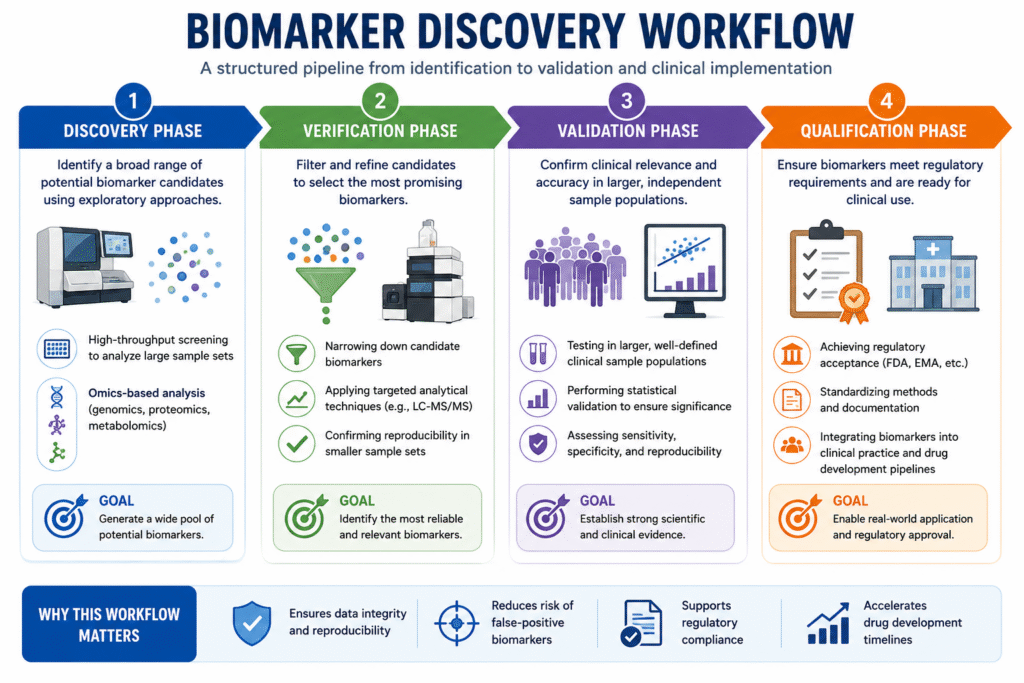
Biomarker Discovery follows a structured, multi-phase workflow that ensures identified biomarkers are scientifically valid, clinically relevant, and regulatory-ready. This stepwise approach minimizes risk and improves reliability in both research and drug development.
1. Discovery Phase
This phase focuses on identifying potential biomarker candidates using broad, exploratory techniques.
- High-throughput screening to analyze large sample sets
- Omics-based approaches such as:
- Genomics (DNA-level insights)
- Proteomics (protein expression profiling)
- Metabolomics (metabolic pathway analysis)
Goal: Generate a wide pool of potential biomarkers.
2. Verification Phase
In this stage, promising candidates are filtered and refined for further study.
- Narrowing down the list of biomarker candidates
- Applying targeted analytical techniques (e.g., LC-MS/MS)
- Confirming reproducibility in smaller sample sets
Goal: Identify the most reliable and relevant biomarkers.
3. Validation Phase
This phase confirms the clinical relevance and accuracy of selected biomarkers.
- Testing in larger, well-defined clinical sample populations
- Performing statistical validation to ensure significance
- Assessing sensitivity, specificity, and reproducibility
Goal: Establish strong scientific and clinical evidence.
4. Qualification Phase
This final phase ensures biomarkers meet regulatory and clinical use requirements.
- Achieving regulatory acceptance (FDA, EMA, etc.)
- Standardizing methods and documentation
- Integrating biomarkers into clinical practice and drug development pipelines
Goal: Enable real-world application and regulatory approval.
Why This Workflow Matters
- Ensures data integrity and reproducibility
- Reduces risk of false-positive biomarkers
- Supports regulatory compliance
- Accelerates drug development timelines
This structured workflow is essential for translating raw biological data into actionable, validated biomarkers that can drive precision medicine forward.
5: Technologies Driving Biomarker Discovery
Advanced technologies are the backbone of Biomarker Discovery, enabling faster, more accurate, and high-throughput identification of clinically relevant biomarkers. These tools allow researchers to generate, analyze, and interpret complex biological data with precision.
Key Technologies in Biomarker Discovery:
- Mass Spectrometry (LC-MS/MS)
Provides high sensitivity and specificity for detecting and quantifying biomolecules. Widely used in proteomics and metabolomics for detailed molecular profiling. - Next-Generation Sequencing (NGS)
Delivers comprehensive genomic insights by rapidly sequencing DNA and RNA, helping identify genetic mutations, expression patterns, and disease-associated variants. - Nuclear Magnetic Resonance (NMR)
Enables structural and metabolic analysis of biomolecules. It is highly reproducible and useful for studying complex biological systems and metabolite identification. - Bioinformatics & AI
Uses advanced algorithms for pattern recognition, data integration, and predictive modeling, transforming large datasets into actionable biomarker insights. - High-Throughput Screening (HTS)
Allows rapid analysis of thousands of samples simultaneously, accelerating the discovery phase and increasing efficiency in identifying potential biomarkers.
Why These Technologies Matter
- Enable multi-omics integration for deeper biological understanding
- Improve accuracy and reproducibility of biomarker identification
- Accelerate drug development timelines
- Support regulatory-grade data generation
6: Role of Biomarker Discovery in Drug Development
Biomarker Discovery plays a critical role in improving the efficiency, precision, and success rates of drug development. By providing measurable biological insights, it enables data-driven decisions across every stage of the drug lifecycle.
Applications in Drug Development:
- Target identification and validation
Biomarkers help identify and confirm biological targets that are directly involved in disease mechanisms, ensuring drugs are developed with higher relevance and efficacy. - Dose optimization
They guide the selection of optimal drug dosage by measuring biological responses, helping balance efficacy and safety. - Patient stratification
Biomarkers enable the selection of specific patient populations who are most likely to respond to a therapy, improving clinical trial outcomes. - Monitoring therapeutic response
They provide real-time insights into how patients respond to treatment, allowing adjustments and improving overall treatment effectiveness. - Identifying adverse effects early
Safety biomarkers detect potential toxicity signals early in development, reducing risks in later clinical stages.
Impact:
- Reduces clinical trial failures by improving patient selection and endpoint clarity
- Accelerates regulatory approvals with strong, data-backed evidence
- Improves ROI by minimizing costly late-stage failures
- Enhances decision-making across preclinical and clinical phases
Why It Matters
Biomarker Discovery transforms traditional drug development into a more predictive, efficient, and patient-centric process, ultimately leading to faster delivery of safer and more effective therapies.
7: Challenges in Biomarker Discovery
Biomarker Discovery faces several scientific and regulatory challenges that can impact reliability, reproducibility, and clinical adoption. Addressing these challenges is essential to ensure that identified biomarkers are truly meaningful and actionable.
Common Challenges:
- Biological variability
Differences between individuals (genetics, lifestyle, environment) can make it difficult to identify consistent biomarkers across populations. - Data complexity and integration
Multi-omics datasets (genomics, proteomics, metabolomics) generate vast and complex data, making integration and interpretation challenging. - Reproducibility issues
Inconsistent experimental conditions or analytical methods can lead to results that are difficult to replicate across studies or laboratories. - Limited clinical validation
Many discovered biomarkers fail to demonstrate strong clinical relevance due to insufficient validation in large, diverse patient populations. - Regulatory hurdles
Strict regulatory requirements demand robust evidence, standardized methods, and high-quality documentation before approval.
How to Overcome Them:
- Use standardized protocols
Adopting globally accepted procedures ensures consistency and improves reproducibility across studies. - Implement robust analytical methods
Utilizing validated and sensitive technologies (e.g., LC-MS/MS, NGS) enhances data accuracy and reliability. - Ensure high-quality data generation
Maintaining strict data integrity, proper controls, and quality checks reduces errors and improves confidence in results. - Collaborate with experienced research partners
Working with specialized CROs/CDMOs provides access to advanced technologies, regulatory expertise, and proven workflows.
8: Regulatory Considerations
Biomarkers must meet strict regulatory standards before clinical use.
Regulatory agencies require:
- Analytical validation
- Clinical relevance
- Reproducibility
- Standardized methodologies
Key Focus Areas:
- Data integrity
- Method validation
- Documentation and traceability
ResolveMass Laboratories Inc. ensures all biomarker discovery workflows align with global regulatory expectations, supporting seamless submission processes.
9: Future Trends in Biomarker Discovery
The future of Biomarker Discovery is driven by innovation and integration.
Emerging Trends:
- Multi-omics integration
- AI-driven biomarker identification
- Liquid biopsies
- Digital biomarkers
- Real-world data utilization
These advancements are expected to:
- Enhance precision medicine
- Enable non-invasive diagnostics
- Improve patient outcomes globally
10: Why Choose ResolveMass Laboratories Inc.?
ResolveMass Laboratories Inc. delivers reliable and regulatory-compliant biomarker discovery solutions.
Our Strengths:
- Expertise in advanced analytical techniques
- State-of-the-art instrumentation
- Strong regulatory understanding
- Customized research solutions
- Commitment to data quality and integrity
We combine scientific excellence with industry experience to deliver actionable biomarker insights that drive drug development success.
Conclusion:
Biomarker Discovery is a cornerstone of modern healthcare and pharmaceutical innovation. It enables early diagnosis, personalized treatment, and more efficient drug development processes. As technologies continue to evolve, biomarker discovery will play an even more critical role in shaping the future of precision medicine.
At ResolveMass Laboratories Inc., we are dedicated to advancing biomarker discovery through cutting-edge science, ensuring our partners achieve reliable, high-quality, and regulatory-ready outcomes.
Frequently Asked Questions:
It enables early disease detection, personalized treatment, and better monitoring of patient response. This leads to improved clinical outcomes, reduced healthcare costs, and more efficient therapies tailored to individual patients.
Biomarkers help identify drug targets, select suitable patients for trials, optimize dosage, monitor drug effectiveness, and detect side effects early. This significantly improves the success rate of clinical trials.
Common technologies include mass spectrometry (LC-MS/MS), next-generation sequencing (NGS), nuclear magnetic resonance (NMR), bioinformatics tools, AI, and high-throughput screening. These tools enable precise and large-scale biological analysis.
Biomarkers are classified as diagnostic, prognostic, predictive, pharmacodynamic, and safety biomarkers. Each type serves a unique role in disease detection, treatment planning, and monitoring.
The timeline varies depending on complexity but typically spans several months to years. It includes multiple stages like discovery, verification, validation, and regulatory qualification.
Reference
- Ilyin SE, Belkowski SM, Plata-Salamán CR. Biomarker discovery and validation: technologies and integrative approaches. Trends in biotechnology. 2004 Aug 1;22(8):411-6.https://www.cell.com/trends/biotechnology/abstract/S0167-7799(04)00170-2
- Goossens N, Nakagawa S, Sun X, Hoshida Y. Cancer biomarker discovery and validation. Translational cancer research. 2015 Jun;4(3):256.https://pmc.ncbi.nlm.nih.gov/articles/PMC4511498/
- Rifai N, Gillette MA, Carr SA. Protein biomarker discovery and validation: the long and uncertain path to clinical utility. Nature biotechnology. 2006 Aug 1;24(8):971-83.https://www.nature.com/articles/nbt1235
- Mäbert K, Cojoc M, Peitzsch C, Kurth I, Souchelnytskyi S, Dubrovska A. Cancer biomarker discovery: current status and future perspectives. International journal of radiation biology. 2014 Aug 1;90(8):659-77.https://www.tandfonline.com/doi/abs/10.3109/09553002.2014.892229
- Ng S, Masarone S, Watson D, Barnes MR. The benefits and pitfalls of machine learning for biomarker discovery. Cell and tissue research. 2023 Oct;394(1):17-31.https://link.springer.com/article/10.1007/s00441-023-03816-z

