
Introduction
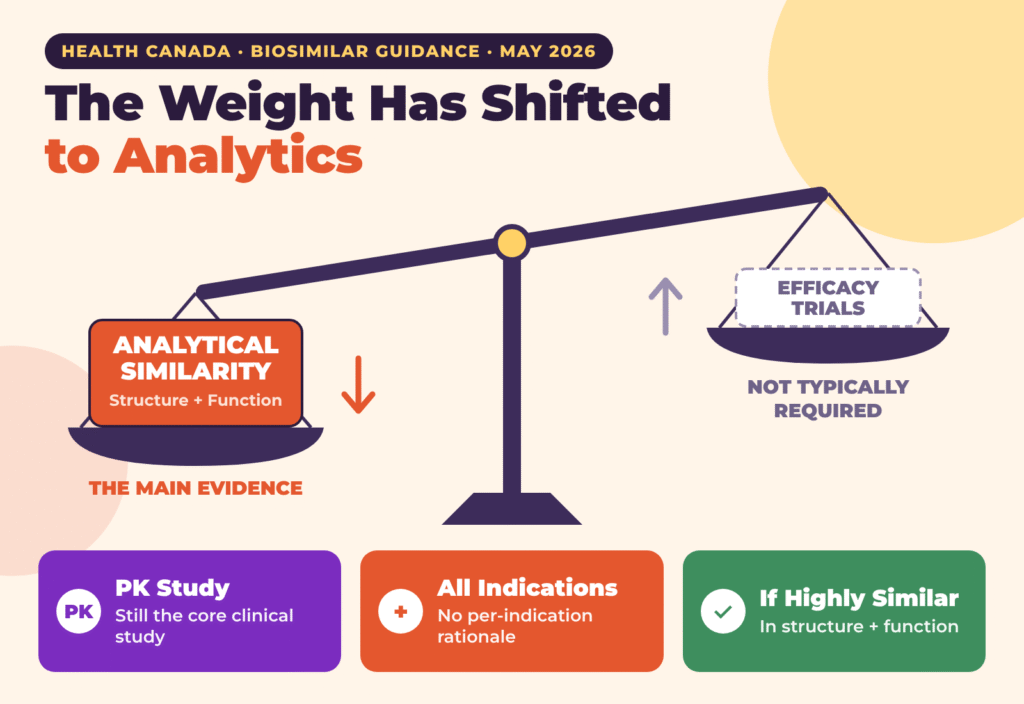
Partnering with a qualified Biosimilar CDMO in Canada allows biotechnology sponsors to obtain the comparative analytical characterization, formulation stability data, and Good Manufacturing Practice (GMP) documentation necessary to support New Drug Submission (NDS) approval by Health Canada’s Biologic and Radiopharmaceutical Drugs Directorate (BRDD). Under Health Canada’s updated biosimilar guidance, published on May 19, 2026, regulatory authorization places greater emphasis on demonstrating physicochemical and functional similarity to the Canadian Reference Biologic Drug (CRBD) rather than routinely requiring comparative clinical efficacy trials. This change places significant regulatory responsibility on analytical comparability and Chemistry, Manufacturing, and Controls (CMC) execution.
For biotechnology sponsors planning to enter the Canadian market or pursue dual North American regulatory filings, partnering with a domestic Canadian laboratory that maintains a Health Canada Drug Establishment Licence (DEL) and active GMP compliance offers important operational advantages. It helps minimize cross-border sample transportation delays while ensuring that development activities remain aligned with Schedule D biologic requirements. ResolveMass Laboratories Inc. operates from a single facility in Laval, Québec, integrating Health Canada GMP compliance, FDA registration, and ISO 9001:2015 certification with PhD-led laboratory execution across mass spectrometry, formulation, synthesis, and bioanalysis. These capabilities support biosimilar development from early-stage characterization through regulatory submission.
Explore biosimilar characterization services to understand how advanced analytical testing supports the development and assessment of biosimilar products.
Share via:
Quick Summary:
- Regulatory shift: Health Canada’s revised biosimilar guidance (May 19, 2026) bases approval mainly on analytical and functional similarity to the Canadian Reference Biologic Drug (CRBD). Comparative clinical efficacy trials are no longer typically required.
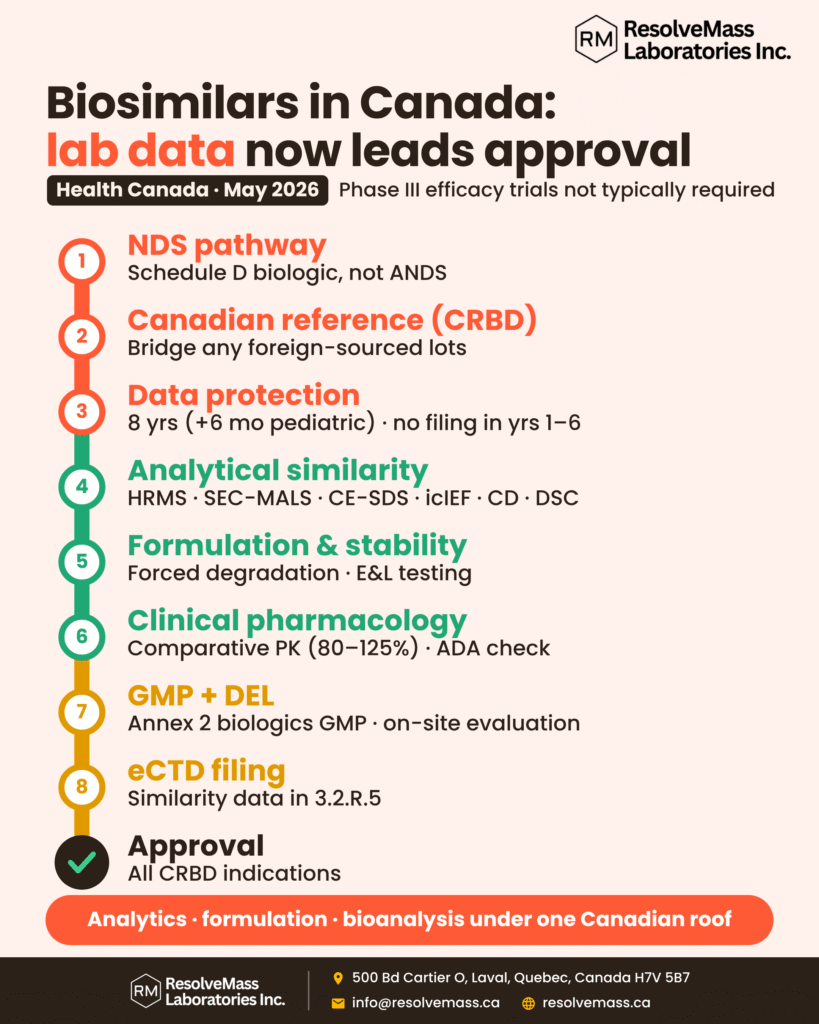
- Filing pathway and dossier: Biosimilars are Schedule D biologics filed as an NDS, not an ANDS. Similarity data goes in a dedicated eCTD section, 3.2.R.5. Once high similarity is shown, all CRBD indications can be claimed without indication-by-indication justification.
- Reference product and IP: The CRBD must come from Health Canada’s Drug Product Database, and foreign-sourced reference lots must be bridged to it. Innovators get 8 years of data protection (8.5 with pediatric data), and no biosimilar NDS can be filed in the first 6 years.
- Analytical characterization: Sponsors need multi-orthogonal, risk-ranked data, using HRMS, SEC-MALS, CE-SDS, icIEF, CD, DSC and functional assays. Clinical data cannot make up for significant analytical differences.
- Formulation and stability: Excipient screening, side-by-side forced degradation studies (ICH Q5C) and extractables and leachables testing confirm that the biosimilar behaves like the reference over its shelf life.
- Clinical pharmacology and GMP: A comparative PK study, with ADA monitoring, has to meet 80.0–125.0% comparability margins. These apply to the AUC 90% CI and the Cmax point estimate, not to a Cmax 90% CI as the article states. Manufacturing needs a Drug Establishment Licence (DEL), Annex 2 GMP compliance and a pre-approval on-site evaluation.
- Why one Canadian CDMO: Splitting work across vendors causes delays and fragmented documentation. ResolveMass’s single GMP, FDA-registered and ISO 9001 site in Laval brings analytics, formulation and bioanalysis under one quality system, producing a submission-ready CMC package.
Navigating Health Canada’s 2026 Biosimilar Regulatory Framework
Health Canada regulates biosimilars as Schedule D biologic drugs submitted through the New Drug Submission (NDS) pathway under Part C, Division 8, section C.08.002 of the Food and Drug Regulations (FDR). This differs from the Abbreviated New Drug Submission (ANDS) pathway, which is generally used for small-molecule generic drugs. Following consultations with 15 stakeholders representing the biopharmaceutical industry, industry organizations, and patient groups, Health Canada released its revised guidance on May 19, 2026. The updated framework streamlines clinical evidence expectations when strong structural and functional similarity to the CRBD has been established.
Several important regulatory changes have operational implications for CDMO testing strategies, analytical development, and regulatory dossier preparation:
Reduced Comparative Efficacy Trial Expectations
According to Health Canada’s revised guidance and related regulatory legal analyses, comparative clinical efficacy studies are generally not required for biosimilar authorization. If a sponsor chooses to conduct these studies, the NDS must explain their scientific purpose and demonstrate the additional evidentiary value they provide.
Automatic Indication Extrapolation
Health Canada has eliminated the requirement for separate scientific justifications for every extrapolated indication. Sponsors may claim all indications authorized for the CRBD without submitting additional indication-specific rationales, provided that a high degree of analytical and mechanism-of-action functional similarity is demonstrated and the dosage delivery requirements are appropriately matched.
Short Polypeptide Pathway Distinction
Chemically synthesized short polypeptides may be eligible for the generic ANDS pathway. In contrast, polypeptides produced through recombinant DNA technology are classified as biologics and must follow the biosimilar NDS pathway.
Dedicated CTD Similarity Section
Sponsors are required to submit their applications electronically in eCTD format and organize the comparative similarity assessment as a separate dataset in CTD Section 3.2.R.5, in addition to the conventional Module 3 CMC documentation.
In addition to meeting quality and clinical pharmacology requirements, sponsors must ensure that the safety and efficacy sections of the Product Monograph accurately reflect the authorized indications of the CRBD. They must also follow Health Canada’s Policy Statement on the Naming of Biologic Drugs and provide a Risk Management Plan (RMP) prepared in accordance with the applicable Health Canada RMP guidance.
Refer to the ICH Q6B guidelines for biological characterization for additional insight into the quality expectations applicable to biologics.
Selecting a CRBD and Bridging Non-Canadian Reference Biologics
Every biosimilar comparability assessment must be based on an authorized CRBD listed in Health Canada’s Drug Product Database (DPD). The database is updated nightly and provides information about Canadian market availability and approved Product Monographs. The selected reference product must correspond to the biosimilar candidate in terms of medicinal ingredient, dose, dosage form, dosing frequency, strength, and route of administration. An already authorized biosimilar or a publicly available pharmacopeial standard cannot be used as the CRBD for establishing regulatory similarity.
When sponsors use a reference biologic drug (RBD) sourced outside Canada, such as a product authorized in the United States or European Union, they must establish that the foreign reference product is suitable for comparison and demonstrate its relationship to the Canadian reference product. The foreign-sourced RBD must be marketed in a jurisdiction where regulatory assessment standards, comparability principles, and post-market surveillance requirements are comparable to those implemented in Canada.
If multiple RBDs are used during different stages of development, sponsors must demonstrate that these products are representative of one another. This requires direct, side-by-side structural and functional analytical comparisons involving the biosimilar candidate, the foreign RBD(s), and the CRBD. Where necessary, these assessments should be supported by comparative clinical pharmacology bridging data. Consulting BRDD at an early development stage is recommended, particularly before finalizing a bridging strategy involving multiple regulatory jurisdictions.
Learn more about biosimilar comparability studies and the analytical considerations involved in demonstrating product similarity.
Intellectual Property, Data Protection, and NDS Filing Pathways
The timelines associated with Canadian biosimilar market entry are influenced by the interaction between data protection provisions under section C.08.004.1 of the FDR and the Patented Medicines (Notice of Compliance) [PM(NOC)] Regulations. These regulatory mechanisms are administered with the involvement of the Office of Patented Medicines and Liaison (OPML).
Innovative biologics containing a medicinal ingredient that has not previously been approved receive an eight-year period of market exclusivity. This period may be extended by an additional six months, bringing the total to 8.5 years, when acceptable pediatric clinical trial data are submitted within the first five years. During the initial six years of this protection period, subsequent-entry sponsors are prohibited from filing an NDS for the protected drug.
Submitting an originating NDS that directly or indirectly references a CRBD at the Drug Identification Number (DIN) level activates Section 5 of the PM(NOC) Regulations. This also establishes the Patent Register status as of the submission filing date. Review performance standards, screening deficiencies, clarification periods, and pause-the-clock procedures are addressed in Health Canada’s Guidance on Management of Drug Submissions and Applications, which became effective on October 1, 2025.
After authorization, sponsors intending to incorporate newly approved CRBD indications into their Product Monograph through a Supplement to a New Drug Submission (SNDS) must provide the revised Sponsor Attestation: SNDS for Biosimilar Products. This document must be included in Module 1.2.3 when the submission is filed.
Analytical Characterization and Quality Requirements for a Biosimilar CDMO in Canada
To meet BRDD expectations, a Biosimilar CDMO in Canada must produce comprehensive, multi-orthogonal, and risk-ranked physicochemical and functional datasets. These results must be specifically organized for CTD Section 3.2.R.5 and aligned with ICH Q6B requirements. Health Canada clearly indicates that clinical and non-clinical evidence cannot compensate for substantial analytical differences between a biosimilar candidate and its reference product. Therefore, any significant variation in quality attributes identified during comparative testing must be investigated and addressed through process development and analytical development.
Achieving the required level of evidence depends on a carefully designed statistical study, independent lot selection, and appropriately validated quality control systems throughout the comparability assessment process.
| Quality & Comparability Domain | Health Canada (May 2026) Requirement | CDMO Analytical & CMC Execution Standard |
|---|---|---|
| Primary Sequence & Expression | The expression construct must encode exactly the same primary amino acid sequence as the CRBD. | Perform intact mass analysis, peptide mapping, and LC-MS/MS sequencing to identify low-level amino acid misincorporation and sequence variants. |
| Two-Tiered Reference Standards | Neither the CRBD nor an international standard can be used as the primary reference standard at the time of market filing. | Develop in-house primary and secondary (working) reference standards in accordance with ICH Q6B, using clinical and commercially representative lots. |
| Lot Selection & Data Independence | Multiple CRBD lots of different ages and independent biosimilar candidate lots derived from independent drug substance lots must be evaluated. | Establish statistical similarity criteria that account for product variability, process variation, and analytical assay precision throughout the proposed shelf-life. |
| Matrix Interference & Extraction | Direct side-by-side analysis is preferred. Any deformulation or extraction performed on the finished product must be scientifically justified. | Document sample-preparation qualification to demonstrate that isolation procedures do not modify higher-order structures or impurity profiles. |
| Purity & Product-Related Impurities | Unique product-related impurities must be identified, characterized, quantified, and supported by an appropriate safety justification. | Apply high-resolution mass spectrometry (HRMS) to characterize oxidation, deamidation, truncation, and aggregates, while demonstrating ICH-compliant process impurity clearance. |
| Comparative Stability Studies | Comparative accelerated, stressed, and forced degradation studies must follow ICH Q5C and ICH Q1 requirements. | Conduct date-matched, side-by-side stress studies to identify potential differences in chemical degradation or conformational stability. |
| Control Strategy & Validation | A stand-alone control strategy independent of the CRBD must be established, with release methods validated according to ICH Q2(R2), Q5C, and Q6B. | Complete GMP validation of release and stability-indicating methods, supported by qualified characterization assays. |
Explore critical quality attributes (CQAs) in biosimilars to understand their role in analytical characterization and quality assessment.
Multi-Orthogonal Platforms and Impurity Profiling Under ICH Guidelines
Biological products manufactured using living systems naturally exhibit microheterogeneity. Consequently, sponsors must assess every critical quality attribute (CQA) using multiple complementary analytical techniques based on different scientific principles. This requirement is particularly important for monoclonal antibodies (mAbs), antibody-drug conjugates (ADCs), fusion proteins, recombinant proteins, therapeutic enzymes, and cytokines, where relatively minor differences in glycosylation, charge variants, or protein folding may influence biological potency and immunogenicity.
Health Canada recommends that sponsors implement a structured risk assessment tool to rank CRBD quality attributes according to their potential effects on biological activity, pharmacokinetics, pharmacodynamics, safety, and immunogenicity.
For comparative characterization, advanced analytical laboratories use Orbitrap and Q-TOF HRMS platforms coupled with UHPLC and LC-MS/MS systems. These technologies help identify sequence variants, post-translational modifications, and glycan profiles with high analytical resolution.
Additional orthogonal biophysical techniques provide complementary information about the structural and physicochemical properties of biologics. These include Size-Exclusion Chromatography with Multi-Angle Light Scattering (SEC-MALS), Capillary Electrophoresis Sodium Dodecyl Sulfate (CE-SDS), Imaged Capillary Isoelectric Focusing (icIEF), Circular Dichroism (CD) spectroscopy, and Differential Scanning Calorimetry (DSC). Together, these methods help evaluate higher-order structures, charge heterogeneity, and different aggregation states.
Discover native mass spectrometry for biosimilars to learn how this technique contributes to advanced structural characterization.
Functional comparability assessments must directly investigate the biological mechanism of action. Depending on the product, these studies may include target-binding affinity and avidity, Fc-effector functions, neutralization activity, and cell-based potency assays. Appropriate consideration must also be given to biological assay variability when interpreting the resulting data.
An important distinction is that process-related impurities do not have to be identical to those found in the CRBD and are excluded from the comparative similarity assessment. However, sponsors must demonstrate that these impurities are adequately controlled and cleared to levels supported by appropriate safety assessments in accordance with ICH guidelines. Following authorization, manufacturing changes are assessed through comparability exercises under ICH Q5E without requiring the sponsor to repeat the original comparison against the CRBD.
Learn more about impurity profiling of biosimilars and its importance in maintaining product quality and regulatory compliance.
Biosimilar Formulation Development and Forced Degradation Studies
Biosimilar formulation development must maintain conformational and colloidal stability throughout the product’s shelf-life while preserving the CRBD’s route of administration and avoiding potential formulation patent barriers. Excipients and interactions with container-closure systems can directly influence protein aggregation, subvisible particle formation, and immunogenicity risks. For this reason, systematic excipient screening and comparative forced degradation studies are essential for establishing whether the biosimilar candidate follows degradation pathways comparable to those of the reference product.
The following table presents representative excipient categories, selected compounds, typical concentration ranges, stabilization mechanisms, and major developability considerations described in ResolveMass Laboratories’ biosimilar formulation guidance.
| Excipient Class | Selected Compound | Representative Concentration | Primary Stabilization Mechanism | Major Developability Risk |
|---|---|---|---|---|
| Amino Acids | L-Histidine | 10 to 20 mM | Helps maintain physiological pH (5.5–6.5) and contributes to conformational stability. | Can undergo photo-oxidation when exposed to ultraviolet or visible light. |
| Amino Acids | L-Arginine HCl | 50 to 150 mM | Reduces localized surface charge effects and interferes with non-specific protein-protein interactions, helping lower viscosity. | Significant changes in pH or concentration may promote liquid-liquid phase separation. |
| Sugars & Polyols | Sucrose | 5% to 9% (w/v) | Supports preferential hydration and functions as a cryoprotectant and lyoprotectant. | May increase solution viscosity and limit the volumes suitable for subcutaneous administration. |
| Sugars & Polyols | Trehalose | 5% to 9% (w/v) | Creates a stable glassy matrix that reduces molecular mobility during freezing and drying. | Requires extremely high purity because trace contaminants may accelerate degradation. |
| Surfactants | Polysorbate 80 | 0.01% to 0.1% (w/v) | Occupies air-water and solid-water interfaces, reducing aggregation caused by agitation. | Susceptible to auto-oxidation, which can generate peroxides capable of damaging sensitive amino acids. |
| Salts | Sodium Chloride | 50 to 150 mM | Increases ionic strength and reduces attractive electrostatic self-association. | May decrease the conformational melting temperature (Tm) and increase opalescence during refrigerated storage. |
In addition to formulation screening, extractables and leachables (E&L) assessments must be performed on primary packaging components, drug delivery devices, and manufacturing contact materials. These studies should comply with applicable USP requirements, ICH Q3D, and ISO 10993 standards.
A comprehensive E&L strategy includes multi-solvent extractables studies, accelerated and real-time leachables monitoring, and toxicological risk assessments. These investigations help protect biologic products from container-derived leachables that may promote oxidation, compromise product stability, or trigger undesirable immune responses.
GMP Manufacturing, Drug Establishment Licensing, and Bioanalytical Readiness
Any biologic drug manufactured, packaged, labelled, tested, or stored for clinical trials or commercial distribution in Canada must comply with Part C, Division 2 of the FDR and operate under an appropriate, active Drug Establishment Licence (DEL).
For further information, explore forced degradation of biosimilars and its role in comparative stability assessment.For further information, explore forced degradation of biosimilars and its role in comparative stability assessment.
In addition to Health Canada’s core Good Manufacturing Practices Guide for Drug Products (GUI-0001), Schedule D biologics must comply with Annex 2 to the Current Edition of the Good Manufacturing Practices Guidelines – Schedule D Drugs (Biological Drugs) (GUI-0027).
Annex 2 establishes stringent biological manufacturing controls covering facility design, personnel qualifications, and cell-bank management. Production areas must remain physically separated from research, diagnostic, and non-production laboratories. Appropriate gowning procedures, decontamination protocols, and containment measures must also be implemented wherever open handling activities create a risk of microbial contamination.
Personnel responsible for biologic manufacturing and quality control must possess formal academic qualifications in relevant scientific disciplines, including biology, chemistry, bacteriology, pharmacology, virology, or immunology. Their qualifications must be supported by continuous training in microbiology and hygiene practices. When biohazardous materials are handled, the facility must also have an appropriately designated Biosafety Officer.
Furthermore, seed lots and cell banks must be developed and maintained under controlled environmental conditions. Before NDS authorization, BRDD conducts an On-Site Evaluation (OSE) to assess manufacturing consistency and verify compliance with applicable requirements. Following authorization, clinical and commercial lots are subject to Health Canada’s Lot Release Program.
Explore cell-line development for biosimilars to understand its contribution to the development of reliable biologic production processes.
Clinical Pharmacology, PK/PD, and Immunogenicity Bioanalysis
Even when comparative Phase III clinical efficacy studies are not required, Health Canada expects sponsors to provide comparative clinical pharmacology evidence. This assessment primarily relies on a comparative pharmacokinetic (PK) study to establish that the biosimilar candidate and CRBD produce comparable systemic exposure.
To meet the specified comparability criteria, the 90% confidence interval for the relative mean maximum concentration (Cmax) of the biosimilar candidate compared with the CRBD should remain within the range of 80.0% to 125.0%, inclusive.
When a pharmacodynamic (PD) biomarker adequately reflects the primary mechanism of action and provides sufficient dynamic range, appropriate temporal measurement, and dose-response sensitivity, PD endpoints may also be incorporated into a combined PK/PD study. Relevant endpoints include the area under the effect-time curve to the last quantifiable measurement (AUECT) and maximum effect (Emax). These parameters are similarly evaluated against an 80.0%–125.0% acceptance interval.
Because immunogenicity can influence drug clearance and patient safety, Health Canada recommends evaluating anti-drug antibodies (ADAs) during comparative PK studies. This assessment generally involves collecting baseline pre-dose and post-dose trough samples.
Bioanalytical laboratories must use validated, drug-tolerant analytical platforms, including ligand-binding assays, ELISA, or LC-MS/MS methods, to detect both binding and neutralizing antibodies. The relationship between ADA status and PK exposure must also be investigated to determine whether antibody development affects the pharmacokinetic profile of the product.
Where exceptional nonclinical safety or toxicokinetic studies are necessary, they must be conducted under strict Good Laboratory Practice (GLP) requirements. This includes independent oversight by a Quality Assurance Unit, validated LIMS audit trails, and reliable data management practices. All generated data must remain attributable, legible, contemporaneous, original, and accurate. Maintaining these standards ensures that preclinical and clinical sample testing remains scientifically traceable and defensible during regulatory review.
Selecting a Specialized Biosimilar CDMO in Canada for End-to-End Execution
Canada’s domestic biomanufacturing and therapeutics infrastructure has experienced considerable growth, supported by more than 2.5 billion in federal investments distributed across 43 ecosystem projects. These investments include 819 million allocated across 11 projects in Ontario and 578 million across 15 projects in Québec.
Within this expanding industry, biotechnology sponsors must carefully evaluate the operational challenges associated with outsourcing different stages of biosimilar development to multiple service providers. These activities may include physicochemical characterization, impurity synthesis, formulation stability testing, and bioanalysis. The decision between working with several specialized contractors and consolidating these activities within a single facility can significantly influence project coordination and regulatory readiness.
Dividing biosimilar CMC activities among multiple vendors can create several operational difficulties, including sample transportation delays, inconsistencies caused by matrix interference, and fragmented documentation during BRDD regulatory review. Integrating analytical development, GMP method validation, forced degradation testing, and bioanalytical execution under a unified quality management system helps maintain consistency throughout the development process.
A centralized approach also supports analytical continuity, beginning with initial CRBD characterization and extending through comparative assessment, data interpretation, and preparation of the CTD Section 3.2.R.5 documentation.
Explore biosimilar comparability study design and CRO support services to understand how specialized CRO support can contribute to an organized biosimilar development program.
Integrating Analytical Characterization, Formulation, and Regulatory Readiness at a Biosimilar CDMO in Canada
Choosing a Biosimilar CDMO in Canada that combines synthesis, formulation, polymer science, and high-resolution mass spectrometry within one facility gives biotechnology sponsors access to coordinated scientific support from early-stage characterization through regulatory filing.
ResolveMass Laboratories Inc., headquartered at 500 Bd Cartier O, Laval, Québec, was established by chemists and analytical scientists to manage complex pharmaceutical molecules within a single laboratory environment. Its projects are handled directly at the bench by PhD chemists and analytical scientists rather than being routed through intermediary account managers.
With three foundational quality credentials—Health Canada GMP compliance supported by a Drug Establishment Licence (DEL), FDA registration (Establishment ID: 3042696771), and ISO 9001:2015 certification—ResolveMass supports biopharmaceutical sponsors across more than nine countries from its Canadian facility.
Its biosimilar and biologics services encompass mAbs, ADCs, fusion proteins, recombinant proteins, therapeutic enzymes, cytokines, peptide-based biosimilars, and nucleic acid therapeutics.
The facility brings together advanced analytical and development capabilities, including Orbitrap and Q-TOF HRMS, SEC-MALS, CE-SDS, icIEF, CD spectroscopy, DSC, glycan analysis, custom forced-degradation impurity synthesis, USP E&L testing, and GLP bioanalysis. Integrating these capabilities enables the development of comprehensive, coordinated, and regulatory-ready CMC data packages to support biosimilar development and submission requirements.
Conclusion
Meeting Health Canada’s May 2026 biosimilar regulatory expectations requires a Biosimilar CDMO in Canada capable of bringing together multi-orthogonal HRMS characterization, ICH Q5C formulation stability studies, validated immunogenicity bioanalysis, and Annex 2 GMP compliance within a unified CTD Section 3.2.R.5 documentation package.
By collaborating with a Canadian laboratory operating from a single site, holding a DEL, and providing direct scientific oversight through PhD-level professionals, biotechnology sponsors can minimize technical transfer challenges, maintain analytical consistency, and strengthen their regulatory readiness throughout biosimilar development. An integrated approach to analytical characterization, formulation development, method validation, and bioanalysis also helps ensure that critical CMC evidence is systematically generated and documented for BRDD review.
To discuss analytical comparability, CRBD bridging, formulation stability, or GMP method validation requirements for your biosimilar development pipeline, connect directly with the scientific team at ResolveMass Laboratories Inc.
Frequently Asked Questions
Health Canada’s revised guidance, finalized on May 19, 2026, generally does not require comparative clinical efficacy trials for biosimilar authorization. Instead, sponsors are expected to provide convincing analytical and functional comparability data supported by comparative clinical pharmacology evidence. Comparative PK studies remain important, while pharmacodynamic (PD) assessments may provide additional evidence when appropriate.
Yes, sponsors can use a reference biologic drug (RBD) obtained from the United States or European Union, provided that the source jurisdiction has comparable regulatory standards and post-market surveillance systems. However, they must demonstrate that the foreign reference product is representative of the Canadian Reference Biologic Drug (CRBD). This generally requires side-by-side analytical comparisons and, where necessary, additional clinical pharmacology bridging studies.
Health Canada requires sponsors to submit biosimilar applications electronically using the electronic Common Technical Document (eCTD) format. The comparative similarity assessment must be presented as a dedicated dataset in CTD Section 3.2.R.5. This section complements the standard Module 3 CMC documentation and provides regulators with organized evidence of structural, physicochemical, and functional comparability.
No, neither the CRBD nor an international reference standard can serve as the primary reference standard in the market application. Sponsors must develop an independent, two-tiered reference standard system consisting of primary and secondary (working) standards. In accordance with ICH Q6B, these standards should be established using representative clinical or commercial product lots to support consistent analytical testing and batch evaluation.
Under Health Canada’s May 2026 guidance, sponsors are no longer expected to provide separate scientific justifications for every extrapolated indication. The biosimilar may receive the same authorized indications as its reference product when sufficient analytical and functional similarity has been demonstrated. The assessment must also establish comparable mechanisms of action and appropriate matching of dosage delivery.
Canadian facilities involved in manufacturing, testing, packaging, or storing Schedule D biologics must maintain an appropriate Drug Establishment Licence (DEL) and comply with Part C, Division 2 of the Food and Drug Regulations (FDR). Their operations must follow the Good Manufacturing Practices Guide for Drug Products (GUI-0001) and Annex 2 – Schedule D Drugs (Biological Drugs) (GUI-0027). These requirements address facility conditions, personnel qualifications, contamination prevention, and biological manufacturing controls.
Canadian biosimilar filing schedules are influenced by data protection provisions under section C.08.004.1 of the FDR and the Patented Medicines (Notice of Compliance) [PM(NOC)] Regulations. Innovative biologics generally receive eight years of market protection, which may increase to 8.5 years when qualifying pediatric clinical trial data are submitted. Subsequent-entry sponsors cannot file an NDS during the first six years, while patent-related requirements may introduce additional considerations when submitting an application referencing a CRBD.
Comparative PK studies generally evaluate whether the 90% confidence interval for the relative mean maximum concentration (Cmax) of the biosimilar candidate compared with the CRBD falls within the 80.0%–125.0% acceptance range. Sponsors should also assess anti-drug antibodies (ADAs) through appropriate baseline and post-dose sampling. Validated, drug-tolerant bioanalytical assays are important for detecting binding and neutralizing antibodies and understanding their potential effects on drug exposure.
Forced degradation studies help determine whether a biosimilar candidate and its reference product respond similarly to different environmental and chemical stress conditions. Comparative accelerated, stressed, and forced degradation experiments conducted under ICH Q5C and ICH Q1 can reveal changes involving oxidation, deamidation, aggregation, and structural instability. These findings help identify potential degradation risks that routine release testing may not detect and support the evaluation of product stability throughout its intended shelf-life.
Reference:
- Health Canada. (2026, May 19). Guidance on information and submission requirements for biosimilar biologic drugs: General considerations. Government of Canada. https://www.canada.ca/en/health-canada/services/drugs-health-products/biologics-radiopharmaceuticals-genetic-therapies/applications-submissions/guidance-documents/information-submission-requirements-biosimilar-biologic-drugs/considerations.html
- Health Canada. (n.d.). Regulatory roadmap for biologic (Schedule D) drugs in Canada. Government of Canada. https://www.canada.ca/en/health-canada/services/drugs-health-products/biologics-radiopharmaceuticals-genetic-therapies/regulatory-roadmap-for-biologic-drugs.html
- Health Canada. (2026, May 19). Guidance on information and submission requirements for biosimilar biologic drugs: Indications, labelling and risk-management plan. Government of Canada. https://www.canada.ca/en/health-canada/services/drugs-health-products/biologics-radiopharmaceuticals-genetic-therapies/applications-submissions/guidance-documents/information-submission-requirements-biosimilar-biologic-drugs/indications-labelling-risk-management-plan.html
- Health Canada. (2020, July). Good manufacturing practices guide for drug products (GUI-0001). Government of Canada. https://www.canada.ca/en/health-canada/services/drugs-health-products/compliance-enforcement/good-manufacturing-practices/guidance-documents/gmp-guidelines-0001/document.html
- Health Canada. (2024, July 4). Annex 2 to the Good manufacturing practices guide – Manufacture of biologics (GUI-0027). Government of Canada. https://www.canada.ca/en/health-canada/services/drugs-health-products/compliance-enforcement/good-manufacturing-practices/guidance-documents/annex-2-current-edition-guidelines-schedule-drugs-biological-drugs-0027.html
- Health Canada. (2026, August 10). Guidance documents – Good manufacturing practices. Government of Canada. https://www.canada.ca/en/health-canada/services/drugs-health-products/compliance-enforcement/good-manufacturing-practices/guidance-documents.html
- Innovation, Science and Economic Development Canada. (2025, October 23). Biomanufacturing: Projects underway. Government of Canada. https://ised-isde.canada.ca/site/ised/en/programs-and-initiatives/health-emergency-readiness-canada/biomanufacturing-projects-underway
Get In Touch With Us
About The Author