


Introduction
Partnering with a specialized biosimilar CDMO in Canada allows biopharmaceutical companies to address the complex technical, analytical, and regulatory requirements involved in converting a recombinant protein sequence into a commercially viable therapeutic product. Unlike small-molecule generics, which possess clearly defined chemical structures that can be reproduced through conventional organic synthesis, biosimilars are large and highly intricate biological macromolecules produced within living cells. Due to the influence of cellular metabolism and manufacturing conditions, inherent variability exists between production batches. As a result, a biosimilar cannot be considered chemically identical to its reference biologic. Instead, it must demonstrate a high degree of similarity in terms of structure, function, purity, and potency, while showing no clinically meaningful differences from the reference product.
To manage this complexity, the biopharmaceutical sector increasingly relies on Contract Development and Manufacturing Organizations (CDMOs) that possess advanced host-cell expression technologies, sophisticated mass spectrometry characterization capabilities, and scalable bioprocessing infrastructure. In Canada, a robust regulatory environment governed by Health Canada, combined with a growing biomanufacturing sector, has established the country as a strong destination for biosimilar development. The integration of Process Analytical Technology (PAT), Quality by Design (QbD) principles, and comprehensive orthogonal analytical methodologies enables manufacturers to reduce development risks, strengthen product understanding, and accelerate regulatory approval and commercialization pathways.
Looking for specialized manufacturing partners? Explore our comprehensive capabilities for your projects at Peptide CDMO in Canada
Share via:
Article Summary:
- Biosimilar CDMOs in Canada provide end-to-end services, from cell line development and process optimization to commercial cGMP manufacturing, ensuring biosimilars meet strict quality, safety, and efficacy standards.
- Health Canada’s regulatory framework emphasizes comprehensive analytical characterization, Totality of Evidence, pharmacokinetic (PK) studies, and risk-based immunogenicity assessments, reducing reliance on large comparative clinical trials.
- Cell line development and host selection are critical for producing biosimilars with comparable structure and function, using CHO cells for complex glycoproteins and E. coli for simpler non-glycosylated proteins.
- Upstream and downstream bioprocessing optimize cell culture conditions, purification, viral clearance, and impurity removal through advanced technologies such as PAT, Protein A chromatography, ion exchange chromatography, and tangential flow filtration.
- High-resolution analytical characterization employs LC-MS/MS, HDX-MS, SEC-MALS, glycan profiling, charge variant analysis, and functional bioassays to demonstrate biosimilarity through the Totality of Evidence approach.
- Commercial scale-up and Process Performance Qualification (PPQ) validate manufacturing consistency, process robustness, aseptic fill-finish operations, and long-term product stability for regulatory approval.
- Selecting an experienced Canadian biosimilar CDMO with advanced analytical capabilities, scalable single-use biomanufacturing, Health Canada regulatory expertise, and a strong Quality Management System (QMS) helps accelerate development, reduce risk, and support successful commercialization.
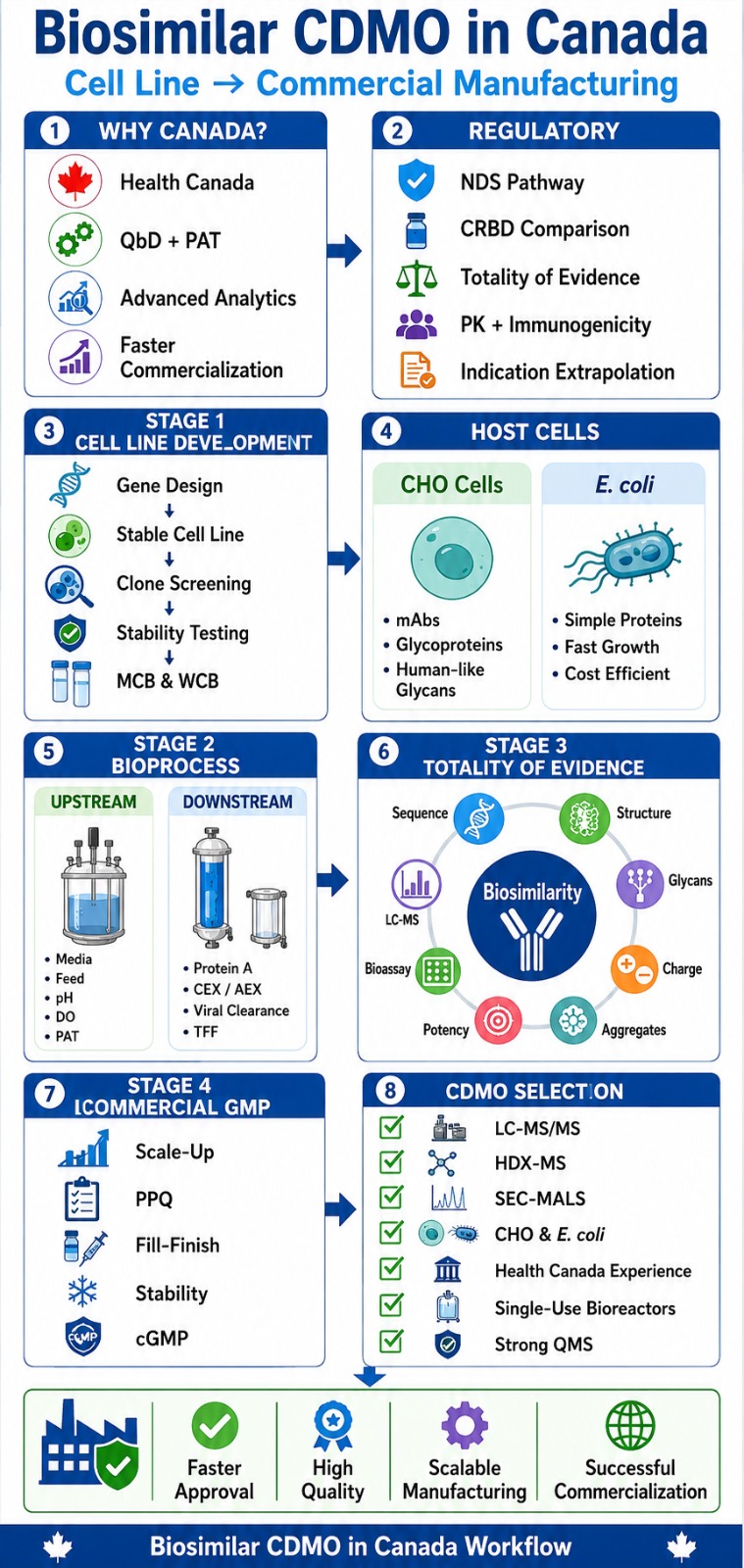
Health Canada Regulatory Framework for Biosimilar Biologics
Health Canada authorizes biosimilar biologic products through the New Drug Submission (NDS) pathway, which requires sponsors to establish a high degree of structural, functional, and analytical similarity to a Canadian Reference Biologic Drug (CRBD). Recent regulatory revisions have significantly reduced the emphasis on comparative clinical efficacy studies, placing greater importance on extensive physicochemical characterization and analytical comparability assessments.
Biosimilar applications are reviewed by Health Canada’s Biologic and Radiopharmaceutical Drugs Directorate (BRDD), previously known as the Biologics and Genetic Therapies Directorate (BGTD), under the provisions of the Food and Drugs Act and the Food and Drug Regulations. Unlike conventional generic pharmaceuticals, biosimilars are not eligible for approval through the Abbreviated New Drug Submission (ANDS) pathway. The biological nature of these products and the variability introduced by living production systems necessitate comprehensive comparative quality, characterization, and manufacturing data packages.
Leveraging accumulated scientific knowledge and aligning its approach with major global regulatory agencies such as the European Medicines Agency (EMA) and the U.S. Food and Drug Administration (FDA), Health Canada has revised its biosimilar guidance framework. The updated approach recognizes that modern analytical technologies—including ultra-high-resolution mass spectrometry, advanced chromatographic techniques, and cell-based functional bioassays—often possess greater sensitivity than traditional clinical efficacy studies for identifying subtle molecular differences. Under this science-driven framework, biosimilar candidates are primarily evaluated through extensive analytical characterization, pharmacokinetic (PK) comparability studies conducted in humans, and risk-based immunogenicity assessments.
In addition, sponsors are no longer expected to submit separate scientific justifications for each requested therapeutic indication. Once similarity of mechanism of action has been adequately demonstrated, indication extrapolation is generally permitted across all approved indications of the reference biologic, streamlining development programs and reducing unnecessary clinical requirements.
| Regulatory Domain | Previous Health Canada Framework | Updated Health Canada Guidance | Operational CDMO Impact |
|---|---|---|---|
| Primary Regulatory Pathway | New Drug Submission (NDS) under Food & Drug Regulations. | New Drug Submission (NDS) under Food & Drug Regulations. | Maintains the rigorous NDS approval pathway; the generic ANDS route remains unavailable for biosimilars. |
| Comparative Efficacy Trials | Generally required across most biologic therapeutic categories. | Typically not required when extensive analytical similarity is demonstrated. | Increases dependence on advanced bioanalytical testing, mass spectrometry characterization, and functional bioassays. |
| Indication Extrapolation | Required extensive scientific justification for each requested indication. | Automatically granted across CRBD indications sharing the same mechanism of action. | Places greater emphasis on receptor-binding studies and mechanism-of-action characterization. |
| Reference Product Sourcing | Canadian Reference Biologic Drug (CRBD) authorized in Canada. | CRBD remains primary; non-Canadian reference products may be used with analytical bridging. | Necessitates three-way analytical comparability studies involving the biosimilar, CRBD, and foreign reference product. |
| Target NDS Review Timelines | 300 calendar days for standard review; 180 days for Priority Review. | 300 calendar days for standard review; 180 days for Priority Review. | Requires fully developed and validated CMC documentation at submission to minimize regulatory queries and review delays. |
Accelerate your regulatory strategy with expert guidance. Learn more about our services at Peptide Drug Development CDMO.
When a development program utilizes a reference biologic sourced outside Canada as a surrogate for the Canadian Reference Biologic Drug during process development or nonclinical studies, Health Canada requires formal bridging comparability assessments. These studies involve direct analytical comparisons of the proposed biosimilar, the CRBD, and the foreign reference product. Evaluations typically encompass primary amino acid sequence verification, higher-order structural characterization, post-translational modification analysis, and biological activity assessments across multiple independent manufacturing lots, generally involving at least three batches from each product.
Need expert support for analytical characterization? Check out our insights on GLP-1 Peptide Analytical Characterization.
Stage 1: Cell Line Development and Expression Platform Optimization
Developing a biosimilar begins with the creation of a new recombinant production cell line capable of reproducing the primary structure and critical quality attributes of the reference biologic. Since the original manufacturer’s proprietary cell line, genetic constructs, and culture conditions are not publicly available, biosimilar developers must establish an entirely new expression system while achieving comparable molecular and functional characteristics. Contract development organizations therefore evaluate thousands of candidate clones to identify those capable of delivering both high productivity and appropriate product quality profiles.
Because originator companies closely protect their manufacturing platforms as trade secrets, biosimilar development starts with de novo gene synthesis and expression vector engineering. The coding sequence is derived from publicly available databases and confirmed through detailed amino acid sequencing of the reference product. The sequence is then codon-optimized to maximize protein expression efficiency within the selected host cell platform.
The cell line engineering workflow typically follows a structured and highly selective process designed to identify robust manufacturing clones capable of long-term commercial production:
Transfection and Stable Integration:
Recombinant expression vectors containing the target gene and appropriate selectable markers are introduced into host cells through methods such as electroporation or chemical lipofection. Stable genomic integration enables sustained expression of the desired protein during large-scale manufacturing.
High-Throughput Single-Cell Isolation:
Advanced robotic screening systems and microfluidic cell-sorting technologies are used to isolate thousands of individual transfected cells into separate culture wells. This process ensures monoclonality and establishes a diverse population of candidate production clones for evaluation.
Tiered Clone Screening:
Candidate clones are initially assessed for growth characteristics and protein productivity, including specific productivity values (qₚ). Promising clones are then subjected to detailed quality evaluations, including analyses of aggregation levels, charge variants, glycosylation patterns, and other critical quality attributes to ensure alignment with the reference biologic.
Genetic Stability Evaluation:
Selected lead clones undergo extensive stability testing across approximately 60 to 90 cell generations. These studies confirm stable vector integration, consistent messenger RNA expression, sustained protein productivity, and preservation of product quality attributes throughout extended cultivation.
Cell Banking:
The final production clone is expanded under current Good Manufacturing Practice (cGMP) conditions to establish both a Master Cell Bank (MCB) and a Working Cell Bank (WCB). These banks are developed and qualified in accordance with ICH Q5A, Q5B, and Q5D guidelines, providing a controlled and reproducible starting material for future manufacturing campaigns.
Streamline your supply chain by partnering with industry leaders. Discover more at Outsource Peptide Manufacturing to CDMO.
Host System Selection for a Biosimilar CDMO in Canada
Host cell selection is a critical component of biosimilar development and is largely determined by the structural complexity of the target biologic. Mammalian expression systems, particularly Chinese Hamster Ovary (CHO) cell lines, are commonly used for complex monoclonal antibodies and other glycoproteins, whereas microbial platforms such as Escherichia coli are frequently employed for non-glycosylated proteins. Selecting the most suitable host system is essential to ensure that post-translational modifications, including N-glycosylation and protein folding patterns, closely resemble those of the reference biologic.
Mammalian expression platforms—including CHO-K1, CHO-DG44, and CHO-S cell line variants—are the preferred systems for manufacturing monoclonal antibodies, fusion proteins, and structurally complex cytokines because they can generate human-like post-translational modifications. These modifications include complex biantennary N-glycosylation, core fucosylation, and terminal sialylation, all of which can significantly influence biological activity, pharmacokinetics, and immunogenicity. In contrast, microbial expression systems such as Escherichia coli and Pichia pastoris are typically selected for simpler therapeutic proteins that do not require glycosylation, including insulin, recombinant human growth hormone, and certain single-chain antibody fragments. While microbial systems offer advantages such as rapid cell growth, high volumetric productivity, and reduced manufacturing costs, they often require additional downstream processing steps to recover and correctly refold proteins that accumulate as insoluble inclusion bodies.
Stage 2: Upstream and Downstream Bioprocess Engineering for a Biosimilar CDMO in Canada
Bioprocess engineering converts a selected production cell line into a scalable and reproducible manufacturing process capable of consistently producing biosimilars that meet predefined critical quality attribute (CQA) specifications. Through coordinated optimization of upstream cultivation processes and downstream purification operations, manufacturers establish process conditions that closely reproduce the quality profile of the reference biologic while effectively eliminating process-related impurities.
Upstream Culture Optimization and Process Analytical Technology
Upstream process development focuses on optimizing cell culture media, feeding strategies, and bioreactor operating conditions to maximize protein expression while maintaining control over critical post-translational modifications. The implementation of Process Analytical Technology (PAT) enables continuous process monitoring and dynamic control, helping to prevent quality deviations throughout bioreactor cultivation.
Upstream development scientists systematically adjust variables such as trace nutrient concentrations, feeding schedules, glucose availability, dissolved oxygen (DO), temperature, and culture pH to direct cellular metabolic activity toward the desired product profile. For example, supplementing culture media with controlled levels of manganese chloride, uridine, and galactose can influence galactosylation patterns on monoclonal antibody Fc domains. Similarly, strategic modifications to culture pH and temperature during late-exponential growth phases can regulate the distribution of acidic and basic charge variants.
Modern bioreactor systems incorporate advanced PAT tools, including inline Raman spectroscopy sensors, automated metabolite analyzers, and real-time process monitoring platforms. These technologies continuously track nutrient consumption, metabolite generation, and product formation throughout cultivation. The resulting process data are integrated into automated control systems, such as Delta-V platforms, which utilize closed-loop feedback mechanisms to maintain process parameters within predefined Quality by Design (QbD) design spaces. This approach enhances process robustness, minimizes variability, and supports consistent product quality across manufacturing campaigns.
Looking to scale up your production processes? Learn about our scalable solutions at Peptide API Scale Up.
Downstream Purification and Viral Clearance
Downstream bioprocess engineering is responsible for isolating the target biosimilar protein from host cell-derived contaminants, aggregates, charge variants, and potential viral impurities through a sequence of highly selective purification and viral clearance operations. Achieving the stringent purity requirements expected for biologic drug substances requires the integration of multiple orthogonal purification technologies.
The purification process typically begins with harvest clarification, where centrifugation and depth filtration are used to remove intact cells and cellular debris from the harvested culture fluid. For monoclonal antibody products, initial capture is commonly performed using Protein A affinity chromatography. This highly selective technique binds antibody Fc regions with exceptional specificity and frequently achieves purification levels exceeding 95% in a single chromatographic step.
Following Protein A capture, the eluate undergoes low-pH viral inactivation, typically within a pH range of 3.5 to 3.8, to eliminate potential retroviral contaminants. Subsequent intermediate and polishing purification stages employ chromatographic techniques such as Cation Exchange (CEX), Anion Exchange (AEX), and Multimodal or Mixed-Mode chromatography. These operations are strategically arranged to separate acidic and basic charge variants, remove high-molecular-weight aggregates, and reduce residual process impurities, including host cell proteins (HCP), host cell DNA (hDNA), and leached Protein A residues.
The purification train concludes with virus-retentive nanofiltration using approximately 20-nanometer membrane filters to provide additional viral safety assurance. Finally, Tangential Flow Filtration (TFF) ultrafiltration and diafiltration (UF/DF) operations concentrate the purified drug substance and exchange it into the final formulation buffer required for long-term storage and subsequent drug product manufacturing.
Explore proven methodologies and analytical depth with our Peptide Characterization Case Study of Semaglutide.
Stage 3: High-Resolution Analytical Characterization and Totality of Evidence
High-resolution analytical characterization serves as the foundation of biosimilar development by demonstrating structural, physicochemical, and functional similarity between the proposed biosimilar and the reference biologic. Regulatory agencies assess this comprehensive analytical dataset using the “Totality of Evidence” approach, which integrates multiple layers of evidence to establish biosimilarity while minimizing reliance on extensive clinical efficacy studies.
Demonstrating biosimilarity requires extensive side-by-side testing against numerous commercial batches of the Canadian Reference Biologic Drug (CRBD) to capture the natural variability inherent to the reference product. Advanced analytical characterization programs typically evaluate between 40 and 60 distinct structural and functional attributes across several complementary analytical tiers.
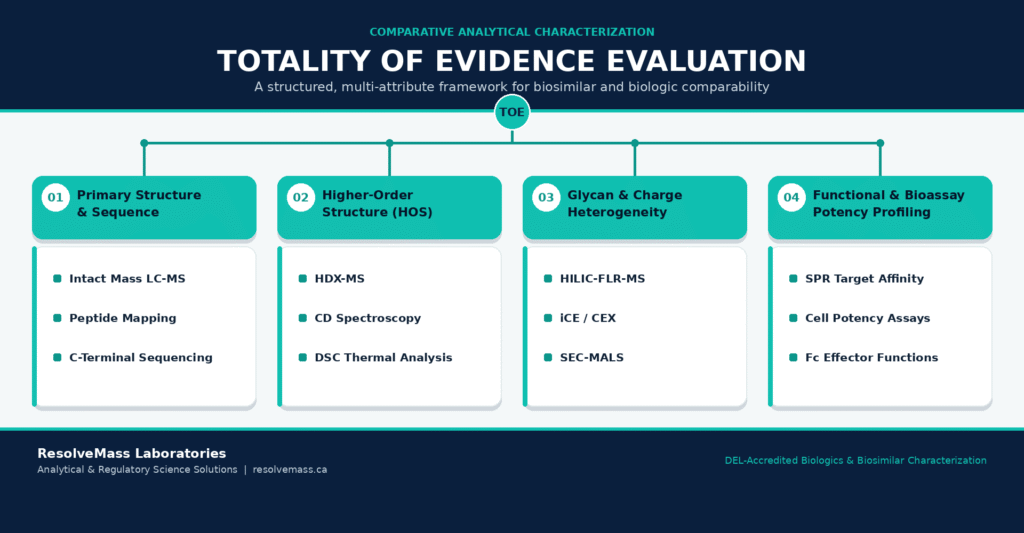
| Structural & Functional Domain | Evaluated Quality Attribute | Primary Analytical Methodology | Clinical & Biological Significance |
|---|---|---|---|
| Primary Structure | Amino acid sequence, exact molecular weight, peptide map | LC-MS/MS peptide mapping, intact mass LC-MS, Edman degradation | Confirms sequence identity and excludes amino acid substitutions, truncations, or sequence-related variants. |
| Higher-Order Structure (HOS) | Secondary, tertiary, and quaternary protein conformation | Hydrogen-Deuterium Exchange Mass Spectrometry (HDX-MS), Circular Dichroism (CD), 2D-NMR, Differential Scanning Calorimetry (DSC) | Verifies correct protein folding required for biological activity and molecular stability. |
| Glycosylation Profile | Oligosaccharide structures, N-glycan occupancy, fucosylation levels | HILIC-FLR-MS glycan mapping, Capillary Gel Electrophoresis (CGE), MALDI-TOF MS | Influences serum half-life, clearance characteristics, and FcγRIIIa-mediated ADCC activity. |
| Charge Heterogeneity | Acidic and basic variants, deamidation, oxidation, lysine heterogeneity | Imaged Capillary Isoelectric Focusing (iCE), Cation Exchange Chromatography (CEX) | Detects process-related chemical modifications that may impact stability and biological performance. |
| Size Variants & Aggregates | High-molecular-weight aggregates and low-molecular-weight fragments | Size-Exclusion Chromatography with MALS (SEC-MALS), Analytical Ultracentrifugation (AUC), Field-Flow Fractionation (FFF) | Measures aggregation levels associated with increased antidrug antibody (ADA) risk and immunogenicity concerns. |
| Functional Activity & Potency | Antigen binding and Fc-mediated effector functions (FcγR, FcRn, C1q binding) | Surface Plasmon Resonance (SPR), Bio-Layer Interferometry (BLI), Reporter Gene Bioassays | Confirms target engagement, ADCC, CDC, ADCP activity, receptor interactions, and endosomal recycling mechanisms. |
Stage 4: Process Scale-Up, PPQ, and Commercial cGMP Biomanufacturing
Process scale-up and commercial process qualification are designed to demonstrate that a biosimilar manufacturing process remains consistent, robust, and capable of meeting predefined critical quality specifications when operated at commercial production volumes. Transitioning from laboratory-scale development to full-scale manufacturing requires comprehensive engineering assessments, process validation strategies, and extensive comparability evaluations.
Scaling a biologics manufacturing process from bench-scale bioreactors ranging from 1 to 10 liters, through pilot-scale systems of 100 to 500 liters, and ultimately into commercial bioreactors exceeding 2,000 liters introduces substantial changes in physical process dynamics. Variations in vessel geometry, impeller design, liquid depth, and mixing behavior can alter oxygen transfer coefficients (kLa), dissolved carbon dioxide (pCO₂) concentrations, and local shear forces experienced by cells. If these scale-dependent effects are not adequately controlled, localized gradients in nutrients, oxygen, or pH can place stress on production cells, potentially altering glycosylation patterns, productivity, and aggregation profiles.
To minimize scale-up risks, process engineers employ engineering strategies that maintain key scale-independent parameters, including volumetric power input (P/V), mixing performance, and impeller tip speed. Scale-down models are also developed to simulate commercial manufacturing conditions and predict process behavior before large-scale implementation.
Commercial readiness is ultimately demonstrated through execution of Process Performance Qualification (PPQ) studies. During PPQ, manufacturers produce multiple consecutive commercial-scale cGMP batches under routine operating conditions to verify process reproducibility and consistent product quality. Validation packages submitted to Health Canada generally include the following components:
Critical Process Parameter (CPP) Consistency:
Evidence demonstrating that critical manufacturing variables, including temperature, pH, feed rates, agitation, and dissolved oxygen levels, remain within validated operating ranges and predefined design spaces throughout production.
In-Process Control (IPC) Verification:
Validation of real-time and at-line analytical testing procedures used to monitor bioburden, bacterial endotoxin levels, host cell protein removal, process performance, and critical quality attribute conformity during manufacturing.
Aseptic Drug Product Fill-Finish:
Qualification of sterile filling operations, including automated vial filling systems, prefilled syringe assembly processes, container-closure integrity testing programs, and automated visual inspection systems used during final product packaging.
Real-Time and Accelerated Stability Programs:
Comprehensive stability studies conducted according to ICH Q1A requirements to establish product shelf-life, evaluate photostability, define storage conditions, and determine acceptable temperature excursion limits throughout the product lifecycle.
Ensure seamless scale-up operations for your pipeline. Read more about our Peptide CDMO Scale-Up Services.
Key Selection Criteria for a Biosimilar CDMO in Canada
Choosing the appropriate contract development and manufacturing partner is a critical strategic decision that can significantly influence the success of a biosimilar development program. Sponsors should evaluate prospective CDMOs based on their scientific expertise, analytical capabilities, manufacturing infrastructure, cGMP compliance standards, and regulatory experience with Health Canada. A qualified biosimilar CDMO must possess the technical resources and operational capacity necessary to reduce development risks, support regulatory submissions, and facilitate successful commercialization.
Biopharmaceutical organizations performing CDMO assessments and technical audits should carefully examine the following core capabilities:
In-House Mass Spectrometry Infrastructure:
The CDMO should maintain advanced analytical characterization capabilities supported by state-of-the-art mass spectrometry platforms, including Orbitrap LC-MS/MS, Hydrogen-Deuterium Exchange Mass Spectrometry (HDX-MS), and Size-Exclusion Chromatography coupled with Multi-Angle Light Scattering (SEC-MALS). Access to these technologies within the organization enables comprehensive structural and functional characterization without dependence on external analytical laboratories, improving project timelines and data consistency.
Flexible Expression System Expertise:
A strong biosimilar CDMO should demonstrate extensive experience with both mammalian and microbial expression systems. Proven operational knowledge of Chinese Hamster Ovary (CHO) platforms as well as microbial hosts such as Escherichia coli allows efficient technology selection and seamless process development based on the specific requirements of each biologic molecule.
Regulatory Track Record with Health Canada BRDD:
Sponsors should assess the organization’s history of regulatory interactions with Health Canada’s Biologic and Radiopharmaceutical Drugs Directorate (BRDD). A proven record of successful pre-submission meetings, Common Technical Document (CTD) Module 3 preparation, biosimilar dossier submissions, and timely responses to regulatory Information Requests demonstrates familiarity with Canadian regulatory expectations and submission requirements.
Scalable Single-Use Biomanufacturing Technology:
Modern biomanufacturing facilities equipped with single-use bioreactor systems ranging from approximately 50-liter seed-train operations to 2,000-liter or larger production-scale reactors provide substantial operational advantages. Single-use technologies improve manufacturing flexibility, reduce turnaround times between campaigns, minimize cleaning validation requirements, and significantly lower the risk of cross-contamination compared with traditional stainless-steel manufacturing systems.
Integrated Quality Management Systems (QMS):
A robust Quality Management System is essential for maintaining regulatory compliance and product quality. Sponsors should verify that the CDMO operates under cGMP-compliant conditions with clearly segregated upstream and downstream manufacturing areas, comprehensive environmental monitoring programs, validated computerized systems, effective deviation and CAPA management processes, and qualified cold-chain logistics networks capable of supporting both North American and international product distribution.
Evaluating your options? Learn what makes a leading provider by exploring our guide on Peptide CDMO in United States.
Conclusion
Collaborating with an experienced biosimilar CDMO in Canada provides biopharmaceutical developers with the scientific expertise, analytical capabilities, manufacturing infrastructure, and regulatory support necessary to successfully advance complex biologics from development through commercialization. Canada’s evolving biosimilar regulatory landscape, supported by Health Canada’s modernized guidance framework, places substantial emphasis on comprehensive analytical characterization and quality comparability rather than routine comparative clinical efficacy studies. This science-based approach enables developers to streamline development programs while maintaining rigorous standards for product quality, safety, and efficacy.
Through the application of advanced bioprocess engineering, high-resolution mass spectrometry characterization, robust cell line development strategies, and scalable cGMP manufacturing platforms, biosimilar developers can generate the extensive Totality of Evidence package required to demonstrate biosimilarity. These capabilities support efficient regulatory review, reduce development uncertainty, and accelerate access to commercial markets.
Not sure whether to partner with a CDMO or CRO? Read our expert comparison on Peptide CDMO vs CRO.
Organizations that integrate analytical excellence, process control, and regulatory expertise throughout the product lifecycle are better positioned to satisfy Health Canada’s current biosimilar requirements and achieve successful market authorization.
To discuss your analytical characterization program, cell line development strategy, process optimization requirements, or commercial biomanufacturing objectives, connect with the biopharmaceutical specialists at ResolveMass through our Contact Us page.
Frequently Asked Questions
Health Canada’s revised biosimilar framework places greater emphasis on advanced analytical characterization and reduces reliance on comparative clinical efficacy studies when strong analytical evidence is available. The updated guidance also streamlines development by allowing indication extrapolation across approved uses of the reference biologic once the mechanism of action and overall biosimilarity have been adequately demonstrated. This approach can reduce development timelines and regulatory complexity.
Mass spectrometry plays a central role in biosimilar development because it enables highly detailed examination of molecular structure and product quality attributes. These techniques can identify subtle differences in amino acid sequence, molecular mass, glycosylation patterns, and other post-translational modifications with exceptional sensitivity. The resulting data provide critical evidence supporting biosimilarity and form a significant component of regulatory submissions.
Developing a biosimilar from initial molecule selection to commercial approval is typically a long-term process that may take approximately seven to ten years. Early-stage activities such as cell line engineering, process development, analytical characterization, and comparability assessments often require several years before large-scale manufacturing validation and regulatory review can begin. The overall timeline depends on product complexity, development strategy, and regulatory requirements.
Small-molecule generic drugs are chemically synthesized and can usually be reproduced with an identical molecular structure to the reference product. Biosimilars, however, are large and structurally complex proteins produced in living cells, making exact replication impossible. As a result, biosimilar development requires extensive analytical, biological, and functional testing to demonstrate a high degree of similarity rather than chemical identity.
Bioprocess engineers carefully manage culture conditions to influence critical post-translational modifications and maintain product consistency. Parameters such as nutrient composition, trace element concentrations, dissolved oxygen, temperature, feeding strategies, and culture pH are optimized to achieve the desired glycosylation and charge variant profiles. Process Analytical Technology (PAT) tools continuously monitor these conditions, enabling real-time adjustments during production.
Purification of monoclonal antibody biosimilars involves multiple sequential operations designed to remove impurities while preserving product quality. The process typically includes harvest clarification, Protein A affinity chromatography, low-pH viral inactivation, cation exchange chromatography, anion exchange chromatography, virus-retentive nanofiltration, and tangential flow filtration for concentration and buffer exchange. Each step contributes to achieving the purity and safety standards required for commercial biologics.
Health Canada may permit the use of a non-Canadian reference biologic during biosimilar development when it originates from a jurisdiction with comparable regulatory standards. However, sponsors must establish a scientific connection between the foreign reference product and the Canadian Reference Biologic Drug through comprehensive bridging studies. These studies typically include detailed analytical and functional comparisons to confirm equivalence among all products being evaluated.
Process Analytical Technology (PAT) helps manufacturers maintain process control as production transitions from laboratory-scale operations to commercial manufacturing volumes. By incorporating real-time monitoring tools, inline sensors, and predictive analytical models, PAT provides continuous insight into critical process parameters. This data-driven approach supports process consistency, reduces variability, and helps maintain product quality throughout scale-up and routine manufacturing.
Before initiating technology transfer, sponsors typically perform comprehensive technical and quality audits of prospective CDMO partners. These evaluations focus on analytical characterization capabilities, cGMP compliance systems, manufacturing scalability, regulatory experience, and expertise with relevant expression platforms. Assessing these factors helps determine whether the organization can reliably support development, validation, regulatory submission, and long-term commercial production requirements.
Reference:
- Bas, T. G. (2025). Innovative formulation strategies for biosimilars: Trends focused on buffer-free systems, safety, regulatory alignment, and intellectual property challenges. Pharmaceuticals, 18(6), 908. https://doi.org/10.3390/ph18060908
- Health Canada. (2026, May 21). Summary of changes: Guidance on information and submission requirements for biosimilar biologic drugs. Government of Canada. https://www.canada.ca/en/health-canada/services/drugs-health-products/biologics-radiopharmaceuticals-genetic-therapies/applications-submissions/guidance-documents/information-submission-requirements-biosimilar-biologic-drugs/summary-changes.html
- Health Canada. (2026, May 19). Guidance on information and submission requirements for biosimilar biologic drugs: Overview. Government of Canada. https://www.canada.ca/en/health-canada/services/drugs-health-products/biologics-radiopharmaceuticals-genetic-therapies/applications-submissions/guidance-documents/information-submission-requirements-biosimilar-biologic-drugs.html
Get In Touch With Us
About The Author


