
Introduction
Selecting a Biosimilar CDMO in the United States requires a thorough assessment of its FDA site inspection history, orthogonal analytical characterization capabilities, and supply chain compliance under the BIOSECURE Act. These factors should take precedence over headline batch pricing or stated bioreactor capacity. Between September 2025 and August 2026, regulatory and trade developments in the United States significantly changed the outsourcing risk landscape for 351(k) sponsors. During this period, the FDA finalized its guidance on Comparative Analytical Assessment (CAA), proposed removing routine comparative clinical efficacy studies (CES) when analytical comparability requirements are adequately met, introduced draft standards for combination-product container closure systems, and saw Congress enact Section 851 of the FY2026 National Defense Authorization Act (the BIOSECURE Act).
As comparative clinical trials may now be reduced or eliminated when structural and functional equivalence is convincingly established, the development and manufacturing partner has assumed a more critical role in determining the success of a Biologics License Application (BLA). At the same time, regulatory oversight of manufacturing facilities has become increasingly stringent, with site-specific quality and facility deficiencies contributing to a substantial proportion of biologics Complete Response Letters (CRLs). Consequently, evaluating a domestic or North American-integrated partner requires a structured, gate-based technical diligence approach covering quality systems, high-resolution mass spectrometry, clonal cell line engineering, aseptic fill-finish presentation, and geopolitical supply chain resilience.
Share via:
Quick Summary:
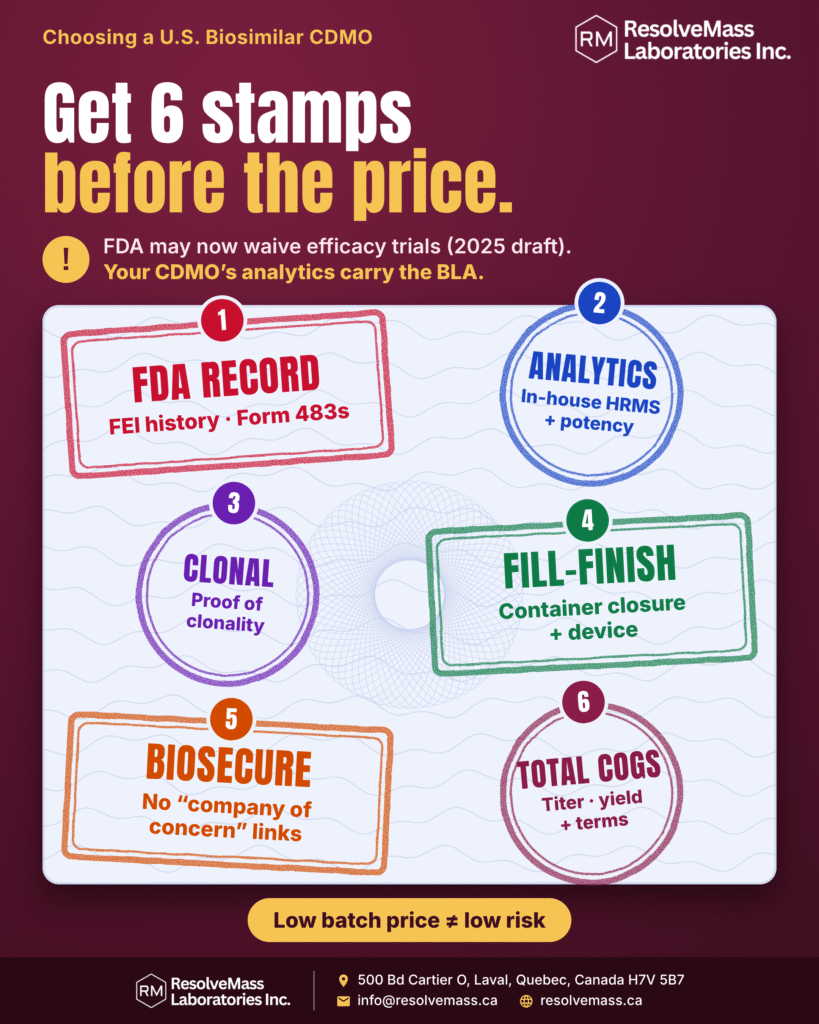
- Choose for compliance and analytics first, not price. A U.S. biosimilar CDMO should be judged first on its FDA inspection history, its orthogonal analytical capabilities and its BIOSECURE compliance. Batch pricing and bioreactor capacity come after.
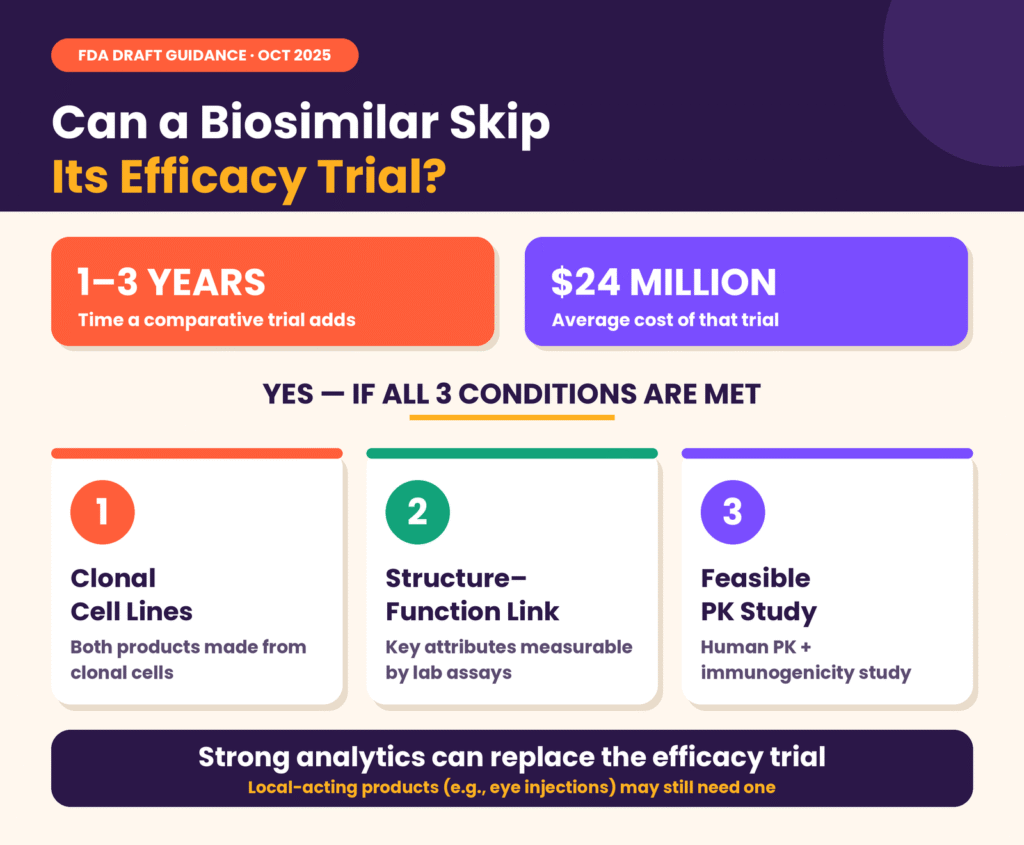
- Analytics now carries more of the approval. The FDA’s final Comparative Analytical Assessment guidance (September 2025) put analytical data at the center of 351(k) licensure. Its October 2025 draft guidance then proposed that comparative efficacy studies, which take 1–3 years and cost about $24M on average, may not be needed. That applies when products are made from clonal cell lines, are well characterized, and can be bridged with a human PK study.
- Check the site’s own FDA record. Using the facility’s FEI number, review recent Form 483s and warning letters, data integrity controls (21 CFR Part 11, ALCOA+) and CAPA trends. Manufacturing and facility problems feature in a large share of biologics Complete Response Letters.
- Keep key analytics under one roof. The partner should run high-resolution mass spectrometry, higher-order structure, post-translational modification, impurity and potency testing within one quality system. Programs using a non-U.S. comparator also need a three-way analytical bridge.
- Prove clonality and match the reference product. Cell lines need formal proof of clonality, stable glycosylation and charge profiles over many generations, and validated scale-down models. Fill-finish partners must handle container closure and device requirements, including ISO 13485 controls under the FDA’s QMSR, which took effect in February 2026.
- Audit the supply chain under BIOSECURE. The Act was signed December 18, 2025, as Section 851 of the FY2026 NDAA. It restricts federal dealings with “biotechnology companies of concern,” and OMB must publish its list by December 2026. Sponsors should audit sub-tier equipment, software and suppliers, and plan for tighter capacity and rising CDMO rates.
- Base the contract on total cost and clear terms. Model total COGS (titer, yield, materials, penalties) rather than batch price. Then set milestone-based tech transfer, fault-based root-cause terms, and a phased or dual-source scaling strategy.
Why Selecting a Biosimilar CDMO in the United States Demands an Analytical-First Strategy
Sponsors evaluating a Biosimilar CDMO in the United States should place analytical capabilities at the forefront of their selection process. This is because current FDA regulatory policies recognize Comparative Analytical Assessments as particularly sensitive and often more decisive than conventional Phase III efficacy trials. According to FDA figures published on October 29, 2025, biologic medications represented only 5% of total U.S. prescriptions but accounted for 51% of overall U.S. drug spending in 2024. Meanwhile, approved biosimilars represented less than 20% of the market, with 76 FDA-approved biosimilars compared with more than 30,000 approved generic drugs as of that date. Historical estimates from a GaBI Online research review placed biosimilar development costs between 42 million and 135 million, excluding regulatory fees, while broader estimates from Mordor Intelligence ranged from 100 million to 300 million. In response to these development costs, the FDA introduced regulatory changes in late 2025 aimed at reducing unnecessary clinical development requirements.
In September 2025, the FDA published its final guidance, Development of Therapeutic Protein Biosimilars: Comparative Analytical Assessment and Other Quality-Related Considerations (90 FR 43458). The guidance established risk-based Critical Quality Attributes (CQAs), multi-lot reference product characterization across expiry periods, and orthogonal analytical method validation as fundamental elements of 351(k) licensure.
Establish a stronger analytical foundation for biosimilar development by understanding how Critical Quality Attributes are identified and evaluated in biosimilars.
One month later, on October 29, 2025, with publication in the Federal Register on November 20, 2025 (90 FR 52410), the FDA released draft guidance proposing that sponsors could potentially eliminate comparative efficacy studies. According to the agency, these studies typically extend development timelines by 1 to 3 years and add an average of 24 million to development budgets. This approach is subject to the following three conditions:
Clonal and Well-Characterized Manufacture: Both the reference biologic and the proposed biosimilar must be manufactured using clonal cell lines, undergo extensive purification, and demonstrate that their characteristics can be comprehensively evaluated using modern analytical technologies.
Evaluable Structure-Function Link: The relationship between the reference product’s quality attributes and clinical efficacy must be generally established. These attributes should also be directly assessable through analytical assays included in the CAA.
Feasible Human PK Bridge: Conducting a human pharmacokinetic (PK) similarity study alongside an immunogenicity assessment must be feasible and clinically meaningful. However, products with localized activity, such as intravitreal therapies, may still require comparative efficacy endpoints.
Together with the FDA’s June 2024 draft guidance, which reduced dependence on clinical switching studies for interchangeability, these regulatory developments place greater emphasis on Chemistry, Manufacturing, and Controls (CMC) documentation within Common Technical Document (CTD) Module 3. A CDMO that considers analytical characterization merely a final batch-release requirement, rather than an essential tool for upstream molecular and process development, can expose sponsors to significant and potentially unresolved comparability risks.
Core Evaluation Pillars for a U.S. Biosimilar Development Partner
A comprehensive CDMO selection strategy should examine regulatory compliance, orthogonal analytical capabilities, biological process engineering, and sterile product presentation as interconnected technical requirements throughout the development lifecycle. Evaluating these four pillars systematically helps sponsors identify potential risks early, avoid expensive comparability failures during development, and reduce approval delays caused by manufacturing facility deficiencies.
Site-Level Regulatory Compliance for a Biosimilar CDMO in the United States
Before reviewing service pricing or manufacturing suite availability, sponsors should obtain the FDA inspection history of the specific manufacturing facility using its FDA Establishment Identifier (FEI) number. Recent enforcement patterns demonstrate why regulatory compliance should be treated as a mandatory qualification criterion rather than a standard procurement consideration.
An industry blog analysis published by DrugPatentWatch, citing PharmaSource data, reported that CDER GMP-related warning letters increased approximately 2.8-fold, rising from 39 in 2023 to 78 in 2024 and 111 in 2025. Approximately 98% of this increase occurred within the United States. Additional industry figures compiled in the same review indicated that 60.5% of biologics Complete Response Letters referenced manufacturing-related concerns, representing 8.4 percentage points more than the corresponding figure for small-molecule drugs. Furthermore, a 2026 study by Dilek and colleagues, referenced through the same secondary analysis, reported that facility deficiencies were cited in 65% of CRLs across 43 novel therapeutics reviewed between 2020 and 2024.
Since sponsors cannot legally transfer their Current Good Manufacturing Practice (cGMP) responsibilities under 21 CFR Parts 210, 211, and 600, pre-contract evaluation must examine the CDMO’s operational quality culture in addition to its formal regulatory status. The following compliance areas require particular attention:
Inspection Scope Alignment: Examine every Form 483 issued during the manufacturing site’s three most recent inspections, along with the inspection records of sister facilities operating under the same Quality Management System (QMS). Confirm that previous pre-approval inspections included relevant biologics manufacturing or sterile fill-finish operations rather than unrelated manufacturing activities involving oral solid dosage forms.
Electronic Data Integrity: Assess compliance with 21 CFR Part 11 and ALCOA+ principles. The evaluation should cover individual user access credentials, audit trail review procedures, batch record review timelines, and trends in Corrective and Preventive Action (CAPA) aging.
Quality Agreement Boundaries: Ensure that the Quality Agreement clearly defines responsibilities relating to quality unit authority, materials management, laboratory controls, documentation, and change control in accordance with FDA expectations. Commercial provisions, including pricing, confidentiality, delivery conditions, and liability limitations, should remain outside the Quality Agreement.
Orthogonal Analytical Characterization and Mass Spectrometry Depth
The selected CDMO, or its dedicated analytical development partner, should have the capability to perform orthogonal physicochemical, structural, and functional characterization within a unified quality system. Essential activities such as potency bioassays and mass spectrometry should preferably remain under coordinated internal control instead of being distributed among unrelated subcontractors. Outsourcing critical potency assays or failing to establish clear ownership of analytical method lifecycles can create validation delays and significant comparability gaps during manufacturing scale-up.
Under ICH Q6B and the FDA’s September 2025 CAA guidance, developers are expected to characterize multiple reference product lots across different expiry periods, commonly involving 10 or more lots. The resulting data must be assessed using a risk-based statistical framework that includes Tier 1 equivalence testing, Tier 2 quality-range limits established from reference product lots, and Tier 3 raw spectral comparisons.
Explore the analytical techniques and regulatory considerations involved in ICH Q6B characterization of biological products to strengthen the quality assessment strategy.
| Characterization Tier | Primary Regulatory Objective | Core Analytical Technologies | CTD Module 3 Deliverable |
|---|---|---|---|
| Primary Structure and Sequence | Establish complete amino acid identity, terminal variants, and disulfide linkages | LC-MS/MS peptide mapping, Orbitrap/Q-TOF intact and reduced mass, Edman degradation, AAA | Molecular mass assignment, extinction coefficient, and sequence verification |
| Higher-Order Structure (HOS) | Demonstrate equivalence in secondary, tertiary, and quaternary protein folding | Far/Near-UV CD, DSC, HDX-MS, SV-AUC, SEC-MALS, native MS, IM-MS | Spectral overlays, thermal stability profiles, and conformational comparability |
| Post-Translational Modifications and Charge | Characterize glycosylation, oxidation, deamidation, and charge heterogeneity | HRMS, HILIC-FLD, site-specific glycopeptide mapping, MAM, icIEF, CEX | Site-specific glycan distribution and Tier 2 quality-range justification |
| Purity, Aggregates, and Impurities | Identify clipped species, aggregates, host cell proteins (HCPs), and hcDNA | SEC-MALS, CE-SDS (reduced/non-reduced), DLS, targeted HCP-MS, qPCR | Comprehensive impurity characterization that addresses the limitations of traditional ELISA methods |
| Functional Potency and MoA | Establish biological activity, target binding, and relevant effector mechanisms | SPR/BLI target binding, FcRn/FcγR binding, reporter gene assays, ADCC/CDC | Tier 1 statistical equivalence testing against reference lot variability |
Improve molecular-level assessment of complex therapeutic proteins through proteomics-based approaches for biosimilar characterization.
For global development programs using a non-U.S.-licensed comparator, such as an EU-sourced reference biologic, the analytical partner must also conduct a complete three-way pairwise analytical bridge. This assessment should include the proposed biosimilar versus the U.S.-licensed reference product, the proposed biosimilar versus the non-U.S. comparator, and the non-U.S. comparator versus the U.S.-licensed reference product.
North American specialist laboratories that combine established regulatory credentials with advanced mass spectrometry infrastructure demonstrate how integrated analytical capabilities can reduce the risks associated with 351(k) submissions. For example, ResolveMass Laboratories Inc. is an ISO 9001:2015 certified, U.S. FDA-registered (FEI 3042696771), and Health Canada GMP-licensed (DEL 3-002945-A) facility located in Laval, Quebec, serving biopharmaceutical sponsors across the United States and Canada. Its services include high-resolution mass spectrometry characterization, including Orbitrap workflows, primary reference standard qualification, forced degradation studies, extractables and leachables (E&L) testing, and CTD Module 3.2.S/3.2.P data packages. These capabilities are delivered through an integrated R&D-to-GMP quality system.
Access specialized biosimilar analytical characterization services to support structural, physicochemical, and functional comparability assessments.
Cell Line Engineering and Upstream-Downstream CQA Matching
Unlike the development of novel biologics, where cell line optimization generally focuses on achieving maximum expression titers, biosimilar manufacturing requires a more targeted approach. A biosimilar CDMO must develop clonal cell lines that reproduce the glycosylation patterns and charge variants of the reference product while maintaining commercially viable productivity. Published CDMO platform benchmarks for mammalian CHO cell lines commonly target antibody titers above 5 to 10 g/L to support competitive commercial Cost of Goods Sold (COGS). These platforms should also demonstrate genetic stability and consistent CQA profiles beyond 60 generations.
An important consideration is that the FDA’s October 2025 CES framework specifically states that both the reference product and the proposed biosimilar must be manufactured using clonal cell lines. Therefore, sponsors should confirm that potential CDMO partners can generate formal Proof of Clonality reports supported by fluorescence-activated cell sorting (FACS) or single-cell imaging and appropriate statistical evidence.
Understand the key development stages and technical requirements involved in cell line development for biosimilars.
Additional documentation should include vector sequence verification, STR genetic identity testing, mycoplasma and adventitious virus clearance, and cGMP release documentation for Master and Working Cell Banks (MCB/WCB).
During upstream and downstream process development, sponsors should also establish whether the CDMO validates its scale-down models through Design of Experiments (DoE) and incorporates Process Analytical Technology (PAT) into process monitoring. These capabilities help ensure that clinical and commercial manufacturing batches consistently remain within the established analytical quality range of the reference product.
Sterile Fill-Finish and Combination Product Presentation Readiness
Assessing aseptic fill-finish capabilities involves more than reviewing available manufacturing capacity. Sponsors must also examine device constituent engineering, primary packaging compatibility, and the suitability of Restricted Access Barrier Systems (RABS) or isolator-based manufacturing lines.
Therapeutic proteins are particularly sensitive to shear stress during pumping, temperature fluctuations, and interactions with container surfaces. These risks must be evaluated across different product presentations, including liquid vials, lyophilized vials, prefilled syringes (PFS), injection pens, and autoinjectors.
In July and August 2026, the FDA issued two draft guidances: Biosimilar and Interchangeable Biosimilar Products: Considerations for Container Closure Systems and Device Constituent Parts (91 FR 48880) and Container Closure Systems for Human Drugs and Biological Products. These documents emphasize that differences in product presentation may affect licensure if they result in changes to the route of administration, dosage form, strength, clinical safety, or potency.
Under 21 CFR Part 4 and 21 CFR 820.10(c), which reflects the FDA’s Quality Management System Regulation harmonizing device cGMP requirements with ISO 13485:2016 and becoming effective in February 2026, container closure systems that function as device constituent parts must comply with the relevant requirements of ISO 13485:2016. Particular attention should be given to Clause 7.3, covering design and development, and Clause 7.4, addressing purchasing controls.
Accordingly, a qualified fill-finish CDMO should be able to support early comparative physical and user-interface assessments, Container Closure Integrity Testing (CCIT), break-loose and glide force testing, and E&L studies using actual commercial formulations. Sponsors should also evaluate the availability of single-use fluid paths and, for dual U.S./EU submissions, a documented Contamination Control Strategy (CCS) aligned with the revised EU GMP Annex 1.
Supply Chain Resilience Under the BIOSECURE Act and Capacity Constraints
Geopolitical supply chain assessment has evolved from an optional risk-management activity into a statutory eligibility requirement following the enactment of the BIOSECURE Act under Section 851 of the FY2026 National Defense Authorization Act on December 18, 2025.
The legislation prohibits U.S. federal executive agencies from procuring biotechnology equipment or services from designated Biotechnology Companies of Concern (BCCs). It also restricts agencies from entering into contracts with, or extending grants and loans to, entities that depend on BCC equipment or services to fulfill federal agreements. Through contractor flow-down provisions and compliance requirements involving the Department of Veterans Affairs, Medicaid, and Medicare Part B, unassessed sub-tier CDMO dependencies may also create risks for commercial access through U.S. public-payer programs.
The statutory implementation schedule and ongoing legal developments make supply chain audits an immediate priority during CDMO selection. Under the legislation, the Office of Management and Budget (OMB) is required to publish its BCC list within one year of enactment, meaning by December 2026.
Restrictions are scheduled to take effect 60 days after Federal Acquisition Regulation (FAR) revisions for companies included on the Pentagon’s Section 1260H list. Companies designated as of December 18, 2025, do not receive the five-year grandfathering protection. For newly designated BCCs, restrictions become effective 90 days after FAR revisions, with a five-year period available for winding down existing contracts.
The regulatory environment remains subject to legal developments. For example, the Department of Defense added WuXi AppTec to the 1260H list in June 2026, but a federal court subsequently enjoined that designation in August 2026.
At the same time, supply chain restructuring has increased competition for available manufacturing capacity and placed additional pressure on CDMO pricing. Transferring cell banks, optimizing manufacturing processes again, and completing regulatory comparability assessments can take several years. Consequently, industry analysts at Vision Lifesciences project that CDMO rates could increase by 5% to 10% annually as available capacity becomes more limited.
Deal-tracking figures cited by CDMO executives also indicate that Europe secured 34 new FDA-approved contract manufacturing deals in 2025, compared with 10 in the United States. In addition, Section 232 tariffs, scheduled to take effect in September 2026 on imported patented medicines, have further influenced the economics of North American manufacturing reshoring.
Before signing a Master Services Agreement, sponsors should verify that the prospective CDMO has no operational, sequencing, software, or raw-material dependencies on restricted entities. They should also confirm that the manufacturer can provide multi-year manufacturing slot visibility across both clinical and commercial production scales.
Due Diligence Checklist and Commercial Governance Framework
Turning a technically promising CDMO proposal into a dependable commercial manufacturing arrangement requires clearly defined pass/fail diligence criteria, comprehensive total-COGS modeling, and well-established contractual responsibilities.
Several manufacturing execution problems that appear to originate from technical operations are actually associated with governance weaknesses. These may include excessive employee attrition, poorly defined Root Cause Analysis (RCA) investigation deadlines, and analytical testing backlogs that are not adequately monitored.
Similarly, attractive batch pricing may not accurately reflect the actual commercial COGS. Total manufacturing costs are influenced by several factors, including expression titer, downstream purification yield, consumable pricing, remedies for batch failures, and manufacturing slot cancellation or take-or-pay provisions.
| Diligence Domain | Mandatory Evidence to Verify | Primary Deal-Breaker or Red Flag |
|---|---|---|
| Regulatory and QMS | Site FEI inspection history, the three most recent Form 483s and responses, deviation/CAPA aging, and 21 CFR Part 11 controls | Unresolved data integrity observations, recurring sterile manufacturing deficiencies, or warning letters issued to sister facilities |
| Analytical and Potency | In-house HRMS, HOS, PTM, HCP-MS, and cell-based potency validation supported by phase-appropriate analytical lifecycle plans | Complete outsourcing of potency bioassays or insufficient Tier 1/Tier 2 statistical comparability capabilities |
| Cell Line and Process | FACS/imaging-based proof of clonality, stability beyond 60 generations, DoE scale-down validation, and viral clearance data | Non-clonal cell populations, glycosylation changes across passages, or incompatible bioreactor scales |
| Fill-Finish and Device | Isolator/RABS qualification, CCIT, E&L compatibility, Annex 1 CCS, and readiness for ISO 13485 Clauses 7.3/7.4 | Late-stage container changes, paper-based batch tracking systems, or unvalidated cold-chain transfers |
| Supply Chain and BIOSECURE | Sub-tier equipment, software, and data audits against 1260H and OMB BCC criteria, along with dual-sourcing options | Unidentified sub-tier suppliers, BCC-associated sequencing/multiomic tools, or dependence on a single commercial manufacturing site |
| Commercial and Governance | Detailed total COGS breakdown covering titer, yield, and materials; designated MSAT/QA leads; and clearly defined fault-bucket RCA remedies | Inflexible take-or-pay penalties, limited manufacturing slot flexibility, high MSAT employee turnover, or unclear liability for manufacturing failures |
After a potential CDMO partner successfully meets these diligence requirements, sponsors should establish three essential onboarding controls before initiating technology transfer:
Execute a Milestone-Based Tech Transfer Plan: Define specific deliverables, analytical method transfer acceptance criteria, bridging batch requirements, operator training expectations, and change-control responsibilities. The plan should clearly establish the interfaces between the sponsor’s team and the CDMO throughout technology transfer.
Enforce Fault-Bucket RCA Terms: Establish clearly defined investigation timelines and assign financial responsibility according to the source of each failure. The contractual framework should distinguish between CDMO execution failures, defects associated with sponsor-supplied materials, and force majeure events.
Adopt a Phased Scaling Strategy When Appropriate: For complex biologic modalities, sponsors may benefit from combining a specialized analytical and early-development partner with a Tier-1 commercial manufacturer. Alternatively, establishing dual commercial manufacturing sources during the earlier development stages can improve supply continuity. Both approaches help maintain early-stage development flexibility without compromising long-term commercial supply resilience.
Conclusion
Choosing the right Biosimilar CDMO in the United States requires a coordinated assessment of site-level regulatory compliance, orthogonal analytical capabilities, and BIOSECURE-compliant manufacturing capacity in line with the FDA’s streamlined 351(k) licensure pathway.
Sponsors that begin by reviewing FEI inspection records, prioritize in-house mass spectrometry capabilities and clonal cell line CQA matching, address container closure and device constituent requirements early, and establish transparent commercial governance are better positioned to achieve meaningful reductions in clinical development costs and timelines.
If your biosimilar development program requires ICH Q6B comparability studies, high-resolution mass spectrometry characterization, extractables and leachables testing, or submission-ready CTD Module 3 analytical packages, connect with ResolveMass Laboratories Inc. to discuss your project requirements directly with our PhD scientific team.
Frequently Asked Questions
The first step is to examine the FDA inspection and compliance history of the actual manufacturing facility using its FDA Establishment Identifier (FEI) number. Sponsors should review the three most recent Form 483 reports, CAPA responses, deviation records, and warning letters involving associated facilities. This assessment helps identify potential quality system weaknesses before entering into a manufacturing agreement.
Manufacturing deficiencies are a significant reason for regulatory setbacks in biologics development and BLA approval. Industry analyses indicate that 60.5% of biologics CRLs and 65% of CRLs in a 2026 review of 43 novel therapeutics referenced manufacturing or facility-related concerns. Common contributing factors include inadequate aseptic processing controls, data integrity problems, and insufficient analytical comparability between manufacturing batches.
The BIOSECURE Act, enacted on December 18, 2025, as Section 851 of the FY2026 National Defense Authorization Act, restricts federal agencies from procuring biotechnology equipment and services from designated Biotechnology Companies of Concern. These requirements can also affect contractors and their downstream suppliers through federal contract provisions. Therefore, sponsors should assess their CDMO’s complete supply chain, including cell banking facilities, analytical service providers, and sub-tier manufacturing vendors, before the OMB’s anticipated December 2026 BCC listing deadline.
An integrated CDMO with in-house analytical and potency testing capabilities can provide better control over method development, validation, and analytical data management. Important technologies include Orbitrap/Q-TOF mass spectrometry, HDX-MS, glycopeptide mapping, and cell-based potency or ADCC bioassays. Depending on qualified external laboratories can introduce additional coordination challenges, method transfer delays, and uncertainties regarding analytical lifecycle ownership.
The number of reference product lots depends on the molecule’s complexity, quality attribute variability, and statistical assessment strategy. However, biosimilar development programs commonly examine 10 or more reference product lots collected across different expiry periods. This information helps establish reference product variability and supports scientifically justified Tier 1 equivalence testing and Tier 2 quality-range acceptance limits.
Yes, a non-U.S.-licensed comparator can be incorporated into a U.S. biosimilar development program when appropriate scientific bridging evidence establishes its relationship with the U.S.-licensed reference product. Sponsors must perform three-way pairwise analytical comparisons covering the proposed biosimilar against the U.S. reference, the proposed biosimilar against the non-U.S. comparator, and the non-U.S. comparator against the U.S. reference. These assessments help demonstrate that the selected comparator is scientifically relevant to the U.S. regulatory submission.
The FDA’s July and August 2026 draft guidances emphasize the importance of evaluating container closure systems and device constituent parts during biosimilar development. Sponsors must consider differences in product presentation, including vials, prefilled syringes, injection pens, and autoinjectors, through comparative engineering and user-interface assessments. Relevant device constituent requirements also involve ISO 13485:2016 Clauses 7.3 and 7.4 under 21 CFR Part 4 and 21 CFR 820.10(c).
A CDMO Quality Agreement should clearly establish the responsibilities of both parties for maintaining cGMP compliance throughout manufacturing and testing activities. It should address quality unit authority, facility and equipment controls, materials management, laboratory operations, documentation practices, and change control procedures. Commercial provisions, including pricing, confidentiality, delivery schedules, and liability limitations, should instead be addressed through the Master Services Agreement.
Cell line clonality and long-term genetic stability are essential considerations when selecting a CDMO for biosimilar development and commercial manufacturing. Sponsors should require documented Proof of Clonality through imaging and statistical assessments, along with evidence that Critical Quality Attributes (CQAs), including glycosylation and charge distribution, remain consistent beyond 60 generations. For monoclonal antibody manufacturing, industry platform benchmarks commonly target expression titers of 5 to 10 g/L or higher to support productivity and commercially competitive manufacturing costs.
Reference:
- U.S. Food and Drug Administration (FDA). Development of Therapeutic Protein Biosimilars: Comparative Analytical Assessment and Other Quality-Related Considerations; Guidance for Industry (September 2025; 90 FR 43458). https://www.fda.gov/regulatory-information/search-fda-guidance-documents/development-therapeutic-protein-biosimilars-comparative-analytical-assessment-and-other-quality
and https://www.federalregister.gov/documents/2025/09/09/2025-17226/development-of-therapeutic-protein-biosimilars-comparative-analytical-assessment-and-other - U.S. Food and Drug Administration (FDA). Scientific Considerations in Demonstrating Biosimilarity to a Reference Product: Updated Recommendations for Assessing the Need for Comparative Efficacy Studies; Draft Guidance for Industry (October/November 2025; 90 FR 52410). https://www.fda.gov/regulatory-information/search-fda-guidance-documents/scientific-considerations-demonstrating-biosimilarity-reference-product-updated-recommendations
- U.S. Food and Drug Administration (FDA). FDA Moves to Accelerate Biosimilar Development and Lower Drug Costs (October 29, 2025). https://www.fda.gov/news-events/press-announcements/fda-moves-accelerate-biosimilar-development-and-lower-drug-costs
- U.S. Food and Drug Administration (FDA). Biosimilar and Interchangeable Biosimilar Products: Considerations for Container Closure Systems and Device Constituent Parts; Draft Guidance for Industry (July/August 2026; 91 FR 48880). https://www.fda.gov/regulatory-information/search-fda-guidance-documents/biosimilar-and-interchangeable-biosimilar-products-considerations-container-closure-systems-and
, https://www.fda.gov/media/193917/download
, and https://www.federalregister.gov/documents/2026/08/03/2026-15630/biosimilar-and-interchangeable-biosimilar-products-considerations-for-container-closure-systems-and - U.S. Food and Drug Administration (FDA). Container Closure Systems for Human Drugs and Biological Products; Draft Guidance (August 2026). https://www.fda.gov/regulatory-information/search-fda-guidance-documents/container-closure-systems-human-drugs-and-biological-products
- U.S. Food and Drug Administration (FDA). Current Good Manufacturing Practice (CGMP) Regulations. https://www.fda.gov/drugs/pharmaceutical-quality-resources/current-good-manufacturing-practice-cgmp-regulations
- International Journal of Drug Regulatory Affairs (IJDRA). BIOSECURE Act and FY2026 NDAA Regulatory Analysis. https://www.ijdra.com/index.php/journal/article/download/840/433
Get In Touch With Us
About The Author