

Advanced Optimization in Biosimilar Formulation Development Service Stability
A comprehensive biosimilar formulation development service stability program is designed to ensure that complex therapeutic proteins maintain their structural, physical, and chemical integrity throughout their entire product lifecycle. Through systematic investigation of degradation pathways, optimization of stabilizing excipients, and establishment of both real-time and accelerated stability profiles, these specialized development services help ensure that follow-on biologics remain safe, pure, and potent. Unlike small-molecule generic drugs, which are exact chemically synthesized copies of their reference listed drugs (RLDs), biosimilars are large and highly complex macromolecules (≈ 10,000 to 150,000 Da) produced within living cell systems. The biological origin of these therapeutics introduces inherent micro-heterogeneity, particularly in post-translational modifications (PTMs) such as glycosylation patterns and charge variant distributions. Because the originator’s proprietary cell lines and upstream and downstream manufacturing processes remain confidential, biosimilar developers must utilize high-resolution analytical characterization techniques to closely match the critical quality attributes (CQAs) of the reference product.
To ensure high-quality, regulatory-ready data, developers must prioritize a deep understanding of Critical Quality Attributes (CQAs) in Biosimilars to guide their development strategy.
Establishing a dependable Biosimilar Formulation Development Service Stability platform requires careful navigation of biophysical chemistry principles, regulatory requirements, and intellectual property considerations. The primary goal of formulation development is to protect the active pharmaceutical ingredient (API) from both physical and chemical degradation throughout its intended shelf-life. This objective is particularly important because proteins are inherently fragile molecules whose biological activity depends on a delicate balance of weak non-covalent interactions, including hydrogen bonding, hydrophobic interactions, and electrostatic forces, as well as covalent disulfide bonds that maintain their native structure. Even a single poorly selected formulation component can initiate conformational unfolding, exposing hydrophobic regions that promote irreversible aggregation. As a result, modern biosimilar development programs increasingly incorporate advanced process engineering, predictive in silico modeling, and multi-attribute physical screening strategies to identify and mitigate risks at the earliest stages of development.
Gain insights into how experts map the structural landscape of biologics by exploring Peptide Mapping in Biosimilars.
Share via:
Article Summary:
- Biosimilar formulation development focuses on maintaining the stability, safety, purity, and effectiveness of complex protein-based medicines throughout their lifecycle by preventing physical and chemical degradation.
- Because biosimilars are produced in living cells and contain inherent biological variability, developers must use advanced analytical techniques to closely match the critical quality attributes (CQAs) of the reference biologic.
- High-concentration biosimilar formulations often face challenges such as increased viscosity and protein aggregation. These issues are addressed through careful optimization of pH, ionic strength, and stabilizing excipients like amino acids, sugars, surfactants, and salts.
- Automated high-throughput screening technologies enable rapid evaluation of hundreds of formulation combinations using minimal protein material, while machine learning and computational modeling help predict stability risks and identify optimal excipients.
- Stability validation relies on orthogonal analytical methods, including Size Exclusion Chromatography (SEC), Multi-Angle Light Scattering (MALS), Dynamic Light Scattering (DLS), and Analytical Ultracentrifugation (AUC), to accurately detect aggregates and confirm structural comparability with the reference product.
- Forced degradation studies expose biosimilars to controlled stress conditions such as heat, oxidation, light, pH extremes, agitation, and freeze-thaw cycles to identify degradation pathways, validate analytical methods, and support shelf-life determination.
- Successful biosimilar development requires a combination of robust stability studies, advanced characterization technologies, regulatory compliance, and strategic formulation design that avoids patent barriers while ensuring long-term product performance and commercial viability.
Mitigating Viscosity and Aggregation in Biosimilar Formulation Development Service Stability
High-concentration formulations address viscosity and aggregation challenges through the strategic selection of specialized excipients capable of disrupting non-specific protein-protein interactions (PPIs). This targeted approach minimizes the formation of transient self-associations and reversible aggregates under highly crowded molecular conditions. The industry’s transition toward subcutaneous (SC) administration has driven therapeutic antibody concentrations beyond the traditional 50 mg/mL threshold into high-concentration (≥ 100 mg/mL) and ultra-high-concentration (≥ 150 mg/mL) formulations. As protein concentrations increase, the average intermolecular distance decreases significantly, resulting in pronounced molecular crowding. This close proximity enhances short-range attractive forces, causing antibody solutions to exhibit highly viscous, gel-like behavior or, in some cases, undergo liquid-liquid phase separation (LLPS).
For robust strategies to prevent structural changes in high-concentration solutions, learn about Aggregation Analysis in Biosimilars.
Elevated viscosity presents substantial challenges for both manufacturing operations and clinical administration. During downstream processing, highly viscous solutions increase pump back-pressure and reduce transmembrane flux during ultrafiltration and diafiltration operations, potentially destabilizing the drug substance and increasing production expenses. From a clinical perspective, viscous formulations require greater injection force for delivery devices, potentially extending injection times, reducing syringeability, and causing localized discomfort or irritation at the injection site. To overcome these challenges, formulation scientists carefully evaluate and optimize pH, ionic strength, and viscosity-reducing excipients.
| Excipient Class | Selected Compound | Representative Concentration | Primary Stabilization Mechanism | Major Developability Risk / Drawback |
|---|---|---|---|---|
| Amino Acids | L-Arginine HCl | 50 to 150 mM | Shields localized surface charges and disrupts non-specific PPIs, reducing solution viscosity. | Can induce liquid-liquid phase separation (LLPS) if pH or concentration changes significantly. |
| Amino Acids | L-Histidine | 10 to 20 mM | Maintains physiological pH (5.5–6.5) and supports conformational stability. | Susceptible to photo-oxidation under UV or visible light exposure. |
| Sugars & Polyols | Sucrose | 5% to 9% (w/v) | Promotes preferential hydration and acts as a cryoprotectant and lyoprotectant. | May increase solution viscosity and restrict subcutaneous administration volumes. |
| Sugars & Polyols | Trehalose | 5% to 9% (w/v) | Forms a stable glassy matrix that limits molecular mobility during freezing and drying. | Requires extremely high purity because trace contaminants may accelerate degradation. |
| Surfactants | Polysorbate 80 | 0.01% to 0.1% (w/v) | Occupies air-water and solid-water interfaces to reduce agitation-induced aggregation. | Vulnerable to auto-oxidation, producing peroxides that may damage sensitive amino acids. |
| Salts | Sodium Chloride | 50 to 150 mM | Enhances ionic strength to reduce attractive electrostatic interactions. | May reduce conformational stability (Tm) and increase opalescence during refrigerated storage. |
To maintain charge uniformity and prevent heterogeneity in your formulations, consider Charge Variant Analysis in Biosimilars: Mass Spectrometry Approaches for Heterogeneity.
High-Throughput Screening Workflows Supporting Biosimilar Formulation Development Service Stability
Automated microscale screening platforms significantly accelerate formulation development by enabling simultaneous evaluation of hundreds of excipient and buffer combinations while consuming minimal amounts of protein material. This parallelized approach replaces traditional empirical testing methods with highly efficient, data-rich biophysical assessments. Historically, formulation screening relied on iterative adjustments of individual variables, a process that was resource-intensive and often unable to capture complex multidimensional interactions among formulation components. Through the integration of robotic liquid-handling systems and 384-well microtiter plate technologies, developers can automate sample preparation and assess extensive ranges of pH values, buffers, stabilizers, and surfactants. This high-throughput strategy enables researchers to identify promising formulations while using only a fraction of the material required by conventional vial-based studies.
To evaluate these extensive formulation matrices, researchers utilize advanced multi-parameter biophysical analysis platforms such as UNCLE. This sophisticated system combines Dynamic Light Scattering (DLS), Static Light Scattering (SLS), and Differential Scanning Fluorimetry (DSF) to analyze up to 48 samples simultaneously in under two hours while requiring only 9 μL of sample per assay. Such capabilities enable concurrent assessment of conformational stability parameters, including thermal unfolding temperature (Tm), alongside colloidal stability indicators such as aggregation onset temperature (Tagg).
Furthermore, computational modeling and machine learning technologies are becoming increasingly integrated into formulation development workflows. Machine learning tools such as Excipient Prediction Software (ExPreSo) analyze the primary amino acid sequence of antibody variable regions to predict localized charge distributions, hydrophobicity profiles, and potential developability concerns. Likewise, all-atom Molecular Dynamics (MD) simulations and fragment mapping methodologies such as SILCS-Biologics provide detailed insights into protein-excipient interactions, facilitating identification of optimal stabilizers and viscosity-reducing agents. By eliminating unsuitable formulation combinations before experimental evaluation begins, these computational approaches substantially reduce development time, costs, and material consumption.
Optimize your development pipeline by utilizing Biosimilar Characterization Services that streamline the path to market.
Orthogonal Characterization of Aggregates to Validate Biosimilar Formulation Development Service Stability
Demonstrating structural comparability requires the application of orthogonal analytical methods capable of characterizing both soluble oligomers and sub-visible particles across a broad size range. This multidimensional analytical strategy ensures that even subtle physical differences between a biosimilar and its reference product are accurately identified and quantified. Size Exclusion Chromatography (SEC) remains the primary analytical technique used to separate and quantify soluble aggregates, dimers, and fragments according to hydrodynamic radius. However, SEC is limited to soluble species capable of passing through chromatographic systems and may occasionally underestimate aggregate levels due to column adsorption effects or dilution-induced dissociation. To address these limitations, SEC is routinely complemented with orthogonal non-chromatographic techniques such as Multi-Angle Light Scattering (MALS), Dynamic Light Scattering (DLS), and Analytical Ultracentrifugation (AUC).
As a recognized provider of advanced biophysical characterization services, ResolveMass Laboratories Inc. offers validated Size Exclusion Chromatography (SEC) workflows specifically designed to monitor aggregation behavior in therapeutic antibodies and biosimilars with exceptional sensitivity. By integrating SEC with MALS and UV absorbance detection, the analytical workflow directly determines the absolute molecular weight of eluting species without dependence on conventional calibration standards, thereby eliminating inaccuracies caused by non-specific column interactions. In a representative monoclonal antibody stability assessment, the SEC-MALS workflow successfully resolved and quantified distinct oligomeric populations, generating high-resolution analytical data essential for establishing comparability with the reference listed drug.
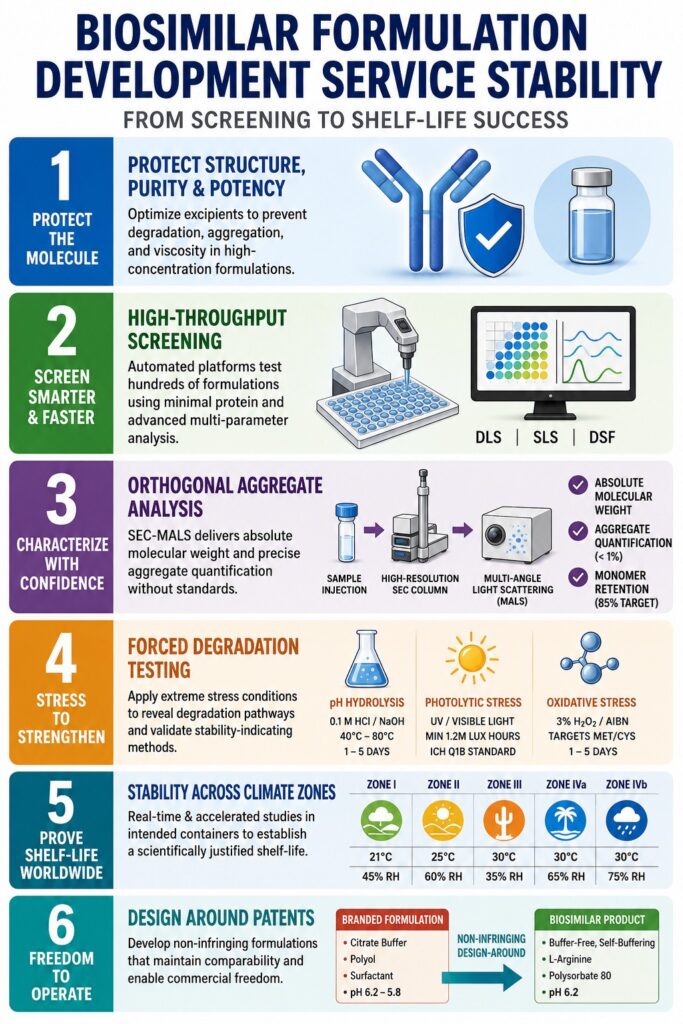
[ Sample Injection ] ---> [ High-Resolution SEC Column ] ---> [ Multi-Angle Light Scattering (MALS) ]
                                                                     |
                                                                     +---> Absolute Molecular Weight (No Standards)
                                                                     |
                                                                     +---> Precise Aggregate Quantification (< 1%)
                                                                     |
                                                                     +---> Verifies Monomer Retention (85% Target)
The analytical validation workflow effectively characterized and quantified the physical state of the antibody, demonstrating excellent chromatographic resolution:
| Fraction Resolved | SEC Retention Time (min) | Relative Proportion (%) | Structural and Biophysical Implications |
| Monomer | 12.8 min | 85% | Represents the active monomeric protein and reflects strong conformational stability. |
| Dimer / Oligomer | 11.2 min | 10% | Indicates early-stage self-association and may require formulation optimization to prevent further aggregation. |
| Higher Aggregates | 9.6 min | 5% | Represents high-molecular-weight species associated with increased immunogenicity risk. |
To ensure the highest level of accuracy in your comparability studies, explore Biosimilar Comparability Studies to meet strict regulatory benchmarks.
Forced Degradation Strategies Under Biosimilar Formulation Development Service Stability Guidelines
Forced degradation studies intentionally expose drug substances and finished products to extreme thermal, chemical, photolytic, and mechanical stress conditions to establish degradation pathways and validate stability-indicating analytical methods. These controlled studies generate critical biophysical information that helps researchers optimize formulation components and understand the molecule’s intrinsic stability profile. Unlike standard real-time stability programs, forced degradation studies deliberately accelerate degradation processes, enabling scientists to identify vulnerabilities such as oxidation-sensitive residues, aggregation liabilities, and fragmentation pathways. Although no single standalone guideline governs forced degradation studies, regulatory expectations are outlined across several International Council for Harmonisation (ICH) guidelines, including ICH Q1A(R2), ICH Q5C, and ICH Q6B.
To create a regulatory-compliant study design, formulators expose biologics to a broad spectrum of biologically relevant stress conditions. Acidic and alkaline hydrolysis studies utilize hydrochloric acid (0.1 M HCl) and sodium hydroxide (0.1 M NaOH) at elevated temperatures ranging from 40°C to 80°C to monitor deamidation and peptide backbone cleavage. Oxidative degradation pathways are investigated using hydrogen peroxide (3% H₂O₂) or radical initiators such as AIBN, which specifically target solvent-accessible methionine and tryptophan residues. Photolytic stability evaluations are conducted according to ICH Q1B requirements, exposing products to UV and visible light conditions of not less than 1.2 million lux hours to assess photo-oxidation susceptibility. Mechanical agitation studies and repeated freeze-thaw cycles (24 hours at -80°C followed by 24 hours of thawing) simulate transportation and storage stresses. The desired degradation range is typically maintained between 5% and 20%, ensuring that degradation products remain detectable and well-resolved while preserving sufficient parent monomer for analysis.
[ Forced Degradation Testing Protocol ]
                                        |
      +---------------------------------+---------------------------------+
      |                                 |                                 |
[ pH Hydrolysis ]              [ Photolytic Stress ]            [ Oxidative Stress ]
 - 0.1 M HCl / NaOH             - UV/Visible Light               - 3% H2O2 / AIBN
 - Temps: 40°C to 80°C          - Min 1.2M Lux Hours             - Targets Met/Cys Residues
 - 1 to 5 Days                  - ICH Q1B Standard               - 1 to 5 Days
To support marketing authorization applications, both real-time and accelerated stability studies must be conducted using representative manufacturing batches stored within their intended commercial container-closure systems. Testing schedules and environmental conditions must comply with global climate zone requirements to establish a scientifically justified shelf-life.
| Climate Zone | Climate Type | Representative Countries | Long-Term Testing Temp | Relative Humidity (RH) |
| Zone I | Temperate | United Kingdom, Northern Europe, United States | 21°C | 45% RH |
| Zone II | Subtropical & Mediterranean | Japan, Southern Europe | 25°C | 60% RH |
| Zone III | Hot and Dry | Iraq, India | 30°C | 35% RH |
| Zone IVa | Hot and Humid | Iran, Egypt | 30°C | 65% RH |
| Zone IVb | Hot and Very Humid | Brazil, Singapore | 30°C | 75% RH |
Understand how to stress-test your product effectively by reviewing the best practices in Forced Degradation of Biosimilars.
Overcoming Formulation Patent Thickets to Ensure Commercial Freedom to Operate
Navigating formulation-related patent landscapes requires systematic design-around strategies that avoid proprietary buffer systems, pH ranges, and excipient combinations while maintaining strict analytical comparability with the reference listed drug. Through the development of non-infringing formulations, biosimilar and generic manufacturers can establish a strong Freedom-to-Operate (FTO) position while minimizing litigation risk. Although foundational composition-of-matter patents generally expire after twenty years, branded pharmaceutical companies often construct extensive secondary patent portfolios that cover specific concentration ranges, pH windows, excipient ratios, and device-drug combinations. These layered patent strategies function as evergreening mechanisms that can extend market exclusivity well beyond the expiration of primary patents.
A notable example is AbbVie’s protection strategy for Humira (adalimumab). The original Humira formulation employed a phosphate-citrate buffer system containing sodium chloride, mannitol, and polysorbate 80. To extend exclusivity while reducing injection-site pain associated with citrate-containing formulations, AbbVie developed and patented a high-concentration (100 mg/mL), citrate-free version protected under U.S. Patent No. 9,085,619. This reformulation successfully transitioned a substantial portion of patients to the citrate-free product before biosimilar market entry, illustrating how formulation innovation can become a critical commercial strategy.
[ Branded Formulation Patent ] ---> Citrate Buffer + Polyol + Surfactant (pH 5.2 to 5.8)
                                       |
                     (Strategic Non-Infringing Design-Around)
                                       v
[ Biosimilar Product ] ---> Buffer-Free, Self-Buffering + L-Arginine + Polysorbate 80 (pH 6.2)
To navigate such patent barriers, biosimilar developers perform comprehensive claim-mapping analyses. For example, when a patent claim protects a specific class of stabilizers through a Markush structure, developers may select an alternative chemical class to avoid literal infringement. Similarly, when claims specify narrow pH or concentration ranges, formulators can strategically develop products outside those boundaries while documenting scientific justifications such as enhanced stability or demonstrated bioequivalence. Another increasingly attractive design-around strategy involves buffer-free, high-concentration formulations that exploit the protein’s inherent self-buffering capacity. By utilizing ionizable amino acid side chains within the antibody itself to maintain the desired pH range, developers can eliminate traditional buffering agents and simultaneously avoid patent restrictions and citrate-associated injection-site discomfort.
For a deep dive into the underlying post-translational changes that can influence patentability and efficacy, see Post-Translational Modifications (PTMs) in Biosimilars.
Strategic Conclusions on Biosimilar Formulation Development Service Stability
Achieving long-term biosimilar stability requires a comprehensive strategy that combines biophysical preservation, advanced screening technologies, and proactive intellectual property planning. By addressing physical degradation mechanisms, solution viscosity challenges, and regulatory expectations early in the development process, manufacturers can significantly reduce the likelihood of late-stage failures while building a robust totality-of-the-evidence package. The application of orthogonal analytical technologies, including the integration of Size Exclusion Chromatography, Multi-Angle Light Scattering, and Dynamic Light Scattering, ensures that subtle structural alterations and soluble aggregates are identified, characterized, and controlled with a high degree of precision.
To discuss how specialized analytical characterization and stability assessment workflows can strengthen and accelerate your development pipeline, please visit our Contact Us page.
Frequently Asked Questions
A biosimilar must demonstrate a high degree of similarity to its reference biologic in terms of safety, efficacy, purity, and overall quality. While the active molecule should closely match the reference product, certain differences in excipients, buffering systems, or delivery configurations may be acceptable. Regulatory agencies focus on whether any differences affect clinical performance. Ultimately, developers must provide robust analytical and clinical evidence showing that the biosimilar performs comparably to the originator product.
High-concentration monoclonal antibody formulations often face challenges related to increased viscosity and protein aggregation. As protein concentration rises, molecules interact more frequently, which can lead to self-association and instability. These effects may complicate manufacturing operations, including filtration and filling processes. Additionally, highly viscous formulations can make subcutaneous administration more difficult and potentially increase patient discomfort during injection.
L-arginine hydrochloride helps lower viscosity by reducing attractive interactions between protein molecules in solution. It acts by shielding charged regions on the protein surface and minimizing non-specific protein-protein interactions. This prevents the formation of temporary molecular networks that contribute to thick, viscous solutions. As a result, the formulation remains easier to process, store, and administer, particularly in high-concentration biologic products.
Forced degradation studies are designed to intentionally expose biologics to stressful conditions such as heat, oxidation, light, and extreme pH environments. These studies help scientists understand how a product degrades and identify potential degradation products. Regulatory authorities also expect this testing to confirm that analytical methods can accurately detect stability changes. The data generated support the reliability of shelf-life claims and overall product quality assessments.
High-throughput DLS platforms allow researchers to evaluate large numbers of formulation candidates simultaneously using automated workflows. By combining multi-well plate formats with robotic liquid handling systems, developers can rapidly assess particle size, aggregation behavior, and stability trends. These methods require only small amounts of protein, making them highly efficient during early-stage development. The approach significantly accelerates the identification of optimal excipient combinations and formulation conditions.
Citrate-free formulations have become increasingly popular because they improve patient comfort during subcutaneous administration. Citrate-containing buffers are known to cause stinging, burning, or irritation at the injection site in some patients. Removing citrate can reduce injection-related discomfort and improve treatment adherence over the long term. Additionally, citrate-free formulations may provide biosimilar manufacturers with opportunities to develop differentiated products while avoiding certain formulation-related patent constraints.
In most forced degradation studies, developers aim to achieve degradation levels ranging from approximately 5% to 20% of the original protein. This controlled level of degradation ensures that degradation products are present in sufficient quantities for reliable detection and characterization. At the same time, the parent molecule remains intact enough to allow meaningful comparisons. Maintaining this balance helps validate the sensitivity and specificity of stability-indicating analytical methods.
Advanced in silico platforms use computational modeling, machine learning, and molecular simulations to predict how proteins interact with potential excipients. These tools analyze characteristics such as surface charge distribution, hydrophobic regions, and structural stability. By identifying promising formulation components before laboratory testing begins, they reduce the number of experimental trials required. This predictive approach helps accelerate development timelines while minimizing material consumption and overall costs.
Reference:
- International Council for Harmonisation of Technical Requirements for Pharmaceuticals for Human Use. (1996). Q5C quality of biotechnological products: Stability testing of biotechnological/biological products. https://database.ich.org/sites/default/files/Q5C%20Guideline.pdf
- International Council for Harmonisation of Technical Requirements for Pharmaceuticals for Human Use. (2003). Q1F: Stability data package for registration applications in climatic zones III and IV. https://database.ich.org/sites/default/files/Q1F_Stability_Guideline_WHO_2018.pdf
- Nichols, P., Li, L., Kumar, S., Buck, P. M., Singh, S. K., Goswami, S., Balthazor, B., Conley, T. R., Sek, D., & Allen, M. J. (2015). Rational design of viscosity reducing mutants of a monoclonal antibody: Hydrophobic versus electrostatic inter-molecular interactions. mAbs, 7(1), 212–230. https://doi.org/10.4161/19420862.2014.985504
- Lella, R. K., Özdemir, H. İ., Önder, Ş., Bezawada, S., Demirkiran, A., & Ozbek, P. (2024). Effect of different buffer components on IgG4 stability. International Journal of Scientific Research and Technology, 1(3), 65–83. https://doi.org/10.5281/zenodo.13954736
Get In Touch With Us
About The Author


