
Introduction
Biosimilar nonclinical toxicity studies are no longer legally required to include in vivo animal testing following the enactment of the FDA Modernization Act 2.0. Regulatory agencies are increasingly relying on high-resolution orthogonal analytical characterization to assess product safety and comparability. Under the modern “totality-of-the-evidence” regulatory framework, advanced biophysical techniques and functional in vitro assays can demonstrate greater sensitivity than non-human animal models in identifying subtle structural, conformational, and functional differences.
Historically, biosimilar approval under Section 351(k) of the Public Health Service (PHS) Act generally involved animal toxicity studies as a preliminary safety assessment before human clinical trials. However, comparative animal toxicity models frequently lack the discriminatory power required to detect minor post-translational modification (PTM) differences. They may also produce misleading safety signals because of species-specific anti-drug antibody (ADA) responses that neutralize the administered drug.
Following the legislative reforms introduced by the FDA Modernization Act 2.0, the U.S. statutory framework has become more closely aligned with the approaches of leading global regulatory authorities, including the European Medicines Agency (EMA) and the UK Medicines and Healthcare products Regulatory Agency (MHRA). Consequently, the strategic approach to Biosimilar Nonclinical Toxicity Studies has shifted away from routine animal testing toward comprehensive biophysical profiling, higher-order structure (HOS) analysis, and mechanistic cell-based bioassays.
For a deeper understanding of the analytical approaches used to assess biosimilar safety and product quality, explore our comprehensive biosimilar characterization services.
Share via:
Quick Summary:
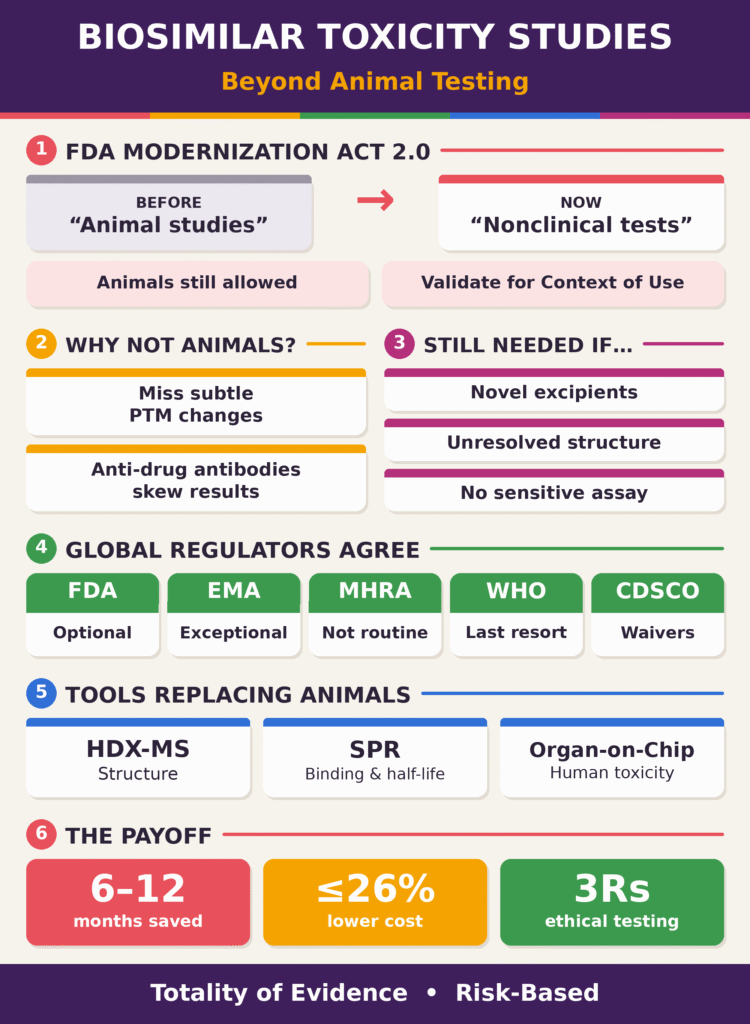
- The law changed: The FDA Modernization Act 2.0 (Section 3209, Pub. L. 117-328) replaced “animal studies” with “nonclinical tests” in Section 351(k) of the PHS Act and Section 505 of the FD&C Act. This makes non-animal methods a legal basis for biosimilar safety assessment.
- Permissive, not prohibitive: The Act does not ban animal testing, and it does not make FDA accept unvalidated alternatives. IND (21 CFR 312.23) and GLP (21 CFR Part 58) rules are unchanged, so any non-animal method must be qualified for its Context of Use.
- Animal models have real limits: Non-human primate studies often cannot detect subtle PTM differences. Species-specific anti-drug antibodies can also neutralize the drug or cause immune-complex toxicity that does not reflect human responses.
- Global regulators agree: EMA, MHRA, WHO and CDSCO now limit animal studies to exceptional cases with unresolved uncertainty. They favour orthogonal in vitro and analytical comparability in line with the 3Rs.
- Advanced tools replace animal data: HDX-MS maps higher-order structure at the peptide level. SPR measures binding to the target antigen, FcRn and Fcγ receptors, which informs potency, half-life and effector function. Organ-on-chip systems give human-relevant toxicity data.
- Residual uncertainty is handled case by case: Analytical differences are first tested with sensitive functional assays, such as ADCC assays when FcγRIIIa binding differs. Animal studies may still be needed for novel excipients, unresolved structural changes, or when no sensitive in vitro assay exists.
- Strategic payoff: Analytical-first development can shorten timelines by 6–12 months and cut preclinical costs by up to 26%, though actual savings vary by product. It also supports the 3Rs and gives more human-relevant safety evidence under a totality-of-the-evidence approach.
Statutory Impact of the FDA Modernization Act 2.0 on Biosimilar Nonclinical Toxicity Studies
The FDA Modernization Act 2.0 formally removed the statutory requirement for animal testing in biosimilar evaluation by replacing the term “animal” with the technology-neutral expression “nonclinical tests” in Section 351(k) of the Public Health Service Act and Section 505 of the Federal Food, Drug, and Cosmetic Act. Enacted as Section 3209 of the Consolidated Appropriations Act, 2023 (Pub. L. 117-328), this amendment provides a legal basis for using non-animal testing alternatives, including complex cell-based assays, microphysiological systems (MPS), organ-on-a-chip technologies, and computational in silico modeling.
Although Section 3209 expanded the range of legally acceptable evidence, the legislation is permissive rather than prohibitive. It neither prohibits animal testing nor requires the U.S. Food and Drug Administration (FDA) to automatically accept alternative platforms that have not been adequately validated. Although the overarching statute, 42 U.S.C. 262(k)(2)(A)(i)(I)(bb), was amended, the Act did not revise the FDA’s codified Investigational New Drug (IND) regulations under 21 CFR 312.23(a)(8) or modify Good Laboratory Practice (GLP) standards under 21 CFR Part 58. Therefore, sponsors conducting Biosimilar Nonclinical Toxicity Studies must demonstrate that any proposed non-animal method is scientifically qualified and appropriate for its defined Context of Use (CoU).
| Statutory and Regulatory Element | Pre-FDA Modernization Act 2.0 Framework | Post-FDA Modernization Act 2.0 Framework (Pub. L. 117-328, Sec. 3209) |
|---|---|---|
| PHS Act Sec. 351(k) Statutory Text | Explicitly required “animal studies (including the assessment of toxicity).” | Replaced with “nonclinical tests (including the assessment of toxicity).” |
| FD&C Act Sec. 505 Statutory Text | Prescribed preclinical animal studies for safety clearance. | Amended the terminology to the method-neutral expression “nonclinical tests.” |
| Accepted Nonclinical Platforms | Animal models, including rodents and non-human primates, served as the default expectation. | Cell-based assays, Microphysiological Systems (MPS), Organ-on-a-Chip technologies, in silico models, and animal models. |
| FDA Review Criteria | Animal toxicity testing was generally expected unless explicitly waived. | Non-animal platforms require appropriate method qualification and validation for their Context of Use (CoU). |
| Animal Welfare and GLP Oversight | Governed by the Animal Welfare Act (AWA), PHS Policy, and 21 CFR Part 58. | AWA, PHS Policy, IACUC oversight, and GLP requirements remain applicable. |
This legislative evolution reflects the limited predictive value of non-human primate (NHP) models for certain complex biotherapeutics, including monoclonal antibodies (mAbs), fusion proteins, and antibody-drug conjugates (ADCs). When therapeutic proteins designed for human targets are administered to animals, xenogeneic immune responses can routinely trigger high-titer anti-drug antibodies (ADAs). These antibodies may alter drug clearance, neutralize pharmacological activity, and cause immune-complex toxicities that do not accurately represent biological responses in humans.
Understanding how manufacturing processes influence product attributes is equally important when evaluating biosimilar quality and safety. Learn more about the differences between biosimilar and biologic manufacturing.
Global Regulatory Alignment Across FDA, EMA, MHRA, WHO, and CDSCO
International regulatory authorities increasingly recognize that routine in vivo animal toxicity studies may be unnecessary for biosimilar authorization when comprehensive analytical comparability and functional equivalence have been adequately established. Major public health agencies, including the European Medicines Agency (EMA), the UK Medicines and Healthcare products Regulatory Agency (MHRA), the World Health Organization (WHO), and India’s Central Drugs Standard Control Organization (CDSCO), have developed regulatory guidance that limits the need for animal testing to exceptional circumstances in which residual uncertainty remains.
The EMA helped establish this scientific approach through its revised nonclinical and clinical guideline (EMEA/CHMP/BMWP/42832/2005 Rev 1). The guideline recognizes the importance of in vitro functional bioassays, which can offer greater specificity and sensitivity than animal models for detecting relevant structural differences. The EMA also discourages repeat-dose toxicity studies in non-human primates when they do not provide meaningful additional information. Furthermore, the EMA’s reflection paper on a tailored clinical approach (EMA/CHMP/BMWP/60916/2025) reinforces the role of analytical comparability and clinical pharmacokinetic (PK) data in supporting regulatory decisions without necessarily requiring comparative animal toxicity studies or Phase III efficacy trials.
The UK MHRA has established guidance indicating that in vivo animal studies are not routinely requested for standard biosimilar submissions. Developers may therefore limit Module 4 of the Common Technical Document (CTD) to relevant GLP-compliant in vitro studies, subject to applicable regulatory requirements and the specific circumstances of the submission. This approach can also accommodate differences in regulatory expectations across jurisdictions. Similarly, the WHO revised its biosimilar evaluation guidelines (TRS 1043 Annex 3) to incorporate the 3Rs principles (Replace, Reduce, Refine), limiting in vivo animal testing to situations in which in vitro analytical characterization does not resolve important safety questions.
| Regulatory Authority | Document / Regulatory Guidance | In Vivo Animal Study Expectation | Primary Nonclinical Requirement |
|---|---|---|---|
| US FDA | 351(k) BLA Guidance and FDA Modernization Act 2.0 | Animal testing is no longer a statutory default requirement; the legislation permits alternatives. | In vitro bioassays and biophysical methods appropriately qualified for their Context of Use (CoU). |
| EMA (European Union) | Guideline Rev. 1 and Reflection Paper EMA/CHMP/BMWP/60916/2025 | Exceptional use; repeat-dose studies in non-human primates are discouraged when they provide limited value. | Orthogonal in vitro functional and kinetic comparability assessments. |
| MHRA (United Kingdom) | Guidance on Licensing Biosimilar Products | Animal studies are not routinely requested for standard biosimilar regulatory submissions. | Comprehensive analytical, biophysical, and cell-based bioassays. |
| WHO | Evaluation of Biosimilars Guidelines (TRS 1043 Annex 3) | Restricted to cases in which in vitro evidence leaves unresolved safety questions. | Comprehensive in vitro comparability package aligned with the 3Rs principles. |
| CDSCO (India) | Draft Guidelines on Similar Biologics 2025 | Animal toxicity study waivers may be granted under ten defined conditions. | In vitro characterization, with in vivo studies expected to be uncommon. |
A scientifically robust comparability strategy helps sponsors organize analytical findings and demonstrate that observed differences do not compromise product quality or function. Explore the key considerations involved in biosimilar comparability studies.
Advanced In Vitro Technologies and Biophysical Platforms Replacing Animal Testing
Advanced analytical platforms, including Hydrogen-Deuterium Exchange Mass Spectrometry (HDX-MS), Surface Plasmon Resonance (SPR), and human Microphysiological Systems (MPS), can replace certain animal testing procedures by providing sub-molecular higher-order structural mapping and physiologically relevant kinetic data. These technologies enable biosimilar developers to investigate structural integrity, binding dynamics, and cellular bioactivity without relying on animal models.
Higher-Order Structure Characterization via HDX-MS
Hydrogen-Deuterium Exchange Mass Spectrometry (HDX-MS) measures the exchange of backbone amide hydrogen atoms with deuterium from heavy water (D2O). This process provides information about sub-molecular protein dynamics, secondary and tertiary structures, and domain-level equivalence. Highly structured or solvent-shielded regions generally exchange hydrogen more slowly because of stable hydrogen bonding and restricted solvent accessibility, whereas flexible or solvent-exposed regions typically exchange more rapidly.
The exchange reaction is quenched by lowering the pH to 2.5 and the temperature to 0 °C. This is followed by online pepsin digestion and high-resolution LC-MS analysis using Data-Dependent Acquisition (DDA) or Data-Independent Acquisition (DIA). The differential uptake value (ΔD) quantifies localized conformational differences at the peptide level:
ΔD = mbiosimilar − mreference
Here, m represents the centroid mass of a deuterium-exchanged peptide. Applying statistical equivalence testing to pooled HDX-MS datasets from reference and biosimilar lots helps establish conformational comparability across functional domains, including VH, VL, CH1, CH2, and CH3.
Unlike global spectroscopic techniques, such as Circular Dichroism (CD) and Fourier-Transform Infrared Spectroscopy (FTIR), which provide averaged information about protein secondary structure, HDX-MS can identify localized structural differences with greater spatial resolution. These differences may arise from post-translational modifications (PTMs), including deamidation and altered glycosylation. This level of detail helps investigators determine whether observed structural variations affect protein stability, molecular interactions, or biological function.
Integrating complementary analytical techniques can strengthen the evidence supporting structural equivalence between a biosimilar and its reference product. Discover how native mass spectrometry for biosimilars can contribute to detailed molecular characterization.
Receptor Binding Kinetics and Effector Profiling via SPR
Real-time Surface Plasmon Resonance (SPR) bioassays quantify target antigen binding affinity and evaluate kinetic interactions with FcRn and FcγR receptors using association rate constants (ka), dissociation rate constants (kd), and equilibrium dissociation constants (KD). These measurements help assess biological potency and predict aspects of systemic drug exposure, including the potential influence of receptor interactions on human systemic half-life.
For monoclonal antibody biosimilars, SPR analysis evaluates binding kinetics across several critical targets and pathways:
- Target Antigens: Confirming comparable binding affinity (KD) and supporting the assessment of target-binding and neutralization activity relative to the reference product.
- Neonatal Fc Receptor (FcRn): Evaluating pH-dependent binding at pH 6.0 and pH 7.4 to characterize interactions involved in endosomal recycling and support predictions of human pharmacokinetic half-life without relying on animal PK studies.
- Fcγ Receptors (FcγRIa, FcγRIIa, FcγRIIIa) and C1q: Characterizing Fc-mediated effector mechanisms, including Antibody-Dependent Cellular Cytotoxicity (ADCC) and Complement-Dependent Cytotoxicity (CDC), to establish functional comparability between the biosimilar and the reference product.
These receptor-binding measurements provide quantitative information about molecular interactions that may be difficult to interpret reliably using animal models alone. When integrated with orthogonal analytical techniques and cell-based functional assays, SPR data strengthen the overall assessment of biosimilarity.
Human Microphysiological Systems and Organ-on-a-Chip Models
Microphysiological Systems (MPS) combine microfluidic perfusion with three-dimensional human cell cultures to reproduce selected aspects of tissue and organ physiology. These systems can model human-relevant toxicity mechanisms while reducing the species-translation barriers associated with conventional animal experiments.
Human organ-on-a-chip platforms, including hepatic, microvascular, and renal tissue chips, support targeted safety evaluations, drug-induced liver injury (DILI) screening, and endothelial permeability testing using human cellular architecture. By reproducing selected physiological conditions and cellular interactions, these models can provide information about biological responses that may not be accurately represented in traditional rodent and non-human primate models.
Although MPS and organ-on-a-chip technologies do not reproduce every aspect of whole-body physiology, they can contribute valuable mechanistic evidence when appropriately validated. Their integration with analytical characterization and established in vitro bioassays can help developers investigate specific safety concerns without automatically resorting to animal testing.
Mitigating Residual Uncertainty in Biosimilar Nonclinical Toxicity Studies
Residual uncertainty in Biosimilar Nonclinical Toxicity Studies can be addressed by using orthogonal functional bioassays to investigate observed structural differences and determine whether minor variations in quality attributes have potential clinical consequences. Under the regulatory totality-of-the-evidence framework, agencies assess whether the sponsor’s analytical package has sufficient sensitivity to identify differences in critical quality attributes (CQAs) and evaluate their relevance to product quality, safety, and biological activity.
Residual uncertainty may arise when physical, chemical, or structural analyses identify differences between the biosimilar candidate and the reference product. When an analytical variation is detected, the applicant must assess its potential functional implications. Examples include minor changes in high-mannose glycan abundance, C-terminal lysine heterogeneity, and localized oxidation.
For instance, if a biosimilar mAb demonstrates a slight difference in FcγRIIIa affinity, targeted in vitro ADCC assays using human natural killer (NK) cells or effector reporter cell lines can help determine whether this structural variation affects biological activity. If appropriately designed and sufficiently sensitive functional bioassays demonstrate that the difference does not meaningfully alter biological potency, the associated uncertainty may be reduced or resolved. This evidence can eliminate the need for additional animal testing when no other unresolved concerns justify it.
A systematic assessment of critical quality attributes is essential for interpreting analytical differences and determining their potential impact on biosimilarity. Read more about identifying and evaluating critical quality attributes (CQAs) in biosimilars.
Nevertheless, certain operational circumstances may lead regulatory review divisions to request additional nonclinical safety data, potentially including animal studies. These situations may include:
- Novel Excipients: The biosimilar formulation contains an excipient without an established clinical safety record for the intended route of administration. Additional GLP-compliant local tolerance or safety testing may be required, depending on the available evidence and the formulation’s characteristics.
- Unresolved Structural Alterations: Analytical characterization identifies novel impurities, uncharacterized chemical modifications, or higher-order structural disruptions that cannot be adequately assessed using available cell-based systems or other validated analytical methods.
- Absence of Sensitive In Vitro Assays: The reference product has a complex or multifactorial mechanism of action for which sufficiently sensitive, validated cell lines or microphysiological models are unavailable. In such circumstances, additional studies may be considered to address specific questions that existing methods cannot resolve.
The need for additional testing should therefore be determined by the nature of the uncertainty, the sensitivity of available methods, and the relevance of the proposed study to human safety. Animal testing is not automatically required whenever an analytical difference is identified; rather, the difference must be investigated using a scientifically justified, risk-based approach.
When potential impurities require further investigation, targeted analytical methods can help characterize their identity, abundance, and possible effects on product quality. Explore impurity profiling of biosimilars to understand how impurity assessment supports a comprehensive comparability evaluation.
Strategic Advantages: Development Efficiency, Ethics, and Economic Savings
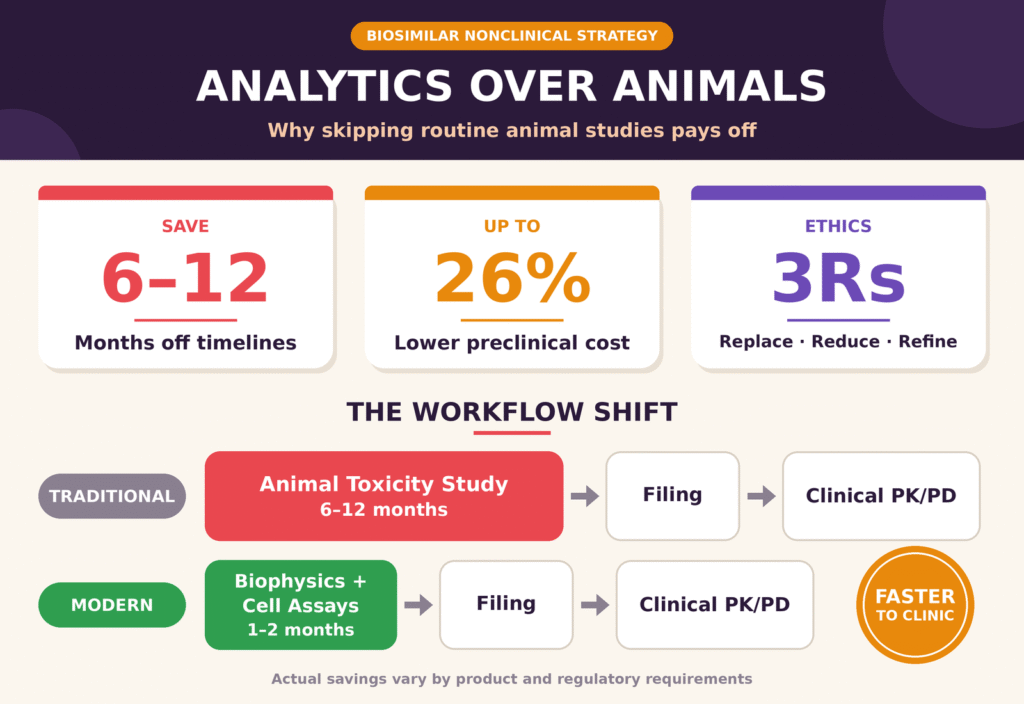
Transitioning from animal studies to advanced analytical methodologies can reduce biosimilar development timelines by 6 to 12 months, lower preclinical costs by up to 26%, and support compliance with the internationally recognized 3Rs ethical framework. Repeat-dose in vivo toxicity studies in non-human primates involve substantial financial expenditure, lengthy quarantine periods, extensive protocol preparation, and comprehensive histopathological evaluations. These requirements can increase development costs and delay the availability of important safety information.
Replacing routine animal testing with suitable analytical workflows can streamline biosimilar development through the following approaches:
- Traditional Development Workflow: Repeat-Dose Animal Toxicity Study (6–12 Months) → Regulatory Filing → Human Clinical PK/PD Studies.
- Modernized Analytical Workflow: High-Resolution Biophysics and Cell Assays (1–2 Months) → Regulatory Filing → Human Clinical PK/PD Studies.
The potential time and cost savings depend on the product’s characteristics, the complexity of the analytical package, the availability of validated alternative methods, and the applicable regulatory requirements. Therefore, the stated timelines and cost reductions should be interpreted as potential development advantages rather than universal outcomes for every biosimilar program.
From an ethical perspective, waiving unnecessary animal studies supports the 3Rs framework (Replace, Reduce, Refine), which is reflected in national animal welfare legislation and institutional animal care standards. Because therapeutic biological products are designed to interact with specific human targets, evaluating human-targeted biologics in animals can generate confounding immunogenicity profiles and other findings with limited relevance to human responses.
Replacing uninformative animal experiments with human-derived cellular models and high-resolution biophysical techniques can improve scientific translatability while reducing unnecessary animal use. This approach also allows developers to focus resources on experiments that provide meaningful information about molecular structure, functional activity, and potential safety risks.
Conclusion
The approach to Biosimilar Nonclinical Toxicity Studies has undergone a fundamental transformation, moving from routine empirical animal testing toward high-resolution biophysical and cellular characterization. Legislative developments, particularly the FDA Modernization Act 2.0, together with evolving guidance from the EMA, MHRA, and WHO, support the use of orthogonal structural analysis, functional binding kinetics, and cell-based bioactivity assays to evaluate biosimilarity and product safety. However, the need for additional nonclinical studies remains dependent on the specific product, the quality of the available evidence, and any unresolved safety concerns.
By incorporating advanced mass spectrometry platforms such as HDX-MS and kinetic interaction techniques such as SPR, biosimilar developers can investigate structural variations at the sub-molecular level. These biophysical methodologies can help resolve residual uncertainty more efficiently and provide more directly relevant mechanistic information than animal models in appropriate contexts. Biosimilar sponsors that implement comprehensive analytical fingerprinting early in development can improve regulatory preparedness, reduce preclinical expenditures, and potentially accelerate patient access to high-quality biotherapeutics.
ResolveMass Laboratories Inc. supports biopharmaceutical developers by providing validated, high-resolution biophysical characterization packages designed to address modern global regulatory expectations. Its analytical capabilities can help sponsors evaluate critical quality attributes, investigate higher-order structural differences, and develop scientifically justified comparability strategies for biosimilar programs.
For support with analytical characterization, structural assessment, and regulatory-ready comparability data, explore our end-to-end biosimilar analytical package for regulatory submissions.
For expert consultation on orthogonal analytical characterization, higher-order structure mapping, mass spectrometry bioanalysis, and customized regulatory strategies for biosimilar nonclinical testing, connect with our scientific team through the ResolveMass Laboratories Contact Page.
Frequently Asked Questions
Under Section 3209 of the Act, nonclinical testing can include in vitro, in silico, and in chemico methods, such as cell-based assays, microphysiological systems (MPS), organ-on-a-chip platforms, and computer simulations. The selected method must be scientifically suitable for its intended Context of Use and provide reliable evidence to address the relevant nonclinical safety questions.
Hydrogen-Deuterium Exchange Mass Spectrometry (HDX-MS) examines higher-order structure and protein conformational dynamics by measuring deuterium exchange along the protein backbone. Its peptide-level resolution helps identify localized structural differences across protein domains, providing detailed evidence for comparative characterization and determining whether observed variations require further safety assessment.
Yes, the FDA can license a biosimilar under Section 351(k) without animal toxicity data when the submitted evidence adequately establishes biosimilarity and addresses relevant safety concerns. A comprehensive assessment may include analytical characterization, functional bioassays, and clinical pharmacokinetic/pharmacodynamic (PK/PD) data, depending on the product and any remaining uncertainties.
Monoclonal antibodies frequently recognize human-specific epitopes that may differ from their counterparts in laboratory animals, limiting the relevance of animal models. Additionally, humanized therapeutic proteins can trigger anti-drug antibody (ADA) responses in animals, potentially altering drug clearance, neutralizing biological activity, and producing immune-complex effects that do not accurately predict human responses.
The EMA’s biosimilar guideline, EMEA/CHMP/BMWP/42832/2005 Rev 1, and its reflection paper, EMA/CHMP/BMWP/60916/2025, address nonclinical evaluation and the use of tailored development approaches. These documents emphasize analytical and functional comparability, while discouraging animal studies that provide limited additional information, including repeat-dose toxicity studies in non-human primates where appropriate.
Surface Plasmon Resonance (SPR) measures real-time molecular binding kinetics, including association (ka), dissociation (kd), and equilibrium dissociation (KD) constants. Assessing interactions with target receptors, Fcγ receptors, and FcRn helps establish binding comparability and characterize Fc-mediated functions, while pH-dependent FcRn binding provides insights into endosomal recycling and potential effects on serum half-life.
When a biosimilar contains an excipient without an established safety record for the intended route of administration, regulatory authorities may request additional evidence to assess its safety. Depending on the available information and potential risks, this may include targeted GLP-compliant toxicity or local tolerance studies focused on the excipient and the formulation.
No, the FDA Modernization Act 2.0 amended statutory provisions in the FD&C Act and the PHS Act but did not automatically revise existing IND regulations, including 21 CFR 312.23(a)(8). The amended statute permits the use of qualified non-animal approaches, but sponsors must still comply with applicable regulatory requirements and provide scientifically adequate evidence to support their proposed testing strategy.
Microphysiological Systems (MPS), including organ-on-a-chip technologies, combine human cell cultures with controlled microfluidic environments to reproduce selected features of tissue and organ function. These platforms can support investigations of tissue-specific toxicity, drug permeability, and organ-level responses, providing human-relevant mechanistic evidence that complements conventional analytical methods and may reduce dependence on animal testing.
Reference:
- Lim, S. (n.d.). Overview of the regulatory framework and FDA’s guidance for the development and approval of biosimilar and interchangeable products in the US. U.S. Food and Drug Administration. https://www.fda.gov/files/drugs/published/Overview-of-the-Regulatory-Framework-and-FDA%27s-Guidance-for-the-Developmet-and-Approval-of-Biosmiliar-and-Interchangeable-Products-in-the-US.pdf
- European Medicines Agency. (2014). Guideline on similar biological medicinal products containing biotechnology-derived proteins as active substance: Non-clinical and clinical issues (Revision 1). https://www.ema.europa.eu/en/documents/scientific-guideline/guideline-similar-biological-medicinal-products-containing-biotechnology-derived-proteins-active-substance-non-clinical-and-clinical-issues-revision-1_en.pdf
- U.S. Food and Drug Administration. (n.d.). FDA’s overview of the regulatory guidance for the development and approval of biosimilar products in the US. https://www.fda.gov/files/drugs/published/FDA%E2%80%99s-Overview-of-the-Regulatory-Guidance-for-the-Development-and-Approval-of-Biosimilar-Products-in-the-US.pdf
- Chapman, K., Adjei, A., Baldrick, P., da Silva, A., De Smet, K., DiCicco, R., Hong, S. S., Jones, D., Leach, M. W., McBlane, J., Ragan, I., Reddy, P., Stewart, D. I. H., Suitters, A., & Sims, J. (2016). Waiving in vivo studies for monoclonal antibody biosimilar development: National and global challenges. mAbs, 8(3), 427–435. https://doi.org/10.1080/19420862.2016.1145331
- Pipalava, P., Patel, R., Mehta, M., Dahiya, M., Singh, I., & Jose, V. (2019). An update on the animal studies conducted for biosimilar approvals: Regulatory requirement vs actual scenario. Regulatory Toxicology and Pharmacology, 107, Article 104415. https://doi.org/10.1016/j.yrtph.2019.104415
- U.S. Food and Drug Administration. (n.d.). Industry information and guidance. https://www.fda.gov/drugs/biosimilars/industry-information-and-guidance
Get In Touch With Us
About The Author