

Introduction:
Understanding biosimilar vs biologic is important for pharmaceutical companies developing follow-on biological products, researchers evaluating biologic comparability, and healthcare professionals explaining treatment options. Although a biosimilar is a type of biologic, it is not simply another name for an originator biologic. A biosimilar is specifically developed to demonstrate a high degree of similarity to an already-approved biological reference product, with no clinically meaningful differences in the relevant safety, purity, potency, or effectiveness attributes.
Unlike many conventional small-molecule drugs, biologics are generally large, structurally complex molecules produced using living systems. Their characteristics can be influenced by the cell line, manufacturing process, raw materials, purification conditions, formulation, and storage. Consequently, biological medicines cannot generally be copied in exactly the same way as chemically synthesized small molecules — a point explored further in the difference between biosimilar and biologic manufacturing.
This distinction makes analytical characterization, comparability assessment, and process understanding fundamental components of biosimilar development.
Summary:
- Biosimilar vs Biologic: a biosimilar is itself a biologic medicine, but it is developed to be highly similar to an already-approved biologic called the reference product.
- Biologics are complex medicines produced from biological sources such as living cells, microorganisms, or other biological materials.
- Biosimilars are not exact copies of their reference biologics, because biological manufacturing naturally introduces some variability.
- Regulatory agencies such as the FDA, EMA, and WHO require extensive analytical evidence — and, where appropriate, nonclinical and clinical evidence — to establish biosimilarity.
- Biosimilar development relies heavily on comparative analytical characterization, including physicochemical, structural, biological activity, purity, impurity, and immunogenicity-related assessments.
- A biosimilar must demonstrate no clinically meaningful differences from its reference product in relevant aspects of safety and effectiveness.
- An interchangeable biosimilar is a specific FDA regulatory designation with additional requirements — not every biosimilar is automatically interchangeable.
- For pharmaceutical developers, robust analytical characterization is central to establishing biosimilarity and supporting regulatory submissions.
1: What Is a Biologic?
A biologic is a medicinal product whose active substance is derived from a biological source or produced using biological systems, and it spans everything from relatively simple recombinant proteins to highly complex monoclonal antibodies.
Examples of biological medicines include:
- Insulin and insulin analogues
- Growth hormones
- Monoclonal antibodies
- Recombinant therapeutic proteins
- Blood and plasma-derived products
- Certain vaccines
- Immune-modulating biological products
- Certain advanced therapy products
Biologics are typically more structurally complex than traditional small-molecule medicines. Their properties can include higher-order structure, post-translational modifications, aggregation profiles, charge variants, glycosylation patterns, and biological activity.
Why Are Biologics Complex?
Biologic complexity comes partly from the manufacturing process itself — a biologic may be produced by genetically engineered microorganisms or mammalian cells, followed by multiple purification and formulation steps.
Important characteristics can include:
- Primary amino acid sequence
- Higher-order structure
- Disulfide-bond arrangement
- Glycosylation
- Charge heterogeneity
- Size variants and aggregates
- Process-related impurities
- Product-related impurities
- Biological potency
- Immunogenicity-related characteristics
Because these attributes can affect product quality and clinical performance, biological products require extensive characterization and process control.
2: What Is a Biosimilar?
A biosimilar is a biological medicine that is highly similar to an already-approved biological reference product and has no clinically meaningful differences from that reference product in the relevant aspects of safety and effectiveness.
The key point is that a biosimilar is a biologic — the term “biosimilar” simply describes its relationship to an existing reference biologic.
FDA defines a biosimilar as a biological product that is highly similar to the reference product, notwithstanding minor differences in clinically inactive components, and for which there are no clinically meaningful differences in safety, purity, and potency. EMA similarly describes biosimilars as biological medicines highly similar to an already-authorized reference medicine, with comparable structure, biological activity, efficacy, safety, and immunogenicity profiles.
Why Isn’t a Biosimilar Identical to Its Reference Biologic?
A biosimilar is not expected to be molecularly identical to its reference biologic, because biologics are produced using complex biological systems where even the same product can exhibit some natural variability between manufacturing batches.
FDA therefore does not require an exact molecular copy; instead, the regulatory standard focuses on demonstrating high similarity and ruling out clinically meaningful differences. This is also why manufacturing approach is one of the clearest points of contrast between an originator biologic and a biosimilar — see the difference between biosimilar and biologic manufacturing for a closer look at how process design decisions shape the final comparability case.
3: Biosimilar vs Biologic: Key Differences at a Glance
The simplest way to understand biosimilar vs biologic is to remember that a biosimilar is a type of biologic, while “reference biologic” identifies the previously approved biological product against which the biosimilar is compared.
| Feature | Reference Biologic | Biosimilar |
|---|---|---|
| What is it? | An approved biological medicine | A biological medicine developed to be highly similar to a reference product |
| Manufacturing | Biological/biotechnological process | Biological/biotechnological process |
| Relationship | Original/reference product | Compared directly with the reference product |
| Molecular identity | Complex biological molecule | Highly similar, but not necessarily identical |
| Development basis | Independent demonstration of quality, safety, and efficacy | Demonstration of biosimilarity using comparative evidence |
| Analytical characterization | Extensive | Extensive head-to-head comparison with reference |
| Clinical development | Full development program appropriate to the product | Stepwise biosimilar development strategy |
| Regulatory pathway | Full biologic application pathway, depending on jurisdiction | Specific biosimilar pathway where available (e.g., 351(k) in the US) |
| Interchangeability | Not applicable as a biosimilar designation | May receive an additional interchangeable designation in some jurisdictions |
| Purpose | Establish an original biological medicine | Provide a highly similar alternative to the reference product |
FDA states that biosimilar development is based on demonstrating biosimilarity rather than independently re-establishing the complete safety and effectiveness profile from the beginning. This creates an abbreviated development pathway while maintaining rigorous regulatory requirements.
4: Biosimilar vs Biologic: How Does Development Differ?
The biggest difference in development is the regulatory objective: an original biologic sponsor must establish the product’s quality, safety, and effectiveness independently, while a biosimilar developer begins with an already-established reference product and performs a structured comparability exercise.
WHO describes biosimilar development as a stepwise process in which demonstrated similarity allows some reliance on information already established for the licensed reference product.
A typical biosimilar development sequence includes:
- Reference product characterization
- Extensive analytical characterization of the proposed biosimilar
- Head-to-head analytical comparison
- Assessment of biological activity
- Evaluation of impurities and product-related variants
- Nonclinical assessment where appropriate
- Pharmacokinetic/pharmacodynamic studies where appropriate
- Clinical immunogenicity and other clinical assessments as required
- Integrated assessment of the totality of evidence
- Regulatory submission and review
The precise requirements depend on the product, jurisdiction, available analytical technologies, residual uncertainties, and regulatory pathway. Sponsors preparing for this sequence often rely on a dedicated biosimilar comparability study design and CRO support service to structure the program from reference-product sourcing through the final data package.
5: Why Analytical Characterization Is Critical for Biosimilars
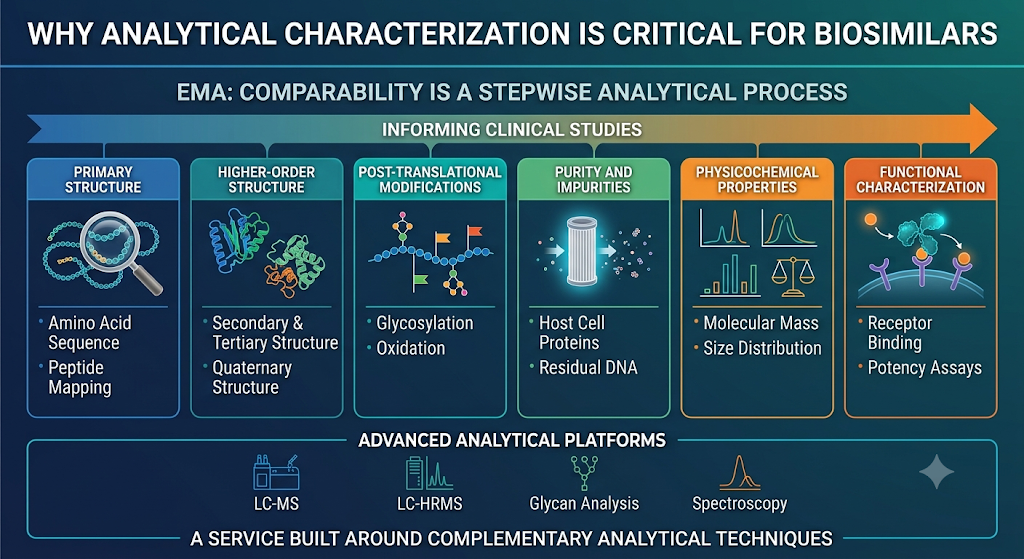
Analytical characterization is one of the most important components of biosimilar development because the developer must build a detailed, evidence-based understanding of the proposed biosimilar relative to its reference product.
EMA specifically describes biosimilar comparability as a comprehensive, stepwise process, with analytical studies informing the extent of subsequent nonclinical and clinical studies.
Important analytical characterization areas include:
Primary structure
- Amino acid sequence
- Sequence coverage
- Peptide mapping
- Disulfide bonds
Higher-order structure
- Secondary structure
- Tertiary structure
- Quaternary structure
- Conformational characteristics
Post-translational modifications
- Glycosylation
- Oxidation
- Deamidation
- Other modifications
Purity and impurities
- Aggregates
- Fragments
- Host-cell proteins
- Residual DNA
- Process-related impurities
- Product-related variants
Physicochemical properties
- Molecular mass
- Charge variants
- Hydrophobicity
- Size distribution
Functional characterization
- Receptor binding
- Enzymatic activity
- Cell-based potency
- Other mechanism-relevant biological assays
Advanced analytical platforms such as LC-MS, LC-HRMS, peptide mapping, intact mass analysis, glycan analysis, chromatography, electrophoretic techniques, spectroscopy, and bioassays can all contribute to this characterization strategy. A full-scope biosimilar analytical characterization service is typically built around exactly this set of orthogonal techniques rather than any single assay.
Primary Sequence, Peptide Mapping, and Sequence Variants
Primary structure confirmation is usually the starting point of a comparability exercise, established through peptide mapping and LC-MS/MS sequence coverage of both the biosimilar and the reference product. A dedicated peptide mapping service for biosimilars is generally used to confirm sequence identity, disulfide connectivity, and modification sites at this stage.
For peptide-based biosimilars in particular, primary structure work also needs to rule out low-level sequence errors introduced during synthesis or expression. These issues are addressed through targeted sequence variant and misincorporation analysis for peptide biosimilars, which can detect amino acid substitutions or misincorporations that peptide mapping alone might not fully resolve.
Host Cell Proteins and Process-Related Impurities
Host cell proteins (HCPs) are one of the most closely scrutinized impurity categories in a biosimilar submission, since residual HCPs can carry immunogenicity risk even at trace levels. Host cell protein analysis for biosimilars, typically performed by ELISA and orthogonal LC-MS/MS methods, is used to confirm that HCP levels and identity in the biosimilar are adequately controlled relative to the reference product and process capability.
6: What Is the Role of Comparability in Biosimilar Development?
Comparability determines whether the proposed biosimilar is sufficiently similar to its reference product and helps identify residual uncertainties that may require additional investigation.
A robust comparability program should not focus on only one analytical measurement — it should evaluate multiple critical quality attributes using orthogonal analytical methods. For example, a therapeutic protein may require characterization across the following attributes:
| Attribute | Example Analytical Approach |
|---|---|
| Primary sequence | Peptide mapping, LC-MS/MS |
| Intact molecular mass | LC-MS/HRMS |
| Disulfide bonds | Peptide mapping with targeted workflows |
| Glycosylation | Glycan profiling, LC-MS |
| Aggregation | SEC-based methods |
| Charge variants | Ion-exchange chromatography |
| Hydrophobic variants | HIC or related chromatographic approaches |
| Higher-order structure | Spectroscopic techniques |
| Potency | Cell-based or biochemical assay |
| Process impurities | ELISA, LC-MS/MS, or other validated methods |
The objective is not simply to generate a large analytical dataset — the data must be scientifically interpreted in the context of the molecule’s structure, function, manufacturing process, and potential clinical relevance. Sponsors assembling this evidence for a submission often consolidate it through an end-to-end biosimilar analytical package for a regulatory submission rather than piecing together individual study reports.
7: Is a Biosimilar the Same as a Generic Drug?
No. A biosimilar and a generic drug are not the same, although both can provide alternatives to previously approved products.
Generic drugs generally contain the same active ingredient as their small-molecule reference drug and are commonly evaluated through pharmaceutical equivalence and bioequivalence approaches. Biosimilars, in contrast, involve complex biological molecules for which an exact copy is generally not feasible — a distinction WHO also draws explicitly between conventional generic medicines and biosimilar development.
| Characteristic | Generic Drug | Biosimilar |
|---|---|---|
| Typical molecule | Small molecule | Biological molecule |
| Manufacturing | Chemical synthesis commonly used | Biological/biotechnological production |
| Copy relationship | Generally chemically identical active ingredient | Highly similar biological product |
| Key comparison | Pharmaceutical equivalence/bioequivalence | Extensive analytical and functional similarity |
| Molecular complexity | Usually lower | Often high |
| Natural variability | Generally limited | Inherent biological variability |
| Development approach | Generic drug pathway | Biosimilar pathway |
A biosimilar, in short, should not be treated as simply the biological equivalent of a generic drug.
8: What Does “Interchangeable Biosimilar” Mean?
An interchangeable biosimilar is a biosimilar that has met additional FDA requirements for interchangeability — and it’s an important distinction, because not every biosimilar automatically receives that designation.
For an interchangeable product, FDA requires additional information supporting the expectation that the product can produce the same clinical result as the reference product in any given patient; for certain products, switching-related information is also evaluated. Importantly, interchangeability does not mean that an interchangeable biosimilar is inherently safer or more effective than a non-interchangeable one — both must meet the applicable FDA standards for biosimilarity. This distinction is covered in more depth in the difference between biosimilarity and interchangeability.
9: What Are the Benefits of Biosimilars?
Biosimilars can expand treatment options and potentially improve access to biological therapies.
Potential benefits include:
- Greater competition in the biologic medicines market
- Potential reductions in treatment costs
- Additional treatment options
- Greater patient access to biological therapies
- Continued innovation in biologic development
- More efficient use of healthcare resources
FDA notes that biosimilars may help increase patient access to biologic medications. However, the actual economic impact varies according to healthcare systems, reimbursement policies, competition, manufacturing costs, market dynamics, and individual products.
10: What Are the Main Challenges in Biosimilar Development?
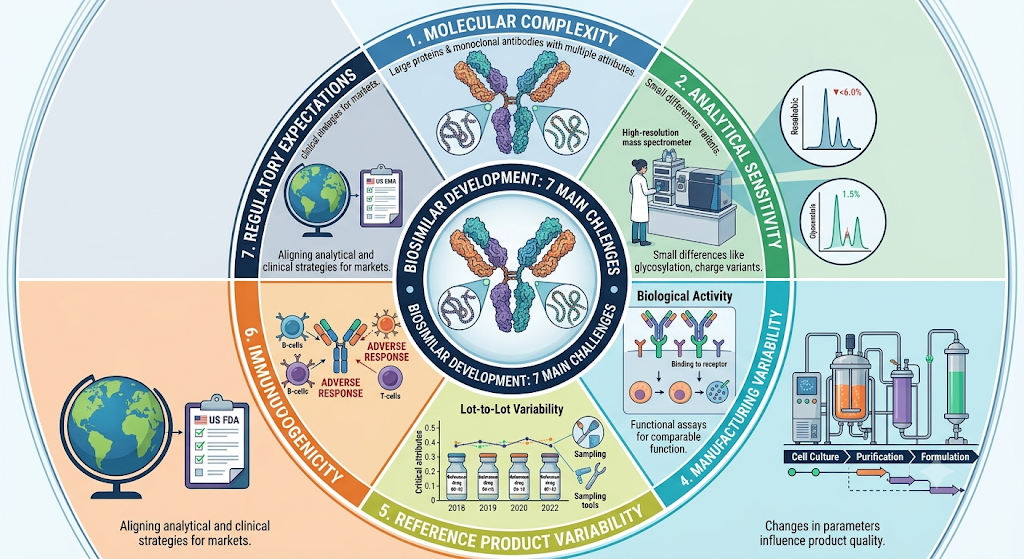
Biosimilar development presents significant scientific and analytical challenges because biological molecules are inherently complex.
- Molecular complexity — Large proteins and monoclonal antibodies can have multiple structural and chemical attributes that need to be evaluated.
- Analytical sensitivity — Small differences in glycosylation, charge variants, aggregation, oxidation, or other attributes may require highly sensitive analytical methods.
- Biological activity — Structural similarity alone is not sufficient; developers must confirm that relevant functional characteristics are comparable.
- Manufacturing variability — Changes in cell culture, purification, formulation, or other manufacturing parameters can influence product quality.
- Reference product variability — Reference biologics themselves can exhibit lot-to-lot variability, making scientifically appropriate reference-product sampling and characterization important.
- Immunogenicity — Differences in product attributes can potentially affect immune responses, making immunogenicity an important consideration.
- Regulatory expectations — Requirements differ among jurisdictions, so developers must align analytical and clinical strategies with the intended regulatory markets.
11: How Can a CRO Support Biosimilar Development?
A specialized analytical CRO can support biosimilar programs by providing independent characterization, comparative testing, method development, validation, and scientifically documented reports.
For organizations developing complex biological products, a well-designed analytical strategy helps connect molecular characterization → critical quality attributes → functional performance → regulatory evidence.
At ResolveMass Laboratories Inc., analytical capabilities relevant to complex biologic and biosimilar programs include advanced mass spectrometry and structural characterization approaches designed to generate high-quality analytical evidence.
Potential areas of support include:
- Peptide mapping
- LC-MS/MS characterization
- High-resolution mass spectrometry
- Intact mass analysis
- Protein characterization
- Glycopeptide and glycan characterization
- Disulfide-bond mapping
- Impurity profiling
- Comparative analytical studies
- Structural characterization
- Method development and optimization
- Regulatory-supporting analytical documentation
The appropriate testing strategy should always be customized according to the molecule, dosage form, critical quality attributes, reference product, development stage, and applicable regulatory requirements — which is exactly what a structured biosimilar comparability study design and CRO support service is meant to scope out from the start.
12: FDA, EMA, and WHO Perspectives on Biosimilars
The fundamental scientific principle is broadly consistent across major regulatory frameworks: a biosimilar must demonstrate a high degree of similarity to a suitable reference biological product and must not have clinically meaningful differences in relevant safety and effectiveness characteristics.
- FDA defines biosimilarity using high similarity and the absence of clinically meaningful differences in safety, purity, and potency.
- EMA uses a comprehensive, stepwise comparability approach focused on similarity in quality, biological activity, efficacy, safety, and immunogenicity.
- WHO provides internationally applicable principles for licensing biosimilars and emphasizes a stepwise approach supported by comprehensive comparison with an appropriately licensed reference product.
Because national requirements can differ, sponsors should always consult the current guidance applicable to their intended market.
Conclusion:
The most important point in biosimilar vs biologic is that a biosimilar is itself a biologic medicine — but one specifically developed to demonstrate high similarity to an already-approved reference biologic. Unlike conventional generic drugs, biosimilars cannot generally be exact molecular copies, because biological products are complex and naturally variable.
Successful biosimilar development therefore depends on a science-driven, stepwise comparison incorporating extensive analytical characterization, functional assessment, and appropriate nonclinical and clinical evidence. FDA, EMA, and WHO frameworks all place substantial emphasis on demonstrating similarity and addressing any residual uncertainty through a totality-of-evidence approach. For pharmaceutical developers, analytical characterization is consequently more than a testing exercise — it is a central part of establishing biosimilarity and building a defensible regulatory package.
Frequently Asked Questions:
Yes, a biosimilar is a type of biological medicine.
It is developed specifically to closely match an already approved reference biologic.
Biosimilars can contain complex proteins such as monoclonal antibodies or recombinant therapeutic proteins.
They undergo extensive analytical and, where required, clinical evaluation.
The term “biosimilar” primarily describes its regulatory and developmental relationship to the reference product.
Approved biosimilars are required to demonstrate that they have no clinically meaningful differences from their reference products.
Regulatory agencies evaluate evidence related to quality, biological activity, safety, and effectiveness.
The assessment is based on the totality of available evidence rather than one individual test.
Analytical characterization is an important part of establishing similarity.
Once approved, biosimilars are considered appropriate alternatives within their authorized indications.
A biosimilar is not automatically safer than its reference biologic.
Both products must meet applicable regulatory standards for quality, safety, and effectiveness.
Biosimilar development specifically evaluates whether meaningful differences exist between the products.
Analytical, functional, and clinical evidence may contribute to this assessment.
The appropriate product choice should ultimately follow its approved labeling and applicable clinical guidance.
Generic drugs generally contain the same active ingredient as their reference small-molecule medicines.
Biosimilars are biological products that are highly similar to their reference biologics.
Biological molecules are much more structurally complex than most conventional small-molecule drugs.
Consequently, biosimilar development relies heavily on comparative analytical and functional characterization.
A biosimilar should therefore not simply be considered the “generic version” of a biologic.
Biosimilarity means that a proposed biological product has been demonstrated to be highly similar to its reference product.
Minor differences may exist, particularly in complex biological attributes.
However, these differences should not result in clinically meaningful differences in relevant safety or effectiveness.
Biosimilarity is established through a structured comparison using analytical and other appropriate evidence.
Regulatory agencies assess the overall evidence before granting approval.
Reference
- Mysler E, Pineda C, Horiuchi T, Singh E, Mahgoub E, Coindreau J, Jacobs I. Clinical and regulatory perspectives on biosimilar therapies and intended copies of biologics in rheumatology. Rheumatology international. 2016 May;36(5):613-25.https://link.springer.com/article/10.1007/s00296-016-3444-0
- De Mora F. Biosimilar: what it is not. British Journal of Clinical Pharmacology. 2015 Nov;80(5):949-56.https://bpspubs.onlinelibrary.wiley.com/doi/abs/10.1111/bcp.12656
- Blandizzi C, Meroni PL, Lapadula G. Comparing originator biologics and biosimilars: a review of the relevant issues. Clinical therapeutics. 2017 May 1;39(5):1026-39.https://www.sciencedirect.com/science/article/pii/S0149291817301960
- Sekhon BS, Saluja V. Biosimilars: an overview. Biosimilars. 2011 Mar 15:1-1.https://www.tandfonline.com/doi/abs/10.2147/BS.S16120
- Patel PK, King CR, Feldman SR. Biologics and biosimilars. Journal of Dermatological Treatment. 2015 Jul 4;26(4):299-302.https://www.tandfonline.com/doi/abs/10.3109/09546634.2015.1054782
About the Author


