

Summary:
- Buprenorphine PLGA Depot Characterization is essential for ensuring consistent release performance, stability, and regulatory compliance in long-acting injectable formulations.
- High drug loading in PLGA depots introduces challenges such as burst release, polymer-drug incompatibility, residual solvent retention, and particle heterogeneity.
- Advanced analytical tools including LC-MS, GPC, DSC, SEM, particle sizing, and in vitro release testing are critical for complete characterization.
- Regulatory agencies increasingly expect orthogonal analytical characterization and stability-indicating methods for depot formulations.
- Proper characterization directly impacts product safety, bioavailability, shelf life, and in vivo performance.
- ResolveMass Laboratories Inc. supports pharmaceutical developers with advanced analytical solutions for complex PLGA-based injectable systems.
1: Introduction:
Buprenorphine PLGA Depot Characterization is critical for the development of long-acting injectable formulations intended for opioid dependence treatment and chronic pain management. High drug-load PLGA depot systems present substantial analytical and formulation challenges due to complex drug-polymer interactions, altered release kinetics, residual solvent concerns, and stability risks.
As pharmaceutical companies increasingly develop long-acting injectable depots with higher API loading to reduce injection frequency and improve patient compliance, comprehensive analytical characterization becomes essential for ensuring product quality, safety, efficacy, and regulatory compliance.
This article discusses the multi-technique analytical strategies commonly used for the characterization of high drug-load buprenorphine PLGA depots and highlights critical regulatory considerations for ANDA submissions.
2. Analytical Strategy Overview (Multi-Technique Approach)
A comprehensive analytical characterization program for buprenorphine PLGA depots requires multiple orthogonal analytical techniques to fully evaluate:
- Drug loading and encapsulation efficiency
- Polymer integrity and degradation
- Particle morphology
- Residual solvents
- Impurity profiles
- Release kinetics
- Structural confirmation
- Comparative sameness between test and reference products
Because no single analytical technique can fully characterize a complex biodegradable depot system, developers typically implement a combined workflow involving:
| Analytical Technique | Purpose |
|---|---|
| HRMS/MS | Structural confirmation and impurity analysis |
| LC-MS Peptide Mapping | Comparative fingerprinting |
| Intact Mass Analysis | Molecular integrity assessment |
| NMR Spectroscopy | Orthogonal structural confirmation |
| GPC/SEC | Polymer molecular weight analysis |
| SEM Imaging | Particle morphology characterization |
| GC-MS | Residual solvent analysis |
| In Vitro Release Testing | Drug release evaluation |
This orthogonal analytical strategy improves regulatory confidence and supports product sameness assessment.
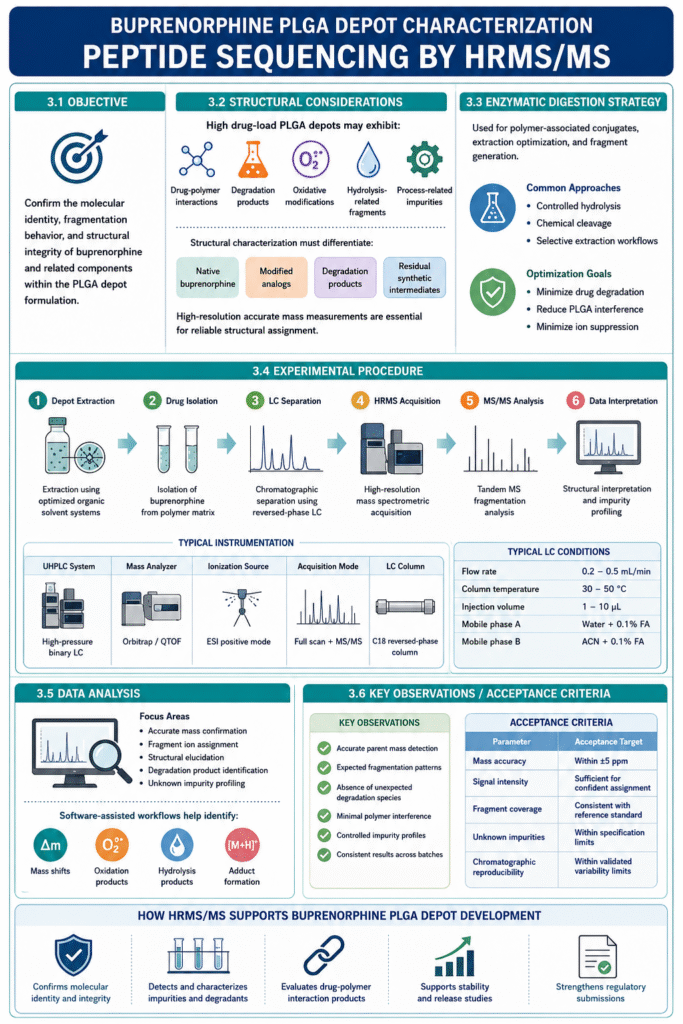
3. Peptide Sequencing by HRMS/MS
3.1 Objective
The objective of peptide sequencing by high-resolution tandem mass spectrometry (HRMS/MS) is to confirm the molecular identity, structural integrity, and fragmentation behavior of buprenorphine and associated formulation-related species present within the PLGA depot matrix. In high drug-load long-acting injectable systems, HRMS/MS plays a critical role in detecting degradation products, process-related impurities, and potential drug-polymer interaction products that may impact formulation stability and therapeutic performance.
Because PLGA depot formulations represent highly complex analytical matrices, accurate structural confirmation is essential for ensuring product quality, batch consistency, and regulatory compliance throughout product development and commercialization.
3.2 Structural Considerations
High drug-load buprenorphine PLGA depots may undergo multiple chemical and physical changes during formulation manufacturing, storage, and in vitro release testing. These systems can exhibit several structurally relevant species that require careful analytical differentiation.
Potential structural variations commonly observed include:
- Drug-polymer interactions
- Oxidative degradation products
- Hydrolysis-related fragments
- Residual synthetic intermediates
- Process-related impurities
- Adduct formation
- Solvent-associated modifications
Structural characterization must therefore distinguish between:
| Structural Component | Analytical Importance |
|---|---|
| Native buprenorphine | Identity confirmation |
| Oxidized analogs | Stability assessment |
| Hydrolysis products | Degradation monitoring |
| PLGA-associated species | Matrix interaction evaluation |
| Residual intermediates | Process impurity control |
The presence of PLGA degradation products can complicate spectral interpretation because polymer-derived oligomers may generate overlapping signals or contribute to ion suppression during electrospray ionization.
High-resolution accurate mass analysis is therefore necessary to:
- Differentiate closely related molecular species
- Confirm elemental composition
- Resolve low-level degradation products
- Improve confidence in impurity identification
Advanced HRMS instruments such as Orbitrap and QTOF systems provide the mass accuracy and resolving power required for reliable structural assignment in complex depot formulations.
3.3 Enzymatic Digestion Strategy
Although buprenorphine is not classified as a peptide therapeutic, selective cleavage or extraction strategies may still be implemented to improve analytical characterization of formulation-associated species.
In PLGA depot systems, digestion or controlled cleavage workflows may support:
- Fragment generation for structural confirmation
- Polymer-associated conjugate analysis
- Improved analyte extraction efficiency
- Reduction of polymer interference
- Enhanced LC-MS sensitivity
Common analytical preparation strategies include:
Controlled Hydrolysis
Controlled hydrolysis conditions may be used to partially degrade the PLGA matrix while preserving buprenorphine integrity. This approach improves analyte accessibility and reduces polymer-associated signal suppression.
Chemical Cleavage
Chemical cleavage workflows may assist in:
- Breaking down polymer-associated complexes
- Generating smaller structurally informative fragments
- Simplifying chromatographic profiles
Selective Extraction Workflows
Optimized solvent extraction procedures are designed to selectively recover buprenorphine while minimizing co-extraction of polymer degradation products and excipient-related interferences.
Sample preparation parameters are carefully optimized to minimize:
| Analytical Challenge | Mitigation Strategy |
|---|---|
| Drug degradation | Controlled temperature and pH |
| PLGA interference | Selective extraction solvents |
| Ion suppression | Sample cleanup and dilution |
| Oxidation artifacts | Inert atmosphere handling |
Proper sample preparation is one of the most critical factors influencing HRMS/MS data quality in depot characterization studies.
3.4 Experimental Procedure
A typical HRMS/MS characterization workflow for buprenorphine PLGA depots involves several carefully controlled analytical steps.
Typical Workflow
- Depot sample collection and homogenization
- Extraction using optimized organic solvent systems
- Separation of buprenorphine from polymer matrix components
- Chromatographic separation using reversed-phase UHPLC
- High-resolution mass spectrometric acquisition
- Tandem MS fragmentation analysis
- Structural interpretation and impurity profiling
Reverse-phase liquid chromatography is commonly employed because it provides strong retention and separation of hydrophobic analytes and related degradants.
Typical Instrumentation
| Instrument Component | Example |
|---|---|
| UHPLC System | High-pressure binary LC |
| Mass Analyzer | Orbitrap or QTOF |
| Ionization Source | ESI positive mode |
| Acquisition Mode | Full scan + data-dependent MS/MS |
| LC Column | C18 reversed-phase column |
Common Experimental Conditions
| Parameter | Typical Range |
|---|---|
| Flow rate | 0.2–0.5 mL/min |
| Column temperature | 30–50°C |
| Injection volume | 1–10 µL |
| Mobile phase A | Water + 0.1% formic acid |
| Mobile phase B | Acetonitrile + 0.1% formic acid |
Gradient optimization is critical for resolving structurally similar degradation products and low-level impurities.
3.5 Data Analysis
HRMS/MS data analysis focuses on confirming molecular identity and detecting structurally relevant formulation-related species.
Key analytical objectives include:
- Accurate mass confirmation
- Fragment ion assignment
- Structural elucidation
- Degradation product identification
- Unknown impurity characterization
- Comparative profile assessment
Software-assisted workflows are commonly used to evaluate:
| Data Analysis Feature | Purpose |
|---|---|
| Mass shift detection | Oxidation/hydrolysis monitoring |
| Isotope pattern analysis | Formula confirmation |
| Fragment matching | Structural verification |
| Extracted ion chromatograms | Trace impurity detection |
| Adduct analysis | Ionization behavior assessment |
High-resolution fragmentation spectra allow analysts to confidently differentiate between:
- Native drug molecules
- Oxidative degradants
- Hydrolyzed species
- Process impurities
- Polymer-associated adducts
Comparative spectral analysis against authenticated reference standards further strengthens structural assignments.
3.6 Key Observations / Acceptance Criteria
Key Observations
Successful HRMS/MS characterization of buprenorphine PLGA depots typically demonstrates:
- Accurate parent mass detection
- Expected fragmentation behavior
- Stable chromatographic performance
- Minimal polymer-related interference
- Controlled impurity profiles
- Absence of significant unexpected degradants
Consistent fragmentation patterns across batches support formulation reproducibility and analytical reliability.
Acceptance Criteria
| Parameter | Acceptance Target |
|---|---|
| Mass accuracy | Within ±5 ppm |
| Signal intensity | Sufficient for confident structural assignment |
| Fragment ion coverage | Consistent with reference standard |
| Chromatographic reproducibility | Within validated variability limits |
| Unknown impurity levels | Within specification limits |
| Polymer interference | Minimal and controlled |
Reliable HRMS/MS characterization provides essential structural evidence supporting formulation quality, stability assessment, impurity control, and regulatory submissions for complex long-acting injectable depot systems.
4. Peptide Mapping (Comparative Fingerprinting)
4.1 Objective
Peptide mapping or comparative fingerprinting is used to establish analytical similarity between the test product and reference listed drug (RLD).
4.2 Strategy
The strategy involves generating reproducible chromatographic fingerprints that compare:
- Drug-related peaks
- Degradation profiles
- Impurity distribution
- Release-associated modifications
Fingerprint similarity supports formulation sameness assessment.
4.3 Experimental Workflow
Typical workflow includes:
- Sample extraction
- Chromatographic separation
- UV and MS detection
- Comparative overlay analysis
- Peak purity evaluation
4.4 LC Conditions
Typical LC Parameters
| Parameter | Condition |
|---|---|
| Column | C18 reversed phase |
| Mobile Phase A | Water + 0.1% FA |
| Mobile Phase B | ACN + 0.1% FA |
| Flow Rate | 0.2–0.5 mL/min |
| Detection | UV + HRMS |
Gradient optimization is critical for resolving closely related impurities.
4.5 Data Analysis
Comparative analysis evaluates:
- Peak retention times
- Relative peak areas
- Peak purity
- Chromatographic overlay similarity
Software tools assist in statistical fingerprint comparison.
4.6 Key Observations / Acceptance Criteria
Key Observations
- Comparable chromatographic profiles
- Similar impurity distribution
- Consistent peak patterns
Acceptance Criteria
| Attribute | Target |
|---|---|
| Peak matching | ≥ predefined similarity threshold |
| Retention time variation | Minimal |
| Unknown peaks | Within acceptable limits |
5. Impurity Profiling by HRMS
5.1 Objective
The objective of impurity profiling is to identify, characterize, and quantify process-related and degradation-related impurities present in the depot formulation.
5.2 Types of Expected Impurities
Potential impurities include:
- Oxidation products
- Hydrolysis products
- Residual monomers
- Residual solvents
- Polymer degradation products
- Process-related contaminants
High drug loading may increase impurity generation due to altered microenvironment conditions.
5.3 Experimental Approach
The analytical workflow generally includes:
- Optimized extraction
- High-resolution chromatographic separation
- Accurate mass detection
- Fragmentation-based structural confirmation
Stress studies are often conducted under:
- Heat
- Light
- Oxidative conditions
- Humidity exposure
5.4 LC-HRMS Conditions
Typical Analytical Conditions
| Parameter | Condition |
|---|---|
| LC Column | High-resolution C18 |
| Ionization | ESI positive |
| Resolution | High-resolution accurate mass |
| Scan Mode | Full scan + ddMS/MS |
5.5 Data Processing
Data processing involves:
- Extracted ion chromatograms
- Accurate mass filtering
- Isotope pattern analysis
- Library comparison
- Unknown impurity characterization
5.6 Key Observations / Acceptance Criteria
Key Observations
- Identification of known degradants
- Controlled impurity levels
- Stable impurity profile over time
Acceptance Criteria
| Parameter | Requirement |
|---|---|
| Known impurities | Within ICH limits |
| Unknown impurities | Below reporting threshold |
| Total impurities | Within specification |
6. Intact Mass Analysis
6.1 Objective
Intact mass analysis confirms the molecular integrity and identity of buprenorphine within the PLGA depot matrix.
6.2 Method
Typical workflow includes:
- Direct extraction from depot formulation
- Desalting and cleanup
- High-resolution intact mass acquisition
This method enables rapid confirmation of:
- Molecular weight
- Adduct formation
- Degradation-related shifts
6.3 Observations
Common Observations
- Expected molecular mass detection
- Minimal fragmentation
- Controlled adduct formation
- Absence of unexpected molecular variants
Consistent intact mass profiles support formulation integrity.
7. NMR Characterization (Orthogonal Confirmation)
7.1 Objective
NMR spectroscopy provides orthogonal structural confirmation of:
- Buprenorphine identity
- PLGA composition
- Drug-polymer interactions
- Residual solvent presence
7.2 Techniques
Common NMR approaches include:
| Technique | Purpose |
|---|---|
| 1H NMR | Structural confirmation |
| 13C NMR | Carbon framework analysis |
| DOSY NMR | Molecular diffusion analysis |
| Solid-state NMR | Polymer matrix evaluation |
7.3 Key Focus Areas
NMR studies focus on:
- Chemical shift consistency
- Polymer composition
- Drug encapsulation effects
- Interaction-related spectral changes
Orthogonal confirmation strengthens analytical confidence.
7.4 Acceptance Criteria
Acceptance Criteria
| Parameter | Acceptance Requirement |
|---|---|
| Spectral consistency | Matches reference |
| Residual solvent signals | Within limits |
| Structural integrity | Confirmed |
8. Comparative Sameness Assessment (RLD vs Test)
Comparative sameness assessment is essential for demonstrating equivalence between the test formulation and reference listed drug (RLD).
Critical comparison parameters include:
- Drug loading
- Particle size distribution
- Polymer molecular weight
- Release kinetics
- Impurity profiles
- Structural confirmation
- Stability behavior
Regulatory agencies increasingly expect extensive orthogonal analytical evidence to support sameness claims for complex injectable depots.
9. Regulatory Considerations for ANDA
ANDA submissions for long-acting injectable depot systems require extensive analytical characterization.
Regulatory expectations typically include:
- Comprehensive impurity profiling
- Stability-indicating analytical methods
- Orthogonal structural characterization
- Comparative release testing
- Residual solvent analysis
- Polymer characterization
- Batch reproducibility data
Developers should align characterization strategies with:
- ICH guidelines
- FDA product-specific guidance
- Complex generic expectations
Robust analytical packages significantly reduce regulatory risk.
10. Conclusion
Buprenorphine PLGA Depot Characterization requires a highly integrated, multi-technique analytical approach to fully evaluate complex long-acting injectable formulations with high drug loading.
Comprehensive characterization involving:
- HRMS/MS sequencing
- Comparative fingerprinting
- Impurity profiling
- Intact mass analysis
- NMR confirmation
- Sameness assessment
is essential for ensuring formulation quality, stability, safety, and regulatory compliance.
As long-acting injectable technologies continue to evolve, advanced orthogonal analytical strategies will remain central to successful product development and ANDA approval pathways.
Frequently Asked Questions:
Common impurities may include:
-Oxidation products
-Hydrolysis degradants
-Residual monomers
-Process-related impurities
-Polymer degradation products
-Residual solvents
Comprehensive impurity profiling is critical for regulatory approval and product quality assurance.
Comparative sameness assessment involves evaluating the test product against the reference listed drug (RLD) using analytical techniques that compare:
-Drug loading
-Particle size distribution
-Release profiles
-Impurity profiles
-Structural characteristics
-Stability behavior
Regulators expect strong orthogonal analytical evidence to support equivalence claims.
NMR spectroscopy provides orthogonal structural confirmation by evaluating drug identity, polymer composition, drug-polymer interactions, and residual solvents. It complements LC-MS and HRMS data to strengthen analytical confidence in complex depot formulations.
In vitro release testing helps predict how the depot formulation will release buprenorphine over time under physiological conditions. It is essential for understanding release mechanisms, ensuring batch consistency, supporting stability studies, and establishing in vitro–in vivo correlation (IVIVC).
Residual solvents from manufacturing processes can affect product safety, stability, and release behavior. Analytical techniques such as headspace GC-MS are used to ensure solvent levels comply with ICH Q3C regulatory guidelines and remain within acceptable toxicity limits.
Reference
- Schreiner V, Detampel P, Jirkof P, Puchkov M, Huwyler J. Buprenorphine loaded PLGA microparticles: Characterization of a sustained-release formulation. Journal of Drug Delivery Science and Technology. 2021 Jun 1;63:102558.https://www.sciencedirect.com/science/article/pii/S1773224721002380
- Otte A, Johnson C, Garner J, Park K. Long-Acting injectable buprenorphine PLGA microparticle formulation. International Journal of Pharmaceutics. 2025 Jul 27:126006.https://www.sciencedirect.com/science/article/pii/S0378517325008439
- Park K, Skidmore S, Hadar J, Garner J, Park H, Otte A, Soh BK, Yoon G, Yu D, Yun Y, Lee BK. Injectable, long-acting PLGA formulations: Analyzing PLGA and understanding microparticle formation. Journal of Controlled Release. 2019 Jun 28;304:125-34.https://www.sciencedirect.com/science/article/pii/S0168365919302512
- Poudel S, Pangeni R, Huo Z, Farkas D, Gulec S, Zhang Q, Lasaosa M, Tong R, Moeller FG, Li Q, Wang Y. A systematic approach to develop and characterize a compositionally equivalent buprenorphine in situ forming implant (Sublocade®). Journal of Controlled Release. 2026 Mar 4:114793.https://www.sciencedirect.com/science/article/pii/S0168365926001951
- Gonella A, Grizot S, Liu F, López Noriega A, Richard J. Long-acting injectable formulation technologies: challenges and opportunities for the delivery of fragile molecules. Expert Opinion on Drug Delivery. 2022 Aug 3;19(8):927-44.https://www.tandfonline.com/doi/abs/10.1080/17425247.2022.2105318
About the Author


