
Canadian vs. US Peptide CDMOs: Which Is Right for Your Program?
 By Anusha Sinha
•
July 22, 2026
By Anusha Sinha
•
July 22, 2026
# Introduction
Selecting between Canadian vs. US Peptide CDMOs requires a strategic evaluation of regulatory flexibility, fiscal incentives, manufacturing capacity, and phase-appropriate synthesis capabilities. While US contract development and manufacturing organizations (CDMOs) offer extensive commercial-scale infrastructure, Canadian CDMOs can provide meaningful cost advantages through research and development (R&D) tax credits, streamlined pathways for clinical entry, and specialized analytical characterization capabilities for complex peptide sequences.
Learn more about integrated Pharmaceutical CDMO Services in the US and Canada to streamline your North American supply chain strategy.
The global peptide therapeutics market is expanding rapidly and is projected to increase from 3.2 billion in 2026 to 9.0 billion by 2036, representing a compound annual growth rate (CAGR) of 10.8%. This accelerating demand is being driven largely by therapies for metabolic diseases, including glucagon-like peptide-1 (GLP-1) receptor agonists, targeted oncology compounds, peptide-drug conjugates (PDCs), and emerging anti-infective therapies. As biopharmaceutical sponsors progress from candidate selection through clinical development and toward commercial supply, choosing the most suitable North American manufacturing location becomes an important operational decision.
Discover Synthesis Solutions: Explore scalable Peptide CDMO Services designed to support program requirements from early phase to commercialization.
Sponsors must weigh the physical scale and proximity to the domestic market offered by US facility networks against the fiscal advantages, flexible pre-IND clinical packaging options, and specialized chemistry capabilities available through Canadian contract manufacturers. A clear understanding of the differences in regulatory frameworks, tax structures, and technical methodologies between the two countries allows drug developers to optimize supply chain architecture while protecting critical program timelines.
Need Help Choosing Between Canadian and US Peptide CDMOs?
Our team can help you evaluate Canadian and US CDMO options based on your peptide’s complexity, development phase, required scale, analytical needs, timeline, and budget.
Contact usArticle Summary Key Takeaways
- Canadian and US peptide CDMOs each offer distinct advantages, making the best choice dependent on a sponsor’s development stage, budget, regulatory strategy, and manufacturing goals.
- Canadian CDMOs can accelerate early clinical development by allowing pre-IND packaging under Health Canada regulations, helping reduce clinical trial startup timelines while maintaining regulatory compliance.
- Canada’s SR&ED program and provincial R&D tax incentives can significantly lower development costs, providing valuable financial support for process development, analytical testing, and clinical manufacturing.
- US peptide CDMOs are well suited for large-scale commercial production, offering extensive manufacturing infrastructure, high-capacity reactors, and established experience with global product supply.
- Canadian manufacturers often specialize in complex peptide chemistry, including lipidation, PEGylation, cyclization, peptide-drug conjugates, and advanced analytical characterization using LC-MS/MS, HRMS, and NMR techniques.
- Both Canadian and US CDMOs provide strong intellectual property protection, regulatory alignment with international standards, and reliable North American supply chains that reduce manufacturing and logistics risks.
- For many biotechnology companies, Canadian CDMOs are ideal for early-phase and technically challenging programs, while US facilities become increasingly valuable for late-stage development and high-volume commercial manufacturing.
# Evaluating Canadian vs. US Peptide CDMOs Across Regulatory and Clinical Pathways
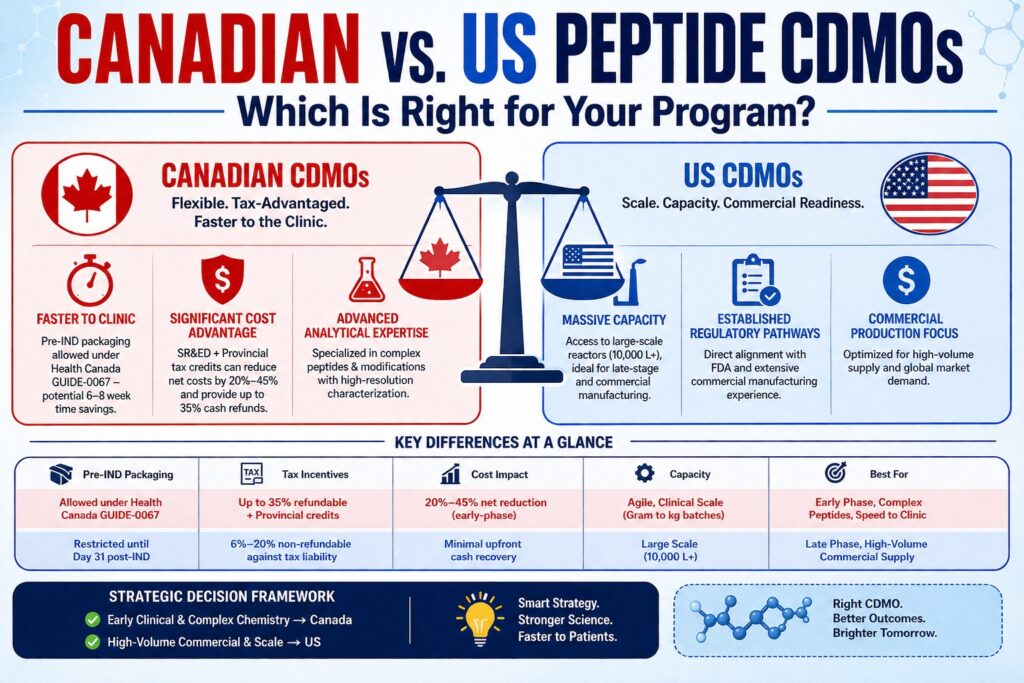
Canadian CDMOs can provide significant time advantages for clinical-stage sponsors by leveraging Health Canada’s foreign-drug packaging provisions to label clinical trial materials while a US FDA IND review is still in progress. This approach can potentially reduce first-patient-in timelines by six to eight weeks. By comparison, US-based facilities generally require sponsors to wait for full FDA IND clearance before beginning clinical labeling and packaging activities.
Under US regulatory requirements, sponsors submitting an Investigational New Drug (IND) application must complete a mandatory 30-day review period before receiving a “Safe to Proceed” notification from the US Food and Drug Administration (FDA). In addition, investigational medicinal products (IMPs) cannot be packaged or labeled specifically for US clinical sites before the IND becomes active on day 31. Canadian regulatory provisions, however, provide an alternative pathway. Specifically, Health Canada’s Conditions for Provision of Packaging/Labelling Services for Drugs under Foreign Ownership (GUIDE-0067) permits bulk drug substances and clinical products to be imported, labeled, and packaged at a Canadian CDMO while the US FDA IND review remains in progress. Following FDA clearance, pre-packaged clinical supplies held at the Canadian facility can be dispatched immediately to US investigator sites, helping eliminate upstream delays in clinical trial supply.
Optimize US Regulatory Strategy: Read our guide on How to Choose a Peptide CDMO in the US to align regulatory requirements with your manufacturing roadmap.
For sponsors conducting clinical trials directly in Canada, Health Canada’s Clinical Trial Application (CTA) framework provides a similarly rigorous but highly structured regulatory assessment under Division C.05 of the Food and Drug Regulations. Approval is issued through a No Objection Letter (NOL), generally within a 30-day review period, using standardized Quality Overall Summary – Chemical Entities (QOS-CE) templates for Phase I, II, and III studies.
Both Health Canada and the US FDA require comprehensive Chemistry, Manufacturing, and Controls (CMC) documentation, together with rigorous analytical sameness characterization for synthetic peptides. Establishing structural equivalence and controlling process-related impurities requires advanced analytical profiling, including:
- Primary Structure Verification: Complete confirmation of the amino acid sequence using high-resolution tandem mass spectrometry (LC-MS/MS) and peptide mapping.
- Stereochemical and Conformational Integrity: Assessment of chiral purity, counterion quantification, such as trifluoroacetate [TFA] exchange to acetate or hydrochloride, circular dichroism, and two-dimensional nuclear magnetic resonance (2D NMR) spectroscopy.
- Impurity Characterization and Forced Degradation: Identification and quantification of deletion sequences, truncated fragments, insertion peptides, and D-amino acid diastereomers under thermal, oxidative, hydrolytic, and photolytic stress conditions aligned with ICH Q3A/Q3B guidelines.
Ensure Analytical Excellence: Discover specialized Peptide Analytical Characterization Services to meet stringent regulatory guidelines.
# Financial Mechanics: Tax Incentives in Canadian vs. US Peptide CDMOs
Canadian CDMOs can offer substantial cost advantages through the federal Scientific Research and Experimental Development (SR&ED) program and provincial tax credit programs. Depending on eligibility and corporate structure, these incentives may provide up to 35% in direct cash refunds or tax reductions on qualifying R&D service fees. In comparison, US R&D tax incentives under Section 41 are non-refundable for most established entities and generally offset existing tax liabilities rather than providing direct capital recovery.
Canada’s SR&ED tax incentive program is considered one of the most competitive life sciences funding mechanisms globally, distributing more than 4.2 billion annually among over 20,000 claimants. Foreign sponsors with parent companies located outside Canada may access these potential benefits by operating through a Canadian subsidiary or by structuring contract development agreements with Canadian CDMOs in which eligible experimental activities are conducted locally. Such activities may include process scouting, solid-phase reaction optimization, and analytical method development. Eligible SR&ED expenditures can include direct labor salaries, raw materials, process consumables, and up to 80% of contract service fees paid to arm’s-length Canadian entities.
Beyond the federal incentive, individual Canadian provinces provide additional R&D tax credits that may be combined with federal benefits and range from 3.5% to 30%. These stacked incentives can further reduce the net cost of clinical API production. For example, combining federal SR&ED incentives with provincial programs in Ontario or British Columbia may offset approximately 20% to 45% of total clinical manufacturing and analytical expenditures, depending on eligibility and the applicable program structure.
In contrast, US-based R&D tax credits under Section 41 of the Internal Revenue Code (IRC) are primarily non-refundable for established commercial entities and must generally be applied against active US corporate tax liabilities. For early-stage, pre-revenue biopharmaceutical companies, US credits may in some cases be applied against payroll taxes. However, overall cost recovery may remain considerably lower than the direct cash refunds or tax reductions that can potentially be obtained through eligible Canadian CDMO partnerships.
Accelerate Drug Development: Partner with an experienced provider for Peptide Drug Development CDMO solutions tailored for early-to-late phase success.
| Financial and Regulatory Parameter | Canadian CDMO Strategy (SR&ED Enabled) | US CDMO Strategy (IRC Sec. 41) |
|---|---|---|
| Federal R&D Credit Rate | Up to 35% refundable (CCPC) / 15% non-refundable or refundable (non-CCPC) | 6% to 20% non-refundable credit against active tax liability |
| Provincial / State Stacking | Additional 3.5% to 30% refundable/non-refundable credits | Varies by state; rarely refundable for foreign contract work |
| Contract Service Eligibility | Up to 80% of eligible Canadian CDMO service fees claimed | Strictly limited to US domestic contractor expenses |
| Impact on Net COGS | 20% to 45% net reduction in early-phase development cost | Standard commercial pricing with minimal upfront cash recovery |
| Pre-IND Packaging Flexibility | Permitted under GUIDE-0067 prior to active IND status | Restricted until Day 31 post-IND submission |
Swipe horizontally to view the full table on smaller screens.
# Technical Capabilities: Choosing Canadian vs. US Peptide CDMOs for Complex Chemistry
Choosing between Canadian vs. US Peptide CDMOs based on technical capabilities requires sponsors to match sequence length and structural modifications with the appropriate facility and reactor design. Canadian vendors often excel in agile and highly customized clinical batch scale-up, whereas US partners frequently provide greater capacity for mega-scale commercial production. Canadian contract developers also offer specialized expertise in complex modifications, including lipidation, PEGylation, cyclization, and peptide-drug conjugates.
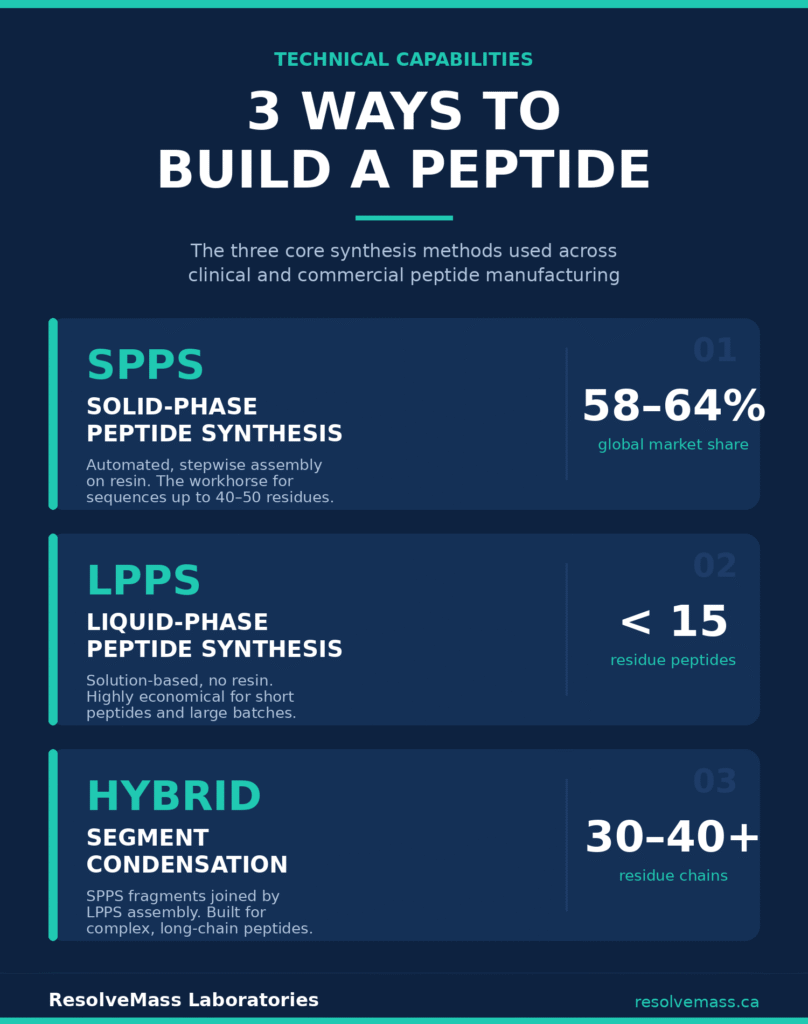
The global peptide manufacturing landscape is currently organized around three primary synthetic methodologies:
- Solid-Phase Peptide Synthesis (SPPS): SPPS is the dominant approach in early-to-mid phase development and accounts for approximately 58% to 64% of the global market. The method uses automated, stepwise assembly on insoluble resin supports, including Fmoc/Boc strategies, and enables rapid production of sequences of up to 40 or 50 amino acids.
- Liquid-Phase Peptide Synthesis (LPPS): LPPS is conducted in solution without resin supports. This approach can be highly cost-effective for short peptides (<15 residues) and for large commercial batch sizes in which intermediate isolation and solvent reduction are important considerations.
- Hybrid / Segment Condensation: This strategy combines SPPS for the preparation of individual short fragment blocks with LPPS for final convergent assembly. It is commonly used for complex long-chain peptides exceeding 30 to 40 residues.
The unprecedented demand for GLP-1 metabolic agonists has contributed to a global shortage of high-volume SPPS reactor capacity and preparative High-Performance Liquid Chromatography (prep-HPLC) purification systems. Large US contract manufacturing facilities have allocated substantial portions of their installed reactor capacity, including 10,000 L to 20,000 L scales, to long-term commercial supply agreements for major pharmaceutical blockbuster products. This commercial capacity constraint has made it increasingly challenging for emerging biotechnology companies to secure timely clinical synthesis slots at major US manufacturing hubs.
Master GLP-1 Characterization: Access expert insights on GLP-1 Peptide Analytical Characterization to address purity and stability challenges.
Canadian CDMOs help address this market imbalance by providing dedicated and agile clinical manufacturing infrastructure. Rather than competing solely on multi-ton bulk production capacity, Canadian facilities frequently specialize in process development, Quality by Design (QbD) optimization, complex chemical modifications, including lipidation, PEGylation, cyclization, and unnatural amino acids, and scale-up from gram quantities to multi-kilogram cGMP clinical batches.
Examine Real-World Data: Read our detailed Peptide Characterization Case Study of Semaglutide to review structural analysis and impurity profiling methodologies.
# Supply Chain Resilience, IP Security, and Cross-Border Logistics
Both Canadian and US peptide manufacturers offer strong intellectual property protection, supply chain visibility, and regulatory alignment compared with offshore manufacturing alternatives. These advantages help protect sponsors against geopolitical instability and raw material supply constraints. Operating within North American jurisdictions supports strict adherence to International Council for Harmonisation (ICH) guidelines while providing strong legal mechanisms for protecting proprietary sequence patents.
Recent legislative developments, including initiatives such as the US BIOSECURE Act, have increased scrutiny of dependencies on foreign manufacturing networks. As a result, biopharmaceutical companies are increasingly reassessing manufacturing risk and shifting supply chain strategies toward secure North American networks. Working with either a Canadian or US CDMO enables critical raw materials, peptide coupling reagents, such as HATU and PyBOP, and protected amino acids to be sourced through validated direct supply channels supported by complete audit trails and formal regulatory change control processes.
Streamline Scale-Up: Learn strategies to mitigate risk during Peptide API Scale-Up for smooth clinical transitions.
Cross-border transportation between Canada and the US benefits from streamlined customs procedures and regulatory agreements. When bulk peptide active pharmaceutical ingredients (APIs) or drug products are transported across the border, established CDMOs manage the necessary regulatory documentation, including End-Use Letters, Canadian Customs Invoices, and Health Canada Annex A filings. This integrated approach helps ensure that clinical drug products manufactured or packaged in Canada can move efficiently into US distribution channels with minimal regulatory friction.
Simplify CDMO Operations: Find out how to efficiently Outsource Peptide Manufacturing to a CDMO without losing quality oversight.
# Strategic Decision Framework for Canadian vs. US Peptide CDMO Selection
Evaluating Canadian vs. US Peptide CDMOs requires a structured decision-making framework that considers clinical trial phase, sequence length, budget limitations, and speed-to-clinic objectives. Early-stage clinical programs involving complex peptide sequences may achieve strong return on investment (ROI) through Canadian manufacturing partnerships, while high-volume commercial manufacturing may ultimately require dual sourcing across Canadian and US infrastructure.
Biopharmaceutical developers should consider the following key criteria when evaluating potential providers:
- Stage of Development: Preclinical through Phase II programs can benefit substantially from Canada’s SR&ED tax incentives and flexible clinical packaging pathways. Late-Phase III programs and high-volume commercial blockbuster products may require the large-scale reactor capacity available at major US manufacturing sites.
- Chemical and Analytical Complexity: Highly modified peptides, cyclic structures, and peptide-drug conjugates require advanced orthogonal analytical characterization, including LC-MS/MS, HRMS, and chiral testing. Specialized Canadian CDMO laboratories can provide significant expertise in these analytical areas.
- Capacity Availability and Timelines: Securing immediate availability for SPPS synthesis and prep-HPLC purification can help sponsors avoid the extended waiting periods currently affecting many large US manufacturing facilities.
- Capital Allocation and Runway: Maximizing available cash runway through refundable Canadian R&D tax credits can help emerging biotechnology companies extend the financial resources available for clinical development programs.
| Molecule Profile & Program Goal | Recommended Synthesis Approach | Preferred CDMO Location | Strategic Rationale |
|---|---|---|---|
| Short Peptides (≤15 residues), Early Phase | SPPS or LPPS | Canadian CDMO | Fast turnaround, lower setup cost, and SR&ED tax recovery |
| Complex Sequences (>30 residues / PDCs) | Hybrid Fragment Condensation | Canadian CDMO | Specialized QbD development and advanced LC-MS characterization |
| Pre-IND Phase 1 Speed-to-Clinic | SPPS | Canadian CDMO | Pre-IND packaging under GUIDE-0067 can save 6–8 weeks in FPI |
| Commercial GLP-1 Agonist (>100 kg/year) | SPPS / Hybrid | US CDMO / Dual Sourced | Access to 10,000 L+ reactor capacity and mega-prep HPLC |
Swipe horizontally to view the full table on smaller screens.
Select the Right Partner: Review essential selection criteria to identify the Best Peptide CDMO for your therapeutic goals.
# Conclusion: Determining Which Canadian vs. US Peptide CDMOs Suit Your Program
Determining whether Canadian vs. US Peptide CDMOs are the right fit for a drug candidate depends largely on whether the primary strategic objective is rapid clinical entry and capital conservation or ultra-high-volume commercial production. For clinical-stage programs that require rapid packaging, high E-E-A-T analytical characterization, and substantial R&D cash refunds, Canadian CDMOs can represent a highly cost-effective and operationally efficient pathway. By using pre-IND clinical packaging flexibilities and high-resolution characterization platforms, biopharmaceutical developers can potentially reduce time-to-clinic while continuing to meet rigorous global regulatory compliance requirements.
To discuss your program’s specific synthesis, analytical characterization, or regulatory requirements, contact the expert technical team at ResolveMass Laboratories Contact Us Page.
# Frequently Asked Questions on Canadian vs. US Peptide CDMOs
How does Canada’s SR&ED program reduce total cost of goods (COGS) for peptide programs?
Canada’s SR&ED program can reduce the overall cost of peptide development by providing refundable federal tax credits on eligible R&D activities conducted in Canada, together with additional provincial incentives where applicable. Sponsors working with Canadian CDMOs may access these benefits through an eligible Canadian subsidiary or an appropriately structured service agreement. Qualifying activities can include process development, reaction optimization, and analytical method development. In eligible situations, a portion of qualifying CDMO expenditures may also be included in the claim.
Can clinical batches produced by Canadian CDMOs be imported into the US for FDA-regulated clinical trials?
Yes, peptide clinical batches manufactured by a Canadian CDMO under appropriate cGMP controls can be used to support US FDA-regulated clinical development programs. Canadian manufacturing standards are aligned with internationally recognized quality expectations and applicable ICH requirements for pharmaceutical manufacturing. The manufacturing, testing, and documentation package must still satisfy the requirements applicable to the relevant US IND. Appropriate quality documentation and regulatory controls help support the importation and use of Canadian-manufactured peptide products in US clinical trials.
How does Health Canada’s pre-IND clinical packaging strategy save 6 to 8 weeks on trial timelines?
Under Health Canada’s GUIDE-0067 framework, eligible bulk peptide drug products may be imported into Canada and prepared for clinical use while the US FDA conducts its 30-day IND review. The Canadian CDMO can complete required labeling and packaging activities before the US IND becomes active. Once FDA clearance is obtained, the prepared clinical supplies can be shipped to US investigator sites without waiting for a separate US packaging cycle. This approach can potentially reduce clinical supply delays by approximately six to eight weeks.
What analytical characterization studies are required by Health Canada and the US FDA for peptide sameness?
Health Canada and the US FDA expect comprehensive analytical characterization to establish the identity, structural integrity, purity, and quality of synthetic peptides. Typical orthogonal techniques may include LC-MS/MS, high-resolution mass spectrometry (HRMS), chiral HPLC, 2D NMR, circular dichroism, and counterion profiling. Forced degradation studies may also be conducted under thermal, oxidative, hydrolytic, and photolytic stress conditions. The specific analytical package depends on the peptide, its manufacturing process, development stage, and regulatory requirements.
When should a sponsor choose Solid-Phase Peptide Synthesis (SPPS) over Liquid-Phase Peptide Synthesis (LPPS)?
Solid-Phase Peptide Synthesis (SPPS) is generally advantageous when sponsors require rapid, automated synthesis of moderate- to longer-length peptide sequences, particularly during clinical development. Liquid-Phase Peptide Synthesis (LPPS) may be more suitable for short sequences (<15 residues) and manufacturing scenarios where solution-phase processing offers economic advantages. Hybrid fragment condensation can be useful for longer and structurally complex peptides. The final selection depends on sequence length, chemical complexity, process yield, scalability, purification requirements, and target production volume.
How is the global GLP-1 capacity shortage impacting CDMO selection in North America?
The rapid expansion of GLP-1 therapies for obesity and diabetes has placed considerable demand on large-scale SPPS reactors and preparative HPLC purification systems. Major US manufacturing facilities have allocated significant capacity to high-volume commercial programs, reducing immediate availability for some emerging clinical-stage projects. As a result, sponsors developing non-GLP-1 peptides may consider agile Canadian CDMOs with available clinical manufacturing capacity. This can provide greater scheduling flexibility and potentially faster access to synthesis and purification slots.
What cross-border customs documentation is required when shipping peptide APIs between Canada and the US?
Cross-border shipment requirements depend on the product, intended use, regulatory status, and applicable import procedures. For investigational drug products imported into Canada before active IND approval under GUIDE-0067, the required Health Canada documentation may include Part 1 of Annex A, submitted within the applicable advance notification period. Supporting shipping and customs documents can include a Bill of Lading, Packing Slip, End-Use Letter, and Canadian Customs Invoices. The responsible CDMO and sponsor should confirm the complete documentation package before shipment.
How do Canadian and US peptide CDMOs ensure intellectual property (IP) protection compared to offshore facilities?
Canadian and US peptide CDMOs operate within established legal and regulatory systems that provide strong mechanisms for protecting confidential information, proprietary sequences, and patent-related intellectual property. Contractual confidentiality provisions, controlled access procedures, and defined ownership terms help protect sponsor information throughout development and manufacturing. Facilities also operate under applicable quality systems and cGMP requirements. These protections can provide sponsors with greater legal and operational control compared with certain offshore manufacturing arrangements.
How can biopharmaceutical companies structure CDMO contracts to maximize R&D tax recovery in Canada?
Sponsors should clearly distinguish eligible scientific research activities from routine manufacturing activities when structuring agreements with Canadian CDMOs. Activities such as route scouting, process optimization, experimental scale-up, and analytical method validation may qualify when they involve eligible scientific uncertainty and experimental work. Contracts should clearly define the scope of R&D activities, associated expenditures, responsibilities, and applicable intellectual property rights. Working with qualified tax and regulatory professionals can help ensure that the agreement structure supports accurate SR&ED eligibility assessment and documentation.
Reference:
- U.S. Food and Drug Administration. (n.d.). IND applications for clinical investigations: Chemistry, manufacturing, and control (CMC) information. Retrieved July 22, 2026, from FDA CMC Information Guidance
- Health Canada. (2009). Quality (chemistry and manufacturing) guidance: Clinical trial applications (CTAs) for pharmaceuticals. Government of Canada. Health Canada guidance document
- Lernhardt, W., Karlen, C., Tinder, R., Jenkins, I., Ko, S., Casazza, K., Robinson, B., Mathur, E. J., Andrade, D., Gutierrez-Castrellon, P., Uffens, J., & Lakey, J. R. T. (2025). Peptide therapeutics 2.0: AI-driven design, sustainable synthesis, and next-generation medicine. American Journal of Biomedical Science & Research, 28(1), Article 003631. https://doi.org/10.34297/AJBSR.2025.28.003631
- Kekessie, I., Wegner, K., Martinez, I., Kopach, M. E., White, T. D., Tom, J. K., Kenworthy, M. N., Gallou, F., Lopez, J., Koenig, S. G., Payne, P. R., Eissler, S., Arumugam, B., Li, C., Mukherjee, S., Isidro-Llobet, A., Ludemann-Hombourger, O., Richardson, P., Kittelmann, J., Pedersen, D. S., & van den Bos, L. J. (2024). Process mass intensity (PMI): A holistic analysis of current peptide manufacturing processes informs sustainability in peptide synthesis. The Journal of Organic Chemistry, 89(7), 4261–4282. https://doi.org/10.1021/acs.joc.3c01494
Need Help Choosing Between Canadian and US Peptide CDMOs?
Our team can help you evaluate Canadian and US CDMO options based on your peptide’s complexity, development phase, required scale, analytical needs, timeline, and budget.
Contact us
About The Author
Anusha Sinha
Anusha Sinha, B.Pharm, is an experienced pharma professional with a strong background in Analytical Chemistry and Polymer Chemistry. With a passion for translating complex scientific data into clear, accessible content, she plays a vital role in communicating ResolveMass Laboratories Inc.’s advanced testing capabilities. In addition to her scientific expertise, Anusha leads Business Development initiatives, helping clients across pharmaceutical, biotechnology, and materials science sectors find tailored analytical solutions. Her combined experience in science and strategy positions her at the forefront of client engagement and technical communication.

