


Introduction:
Carmustine PLGA characterization sits at the intersection of polymer science, oncology pharmacology, and regulatory compliance — making it one of the most technically demanding challenges in solid implant drug delivery. Carmustine (BCNU, bis-chloroethylnitrosourea), the alkylating chemotherapeutic agent embedded in the commercially approved Gliadel® wafer, is delivered locally to the brain resection cavity through a PLGA-based biodegradable implant. This drug-polymer matrix design eliminates systemic toxicity concerns and sustains local drug exposure over days to weeks — but it also introduces a series of analytical complexities that do not exist in conventional dosage forms.
Unlike oral tablets or injectable suspensions, a solid PLGA implant undergoes simultaneous drug release and polymer degradation in a three-dimensional matrix. The analytical scientist must therefore characterize not just the drug, but the evolving polymer architecture, the drug-polymer interaction, the surface and bulk morphology, and the real-time release kinetics — all while managing the chemical instability of carmustine itself. Understanding these layers is critical for any CRO developing or supporting PLGA-based solid implant programs.
This article outlines the principal analytical challenges in carmustine PLGA wafer characterization and explains how a systematic, instrument-specific approach is required to generate regulatory-grade data packages.
Summary:
- Carmustine PLGA wafers (Gliadel®) are biodegradable solid implants used for local chemotherapy in glioblastoma, and their characterization demands a multi-modal analytical strategy.
- Key analytical challenges include accurately measuring drug loading and homogeneity, quantifying PLGA molecular weight and degradation kinetics, characterizing implant morphology, and assessing in vitro drug release profiles.
- Regulatory agencies (FDA, ICH) expect a comprehensive physicochemical characterization package for solid implant systems — analytical rigor is non-negotiable.
- Techniques such as HPLC, GPC/SEC, DSC, SEM, micro-CT, and USP Apparatus 4 dissolution are central to a complete characterization strategy.
- ResolveMass Laboratories provides end-to-end analytical development and characterization services for PLGA-based solid implant drug delivery systems.
1: What Is a Carmustine PLGA Wafer and How Does It Work?
A carmustine PLGA wafer is a biodegradable solid implant in which the chemotherapeutic agent carmustine is homogeneously dispersed within a poly(lactic-co-glycolic acid) (PLGA) polymer matrix. The wafer degrades via hydrolytic chain scission of ester bonds in the PLGA backbone, releasing carmustine in a sustained, locally controlled manner over approximately 2–3 weeks post-implantation.
Key design parameters of the carmustine PLGA wafer system include:
- Polymer composition: PLGA lactide:glycolide ratio determines degradation rate; higher glycolide content accelerates hydrolysis.
- Drug loading: Typically 3.85% w/w carmustine per wafer in the Gliadel® product.
- Molecular weight of PLGA: Governs degradation onset and duration; characterization requires accurate Mw and Mn values.
- Implant geometry: Disc-shaped wafers (~14 mm diameter, ~1 mm thickness) with defined surface area governing diffusion-controlled release.
- Matrix porosity: Influences both the rate of water ingress and the tortuosity of drug diffusion pathways.
The physicochemical interdependence of these parameters is why carmustine PLGA wafer characterization cannot rely on a single analytical technique — it requires an integrated strategy.
2: Core Analytical Challenges in Carmustine PLGA Wafer Characterization
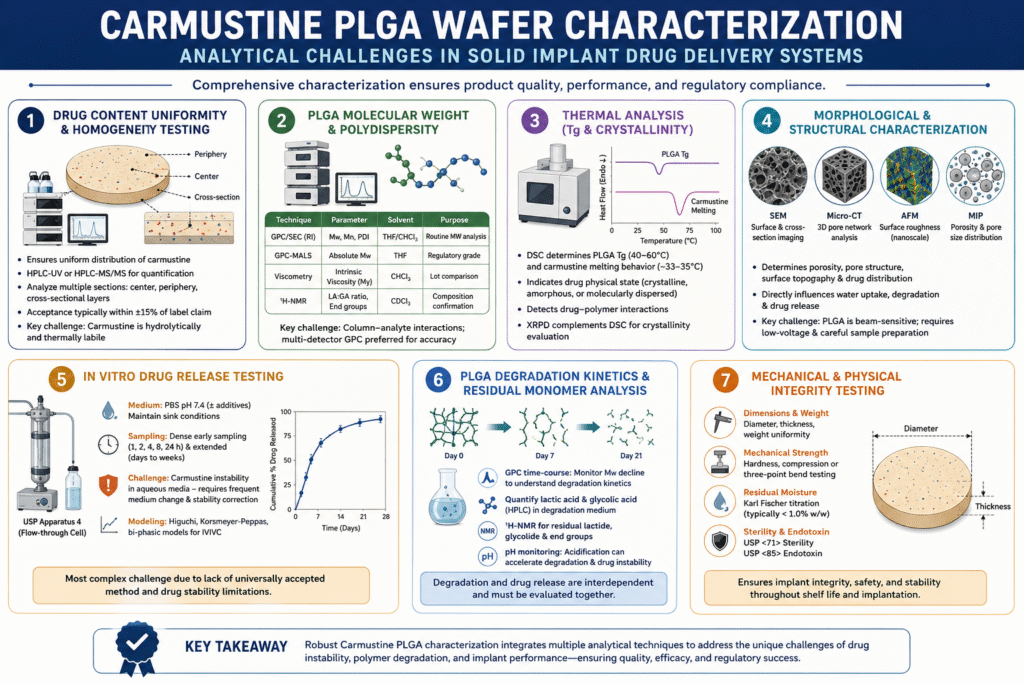
1. Drug Content Uniformity and Homogeneity Testing
The first and most fundamental characterization question is whether carmustine is uniformly distributed throughout the PLGA matrix. Non-uniform distribution leads to dose dumping or subtherapeutic local concentrations — both clinically unacceptable outcomes.
Analytical approach:
- HPLC-UV or HPLC-MS/MS: Quantification of extracted carmustine against a validated reference standard. Reversed-phase C18 columns with UV detection at 230 nm are standard; however, carmustine’s chemical instability (it hydrolyzes rapidly in aqueous media) demands that extraction solvents and analytical timelines be tightly controlled.
- Sampling strategy: Multiple wafer sections must be analyzed (center, periphery, cross-sectional layers) to generate a statistically valid homogeneity profile.
- Regulatory benchmark: ICH Q6A guidelines require that drug content uniformity testing demonstrate that individual units fall within ±15% of the label claim, with a tighter acceptance criterion typically expected for implants.
Key challenge: Carmustine is thermally and hydrolytically labile. Sample preparation must minimize exposure to aqueous conditions and elevated temperatures. Acetonitrile or methanol-based extraction systems with immediate analysis are preferred.
2. PLGA Molecular Weight and Polydispersity Characterization
PLGA molecular weight (Mw, Mn) and the polydispersity index (PDI) are primary determinants of the implant’s degradation rate and, consequently, the drug release profile. This is a cornerstone of carmustine PLGA characterization that must be performed on both the starting polymer and the degrading implant over time.
Analytical techniques:
| Technique | Parameter Measured | Solvent System | Notes |
|---|---|---|---|
| GPC/SEC with RI detection | Mw, Mn, PDI | THF or chloroform | Requires narrow-PDI PMMA or PS calibration standards |
| GPC with multi-angle light scattering (MALS) | Absolute Mw | THF | Preferred for regulatory submissions |
| Viscometry (Mark-Houwink) | Intrinsic viscosity → Mv | Chloroform | Useful as a rapid lot-release test |
| NMR (¹H-NMR) | LA:GA ratio, end-group analysis | CDCl₃ | Confirms polymer composition and block structure |
Key challenge: GPC columns must be calibrated appropriately for polyester standards, and column-analyte interactions with PLGA in THF can cause anomalous elution behavior. Multi-detector GPC (RI + MALS + viscometer) is strongly preferred for absolute molecular weight determination in regulatory contexts.
3. Thermal Analysis: Glass Transition Temperature (Tg) and Crystallinity
Differential Scanning Calorimetry (DSC) is an essential tool for carmustine PLGA wafer characterization because it reveals both the polymer’s thermal properties and the physical state of the drug within the matrix.
What DSC reveals:
- Tg of PLGA: Typically 40–60°C for pharmaceutical grades. The Tg determines the polymer chain mobility at physiological temperature (37°C), which directly governs drug diffusion rates through the matrix.
- Carmustine crystallinity: Drug present as a crystalline dispersion versus amorphous dispersion will exhibit markedly different dissolution and release behavior. DSC identifies melting endotherms for crystalline carmustine (~33–35°C reported for bulk drug).
- Drug-polymer interactions: Suppression or shift of carmustine’s melting endotherm in the formulation versus pure drug is indicative of molecular-level mixing or solid solution formation.
Supporting technique: X-ray powder diffraction (XRPD) provides complementary crystallinity data and confirms amorphous or crystalline drug state within the polymer matrix, which is particularly important post-sterilization or post-storage stability.
4. Morphological and Structural Characterization
The internal architecture of a PLGA wafer — its porosity, surface topography, and three-dimensional drug distribution — has a direct mechanistic relationship to its release kinetics. This dimension of carmustine PLGA characterization is frequently underestimated.
Techniques employed:
- Scanning Electron Microscopy (SEM): Cross-sectional imaging of the wafer reveals surface pore structure, drug crystal distribution, and early degradation features (surface erosion, crack formation). SEM images of the wafer surface and cross-section are expected in CMC documentation.
- Micro-Computed Tomography (Micro-CT): Provides three-dimensional reconstruction of internal pore networks without destructive sectioning. Particularly valuable for tracking how porosity evolves during in vitro degradation studies.
- Atomic Force Microscopy (AFM): Surface roughness characterization at nanometer resolution, useful for correlating surface structure with initial burst release.
- Mercury Intrusion Porosimetry (MIP): Quantification of total porosity, pore size distribution, and tortuosity — inputs into mathematical models of diffusion-controlled release.
Key challenge: PLGA implants are beam-sensitive under high-energy SEM conditions. Low-voltage SEM with cryo-preparation or osmium staining is often required to preserve morphological features and avoid polymer melting at the beam interface.
5. In Vitro Drug Release Testing: The Most Complex Challenge
Designing a discriminating, physiologically relevant, and reproducible in vitro release (IVR) method for a solid PLGA implant like the carmustine wafer is arguably the most technically difficult component of the characterization program. FDA’s guidance on modified-release solid oral dosage forms does not map cleanly onto solid implant systems, and there is no universally accepted compendial method for PLGA wafers.
Apparatus options and rationale:
| Apparatus | Applicability to PLGA Wafers | Limitations |
|---|---|---|
| USP Apparatus 4 (Flow-through cell) | Preferred for solid implants | Requires method optimization for flow rate, cell geometry |
| Rotating bottle / vial method | Commonly used in academic and early development | Poor reproducibility across labs |
| Dialysis membrane method | Used for semi-solid systems | May underestimate burst release |
| Franz diffusion cell | Suitable for surface-eroding systems | Less appropriate for bulk-degrading PLGA |
Critical method parameters:
- Release medium: Phosphate buffered saline (PBS, pH 7.4) at 37°C is standard; however, the addition of enzymes or surfactants (e.g., 0.02% Tween-80) may be needed to maintain sink conditions for carmustine.
- Sink conditions: Carmustine solubility in PBS is limited (~0.5 mg/mL at 37°C). Ensuring sink conditions throughout the release experiment, particularly during the slow degradation phase, is critical for data validity.
- Sampling frequency: Dense early-time sampling (hours 1, 2, 4, 8, 24) is required to capture burst release; extended sampling (days 3, 7, 14, 21) characterizes the sustained phase.
- Carmustine stability in release medium: The half-life of carmustine in aqueous PBS at 37°C is short (< 24 hours). This requires either frequent medium exchange with stability-corrected calculations or incorporation of an organic co-solvent to minimize hydrolytic degradation during sampling.
IVIVC considerations: Establishing an in vitro–in vivo correlation (IVIVC) for PLGA solid implants remains an open scientific challenge. ResolveMass Laboratories approaches this through mathematical release modeling (Higuchi, Korsmeyer-Peppas, and bi-phasic degradation models) to connect in vitro dissolution profiles with preclinical pharmacokinetic data.
6. PLGA Degradation Kinetics and Residual Monomer Analysis
Because the drug release mechanism in a PLGA wafer is coupled to polymer hydrolysis, characterizing degradation kinetics is inseparable from the drug release characterization.
Analytical strategy for degradation monitoring:
- GPC time-point sampling: Wafer segments recovered at defined intervals (days 0, 3, 7, 14, 21) analyzed for Mw decline; a first-order Mw decrease confirms bulk degradation kinetics.
- Lactic acid and glycolic acid quantification: HPLC with refractive index or UV detection measures monomer release into degradation medium, providing a direct polymer degradation mass balance.
- Residual monomer by ¹H-NMR: Regulatory agencies expect residual lactide and glycolide levels to be characterized in the starting polymer and finished product — ICH Q3C limits for class 3 residual solvents provide a useful framework.
- pH monitoring of degradation medium: As PLGA degrades, lactic and glycolic acid release acidifies the local microenvironment. This can accelerate carmustine degradation and must be accounted for in release calculations.
7. Mechanical and Physical Integrity Testing
Solid implants must maintain dimensional and mechanical integrity during handling, packaging, and implantation. For the carmustine PLGA wafer, the following physical tests constitute a complete characterization package:
- Dimensions and weight uniformity: Caliper measurements of diameter and thickness; balance-verified weight within specification.
- Hardness / friability: Modified tablet hardness testing or three-point bend testing adapted for disc geometries.
- Residual moisture (Karl Fischer titration): PLGA hydrolysis is water-catalyzed; residual moisture in the final product must be below a defined limit (typically < 1.0% w/w) to ensure shelf-life stability.
- Sterility and endotoxin: As an implantable device-drug combination, the wafer must meet USP <71> sterility requirements and bacterial endotoxin limits per USP <85>.
3: Regulatory Expectations for Solid Implant Characterization
FDA’s guidance documents for combination products and drug-device combinations, along with ICH Q8 (Pharmaceutical Development), Q9 (Quality Risk Management), and Q10 (Pharmaceutical Quality System), define the framework within which PLGA implant characterization packages must be constructed.
Key regulatory expectations include:
- A fully validated analytical method for drug content and release (per ICH Q2(R1)).
- Characterization of the PLGA polymer as a critical excipient, including source, molecular weight specification, LA:GA ratio, and degradation profile.
- A minimum of 6-month accelerated and 12-month real-time stability data for new drug product applications.
- Justification of the in vitro release method with evidence of discriminating power.
- For the drug substance (carmustine), a degradation impurity profile consistent with ICH Q3B, given its chemical instability.
4: How ResolveMass Laboratories Approaches Carmustine PLGA Characterization
ResolveMass Laboratories Inc. is a Canadian CRO with deep specialization in PLGA-based drug delivery systems and long-acting injectables (LAIs). Our analytical capabilities for solid implant characterization include:
- Validated HPLC and HPLC-MS/MS methods for carmustine quantification and impurity profiling.
- Multi-detector GPC (RI + MALS) for absolute PLGA molecular weight characterization.
- DSC and XRPD for solid-state characterization of drug-polymer matrices.
- SEM and micro-CT for morphological and structural analysis of solid implants.
- Custom USP Apparatus 4 methods for sustained-release solid implant dissolution testing.
- PLGA degradation kinetics studies with time-point GPC and monomer quantification.
- Regulatory-ready analytical packages aligned with FDA and ICH expectations.
Our scientific team brings formulation expertise, instrument-specific method development experience, and a thorough understanding of the regulatory landscape for drug-device combination products — enabling sponsors to de-risk analytical development and accelerate their timelines.
Conclusion:
Carmustine PLGA characterization demands a comprehensive, multi-technique analytical strategy that addresses drug content uniformity, polymer molecular weight, solid-state properties, implant morphology, in vitro release kinetics, and polymer degradation — simultaneously. Each layer of characterization is interdependent: PLGA Mw determines degradation rate, degradation rate governs drug release, and drug release kinetics are only meaningful if measured in a validated, discriminating in vitro system with appropriate stability controls for carmustine’s inherent chemical lability.
There is no shortcut in this work. The analytical complexity is proportional to the clinical stakes — these are implants placed directly in brain resection cavities. Generating a regulatory-grade characterization package for a carmustine PLGA wafer requires both deep polymer science expertise and rigorous pharmaceutical analytical capability, applied together.
ResolveMass Laboratories is positioned to support every phase of this characterization work, from early formulation screening through CMC-ready analytical packages.
Frequently Asked Questions:
Drug content uniformity is critical because it ensures that carmustine is evenly distributed throughout the PLGA wafer, allowing consistent and predictable drug delivery. Non-uniform distribution can lead to dose dumping, localized toxicity, or subtherapeutic drug concentrations, ultimately affecting treatment efficacy and patient safety. Regulatory agencies also require content uniformity testing to verify batch-to-batch consistency and product quality.
PLGA molecular weight directly influences the degradation rate of the polymer matrix and, consequently, the release profile of carmustine. Higher molecular weight PLGA generally degrades more slowly, resulting in prolonged drug release, while lower molecular weight PLGA degrades faster and can accelerate drug release. Monitoring molecular weight throughout development is essential for achieving the desired release kinetics and implant performance.
The biggest challenge is developing a release method that accurately reflects in vivo conditions while accounting for the instability of carmustine and the complex degradation behavior of PLGA. Maintaining sink conditions, preventing drug degradation in the release medium, and capturing both the initial burst release and long-term sustained release phases require carefully optimized testing protocols. Additionally, there is no universally accepted compendial method for PLGA implant systems.
Thermal analysis provides critical information about the physical state of both the polymer and the drug within the implant. Techniques such as Differential Scanning Calorimetry (DSC) help determine the glass transition temperature (Tg) of PLGA, assess drug crystallinity, and identify potential drug-polymer interactions. These properties directly affect stability, degradation behavior, and drug release performance, making thermal analysis a key component of Carmustine PLGA characterization.
Morphology influences how water penetrates the implant, how the polymer degrades, and how the drug is released over time. Characteristics such as pore size, porosity, surface roughness, and internal structure can significantly impact release kinetics and overall implant performance. Techniques such as SEM, Micro-CT, and AFM are commonly used to evaluate these structural attributes and establish relationships between implant architecture and drug delivery behavior.
Carmustine is considered analytically challenging because it is both hydrolytically and thermally unstable. The drug can degrade rapidly during sample preparation, storage, release testing, and stability studies if conditions are not carefully controlled. Accurate quantification therefore requires optimized analytical methods, rapid sample processing, and carefully selected solvents to minimize degradation and ensure reliable results.
Residual moisture can significantly accelerate PLGA hydrolysis, leading to premature polymer degradation and altered drug release profiles. Increased moisture levels may also contribute to carmustine degradation, reducing product potency and shelf life. For this reason, residual moisture is routinely monitored using Karl Fischer titration and controlled within strict specifications to maintain long-term stability and product quality.
Reference:
- Wan GY. Manufacturing and development of implantable drug delivery device for the localised treatment of glioblastoma (Doctoral dissertation, University of Birmingham).https://etheses.bham.ac.uk/id/eprint/14735/
- Shapira-Furman T, Serra R, Gorelick N, Doglioli M, Tagliaferri V, Cecia A, Peters M, Kumar A, Rottenberg Y, Langer R, Brem H. Biodegradable wafers releasing Temozolomide and Carmustine for the treatment of brain cancer. Journal of controlled release. 2019 Feb 10;295:93-101.https://www.sciencedirect.com/science/article/pii/S0168365918307533
- Pereira DY, Yip AT, Lee BS, Kamei DT. Modeling mass transfer from carmustine-loaded polymeric implants for malignant gliomas. Journal of Laboratory Automation. 2014 Feb;19(1):19-34.https://journals.sagepub.com/doi/abs/10.1177/2211068213499157
- Kartal A, Kim MJ, Chanbour H, Tsehay Y, Alomari S. Limitations of Gliadel Wafers and Strategies for Next-Generation Local Delivery Systems for Glioblastoma. Cancers. 2026 Mar 11;18(6):907.https://www.mdpi.com/2072-6694/18/6/907
About the Author


