

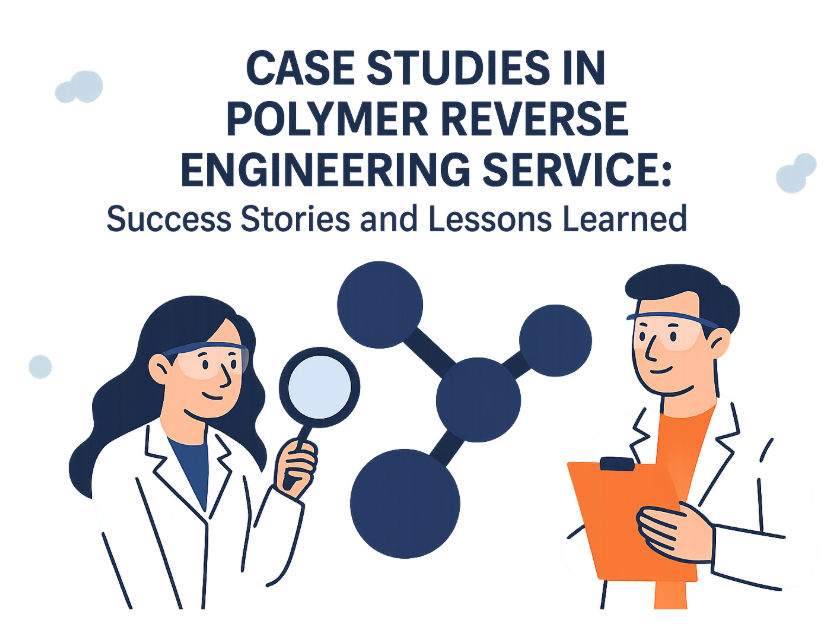
What is Polymer Reverse Engineering?
Polymer reverse engineering is a process where scientists break down and analyze plastic or rubber materials to understand how they’re made. This includes identifying:
- The base polymer
- Additives like stabilizers, colorants, or plasticizers
- How the material behaves with heat or chemicals
- Molecular weight and how it’s distributed
It’s often used to:
- Recreate competitor products
- Investigate product failures
- Improve existing formulations
- Ensure regulatory compliance
Learn more: Reverse Engineering Service for Polymers in Medical Devices: Innovations and Challenges
🧪 Case Study 1: Understanding a Medical Catheter Material
Client Problem:
A medical device company wanted to copy a flexible and solvent-resistant catheter but didn’t know what materials were used.
Our Solution:
- We used FTIR and DSC to find the polymer blend.
- TGA revealed heat stability and additive loss.
- GC-MS detected plasticizers and stabilizers.
- GPC helped find the molecular weight.
Result:
We helped them replicate the material successfully for FDA submission after doing extractables/leachables testing.
👉 Learn more about Impurity Profiling for Generic USFDA Submissions
🔧 Case Study 2: Cracking in an Automotive Gasket
Client Problem:
An automotive supplier reported cracks in rubber gaskets under heat.
Our Solution:
- DSC & TGA showed poor heat resistance.
- FTIR identified degraded NBR rubber.
- SEM-EDX detected contamination by chlorine.
- The root cause was traced to PVC contamination.
Result:
The client changed their process and materials, fixing the issue.
✅ Related: Crosslinked Polymer Analysis: Challenges in Structural Elucidation
🎥 Case Study 3: Recreating a Barrier Film for Packaging
Client Problem:
A startup wanted to replicate a competitor’s 5-layer plastic film that blocked oxygen well.
Our Solution:
- Microscopy mapped film structure.
- DSC & FTIR identified materials (like EVOH).
- GC-MS revealed additives.
- We studied the surface treatment (like corona discharge).
Result:
We provided a full report to help their manufacturer recreate the film.
🎯 Read: How Polymer Nanoparticles are Made: A Step-by-Step Guide
🧰 Techniques Used in Reverse Engineering
Here’s a list of methods we use to study unknown polymers:
| Technique | Purpose |
|---|---|
| FTIR | Find polymer type by functional groups |
| DSC | Check melting point and glass transition |
| TGA | See how material behaves when heated |
| GC-MS | Detect additives like plasticizers or antioxidants |
| GPC | Measure molecular weight |
| SEM-EDX | Analyze fillers and surface composition |
Each case may need a different set of tools depending on the complexity.
🏆 Why Choose Resolvemass?
At Resolvemass Laboratories Inc., our Polymer Reverse Engineering service helps clients:
- Improve or replicate materials
- Investigate failures
- Understand their competitors
- Get through regulatory hurdles
With our advanced labs, qualified scientists, and deep industry experience, we provide detailed, actionable reports — not just raw data.
Want to dive deeper into advanced analytical techniques?
📖 Explore: Molecular Weight and Polydispersity Estimation of Polymers
📘 References
- Lewis PR. Forensic Polymer Engineering: Why polymer products fail in service. Woodhead Publishing; 2016 Jun 9.
- De Brito MP, Dekker R, Flapper SD. Reverse logistics: a review of case studies. Springer Berlin Heidelberg; 2005.
- Gupta SD, Mukhopadhyay R, Baranwal KC, Bhowmick AK. Reverse engineering of rubber products: Concepts, tools, and techniques. CRC press; 2013 Sep 19.
Case Study: Building an IND-Enabling CMC Analytical Package for a Virtual Biotech
Introduction Building an IND-Enabling CMC Analytical Package for a virtual biotech requires establishing a phase-appropriate,…
Case Study: Analytical Method Transfer and Re-Validation After a Sponsor Changed CDMOs
Introduction When a drug product is transferred to a new contract facility, executing an Analytical…
Can a CDMO Manufacture Both Peptides and Biologics?
Introduction: Can a CDMO manufacture both peptides and biologics? Yes, a Contract Development and Manufacturing…
GMP Release and Stability Testing Services at a CDMO: Scope, Turnaround, and Deliverables
Introduction Engaging specialized GMP Release and Stability Testing Services at a CDMO enables biopharmaceutical developers…
Solid-State Characterization and Polymorph Screening at a CDMO: XRPD, DSC, TGA, and Beyond
1. Introduction Solid-state characterization and polymorph screening are essential components of pharmaceutical development because the…
How Can You Verify the Identity and Purity of Compounded or Research-Grade Peptides?
Introduction: Peptide Identity and Purity Testing is essential for determining whether a compounded or research-grade…


