

Introduction:
Exenatide PLGA Microsphere Characterization plays a pivotal role in the development of long-acting injectable formulations, particularly for GLP-1 analogs used in diabetes management. While PLGA (poly(lactic-co-glycolic acid)) enables sustained release, it introduces complex peptide–polymer interactions that can compromise product quality. Advanced insights from PLGA-based systems, such as PLGA microsphere formulation development and PLGA polymer characterization for generics, are essential to address these challenges.
In this case study, we explore how ResolveMass Laboratories Inc. addressed analytical and formulation challenges associated with Exenatide-loaded PLGA microspheres—delivering robust, reproducible, and regulatory-aligned characterization strategies. Similar learnings from PLGA characterization in Lupron Depot and reverse engineering of PLGA polymer in Lupron Depot further strengthen the scientific foundation.
Summary:
- Exenatide PLGA Microsphere Characterization is critical for ensuring drug stability, release kinetics, and regulatory compliance.
- Peptide–polymer interactions often lead to aggregation, acylation, and potency loss during formulation and storage.
- Advanced analytical tools such as LC-MS, HRMS, SEC, and NMR are essential to decode these interactions.
- Process optimization and orthogonal characterization strategies can significantly reduce impurities and improve release profiles.
- A tailored analytical approach—similar to approaches used in PLGA reverse engineering for ANDA—is necessary to successfully support complex generics.
1: What are the Key Challenges in Exenatide PLGA Microsphere Characterization?
The primary challenge in Exenatide PLGA Microsphere Characterization is the chemical and physical interaction between PLGA and Exenatide, which leads to instability, impurity formation, and inconsistent drug performance. These challenges are commonly observed across applications such as PLGA for oncology implants and dexamethasone PLGA implant characterization.
Key Issues Observed:
- Peptide Acylation:
Reactive PLGA degradation products (lactic and glycolic acid oligomers) can covalently modify Exenatide, resulting in acylated impurities and reduced biological activity. - Aggregation:
Structural stress during encapsulation and release can induce peptide aggregation, impacting solubility and therapeutic effectiveness. - Heterogeneous Release Profiles:
Poorly controlled microsphere architecture leads to:- Initial burst release
- Followed by inconsistent sustained release, affecting dosing predictability
- Polymer Degradation Impact:
PLGA hydrolysis generates an acidic microenvironment, which:- Accelerates peptide degradation
- Promotes structural denaturation and impurity formation
Why This Matters:
- Impacts Bioavailability and Efficacy:
Instability and modification of Exenatide directly reduce therapeutic performance. - Leads to Batch-to-Batch Variability:
Uncontrolled interactions cause inconsistent product quality, challenging scale-up and commercialization. - Raises Regulatory Concerns for ANDA Submissions:
Regulatory agencies require:- Detailed impurity profiling
- Demonstration of product consistency
- Robust characterization of release kinetics
Failure to address these challenges can delay approval of complex generic formulations.
2: Case Background: Exenatide Microsphere Formulation
The objective of this case was to characterize and resolve instability issues in a long-acting Exenatide PLGA microsphere formulation, with a focus on identifying root causes and improving analytical reliability.
Objectives:
- To ensure reproducible in vitro release performance aligned with regulatory expectations
- To perform in-depth Exenatide PLGA Microsphere Characterization
- To identify the source of instability and impurity formation
- To optimize analytical and extraction methodologies
Observed Problems:
- Unexpected Impurity Peaks in LC-MS:
- Multiple unknown peaks indicated potential peptide modification or degradation
- Suggested interaction between Exenatide and PLGA degradation byproducts
- Reduced Peptide Recovery During Extraction:
- Low recovery pointed to strong peptide–polymer binding or adsorption
- Resulted in inaccurate quantification and poor method reproducibility
- Inconsistent In Vitro Release Behavior:
- High variability in release profiles across batches
- Indicated non-uniform microsphere structure and uncontrolled release kinetics
These challenges are frequently encountered in PLGA reverse engineering CRO studies, especially during generic development.
3: Root Cause: Peptide-Polymer Interactions
The instability in Exenatide PLGA Microsphere Characterization was traced to chemical and physical interactions between Exenatide and PLGA degradation byproducts, leading to peptide modification, loss, and degradation.
Mechanisms Identified:
| Interaction Type | Impact on Exenatide |
|---|---|
| Acylation (Covalent) | Increase in molecular mass due to covalent attachment of PLGA fragments, resulting in reduced potency and altered activity |
| Adsorption (Physical) | Non-specific binding of peptide to polymer matrix, causing reduced recovery during extraction and analytical variability |
| Acidic Microclimate | Localized drop in pH from PLGA hydrolysis, leading to peptide degradation, denaturation, and impurity formation |
Insight:
Even minor PLGA degradation can create a localized acidic microenvironment within microspheres, significantly accelerating peptide instability and chemical modification.
- PLGA hydrolysis generates lactic and glycolic acid oligomers
- These byproducts:
- Catalyze acylation reactions
- Promote structural unfolding of Exenatide
- The confined microsphere environment amplifies these effects, making them more severe than in solution-based systems
Understanding polymer behavior—such as explained in PLGA polymer grade role in long-acting formulations—is key to mitigating these issues.
4: Analytical Startegy: How we solved it
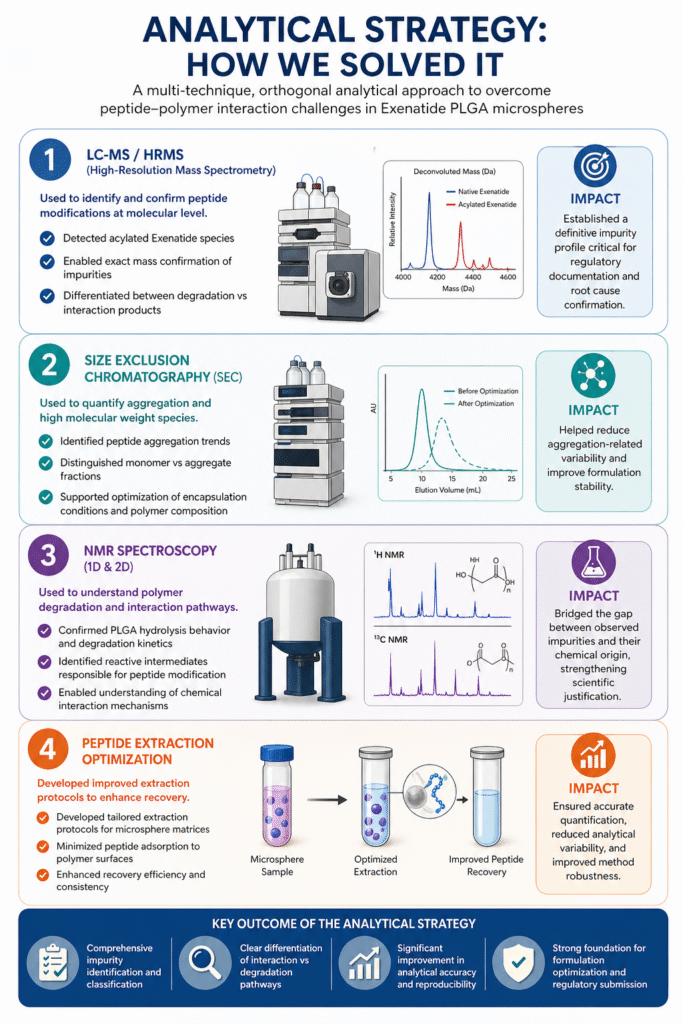
A robust Exenatide PLGA Microsphere Characterization strategy was achieved using a multi-technique, orthogonal analytical approach to accurately identify, quantify, and mitigate peptide–polymer interaction challenges.
1. LC-MS / HRMS (High-Resolution Mass Spectrometry)
Used to identify and confirm peptide modifications at molecular level.
- Detected acylated Exenatide species
- Enabled exact mass confirmation of impurities
- Differentiated between degradation vs interaction products
2. Size Exclusion Chromatography (SEC)
Used to quantify aggregation and high molecular weight species.
- Identified peptide aggregation trends
- Helped optimize formulation conditions
3. NMR Spectroscopy (1D & 2D)
Used to understand polymer degradation and interaction pathways.
- Confirmed PLGA hydrolysis patterns
- Provided structural insights into interaction mechanisms
4. Peptide Extraction Optimization
Developed improved extraction protocols to enhance recovery.
- Reduced peptide adsorption losses
- Improved reproducibility of analytical results
These approaches align with advanced workflows used in PLGA characterization for parenteral use.
5: Formulation Optimization Insights
Adjusting formulation parameters in Exenatide PLGA Microsphere Characterization significantly reduced peptide–polymer interactions, leading to improved stability, reproducibility, and release performance.
Key Improvements:
- Optimized Polymer Composition (Lactide:Glycolide Ratio):
- Fine-tuned ratio to control degradation rate and acidity
- Reduced formation of reactive degradation byproducts
- Improved peptide compatibility and stability
- Controlled Microsphere Porosity:
- Engineered internal structure to regulate drug diffusion pathways
- Minimized initial burst release
- Enabled more predictable and sustained release kinetics
- Minimized Residual Solvents and Moisture:
- Reduced hydrolysis rate of PLGA
- Prevented formation of acidic microclimate داخل microspheres
- Enhanced long-term formulation stability
- Incorporated Stabilizers:
- Added excipients to protect Exenatide from denaturation and aggregation
- Reduced acylation and chemical degradation pathways
- Improved overall peptide integrity during storage and release
Impact of Optimization:
| Parameter | Before Optimization | After Optimization |
|---|---|---|
| Peptide Stability | Low | Significantly Improved |
| Impurity Formation | High | Reduced |
| Burst Release | High | Controlled |
| Release Consistency | Variable | Reproducible |
| Analytical Recovery | Inconsistent | Reliable |
6: In Vitro Release Characterization
A refined analytical method enabled accurate monitoring of release kinetics in Exenatide PLGA Microsphere Characterization, ensuring reliable evaluation of formulation performance before and after optimization.
Observations After Optimization:
- Reduced Initial Burst Release:
Controlled microsphere structure minimized rapid surface drug release. - More Consistent Sustained Release Profile:
Improved polymer design enabled predictable and uniform drug diffusion over time. - Lower Impurity Formation Over Time:
Reduced peptide–polymer interactions led to enhanced chemical stability during release studies.
Release Profile Comparison:
| Parameter | Before Optimization | After Optimization |
|---|---|---|
| Burst Release | High | Controlled |
| Impurity Levels | Elevated | Reduced |
| Release Consistency | Variable | Reproducible |
7: Regulatory and ANDA Implications
Detailed Exenatide PLGA Microsphere Characterization is essential for regulatory acceptance of complex generics, as it demonstrates product quality, consistency, and equivalence to the reference listed drug (RLD).
Key Requirements Addressed:
- Impurity Profiling and Identification:
Comprehensive identification and structural characterization of impurities using advanced techniques (LC-MS, HRMS, NMR) to ensure safety and compliance. - Demonstration of Sameness to Reference Listed Drug (RLD):
Establishing qualitative (Q1) and quantitative (Q2) sameness, along with comparable:- Physicochemical properties
- Peptide integrity
- Release behavior
- Reproducible Release Kinetics:
Consistent in vitro release profiles are critical to demonstrate therapeutic equivalence and batch reliability. - Robust Analytical Validation:
Fully validated methods ensuring:- Accuracy
- Precision
- Specificity
- Reproducibility
Regulatory Framework & Compliance
ResolveMass Laboratories Inc. ensured alignment with globally accepted regulatory guidelines:
- International Council for Harmonisation Q6A (Specifications):
Defines acceptance criteria for drug substance and drug product गुणवत्ता and performance. - International Council for Harmonisation Q3B (Impurities in Drug Products):
Establishes thresholds, reporting, and qualification requirements for impurities. - U.S. Food and Drug Administration Guidance for Complex Injectables:
Provides expectations for:- Complex formulation characterization
- In vitro–in vivo correlation (IVIVC)
- Demonstration of sameness and performance
8: Key Takeaways from this Case Study
Exenatide PLGA Microsphere Characterization demonstrates that complex peptide–polymer systems can be effectively controlled with the right scientific and analytical approach.
Peptide–Polymer Interactions Are Inevitable—But Manageable:
While interactions between Exenatide and PLGA cannot be completely avoided, a well-designed analytical strategy enables their identification, control, and mitigation. Multi-Dimensional Characterization Is Essential:
Successful characterization requires an integrated approach combining:
- Chemical analysis (impurity profiling, degradation pathways)
- Structural insights (molecular interactions, polymer behavior)
- Functional evaluation (release kinetics and performance)
Orthogonal Techniques Provide Complete Understanding:
No single method is sufficient. Techniques like LC-MS, SEC, and NMR must be used together to fully map degradation and interaction mechanisms. Early Insight Prevents Late-Stage Failures:
Identifying peptide–polymer interaction risks early in development helps:
- Avoid costly reformulation
- Reduce regulatory delays
- Improve scalability and reproducibility
9: Why ResolveMass Laboratories Inc.?
ResolveMass Laboratories Inc. brings deep expertise in:
- Complex peptide characterization
- Long-acting injectable analysis
- HRMS and advanced structural elucidation
- Regulatory-driven analytical development
Our approach is grounded in:
- Scientific rigor
- Proven methodologies
- Industry-aligned compliance
Conclusion:
Exenatide PLGA Microsphere Characterization is not just an analytical task—it is a strategic necessity for successful formulation development and regulatory approval. By combining advanced analytical tools with deep scientific insight, peptide–polymer interaction challenges can be effectively understood and mitigated.
This case study demonstrates that with the right expertise and methodology, even the most complex formulation challenges can be transformed into scalable, compliant, and high-quality pharmaceutical solutions.
Frequently Asked Questions:
Exenatide PLGA Microsphere Characterization is the comprehensive analytical evaluation of Exenatide-loaded PLGA formulations to assess stability, impurity profile, and drug release performance.
It involves techniques like LC-MS, SEC, and NMR to ensure product quality and regulatory compliance.
It is critical for ensuring consistent drug delivery, safety, and regulatory approval of long-acting injectable formulations.
Without proper characterization, peptide instability and variability can compromise therapeutic efficacy.
The key challenges include peptide acylation, aggregation, and inconsistent release profiles due to peptide–polymer interactions.
Additionally, PLGA degradation creates an acidic microenvironment that accelerates peptide instability.
PLGA degrades into acidic byproducts that can chemically modify and degrade Exenatide.
This leads to impurity formation, reduced potency, and altered release behavior.
Peptide acylation is a chemical reaction where PLGA degradation products covalently modify Exenatide.
This results in increased molecular weight, reduced biological activity, and regulatory concerns.
Reference
- Li T, Chandrashekar A, Beig A, Walker J, Hong JK, Benet A, Kang J, Ackermann R, Wang Y, Qin B, Schwendeman AS. Characterization of attributes and in vitro performance of exenatide-loaded PLGA long-acting release microspheres. European Journal of Pharmaceutics and Biopharmaceutics. 2021 Jan 1;158:401-9.https://www.sciencedirect.com/science/article/pii/S0939641120303088
- Wang Y, Sun T, Zhang Y, Chaurasiya B, Huang L, Liu X, Tu J, Xiong Y, Sun C. Exenatide loaded PLGA microspheres for long-acting antidiabetic therapy: preparation, characterization, pharmacokinetics and pharmacodynamics. RSC advances. 2016;6(44):37452-62.https://pubs.rsc.org/en/content/articlehtml/2016/ra/c6ra02994a
- Sheikhi M, Sharifzadeh M, Hennink WE, Firoozpour L, Hajimahmoodi M, Khoshayand MR, Shirangi M. Design of experiments approach for the development of a validated method to determine the exenatide content in poly (lactide-co-glycolide) microspheres. European Journal of Pharmaceutics and Biopharmaceutics. 2023 Nov 1;192:56-61.https://www.sciencedirect.com/science/article/pii/S093964112300259X
- Gao Z, Wei Y, Ma G. A review of recent research and development on GLP-1 receptor agonists-sustained-release microspheres. Journal of Materials Chemistry B. 2023;11(47):11184-97.https://pubs.rsc.org/en/content/articlehtml/2023/od/d3tb02207b
About the Author


