

Introduction:
The right CDMO capabilities for generic injectable ANDA development should cover the entire product lifecycle — from formulation and analytical development through GMP manufacturing, stability, validation, and regulatory submission support. Complex injectable products generally require greater scientific and operational integration than conventional oral solid dosage forms.
For pharmaceutical companies developing an injectable generic, selecting a CDMO should not be based solely on manufacturing capacity. The more important question is whether the CDMO can scientifically demonstrate that the proposed generic product is equivalent, controlled, reproducible, stable, and supported by appropriate CMC and analytical evidence. This is especially true for sponsors evaluating CDMO options for generic drug development in Canada or comparing pharmaceutical CDMO partners across the US and Canada, where regulatory expectations and analytical depth vary by partner.
FDA’s ANDA framework requires applicants to submit appropriate information in Common Technical Document (CTD) format and places significant emphasis on complete, high-quality applications.
Summary:
- CDMO capabilities for generic injectable ANDA projects must extend beyond routine manufacturing to include formulation development, analytical characterization, process development, sterile manufacturing, bioequivalence support, stability testing, quality systems, and regulatory documentation.
- Complex injectable products include long-acting injectables, suspensions, emulsions, liposomes, depot formulations, peptides, and drug-device combinations — each with distinct analytical and regulatory demands.
- A qualified CDMO connects formulation science, analytical development, process understanding, GMP manufacturing, and regulatory strategy into a single, traceable development program.
- Analytical work should address critical quality attributes (CQAs), impurities, degradation products, particulate matter, assay performance, and container-closure risk with orthogonal, submission-ready methods.
- Technology transfer, method validation, stability, deviation/CAPA management, change control, and documentation systems are essential for scale-up and commercialization.
- Early assessment of CDMO capabilities reduces development risk, prevents analytical gaps, and improves overall ANDA readiness.
1: What Are the Essential CDMO Capabilities for Generic Injectable ANDA Projects?
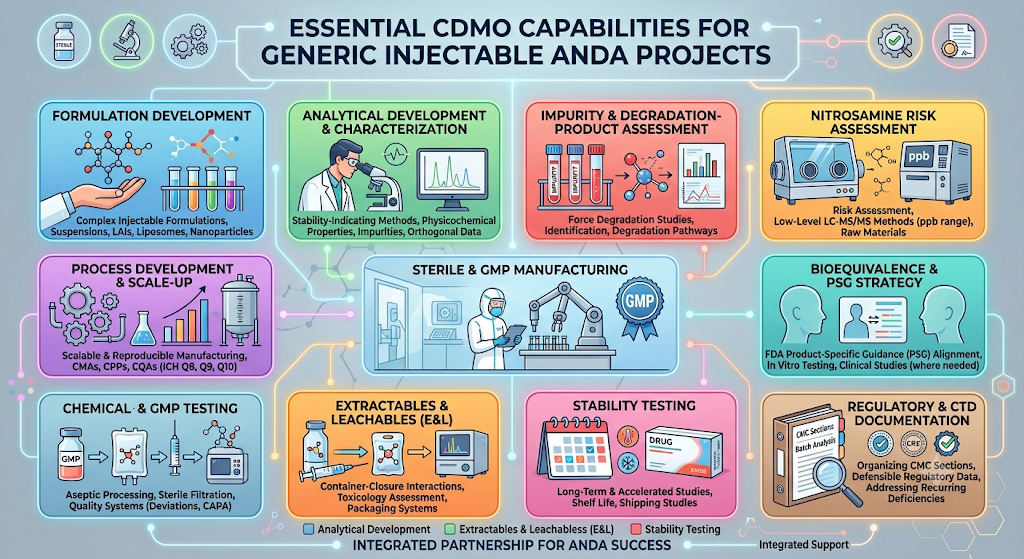
The essential CDMO capabilities for generic injectable ANDA projects include formulation development, analytical development, product characterization, process development, sterile/GMP manufacturing, stability testing, quality systems, technology transfer, and regulatory support.
A practical CDMO evaluation should cover the following areas:
| Capability Area | What the CDMO Should Demonstrate |
|---|---|
| Formulation Development | Experience with complex injectable formulations |
| Analytical Development | Stability-indicating and product-specific methods |
| Characterization | Comprehensive physicochemical and impurity characterization |
| Process Development | Scalable and reproducible manufacturing processes |
| Sterile Manufacturing | Appropriate aseptic/sterile processing capabilities |
| Bioequivalence Support | Strategy aligned with applicable FDA PSG expectations |
| GMP Quality System | Validated systems, deviations, CAPA, and change control |
| Stability | Appropriate stability programs and data management |
| Technology Transfer | Controlled transfer from development to GMP production |
| Regulatory Support | CTD/CMC documentation and regulatory response support |
A CDMO that cannot demonstrate these capabilities may create gaps between development, analytical testing, manufacturing, quality, and regulatory submission. Sponsors comparing outsourcing models often also weigh a CDMO vs. CRO decision for generic drug development, since the two models allocate scientific and regulatory responsibility differently.
1. Formulation Development Capability
A complex injectable CDMO should have demonstrated experience developing formulations that address solubility, stability, viscosity, particle size, aggregation, precipitation, osmolality, pH, and drug-release behavior.
For injectable suspensions, this typically requires careful control of:
- Particle size distribution
- Solid-state characteristics
- Sedimentation and redispersibility
- Viscosity and drug loading
- Surface properties
- Release behavior
Long-acting injectables (LAIs) introduce additional challenges involving controlled drug release, polymer degradation, microsphere characteristics, and in vitro/in vivo relationships. Sponsors developing depot products should review dedicated guidance on CDMO capabilities for long-acting injectable formulation development, including project-specific considerations such as CRO support for leuprolide depot development and the broader question of how to select a leuprolide depot CDMO.
For liposomal or nanoparticle-based products, the development program should evaluate:
- Particle size and distribution
- Encapsulation efficiency and drug loading
- Free versus encapsulated drug
- Lipid composition and morphology
- Release behavior, aggregation, and stability
The CDMO should demonstrate that formulation decisions are supported by experimental evidence and risk-based development, not formulation screening alone.
Peptide Injectable Formulation Considerations
Many complex generic injectables are peptide-based, which adds its own layer of formulation and analytical complexity. A CDMO working on peptide injectables should be able to point to dedicated peptide CDMO services covering synthesis, purification, and formulation, and sponsors evaluating partners should understand what separates the best peptide CDMOs from generalist manufacturers, as well as the practical differences in a peptide CDMO vs. CRO or peptide CDMO vs. CMO comparison. For sponsors based in or targeting the US market, it’s also worth reviewing what a peptide CDMO in the United States should offer before committing to outsourcing peptide manufacturing to a CDMO, particularly where specialized peptide CDMO services are required for complex sequences or modified peptides.
2. Analytical Development and Characterization
Analytical development is one of the most important CDMO capabilities for generic injectable ANDA projects because regulatory decisions depend heavily on reliable analytical evidence. A capable analytical organization should be able to develop, optimize, validate, transfer, and execute methods appropriate for the specific product.
Typical analytical requirements may include:
- Assay, identification, and related substances/degradation products
- Content uniformity, where applicable
- Preservative content, pH, and osmolality
- Water content, residual solvents, and elemental impurities
- Particulate matter and visible particles
- Extractables and leachables, where relevant
- Container-closure characterization
- Sterility-related testing, endotoxin testing, and microbial limits, where applicable
For complex molecules or formulations, advanced analytical technologies may also be required, including LC-MS/MS, high-resolution mass spectrometry (HRMS), GC-MS, NMR spectroscopy, SEC, ion-exchange chromatography, RP-HPLC, particle-size analysis, and spectroscopic characterization. The objective is not simply to generate more analytical data — it is to generate orthogonal, scientifically meaningful data that demonstrate product quality and comparability.
3. Impurity and Degradation-Product Assessment
A complex injectable CDMO should have the capability to investigate both known and unknown impurities. Injectable products can be affected by degradation arising from API or excipient degradation, oxidation, hydrolysis, light exposure, temperature stress, manufacturing processes, container-closure interactions, leachables, and packaging components.
A strong analytical strategy should include forced degradation studies where scientifically appropriate, impurity identification, degradation pathway assessment, and stability-indicating method development. For unknown peaks, high-resolution mass spectrometry can help determine accurate mass and provide structural information that supports impurity identification — an approach that is particularly valuable for ANDA development, since the analytical package must demonstrate that selected methods can detect meaningful changes in product quality.
Nitrosamine Risk Assessment
Since the FDA’s nitrosamine guidance expansion, generic injectable sponsors are expected to submit a documented nitrosamine risk assessment covering API synthesis route, formulation excipients, and packaging-derived leachables — regardless of dosage form. A CDMO without validated low-level (ppb-range) LC-MS/MS methods cannot support this requirement in-house; sponsors should confirm a partner’s nitrosamine testing capabilities for CDMO projects before finalizing a development timeline.
4. Process Development and Scale-Up
A capable injectable CDMO must be able to translate laboratory formulation knowledge into a controlled and reproducible manufacturing process. Scale-up can introduce changes in mixing efficiency, shear, heat transfer, addition rates, homogenization, filtration, filling, hold times, equipment geometry, process temperature, and sterilization conditions — and for complex injectables, seemingly minor process changes can affect critical quality attributes.
A science-based process development program should identify:
- Critical Material Attributes (CMAs)
- Critical Process Parameters (CPPs)
- Critical Quality Attributes (CQAs)
- Relationships between materials, processes, and product performance
This approach is consistent with the pharmaceutical development and quality risk management principles described in ICH Q8, Q9, and Q10.
5. Sterile and GMP Manufacturing Capability
For injectable ANDA projects, GMP manufacturing capability is essential. A CDMO should be able to demonstrate appropriate controls for raw-material management, environmental monitoring, aseptic processing (where applicable), sterile filtration, filling and finishing, cleaning, equipment qualification, process validation, container-closure integrity, personnel training, batch documentation, deviation management, CAPA, and change control.
The GMP environment should be supported by an effective pharmaceutical quality system rather than documented procedures alone. A mature quality system integrates GMP requirements with pharmaceutical development and quality risk management, providing a structured approach to maintaining product quality throughout the product lifecycle.
Ophthalmic injectables and related sterile ophthalmic products carry their own container-closure and sterility considerations; sponsors working in this space should review specific CDMO services for generic ophthalmic drug products.
6. Bioequivalence and Product-Specific Guidance Strategy
Bioequivalence strategy for a complex injectable is product-specific, so a CDMO should understand the applicable FDA Product-Specific Guidance (PSG) before finalizing development activities. FDA publishes PSGs describing its current recommendations for developing generic versions of specific drug products.
Depending on the product, the development strategy may involve:
- Comparative physicochemical characterization
- In vitro performance and release testing
- Pharmacokinetic and, where appropriate, pharmacodynamic studies
- Comparative clinical studies, where required
- Device-related comparisons and additional product-specific studies
The applicable PSG should be reviewed early in development rather than near ANDA completion, particularly because FDA periodically publishes new and revised guidances for complex generic products.
7. Stability Testing Capability
Stability testing should demonstrate that the injectable product maintains its quality throughout the proposed shelf life under appropriate storage conditions. A CDMO should have a documented stability strategy covering long-term, accelerated, and (where applicable) intermediate stability, photostability, in-use stability, freeze-thaw studies, shipping/temperature-excursion studies, and container-closure evaluation.
Stability-indicating analytical methods are essential because the stability program must detect meaningful changes in product quality. For complex injectables, stability programs may need to monitor assay, degradation products, particle size, aggregation, pH, appearance, particulate matter, and release characteristics simultaneously. A well-designed program provides critical evidence supporting the proposed shelf life and storage conditions.
8. Extractables and Leachables and Container-Closure Assessment
Injectable products can interact with their packaging systems, particularly during long-term storage. A qualified CDMO should be capable of evaluating potential risks associated with vials, elastomeric closures, syringes, plastic components, bags, tubing, administration sets, prefilled syringe components, and drug-delivery devices.
Extractables and leachables investigations may use LC-MS, GC-MS, ICP-MS, headspace GC-MS, non-targeted screening, and targeted quantification. The analytical strategy should be based on the formulation, packaging configuration, route of administration, exposure conditions, and toxicological relevance of detected compounds. Container-closure evaluation should be built into development from the start, not treated as a packaging afterthought.
9. Technology Transfer and Scale-Up Readiness
A strong CDMO should have a formal technology-transfer process that maintains product and process knowledge throughout development. A robust technology-transfer package should address master formulation, manufacturing process, raw-material specifications, equipment requirements, analytical methods and method transfer, sampling plans, in-process controls, critical process parameters and quality attributes, acceptance criteria, stability requirements, and cleaning requirements.
Technology transfer becomes especially important when a product moves from a development site into commercial manufacturing. The objective should be knowledge transfer — not simply document transfer — so the receiving team understands not only what process steps are performed but why specific controls and acceptance criteria are required. Peptide products introduce their own transfer complexities around sequence-specific purification and degradation control, which is why sponsors should evaluate peptide technology transfer capabilities and confirm a partner’s experience specifically with peptide technology transfer to a CDMO.
10. GMP Analytical Quality System
The analytical laboratory supporting an ANDA project should have a quality system capable of producing defensible regulatory data. Sponsors should evaluate whether the CDMO has qualified instruments, calibration and preventive maintenance programs, validated analytical methods, system suitability procedures, reference-standard qualification, controlled reagents, data-integrity controls, audit trails, OOS/OOT investigation procedures, laboratory deviation management, CAPA, change control, analyst training, and controlled documentation.
The ability to generate an analytical result is only one part of laboratory capability — the CDMO must also demonstrate that the result is traceable, reproducible, reviewable, and supported by appropriate documentation.
11. Regulatory and CTD Documentation Support
A technically capable CDMO should understand how analytical and manufacturing data ultimately fit into the ANDA submission. FDA’s ANDA framework uses the CTD structure and requires appropriate CMC information to support the proposed generic product. A CDMO should be able to generate organized documentation supporting relevant CMC sections, including drug substance information, drug product development, manufacturing process and controls, specifications, analytical procedures and validation, batch analysis, reference standards, container-closure systems, and stability data.
The CDMO should also have a controlled process for responding to regulatory questions, laboratory investigations, and deficiency requests. FDA’s Good ANDA Submission Practices guidance addresses recurring deficiencies that can delay ANDA approval, which is why regulatory documentation should be considered throughout development rather than assembled only afterward. Sponsors should confirm a partner’s track record on regulatory support for generic drugs across the US and Canada as part of this evaluation, and review how the CDMO’s overall CMC strategy for complex generic injectables is structured before development begins.
12. Data Integrity and Traceability
Data integrity is a fundamental consideration when selecting a CDMO for regulatory development. The organization should be able to demonstrate appropriate controls for attributable data, legible records, contemporaneous documentation, original records or verified copies, accurate results, controlled electronic systems, audit trails, secure access controls, data backup and recovery, and controlled changes to records.
The question for a sponsor should not simply be “Can the CDMO perform this test?” A more important question is: can the CDMO generate reliable, traceable, reviewable data that can withstand regulatory scrutiny? This distinction matters most for ANDA projects, where analytical results become part of the scientific and regulatory justification for product quality.
2: CDMO Capabilities Checklist for Generic Injectable ANDA: Sponsor Evaluation
Before selecting a development or analytical partner, sponsors can use the checklist below.
Scientific Capabilities
- Experience with complex injectable products
- Formulation development expertise
- Injectable product characterization
- Impurity profiling and forced degradation studies
- Advanced mass spectrometry and particle characterization
- Release/performance testing
Manufacturing Capabilities
- GMP manufacturing and sterile/aseptic processing capability
- Scale-up experience and process validation
- Equipment qualification
- Container-closure integrity testing
- Commercial manufacturing readiness
Quality Capabilities
- GMP laboratory with validated analytical methods
- OOS/OOT investigation system
- CAPA and change control
- Audit-trail controls and a data-integrity program
Regulatory Capabilities
- Experience supporting ANDAs
- Product-Specific Guidance assessment
- CTD documentation and CMC strategy
- Regulatory response support
- Pre-ANDA meeting support, where applicable
3: Why an Integrated Analytical and CDMO Strategy Matters
The strongest development programs connect formulation, analytical science, manufacturing, quality, and regulatory strategy from the beginning. For example, a formulation change can affect particle size; particle size can influence dissolution or release; release behavior can influence product performance; packaging can influence chemical stability; and manufacturing conditions can influence impurity formation. These relationships mean that isolated outsourcing across multiple disconnected vendors can create fragmented data and inconsistent decision-making.
An integrated CDMO or analytical partner instead establishes a development knowledge base in which analytical results directly inform formulation and process decisions. Early regulatory interaction and a clear understanding of FDA expectations also reduce the risk of generating data that don’t adequately address the applicable development pathway — a key reason sponsors weigh a CRO vs. in-house ANDA development approach, and increasingly look at structured CRO-CDMO ANDA partnership models rather than piecing together multiple vendors. For sponsors early in the process, understanding what a generic drug development CRO for ANDA projects actually delivers — versus a manufacturing-only CDMO — is a useful first step.
4: How ResolveMass Laboratories Can Support Complex Injectable ANDA Development
ResolveMass Laboratories Inc. provides analytical science and characterization support for pharmaceutical development programs, helping sponsors address complex analytical questions that arise during generic drug development with a CDMO partner.
For complex injectable programs, analytical support may include:
- Advanced pharmaceutical characterization
- LC-MS/MS and HRMS analysis
- Impurity profiling and degradation-product investigation
- Analytical method development and validation
- Stability-indicating analytical methods
- Extractables and leachables investigations
- Container-closure-related analytical assessments
- Physicochemical characterization
- Analytical technology transfer
- GMP-oriented analytical documentation
The value of an analytical partner is greatest when testing is connected to the broader CMC strategy. Instead of treating analytical testing as a final-stage activity, sponsors can use analytical evidence throughout development to identify risks, understand formulation behavior, support process decisions, and strengthen regulatory documentation. This is particularly relevant for companies exploring outsourcing generic drug development in Canada for the first time, or evaluating CDMO options for generic projects in Canada more broadly.
5: How to Select the Right CDMO for a Complex Injectable ANDA
The best CDMO is not necessarily the organization with the largest manufacturing facility — it is the partner that can demonstrate scientific competence, regulatory awareness, GMP maturity, analytical depth, scalability, and transparent communication. This is especially important when choosing the right CRO/CDMO for an ANDA submission, where the wrong choice can add months or years to a program.
Before signing a development agreement, sponsors should ask:
- Has the CDMO previously worked with complex injectable formulations?
- Can it support both development-stage and GMP-stage analytical requirements?
- Does it have appropriate analytical characterization technologies?
- Can analytical methods be transferred and validated?
- Does the organization understand the applicable FDA Product-Specific Guidance?
- Can it support CTD-ready CMC documentation?
- How are deviations, OOS results, and CAPAs managed?
- How is data integrity demonstrated?
- Can the process be scaled from laboratory development to commercial manufacturing?
- Can the CDMO support regulatory questions after submission?
A CDMO that can answer these questions with documented evidence, appropriate technical resources, and relevant project experience is better positioned to support a complex ANDA program. Sponsors evaluating a partner for the first time should also review practical guidance on outsourcing a first generic drug project to a CDMO, since first-time outsourcing decisions carry different risks than follow-on programs with an established partner.
Conclusion:
Selecting the right CDMO capabilities for generic injectable ANDA development is a strategic CMC decision, not simply a manufacturing decision. Complex injectables require coordinated expertise across formulation development, analytical characterization, process development, sterile manufacturing, stability, container-closure evaluation, quality systems, and regulatory documentation.
For sponsors, the ideal CDMO should provide a combination of technical depth, GMP discipline, analytical capability, regulatory awareness, data integrity, and lifecycle support. A well-designed partnership can transform fragmented development activities into a coherent CMC strategy, generating reliable evidence that supports product quality, regulatory review, and eventual commercialization.
ResolveMass Laboratories Inc. supports pharmaceutical companies with advanced analytical characterization, impurity investigation, mass spectrometry, extractables and leachables testing, method development, validation, and other analytical requirements associated with complex generic injectable drug development.
Frequently Asked Questions:
A generic injectable may be considered complex because of its formulation, route of administration, delivery system, active ingredient, dosage form, or drug-device combination. Examples can include long-acting injectables, liposomes, emulsions, suspensions, microspheres, nanoparticles, and other modified-release or complex delivery systems.
Analytical development provides reliable methods for identifying, quantifying, and monitoring critical product attributes. Properly developed and validated analytical methods generate evidence for product quality, stability, impurity control, batch release, comparability, and CMC sections of the ANDA.
Impurity profiling helps identify and control process-related impurities, degradation products, and potentially unknown compounds. Understanding impurity profiles is important for establishing appropriate specifications, stability-indicating methods, and scientifically justified control strategies.
Yes, when the project requires sterile injectable manufacturing, the CDMO should have appropriate sterile or aseptic processing capabilities and supporting GMP controls. These may include environmental monitoring, sterile filtration, aseptic filling, equipment qualification, process validation, and appropriate contamination-control measures.
Effective technology transfer ensures that formulation, manufacturing, analytical, and process knowledge is successfully transferred between development and manufacturing teams. A controlled transfer can reduce variability, prevent knowledge gaps, and improve the reproducibility of the manufacturing process.
Reference
- Sinha A. Key Analytical Challenges in Leuprolide Depot Generic Development and How to Overcome Them.https://resolvemass.ca/leuprolide-depot-analytical-challenges/
- Pawar J, Hegde N, Sharma S. Focusing on first cycle approval in ANDA submission: understanding common deficiencies & case study insights. Therapeutic Innovation & Regulatory Science. 2025 May;59(3):426-37.https://link.springer.com/article/10.1007/s43441-025-00755-5
- PARASRAMPURIA S, SERTKAYA A, LORD A, BERGER C. Cost of generic drug development and approval final [Internet]. 2021 Dec 31.https://aspe.hhs.gov/sites/default/files/documents/66e13df52a6d314ba4e10c8e55b68b4b/cost-of-generic-drugs-erg.pdf
- Bangarurajan K, Ramkishan A, Gupta VK. The Global Scenario of Generic Drugs: Promises, Challenges and the Road Ahead. Generic Drugs: Science, Technology, Regulatory Frameworks and Socio-Economic Aspects. 2026 Apr 6:189.https://books.google.com/books?hl=en&lr=&id=ByHREQAAQBAJ&oi=fnd&pg=PA189&dq=CDMO+Capabilities+Checklist+for+Complex+Generic+Injectable+ANDA+Projects&ots=6081ZCdeSK&sig=W3jW1g5GZlzwM0Z45m0yrMElSeY
About the Author


