

Introduction
CDMO Services for Generic Topical and Semisolid Drug Products provide the specialized formulation development, analytical characterization, and manufacturing capabilities necessary to support characterization-based bioequivalence pathways for Abbreviated New Drug Application (ANDA) approvals. Through the establishment of qualitative (Q1), quantitative (Q2), and microstructural (Q3) sameness, combined with comprehensive in vitro performance assessments, these contract development and manufacturing services help pharmaceutical companies obtain biowaivers and avoid expensive clinical endpoint bioequivalence studies.
Topical semisolid dosage forms—including emulsified systems such as creams, hydrocarbon- or oleaginous-based ointments, and polymeric gel matrices—present unique physicochemical challenges. In contrast to oral solid dosage forms, where systemic pharmacokinetic measurements can serve as a direct indicator of bioequivalence, topical products generally produce their therapeutic action locally within specific skin layers, including the stratum corneum, viable epidermis, and dermis. The internal organization and microstructure of a semisolid formulation play a critical role in controlling drug release behavior, partitioning characteristics, thermodynamic activity, and permeation through the skin.
Following the publication of multiple United States Food and Drug Administration (FDA) draft guidances addressing topical product characterization, in vitro release testing (IVRT), and in vitro permeation testing (IVPT), the regulatory environment has increasingly shifted toward standardized in vitro bioequivalence approaches. A successful ANDA development program requires comprehensive reverse engineering of the Reference Listed Drug (RLD), confirmation of critical quality attributes (CQAs), validation of diffusion-based performance methods, and strict management of critical process parameters (CPPs) throughout manufacturing scale-up and commercialization.
Looking to streamline your generic submission pipeline? Explore our comprehensive One-Stop CDMO Analytical Services for ANDA.
Share via:
Article Summary:
- CDMO services support generic topical and semisolid ANDA development through formulation, analytical testing, manufacturing, scale-up, and regulatory support for creams, ointments, and gels.
- Q1/Q2/Q3 sameness is central to characterization-based bioequivalence: Q1 confirms the same excipients, Q2 targets excipient concentrations within ±5%, and Q3 evaluates microstructure such as rheology, particle size, polymorphism, and thermodynamic activity.
- Deformulation and reverse engineering use techniques such as HPLC/LC-MS, GC-MS, NMR, FTIR, DSC, and TGA to identify and characterize the RLD’s APIs and excipients.
- IVRT and IVPT provide key in vitro performance evidence: IVRT measures drug release from the formulation, while IVPT measures drug permeation through human skin and evaluates parameters such as Jmax and AMT.
- Manufacturing scale-up must control critical process parameters including homogenization, cooling, mixing, polymer hydration, crystallization, and vacuum processing to maintain Q3 equivalence and batch consistency.
- Regulatory strategies integrate Q1/Q2/Q3 characterization with IVRT and IVPT under FDA Product-Specific Guidances, No Significant Difference (NSD) assessments, and, where appropriate, PDEV/Pre-ANDA meetings.
- SUPAC-SS compliance provides a framework for post-approval manufacturing changes, while an integrated CDMO approach can help reduce regulatory risk, development time, and the need for costly clinical endpoint bioequivalence studies.
Scientific Foundations of Q1, Q2, and Q3 Sameness in CDMO Services for Generic Topical and Semisolid Drug Products
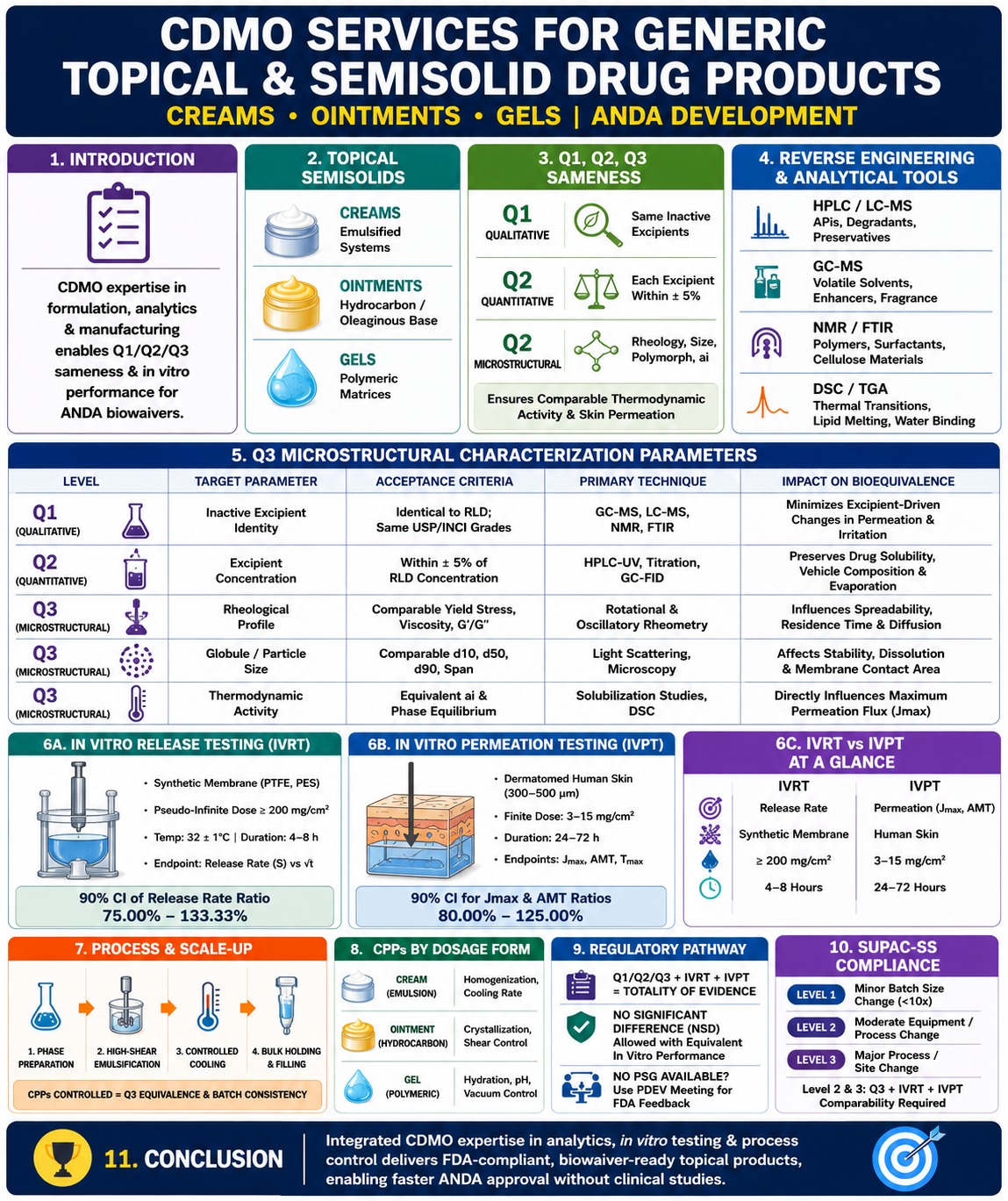
Q1, Q2, and Q3 sameness evaluations within CDMO Services for Generic Topical and Semisolid Drug Products are designed to demonstrate that a generic formulation contains the same active and inactive ingredients, equivalent excipient levels, and a comparable physical microstructure to the Reference Listed Drug (RLD). This layered approach to physicochemical equivalence helps ensure comparable thermodynamic activity and skin permeation behavior throughout the topical dosage form.
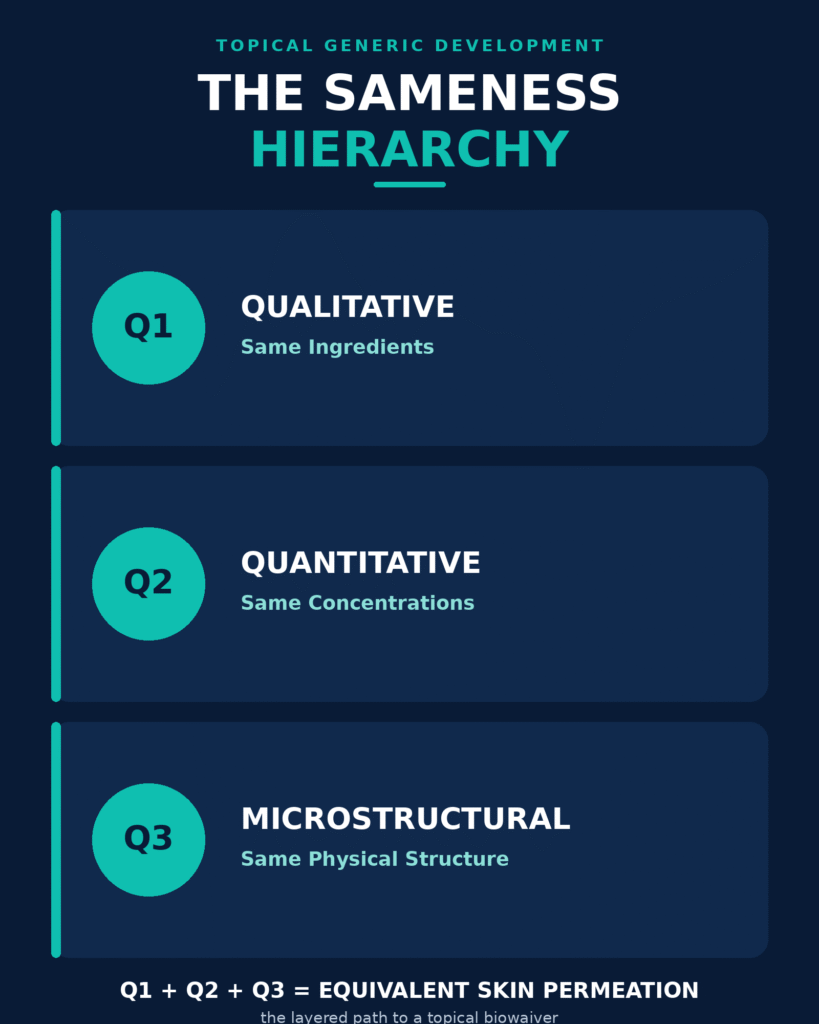
The regulatory framework governing generic semisolid products is built upon a hierarchical model of formulation sameness:
- Qualitative Sameness (Q1): Demonstrates that the generic formulation contains the same inactive excipients as the RLD.
- Quantitative Sameness (Q2): Requires that each inactive excipient is present at concentrations within ± 5% of the corresponding concentration in the RLD.
- Microstructural Sameness (Q3): Evaluates critical physical attributes such as rheological characteristics, globule size distribution, phase equilibrium, API polymorphic form, and thermodynamic activity.
When Q1 and Q2 sameness are established together with Q3 microstructural equivalence, the thermodynamic driving force responsible for active pharmaceutical ingredient (API) release remains comparable between the generic formulation and the reference product.
Learn more about navigating complex generic approvals with our guide on Bioequivalence Study Design for Complex Generic Drug Products.
Deformulation and Analytical Reverse Engineering Techniques
Deformulation involves the identification and quantification of all APIs and excipients within the RLD to facilitate accurate Q1/Q2 matching. Reverse engineering programs utilize multiple orthogonal analytical technologies, including chromatographic, spectroscopic, and thermal characterization methods, to decipher complex lipid-based and polymeric formulation systems.
- High-Performance Liquid Chromatography (HPLC / LC-MS): Used for the separation and quantification of APIs, degradation products, preservatives, and solubilizing agents.
- Gas Chromatography-Mass Spectrometry (GC-MS): Employed to identify volatile co-solvents, penetration enhancers, fragrance constituents, and low-molecular-weight lipid species.
- Nuclear Magnetic Resonance (NMR) and Fourier-Transform Infrared Spectroscopy (FTIR): Applied to verify chemical identity and quantify complex polymeric excipients, surfactants, and cellulose-derived materials.
- Differential Scanning Calorimetry (DSC) and Thermogravimetric Analysis (TGA): Utilized to characterize thermal transitions, water-binding behavior, and lipid melting characteristics within semisolid systems.
Microstructural (Q3) Characterization Parameters in CDMO Services for Generic Topical and Semisolid Drug Products
Microstructural Q3 characterization focuses on evaluating rheological properties, physical state, particle size distribution, and phase organization to verify that the generic formulation performs similarly to the reference product. Any alteration in formulation microstructure can influence the thermodynamic activity (ai) of the API and subsequently impact skin permeation performance.
Advanced characterization programs incorporate rotational and oscillatory rheometry to evaluate yield stress, flow behavior, thixotropic recovery, and viscoelastic properties, including storage modulus (G’) and loss modulus (G”) over a range of temperatures. Particle and globule size distributions are measured using optical microscopy, static light scattering, and dynamic light scattering to determine d10, d50, d90, and span values. API polymorphic stability is examined through X-ray Powder Diffraction (XRD) and Raman spectroscopy, while phase distribution studies assess API partitioning between aqueous and lipophilic domains, alongside pH measurements following 50% aqueous dilution.
| Characterization Level | Target Parameter | Regulatory Acceptance Criteria | Primary Analytical Technique | Impact on Bioequivalence |
|---|---|---|---|---|
| Q1 (Qualitative) | Inactive Excipient Identity | Identical ingredients to the RLD; matching USP/INCI grades where applicable | GC-MS, LC-MS, NMR, FTIR | Minimizes the risk of excipient-driven changes in skin permeation and irritation potential |
| Q2 (Quantitative) | Excipient Concentration | Within ± 5% of the target RLD concentration | HPLC-UV, Titration, GC-FID | Preserves drug solubility, vehicle composition, and evaporation behavior |
| Q3 (Microstructural) | Rheological Profile | Statistically comparable yield stress, viscosity profile, and G’/G” values | Rotational and Oscillatory Rheometry | Influences spreadability, residence time, and diffusion characteristics |
| Q3 (Microstructural) | Globule/Particle Size | Comparable d10, d50, d90, and span distributions | Static/Dynamic Light Scattering, Laser Diffraction | Affects stability, dissolution performance, and membrane contact area |
| Q3 (Microstructural) | Thermodynamic Activity | Equivalent thermodynamic activity (ai) and phase equilibrium | Solubilization Studies, Differential Scanning Calorimetry | Directly influences maximum permeation flux (Jmax) through the skin |
Expanding your generic portfolio across complex dosage forms? Read about our CDMO Services for Generic Ophthalmic Drug Products.
In Vitro Release Testing (IVRT) and In Vitro Permeation Testing (IVPT) Execution
In Vitro Release Testing (IVRT) and In Vitro Permeation Testing (IVPT) represent the primary surrogate performance methodologies used by regulatory authorities to establish bioequivalence for generic topical semisolids without conducting clinical studies. IVRT measures the intrinsic release rate of a drug from a formulation through a synthetic membrane, whereas IVPT evaluates the transport of drug molecules across human skin into a physiological receptor medium.
These in vitro methodologies serve as the foundation of characterization-based biowaiver submissions. IVRT functions as a sensitive indicator of formulation structure and manufacturing consistency, capable of identifying subtle variations in formulation composition or processing. In contrast, IVPT provides pharmacokinetic information related to drug delivery into and across the skin, serving as a surrogate indicator of local bioavailability and therapeutic performance.
In Vitro Release Testing (IVRT) Method Development and Validation
IVRT method development performed under USP requirements evaluates the steady-state release behavior of the API from the semisolid matrix using Vertical Diffusion Cells (Franz cells) fitted with inert synthetic membranes. Common membrane materials include polytetrafluoroethylene (PTFE), polyethersulfone (PES), and cellulose acetate. These membranes separate the donor compartment from the receptor chamber, which contains an aqueous or hydroalcoholic receptor medium maintained at 32°C ± 1°C.
A pseudo-infinite dose (≥ 200 mg/cm²) is applied to the donor chamber to sustain zero-order release conditions throughout the experiment. The cumulative amount of drug released per unit surface area (Q) is plotted against the square root of time (√t) according to the Higuchi diffusion model:
Q = 2C₀ √(D·t/π) = S·√t
where S represents the release rate slope.
Comprehensive IVRT method validation in accordance with ICH Q2(R2) guidance includes assessment of membrane inertness, sink condition maintenance, linearity (r² ≥ 0.97), accuracy, precision, recovery, range, and specificity. A critical component of validation is demonstrating discriminatory power by showing that the method can distinguish between target formulations and intentionally modified formulations with altered API concentrations. Regulatory acceptance generally requires the bioequivalence release rate ratio between test and reference products to fall within the non-parametric 90% confidence interval range of 75.00% to 133.33%.
In Vitro Permeation Testing (IVPT) Protocol Design and Cutaneous Pharmacokinetics
IVPT protocol design focuses on evaluating the cutaneous pharmacokinetics of a generic formulation by measuring maximum flux (Jmax) and cumulative permeation (AMT) through dermatomed human skin. Human donor skin, commonly obtained from abdominal or posterior torso tissue and dermatomed to a thickness of 300–500 µm, is mounted within diffusion cell systems. Skin integrity is verified using transepithelial electrical resistance (TEER) measurements or transepidermal water loss (TEWL) assessments.
Unlike IVRT, IVPT employs finite dosing conditions, typically ranging from 3 to 15 mg/cm², to replicate real-world patient application practices. Samples collected from the receptor medium over a period of 24 to 72 hours are used to generate permeation profiles and calculate key pharmacokinetic parameters:
- Maximum Flux (Jmax): The highest observed permeation rate per unit area (ng/cm²/hr).
- Total Cumulative Permeation (AMTt): The cumulative amount of drug permeating through the skin barrier over the study period (ng/cm²).
- Time to Maximum Flux (Tmax): The time required to reach peak permeation rate.
To satisfy regulatory bioequivalence requirements, the 90% confidence intervals for the geometric mean Test/Reference ratios of Jmax and AMT must fall within the accepted range of 80.00% to 125.00% across multiple skin donors.
| Experimental Parameter | In Vitro Release Testing (IVRT) | In Vitro Permeation Testing (IVPT) |
|---|---|---|
| Primary Objective | Evaluates formulation structure, quality, and batch consistency | Measures cutaneous pharmacokinetics and local bioavailability for bioequivalence assessment |
| Membrane/Tissue | Synthetic inert membrane (PTFE, PES, Nylon, etc.) | Dermatomed human skin (300–500 µm thickness) |
| Dosing Regime | Pseudo-infinite dose (≥ 200 mg/cm²) | Finite dose (3–15 mg/cm²) |
| Receptor Medium | Hydroalcoholic or aqueous buffer under sink conditions | Physiological buffer such as PBS with 0.5% Volpo or BSA under sink conditions |
| Sampling Duration | 4–8 hours | 24–72 hours |
| Primary Endpoint Metrics | Drug release rate (S) versus √t | Jmax, AMT, and Tmax |
| Statistical Criteria | 90% CI of release rate ratio within 75.00%–133.33% | 90% CI for Jmax and AMT ratios within 80.00%–125.00% |
Need advanced characterization for non-topical complex active ingredients? Check out our work in GLP-1 Peptide Analytical Characterization.
Process Development, Critical Process Parameters, and Scale-Up for CDMO Services for Generic Topical and Semisolid Drug Products
Commercial-scale production of generic creams, ointments, and gels requires careful management of Critical Process Parameters (CPPs), including homogenization speed, cooling profiles, and mixing intensity, to preserve Q3 microstructural equivalence throughout scale-up activities. Maintaining control of these variables ensures that large-scale manufacturing produces formulations with consistent physical stability and release characteristics equivalent to laboratory-developed batches.
Manufacturing operations for semisolid topical products generally involve four coordinated process stages:
- Phase Preparation: Water-soluble APIs and hydrophilic ingredients are dissolved within the aqueous phase vessel, while lipophilic excipients, emulsifiers, and hydrophobic APIs are heated and melted within the oil phase vessel at temperatures ranging from 70°C to 80°C.
- High-Shear Emulsification: The aqueous and oil phases are combined under controlled addition conditions and homogenized using rotor-stator systems operating at target tip speeds of 15–25 m/s to generate a uniform droplet size distribution.
- Controlled Structure Development and Cooling: The emulsion is cooled according to predefined temperature gradients of 0.5–1.0°C/min while anchor agitators and wall scrapers maintain uniform mixing. Simultaneously, vacuum levels between 200 and 500 mbar are applied to remove entrapped air.
- Bulk Holding and Filling: The finished product is transferred through low-shear positive displacement pumps into storage vessels before automated tube filling and sealing operations.
Exploring outsourcing for your active ingredients? Discover key strategies to Outsource Peptide Manufacturing to CDMO.
Critical Process Parameters Across Creams, Ointments, and Gels
CPP requirements vary depending on the dosage form. For emulsified creams, homogenization energy and cooling profiles determine droplet size and rheological properties. In ointments, crystallization behavior and phase transitions influence matrix structure. For gels, polymer hydration, pH adjustment, and vacuum processing significantly affect viscosity and clarity. Tight process control minimizes structural variability that could compromise bioequivalence performance.
| Dosage Form | Critical Process Parameter (CPP) | Impacted Critical Quality Attribute (CQA) | Scale-Up Control Strategy |
|---|---|---|---|
| Cream (Emulsion) | Homogenizer tip speed, rotor-stator gap, homogenization duration | Globule size distribution (d50/d90), emulsion stability, yield stress | Scale equipment based on constant tip speed calculations (v = π·d·N) |
| Cream (Emulsion) | Cooling rate and jacket temperature differential | Rheological profile, viscoelastic modulus (G’), phase stability | Maintain cooling rates within ± 0.2°C/min through automated temperature control |
| Ointment (Hydrocarbon) | Cooling profile during lipid solidification and shear during crystallization | API particle size distribution, polymorphic consistency, ointment firmness | Control sweep agitation speed throughout critical phase-transition temperatures (40–50°C) |
| Gel (Polymeric Matrix) | Polymer hydration time, neutralization rate, vacuum pressure | Clarity, pH, viscosity, air entrapment | Utilize in-line pH monitoring and maintain vacuum below 300 mbar |
Regulatory Scale-Up and Post-Approval Changes (SUPAC-SS) Compliance
SUPAC-SS guidance establishes the testing expectations associated with manufacturing changes occurring after product approval, including modifications in batch size, equipment configuration, and manufacturing location. These changes are categorized into Level 1 (minor batch-size changes less than tenfold), Level 2 (moderate equipment or process modifications), and Level 3 (major process or site-transfer changes).
For Level 2 and Level 3 changes, manufacturers are generally required to perform extensive comparative assessments, including Q3 characterization, IVRT release testing, and IVPT performance evaluations, to demonstrate that post-change batches remain equivalent to previously approved exhibit batches.
Scaling up your API synthesis alongside formulation? Discover our specialized Peptide API Scale-Up services.
Regulatory Pathways, FDA Product-Specific Guidances, and Biowaiver Execution
Regulatory approval strategies for generic topical products increasingly rely on FDA Product-Specific Guidances (PSGs) and characterization-based biowaiver approaches supported by comprehensive totality-of-evidence submissions. The integration of Q1/Q2/Q3 sameness data with IVRT and IVPT performance results provides a scientifically justified alternative to traditional clinical endpoint bioequivalence studies.
The FDA’s evolving biowaiver framework allows generic sponsors to replace clinical endpoint studies with a comprehensive package demonstrating formulation sameness, microstructural equivalence, comparable drug release behavior, and equivalent skin permeation performance. This evidence-based approach reduces development timelines while maintaining confidence in therapeutic equivalence.
Under the “No Significant Difference” (NSD) assessment framework, certain minor formulation or microstructural differences may be considered acceptable provided that IVRT and IVPT studies demonstrate equivalent functional performance. In situations where an FDA Product-Specific Guidance is unavailable, sponsors may pursue the GDUFA Pre-ANDA Product Development (PDEV) meeting pathway. Through this process, developers can present Q1/Q2/Q3 characterization results, IVRT findings, and IVPT data directly to the FDA to obtain feedback regarding the suitability of proposed in vitro bioequivalence strategies before submitting an ANDA.
Comparing North American manufacturing alternatives? Read our analysis on Canadian vs. US Peptide CDMOs.
Conclusion
CDMO Services for Generic Topical and Semisolid Drug Products provide the specialized scientific expertise, analytical capabilities, and process engineering support required to achieve characterization-based bioequivalence approvals for complex topical creams, ointments, and gels. Successful generic topical ANDA programs depend upon an integrated development strategy that combines comprehensive deformulation, microstructural equivalence assessment, validated IVRT and IVPT methodologies, and robust scale-up controls.
Looking for the right partner in North America? Read how to choose the right partner in our guide on How to Choose a Peptide CDMO in the US.
By partnering with experienced CDMO organizations, pharmaceutical sponsors can effectively meet FDA Product-Specific Guidance expectations, reduce the risk of regulatory deficiencies, and accelerate commercialization timelines for generic topical products without relying on expensive clinical endpoint bioequivalence studies. To learn more about advancing generic topical development programs or discussing specific ANDA strategies, contact the technical team at ResolveMass Contact Services.
Frequently Asked Questions (FAQs)
IVRT and IVPT serve different but complementary purposes during topical product development. IVRT focuses on measuring the rate at which a drug is released from the formulation through a synthetic membrane, making it a useful tool for assessing formulation consistency and quality. IVPT, on the other hand, measures drug permeation through human skin and provides pharmacokinetic parameters such as Jmax and AMT, offering a more clinically relevant assessment of local drug delivery.
IVRT studies are generally conducted under pseudo-infinite dosing conditions, often using doses greater than or equal to 200 mg/cm² to maintain consistent release kinetics throughout the experiment. IVPT studies use finite dosing conditions, commonly ranging from 3 to 15 mg/cm², to better mimic how patients apply topical products in real-world settings. These different dosing approaches reflect the distinct objectives of each test method.
When a generic formulation differs from the RLD in excipient composition or concentration, regulators typically require additional evidence to demonstrate equivalent performance. Expanded IVPT studies, enhanced physicochemical characterization, and in some cases comparative clinical investigations may be necessary. The goal is to confirm that formulation differences do not adversely affect drug delivery, safety, or therapeutic effectiveness.
Q3 characterization relies on a combination of advanced analytical methods to compare the physical structure of the generic and reference products. Techniques such as rotational and oscillatory rheometry evaluate viscosity and viscoelastic properties, while light scattering methods measure particle or globule size distribution. Additional tools including X-ray Powder Diffraction (XRD), Raman spectroscopy, and phase distribution studies help verify polymorphic form, structural organization, and formulation behavior.
Human excised skin closely replicates the biological barrier properties encountered during actual product use. It preserves the unique lipid composition, stratum corneum structure, and permeability characteristics of human tissue, providing highly relevant permeation data. Alternative models, including animal skin and synthetic membranes, may not accurately reflect human skin absorption patterns and can lead to misleading estimates of drug transport.
Manufacturing parameters such as homogenization speed, mixing intensity, cooling rate, and vacuum conditions play a major role in determining the final microstructure of creams, ointments, and gels. Variations in these parameters can influence droplet size, polymer network formation, viscosity, and phase stability. Poor process control during scale-up may alter rheological properties and compromise Q3 sameness, potentially affecting bioequivalence outcomes.
Thermodynamic activity represents the driving force that promotes movement of the active pharmaceutical ingredient from the formulation into the skin. Even when two products contain the same amount of drug, differences in formulation structure can alter the drug’s effective activity and influence permeation behavior. Maintaining comparable Q1, Q2, and Q3 characteristics helps ensure that the generic product exhibits thermodynamic activity similar to that of the RLD.
The NSD concept allows regulators to assess whether minor formulation or microstructural differences have a meaningful impact on product performance. A generic product may still be considered suitable for a characterization-based bioequivalence pathway if scientific evidence demonstrates that small differences do not affect drug release, skin permeation, safety, or efficacy. This approach supports a more comprehensive, evidence-based evaluation of topical products.
SUPAC-SS provides a structured framework for evaluating manufacturing and scale-up changes after product approval. Depending on the magnitude of the change, additional testing may be required to confirm that product quality and performance remain unchanged. Comparative Q3 characterization, IVRT studies, and other supporting analyses are often used to demonstrate that post-change batches continue to perform equivalently to the originally approved formulation.
Reference:
- U.S. Food and Drug Administration. (2024). Draft guidance for industry: Bioequivalence studies with pharmacokinetic endpoints for drugs submitted under an ANDA (Guidance for Industry). U.S. Department of Health and Human Services. https://www.fda.gov/media/173387/download
- U.S. Food and Drug Administration. (2024). In vitro permeation test studies for topical drug products submitted in ANDAs: Guidance for industry. U.S. Department of Health and Human Services. https://www.fda.gov/regulatory-information/search-fda-guidance-documents/in-vitro-permeation-test-studies-topical-drug-products-submitted-andas
- U.S. Food and Drug Administration. (2022). Physiologically based pharmacokinetic analyses — Format and content: Guidance for industry. U.S. Department of Health and Human Services. https://www.fda.gov/media/162471/download
- U.S. Food and Drug Administration. (2018). Physiologically based pharmacokinetic analyses — Format and content: Guidance for industry. U.S. Department of Health and Human Services. https://www.fda.gov/media/110389/download
- Jain, S., & Jain, N. K. (2025). Q1 and Q2 selection, Q3, IVRT, IVPT, pharmacokinetic and pharmacodynamic evaluation for topical generic product. ResearchGate. https://www.researchgate.net/publication/390461558_Q1_and_Q2_Selection_Q3_IVRT_IVPT_pharmacokinetic_and_pharmacodynamic_evaluation_fo_Topical_Generic_Product
Get In Touch With Us
About The Author


