

Introduction
A US-based cGMP peptide Contract Development and Manufacturing Organization (CDMO) provides comprehensive expertise in process chemistry, downstream purification, advanced analytical characterization, and regulatory documentation for synthetic peptide active pharmaceutical ingredients (APIs). Through integrated cGMP Peptide Manufacturing Services, these specialized organizations help bridge the transition from early-stage peptide discovery to commercial-scale drug substance manufacturing while operating under stringent US Food and Drug Administration (FDA) requirements.
Synthetic peptide therapeutics occupy a unique position between conventional small-molecule pharmaceuticals and large biological products. Unlike small molecules, which are generally manufactured through traditional organic synthesis routes, and biologics, which are produced using living cellular systems, synthetic peptides require specialized solid-phase, liquid-phase, or hybrid synthesis approaches. These manufacturing strategies must be supported by sophisticated purification technologies and robust analytical validation programs. As regulatory expectations for synthetic peptides continue to advance—particularly in areas such as peptide-related impurity characterization, immunogenicity risk evaluation, and demonstration of active ingredient sameness—pharmaceutical companies increasingly depend on experienced organizations such as ResolveMass Laboratories Inc. to maintain process reliability, batch reproducibility, and compliance with global regulatory requirements.
Learn more about the difference between a peptide and a small-molecule drug.
Share via:
Article Summary:
- US cGMP peptide CDMOs provide end-to-end support for peptide drug development, including synthesis, purification, analytical characterization, quality assurance, and regulatory documentation.
- Three primary manufacturing platforms are used based on peptide complexity and scale: Solid-Phase Peptide Synthesis (SPPS), Liquid-Phase Peptide Synthesis (LPPS), and Hybrid Fragment Condensation strategies.
- Advanced purification technologies such as preparative RP-HPLC, ion-exchange chromatography, tangential flow filtration (TFF), and lyophilization are employed to achieve peptide purities typically exceeding 98%.
- Comprehensive analytical characterization includes UHPLC-HRMS/MS, NMR spectroscopy, HPLC/UPLC testing, endotoxin analysis, sterility testing, and stability studies to confirm product quality and regulatory compliance.
- FDA regulatory expectations for synthetic peptides require identification and characterization of peptide-related impurities at ≥0.10%, while new impurities above 0.10% may require immunogenicity risk assessment.
- Quality systems operate under FDA cGMP, 21 CFR Part 211, and ICH Q7 requirements, ensuring traceability, validated processes, equipment qualification, and consistent batch-to-batch performance.
- Regulatory support services include CMC documentation, Type II Drug Master File (DMF) maintenance, audit readiness, and submission support to facilitate clinical development and commercial approval of peptide therapeutics.
Core Technical Capabilities in cGMP Peptide Manufacturing Services
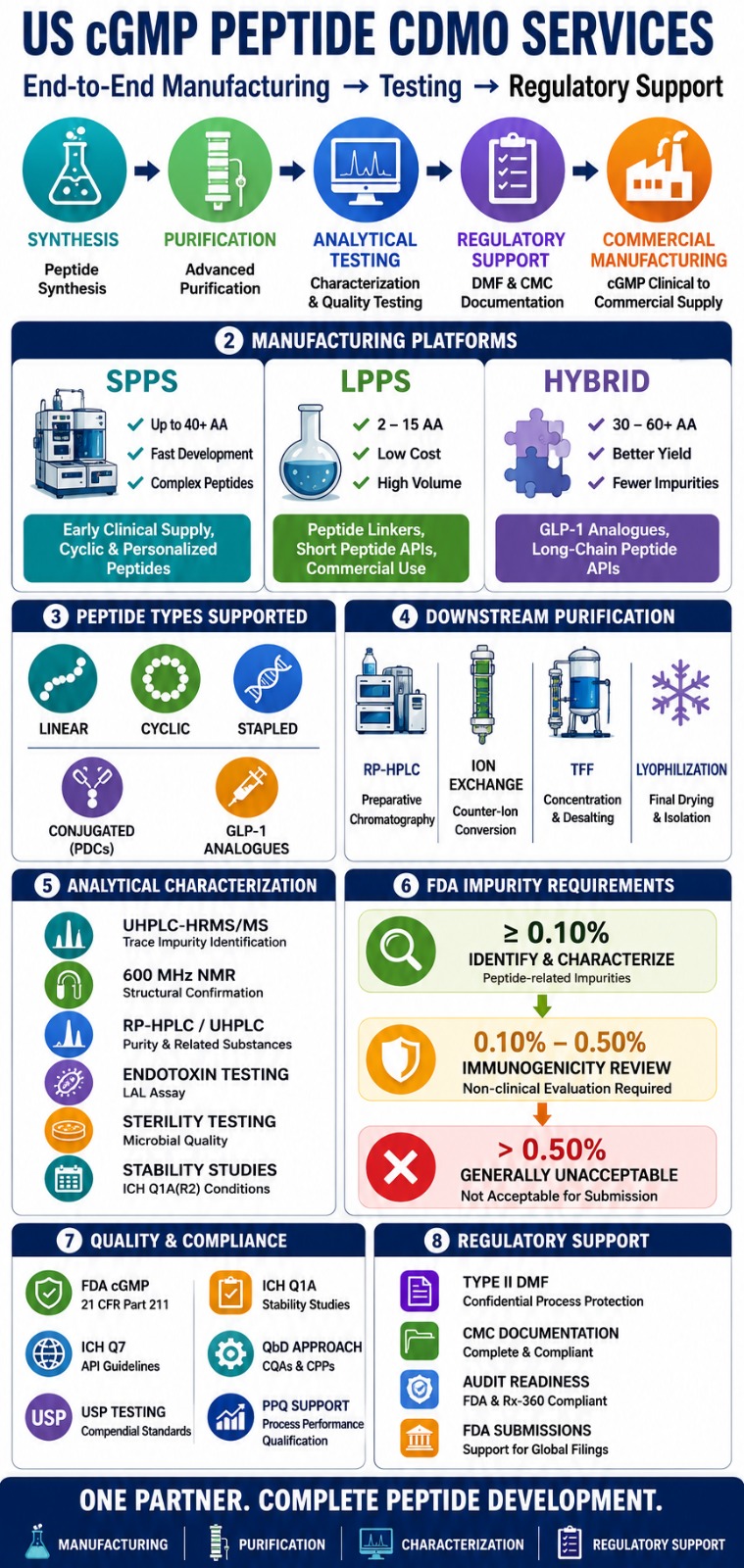
Comprehensive cGMP Peptide Manufacturing Services combine specialized infrastructure, process development expertise, and phase-appropriate quality systems to support the synthesis, purification, and characterization of complex peptide APIs. These integrated capabilities enable sponsors to transition efficiently from early clinical manufacturing to large-scale commercial production without compromising quality or regulatory compliance.
The operational framework of a leading peptide CDMO is typically built upon four major functional areas:
- Advanced synthetic chemistry platforms designed for linear, cyclic, stapled, and conjugated peptide molecules.
- Preparative purification technologies capable of removing structurally related impurities and performing counter-ion conversion processes.
- Orthogonal analytical testing platforms used for structural confirmation, compendial testing, and trace-level impurity characterization.
- Regulatory support services, including Drug Master File (DMF) maintenance and Chemistry, Manufacturing, and Controls (CMC) documentation.
Explore guidelines on how to outsource peptide manufacturing to a CDMO.
Chemical Synthesis Platforms in cGMP Peptide Manufacturing Services
Modern peptide CDMOs typically employ three principal synthesis approaches—Solid-Phase Peptide Synthesis (SPPS), Liquid-Phase Peptide Synthesis (LPPS), and Hybrid Fragment Condensation. The selection of a manufacturing strategy depends on factors such as peptide length, target purity specifications, sequence complexity, and required production scale. These platforms support the efficient production of native peptide sequences, modified analogues, cyclic peptides, and peptide-drug conjugates (PDCs).
Solid-Phase Peptide Synthesis (SPPS) remains the preferred industry approach for short-to-medium peptide sequences, often extending beyond 40 amino acid residues. Automated synthesizers ranging from 25-liter to 160-liter capacities are commonly utilized, and microwave-assisted technologies are frequently incorporated to reduce aggregation risks in sterically demanding regions of the sequence. Liquid-Phase Peptide Synthesis (LPPS) offers excellent volumetric efficiency and lower manufacturing costs for shorter peptides containing approximately 2 to 15 residues, particularly when commercial production volumes reach hundreds of kilograms. For highly complex peptide targets exceeding approximately 30 to 40 residues, CDMOs frequently implement Hybrid Fragment Strategies. In this approach, protected peptide fragments generated through SPPS are coupled in solution phase, improving overall process yields while reducing the formation of deletion-related impurities.
To address difficult sequences with aggregation tendencies, manufacturers often utilize high-purity Fluorenylmethoxycarbonyl (FMOC) amino acid derivatives, pseudoproline dipeptides, N-methylated amino acids, and specialized protecting groups including 2,4-dimethoxybenzyl (DmB) and 2-hydroxy-4-methoxybenzyl (HmB).
Discover key strategies for peptide API scale-up.
| Synthesis Methodology | Typical Sequence Length | Target Scale Range | Key Chemical Advantages | Primary Clinical Applications |
|---|---|---|---|---|
| Solid-Phase (SPPS) | Up to 40+ residues | Grams to 25+ kg/batch | High automation, rapid process optimization, effective management of hydrophobic and aggregation-prone sequences | Early-phase clinical supply, complex cyclic peptides, personalized neoantigen therapeutics |
| Liquid-Phase (LPPS) | 2 to 15 residues | 100+ kg manufacturing campaigns | Cost-efficient production, high volumetric productivity, elimination of resin-related limitations | Peptide linkers, short peptide APIs, commercial diagnostic applications |
| Hybrid Strategy | 30 to 60+ residues | Multi-kilogram scale | Reduced deletion impurities, improved crude yields, enhanced scalability | Commercial GLP-1 analogues, long-chain polypeptide APIs |
Downstream Purification and Isolation Technologies
US-based cGMP peptide CDMOs employ advanced preparative chromatography, counter-ion exchange technologies, ultrafiltration systems, and controlled drying processes to achieve drug substance purities exceeding 98%. These downstream operations are designed to isolate the target peptide while effectively removing closely related impurities, including deletion sequences, diastereomeric variants, and cleavage-derived by-products.
Preparative Reverse-Phase High-Performance Liquid Chromatography (RP-HPLC) serves as the primary purification platform in most peptide manufacturing programs. Dynamic Axial Compression (DAC) columns with internal diameters ranging from 150 mm to 600 mm are commonly used, supporting flow rates that may exceed 20 liters per hour. Many facilities integrate Process Analytical Technology (PAT)-enabled inline blending systems to maintain accurate buffer preparation and improve peak fraction collection efficiency. Secondary purification steps frequently incorporate automated ion-exchange chromatography systems to facilitate trifluoroacetate (TFA) counter-ion exchange to acetate or hydrochloride salt forms. This process is often followed by Tangential Flow Filtration (TFF) using membranes with molecular weight cutoffs between 1 kDa and 10 kDa for concentration and desalting purposes.
Final isolation of purified peptides is generally achieved through large-scale tray lyophilization systems capable of handling up to 100-liter volumes, controlled precipitation techniques, or spray-drying operations. To ensure compliance with stringent bioburden and endotoxin requirements, isolation activities are performed within Class 100,000 (Grade D) cleanroom environments or specialized Grade A isolators operating within Grade C cleanroom backgrounds.
Read about key considerations when formulating a lyophilized peptide injectable.
Analytical Method Validation and Regulatory Impurity Profiling
Analytical laboratories operating within a US cGMP peptide CDMO perform extensive structural characterization, compendial release testing, and trace impurity analysis to meet FDA regulatory expectations. These analytical programs are designed to verify amino acid sequence integrity, structural attributes, counter-ion composition, and long-term product stability.
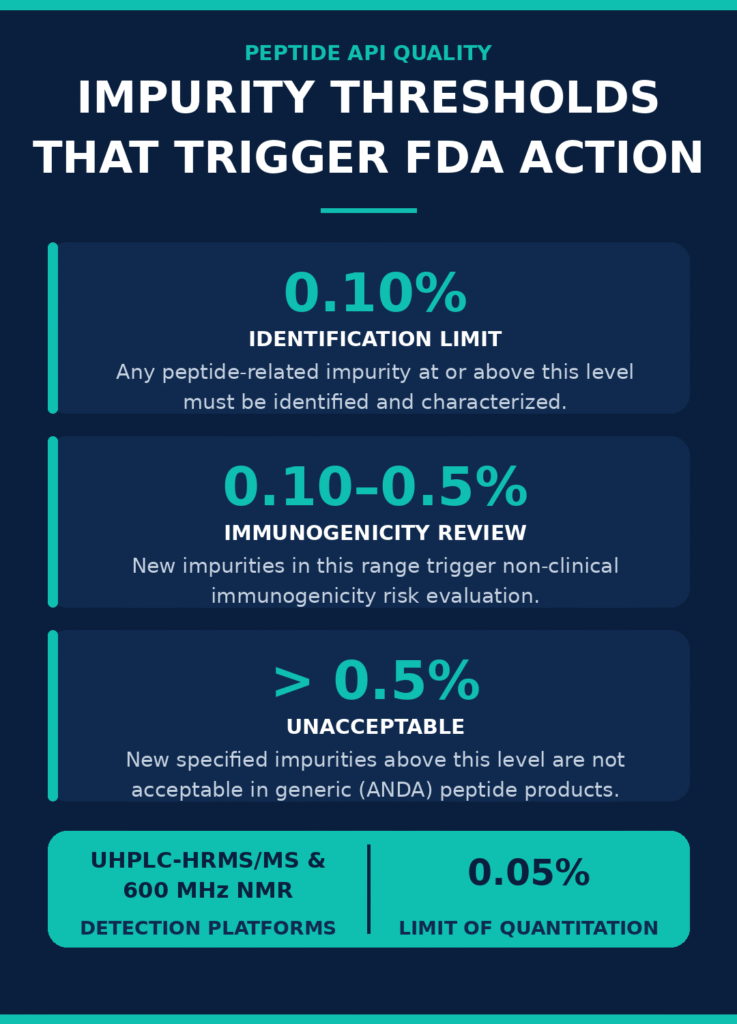
Under FDA recommendations applicable to synthetic peptide drug products that reference recombinant or synthetic listed drugs, peptide-related impurities present at or above 0.10% must be identified and appropriately characterized. For generic peptide products submitted through the ANDA pathway, newly identified specified impurities exceeding 0.5% are generally considered unacceptable. Additionally, newly detected impurities present between 0.10% and 0.5% typically require non-clinical immunogenicity risk evaluations. To support these requirements, analytical teams utilize Ultra-High-Performance Liquid Chromatography coupled with High-Resolution Mass Spectrometry (UHPLC-HRMS/MS) and 600 MHz Nuclear Magnetic Resonance (NMR) spectroscopy. These technologies routinely achieve limits of quantitation (LOQ) of 0.05% or lower, enabling detailed impurity characterization and regulatory transparency.
Understand specialized methods for GLP-1 peptide analytical characterization.
Release testing programs are performed in accordance with United States Pharmacopeia (USP) requirements, including applicable USP chapters for chromatography, sterility testing, and bacterial endotoxin determination. Stability studies are conducted under International Council for Harmonisation (ICH) Q1A(R2) conditions using long-term, accelerated, and stress-testing protocols.
Read our detailed peptide characterization case study of semaglutide.
| Quality & Regulatory Parameter | Applicable Guidance / Standard | Regulatory Acceptance Threshold | Core Analytical Platform |
| Impurity Identification | FDA Synthetic Peptide Guidance / ICH Q3A | ≥ 0.10% of total drug substance | UHPLC-HRMS / MS-MS fragmentation |
| New Impurity Qualification | FDA Synthetic Peptide Guidance | < 0.5% (Requires immunogenicity testing if > 0.10%) | In silico MHC binding and in vitro T-cell assays |
| Chromatography Validation | USP Requirements | Resolution ≥ 1.5 with peak symmetry compliance | RP-HPLC / UHPLC-UV |
| Bacterial Endotoxin Control | USP Requirements | Product-specific limits (e.g., < 5 EU/mg) | LAL Chromogenic / Turbidimetric assay |
| Sterility Assurance | USP Requirements | Absence of microbial growth over 14 days | Direct inoculation / Membrane filtration |
Quality Assurance, Compliance, and Dossier Support
A US cGMP peptide CDMO operates within a Quality Management System (QMS) that aligns with 21 CFR Part 211 requirements for pharmaceutical products and ICH Q7 guidance for active pharmaceutical ingredients. These systems ensure complete material traceability, validated equipment qualification and maintenance, comprehensive documentation practices, and accurate batch manufacturing records.
By applying Quality by Design (QbD) principles, CDMOs establish critical quality attributes (CQAs) and critical process parameters (CPPs) using scale-down models (SDMs) before initiating formal Process Performance Qualification (PPQ) activities. In addition, these organizations prepare Chemistry, Manufacturing, and Controls (CMC) documentation and maintain Type II Drug Master Files (DMFs) with the US FDA, allowing sponsor companies to reference proprietary manufacturing processes while protecting confidential information. Facilities are routinely subject to regulatory inspections as well as independent Rx-360 audits to maintain ongoing compliance and operational excellence.
Learn more about preparing CMC documentation at a CDMO for ANDA submissions.
Conclusion
Collaborating with a US-based cGMP peptide CDMO provides drug developers with access to integrated process development expertise, advanced analytical characterization capabilities, high-performance downstream purification technologies, and comprehensive regulatory support. Through specialized cGMP Peptide Manufacturing Services, biopharmaceutical organizations can meet stringent FDA impurity requirements, ensure consistent clinical and commercial batch quality, and accelerate the development timeline for complex peptide therapeutics. Companies seeking technical expertise, analytical support, or manufacturing guidance can benefit from consultation with experienced industry specialists.
See our complete guide on how to choose a peptide CDMO in the US.
To discuss project requirements or learn more about available technical capabilities, visit the Contact Us page to connect with an expert.
Frequently Asked Questions
Peptide aggregation is managed through a combination of optimized chemistry and advanced process controls. CDMOs often incorporate specialized amino acid derivatives, pseudoproline dipeptides, and N-methylated residues to reduce intermolecular interactions during chain assembly. Process parameters such as temperature, solvent selection, and microwave-assisted synthesis are also carefully adjusted to improve coupling efficiency and minimize aggregation-related defects.
Regulatory authorities expect peptide manufacturers to identify and characterize impurities that exceed established reporting thresholds. Peptide-related impurities present at significant levels require detailed analytical investigation to determine their structure and potential impact on product quality. For generic peptide products, the presence of new impurities may trigger additional regulatory review and supporting scientific justification before approval can be granted.
Certain peptide impurities may alter the biological profile of a drug substance by introducing structural features that were not present in the intended molecule. These changes can potentially influence how the immune system recognizes the product. As a result, regulatory agencies may require computational and laboratory-based studies to evaluate whether newly detected impurities could increase the risk of unwanted immune responses.
LPPS is often selected for shorter peptide sequences that are manufactured at large commercial scales. Because the process does not rely on solid resin supports, it can offer economic advantages and improved reactor utilization for high-volume production. This approach is particularly beneficial when the peptide structure is relatively simple and the manufacturing objective focuses on cost-efficient large-scale output.
Counter-ion exchange is typically carried out after purification to replace residual trifluoroacetic acid with a more suitable pharmaceutical counter-ion. The purified peptide is processed through chromatographic or ion-exchange systems and exposed to carefully selected buffer solutions. This step helps improve product quality, optimize formulation compatibility, and ensure compliance with final drug substance specifications.
Peptide products intended for sterile administration are evaluated using recognized pharmacopeial methods for both sterility and bacterial endotoxin testing. Sterility assessments verify the absence of viable microorganisms, while endotoxin testing confirms that bacterial pyrogens remain below acceptable limits. These quality control measures are essential for ensuring patient safety and regulatory compliance.
A Type II Drug Master File allows a CDMO to submit confidential manufacturing and quality information directly to the FDA. Sponsors can then reference this information within their regulatory submissions without gaining access to proprietary process details. This arrangement simplifies regulatory filings while protecting the intellectual property and technical know-how of the manufacturing organization.
Scale-down models are laboratory-scale systems designed to mimic commercial manufacturing operations as closely as possible. They enable scientists to study process behavior, identify critical process parameters, and evaluate operational limits before full-scale production begins. These models support Quality by Design initiatives by providing valuable data on process consistency and robustness.
High-resolution mass spectrometry provides highly accurate molecular weight measurements and detailed fragmentation information for peptide molecules. When combined with chromatographic separation techniques, it allows scientists to confirm amino acid sequence integrity, detect structural modifications, and identify low-level impurities. This analytical approach plays a critical role in demonstrating product identity, consistency, and regulatory compliance.
Reference:
- Elsayed, Y. Y., Kühl, T., & Imhof, D. (2025). Regulatory guidelines for the analysis of therapeutic peptides and proteins. Journal of Peptide Science, 31(3), e70001. https://doi.org/10.1002/psc.70001
- U.S. Food and Drug Administration. (2024, October). M13A bioequivalence for immediate-release solid oral dosage forms: Guidance for industry. U.S. Department of Health and Human Services. https://www.fda.gov/media/165049/download
- United States Pharmacopeia. (2025). 〈1503〉 Quality attributes of synthetic peptide drug substances. USP–NF. https://doi.org/10.31003/USPNF_M12935_03_01
Get In Touch With Us
About The Author


