

Introduction: Navigating the Complexities of Extended-Release Parenterals
The Challenges in Long Acting Injectable Formulation mainly involve creating drug systems that release medicine in a steady, predictable, and safe way over a long time. At the same time, the drug and its carrier must stay stable during this entire period. Long-acting injectables (LAIs) are advanced injectable systems designed to provide therapeutic effects from a single dose that can last from days to several months. Because they bypass the digestive system and liver metabolism, they improve drug availability in the body and reduce how often patients need to take medication.
These systems are especially useful in long-term diseases such as schizophrenia, HIV, hormone-related cancers, and substance use disorders, where missing doses can lead to serious health issues. LAIs reduce the burden on both patients and caregivers by simplifying treatment schedules and maintaining stable drug levels in the body. This helps prevent relapse and improves overall treatment outcomes.
In the past, LAIs mainly used poorly soluble drugs in oil-based or suspension forms. One early example is penicillin G benzathine, introduced in 1952. Today, about 70 LAI products are available, and research is moving toward more complex drug types like peptides, biologics, and nucleic acids. These require advanced delivery systems, often using biodegradable polymers such as PLGA. However, these modern approaches bring new Challenges in Long Acting Injectable Formulation, including stability issues, release control, and manufacturing complexity. To address these, scientists now use advanced modeling tools and material science knowledge to design better formulations.
Explore the foundations of LAI technology: Long Acting Injectable Drug Delivery Technologies
Share via:
What Are the Primary Physicochemical Challenges in Long Acting Injectable Formulation?
The key Challenges in Long Acting Injectable Formulation at the physicochemical level involve balancing drug properties such as solubility, partition coefficient (logP), and required dose with the behavior of the polymer system. These factors directly affect how the drug is released over time.
Even small changes in these properties can lead to major differences in drug performance. Therefore, early testing and detailed characterization are essential. It is also important to study how the drug interacts with the polymer to avoid instability or uneven drug release.
Deep dive into technical characterization: Long Acting Injectables Characterization
Drug Candidate Selection: LogP, Solubility, and Effective Dose Constraints
Choosing the right drug candidate is one of the first and most important steps. Drug absorption from an injection site is very different from oral delivery, so properties like solubility and permeability must be carefully considered.
The required dose is often the biggest limitation because injection volumes are usually limited to 1–3 mL for patient comfort. This means the formulation must be highly concentrated. For example:
- Solid implants: up to ~10 mg/month
- In situ depots: up to 300 mg/month
- PLGA microparticles: up to 380 mg/month
- Oily suspensions: up to 1000 mg/month
Polymer-based systems often reduce drug loading capacity, making it harder to deliver high doses. In such cases, strategies like prodrug design are used to improve drug properties.
Learn about formulation development services: Long Acting Injectable Formulation Development
Managing Initial Burst Release: A Key Challenge in Long Acting Injectable Formulation
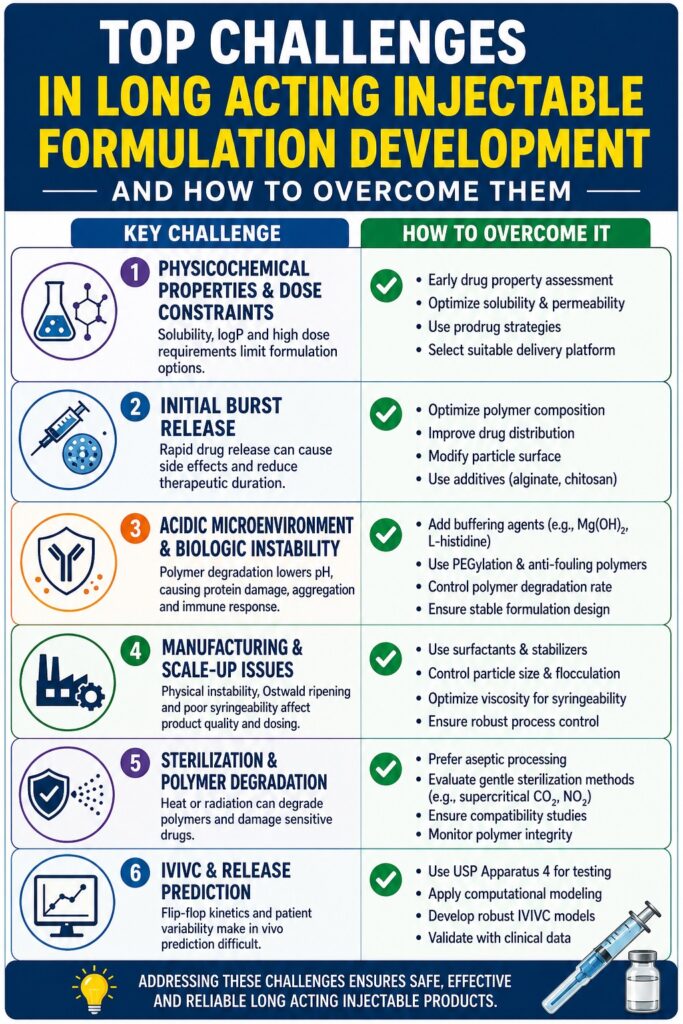
One of the most critical Challenges in Long Acting Injectable Formulation is controlling the initial burst release. This refers to a rapid release of a large amount of drug soon after injection, sometimes more than 30% within the first day.
This happens when drug particles are located near the surface of the formulation. It can cause side effects due to high drug levels and reduce the duration of action.
In PLGA systems, burst release may lead to tissue irritation and lower effectiveness. In in situ depots, it can result from fast solvent diffusion before the polymer hardens. Real-life conditions like body movement can further increase release rates.
To reduce this effect, scientists use several strategies:
- Adjusting polymer composition
- Improving drug distribution within particles
- Modifying surface properties
- Using additives like alginate or chitosan
These methods help achieve more controlled and predictable drug release.
See a real-world example of release control: Leuprolide Depot Case Study: Sustained Release
Neutralizing Acidic Microenvironment and Protecting Biologics
Another major issue in the Challenges in Long Acting Injectable Formulation is maintaining the stability of sensitive drugs like proteins and peptides. As PLGA breaks down, it produces acidic byproducts, lowering the internal pH to levels as low as 2.2–3.5.
This acidic environment can:
- Damage proteins
- Cause aggregation
- Reduce drug effectiveness
- Trigger immune responses
To solve this problem, buffering agents such as magnesium hydroxide or L-histidine are added to neutralize the acid. Other techniques include PEGylation and anti-fouling polymers to reduce unwanted interactions.
These approaches help maintain drug stability and improve safety.
Understand the regulatory path for these products: Regulatory Pathway for Complex Peptide Injectables
How Do Manufacturing and Scale-Up Create Challenges in Long Acting Injectable Formulation?
Scaling up production introduces additional Challenges in Long Acting Injectable Formulation. Manufacturing must ensure consistent quality, sterility, and performance across large batches.
Physical Stability, Ostwald Ripening, and Syringeability
Suspension-based LAIs can become unstable over time due to a process called Ostwald ripening, where small particles dissolve and redeposit onto larger ones. This leads to:
- Particle growth
- Sedimentation
- Caking
Caking makes it difficult to resuspend the drug, affecting syringeability and dosing accuracy. To prevent this:
- Surfactants are added
- Stabilizers improve dispersion
- Controlled flocculation ensures easy resuspension
These factors are important for both usability and patient safety.
Complexities in Sterilization and Polymer Degradation
Sterilization is essential but challenging. Traditional methods like heat or radiation can damage both the drug and polymer:
- Gamma radiation may break polymer chains
- Heat can destroy sensitive biologics
Because of this, aseptic processing is often used, although it is expensive and complex. New methods like supercritical CO₂ and nitrogen dioxide are being explored as safer alternatives.
Expert support for complex manufacturing: CRO for Complex Injectables
Delivery Technologies Addressing Challenges in Long Acting Injectable Formulation
Different delivery systems are used to overcome specific Challenges in Long Acting Injectable Formulation, each with its own strengths and limitations.
Polymeric Microparticles and Nanocrystals
PLGA microparticles are widely used because they allow controlled drug release by adjusting polymer properties. However, they have:
- Limited drug loading
- Complex manufacturing processes
Nanocrystal suspensions offer:
- High drug loading
- Simpler production
But they provide less control over release rates.
The Evolution of In Situ Forming Depots (ISFDs)
ISFDs are injected as liquids and form a solid depot inside the body. They offer:
- Easier manufacturing
- Higher drug loading
- No need for reconstitution
These systems improve patient convenience and reduce dosing errors while offering better control over drug release.
Compare development models for complex generics: CRO vs In-House ANDA Development
Overcoming IVIVC Challenges in Long Acting Injectable Formulation
Establishing in vitro-in vivo correlation (IVIVC) is another important aspect of the Challenges in Long Acting Injectable Formulation. It helps predict how a drug behaves in the body based on lab tests.
Flip-Flop Kinetics and Accelerated Testing
LAIs often show flip-flop kinetics, where drug absorption is slower than elimination. This makes analysis more complex. Accelerated testing methods are used, but they must accurately reflect real conditions.
Review technical requirements for generic submissions: Analytical Requirements for ANDA Generic Drugs
Advanced Tools: USP Apparatus 4 and Computational Modeling
USP Apparatus 4 simulates real biological conditions and improves testing accuracy. Computational tools help account for patient variability and improve prediction models. These technologies support regulatory approval and better product design.
Advanced Analytical Strategies to Solve Challenges in Long Acting Injectable Formulation
Advanced analytical methods are essential to address the Challenges in Long Acting Injectable Formulation and ensure product quality.
Precision Polymer Analysis
Techniques such as:
- GPC
- NMR
- FTIR
- DSC
- TGA
are used to study polymer properties and optimize formulations.
Bioanalytical Testing and Impurity Detection
Methods like LC-MS/MS detect impurities at very low levels. Extractables and leachables studies ensure packaging safety. These tests are critical for maintaining product quality and patient safety.
ResolveMass Laboratories Inc.: Expertise in Long Acting Injectable Formulation
ResolveMass Laboratories Inc. offers specialized services to address the Challenges in Long Acting Injectable Formulation. With advanced technology and strong regulatory knowledge, they support:
- Formulation development
- Polymer analysis
- Peptide and biologic drug delivery
- Manufacturing scale-up
Their expertise helps reduce development time and ensures compliance with global standards.
Accelerate your development timeline: CDMO to Accelerate Generic Drug Development
Conclusion
The Challenges in Long Acting Injectable Formulation require a combination of scientific knowledge, advanced tools, and careful planning. Issues like burst release, drug stability, polymer degradation, and manufacturing complexity must all be addressed.
With the help of modern technologies, innovative delivery systems, and detailed analytical methods, these challenges can be managed effectively. Long-acting injectables continue to play a vital role in improving patient adherence and treatment outcomes, making them an important part of modern healthcare.
Frequently Asked Questions on Challenges in Long Acting Injectable Formulation
Several approaches are used to manage the Challenges in Long Acting Injectable Formulation, including oil-based suspensions, polymeric microparticles like PLGA, in situ forming depots, and solid implants. Each method is selected based on the drug’s properties, required dose, and treatment duration. The goal is to achieve steady and long-term drug release with minimal side effects.
PLGA is widely used because it is safe, biodegradable, and breaks down into substances that the body can easily remove. Scientists can adjust its composition to control how fast the drug is released. This flexibility makes it highly suitable for solving many Challenges in Long Acting Injectable Formulation.
Initial burst release happens when drug particles near the surface of microparticles dissolve quickly after injection. This can lead to a sudden spike in drug levels in the body. It is one of the key Challenges in Long Acting Injectable Formulation because it may cause side effects and reduce the duration of therapy.
As PLGA degrades, it creates an acidic environment inside the formulation. This low pH can damage sensitive drugs like peptides and proteins. Managing this issue is a major part of addressing the Challenges in Long Acting Injectable Formulation, as it directly affects drug safety and effectiveness.
Common sterilization methods such as heat and radiation can damage both the drug and the polymer system. These processes may change the structure and performance of the formulation. This makes sterilization a critical concern among the Challenges in Long Acting Injectable Formulation.
Ostwald ripening is a process where smaller particles dissolve and redeposit onto larger ones over time. This causes particle growth, leading to settling and difficulty in resuspension. It is an important issue within the Challenges in Long Acting Injectable Formulation because it affects product stability and usability.
Generic LAIs must closely match the original product in composition and performance. Even small differences in structure or manufacturing can change how the drug is released. This complexity makes it one of the toughest Challenges in Long Acting Injectable Formulation.
Scientists use specialized lab equipment and models to simulate how the drug behaves inside the body. They compare lab results with actual patient data to build reliable predictions. Establishing IVIVC is essential for overcoming the Challenges in Long Acting Injectable Formulation and ensuring consistent performance.
Reference:
- Author(s). (2024). Long-acting parenteral formulations of hydrophilic drugs, proteins, and peptides: Current technologies and challenges. Pharmaceutics. https://pmc.ncbi.nlm.nih.gov/articles/PMC11870889/
- Nakmode, D. D., Singh, B., Abdella, S., Song, Y., & Garg, S. (2025). Long-acting parenteral formulations of hydrophilic drugs, proteins, and peptide therapeutics: Mechanisms, challenges, and therapeutic benefits with a focus on technologies. Drug Delivery and Translational Research, 15, 1156–1180. https://pubmed.ncbi.nlm.nih.gov/39542257/
- Bao, Q., Wang, X., Wan, B., Zou, Y., Wang, Y., & Burgess, D. J. (2023). Development of in vitro-in vivo correlations for long-acting injectable suspensions. International Journal of Pharmaceutics, 634, 122642. https://pubmed.ncbi.nlm.nih.gov/36709013/
- Wang, Y., Burgess, D. J., & Hussain, A. S. (2024). In vitro–in vivo correlation (IVIVC) development for long-acting injectable drug products. International Journal of Pharmaceutics. https://pmc.ncbi.nlm.nih.gov/articles/PMC11663134/
- Zheng, C., & Liang, W. (2010). A one-step modified method to reduce the burst initial release from PLGA microspheres. Drug Delivery, 17(2), 77–82. https://pubmed.ncbi.nlm.nih.gov/20067365/
- Malavia, N., & Burgess, D. J. (2026). Insights into development of long-acting injectable suspensions. Journal of Controlled Release, 392, 114721. https://pubmed.ncbi.nlm.nih.gov/41690479/
Get In Touch With Us
About The Author


