

Introduction
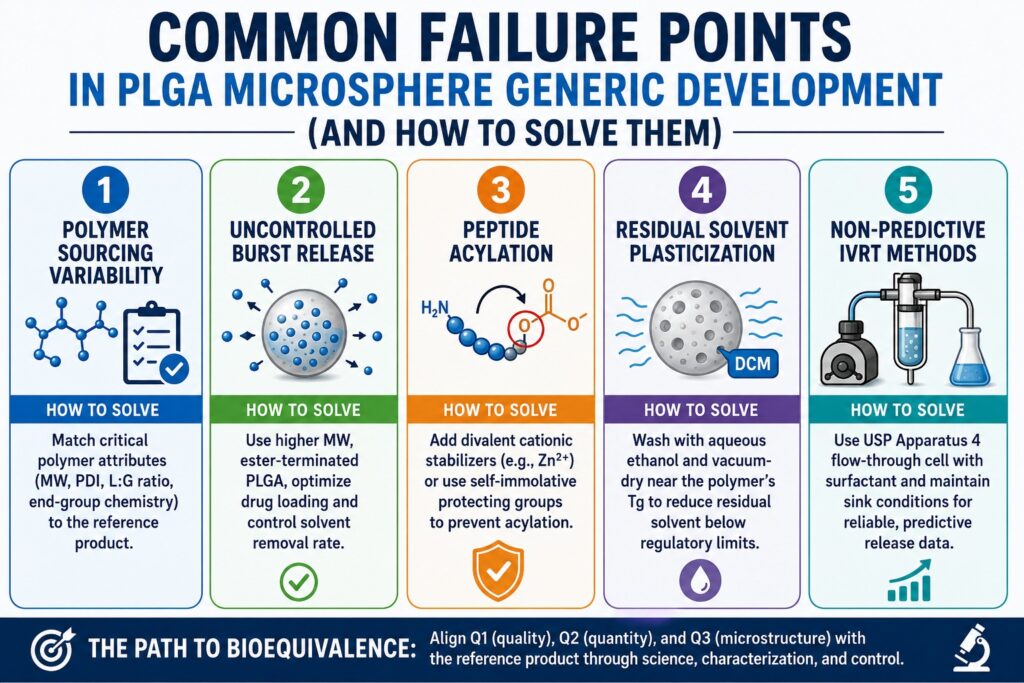
The development of generic long-acting injectables (LAIs) requires the establishment of qualitative, quantitative, and microstructural (Q1/Q2/Q3) equivalence to ensure the same therapeutic performance as the reference listed drug (RLD). Achieving this degree of similarity remains challenging because developers must address numerous Challenges in PLGA Microsphere Development that directly influence drug release kinetics and biological behavior. Although the Food and Drug Administration (FDA) has approved multiple innovator long-acting injectable products since 1989, generic manufacturers have historically faced significant difficulties in demonstrating bioequivalence (BE). A major reason for this challenge is the “mechanistic invisibility” of the polymer matrix that controls drug release. To successfully overcome these development barriers, manufacturers must systematically resolve five major failure points: polymer sourcing variability, uncontrolled burst release, peptide acylation, residual solvent-induced plasticization, and non-predictive in vitro release testing (IVRT) methods.
Article Summary:
- Generic PLGA long-acting injectables must closely match the reference product in composition and microstructure to achieve bioequivalence.
- Polymer properties such as molecular weight, monomer ratio, and end-group chemistry strongly influence drug release and degradation.
- Controlling burst release requires careful optimization of polymer selection, drug loading, and manufacturing conditions.
- Peptide drugs can degrade through acylation inside PLGA matrices, but stabilizers and protective strategies can reduce this risk.
- Residual solvents may alter polymer behavior and cause inconsistent release, making proper drying essential.
- Advanced release testing methods and detailed polymer characterization are critical for developing safe, effective, and regulatory-compliant generic products.
Overcoming Polymer Sourcing Challenges in PLGA Microsphere Development
Addressing raw material sourcing challenges requires collaboration with specialized polymer manufacturers capable of custom synthesis, along with the use of highly sensitive analytical technologies such as multi-angle light scattering and quantitative NMR. These approaches eliminate the uncertainties associated with broad supplier specifications that often contribute to bioequivalence failures.
Partner with a Trusted Regulatory Supplier: Secure a dependable supply of high-purity, regulatory-compliant polymers by exploring our GMP PLGA excipient supplier options.
Critical Polymer Attributes (CPAs) and Discrepancies
Commercially available polymer grades typically possess broad specification ranges that differ substantially from the tightly controlled proprietary parameters used by innovator companies. Even when a generic manufacturer procures a polymer with a nominally identical lactic-to-glycolic (L) ratio, small variations in macromolecular characteristics can significantly affect degradation behavior and drug release performance.
Molecular Weight Distribution
Conventional Gel Permeation Chromatography (GPC) frequently fails to fully characterize critical parameters such as the polydispersity index (PDI) and the abundance of low-molecular-weight oligomers. In one comparative study, a generic PLGA grade exhibited a PDI of 1.8, whereas the RLD polymer demonstrated a PDI of 1.4. The increased concentration of low-molecular-weight chains (<5 kDa) accelerates autocatalytic ester hydrolysis, leading to premature matrix degradation and early drug release.
Optimize Molecular Characteristics: Learn how to accurately evaluate polymer uniformity and polydispersity by reviewing our guide on PLGA polymer molecular weight and PDI.
Lactide-to-Glycolide (L) Ratio and Sequence Distribution
The balance between hydrophobic lactic acid (LA) and hydrophilic glycolic acid (GA) determines the extent of water penetration into the polymer matrix. PLGA 50:50 undergoes relatively rapid degradation, typically within 3 to 4 weeks, because of its amorphous and hydrophilic nature. In contrast, PLGA 75:25 and PLGA 85:15 degrade over substantially longer periods, often extending across several months. Beyond the overall monomer ratio, the sequence distribution or “blockiness” of the polymer also influences degradation behavior. Polymers containing block-like monomer arrangements tend to erode unevenly, whereas truly random copolymers generally exhibit more predictable erosion profiles.
Master Release Kinetics: Discover how adjusting the monomer ratio shifts degradation timelines and performance by reading about PLGA ratio release kinetics.
End-Group Chemistry
Carboxylic acid-terminated PLGA contains hydrophilic and ionizable free carboxyl groups (-COOH) that actively catalyze ester bond hydrolysis. In comparison, ester-terminated PLGA is capped with alkyl groups, commonly ethyl esters (-COOC₂H₅), making the polymer more hydrophobic, more resistant to hydrolysis, and less susceptible to swelling. Selecting an acid-terminated polymer when the RLD utilizes an ester-terminated grade can dramatically alter release behavior, shifting the mechanism from controlled diffusion to rapid erosion-driven drug release.
| PLGA Grade | Lactic (LA) Ratio | Typical Degradation Rate | Primary Application Focus | End-Group Architecture |
|---|---|---|---|---|
| PLGA 50:50 | 50:50 | 3–4 weeks | Fast-degrading injectable microspheres, vaccines, peptide delivery | Acid or Ester terminated |
| PLGA 65:35 | 65:35 | 6–8 weeks | Medium-duration depot systems, flexible tissue scaffolds | Acid or Ester terminated |
| PLGA 75:25 | 75:25 | 12–16 weeks | Balanced controlled erosion, long-acting depot systems | Acid or Ester terminated |
| PLGA 85:15 | 85:15 | 20–24 weeks | Ultra-long-acting drug release systems, implants | Acid or Ester terminated |
The Lupron Depot Case Study: Reverse-Engineering Macromolecular Architecture
A landmark example of PLGA reverse engineering is provided by the United States Pharmacopeia (USP) characterization of Lupron Depot® (75:25 PLGA, 1-month depot formulation). Analysis of the extracted RLD polymer revealed a weight-average molecular weight (Mw) of 13,583 Da and a PDI of 1.68. These values closely matched an internally synthesized polymer standard with an Mw of 12,118 Da and a PDI of 1.70.
Potentiometric titration determined an acid value of 10.2 mg KOH/g for the extracted polymer, compared with 11.8 mg KOH/g for the synthesized standard. This close agreement confirmed the use of an acid-terminated polymer in the innovator product. Furthermore, 13C-NMR spectroscopy demonstrated that the polymer possessed a strictly linear architecture rather than a branched or star-shaped configuration. This structural feature contributes to the predictable bulk erosion and controlled release profile necessary for leuprolide delivery.
| Attribute | Lupron Depot Extracted Polymer | In-House Synthesized Standard | Analytical Method |
| Monomer Ratio (LA) | 75:25 | 75:25 | 1H-NMR Spectroscopy |
| Weight-Average Mw (Mw) | 13,583 Da | 12,118 Da | Gel Permeation Chromatography (GPC) |
| Polydispersity Index (PDI) | 1.68 | 1.70 | GPC-MALS |
| Acid Value | 10.2 mg KOH/g | 11.8 mg KOH/g | Potentiometric Titration |
| Glass Transition Temperature (Tg) | 40.54°C | 43.84°C | Differential Scanning Calorimetry (DSC) |
| Polymer Topology | Fully Linear | Fully Linear | DOSY NMR / 4D GPC Mapping |
Achieve Microstructural Matching: Benchmark your formulations against alternative biomaterials by checking out our structural comparison of PLA vs PLGA vs PCL.
Uncontrolled Initial Burst Release: Overcoming Mass Transport Failure Points
Uncontrolled burst release can be mitigated by selecting higher-molecular-weight, ester-terminated polymers and carefully controlling solvent removal rates during microparticle manufacturing. These strategies reduce the tendency of drug molecules to migrate toward the particle surface during polymer solidification.
Mitigate initial burst spikes by matching your polymer matrix to the drug profile; learn more about optimizing PLGA for depot formulation.
Critical Process Parameter Control to Resolve Microstructural Challenges in PLGA Microsphere Development
Microstructural consistency can be achieved by optimizing homogenization speed, emulsifier concentration, and solvent removal kinetics through a structured Design of Experiments (DoE) approach. This systematic optimization produces a narrow particle size distribution and effectively retains the active ingredient within a dense and non-porous polymer matrix.
During oil-in-water (O/W) or water-in-oil-in-water (W/O/W) emulsification, the organic solvent, typically dichloromethane, diffuses into the continuous aqueous phase. If solvent removal occurs too quickly, premature polymer hardening traps a large fraction of the drug near the microsphere surface. Once hydrated, these surface-associated drug molecules dissolve rapidly, resulting in a supratherapeutic plasma concentration spike.
In a naltrexone microsphere development program, an initial formulation employing low-molecular-weight (15 kDa), acid-capped 50:50 PLGA with 28% w/w drug loading produced a 24-hour burst release of 31.2% in phosphate-buffered saline (PBS, pH 7.4, 37°C). This value significantly exceeded the target specification of ≤15%.
A comprehensive root cause investigation identified three primary strategies for controlling burst release:
End-Group Substitution
Replacing the acid-capped polymer with an ester-capped polymer of equivalent composition and molecular weight (50:50 PLGA, 25 kDa) reduced the 24-hour burst release from 21.3% to 13.8%. The ester end groups minimized early water penetration and reduced autocatalytic degradation at the particle surface.
Molecular Weight Selection
Increasing polymer molecular weight from 15 kDa to 45 kDa reduced the burst fraction from 28.4% to 9.1%. Greater chain entanglement density restricted rapid pore formation and improved matrix integrity.
Solvent Evaporation Kinetics
Extending solvent removal over a controlled four-hour period allowed polymer chains to relax and solidify uniformly. This approach preserved structural integrity and maintained burst release below 10%.
| Critical Process Parameter (CPP) | Operating Range | Affected Critical Quality Attribute (CQA) | Performance Impact |
| Homogenization Speed | 6,000–12,000 rpm | Particle Size Distribution | Influences syringeability, needle passability, and degradation behavior |
| Emulsifier (PVA) Concentration | 0.5%–2.0% w/v | Surface Smoothness and Adsorption | Concentrations >1.5% may reduce formulation purity |
| Solvent Removal Rate | 3–4 hours controlled drying | Porosity and Core-Shell Density | Rapid solvent loss increases burst release and void formation |
| Drug Loading (Naltrexone) | 10%–20% w/w | Initial Burst Release | Loadings >30% promote water ingress and dose dumping |
Chemical Degradation of Biologics: Mitigating Peptide Acylation and Matrix Instability
Peptide acylation within degrading PLGA matrices can be minimized through the incorporation of divalent cationic stabilizers or reversible self-immolative amine-protecting groups. These strategies inhibit nucleophilic attack by peptide amines on hydrolyzing ester bonds within the polymer matrix.
The Acylation Mechanism in Degrading Matrices
PLGA degrades through a bulk erosion mechanism in which water penetrates the entire matrix and hydrolyzes ester bonds into lactic acid and glycolic acid monomers and oligomers. Acidic degradation products become trapped within internal pores, generating an acidic microenvironment where local pH values may drop below 3.
Hydrophobic polymer surfaces promote peptide adsorption. Once adsorbed, primary amines located at the peptide N-terminus or within lysine side chains become positioned for nucleophilic attack on polymer ester carbonyl groups. This reaction generates covalently linked acylated peptide species that are therapeutically inactive, potentially immunogenic, and possibly toxic.
For long-term zero-order therapeutic profiles, view our advanced options for PLGA for controlled release systems.
Advanced Mitigation Strategies
Divalent Cationic Salts
Water-soluble salts such as zinc chloride (ZnCl₂), manganese chloride (MnCl₂), and calcium chloride (CaCl₂) function as highly effective stabilizers. Their divalent cations competitively interact with polymer carboxyl groups, reducing peptide adsorption and preventing the initial steps that lead to acylation. Among these salts, Zn²⁺ has demonstrated particularly strong inhibition of exenatide acylation in degrading PLGA microspheres.
Self-Immolative Protecting Groups (SIP)
Temporary protection of peptide primary amines using compounds such as O-4-nitrophenyl-O’-4-acetoxybenzyl carbonate provides another effective strategy. In studies involving octreotide microspheres, peptide protection reduced the acylated fraction from 52.5% to negligible levels during a 50-day incubation period. As degradation progresses, the acidic microenvironment triggers cleavage of the protective group, releasing the native active peptide.
pH-Modifying Excipients
Basic excipients such as magnesium hydroxide [Mg(OH)₂] and magnesium carbonate can neutralize acidic degradation products and stabilize the microenvironment. However, these additives require careful evaluation because they may increase water uptake, accelerate polymer degradation, or promote base-catalyzed reactions such as deamidation.
Residual Solvent Retention and Polymer Plasticization: Process Solutions for Microstructural Sameness
Excessive residual solvent levels can be addressed through aqueous ethanolic washing and optimized vacuum-drying procedures performed near the polymer’s glass transition temperature. These measures prevent polymer plasticization and preserve microstructural integrity.
Impact of Residual Dichloromethane (DCM) and Ethyl Acetate
Dichloromethane (DCM) remains the preferred solvent for dissolving high-molecular-weight PLGA. However, regulatory limits restrict its permitted daily exposure to 6 mg/day, corresponding to <600 ppm according to USP and ICH Q3C guidelines. When solvent removal is inadequate, residual DCM acts as a plasticizer within the polymer matrix, lowering the glass transition temperature (Tg), which typically falls between 40°C and 65°C.
When Tg drops below storage temperature or physiological temperature (37°C), polymer chain mobility increases substantially. This enhanced mobility can cause pore closure, structural rearrangement, and unpredictable drug diffusion behavior, resulting in batch-to-batch variability.
Process Engineering Solutions
Aqueous Ethanolic Wash
Following microsphere collection, washing with a 25% aqueous ethanol solution substantially improves solvent extraction efficiency. Ethanol penetrates the outer polymer layer and facilitates diffusion of trapped DCM from the matrix. This process also promotes controlled surface restructuring, sealing pores and reducing initial burst release.
Drying Temperature Optimization
Vacuum drying should be performed near the polymer’s native Tg. For DCM-based formulations, drying at approximately 40°C under pressures of 5 mbar or lower can reduce residual solvent levels below 100 ppm without damaging particle structure. Ethyl acetate-based systems generally require longer drying cycles because of the stronger interaction between the solvent and polymer matrix.
Access High-Quality Polymers Globally: Source premium, ready-to-ship formulation ingredients by choosing to buy PLGA polymer batches directly from our catalog.
Non-Predictive Dissolution and In Vitro Release Testing (IVRT) Bias
Bias in IVRT can be minimized by replacing manual sample-and-separate methods with modified USP Apparatus 4 flow-through cell systems. This approach maintains sink conditions throughout testing and eliminates particle loss during sampling, resulting in more predictive in vitro-in vivo correlations (IVIVC).
Limitations of Sample-and-Separate Methods
The sample-and-separate method remains widely used because of its simplicity; however, it is highly susceptible to experimental variability. Microspheres may be lost or damaged during filtration and centrifugation, leading to inaccurate release measurements and artificially low cumulative release values. Additionally, static vessels often fail to maintain sink conditions, causing localized drug accumulation that suppresses continued release.
Advantages of USP Apparatus 4
USP Apparatus 4 eliminates many of these limitations. Microspheres are placed within a flow-through cell while pre-heated release medium continuously circulates through the system. This setup maintains sink conditions, prevents particle loss, and generates highly reproducible release profiles that more closely reflect in vivo performance.
Surfactant Integration
For hydrophobic proteins and small molecules such as bovine serum albumin and steroid compounds, measured release may appear artificially low because of adsorption to tubing and pump surfaces. The addition of non-ionic surfactants, including 0.01% to 0.1% w/v sodium dodecyl sulfate (SDS) or Tween-20, prevents surface adsorption. Importantly, SDS does not alter the fundamental ester hydrolysis mechanism of PLGA, preserving the biological relevance of the release test.
Accelerated Release Testing
Because real-time release studies for depot formulations may extend over several months, accelerated IVRT methods are essential for quality control applications. Increasing the testing temperature to 45°C or 50°C enhances water diffusion and polymer chain mobility, reducing a 90-day release profile to less than two weeks. Lowering the pH can also accelerate ester hydrolysis, although excessive acidification may alter the dominant release mechanism from bulk erosion to surface erosion.
Concluding Pathways for Successful Complex Generic Development
Demonstrating bioequivalence for PLGA microsphere products requires a comprehensive approach that aligns the qualitative (Q1), quantitative (Q2), and microstructural (Q3) characteristics of the generic product with those of the RLD. Because innovator manufacturers rarely disclose detailed polymer specifications, generic developers must rely on sophisticated and complementary analytical methods to bridge this knowledge gap.
Through cGMP-compliant workflows and advanced polymer synthesis capabilities, ResolveMass Laboratories Inc. supports generic developers by providing complete analytical characterization services, including 4D GPC-MALS for topology and branching analysis, quantitative NMR (¹H, ¹³C, and DOSY) for polymer architecture characterization, and modulated DSC for comprehensive thermal profiling. Working with specialized experts reduces the trial-and-error burden of formulation development and transforms the “mechanistic invisibility” of complex polymer systems into a predictable and scalable route toward regulatory approval.
From custom macromolecular design to full-scale validation, leverage technical expertise by visiting our specialized portal for custom PLGA synthesis or explore end-to-end scale-up capabilities through our PLGA contract manufacturing services.
To explore custom polymer synthesis services, obtain standard PLGA grades, or investigate formulation-related challenges, developers are encouraged to visit the ResolveMass Laboratories Inc. contact page.
Frequently Asked Questions
The degradation rate of PLGA microspheres is influenced by several polymer characteristics, including the lactide-to-glycolide (L) ratio, molecular weight, end-group chemistry, and environmental conditions such as pH. Polymers with a higher glycolide content tend to absorb water more readily, which accelerates hydrolysis and matrix breakdown. Molecular weight also plays an important role, as lower-molecular-weight polymers generally degrade faster than higher-molecular-weight grades. In addition, acid-terminated polymers often degrade more rapidly due to enhanced autocatalytic activity within the matrix.
The glass transition temperature (Tg) determines whether the polymer exists in a rigid, glassy state or a more flexible, rubbery state. Maintaining an appropriate Tg is essential because it directly affects microsphere stability during manufacturing, storage, and drug release. When residual solvents or absorbed moisture lower the Tg, polymer chains become more mobile and can undergo structural changes. These changes may result in particle aggregation, pore collapse, and variations in release performance over time.
Acid-terminated PLGA contains free carboxyl end groups that increase hydrophilicity and promote water uptake once the microspheres are exposed to an aqueous environment. This often leads to faster polymer erosion and a greater likelihood of initial burst release. In contrast, ester-terminated PLGA possesses capped end groups that make the polymer more hydrophobic and resistant to hydrolytic degradation. As a result, ester-capped grades generally provide more controlled and sustained drug release profiles.
Q1, Q2, and Q3 equivalence are critical requirements for demonstrating similarity between a generic product and its reference listed drug (RLD). Q1 equivalence refers to using the same inactive ingredients as the innovator product. Q2 equivalence focuses on matching the quantity of those ingredients within an acceptable range. Q3 equivalence extends beyond composition and requires alignment of microstructural attributes such as particle size, porosity, morphology, and drug distribution within the formulation.
Reducing initial burst release requires careful optimization of formulation and process parameters during microsphere production. A slower solvent evaporation rate allows polymer chains to solidify more uniformly, minimizing drug accumulation at the particle surface. Lowering drug loading levels can further reduce the risk of surface-associated drug release. In many cases, selecting a higher-molecular-weight, ester-terminated PLGA also improves matrix integrity and helps achieve a more controlled release profile.
Peptide acylation is a major concern because it can alter the chemical structure and biological activity of therapeutic peptides encapsulated within PLGA microspheres. During polymer degradation, acidic byproducts accumulate and create an environment that promotes unwanted reactions between peptide amines and PLGA ester bonds. These reactions generate acylated peptide species that may exhibit reduced efficacy or increased immunogenicity. Consequently, controlling acylation is essential for maintaining product safety, potency, and stability.
Demonstrating polymer sameness requires the use of multiple complementary analytical techniques capable of evaluating different polymer attributes. GPC-MALS is commonly used to determine absolute molecular weight and polydispersity index, while 1H-NMR helps verify the lactide-to-glycolide ratio. 13C-NMR provides valuable information regarding end-group chemistry and monomer sequence distribution. Differential Scanning Calorimetry (DSC) is also important for assessing thermal behavior and confirming the polymer’s glass transition temperature (Tg).
Residual dichloromethane can significantly influence both the physical stability and performance of PLGA microspheres. When retained within the polymer matrix, DCM acts as a plasticizer that lowers the glass transition temperature and increases polymer chain mobility. This can lead to structural changes such as pore collapse, altered drug distribution, and inconsistent release characteristics. Excessive residual solvent levels may also create toxicological concerns and result in non-compliance with regulatory requirements.
USP Apparatus 4 offers several advantages over traditional sample-and-separate techniques for in vitro release testing. The flow-through cell design continuously supplies fresh dissolution medium, ensuring stable sink conditions throughout the experiment. Unlike filtration or centrifugation-based methods, it minimizes particle loss and reduces sampling-related variability. These features contribute to more reproducible, reliable, and biorelevant release data that better reflect in vivo performance.
Reference:
- Wang, M., Wang, S., Zhang, C., Ma, M., Yan, B., Hu, X., Shao, T., Piao, Y., Jin, L., & Gao, J. (2024). Microstructure formation and characterization of long-acting injectable microspheres: The gateway to fully controlled drug release pattern. International Journal of Nanomedicine, 19, 1571–1595. https://doi.org/10.2147/IJN.S445269
- Zhang, Y., & Schwendeman, S. P. (2012). Minimizing acylation of peptides in PLGA microspheres. Journal of Controlled Release, 162(1), 119–126. https://doi.org/10.1016/j.jconrel.2012.04.022
- Kias, F., & Bodmeier, R. (2024). Acceleration of final residual solvent extraction from poly(lactide-co-glycolide) microparticles. Pharmaceutical Research, 41(9), 1869–1879. https://doi.org/10.1007/s11095-024-03744-9
- Wang, L., Liu, W., Jiang, Q., Wang, X., Xu, D., Fang, Y., Wang, S., & Tang, J. (2026). Span value as a critical quality attribute for PLGA microspheres: Controlling burst release and enhancing therapeutic efficacy via wet sieving. Pharmaceutics, 18(2), 180. https://doi.org/10.3390/pharmaceutics18020180
- Wang, Y. (2017, October 6). Introduction: Characterization of complex excipients and formulations [Conference presentation]. Demonstrating Equivalence of Generic Complex Drug Substances and Formulations Workshop, U.S. Food and Drug Administration. https://www.fda.gov/files/drugs/published/Introduction–Characterization-of-Complex-Excipients-and-Formulations-Presentation.pdf
Get In Touch With Us
About The Author


