
Introduction
A chemically synthesized protein may qualify for approval as a biosimilar under Section 351(k) of the Public Health Service (PHS) Act if its sequence contains more than 40 amino acids and it demonstrates the required analytical, structural, and functional similarity to a recombinant reference product. The regulatory landscape surrounding Chemically Synthesized vs Recombinant Proteins has evolved considerably, driven by advances in solid-phase peptide synthesis (SPPS), chemical ligation technologies, and high-resolution analytical characterization methods.
Historically, biological therapeutics were defined primarily by their production in living host systems, including Escherichia coli, yeast, and Chinese Hamster Ovary (CHO) cell lines. This approach reinforced the long-standing regulatory principle that “the process defines the product.” However, statutory amendments introduced through the Biologics Price Competition and Innovation Act (BPCIA), together with subsequent regulatory provisions established by the U.S. Food and Drug Administration (FDA), clarified the criteria used to classify biological products according to amino acid sequence length. Under the applicable framework, a fully defined alpha amino acid polymer containing more than 40 amino acids falls within the regulatory definition of a protein and biological product, regardless of whether it is produced through recombinant expression or chemical synthesis. Consequently, a chemically synthesized protein containing more than 40 amino acids may be eligible for consideration under the 351(k) biosimilar pathway when compared with an appropriate recombinant reference product.
Share via:
Quick Summary:
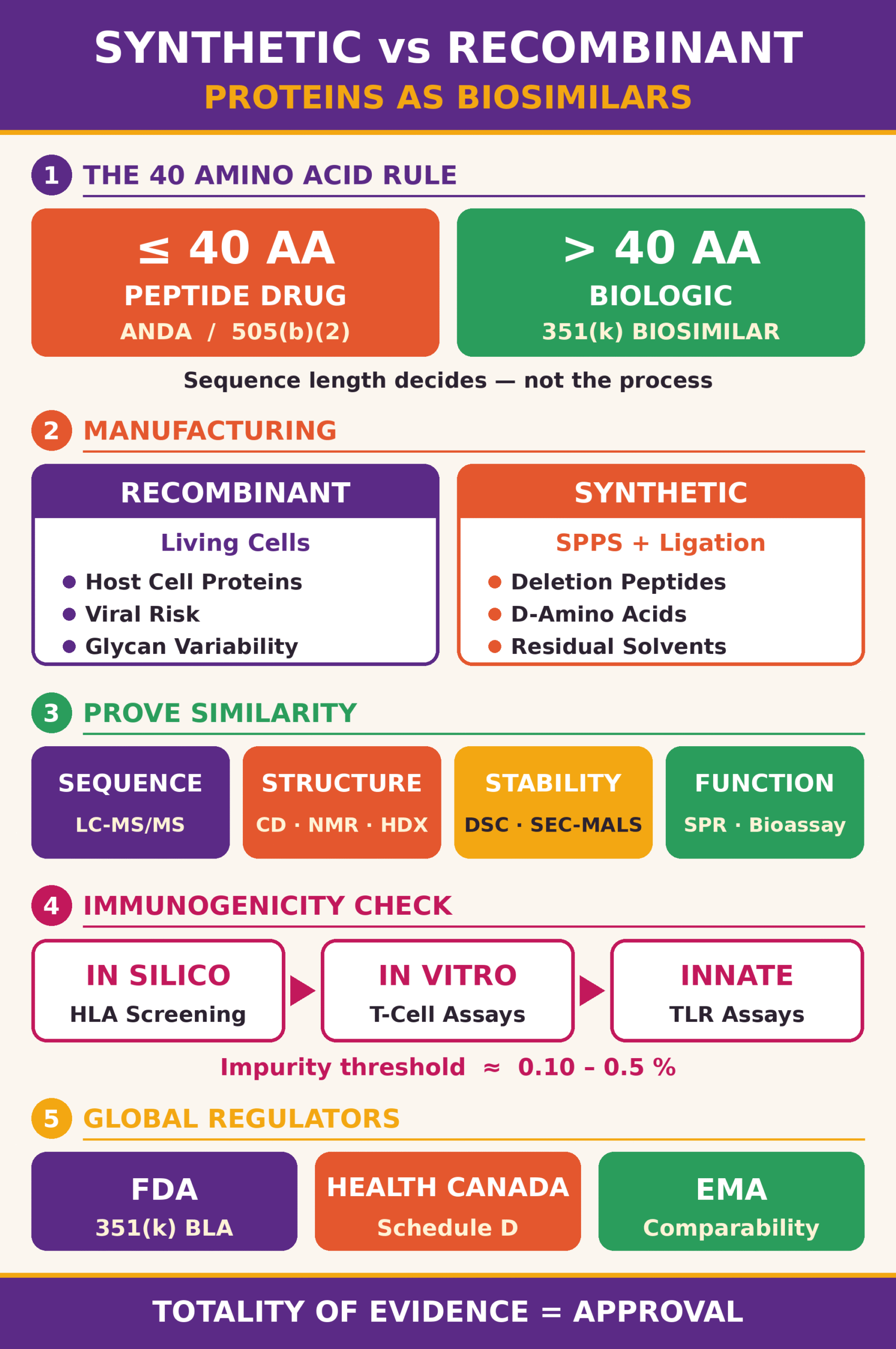
- The 40 amino acid rule: A chemically synthesized protein with more than 40 amino acids counts as a biological product under the PHS Act. It can seek approval as a biosimilar under Section 351(k), whether it is made by recombinant expression or chemical synthesis.
- Shorter peptides follow a different route: Synthetic peptides of 40 or fewer amino acids, such as glucagon, teriparatide and liraglutide, are not biosimilars. They are typically filed as ANDAs (505(j)) or 505(b)(2) NDAs under the FD&C Act.
- Different manufacturing risks: Recombinant production in living cells can bring host cell proteins, viral risk and glycosylation variability. Chemical synthesis (SPPS with ligation) avoids these but can introduce deletion peptides, D-amino acids, protecting-group residues and residual solvents.
- Analytical comparability is central: Similarity must be shown across primary sequence (LC-MS/MS), higher-order structure (CD, NMR, HDX-MS), stability and aggregation (DSC, SEC-MALS), and function (SPR, bioassays). Structure gets special scrutiny because synthetic proteins fold outside a cell.
- Immunogenicity risk is assessed in tiers: Synthetic impurities above roughly 0.10–0.5% may need qualification. Evaluation moves from in silico HLA screening to in vitro T-cell assays and innate immune (TLR) assays.
- Global regulators are broadly aligned: The FDA, Health Canada (Schedule D) and the EMA share similar scientific expectations. All three focus on analytical, functional and immunogenicity comparability, even though their legal pathways differ.
- Totality of evidence decides approval: Neither the manufacturing method nor sequence length alone determines approval. Success depends on robust process controls, well-characterized impurities, and strong structural, functional and clinical data.
Regulatory Framework Governing Chemically Synthesized vs Recombinant Proteins
The regulatory classification of Chemically Synthesized vs Recombinant Proteins depends significantly on amino acid sequence length. Under the framework described here, polymers containing more than 40 amino acids may be subject to biological product regulation and evaluated through the 351(k) biosimilar pathway, whereas molecules containing 40 or fewer amino acids generally fall within the regulatory framework for peptide or small-molecule drugs, subject to applicable product-specific requirements.
The regulatory framework for synthetic proteins was clarified through amendments to 21 CFR 600.3, establishing a distinction based on amino acid sequence length. Congress also removed the statutory parenthetical that excluded “chemically synthesized polypeptides” from the definition of a biological product under Section 351(i) of the PHS Act. Consequently, synthetic polymers exceeding 40 amino acids may fall under biological product regulation pursuant to the PHS Act rather than being regulated exclusively as drugs under the Federal Food, Drug, and Cosmetic Act (FD&C Act).
In contrast, synthetic versions of shorter recombinant peptides, such as glucagon (29 amino acids), teriparatide (34 amino acids), and liraglutide (31 amino acids), do not qualify as biological products or biosimilars under PHS Act Section 351(k) solely on the basis of their sequence. Depending on the specific product and applicable regulatory requirements, these synthetic peptides may be submitted as generic drugs through Abbreviated New Drug Applications (ANDAs) under Section 505(j) or through 505(b)(2) New Drug Applications (NDAs) under the FD&C Act. Such applications are evaluated according to the relevant FDA requirements and product-specific guidance documents.
For molecules exceeding the 40-amino acid threshold, establishing biosimilarity under Section 351(k) requires evidence that the proposed product is “highly similar” to the reference product, notwithstanding minor differences in clinically inactive components. The applicant must also demonstrate that no clinically meaningful differences exist in safety, purity, or potency.
| Parameter | Synthetic Peptides (40 or Fewer Amino Acids) | Synthetic Proteins (More Than 40 Amino Acids) | Recombinant Biosimilars (More Than 40 Amino Acids) |
|---|---|---|---|
| Statutory Framework | FD&C Act Section 505(j) or 505(b)(2) | PHS Act Section 351(k) BLA | PHS Act Section 351(k) BLA |
| Legal Classification | Small-Molecule / Peptide Drug | Biological Product / Biosimilar, where eligible | Biological Product / Biosimilar |
| Reference Basis | Reference Listed Drug (RLD) | Reference Biological Product | Reference Biological Product |
| Market Exclusivity | 5 Years (NCE) / 3 Years under Hatch-Waxman, where applicable | 12 Years for the Reference Product, where applicable | 12 Years for the Reference Product, where applicable |
| Primary Quality Benchmark | Deletion and racemization profiling | Higher-order structure and synthetic impurities | Host cell proteins, viral safety, and glycosylation |
Manufacturing Nuances: Chemically Synthesized vs Recombinant Proteins
Manufacturing Chemically Synthesized vs Recombinant Proteins involves distinct production processes and impurity-related risks. Recombinant cell culture can generate host cell proteins and variable post-translational modifications, whereas chemical synthesis provides greater control over sequence assembly and can eliminate biologically derived process contaminants. However, chemical synthesis introduces its own potential quality challenges, including stepwise deletion sequences, truncation products, and stereoisomers.
Recombinant protein production involves introducing genetic vectors into host cell systems, such as CHO cells, E. coli, or Saccharomyces cerevisiae. The cellular machinery then carries out transcription, translation, and post-translational processing. Although recombinant expression is well suited to producing large and structurally complex macromolecules, it can introduce batch-to-batch microheterogeneity. Examples include variations in N- or O-linked glycosylation patterns, C-terminal lysine clipping, enzymatic oxidation, and deamidation. Recombinant manufacturing also requires control of potential process-related contaminants, including host cell proteins (HCPs), host cell DNA, endogenous or adventitious viral agents, and bacterial endotoxins.
Learn more about post-translational modifications in biosimilars.
Chemical synthesis, using Solid-Phase Peptide Synthesis (SPPS) in combination with Convergent Fragment Ligation or Native Chemical Ligation (NCL), assembles the polypeptide backbone through successive reactions involving purified amino acid building blocks. Because this approach does not rely on living production cells, it can eliminate host cell-derived contaminants and reduce concerns associated with certain adventitious viral agents introduced through biological expression systems. Nevertheless, chemical synthesis produces a distinct impurity profile that may include sequence deletion peptides, truncation products, incomplete side-chain deprotection, amino acid racemization, such as conversion between L- and D-enantiomers, residual organic solvents such as N,N-dimethylformamide, and different aggregation states.
Explore methods for identifying and evaluating impurities in biosimilar products.
| Quality Attribute | Recombinant Protein Expression | Chemically Synthesized Protein |
|---|---|---|
| Production System | Living host cells, including CHO, E. coli, and yeast | Cell-free chemical synthesis using SPPS / NCL |
| Primary Sequence Integrity | High translational fidelity through the genetic code | Potential for stepwise deletion, truncation, or insertion |
| Post-Translational Modifications | Complex, potentially heterogeneous enzymatic PTMs | More homogeneous profiles, with site-specific incorporation possible through chemical or chemo-enzymatic approaches |
| Process-Related Impurities | Host Cell Proteins (HCPs), host DNA, and potential viral contaminants | Coupling reagents, residual solvents, and protecting groups |
| Product-Related Impurities | Glycoforms, charge variants, and biological aggregates | Stereoisomers, including D-amino acids, and deletion peptides |
| Batch-to-Batch Consistency | May vary with cell line characteristics and culture conditions | Can be highly reproducible when synthesis and purification processes are well controlled |
Analytical Comparability and Characterization of Chemically Synthesized vs Recombinant Proteins
Demonstrating biosimilarity between Chemically Synthesized vs Recombinant Proteins requires a comprehensive analytical comparability package. This package must establish the relevant similarities in primary amino acid sequence, folding conformation, higher-order structure (HOS), and functional potency relative to the recombinant reference product. Because a chemically synthesized protein folds outside a biological cell and may not benefit from native cellular chaperones, demonstrating appropriate higher-order structural similarity is particularly important.
Primary amino acid sequence identity and complete disulfide bond mapping can be assessed using high-resolution liquid chromatography-tandem mass spectrometry (LC-MS/MS), peptide mapping, and automated Edman degradation or N-/C-terminal sequencing. These techniques help confirm sequence integrity, identify potential modifications, and characterize structural differences that could affect product quality or biological function.
Discover how proteomics approaches support biosimilar characterization.
Secondary, tertiary, and quaternary conformations should be evaluated under physiological conditions and, where appropriate, accelerated stress conditions using complementary analytical technologies.
Secondary Structure
Far-ultraviolet Circular Dichroism (Far-UV CD) and Fourier-Transform Infrared (FTIR) spectroscopy are used to assess secondary structural features, including α-helix and β-sheet content. These methods help identify differences in the protein’s secondary structure that may affect its overall conformation and stability.
Tertiary and Quaternary Structure
Near-UV CD, 2D Nuclear Magnetic Resonance (NMR) spectroscopy, including 1H-15N HSQC, X-ray crystallography, Hydrogen-Deuterium Exchange Mass Spectrometry (HDX-MS), and Cryo-Electron Microscopy (Cryo-EM) provide complementary information about three-dimensional folding, domain organization, and molecular interactions. The appropriate combination of these methods depends on the size, complexity, and structural characteristics of the protein under investigation.
Thermodynamic Stability and Aggregation
Differential Scanning Calorimetry (DSC), Size-Exclusion Chromatography with Multi-Angle Light Scattering (SEC-MALS), and Analytical Ultracentrifugation (AUC) are used to evaluate thermal unfolding transitions, molecular size distributions, and soluble or insoluble oligomeric aggregation states. These measurements help determine whether structural stability and aggregation behavior are comparable between the synthetic candidate and the reference product.
Read more about aggregation analysis in biosimilars and the analytical methods used to evaluate protein aggregation.
Functional Potency and Kinetics
Cell-based functional bioassays, surface plasmon resonance (SPR), and bio-layer interferometry (BLI) are used to assess biological activity, target receptor interactions, and binding kinetics. These methods help establish whether target receptor binding affinities (KD) and relevant intracellular signaling pathways are comparable to those of the recombinant reference product. Together, these assessments support a comprehensive evaluation of functional similarity.
Review the key critical quality attributes (CQAs) of biosimilars that guide analytical characterization and comparability assessments.
Impurity Profiles and Immunogenicity Risks in Chemically Synthesized vs Recombinant Proteins
Assessing immunogenicity in Chemically Synthesized vs Recombinant Proteins requires evaluating whether synthetic process-related impurities or sequence variants could introduce new T-cell epitopes or trigger innate immune activation that is not associated with the recombinant reference product. Immunogenicity is an important clinical consideration when a synthetic candidate is developed as a proposed biosimilar to an established recombinant biological product.
Chemical synthesis may generate impurities such as D-amino acid enantiomers, t-butylated amino acid side chains, and trace deletion fragments that are not typically associated with the recombinant reference product. The presence of these impurities does not automatically establish an increased immunogenicity risk; their significance depends on their identity, concentration, biological properties, and potential effects on the final drug product.
When a novel synthetic peptide-related impurity reaches an applicable regulatory reporting or qualification threshold, potentially around 0.10% to 0.5% depending on the impurity and relevant requirements, the applicant may need to provide scientific evidence to characterize its safety and assess whether it could affect immunogenicity or biological activity. The appropriate threshold and qualification strategy must be determined according to the applicable regulatory guidance and the specific product.
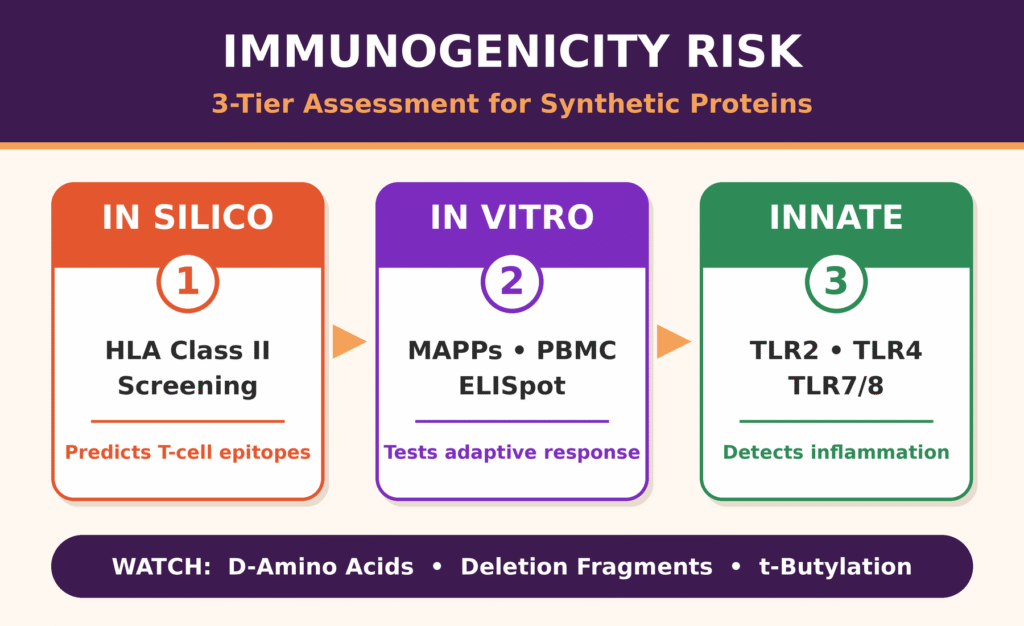
Regulatory bodies use a risk-based, multi-tiered approach to immunogenicity assessment.
In Silico Adaptive Immunogenicity Modeling
Computational algorithms can screen novel synthetic sequence impurities against a broad range of Human Leukocyte Antigen (HLA) Class II alleles. These analyses predict potential Major Histocompatibility Complex (MHC) binding affinity and the possibility of T-cell epitope formation. The results help identify impurities that may warrant further investigation through experimental testing.
In Vitro Adaptive Immune Assays
Experimental methods such as MHC-Associated Peptide Proteomics (MAPPs), human peripheral blood mononuclear cell (PBMC) T-cell proliferation assays, and Enzyme-Linked Immunospot (ELISpot) assays can be used to investigate whether specific impurities have the potential to activate adaptive immune responses. These approaches provide complementary evidence to support the assessment of immunogenicity risk.
Innate Immune Response Assays (IIRA)
Samples of the fully formulated drug product can be evaluated using suitable cell-based systems expressing pattern recognition receptors, such as Toll-like Receptors TLR2, TLR4, and TLR7/8. These assessments help determine whether trace chemical reagents, residual solvents, aggregates, or other product-related impurities could stimulate innate immune activation and proinflammatory cytokine release.
Explore forced degradation studies for biosimilars to understand how stress testing can help reveal degradation pathways and support product quality and stability assessments.
Global Regulatory Alignment: FDA, Health Canada, and EMA Guidelines
Global regulatory authorities share broadly consistent scientific expectations for evaluating proposed biosimilars, including synthetic candidates. These expectations emphasize analytical and structural comparability, functional similarity, and immunogenicity risk assessment, although the applicable statutory provisions and regulatory pathways differ across the FDA, Health Canada, and European Medicines Agency (EMA) frameworks.
United States: FDA
In the United States, the FDA applies the statutory framework established under the PHS Act to the classification and regulation of biological products. Under the sequence-length distinction discussed in this article, synthetic molecules containing more than 40 amino acids may be evaluated through the 351(k) biosimilar pathway when the applicable eligibility requirements are satisfied. Shorter synthetic peptides may instead fall under the relevant FD&C Act pathways, including 505(j) ANDAs, where appropriate.
Canada: Health Canada
Health Canada regulates biosimilar biologic drugs under Schedule D of the Food and Drugs Act. Its regulatory approach emphasizes a comprehensive analytical comparability exercise supported by appropriate functional assessments and comparative clinical pharmacokinetic/pharmacodynamic (PK/PD) studies, where required. The extent of the supporting evidence depends on the product’s characteristics, the available scientific information, and the applicable regulatory requirements.
European Union: EMA
Similarly, the European Medicines Agency (EMA) evaluates biosimilar and biological medicinal products according to established quality, safety, and comparability guidelines. For a proposed synthetic protein, the relevant quality assessment may include validation of chemical synthesis steps, fragment ligation purity, higher-order structural similarity, impurity characterization, and a risk-based immunogenicity assessment. The supporting nonclinical and clinical evidence is determined by the specific product and the applicable regulatory framework.
Across these jurisdictions, a chemically synthesized protein may be considered for biosimilar authorization when it satisfies the applicable eligibility requirements and demonstrates the necessary analytical, structural, functional, and clinical comparability to an approved reference product. Regulatory acceptance depends on the totality of the evidence rather than on manufacturing method or sequence length alone.
Learn how ICH Q6B guidelines support the characterization of biological products and help establish appropriate specifications for quality assessment.
Conclusion: The Future of Chemically Synthesized vs Recombinant Proteins in Biosimilar Development
A chemically synthesized copy of a therapeutic protein containing more than 40 amino acids may be eligible for consideration under Section 351(k) when it satisfies the applicable statutory requirements and demonstrates the required analytical, structural, functional, and clinical comparability to the reference product. The continuing development of Chemically Synthesized vs Recombinant Proteins highlights the potential of synthetic manufacturing to provide greater control over sequence assembly, impurity profiles, and product consistency, making synthetic biologics an increasingly important area of research in affordable healthcare.
Advances in convergent chemical ligation, high-resolution mass spectrometry, and computational immunogenicity modeling have helped address several technological challenges that historically distinguished synthetic chemistry from recombinant biotechnology. These developments create opportunities to investigate alternative manufacturing approaches for selected therapeutic proteins while maintaining rigorous quality and safety standards.
By implementing comprehensive analytical characterization strategies, orthogonal testing methods, and scientifically justified comparability assessments, developers can generate the evidence needed to evaluate synthetic therapeutic proteins against established recombinant reference products. Ultimately, the successful development of these products will depend on robust manufacturing controls, well-characterized impurity profiles, reliable structural and functional data, and compliance with the relevant regulatory requirements.
Explore the end-to-end analytical package for biosimilar regulatory submissions to understand how integrated characterization data can support a comprehensive comparability assessment.
For specialized analytical testing, higher-order structural characterization, and regulatory biosimilar comparability guidance, visit ResolveMass Laboratories Inc. at Contact ResolveMass Laboratories Inc..
Frequently Asked Questions (FAQs)
The FDA regulatory framework distinguishes certain synthetic alpha amino acid polymers according to their sequence length. Polymers containing 40 or fewer amino acids generally fall under the drug regulatory framework, whereas those exceeding 40 amino acids may be classified as biological products under the PHS Act, subject to the applicable statutory definitions and requirements.
Synthetic versions of shorter peptides, including teriparatide, liraglutide, and glucagon, are generally evaluated under applicable drug approval pathways rather than the 351(k) biosimilar pathway. Depending on the product and regulatory requirements, an application may be submitted through a 505(j) Abbreviated New Drug Application (ANDA) or a 505(b)(2) New Drug Application (NDA).
Chemical protein synthesis offers precise control over amino acid sequence assembly and can provide consistent batch-to-batch quality when manufacturing processes are well controlled. Because it does not require living host cells, it also avoids host cell proteins (HCPs), host cell DNA, and certain biological contaminants associated with cell culture production.
Higher-order structural comparability is established through complementary analytical methods selected according to the protein’s characteristics. Techniques may include 2D NMR spectroscopy, Far-UV and Near-UV Circular Dichroism, X-ray crystallography, Differential Scanning Calorimetry (DSC), SEC-MALS, and LC-MS/MS peptide mapping to evaluate structural features, stability, and sequence integrity.
Recombinant proteins may contain host cell proteins, residual host cell DNA, and heterogeneous glycoforms resulting from biological production. Chemically synthesized proteins can instead contain deletion peptides, D-amino acid stereoisomers, residual organic solvents, and incomplete deprotection products, making process-specific impurity characterization essential for quality and safety assessment.
Immunogenicity evaluation may involve computational screening of potential HLA Class II binding, in vitro MHC-Associated Peptide Proteomics (MAPPs), and PBMC T-cell activation assays. Innate Immune Response Assays (IIRA) may also be appropriate to investigate cytokine release and potential immune activation, depending on the identified risks and applicable regulatory guidance.
A chemically synthesized protein that qualifies for approval as a biosimilar may also be considered for an interchangeability designation if it meets the applicable regulatory requirements. In the United States, the applicant must establish that the product can be expected to produce the same clinical result as the reference product in any given patient and satisfy the other statutory criteria for interchangeability.
Health Canada and the European Medicines Agency (EMA) evaluate proposed biosimilars through their respective regulatory frameworks, emphasizing comprehensive analytical comparability, structural characterization, functional activity, and appropriate safety assessments. Whether a chemically synthesized product qualifies for authorization depends on the applicable regional requirements and the strength of the supporting scientific evidence.
Chemical protein synthesis can reduce reliance on cell culture facilities, large-scale bioreactors, and certain downstream purification processes associated with recombinant manufacturing. These advantages may simplify selected production operations, improve manufacturing consistency, and reduce some infrastructure requirements, although overall costs depend on synthesis complexity, purification needs, process yield, and scale of production.
Reference:
- U.S. Food and Drug Administration. (2018). Definition of the term “biological product”: Preliminary regulatory impact analysis, initial regulatory flexibility analysis, and unfunded mandates reform act analysis (Docket No. FDA-2018-N-2732). https://www.fda.gov/media/122985/download
- U.S. Food and Drug Administration. (n.d.). Definition of the term “biological product.” https://www.fda.gov/files/drugs/published/Biological-Product-Definitions.pdf
- U.S. Food and Drug Administration. (2015). Quality considerations in demonstrating biosimilarity of a therapeutic protein product to a reference product: Guidance for industry. https://www.fda.gov/media/135612/download
- U.S. Food and Drug Administration. (2018). Definition of the term “biological product”: Proposed rule—Preliminary regulatory impact analysis. https://www.fda.gov/about-fda/economic-impact-analyses-fda-regulations/definition-term-biological-product-proposed-rule-preliminary-regulatory-impact-analysis
- Jiao, T. (2024, September 25). Teriparatide injection first generic approval: Quality-related review considerations [Presentation]. Office of Pharmaceutical Quality, Center for Drug Evaluation and Research, U.S. Food and Drug Administration. https://www.fda.gov/media/184411/download
- U.S. Food and Drug Administration. (2024). FDA publishes revised draft product-specific guidances for certain generic peptide products. https://www.fda.gov/drugs/drug-alerts-and-statements/fda-publishes-revised-draft-product-specific-guidances-certain-generic-peptide-products
- European Medicines Agency. (n.d.). Development and manufacture of synthetic peptides. https://www.ema.europa.eu/en/scientific-guidelines/development-manufacture-synthetic-peptides
Get In Touch With Us
About The Author