


Introduction
Establishing a dependable Clinical Trial Material Supply for Peptide Programs requires a coordinated Chemistry, Manufacturing, and Controls (CMC) strategy that integrates specialized chemical synthesis, comprehensive impurity characterization, and adherence to international regulatory requirements. Managing this supply chain requires the systematic advancement of investigational peptides from initial candidate characterization through Phase I–III clinical development, while maintaining consistent and stringent quality standards throughout every stage of the program.
Synthetic peptides occupy a distinctive structural and regulatory position between conventional small-molecule pharmaceuticals and complex biological therapeutics. This intermediate nature creates several specialized technical challenges, including sequence-dependent aggregation, chiral instability, side-chain reactive impurities such as aspartimide formation and oxidation products, and complicated counter-ion behavior. As clinical candidates move from preliminary toxicity studies into trials involving increasingly larger patient populations, the clinical trial material supply chain must progressively evolve from flexible, small-batch synthesis toward validated and commercially scalable manufacturing systems. This progression requires systematic control of critical quality attributes, continuous consideration of evolving regulatory expectations from authorities such as the US Food and Drug Administration (FDA) and the European Medicines Agency (EMA), and compliance with international quality standards established by the International Council for Harmonisation (ICH).
Compare the structural and manufacturing differences between peptides and traditional small-molecule APIs at Difference Between a Peptide and a Small Molecule Drug.
Share via:
Quick Summary:
- Clinical Trial Material (CTM) supply for peptide programs requires an integrated CMC strategy covering peptide synthesis, impurity characterization, GMP controls, regulatory compliance, and scalable manufacturing.
- Phase I focuses on small-batch SPPS, early cGMP implementation, sequence confirmation, basic purity testing, stability, and counter-ion selection such as acetate or hydrochloride while controlling residual TFA.
- Phase II emphasizes process optimization and scale-up, with stronger control of aspartimide formation, racemization, diketopiperazine formation, oxidation, and aggregation, supported by qualified LC-MS methods.
- Phase III advances toward multi-kilogram manufacturing using scaled SPPS, LPPS, or hybrid approaches, with DoE, process characterization, pre-PPQ, and formal PPQ supporting commercial readiness.
- Regulatory and impurity control must address sequence-related impurities, truncations, insertions, diastereomers, residual reagents, solvents, and potentially mutagenic impurities, aligned with FDA, EMA, and ICH expectations.
- Clinical labeling and packaging require multilingual information, protection of study blinding, QP certification, traceability, and controlled relabeling procedures when shelf life is extended.
- Cold-chain logistics and CCIT protect peptide quality throughout distribution through validated temperature control, monitoring, qualified shippers, and integrity testing such as HVLD, vacuum decay, and laser headspace analysis.
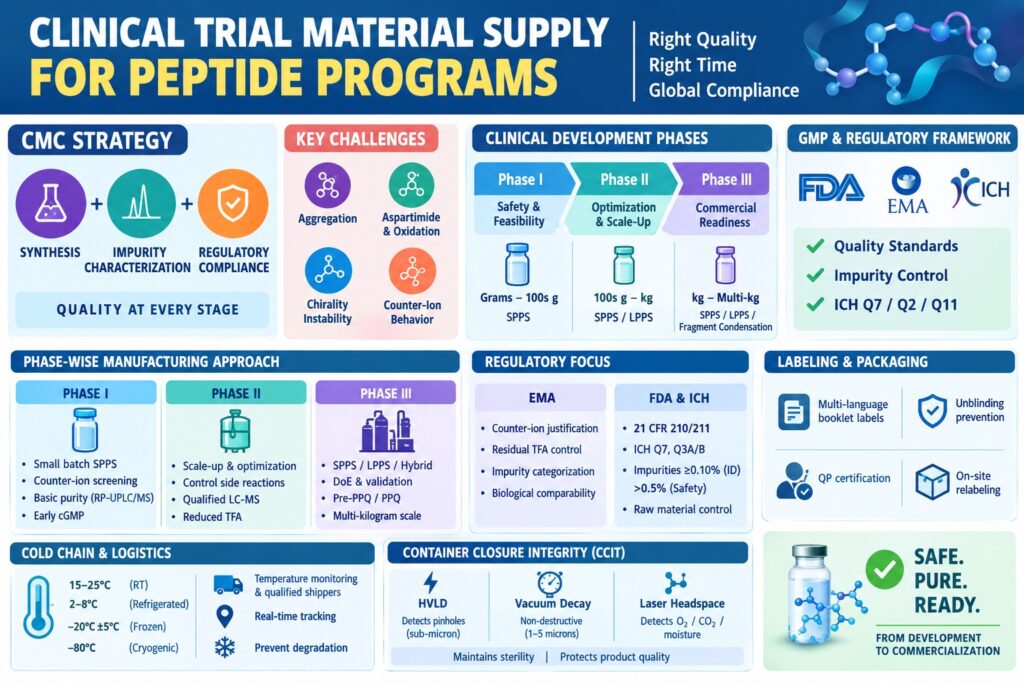
Phase-Appropriate Strategy for Clinical Trial Material Supply for Peptide Programs
A phase-appropriate strategy for Clinical Trial Material Supply for Peptide Programs progressively increases manufacturing capability from small-batch Solid-Phase Peptide Synthesis (SPPS) during Phase I to robust, multi-kilogram manufacturing processes characterized and validated in accordance with ICH Q11 during Phase III. This staged approach ensures that analytical characterization, regulatory controls, manufacturing oversight, and impurity acceptance criteria evolve in proportion to the increasing patient exposure associated with each clinical development phase.
| Parameter | Phase I Clinical Supply | Phase II Clinical Supply | Phase III Clinical Supply |
|---|---|---|---|
| Manufacturing Scale & Synthesis Mode | Grams to hundreds of grams; Solid-Phase Peptide Synthesis (SPPS) | Multi-hundred grams to kilograms; Optimized SPPS or hybrid SPPS/LPPS | Kilograms to multi-kilograms; Scaled SPPS, LPPS, or fragment condensation |
| Quality System Level | Early cGMP compliance; FDA 21 CFR Part 210/211 exemption for final drug product | Full cGMP compliance under 21 CFR Parts 210/211 and ICH Q7 | Full cGMP; commercial readiness under ICH Q7, Q11, and Q12 |
| Analytical Method Validation | Method suitability and basic purity assay (RP-UPLC/MS) | Qualified methods; partial validation for critical purity assays | Fully validated analytical methods under ICH Q2 |
| Impurity Profiling & Control | Identification of main impurities (>0.10%); target purity >90–95% | Characterization of co-eluting deletion/insertion sequences and diastereomers | Formal limits for stereoisomers, truncations, and mutagenic impurities |
| Counter-Ion Strategy | Preliminary selection (acetate vs. TFA); screening residual levels | Established ratio targets; residual TFA reduction (<0.1%) | Justified choice; validated exchange process and tight specifications |
| Process Validation | Non-validated; process demonstration batch | Process design and characterization batches; DoE studies | Execution of pre-PPQ and formal PPQ validation batches |
Phase I Clinical Supply Execution
Phase I clinical supply execution primarily concentrates on demonstrating preliminary product safety, confirming the peptide sequence, and establishing fundamental formulation stability before administration to humans during initial clinical trials. Manufacturing generally employs small-scale Solid-Phase Peptide Synthesis (SPPS), combined with early counter-ion screening, to generate material suitable for first-in-human studies.
During the initial stages of Phase I development, non-GMP feasibility batches and toxicological batches are manufactured to establish preliminary solubility and stability characteristics before the synthetic process is transferred into a cGMP-compliant manufacturing environment. SPPS remains the predominant synthetic approach because it provides relatively rapid processing and efficient production at smaller batch scales. Raw material controls emphasize confirmation of the identity and purity of protected amino acids, functionalized resins, linkers, and coupling reagents used throughout peptide assembly.
An important Chemistry, Manufacturing, and Controls consideration during Phase I is the evaluation and selection of the peptide counter-ion. Although trifluoroacetic acid (TFA) is routinely employed during cleavage and Reverse-Phase High-Performance Liquid Chromatography (RP-HPLC) purification, residual TFA can create concerns associated with cytotoxicity and product stability. Consequently, early process development investigates counter-ion exchange approaches capable of converting TFA salts into physiologically compatible acetate or hydrochloride forms. Establishing appropriate residual TFA targets at an early stage helps create a defined control strategy that can be further optimized as the peptide program advances.
Discover custom peptide synthesis solutions tailored for early-phase clinical programs at Custom Peptide Synthesis Services.
Phase II Process Optimization and Scale-Up
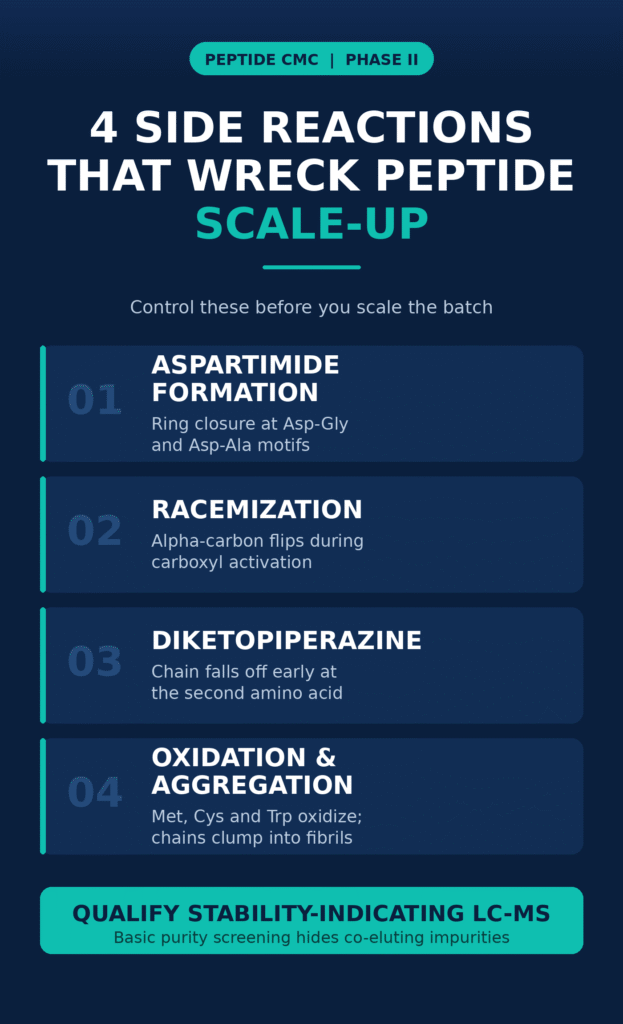
Phase II manufacturing emphasizes increasing production scale, improving synthetic efficiency and yields, and systematically minimizing sequence-dependent side reactions during peptide assembly. Process development activities focus on controlling important chemical liabilities, including aspartimide formation, racemization, diketopiperazine generation, and oxidation, while analytical LC-MS methods are progressively qualified to provide more reliable characterization of the manufactured peptide.
As patient enrollment and exposure increase during Phase II trials, manufacturing activities generally progress from exploratory laboratory-scale synthesis toward automated pilot-scale reactors and more controlled production environments. Process optimization during this stage concentrates on mitigating well-characterized chemical side reactions, including:
- Aspartimide Formation: A sequence-dependent cyclization reaction that occurs predominantly at Asp-Gly or Asp-Ala motifs under basic deprotection conditions.
- Racemization: Base-catalyzed $\alpha$-carbon racemization that can occur during carboxyl activation and therefore requires optimized coupling additives, including Oxyma Pure or HOAt.
- Diketopiperazine (DKP) Formation: Premature cleavage that can develop during deprotection of the second amino acid in C-terminal alkyl ester sequences.
- Oxidation and Aggregation: Susceptibility of Methionine, Cysteine, and Tryptophan residues to atmospheric oxygen, together with hydrophobic self-assembly that can result in the formation of insoluble fibrils.
Analytical methodologies must also become more sophisticated during Phase II, progressing beyond preliminary purity assessment toward qualified, stability-indicating liquid chromatography-mass spectrometry (LC-MS) assays. These methods should be capable of resolving closely co-eluting degradation products and other peptide-related impurities that may not be adequately differentiated using basic purity screening approaches.
Explore end-to-end analytical testing solutions for peptide characterization and purity profiling at Peptide Analytical Testing Services.
Phase III Commercial Readiness and Process Validation
Phase III clinical manufacturing is focused on demonstrating commercial-scale process reproducibility through comprehensive process characterization, Design of Experiments (DoE), and process validation performed according to applicable ICH guidelines. Late-stage manufacturing may employ scaled SPPS, liquid-phase synthesis (LPPS), or hybrid fragment condensation approaches, followed by pre-PPQ activities and formal Process Performance Qualification (PPQ) campaigns.
Phase III manufacturing provides the principal technical foundation for eventual commercial drug production and frequently requires multi-kilogram batch quantities. At this scale, achieving both economic efficiency and robust manufacturing performance may require the incorporation of Liquid-Phase Peptide Synthesis (LPPS) or hybrid fragment condensation strategies. In these approaches, shorter peptide fragments can initially be produced using SPPS and subsequently coupled in solution to construct the complete peptide sequence.
Regulatory expectations for Phase III clinical trial material require extensive process characterization, with Design of Experiments (DoE) principles used to establish relationships between Critical Process Parameters (CPPs) and Critical Quality Attributes (CQAs). Master Batch Production Records (MBPR) are completed and finalized, while pre-Process Performance Qualification (pre-PPQ) batches are manufactured to demonstrate process consistency and identify any remaining process-related risks before formal commercial validation campaigns are undertaken.
Explore process optimization strategies for high-demand peptides at Scaling a GLP-1 Analog from Preclinical Synthesis to GMP Manufacturing.
Regulatory Frameworks and Impurity Control Strategies in Peptide Programs
Regulatory approval of peptide clinical materials requires compliance with applicable FDA and EMA requirements while incorporating ICH quality and impurity-control principles throughout development. Effective compliance depends on the systematic identification, characterization, quantification, and control of sequence-related impurities, process-related impurities, and residual synthesis reagents across each clinical development stage.
European Medicines Agency (EMA) Synthetic Peptide Guidelines
The EMA Guideline on the Development and Manufacture of Synthetic Peptides (EMA/CHMP/CVMP/QWP/367182/2025) establishes formal expectations for the characterization and quality control of synthetic peptide drug substances in Europe. The framework includes requirements for scientifically justified counter-ion selection, appropriate control of residual TFA, and comprehensive comparability assessment when synthetic peptides are developed with reference to biological peptide products.
The EMA framework establishes specific considerations for synthetic peptide quality attributes:
- Counter-Ion Justification: Sponsors are expected to provide a scientific rationale for the selected counter-ion, such as acetate or chloride, and establish appropriate release specifications for residual TFA. Elevated residual TFA levels may receive regulatory attention because of their potential toxicity and possible effects on product stability.
- Impurity Categorization: Impurities should be appropriately classified as sequence-related impurities, including deletion sequences, insertion sequences, truncated peptides, and diastereomers, or as non-sequence-related impurities, such as residual solvents, heavy metals, and reactive reagents.
- Biological Comparability: When a synthetic peptide is developed with reference to an established biological peptide product, extensive structural, conformational, and physicochemical comparability studies may be necessary to demonstrate the relevant similarities and differences between the products.
Review regulatory standards for managing impurities under international guidelines at Impurity Control Strategies Under ICH Q3A.
FDA Regulations and ICH Guidelines for Peptide Impurities
The US FDA regulates synthetic peptide development and manufacturing through applicable requirements under 21 CFR Parts 210/211 and ICH Q7 quality frameworks, with particular attention to the identification, characterization, and control of peptide-related impurities. Impurities at or above 0.10% require analytical identification, while impurities exceeding 0.5% require appropriate non-clinical safety qualification.
Although investigational drug products manufactured during early Phase I development may operate under development-stage and risk-based cGMP expectations, API manufacturing should consistently follow applicable ICH Q7 principles. Conventional small-molecule impurity thresholds established under ICH Q3A and Q3B cannot automatically be applied to synthetic peptides because their sequence-dependent structures create different impurity profiles and characterization requirements.
Peptide-related impurities present at or above 0.10% should be characterized using high-resolution LC-MS together with orthogonal chromatographic techniques. A newly identified peptide-related impurity exceeding 0.5% may require safety qualification through appropriate non-clinical toxicology investigations. In addition, raw materials such as protected amino acids, solvents including DMF and NMP, and coupling agents should undergo risk-based qualification in accordance with ICH Q7 and ICH Q11 principles. These controls help minimize the introduction of trace contaminants and mutagenic impurities that may require control under ICH M7.
Explore full cGMP manufacturing capabilities for peptide active pharmaceutical ingredients at GMP Peptide API Manufacturing Services.
Specialized Clinical Labeling and Packaging Strategies
Clinical labeling and packaging for peptide programs must protect trial blinding, accommodate regulatory requirements across multiple countries, and comply with applicable requirements under the EU Clinical Trials Regulation. These operations commonly involve multi-language booklet label configurations and qualified packaging procedures designed to preserve clinical supply integrity throughout distribution to trial sites.
| Structural Requirement | Historical Framework: EU GMP Annex 13 | Current Framework: EU CTR Annex VI |
|---|---|---|
| Legal Basis | Non-binding guidance under EudraLex Volume 4 | Direct binding law under Regulation (EU) No 536/2014 |
| Language Requirements | Transposed into individual national laws across member states | Directly defined multi-language requirements per country |
| Expiry Date Management | Expiry date modifications managed via system or physical relabeling | Printed use-by date required on primary and secondary containers |
| Primary Container Exclusions | Permitted specific label exemptions for small primary containers | Restricted exemptions requiring formal regulatory justification |
Regulatory Transition: EU GMP Annex 13 to EU CTR Annex VI
The transition from EU GMP Annex 13 to EU CTR Annex VI represents a shift toward directly binding European requirements governing the labeling of investigational medicinal products (IMPs). This regulatory framework establishes greater consistency for multi-country clinical supply operations and standardizes requirements concerning use-by dates on primary and secondary containers.
Under the EU Clinical Trials Regulation (EU No 536/2014), clinical trial labeling requirements moved from approaches based on national implementation toward directly applicable provisions established through Annex VI. This framework supports a more standardized approach to clinical supply distribution across EU member states by establishing common requirements for language, labeling content, and regulatory information.
Learn about regulatory documentation and filing requirements for abbreviated applications at CMC Documentation at a CDMO for ANDA.
Multilingual Booklet Label Design and Unblinding Prevention
Multilingual booklet labels provide a practical mechanism for incorporating extensive regulatory, handling, and safety information in multiple languages within a single secondary packaging configuration. For double-blind studies, careful packaging design is particularly important because active peptide formulations and placebos must remain sufficiently indistinguishable to prevent accidental treatment assignment disclosure.
International peptide clinical trials conducted across multiple geographic regions may use multi-page booklet labels attached to secondary packaging to provide country-specific regulatory information in 20 or more languages. Mandatory clinical label information generally includes:
- Sponsor identification and emergency contact numbers.
- Pharmaceutical form, administration route, quantity, and product strength.
- Clinical trial reference code and site/investigator details.
- Subject identification number and visit designation.
- Specific storage conditions, handling instructions, and clearly stated use-by dates in month/year format.
- Required regulatory statements, such as “For clinical trial use only”.
For double-blind clinical trials, packaging procedures must ensure that active peptide formulations and placebos have comparable physical appearance, fill volumes, secondary packaging, and reconstitution characteristics. Maintaining these similarities is essential for protecting the blinding strategy and preserving the scientific integrity of the clinical study.
Qualified Person (QP) Certification and On-Site Relabeling Protocols
Each IMP batch distributed within the European Union requires formal certification by a Qualified Person (QP), confirming that the applicable manufacturing and quality requirements have been satisfied and that the material complies with the relevant clinical trial authorization and cGMP requirements. If peptide shelf life must be extended during an ongoing clinical trial, any associated on-site relabeling activity must be performed according to controlled GMP procedures under appropriate QP oversight.
The QP confirms that manufacturing and packaging activities comply with the approved Clinical Trial Application (CTA), EudraLex Volume 4, and the Product Specification File (PSF). When additional real-time stability data support an extension of a peptide’s approved shelf life during an ongoing clinical study, the physical labels on clinical kits may need to be updated. On-site relabeling requires application of an additional label displaying the revised use-by date while retaining the original batch number. The original batch code must remain unobstructed so that complete traceability and audit tracking are maintained throughout the clinical supply lifecycle.
Review mandatory stability testing requirements for clinical and commercial submissions at Stability Batches Required for an ANDA Submission.
Cold Chain Logistics and Container Closure Integrity in Clinical Trial Supply
Preserving cold chain integrity and confirming the performance of primary packaging seals are essential for minimizing thermodynamic degradation and preventing microbial contamination in parenteral peptide clinical supplies. Controlled temperature-controlled shipping, together with appropriate container closure integrity testing, helps preserve peptide quality and potency from manufacturing through clinical administration.
| CCIT Methodology | Operational Physics | Detection Capability | Application Suitability |
|---|---|---|---|
| High Voltage Lead Detection (HVLD) | Measures electrical conductivity across primary packaging | Detects pinholes and micro-fissures down to sub-micron scales | Liquid peptide parenteral vials, pre-filled syringes, and cartridges |
| Vacuum Decay Testing | Monitors pressure changes inside an evacuated test chamber | Non-destructive leak detection down to approximately 1–5 microns | Lyophilized peptide vials and liquid-filled containers |
| Laser-Based Headspace Analysis | Measures O2,CO2O_2, CO_2, or water vapor using light absorption | Detects gas exchange and moisture ingress without damaging samples | Lyophilized peptide products packaged under vacuum or inert gas |
Cold Chain Logistics and Temperature-Controlled Transport
Peptide CTM logistics depends on continuous temperature monitoring and qualified thermal packaging systems to minimize physical aggregation and chemical hydrolysis during international transportation. The use of passive vacuum insulation panel shippers or active temperature-controlled units helps maintain the specified storage conditions across refrigerated and frozen transportation environments.
Peptide drug products may require carefully controlled temperature ranges, including controlled room temperature (15∘C15^\circ\text{C} to 25∘C25^\circ\text{C}), refrigerated conditions (2∘C2^\circ\text{C} to 8∘C8^\circ\text{C}), frozen conditions (−20∘C±5∘C-20^\circ\text{C}\pm 5^\circ\text{C}), or deep-frozen cryogenic conditions (−80∘C-80^\circ\text{C}). Temperature excursions outside validated conditions can contribute to chemical hydrolysis, deamidation, or physical self-assembly, potentially resulting in the formation of non-functional aggregates.
To protect clinical shipments moving through international transit routes, clinical supply coordinators use qualified passive vacuum insulation panel (VIP) shippers or active compressor-based containers equipped with calibrated electronic data loggers. Real-time monitoring systems can track internal temperature, ambient conditions, tilt, and shipment location, allowing supply teams to identify and respond rapidly to transportation delays or other events that could compromise the specified storage conditions.
Explore formulation strategies for temperature-sensitive parenteral products at Formulating a Lyophilized Peptide Injectable.
Container Closure Integrity Testing (CCIT) for Parenteral Peptides
Container Closure Integrity Testing verifies that primary packaging systems used for parenteral peptides provide an effective barrier against microbial ingress and unwanted atmospheric exposure. Deterministic techniques, including High Voltage Lead Detection and vacuum decay testing, provide quantitative approaches for evaluating packaging integrity while allowing clinical batches to remain intact.
Because therapeutic peptides are frequently developed for parenteral administration, demonstrating adequate container closure integrity throughout the intended storage period is essential for maintaining product sterility and protecting product quality. Deterministic CCIT methodologies provide quantitative and generally non-destructive approaches that offer advantages over historical probabilistic dye ingress testing. Their application can help verify that lyophilized peptide cakes remain protected against moisture ingress and undesirable headspace gas exchange throughout storage, packaging, and clinical distribution.
Discover aseptic processing and filling services for injectable peptides at Sterile Fill-Finish Services for Peptide Injectables.
Conclusion
Successfully managing the Clinical Trial Material Supply for Peptide Programs requires coordinated integration of scalable synthetic chemistry, phase-appropriate cGMP controls, and rigorous regulatory compliance. Incorporating compliant multi-language labeling, qualified cold chain logistics, and continuous quality oversight helps preserve clinical material quality and integrity from early development through late-stage manufacturing and eventual commercialization.
Managing these technical requirements—from improving synthetic yields and controlling counter-ion exchange to completing QP batch certification under EU CTR Annex VI—demands technical precision and coordinated quality oversight at every stage of development. For specialized analytical testing, CMC development support, and clinical supply oversight designed for complex peptide candidates, visit the ResolveMass Contact Page.
Frequently Asked Questions (FAQs)
The EMA Guideline (EMA/CHMP/CVMP/QWP/367182/2025) establishes specific expectations for synthetic peptide drug substance quality and characterization in Europe. It emphasizes scientific justification of the selected counter-ion, appropriate control of residual TFA, and detailed assessment of sequence-related impurities, including deletion and insertion sequences, truncations, and stereoisomeric impurities.
Trifluoroacetic acid (TFA) is commonly encountered during peptide cleavage and purification and can therefore remain associated with the isolated peptide as a counter-ion. Controlling residual TFA is important because elevated levels may create toxicological and stability concerns, making early evaluation of acetate or chloride exchange strategies valuable for establishing a suitable clinical material profile.
EU CTR Annex VI under Regulation (EU) No 536/2014 specifies key information that must appear on investigational medicinal product labeling. Depending on the applicable requirements, labels include sponsor information, trial identification, pharmaceutical form, administration route, quantity, batch information, subject identification, storage conditions, use-by date, and required clinical trial statements in the applicable local languages.
When additional stability evidence supports extending the shelf life of a peptide clinical trial material, the updated use-by date can be incorporated through a controlled relabeling procedure. An additional label is applied while retaining the original batch number in a clearly visible and traceable manner. Such relabeling activities must be performed according to approved GMP procedures with appropriate Qualified Person (QP) oversight.
Container Closure Integrity Testing (CCIT) demonstrates that the primary packaging system continues to protect parenteral peptide products from microbial ingress and unwanted atmospheric exposure. Deterministic methods can quantitatively evaluate container integrity without compromising valuable clinical material, helping confirm that the packaging system remains protective throughout storage and distribution.
Peptide clinical trial materials can undergo chemical degradation when exposed to temperatures outside their validated storage range, with mechanisms such as hydrolysis, deamidation, and oxidation potentially becoming more pronounced. Temperature variation may also promote conformational changes, aggregation, or precipitation, which can affect product quality, potency, and the formation of unwanted peptide species.
A Qualified Person (QP) is responsible for certifying that an investigational medicinal product batch meets the applicable manufacturing and quality requirements before distribution within the European Union. This assessment includes compliance with cGMP requirements, EudraLex Volume 4, the approved Clinical Trial Application, and the Product Specification File, as applicable to the batch and clinical trial.
Solid-Phase Peptide Synthesis (SPPS) builds the peptide sequence while it remains attached to an insoluble resin, allowing excess reagents and by-products to be removed through repeated washing operations. This makes SPPS highly practical for rapid development and smaller Phase I/II batches, whereas Liquid-Phase Peptide Synthesis (LPPS) performs synthesis in solution and can provide advantages in larger-scale manufacturing when intermediate isolation and process efficiency are appropriately controlled.
The impurity framework for synthetic peptides requires consideration of their sequence-specific characteristics rather than automatically applying conventional small-molecule criteria from ICH Q3A/B. Peptide-related impurities at or above 0.10% are subject to analytical identification, typically using techniques such as LC-MS, while a new individual impurity above 0.5% may require appropriate non-clinical safety qualification based on its characteristics and regulatory assessment.
Reference:
- European Compliance Academy. (2026, April 16). What are the GMP requirements for drug development? GMP Compliance. https://www.gmp-compliance.org/gmp-news/what-are-the-gmp-requirements-for-drug-development
- European Medicines Agency. (2025, December 4). Guideline on the development and manufacture of synthetic peptides (EMA/CHMP/CVMP/QWP/367182/2025). https://www.ema.europa.eu/en/documents/scientific-guideline/guideline-development-manufacture-synthetic-peptides_en.pdf
- Kota, S. (2019). Peptide manufacturing methods and challenges. In V. Srivastava (Ed.), Peptide therapeutics: Strategy and tactics for chemistry, manufacturing and controls (pp. 111–150). Royal Society of Chemistry. https://doi.org/10.1039/9781788016445-00111
- European Medicines Agency. (2025, December 9). Development and manufacture of synthetic peptides—Scientific guideline. https://www.ema.europa.eu/en/development-manufacture-synthetic-peptides-scientific-guideline
- European Medicines Agency. (2025, December 9). Development and manufacture of synthetic peptides—Scientific guideline. https://www.ema.europa.eu/en/development-manufacture-synthetic-peptides-scientific-guideline
- U.S. Food and Drug Administration. (2008, July). Guidance for industry: CGMP for Phase 1 investigational drugs. U.S. Department of Health and Human Services. https://www.fda.gov/media/70975/download
- International Council for Harmonisation of Technical Requirements for Pharmaceuticals for Human Use. (2000, November 10). Good manufacturing practice guide for active pharmaceutical ingredients (Q7). https://database.ich.org/sites/default/files/Q7%20Guideline.pdf
- Pharmaceutical Inspection Convention & Pharmaceutical Inspection Co-operation Scheme. (2021, May 1). Guide to good manufacturing practice for medicinal products: Annexes (PE 009-15). https://www.tga.gov.au/sites/default/files/gmp-guide-annexes.pdf
Get In Touch With Us
About The Author


