
Introduction:
Choosing among CMC consulting services for biotech startups comes down to one question: which partner can turn your science into a defensible, regulator-ready CMC package without draining your runway? For an early-stage company, the answer is a CRO that pairs hands-on analytical and process expertise with clear regulatory judgment.
Startups rarely have in-house CMC teams. Yet the chemistry, manufacturing and controls section is often the most scrutinized part of an IND or CTA, and weak data here can stall a promising molecule even when the clinical rationale is strong. A CRO partner therefore becomes an extension of your team, shaping how your product is characterized, controlled and documented from day one.
This guide explains what CMC consulting involves, the criteria that separate strong partners from weak ones, the red flags to avoid, and how ResolveMass Laboratories Inc. supports startups working on biologics, biosimilars, drug delivery systems and small molecules.
Summary:
The right CMC consulting partner for a biotech startup combines scientific depth, phase-appropriate regulatory thinking, analytical strength and transparent communication.
- What it is: CMC (Chemistry, Manufacturing and Controls) consulting covers process development, analytical characterization, specifications, stability and the regulatory CMC sections of an IND or CTA.
- Why it matters: CMC gaps are among the most common causes of clinical holds, delayed filings and failed comparability exercises.
- How to choose: Evaluate a CRO on technical expertise, analytical capability, regulatory track record, data integrity, communication and scalability.
- Best fit for startups: Look for a partner that works phase-appropriately and does not over-build early-stage programs.
- Red flags: Vague timelines, no named scientific lead, outsourced core testing with no oversight, and no plan for tech transfer.
- ResolveMass Laboratories Inc.: A Canadian analytical CRO/CDMO with focus areas in biosimilar characterization, mass spectrometry, PLGA-based drug delivery and nitrosamine testing.
1: What Are CMC Consulting Services for Biotech Startups?
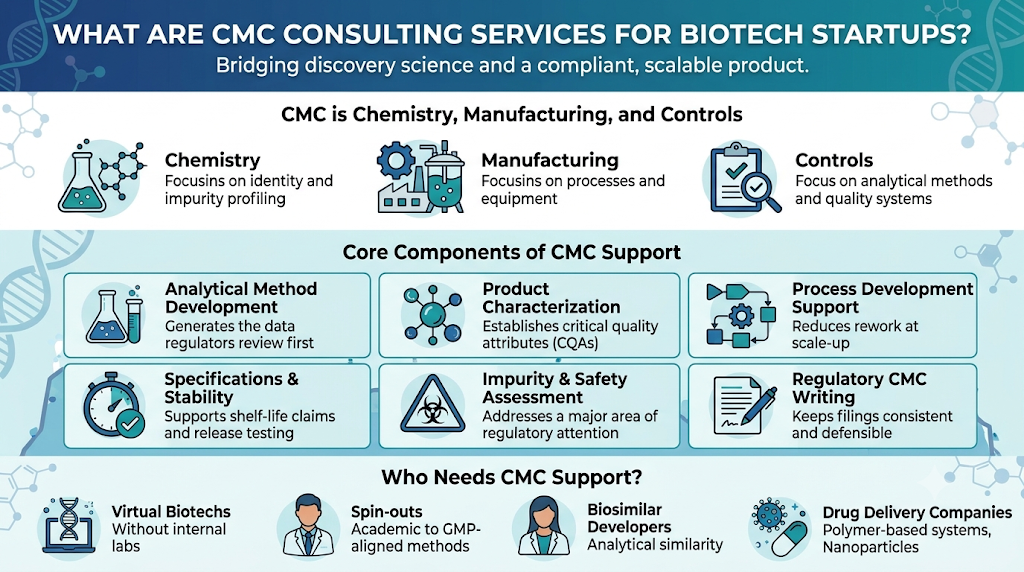
CMC consulting services for biotech startups are expert advisory and laboratory services that define, control and document how a drug substance and drug product are made and tested, so that the data supports regulatory filings and clinical supply. They bridge discovery science and a compliant, scalable product.
CMC stands for Chemistry, Manufacturing and Controls, and it covers three interconnected areas:
- Chemistry: The identity, structure, composition, physicochemical properties and impurity profile of the drug substance and drug product.
- Manufacturing: The processes, materials, equipment and operating conditions used to produce the therapeutic product.
- Controls: The analytical methods, specifications, quality systems and testing procedures that keep product quality consistent.
The exact scope depends on the therapeutic modality, development stage, manufacturing model and regulatory pathway. A synthetic peptide program may need LC-MS/MS, HPLC, amino acid analysis and impurity profiling, while a monoclonal antibody program adds characterization of molecular weight, aggregation, charge variants, glycosylation and biological activity. The goal is scientifically justified evidence that the product can be consistently manufactured and adequately controlled.
Core components of CMC support
| CMC area | What it covers | Why startups need it |
|---|---|---|
| Analytical method development and validation | Assays for identity, purity, potency, impurities and stability | Generates the data regulators review first |
| Product characterization | Structural, physicochemical and higher-order analysis, including mass spectrometry | Establishes critical quality attributes (CQAs) |
| Process development support | Defining critical process parameters and control strategy | Reduces rework at scale-up |
| Specifications and stability | Setting acceptance criteria and running stability programs | Supports shelf-life claims and release testing |
| Impurity and safety assessment | Extractables, leachables, nitrosamines and related impurities | Addresses a major area of regulatory attention |
| Regulatory CMC writing | Module 3 content, quality summaries, response to agency questions | Keeps filings consistent and defensible |
Who typically needs this support?
- Virtual biotechs without internal analytical or manufacturing groups
- Spin-outs moving from academic assays to GMP-aligned methods
- Biosimilar developers who must show analytical similarity to a reference product
- Drug delivery companies developing polymer-based systems such as PLGA microspheres and nanoparticles
2: Why Do Biotech Startups Need an External CRO for CMC Development?
Biotech startups benefit from an external CRO because CMC development needs advanced instruments, experienced scientists, quality systems and regulatory knowledge that are expensive to build in-house. Four challenges usually drive the decision.
Limited internal technical resources
Early-stage companies prioritize discovery and intellectual property, and building an analytical laboratory is a major investment. A qualified CRO provides access to platforms such as:
- Liquid chromatography-mass spectrometry (LC-MS), tandem MS (LC-MS/MS) and high-resolution MS (HRMS)
- Nuclear magnetic resonance (NMR)
- HPLC and UHPLC
- Inductively coupled plasma mass spectrometry (ICP-MS)
- Size exclusion chromatography (SEC) and dynamic light scattering (DLS)
These support molecular identification, purity assessment, structural characterization and impurity investigations.
Faster development without new infrastructure
Outsourcing selected analytical work avoids buying instruments and recruiting specialists for every capability. A CRO can also coordinate complementary techniques, which reduces duplicated testing.
Better understanding of regulatory expectations
CMC requirements change as a product moves from discovery to clinic to commercialization. An experienced CRO helps identify missing analytical information, recommends suitable characterization studies and generates data that supports your broader CMC strategy.
Flexibility as programs change
Changes in formulation, manufacturing conditions, analytical methods or product understanding often require extra testing. A project-based CRO partnership lets you add specialized services as needs evolve. Moving a process between sites is a common example, and the scale-up and tech transfer in CMC planning done early makes those moves smoother.
3: Why Early CMC Planning Matters for Biotech Startups
Early CMC planning matters because regulators expect your product to be well characterized and consistently made before it reaches patients, and fixing CMC problems late costs far more time than preventing them. Strong CMC consulting services for biotech startups protect both timelines and investor confidence.
Common CMC risks and how consulting reduces them
| Risk | Typical consequence | How expert CMC support helps |
|---|---|---|
| Under-characterized product | Questions from regulators, delayed IND or CTA | Orthogonal analytical characterization early |
| Unvalidated or fit-for-purpose gaps | Data that cannot support release or stability | Phase-appropriate method qualification and validation |
| Process changes without comparability | Clinical data questioned after a change | Planned comparability studies |
| Unaddressed impurity risks | Safety concerns, additional studies | Early impurity and nitrosamine risk assessment |
| Inconsistent documentation | Filing delays and repeated agency questions | Unified CMC writing and data review |
The central idea is phase-appropriate CMC: do what the current stage requires, but build a foundation that scales into Phase 2, Phase 3 and commercial development without starting over.
4: How to Choose the Right CRO Partner for CMC Consulting Services
The right CRO partner for CMC consulting services for biotech startups is one with proven technical depth in your modality, a regulatory-aware approach, transparent communication and the capacity to grow with your program. Use the criteria below as a structured scorecard.
Six criteria for evaluating a CMC CRO
| Criterion | What to look for | Questions to ask |
|---|---|---|
| Scientific expertise | Named scientists with experience in your modality (biologic, biosimilar, polymer-based delivery, small molecule) | Who will lead my project, and what similar programs have they supported? |
| Analytical capability | Advanced instrumentation, including high-resolution mass spectrometry, and orthogonal methods | Which techniques will you use to characterize my product, and why? |
| Regulatory awareness | Familiarity with FDA, Health Canada and EMA expectations and ICH guidelines | How do you align study design with ICH Q-series expectations? |
| Quality and data integrity | Documented quality systems, audit trails, traceable raw data | How are data reviewed, stored and made inspection-ready? |
| Communication and project management | Single point of contact, clear timelines, regular updates | How will you report progress and flag problems? |
| Scalability and continuity | Ability to move from development to later-phase support, plus tech transfer | What happens when my program advances to the next phase? |
Why modality-specific experience matters
A CRO that is excellent at small-molecule assays may not be equipped for a biosimilar or a PLGA-based drug delivery system. Higher-order structure, glycosylation, polymer degradation and release kinetics each need specialized methods. Ask for examples of the type of work performed, not just a general capability list.
Evaluating a Canadian CRO partner
For startups seeking a North American partner, a Canadian CRO can offer proximity to Health Canada and FDA-facing programs, collaborative communication across time zones and flexible, project-based engagement. Confirm how the CRO’s data package will be accepted by the agencies in your target markets.
Modality-specific CMC and analytical requirements
The right CRO should show experience with your molecule type, because analytical needs differ widely.
| Therapeutic modality | Important CMC and analytical requirements |
|---|---|
| Small molecules | Identity, assay, related substances, residual solvents, elemental impurities |
| Peptides | Sequence confirmation, molecular weight, purity, amino acid composition, counter-ion analysis |
| Monoclonal antibodies | Aggregation, charge variants, glycosylation, structural integrity, potency |
| Oligonucleotides | Sequence confirmation, molecular weight, purity, truncation impurities, modifications |
| Recombinant proteins | Primary structure, higher-order structure, aggregation, biological activity |
| Cell and gene therapies | Identity, purity, potency, safety-related attributes, process-related impurities |
Do not judge experience by years in operation alone. Relevant project experience, analytical problem-solving and the quality of scientific deliverables are better indicators. For conjugate programs, see ResolveMass’s overview of CMC services for peptide-oligonucleotide conjugates.
Analytical instrumentation and characterization capabilities
A suitable CMC partner has platforms that match your product’s quality attributes, and can explain why each technique fits your molecule rather than just listing instruments.
- LC-MS and LC-MS/MS: Molecular identification, impurity characterization and quantitative analysis.
- HRMS: Accurate-mass measurements and structural investigation of unknown impurities.
- HPLC/UHPLC: Assay, purity and related-substances profiling.
- NMR: Structural confirmation and molecular characterization.
- SEC-MALS and DLS: Molecular weight distribution, particle size and aggregation.
- ICP-MS: Elemental impurity assessment.
- FTIR and DSC: Functional group identification and thermal characterization.
For example, a peptide therapeutic may need complementary LC-MS and chromatographic methods to investigate oxidation, deamidation and deletion sequences. Packaging and container-closure interactions also belong in a CMC package, so ask how the CRO approaches extractables and leachables in CMC.
Analytical method development and validation expertise
Analytical methods demonstrate product identity, strength, purity and quality, so the CRO should develop fit-for-purpose procedures and establish their performance for the intended use. Confirm it can support:
- Method development and optimization
- Method qualification, where appropriate
- Method validation, verification and transfer
- Stability-indicating method development
- System suitability, robustness and specificity investigations
The right approach follows the procedure’s intended use and expectations such as ICH Q2(R2) and ICH Q14. A method for early exploratory characterization may need less qualification than a release-testing method intended for routine GMP use.
Regulatory knowledge and CMC documentation
A CRO should understand the framework for your target markets. US-focused programs center on FDA expectations, while Canadian and international programs may also involve Health Canada and other authorities.
| Regulatory guideline | Importance for CMC development |
|---|---|
| ICH Q5A(R2) | Viral safety evaluation of biotechnology products |
| ICH Q5C | Stability testing of biotechnological and biological products |
| ICH Q5E | Comparability after manufacturing process changes |
| ICH Q6B | Specifications and testing for biotechnological/biological products |
| ICH Q8(R2) | Pharmaceutical development and Quality by Design |
| ICH Q9(R1) | Quality risk management |
| ICH Q10 | Pharmaceutical quality systems |
| ICH Q11 | Development and manufacture of drug substances |
| ICH Q12 | Product lifecycle management |
For gene therapy and other advanced therapies, modality-specific FDA guidance also applies. For example, FDA’s January 2020 guidance on CMC information for human gene therapy IND applications describes recommendations for supporting product identity, quality, purity and strength, including potency.
The pathway shapes what the CMC package must contain. These ResolveMass resources show how requirements differ:
- CMC requirements for 505(b)(2) NDA submissions
- CMC documentation at a CDMO for ANDA filings
- CMC strategy for complex generic injectables
- Leuprolide depot CMC strategy as a long-acting injectable example
- Dexamethasone injection CMC requirements as a small-molecule injectable example
Regulatory guidance must be read in the context of the product, development stage and intended submission. A CRO should never promise regulatory acceptance simply because its testing follows a particular guideline.
Quality systems, documentation and data integrity
Analytical results are only as valuable as the documentation and traceability behind them. Review whether the CRO has:
- Approved standard operating procedures (SOPs)
- Instrument qualification and calibration records
- Analyst training records
- Controlled worksheets, raw data and chromatographic records
- Audit trails, where applicable
- Deviation and out-of-specification (OOS) investigation procedures
- Change control and document management
- Sample receipt, handling and storage records
- Technical review and report approval procedures
Also distinguish between research-grade testing, testing under an established quality system, and GMP-compliant testing. These are not interchangeable, so confirm the quality status of the proposed work and whether it meets your intended submission or manufacturing use.
Scalability and long-term development support
A good CRO considers your program’s future analytical needs, not only the immediate request. A method built for early development may need optimization, qualification, validation or transfer as the product nears later clinical phases. Ask whether the CRO can support:
- Early-stage characterization and analytical method lifecycle management
- Stability studies and comparative characterization
- Manufacturing change investigations
- Analytical method transfer
- Commercial-stage analytical requirements, where within its capabilities
This reduces redevelopment and improves continuity across milestones.
5: Engagement Models: Matching CMC Support to Your Development Stage
The best engagement model depends on your stage: startups usually begin with focused, project-based work and add integrated CMC support as the program advances. Matching scope to stage keeps spending proportionate to risk.
| Stage | Typical CMC focus | Suggested engagement |
|---|---|---|
| Preclinical / candidate selection | Early characterization, developability, impurity risk screening | Targeted analytical studies |
| Pre-IND / IND-enabling | Method qualification, specifications, stability plan, CMC section drafting | Project-based package with a named scientific lead |
| Phase 1 to Phase 2 | Method validation, comparability, process understanding | Integrated or retained support |
| Biosimilar development | Extensive analytical similarity assessment | Dedicated characterization program |
| Later phase / scale-up | Tech transfer, lifecycle management | Coordinated multi-site strategy |
Timelines vary with molecule complexity, sample availability and regulatory scope, so ask any CRO for a written work plan with milestones rather than a single promised date.
6: Why Biotech Startups Work with ResolveMass Laboratories Inc.
ResolveMass Laboratories Inc. is a Canadian analytical CRO/CDMO that supports biotech startups with science-led CMC consulting services, built around advanced analytical characterization and clear, regulator-ready reporting.
Where ResolveMass adds value
| Focus area | How it supports CMC programs |
|---|---|
| Biosimilar characterization | Orthogonal analytical similarity work to support comparability to a reference product |
| Mass spectrometry | High-resolution structural and impurity analysis to define CQAs |
| PLGA-based drug delivery | Characterization of polymer-based microspheres, nanoparticles and release behavior |
| Nitrosamine testing | Risk assessment and sensitive detection support for nitrosamine impurities |
What working with ResolveMass looks like
- Science-first scoping: Proposals are tied to your molecule, modality and stage rather than a generic menu.
- Transparent communication: You know who is leading the work, what is being tested and when results are expected.
- Regulatory-ready data: Reports are written so they can be used in CMC sections of regulatory submissions.
- Startup-friendly flexibility: Project-based engagements that can expand as your program grows.
Conclusion:
The right partner for CMC consulting services for biotech startups is a CRO that combines modality-specific expertise, strong analytical capability, regulatory awareness and open communication. Evaluate candidates with a clear scorecard, watch for red flags, and match the engagement to your development stage.
A well-chosen CMC partner does more than generate data. It helps you build a product story that regulators, investors and future partners can trust. ResolveMass Laboratories Inc. supports startups with science-led analytical and CMC expertise across biosimilar characterization, mass spectrometry, PLGA-based drug delivery and nitrosamine testing.
Frequently Asked Questions:
Choose a CRO based on its experience with your therapeutic modality, analytical instrumentation, method development capabilities, regulatory knowledge, quality systems, data integrity practices, project timelines, and scalability. Request relevant project experience and sample analytical reports before making a decision.
A suitable CMC CRO may provide:
– Drug substance and drug product characterization.
– Analytical method development and validation.
– Impurity identification and profiling.
– Stability testing.
– Structural characterization of peptides and biologics.
– Analytical method transfer.
– CMC-related analytical documentation and regulatory support.
CMC consulting focuses on the broader strategy for chemistry, manufacturing, and controls, including development planning, quality risk assessment, and regulatory considerations. CRO analytical testing focuses on generating laboratory data through analytical methods such as HPLC, LC-MS/MS, HRMS, and ICP-MS. Some organizations provide both services, while others specialize in one area.
CMC development should begin during early product development, ideally alongside preclinical planning. Early characterization, impurity identification, and analytical method development help identify potential quality challenges before they affect clinical development or regulatory submissions.
Reference
- Moore M. Contract research for biotechnology start-ups–a stakeholder resource-based analysis.https://research-repository.uwa.edu.au/en/publications/contract-research-for-biotechnology-start-ups-a-stakeholder-resou/
- Resendez JC. Exploring Preclinical Contract Research Organization Strategic Partnerships (Doctoral dissertation, Walden University).https://search.proquest.com/openview/3fd9594734e4e890a04c4b44f138e675/1?pq-origsite=gscholar&cbl=18750&diss=y
- Gad SC, Spainhour CB, Serota DG. Functions and types of contract support organizations (including CROs, CMDOs, packagers, and contract formulators). InContract Research and Development Organizations-Their History, Selection, and Utilization 2020 Jul 18 (pp. 109-119). Cham: Springer International Publishing.https://link.springer.com/chapter/10.1007/978-3-030-43073-3_5
- Dutton G. Discovery-to-Clinic Path Smoothed by Open Source Manufacturing: Wheeler Bio says that its Portable CMC services can help drug developers and CROs streamline scale-up efforts and expedite IND programs. Genetic Engineering & Biotechnology News. 2022 Apr 1;42(4):16-7.https://journals.sagepub.com/doi/abs/10.1089/gen.42.04.06
- Balconi M, Lorenzi V. The increasing role of contract research organizations in the evolution of the biopharmaceutical industry. African Journal of Business Management. 2017 Sep 28;11(18):478-90.https://academicjournals.org/journal/AJBM/translated-abstract/2D897A766065_in_Italian
About the Author