

Introduction
CMC documentation at a CDMO for ANDA submissions forms the foundation of regulatory compliance by demonstrating that a generic drug product is pharmaceutically equivalent, consistently manufactured, and capable of meeting established quality standards throughout its lifecycle. Within an Abbreviated New Drug Application (ANDA) submitted to the U.S. Food and Drug Administration (FDA), Chemistry, Manufacturing, and Controls (CMC) information is primarily presented in Module 3 (Quality) of the Common Technical Document (CTD).
Preparing a successful ANDA dossier requires close coordination between the generic drug sponsor and the Contract Development and Manufacturing Organization (CDMO). Since an ANDA pathway relies on demonstrating pharmaceutical equivalence and bioequivalence rather than generating independent clinical efficacy and safety data, FDA reviewers place significant emphasis on the quality information contained within Module 3. Every manufacturing parameter, analytical method validation, impurity control strategy, and stability data point generated by the CDMO can directly influence whether the application receives approval in the first review cycle or results in a Complete Response Letter (CRL).
This article provides a detailed examination of the technical and regulatory requirements associated with Section 3.2.S (Drug Substance) and Section 3.2.P (Drug Product) of the CTD, helping sponsors and CDMOs understand the critical elements necessary for a robust generic drug submission.
Article Summary:
- CMC documentation is central to ANDA approval, with most quality, manufacturing, analytical, and stability information presented in CTD Module 3 (Quality).
- Section 3.2.S (Drug Substance) focuses on the API, covering manufacturing, raw-material controls, structural characterization, impurity profiling, analytical methods, specifications, packaging, and stability.
- Section 3.2.P (Drug Product) covers the finished dosage form, including formulation development, QbD, manufacturing processes, excipient controls, product specifications, packaging, dissolution, and stability studies.
- Analytical and impurity control are critical to the dossier, including assessment of mutagenic impurities, nitrosamines, residual solvents, elemental impurities, degradation products, polymorphs, and other quality attributes using validated methods.
- Process development and validation demonstrate manufacturing consistency, with tools such as DoE, CPP/CQA assessment, process validation, scale-up studies, and PPQ supporting robust commercial production.
- Common ANDA CMC deficiencies include weak process-control justification, inconsistencies between Module 2.3 and Module 3, inadequate dissolution methods, incomplete impurity/nitrosamine assessments, and insufficient stability data.
- A cGMP-compliant CDMO can reduce regulatory risk through strong documentation, data reconciliation, risk-based assessments, discriminatory dissolution studies, validated analytical methods, and comprehensive stability programs—helping improve the likelihood of first-cycle approval and successful commercialization.
Learn more about partnering with experts by exploring our guide on how to choose a peptide CDMO in the US.
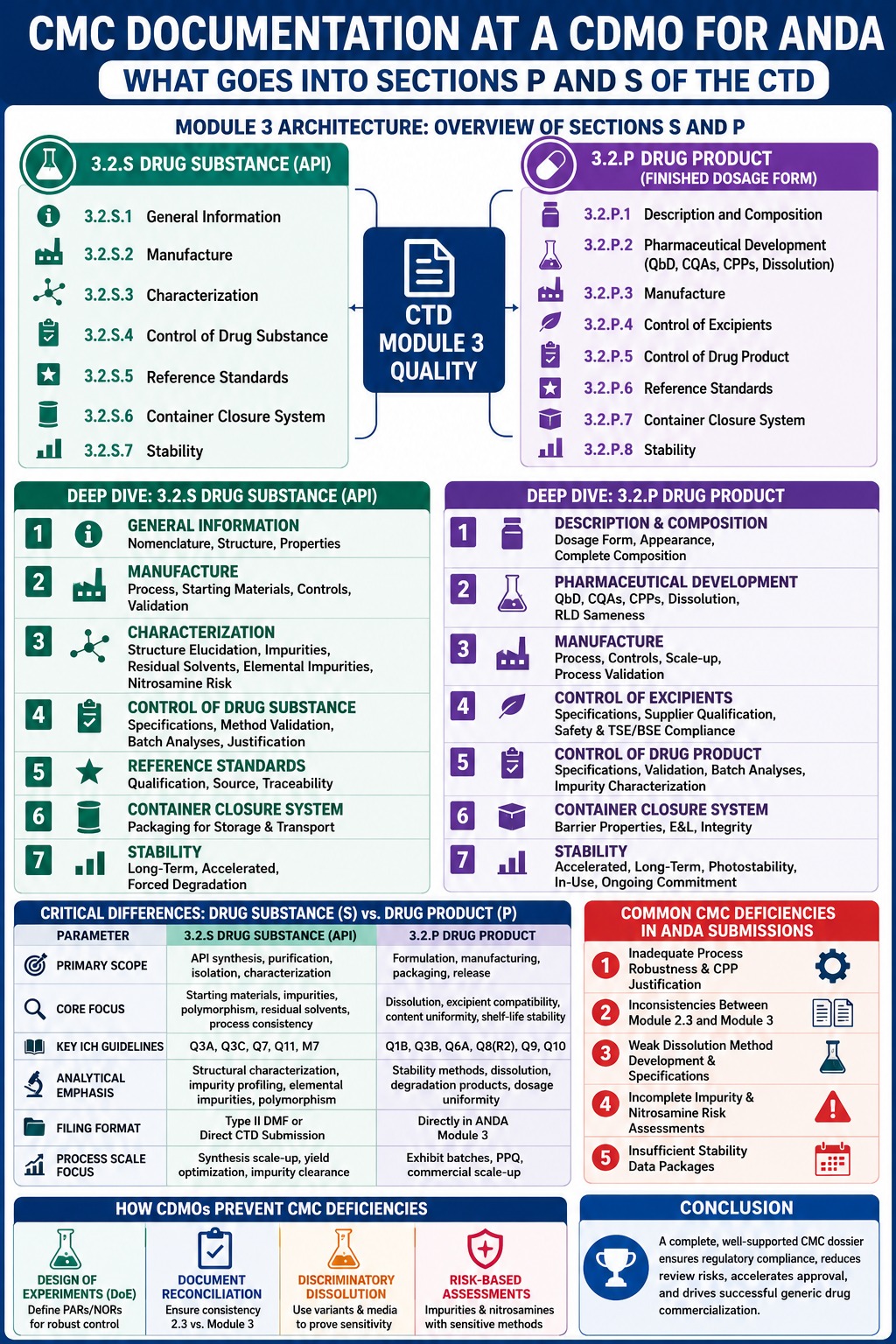
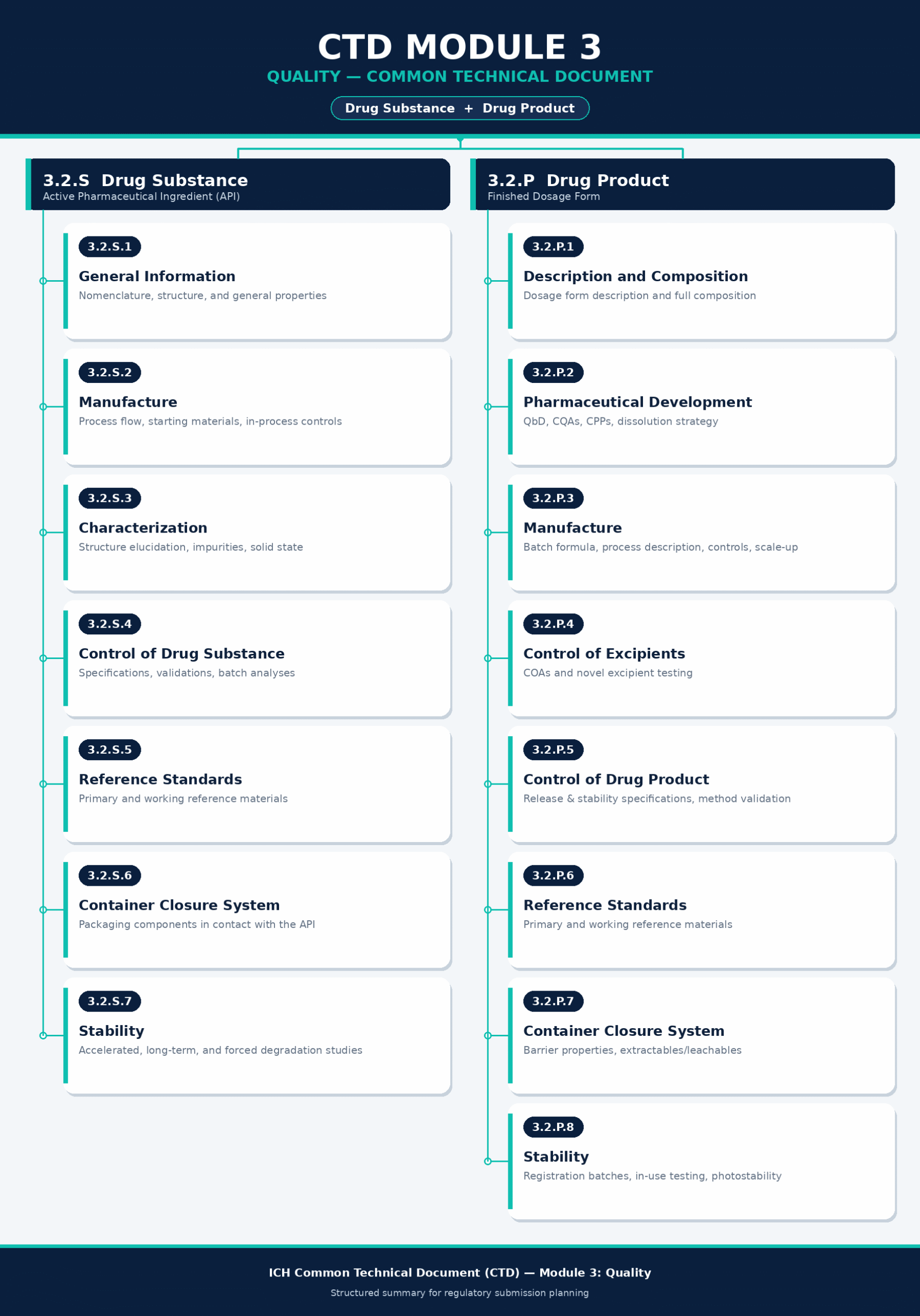
Module 3 Architecture: Overview of Sections S and P
Sections 3.2.S and 3.2.P are structured to organize chemistry, manufacturing, analytical, and stability information into standardized subsections recognized by both the FDA and the International Council for Harmonisation (ICH). These sections enable regulators to systematically evaluate product quality, manufacturing consistency, and long-term stability.
- Section 3.2.S (Drug Substance): Focuses on the Active Pharmaceutical Ingredient (API), including synthesis, raw material controls, physicochemical characterization, impurity assessment, analytical testing procedures, packaging systems, and stability data.
- Section 3.2.P (Drug Product): Focuses on the finished dosage form, covering formulation development, Quality by Design (QbD) studies, manufacturing processes, excipient controls, release specifications, packaging components, and shelf-life stability data.
Discover comprehensive analytical capabilities tailored for regulatory submissions with our one-stop CDMO analytical services for ANDA.
Deep Dive: What Goes Into CTD Section 3.2.S (Drug Substance)
Section 3.2.S is intended to provide comprehensive evidence that the API consistently meets predefined standards for identity, strength, quality, purity, and performance. For ANDA submissions, this information may be supplied directly by the API manufacturer or through a Type II Drug Master File (DMF), accompanied by the appropriate Open Part and a Letter of Authorization (LOA) included within Module 1.
1. General Information (3.2.S.1)
- Nomenclature and Structure (3.2.S.1.1 – 3.2.S.1.2): Includes the International Nonproprietary Name (INN), United States Adopted Name (USAN), chemical nomenclature, CAS registry number, molecular structure with stereochemical details, molecular formula, and molecular weight.
- General Properties (3.2.S.1.3): Documents key physicochemical characteristics such as physical appearance, solubility in water and organic solvents, solubility across physiological pH ranges, pKa values, partition coefficients (log P/log D), hygroscopic behavior, melting range, and polymorphic characteristics.
2. Manufacture (3.2.S.2)
- Manufacturer Information (3.2.S.2.1): Provides the names, addresses, and FDA Establishment Identifier (FEI) numbers of all facilities responsible for synthesis, testing, packaging, storage, and release activities.
- Manufacturing Process and Process Controls (3.2.S.2.2): Presents a detailed manufacturing narrative supported by process flow diagrams that identify reagents, catalysts, solvents, operating conditions, yields, purification steps, and chemical transformations.
- Control of Materials (3.2.S.2.3): Defines Regulatory Starting Materials (RSMs) in accordance with ICH Q11 and includes specifications, supplier qualifications, and quality controls for raw materials, reagents, solvents, and processing aids.
- Critical Steps and Intermediates (3.2.S.2.4): Describes in-process controls, intermediate specifications, hold-time studies, isolation procedures, and acceptance criteria used to maintain process consistency.
- Process Development and Validation History (3.2.S.2.5 – 3.2.S.2.6): Summarizes process optimization activities, route selection rationale, and Design of Experiments (DoE) studies used to justify manufacturing parameters and establish process robustness.
3. Characterization (3.2.S.3)
- Structure Elucidation (3.2.S.3.1): Demonstrates molecular identity through comprehensive analytical characterization techniques including ¹H-NMR, ¹³C-NMR, 2D-NMR (COSY, HSQC, HMBC), FT-IR spectroscopy, High-Resolution Mass Spectrometry (HRMS), UV-Visible spectroscopy, Single Crystal X-Ray Diffraction (SCXRD), and Powder X-Ray Diffraction (PXRD).
- Impurity Profiling (3.2.S.3.2): Provides identification, quantification, and scientific justification for all relevant impurities, including:
- Organic Impurities: Process-related impurities, intermediates, by-products, and degradation compounds assessed according to ICH Q3A requirements.
- Mutagenic and Genotoxic Impurities (ICH M7): Includes purge-factor assessments, clearance studies, risk evaluations, and control strategies for potentially mutagenic compounds.
- Nitrosamine Risk Assessments: Evaluates the potential formation of nitrosamines arising from amines, nitrosating agents, raw materials, process conditions, and environmental sources.
- Residual Solvents (ICH Q3C): Establishes solvent limits and validated analytical methods using headspace GC or GC-MS techniques.
- Elemental Impurities (ICH Q3D): Assesses catalyst residues and inorganic contaminants using validated ICP-MS methodologies.
4. Control of Drug Substance (3.2.S.4)
- Specifications (3.2.S.4.1): Defines release and retest criteria for appearance, identification, assay, impurity profile, enantiomeric purity, moisture content, residue on ignition, elemental impurities, particle size distribution (PSD), and polymorphic form.
- Analytical Procedures and Validation (3.2.S.4.2 – 3.2.S.4.3): Includes detailed analytical procedures and validation reports compliant with ICH Q2(R2), demonstrating Specificity, Linearity, Accuracy, Precision, Range, Limit of Detection (LOD), Limit of Quantitation (LOQ), Robustness, and solution stability.
- Batch Analyses (3.2.S.4.4): Provides Certificates of Analysis (COAs) and comparative analytical results from development, pilot-scale, bioequivalence, and commercial-scale batches.
- Justification of Specifications (3.2.S.4.5): Supplies scientific reasoning supporting each specification limit using historical manufacturing data, pharmacopeial requirements, toxicological considerations, and stability results.
5. Reference Standards, Container Closure, and Stability (3.2.S.5 – 3.2.S.7)
- Reference Standards (3.2.S.5): Includes qualification reports, characterization data, source information, and traceability documentation for primary and secondary standards.
- Container Closure System (3.2.S.6): Describes packaging materials used for API storage and transportation, such as LDPE liners and HDPE drums, while demonstrating compliance with applicable pharmacopeial and regulatory requirements.
- Stability (3.2.S.7): Presents long-term, intermediate, and accelerated stability data generated according to ICH Q1A(R2), along with forced degradation studies evaluating acid, base, oxidative, thermal, and photolytic stress conditions in accordance with ICH Q1B.
Scale your API development efficiently by reviewing our solutions for peptide API scale-up.
Deep Dive: What Goes Into CTD Section 3.2.P (Drug Product)
Section 3.2.P encompasses all information related to the finished pharmaceutical product, including formulation development, manufacturing operations, quality control testing, packaging, and stability. The CDMO must demonstrate that the generic product consistently performs in a manner comparable to the Reference Listed Drug (RLD) and maintains the required Critical Quality Attributes (CQAs).
1. Description and Composition of the Drug Product (3.2.P.1)
- Detailed description of the finished dosage form, including appearance, physical characteristics, identification markings, and presentation.
- Complete quantitative composition for each dosage strength and commercial batch size, clearly identifying the functional role of every excipient and providing justification for any formulation overages.
2. Pharmaceutical Development (3.2.P.2)
Section 3.2.P.2 is often considered one of the most important components of an ANDA because it establishes the scientific basis for formulation design and manufacturing strategy.
- Drug Substance Interaction (3.2.P.2.1.1): Evaluates API properties such as particle size distribution, polymorphism, solubility, and solid-state characteristics that may influence product performance and bioequivalence.
- Excipient Compatibility (3.2.P.2.1.2): Includes compatibility studies, stress testing, and functional excipient evaluations to ensure formulation stability and performance.
- Formulation Development and RLD Q1/Q2 Sameness (3.2.P.2.2.1): Demonstrates qualitative and quantitative similarity to the RLD where required and provides scientific justification for any differences.
- Comparative In Vitro Dissolution (3.2.P.2.2): Presents dissolution comparisons across multiple media using difference factor (f₁) and similarity factor (f₂) calculations.
- Manufacturing Process Development (3.2.P.2.3): Identifies Critical Process Parameters (CPPs) and their impact on Critical Quality Attributes (CQAs) through Design of Experiments (DoE) studies and risk assessments.
3. Manufacture (3.2.P.3)
- Manufacturer Information (3.2.P.3.1): Lists all facilities involved in manufacturing, testing, packaging, storage, and release activities.
- Batch Formula and Process Description (3.2.P.3.2 – 3.2.P.3.3): Includes master batch records, manufacturing flow diagrams, environmental controls, equipment details, and processing instructions.
- Controls of Critical Steps and Intermediates (3.2.P.3.4): Provides sampling plans, blend uniformity testing, moisture controls, tablet physical property evaluations, coating controls, and hold-time studies.
- Process Validation and Scale-Up Strategy (3.2.P.3.5): Describes Process Performance Qualification (PPQ) studies, scale-up approaches, and validation strategies from exhibit batches to commercial production.
4. Control of Excipients (3.2.P.4)
- Includes pharmacopeial specifications, incoming material testing procedures, and supplier qualification programs for all excipients.
- Provides safety assessments and scientific justification for novel excipients when applicable.
- Includes TSE/BSE compliance certifications and documentation confirming the absence of unacceptable animal-derived materials.
5. Control of Drug Product (3.2.P.5)
- Finished Product Specifications (3.2.P.5.1): Establishes release and stability specifications covering appearance, identification, assay, content uniformity, dissolution, impurities, moisture content, and microbiological quality.
- Analytical Procedures and Method Validation (3.2.P.5.2 – 3.2.P.5.3): Includes validated methods for assay, related substances, dissolution, and degradation testing, supported by comprehensive validation reports.
- Batch Analyses (3.2.P.5.4): Presents analytical results and Certificates of Analysis from exhibit, pilot, and registration batches.
- Characterization of Impurities (3.2.P.5.5): Provides identification, toxicological evaluation, and acceptance criteria for degradation products in accordance with ICH Q3B(R2).
6. Container Closure and Stability (3.2.P.7 – 3.2.P.8)
- Container Closure System (3.2.P.7): Includes engineering drawings, material specifications, moisture barrier evaluations, Extractables and Leachables (E&L) studies, and closure integrity assessments.
- Stability Studies (3.2.P.8):
- Provides accelerated and long-term stability data from registration batches packaged in the proposed commercial container closure system.
- Includes ongoing stability commitments and annual monitoring programs.
- Incorporates photostability studies conducted according to ICH Q1B requirements.
Ensure robust product formulation by checking out our specialized services for formulating a lyophilized peptide injectable.
Critical Differences in CMC Documentation: Drug Substance (S) vs. Drug Product (P)
Understanding the distinction between API-related documentation and finished product documentation is essential for efficient technology transfer and successful regulatory submissions.
| Parameter / Dimension | Section 3.2.S (Drug Substance) | Section 3.2.P (Drug Product) |
|---|---|---|
| Primary Scope | API synthesis, purification, isolation, and characterization | Formulation development, manufacturing, packaging, and release |
| Core Regulatory Focus | Starting materials, impurity control, crystalline form, residual solvents, and process consistency | Dissolution performance, excipient compatibility, content uniformity, and shelf-life stability |
| Key ICH Guidelines | ICH Q3A, Q3C, Q7, Q11, M7 | ICH Q1B, Q3B, Q6A, Q8(R2), Q9, Q10 |
| Analytical Emphasis | Structural characterization, impurity profiling, elemental impurities, and polymorphism | Stability-indicating methods, dissolution testing, degradation products, and dosage uniformity |
| Common Filing Format | Type II DMF or direct CTD submission | Incorporated directly into ANDA Module 3 |
| Process Scale Focus | Synthesis scale-up, yield optimization, and impurity clearance | Exhibit batch execution, PPQ activities, and commercial scale-up |
Learn more about scaling up manufacturing operations effectively with peptide CDMO scale-up services.
Common CMC Deficiencies in ANDA Submissions and How CDMOs Prevent Them
CMC-related deficiencies continue to represent a significant portion of FDA review observations. Experienced CDMOs reduce regulatory risk by implementing robust development strategies, comprehensive documentation practices, and science-based control systems.
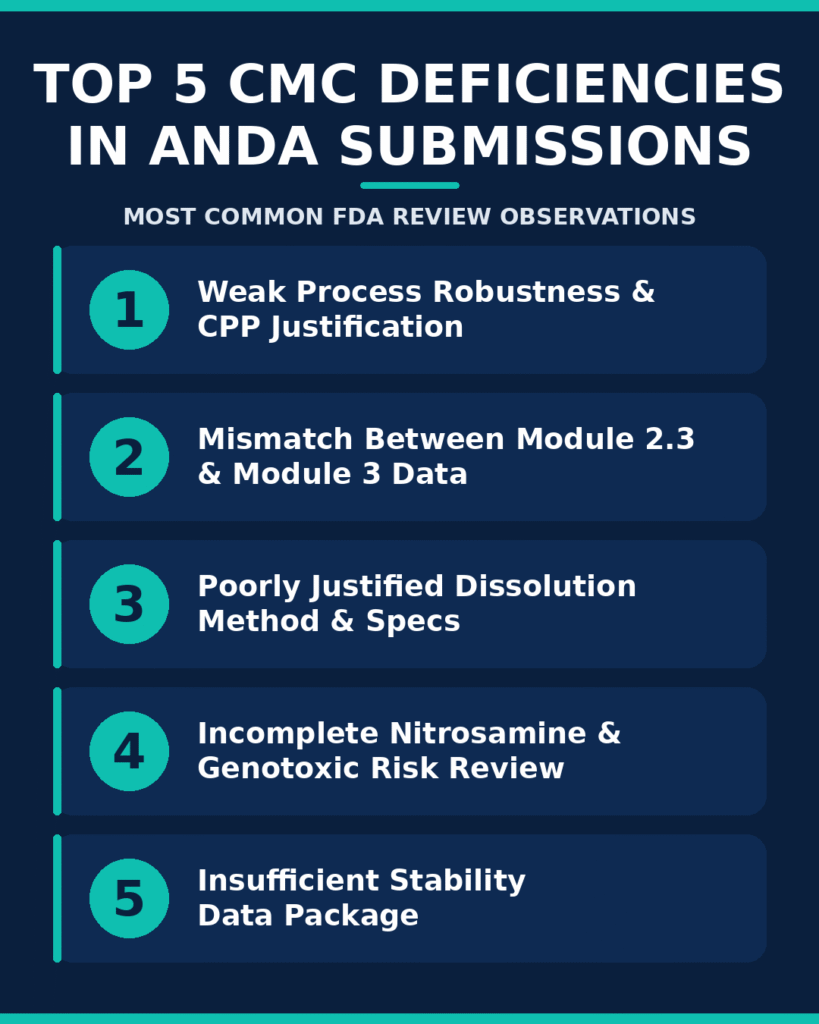
1. Inadequate Manufacturing Process Controls (3.2.P.3.3 / 3.2.S.2.4)
The Challenge: Failure to establish scientifically justified operating ranges for Critical Process Parameters can result in regulatory concerns regarding process reproducibility.
CDMO Strategy: Utilize Design of Experiments (DoE) studies to define Proven Acceptable Ranges (PARs) and Normal Operating Ranges (NORs), supported by risk assessments and validation data.
2. Inconsistencies Between QOS (Module 2.3) and Module 3
The Challenge: Differences between Quality Overall Summary information and detailed technical reports can trigger reviewer questions and data integrity concerns.
CDMO Strategy: Implement comprehensive document reconciliation procedures and traceability systems linking summary data to original source records.
3. Dissolution Method Selection and Specification Justification (3.2.P.5.5)
The Challenge: Inadequate justification of dissolution criteria or failure to demonstrate method discrimination can result in regulatory deficiencies.
CDMO Strategy: Develop discriminatory dissolution methods using formulation variants and multiple test conditions to establish sensitivity and robustness.
4. Incomplete Nitrosamine and Mutagenic Risk Assessments (3.2.S.3.2 / 3.2.P.5.5)
The Challenge: Failure to adequately assess nitrosamine formation pathways or mutagenic impurity risks may delay regulatory approval.
CDMO Strategy: Perform comprehensive risk assessments supported by validated LC-MS/MS or GC-MS/MS methods capable of quantifying trace-level contaminants well below established regulatory limits.
Discover advanced analytical characterization options for complex molecules by visiting GLP-1 peptide analytical characterization.
Conclusion
Preparing a regulatory-ready CMC documentation package at a CDMO for ANDA submissions demands meticulous compliance with FDA and ICH expectations across CTD Sections 3.2.S and 3.2.P. From raw material qualification and impurity control strategies to formulation development, process validation, analytical method validation, and stability testing, every component of Module 3 contributes to the overall assessment of product quality and manufacturing reliability.
A knowledgeable and cGMP-compliant CDMO can significantly strengthen an ANDA submission by generating scientifically sound data, maintaining robust documentation practices, and proactively addressing potential regulatory concerns. By developing a comprehensive and well-supported CMC dossier, sponsors can reduce the risk of review deficiencies, accelerate approval timelines, and improve the likelihood of successful generic product commercialization.
Explore end-to-end manufacturing solutions to streamline your regulatory journey by visiting our main page for peptide CDMO in the United States.
For expert support in CMC authoring, analytical method development, regulatory gap assessments, and quality documentation strategies, connect with the technical team at ResolveMass Laboratories.
Frequently Asked Questions (FAQs)
A Type II Drug Master File allows the API manufacturer to submit confidential manufacturing and control information directly to the FDA without disclosing proprietary details to the ANDA applicant. The sponsor references the DMF within Section 3.2.S and includes a valid Letter of Authorization (LOA), which grants FDA reviewers permission to access the confidential data during application assessment.
The exhibit batch should be large enough to represent the proposed commercial manufacturing process and demonstrate scalability. FDA expectations typically require the batch to be either a defined minimum number of dosage units or a percentage of the intended commercial batch size. This approach ensures that process performance, product quality, and manufacturing controls can be adequately evaluated before approval.
Critical Quality Attributes (CQAs) are measurable characteristics of a drug product that must remain within predefined limits to ensure quality, safety, and efficacy. Critical Process Parameters (CPPs), on the other hand, are manufacturing variables that can directly influence those quality attributes. Effective process control involves identifying CPPs and managing them to consistently achieve the desired CQAs.
Different polymorphic forms of an API can exhibit distinct physical and chemical properties, including changes in solubility, dissolution rate, stability, and bioavailability. Comprehensive characterization helps ensure that the selected crystal form remains stable throughout manufacturing, storage, and distribution. Proper control of polymorphism is essential to maintain consistent therapeutic performance and regulatory compliance.
Excipients must be thoroughly documented to demonstrate their suitability for pharmaceutical use. This includes details regarding the supplier, grade, pharmacopeial compliance, quality specifications, and supporting Certificates of Analysis (COAs). Additional safety assessments and risk evaluations are necessary when novel excipients or materials of animal origin are used in the formulation.
A CDMO demonstrates dissolution similarity by comparing the release profiles of the generic product with those of the Reference Listed Drug (RLD) under multiple dissolution conditions. Statistical tools, including the similarity factor (f₂), are commonly used to evaluate profile comparability. Consistent dissolution behavior supports the conclusion that the generic product performs similarly to the reference product in vitro.
The container closure section should include detailed information about packaging components, construction materials, and performance characteristics. Supporting documentation often covers moisture protection, light barrier properties, compatibility studies, extractables and leachables evaluations, and compliance with relevant pharmacopeial and regulatory requirements. These data help confirm that the packaging adequately protects the product throughout its shelf life.
Analytical method validation must provide documented evidence that the testing procedure is suitable for its intended purpose. Validation studies typically assess parameters such as specificity, accuracy, precision, linearity, sensitivity, range, robustness, and system suitability. The resulting data demonstrate that the method can reliably generate accurate and reproducible results during routine quality control testing.
Reference:
- U.S. Food and Drug Administration. (2014, May). ANDAs: Stability testing of drug substances and products, questions and answers (Guidance for Industry). U.S. Department of Health and Human Services. FDA Guidance Document
- European Medicines Agency. (2025). ICH M4Q: The common technical document for the registration of pharmaceuticals for human use – Quality – Scientific guideline. European Medicines Agency. EMA Guideline Page
- European Medicines Agency. (2006). ICH Q3A(R2): Impurities in new drug substances – Scientific guideline. European Medicines Agency. EMA Guideline Page
- European Medicines Agency. (2006). ICH Q3B(R2): Impurities in new drug products – Scientific guideline. European Medicines Agency. Retrieved from EMA Guideline Page
- European Medicines Agency. (2009). ICH Q8(R2): Pharmaceutical development – Scientific guideline. European Medicines Agency. Retrieved from EMA ICH Q8(R2) Guideline
- International Council for Harmonisation of Technical Requirements for Pharmaceuticals for Human Use. (2012). ICH Q11: Development and manufacture of drug substances (chemical entities and biotechnological/biological entities). Retrieved from https://database.ich.org/sites/default/files/Q11%20Guideline.pdf
- European Medicines Agency. (2023). ICH M7: Assessment and control of DNA reactive (mutagenic) impurities in pharmaceuticals to limit potential carcinogenic risk – Scientific guideline. European Medicines Agency. Retrieved from EMA ICH M7 Guideline
Get In Touch With Us
About The Author


