

Introduction
CMC Services for Peptide Oligonucleotide Conjugates are essential for advancing peptide-oligonucleotide therapeutics from early research into clinical development. These hybrid molecules combine nucleic acids with peptide ligands or delivery motifs to improve cellular uptake, targeting, and therapeutic activity. Because they integrate two different biological components, they offer promising opportunities for developing highly specific and effective treatments.
Peptide-oligonucleotide conjugates (POCs) have more complex structures than standalone peptides or oligonucleotides. This hybrid design can enhance stability, tissue targeting, and drug delivery efficiency. However, the structural complexity also creates additional challenges during synthesis, purification, and manufacturing.
To address these challenges, developers rely on strong Chemistry, Manufacturing, and Controls (CMC) strategies. CMC Support for Peptide-Oligonucleotide Conjugates (POCs) ensures controlled synthesis, reliable conjugation chemistry, and accurate analytical characterization. Proper CMC planning helps maintain product quality, supports scalable manufacturing, and ensures regulatory compliance throughout development.
Explore our specialized services for drug development: Custom Synthesis for Drug Discovery
Share via:
Summary of Key Insights
- CMC Services for Peptide Oligonucleotide Conjugates are critical for ensuring consistent synthesis, conjugation efficiency, and regulatory-ready quality attributes of POCs.
- The most challenging aspects include hybrid molecule design, conjugation chemistry control, impurity profiling, purification strategies, and advanced analytical characterization.
- Successful CMC strategies integrate solid-phase oligonucleotide synthesis, peptide synthesis, controlled conjugation reactions, and orthogonal analytical methods such as LC-MS, HPLC, and capillary electrophoresis.
- Regulatory submissions require robust process characterization, validated analytical methods, and stability data specific to hybrid conjugates.
- Specialized CMC support helps drug developers overcome scale-up challenges, heterogeneity issues, and regulatory expectations for complex conjugates.
- Advanced analytical capabilities—including high-resolution mass spectrometry, peptide mapping, and hybrid assays—are essential to confirm identity, purity, and conjugation efficiency.
- Integrated development strategies allow pharmaceutical teams to transition POC candidates from discovery to IND-enabling manufacturing with reproducible quality and compliance.
Key Manufacturing Considerations in CMC Services for Peptide Oligonucleotide Conjugates
CMC Services for Peptide Oligonucleotide Conjugates focus on combining peptide synthesis, oligonucleotide synthesis, and conjugation chemistry within a controlled manufacturing workflow. Each stage must be optimized individually while also functioning efficiently as part of the full process. Proper coordination between synthesis and conjugation ensures that the final hybrid molecule maintains structural integrity. A well-designed workflow also improves manufacturing efficiency and reduces batch-to-batch variability.
The hybrid nature of POCs requires manufacturing processes that integrate two established synthesis platforms. These include solid-phase oligonucleotide synthesis and solid-phase peptide synthesis (SPPS). Both techniques are widely used in pharmaceutical development and provide strong control over sequence assembly. However, combining them within a single manufacturing strategy introduces additional compatibility and reaction condition considerations.
The final conjugation step adds another layer of complexity. Conjugation reactions must occur under conditions that protect both peptide and oligonucleotide structures. Parameters such as pH, temperature, solvent selection, and reaction time must be carefully controlled. Proper optimization ensures that conjugation proceeds efficiently while minimizing unwanted by-products.
Key Manufacturing Elements
| Component | CMC Considerations | Impact |
|---|---|---|
| Oligonucleotide synthesis | Controlled phosphoramidite chemistry, protecting groups, chain length fidelity | Determines sequence accuracy |
| Peptide synthesis | SPPS optimization, peptide folding, purity | Affects targeting or delivery function |
| Conjugation chemistry | Site-specific linkage methods | Controls homogeneity |
| Purification | Multi-modal chromatography strategies | Removes unconjugated species |
| Analytical characterization | Mass spectrometry and hybrid assays | Confirms identity and conjugation ratio |
According to studies on conjugate therapeutics, reproducible processes and precise control of conjugation sites are major factors influencing product quality and regulatory acceptance. Consistent control of these parameters ensures that each batch meets predefined specifications. Reliable manufacturing processes also simplify regulatory submissions and reduce development risks.
Learn more about our comprehensive POC solutions: Peptide Oligonucleotide Conjugates (POCs) Synthesis Services
Conjugation Chemistry Control in CMC Services for Peptide Oligonucleotide Conjugates
Precise control of conjugation chemistry is essential because variations in conjugate formation can directly affect therapeutic performance and safety. If multiple conjugation variants are produced, it becomes more difficult to characterize and purify the intended product. Maintaining controlled conjugation reactions helps ensure a consistent molecular structure. This consistency is important for predictable biological activity and regulatory approval.
In CMC Support for Peptide-Oligonucleotide Conjugates (POCs), developers must select conjugation strategies that enable reliable attachment between peptide and oligonucleotide components. These methods must also work under scalable manufacturing conditions. At the same time, they should avoid reactions that could damage sensitive biomolecules. Careful selection of conjugation chemistry therefore plays a central role in successful product development.
Developers aim to achieve predictable attachment sites, minimal side reactions, and reaction conditions that can scale for manufacturing. Site-specific conjugation ensures that each molecule maintains the same configuration. Reducing side reactions simplifies purification and improves final product purity. Scalability ensures that laboratory methods can transition smoothly to large-scale production.
Common Conjugation Strategies
| Conjugation Method | Characteristics | CMC Implications |
|---|---|---|
| Maleimide-thiol coupling | Highly selective | Requires thiol stability control |
| Click chemistry (azide-alkyne) | Bioorthogonal and efficient | Facilitates site-specific conjugation |
| Amide bond formation | Robust linkage | Potential side reactions |
| Disulfide linkers | Redox-responsive | Stability concerns |
Scientific reviews highlight that site-specific conjugation approaches significantly reduce structural heterogeneity. Lower heterogeneity simplifies analytical characterization and regulatory documentation. Improved molecular consistency also strengthens batch-to-batch reliability.
Partner with a leading partner for your conjugate projects: Peptide Oligonucleotide Conjugates CRO
Process Development Challenges in CMC Support for Peptide-Oligonucleotide Conjugates
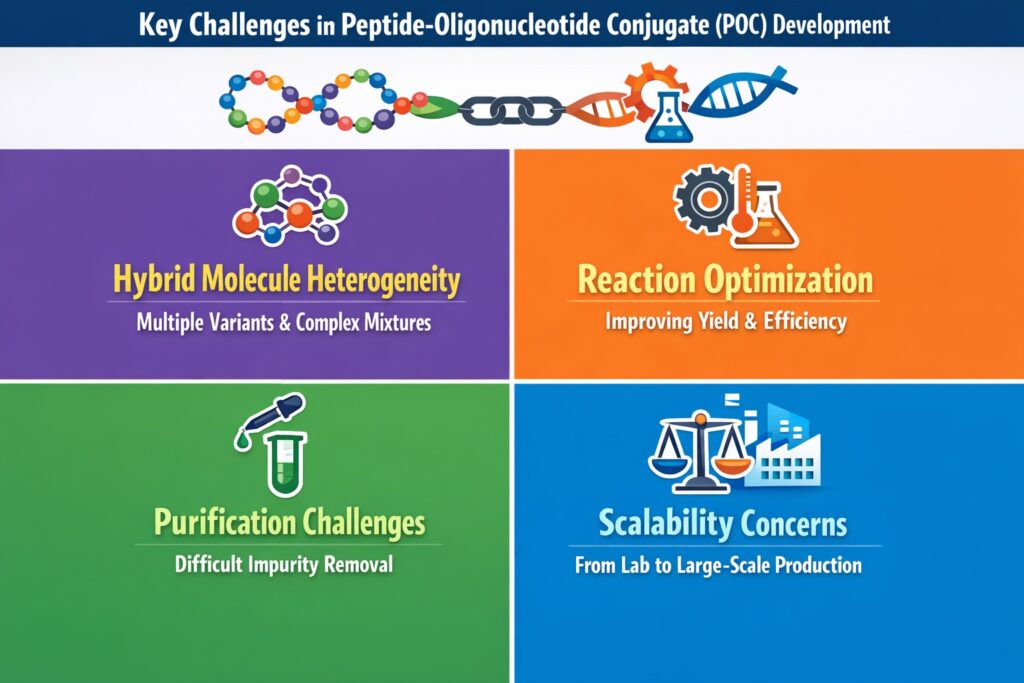
CMC Services for Peptide Oligonucleotide Conjugates must address several technical challenges that arise when combining peptide and nucleic acid components within a single molecule. These components differ in size, charge, and chemical stability. Such differences can influence reaction efficiency and purification behavior. As a result, developers must carefully design manufacturing processes that support both molecular systems.
Major Development Challenges
Hybrid molecule heterogeneity
During synthesis, multiple conjugation products, truncated oligonucleotides, or peptide variants may form. These variations create complex mixtures that require extensive purification and characterization. Addressing heterogeneity early in development improves overall product consistency.
Reaction efficiency optimization
Conjugation yields may decrease because of steric hindrance or incompatible reaction conditions. Developers therefore optimize parameters such as solvent systems, reagent ratios, and reaction temperature. Improved efficiency reduces material loss and increases manufacturing productivity.
Purification complexity
Separating conjugated molecules from unreacted components often requires multi-step purification strategies. Similar chemical properties between impurities can make separation difficult. Chromatographic optimization helps isolate the desired conjugate with high purity.
Scalability of conjugation reactions
Methods that work at milligram scale may behave differently during gram-scale manufacturing. Reaction kinetics and mixing efficiency can influence product quality. Scalable process design helps prevent these issues during production expansion.
Stability considerations
Hybrid molecules may degrade through hydrolysis, oxidation, or enzymatic reactions. Stability testing under different conditions helps identify potential degradation pathways. This information is essential for developing reliable storage and handling procedures.
Research in oligonucleotide therapeutics shows that purification and scale-up remain among the most technically demanding steps in conjugate manufacturing. Addressing these challenges requires strong collaboration between chemistry, analytical, and manufacturing teams.
Access expert conjugation support: Peptide Oligonucleotide Conjugation Services
Analytical Characterization in CMC Services for Peptide Oligonucleotide Conjugates
Robust analytical characterization is a core element of CMC Support for Peptide-Oligonucleotide Conjugates (POCs). Accurate analytical data confirms the identity, purity, and structural integrity of the hybrid molecule. Without reliable analytical methods, it becomes difficult to demonstrate product consistency. Therefore, analytical strategy is a central component of CMC programs.
Because POCs contain both peptide and nucleic acid components, multiple analytical techniques are required to fully evaluate the molecule. Each method provides different structural or compositional information. When used together, these techniques create a comprehensive understanding of product quality.
Core Analytical Methods
| Analytical Method | Purpose |
|---|---|
| LC-MS / HRMS | Confirm molecular weight and conjugation |
| Ion-pair reversed-phase HPLC | Purity assessment |
| Capillary electrophoresis | Charge heterogeneity analysis |
| Peptide mapping | Peptide sequence confirmation |
| UV spectroscopy | Concentration and integrity assessment |
Mass spectrometry has become particularly important for analyzing conjugated oligonucleotide therapeutics. High-resolution instruments allow scientists to detect very small molecular differences and identify trace impurities. This capability supports accurate quality control.
Advanced analytical workflows may also include hybrid LC-MS assays, fragment analysis, conjugation ratio determination, and charge distribution studies. These methods provide deeper insight into molecular structure and stability. Together they support evaluation of critical quality attributes required for regulatory submissions.
Ensure the quality of your sequences: Peptide Characterization Service
Purification Strategies for Peptide-Oligonucleotide Conjugates
Purification is a crucial step in CMC Services for Peptide Oligonucleotide Conjugates because conjugation reactions often produce several closely related impurities. Removing these impurities is necessary to achieve pharmaceutical-grade purity. Effective purification also improves product safety and consistency. For this reason, purification processes receive significant attention during development.
Most purification workflows rely on chromatographic techniques that separate molecules based on charge, hydrophobicity, or size. These differences allow scientists to isolate the desired conjugate from closely related impurities. Selecting the best chromatographic method depends on the specific properties of the conjugate.
Chromatographic Techniques
- Reverse-phase HPLC
- Ion-exchange chromatography
- Size-exclusion chromatography
- Mixed-mode chromatography
These techniques help isolate the target conjugate while removing unwanted by-products generated during synthesis and conjugation.
Key Impurities Removed
- Unconjugated peptide
- Unreacted oligonucleotide
- Truncated oligonucleotide sequences
- Oxidized or hydrolyzed species
Recent studies show that careful chromatographic optimization is essential for achieving pharmaceutical-grade purity in therapeutic oligonucleotides and their conjugates. Well-designed purification workflows improve impurity removal while maintaining product yield.
Optimize your workflow from synthesis to analysis: POC Synthesis and Characterization
Regulatory Considerations in CMC Support for Peptide-Oligonucleotide Conjugates
Regulatory agencies require detailed CMC documentation to demonstrate consistent manufacturing, analytical control, and product stability. Because peptide-oligonucleotide conjugates are hybrid molecules, regulators often request additional characterization data. Comprehensive documentation shows that the manufacturing process is fully understood and controlled.
Regulatory Focus Areas
- Definition of starting materials
- Process controls for conjugation reactions
- Analytical validation
- Stability studies
- Impurity qualification
Each of these areas contributes to building a reliable quality framework for the therapeutic product.
For IND-enabling programs, CMC submissions generally include process development data, characterization of critical quality attributes, validated analytical methods, and stability profiles. These datasets demonstrate that the manufacturing process consistently produces material meeting predefined specifications. Thorough documentation also facilitates regulatory review.
Experts note that hybrid therapeutics require expanded analytical justification due to their structural complexity and heterogeneous impurity profiles. Providing comprehensive analytical evidence helps address regulatory concerns and supports successful clinical development.
Integrated CMC Strategies for POC Development
The most effective CMC Services for Peptide Oligonucleotide Conjugates rely on integrated development strategies that connect chemistry, analytics, and manufacturing early in the development timeline. Early collaboration helps identify potential issues before manufacturing begins at scale. This proactive strategy reduces development risks and improves efficiency.
Best-Practice Strategy
- Early conjugation chemistry screening
- Analytical method development before scale-up
- Process characterization using design-of-experiments
- Orthogonal analytical confirmation
- Stability testing under multiple conditions
Applying these strategies early allows developers to refine manufacturing processes before clinical production. Integrated planning also improves reproducibility and helps maintain consistent quality attributes throughout development stages.
Integrated CMC frameworks significantly reduce development risks and support faster progression toward clinical manufacturing. By aligning scientific expertise across different disciplines, pharmaceutical teams can efficiently translate complex conjugates into therapeutic candidates ready for clinical testing.
Conclusion
CMC Support for Peptide-Oligonucleotide Conjugates (POCs) is essential for transforming complex hybrid molecules into clinically viable therapeutics. Developing these conjugates requires coordinated expertise in synthetic chemistry, conjugation strategies, purification technologies, analytical characterization, and regulatory compliance. Each part of the CMC framework contributes to maintaining product quality, safety, and consistency.
Robust CMC Services for Peptide Oligonucleotide Conjugates ensure reliable product quality, scalable manufacturing processes, and regulatory-ready documentation for IND submissions and clinical development. As peptide-oligonucleotide therapeutics continue to expand in precision medicine and targeted drug delivery platforms, advanced CMC strategies will become even more important. Ongoing innovation in analytical technologies and manufacturing approaches will further support the development of these hybrid therapies.
For expert guidance and analytical support for complex oligonucleotide conjugates, contact ResolveMass Laboratories:
Frequently Asked Questions (FAQs)
The main challenges include conjugation heterogeneity, purification complexity, manufacturing scale-up issues, and the need for advanced analytical characterization. Because POCs combine two different biological components, maintaining consistent structure and purity can be difficult. Careful process optimization and analytical monitoring help address these challenges.
Common methods include LC-MS, ion-pair HPLC, capillary electrophoresis, peptide mapping, and hybrid bioanalytical assays. Each technique provides different information about molecular structure and impurity profiles. Using several complementary methods allows scientists to fully characterize the conjugate.
The selected conjugation strategy affects reaction efficiency, product uniformity, and scalability of the manufacturing process. Site-specific conjugation methods reduce structural variability and simplify purification steps. Choosing the right chemistry is therefore essential for consistent large-scale production.
Conjugation reactions generate multiple impurities such as unconjugated peptides and truncated oligonucleotides. These molecules often have very similar chemical properties, making separation difficult. Advanced chromatographic techniques are typically required to achieve pharmaceutical-grade purity.
Regulators expect detailed descriptions of manufacturing processes, validated analytical methods, impurity profiles, and stability studies. These data demonstrate that the product can be produced consistently and safely. Strong CMC documentation supports regulatory approval and clinical development.
Scalability can be improved by optimizing conjugation reactions, designing efficient purification workflows, and performing early process characterization. Techniques such as design-of-experiments help identify the best reaction conditions. These strategies ensure laboratory methods can transition smoothly to larger manufacturing scales.
Reference:
- Fokina, A., Klabenkova, K., & Stetsenko, D. (2021). Chemistry of peptide-oligonucleotide conjugates: A review. Molecules, 26(18), 5534. https://doi.org/10.3390/molecules26185534
- Venkatesan, N., & Kim, B. H. (2006). Peptide conjugates of oligonucleotides: Synthesis and applications. Chemical Reviews, 106(9), 3712–3761. https://doi.org/10.1021/cr0502448
- Mannes, M., Chigoho, D., Martin, C., Barlow, T., et al. (2025). Targeted delivery of oligonucleotide–peptide conjugates for enhanced kidney-specific therapy. Journal of Medicinal Chemistry, 68(18). https://doi.org/10.1021/acs.jmedchem.5c01893
- Malinowska, A. L., Huynh, H. L., & Bose, S. (2024). Peptide–oligonucleotide conjugation: Chemistry and therapeutic applications. Current Issues in Molecular Biology, 46(10), 11031–11047. https://doi.org/10.3390/cimb46100655
Get In Touch With Us
About The Author


