

Introduction
When a Complete Response Letter (CRL) is issued for a Generic ANDA under 21 CFR 314.110, the applicant immediately faces a pause in the market authorization process. At this stage, a structured regulatory strategy combined with a technically focused remediation plan is essential for addressing every deficiency identified by the U.S. Food and Drug Administration (FDA). The issuance of a Complete Response Letter (CRL) for a Generic ANDA indicates that the U.S. Food and Drug Administration (FDA) has concluded its review cycle but has determined that the Abbreviated New Drug Application (ANDA) cannot be approved in its current form. Although a CRL is not a permanent rejection of the application, it prevents approval from proceeding, postpones commercial launch, and requires the sponsor to undertake a comprehensive scientific and regulatory response to the identified deficiencies.
Within the Generic Drug User Fee Amendments (GDUFA III) framework, successfully managing the period after a CRL requires detailed regulatory knowledge, careful compliance with established communication timelines, and access to appropriate laboratory and technical expertise. Chemistry, Manufacturing, and Controls (CMC) deficiencies described in Module 3 are among the principal factors contributing to delays in generic drug approval, with major first-cycle deficiency citations frequently involving issues related to CMC documentation and supporting data. Addressing these deficiencies can require extensive root-cause investigations, advanced analytical characterization, bio-relevant method development, and, where necessary, formulation re-engineering. This report describes the regulatory options available after a CRL, examines GDUFA III resubmission classifications, reviews major technical factors contributing to non-approval, and discusses contract development and manufacturing organization (CDMO) support strategies that can facilitate successful ANDA resubmission and progression toward FDA approval.
To ensure your application meets all regulatory standards, learn how robust CMC documentation at a CDMO supports successful ANDA submissions.
Share via:
Quick Summary:
- A Complete Response Letter (CRL) means the Generic ANDA cannot be approved in its current form; the applicant must address FDA deficiencies before approval can proceed.
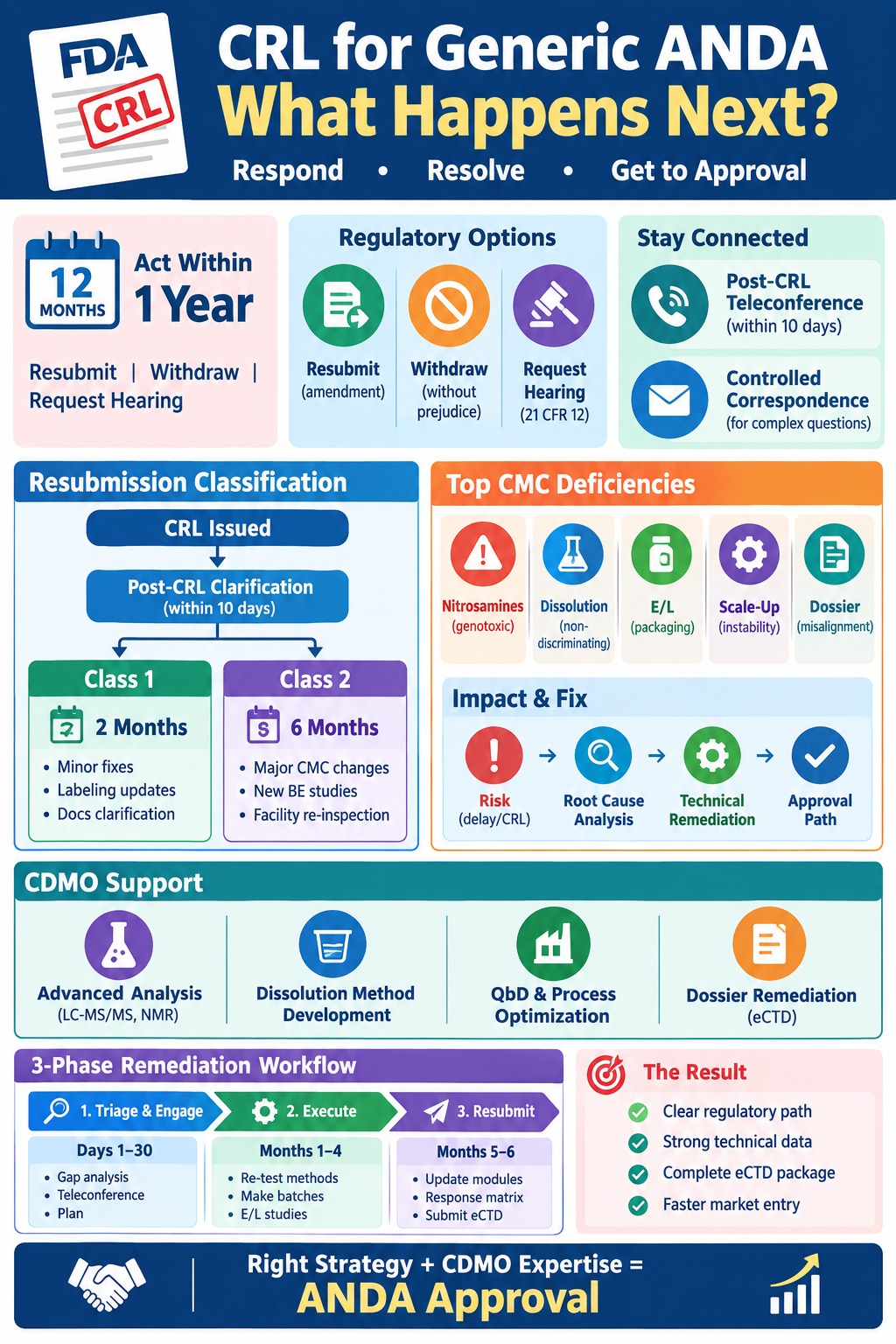
- After a CRL, the applicant generally has 12 months to resubmit, withdraw, or request a hearing under 21 CFR 314.110.
- A Post-CRL Clarification Teleconference can be requested within 10 calendar days to clarify FDA deficiencies; Controlled Correspondence may be used for defined scientific or regulatory questions.
- Resubmissions may be classified as Class 1 (2-month review) for limited corrections or Class 2 (6-month review) for substantial technical, analytical, manufacturing, or facility-related issues.
- Major CMC deficiencies can include nitrosamines/genotoxic impurities, non-discriminating dissolution, extractables & leachables, scale-up instability, and Module 2.3/Module 3 data inconsistencies.
- Specialized CDMO support can help with advanced analytical characterization, impurity identification, dissolution method development, QbD formulation/process optimization, stability batches, and eCTD dossier remediation.
- A structured **3-phase workflow—triage & FDA engagement → technical execution → eCTD resubmission—**helps organize remediation activities and maintain progress toward resubmission within the applicable timeline.
Immediate Post-Issuance Actions Following a Complete Response Letter (CRL) for a Generic ANDA
Once a Complete Response Letter (CRL) for a Generic ANDA has been issued, the applicant must take formal regulatory action within one calendar year. The available options include resubmitting the amended application, withdrawing the application, or requesting an administrative hearing under 21 CFR 314.110. If the applicant does not complete one of these required actions within the applicable 12-month period, the FDA may deem the application withdrawn.
The principal regulatory options available to sponsors under 21 CFR 314.110(b) determine the initial course of action following the CRL:
- Resubmit the Application: The applicant addresses the deficiencies identified across the relevant review disciplines through a comprehensive eCTD amendment. The response should provide a complete resolution of the deficiencies rather than addressing only selected portions of the FDA’s concerns.
- Withdraw the Application: The applicant formally communicates its decision to withdraw the ANDA without prejudice, thereby terminating further regulatory review of the existing application.
- Request an Opportunity for a Hearing: When an applicant disagrees with the FDA’s scientific or regulatory conclusions, it may request an administrative hearing under 21 CFR 12 to challenge the determination described in the CRL.
In practice, many generic drug applicants pursue the resubmission route. However, preparing a successful resubmission requires much more than responding to individual deficiency statements. The sponsor must systematically triage the deficiencies, investigate their underlying causes, determine the appropriate technical corrective actions, and establish whether the required remediation can be completed within the applicable one-year timeframe.
Explore one-stop CDMO analytical services for ANDA submissions.
Regulatory Communication Pathways: Post-CRL Clarification Teleconferences and Controlled Correspondence
Applicants requiring additional clarification regarding deficiencies identified in a Complete Response Letter (CRL) for a Generic ANDA may request a 30-minute Post-CRL Clarification Teleconference within 10 calendar days after issuance of the letter. Sponsors may also use Controlled Correspondence under GDUFA III performance goals when their questions require formal agency feedback. These communication mechanisms provide applicants with an opportunity to clarify the FDA’s deficiency statements before committing substantial technical resources, laboratory work, and financial investment toward a resubmission.
Post-CRL Clarification Teleconferences Under GDUFA III
The Post-CRL Clarification Teleconference is an important mechanism for obtaining focused interaction with the FDA after completion of the ANDA review. To qualify for the applicable GDUFA III user fee performance goals, the applicant must submit a complete teleconference request package through the Electronic Submissions Gateway (ESG) within 10 calendar days of receiving the CRL.
The key operational requirements and performance commitments associated with these teleconferences include:
- Scheduling Commitments: The FDA commits to providing a scheduled meeting date for 90% of granted requests within 14 calendar days after receiving the request.
- Meeting Conduct: The agency aims to conduct 90% of the teleconferences within 30 calendar days after receiving a valid written request.
- Strict Duration and Scope: The teleconference is limited to a non-extendable 30-minute period and is intended only to clarify deficiencies already identified in the CRL. It is not intended for evaluating new data, reviewing alternative bioequivalence protocols, or obtaining advance assessment of a proposed response strategy.
- Written Responses: When an applicant requests written clarification rather than a teleconference, the FDA grants or denies the request within 14 calendar days and provides the final written clarification within 30 calendar days of receiving the request.
Controlled Correspondence Pathways
Questions that go beyond clarification of straightforward deficiency language may require the Controlled Correspondence pathway. Examples include inquiries concerning acceptable salt forms, specific analytical testing limits, or complicated regulatory policies. Under revised GDUFA III guidance, generic drug applicants may submit Controlled Correspondence after receiving a CRL to obtain formal agency feedback on defined scientific or development questions. However, Controlled Correspondence should not be used as a replacement for an ANDA amendment or as a mechanism for obtaining advance review of laboratory datasets.
Classifying Resubmissions: Class 1 vs Class 2 Assessment Cycles for a Complete Response Letter (CRL) for a Generic ANDA
Following a Complete Response Letter (CRL) for a Generic ANDA, the applicant’s resubmission may be categorized as either a 2-month Class 1 review or a 6-month Class 2 review, depending on the nature and extent of the deficiencies being addressed. Class 1 generally applies to more limited deficiencies, whereas Class 2 is associated with substantial technical, analytical, manufacturing, or other changes requiring a more extensive review. The FDA ultimately determines the official classification according to the scope and complexity of the information submitted.
                 +------------------------------------------------+
                 | Complete Response Letter (CRL) Issued          |
                 +------------------------------------------------+
                                         |
                                         v
                 +------------------------------------------------+
                 | Post-CRL Clarification Request (Within 10 Days)|
                 +------------------------------------------------+
                                         |
                        +----------------+----------------+
                        |                                 |
                        v                                 v
        +-------------------------------+ +-------------------------------+
        |     Class 1 Resubmission      | |     Class 2 Resubmission      |
        |    (2-Month PDUFA Clock)      | |    (6-Month PDUFA Clock)      |
        +-------------------------------+ +-------------------------------+
        | * Minor/administrative fixes  | | * Major CMC data/methodology  |
        | * Simple labeling updates     | | * New BE studies or testing |
        | * Document clarifications     | | * Facility re-inspections   |
        +-------------------------------+ +-------------------------------+
The classification of the resubmission has a direct effect on the anticipated regulatory review period and, consequently, the planning associated with commercial market entry. It also determines the extent of scientific and technical documentation that must be prepared to support the sponsor’s response.
| Resubmission Attribute | Class 1 Resubmission | Class 2 Resubmission |
|---|---|---|
| GDUFA Review Goal Date | 2 Months from receipt date | 6 Months from receipt date |
| Deficiency Scope | Minor, administrative, labeling, or simple editorial corrections | Major technical, analytical, process, or facility-related deficiencies |
| Data Requirements | Document updates, minor certification attachments, updated labeling | Substantial new laboratory data, batch records, stability testing, or BE studies |
| CDMO Support Level | Rapid analytical verification, administrative dossier updates | Method re-development, impurity profiling, QbD re-formulation, stability batch manufacturing |
| Reclassification Risk | High if the response introduces unrequested scientific data | Low (already categorized under full review window) |
Although sponsors may propose the amendment classification in the cover letter, the FDA maintains final authority over the classification. If the agency determines that a proposed Class 1 amendment includes complex scientific information requiring review by multiple disciplines, the FDA may reclassify the submission as Class 2. Such reclassification results in the applicable 6-month PDUFA assessment clock.
Chemistry, Manufacturing, and Controls (CMC) Deficiencies Driving Non-Approval
Chemistry, Manufacturing, and Controls (CMC) deficiencies described in Module 3 are significant contributors to generic drug review delays. Common issues include trace nitrosamine impurities, non-discriminating dissolution methods, extractables and leachables, manufacturing scale-up failures, and inconsistencies between different sections of the dossier. Correcting these deficiencies requires detailed technical investigation and close alignment of information presented in Module 2.3 and Module 3.
| Deficiency Category | Common Root Causes | Regulatory & Commercial Impact | CDMO Remediation Strategy |
|---|---|---|---|
| Nitrosamine & Genotoxic Impurities | Uncontrolled synthesis pathways, excipient interactions, packaging degradation | Complete application stall; potential Class 2 resubmission | Highly sensitive LC-MS/MS method development, impurity synthesis, risk assessment |
| Non-Discriminatory Dissolution | Method parameters fail to reflect CQA changes or correlate with in vivo BE | Rejection of dissolution specifications; required method re-validation | Hydrodynamic and pH media optimization, bio-relevant method development |
| Extractables & Leachables (E/L) | Inadequate screening of primary container-closure systems | Quality rejection for liquid, parenteral, or inhalation dosage forms | Controlled extraction studies, toxicological evaluation per ICH standards |
| Scale-Up & Batch Instability | Physical/chemical drift during commercial scale-up; OOS stability results | Major process deficiency citation; facility inspection risks | QbD process optimization, CPP re-mapping, cGMP submission batch manufacturing |
| Dossier Data Misalignment | Transcription errors and data drift between Module 2.3 QoS and Module 3 | Reviewer confusion, extended review cycles, multiple IRs/DRLs | Digital audit trails, cross-module data reconciliation, regulatory rewrite |
Nitrosamine Impurities and Genotoxic Risks
Mutagenic impurities, particularly nitrosamines, continue to represent an important source of major CMC deficiencies. Under ICH M7 and ICH Q3B guidelines, the FDA expects comprehensive risk evaluations that consider the complete manufacturing and packaging pathway, including API synthesis, raw material sources, solvent recycling processes, and interactions involving secondary packaging. When trace nitrosamines are identified at concentrations above acceptable intake thresholds, sponsors must establish appropriate analytical methodologies capable of detecting and quantifying these impurities at trace levels. The resulting data must then support scientifically justified process modifications intended to control or prevent nitrosamine formation.
Discover key impurity control strategies under ICH Q3A.
Non-Discriminatory Dissolution Testing and Bioequivalence Correlation
Demonstrating that in vitro dissolution performance adequately represents product quality and, where appropriate, supports an understanding of in vivo bioequivalence is a critical component of generic drug development. Dissolution deficiencies may occur when the proposed analytical procedure does not possess sufficient discriminating capability. In other words, the method may fail to identify meaningful changes in critical quality attributes (CQAs) that could influence in vivo bioequivalence. Methods with overly broad or permissive acceptance characteristics may therefore be challenged during FDA review, requiring sponsors to refine the methodology and establish more scientifically relevant, bio-relevant dissolution conditions.
Read more about bioequivalence study design for complex generic drug products.
Extractables, Leachables, and Primary Packaging Compatibility
For complex dosage forms, including parenterals, ophthalmic solutions, and inhalation products, compatibility between the drug formulation and the primary container-closure system is an important aspect of product quality and regulatory compliance. Inadequate extractables and leachables (E/L) assessments, insufficient toxicological justification for identified leachables, or the absence of appropriate long-term leachable stability information can result in major CRL citations. A comprehensive assessment of the packaging system is therefore necessary to establish that potentially migrating substances do not create unacceptable quality or patient-safety concerns.
Learn about generic ophthalmic suspension ANDA development.
Dossier Misalignment Between Module 2.3 QoS and Module 3
Inconsistencies between the high-level information presented in the Module 2.3 Quality Overall Summary (QoS) and the detailed manufacturing and analytical information contained in Module 3 can create significant regulatory concerns. Examples include data drift, inconsistent specification limits, differences in reported batch sizes, and discrepancies in analytical parameters. Such contradictions can complicate the FDA review and raise questions about the integrity and oversight of the submitted information. Automated digital audits, structured data verification, and systematic cross-referencing of dossier content are therefore important measures for identifying and correcting inconsistencies before an ANDA resubmission.
Explore solutions for reference listed drug (RLD) sourcing and reverse engineering.
Specialized CDMO Support Options to Resolve a Complete Response Letter (CRL) for a Generic ANDA
Specialized CDMO support can provide generic drug sponsors with technical resources for advanced analytical characterization, impurity isolation, discriminatory dissolution optimization, Quality by Design (QbD) process re-engineering, and regulatory dossier remediation. A technically capable CDMO can help sponsors investigate the underlying causes of deficiencies, generate the necessary supporting data, and prepare the technical package required for resubmission.
Advanced Analytical Characterization and Impurity Isolation
Impurity-related CRLs frequently require advanced analytical investigation to isolate, identify, characterize, synthesize, and quantify unknown degradation products or trace nitrosamines. Specialized CDMO laboratories can apply multiple analytical platforms and complementary techniques to investigate these compounds, including:
- High-resolution LC-MS/MS, GC-MS/MS, and NMR spectroscopy for structural elucidation of unknown impurities.
- Forced degradation stress testing under acid, base, thermal, oxidative, and photolytic conditions to characterize specific degradation pathways.
- Development and validation of analytical methods according to ICH Q2(R1) standards, with appropriate limits of detection (LOD) and limits of quantification (LOQ) for the intended analytical application.
Compare the key differences between a peptide CDMO vs CMO.
Bio-Relevant and Discriminatory Dissolution Method Engineering
When dissolution methodology is identified as a deficiency, CDMO technical teams can systematically evaluate and refine the analytical procedure to improve its discriminating capability. This work may involve assessing dissolution media pH, surfactant concentrations, hydrodynamic conditions, and apparatus-related parameters. Through controlled method development and comparative testing, scientists can establish dissolution procedures capable of detecting meaningful formulation or process changes while maintaining appropriate bio-relevant characteristics.
QbD Formulation Optimization and Process Scale-Up Verification
When physical instability, chemical instability, or batch out-of-specification (OOS) events contribute to a CRL, CDMOs can apply Quality by Design (QbD) principles to reassess and optimize the formulation and manufacturing process. Key activities may include:
- Design Space Mapping: Reassessing and redefining Critical Process Parameters (CPPs) associated with unit operations such as blending, granulation, compression, or aseptic filling.
- Excipient Compatibility Screening: Evaluating excipient ratios and functional grades to reduce degradation, improve formulation stability, and support appropriate drug release profiles.
- Submission Batch Manufacturing: Manufacturing representative cGMP pilot-scale or commercial-scale batches to generate updated stability datasets and demonstrate process consistency.
Learn more about specialized peptide CDMO scale up services.
eCTD Module 3 Dossier Remediation and Regulatory Response Compilation
Beyond laboratory testing and manufacturing activities, CDMO regulatory teams can support the restructuring and remediation of the technical submission. This may include updating Module 3, revising the Module 2.3 Quality Overall Summary (QoS), preparing direct point-by-point response matrices, and compiling eCTD-compliant amendments. A coordinated approach helps ensure that newly generated technical information is accurately incorporated throughout the dossier and that the submitted response provides clear traceability between each FDA deficiency and the corresponding corrective action.
Sequential Post-CRL Remediation Workflow and Commercial Timeline Management
Managing the period following a Complete Response Letter (CRL) for a Generic ANDA requires an organized remediation strategy that integrates deficiency triage, agency communication, laboratory execution, manufacturing activities, and eCTD submission preparation. A structured three-phase workflow can help sponsors coordinate these activities while maintaining progress toward resubmission within the applicable statutory one-year period.
| Remediation Phase | Key Operational Steps | Target Timeframe | Primary Deliverables |
|---|---|---|---|
| Phase 1: Deficient Triage & Agency Engagement | Perform gap analysis; submit Post-CRL Clarification Teleconference request via ESG. | Days 1–30 post-CRL | Clarification request package; FDA meeting execution; remediation plan |
| Phase 2: Technical Execution & CDMO Support | Re-validate analytical methods; manufacture engineering/stability batches; conduct E/L studies. | Months 1–4 post-CRL | Validated testing methods; stability data; batch manufacturing records |
| Phase 3: eCTD Assembly & Resubmission | Update Module 3 and Module 2.3 QoS; finalize response matrix; submit eCTD amendment. | Months 5–6 post-CRL | eCTD Class 1 or Class 2 resubmission package; cover letter justification |
Implementing this phased strategy allows the sponsor to address the underlying causes of the FDA’s deficiencies rather than limiting the response to documentation changes. Early deficiency triage establishes the technical workstream, while agency communication helps clarify applicable regulatory expectations. Laboratory and manufacturing activities can then generate the supporting evidence required for the amended submission, followed by systematic eCTD assembly and cross-module verification. Maintaining this sequence can help reduce avoidable delays while keeping the remediation program aligned with the applicable resubmission timeline.
Find out more about selecting a peptide CDMO in United States.
Conclusion
Successfully addressing a Complete Response Letter (CRL) for a Generic ANDA requires close integration of GDUFA III regulatory communication mechanisms with comprehensive CMC technical remediation. Sponsors must systematically evaluate each FDA deficiency, establish the underlying root cause, generate scientifically appropriate supporting data, and incorporate the resulting information into a consistent and complete resubmission package. Technical specialists and experienced CDMO partners can contribute to this process through advanced analytical characterization, method development, impurity investigation, formulation and process optimization, stability studies, and manufacturing support.
An experienced CDMO can provide the analytical capabilities, manufacturing infrastructure, and regulatory support required to address complex ANDA deficiencies. Combining laboratory re-investigation with structured regulatory engagement allows sponsors to develop a traceable response to the CRL while ensuring that revised technical information is accurately reflected throughout the eCTD dossier. Careful planning, cross-functional coordination, and comprehensive data review are essential components of a successful post-CRL remediation strategy.
Evaluate key factors when comparing United States vs overseas peptide CDMOs.
To obtain support for advanced analytical characterization, custom method development, and CMC technical remediation for ANDA deficiencies, connect with the specialists at ResolveMass Laboratories through ResolveMass Laboratories Contact Us.
Frequently Asked Questions (FAQs)
To qualify for the applicable GDUFA III performance goals, applicants must submit a complete Post-CRL Clarification Teleconference request through the Electronic Submissions Gateway (ESG) within 10 calendar days of receiving the CRL. This mechanism allows sponsors to seek clarification of existing deficiencies before preparing the resubmission. Requests submitted outside the specified period may not receive the same GDUFA III goal-date treatment.
Under the GDUFA III performance commitments, the FDA aims to provide a scheduled date for 90% of granted teleconference requests within 14 calendar days. The agency also aims to conduct 90% of these teleconferences within 30 calendar days after receiving a valid request. Each teleconference is limited to a non-extendable 30-minute duration and focuses on clarification of existing CRL deficiencies.
The classification depends primarily on the scope and complexity of the deficiencies addressed in the resubmitted ANDA. Class 1 generally covers limited administrative, labeling, or straightforward document-related corrections and has a 2-month review goal. Class 2 applies to more substantial technical or manufacturing changes and generally carries a 6-month review goal.
Yes. Although an applicant may propose a resubmission classification in its cover letter, the FDA makes the final determination based on the content and complexity of the amendment. If the submission contains substantial scientific or technical information requiring broader review, the agency may classify it as Class 2. The applicable review goal then changes to the Class 2 timeframe.
Common Chemistry, Manufacturing, and Controls (CMC) deficiencies include nitrosamine and other genotoxic impurities, inadequate dissolution methods, extractables and leachables concerns, and instability during scale-up. Additional issues can arise from manufacturing-process inconsistencies or discrepancies between Module 2.3 and Module 3. These deficiencies may require extensive analytical, manufacturing, and documentation remediation before resubmission.
A specialized CDMO can investigate potential nitrosamine formation pathways across API synthesis, excipients, processing conditions, and packaging. Its analytical team may develop sensitive LC-MS/MS or GC-MS/MS methods, characterize impurities, and perform appropriate risk assessments. Process optimization or formulation changes can then be evaluated when necessary to reduce or control impurity formation.
If the applicant does not resubmit the application, withdraw it, or request an administrative hearing within the applicable one-calendar-year period, the FDA may deem the ANDA withdrawn under 21 CFR 314.110(b). Sponsors should therefore establish a detailed remediation schedule immediately after receiving the CRL. When additional time may be necessary for activities such as stability studies, applicable regulatory procedures should be evaluated well before the deadline.
Yes. Under the GDUFA III framework, applicants may use Controlled Correspondence after receiving a CRL to obtain agency feedback on specific generic drug development, analytical, or regulatory questions. However, this mechanism does not replace the formal ANDA amendment process. It also should not be treated as a method for obtaining advance FDA review of laboratory data intended for a future resubmission.
Differences between the Module 2.3 Quality Overall Summary (QoS) and the detailed information in Module 3 can make the submitted dossier internally inconsistent. Examples include conflicting batch sizes, specification limits, manufacturing parameters, analytical procedures, or other technical details. Such discrepancies can complicate FDA review, generate additional information requests, and contribute to further deficiency findings during the assessment.
Reference:
- U.S. Food and Drug Administration. (n.d.). ANDA assessment program | GDUFA III performance goals and program enhancements. https://www.fda.gov/industry/generic-drug-user-fee-amendments/anda-assessment-program-gdufa-iii-performance-goals-and-program-enhancements
- U.S. Food and Drug Administration. (2022). GDUFA reauthorization performance goals and program enhancements fiscal years 2023–2027. https://www.fda.gov/media/153631/download
- U.S. Food and Drug Administration. (2022). Failure to respond to an ANDA complete response letter within the regulatory timeframe: Guidance for industry (Revision 1). https://www.fda.gov/media/160166/download
- U.S. Food and Drug Administration. (2022). Post-complete response letter clarification teleconferences between FDA and ANDA applicants under GDUFA: Guidance for industry (Revision 1). https://www.fda.gov/media/108337/download
- U.S. Food and Drug Administration. (2026). FY 2026 GDUFA public workshop—Day 2: Edited transcript. https://www.fda.gov/media/194026/download
Get In Touch With Us
About The Author


