


Introduction
Container Closure Integrity Testing (CCIT) for Generic Sterile Drug Products is a critical process used to confirm that a primary packaging system can maintain a continuous, microbial-resistant barrier throughout its intended shelf life without allowing contamination, loss of sterility, or chemical degradation. Demonstrating container closure integrity is a fundamental regulatory requirement for generic sterile drug approval. As a result, contract development and manufacturing organizations (CDMOs) and generic drug sponsors are increasingly expected to transition from traditional qualitative approaches to advanced quantitative and deterministic analytical technologies. Generic sterile drug manufacturers must establish that their proposed container closure system (CCS) delivers sterility assurance, physical stability, and physicochemical barrier performance comparable to the Reference Listed Drug (RLD). Achieving this objective requires navigating complex regulatory expectations, including United States Pharmacopeia (USP) chapters, European Union Good Manufacturing Practice (EU GMP) Annex 1 requirements, and Food and Drug Administration (FDA) guidance documents, while leveraging specialized CDMO expertise, engineered positive controls, and comprehensive lifecycle risk management programs.
Learn more about partnering with a specialized development partner for your pipeline: Explore Peptide Drug Development CDMO Services
Share via:
Article Summary:
- CCIT is essential for sterile drug products to ensure the container closure system maintains sterility, prevents contamination, and protects product quality throughout its shelf life.
- Regulatory expectations are becoming more rigorous, with USP standards, FDA ANDA requirements, and EU GMP Annex 1 emphasizing validated, deterministic CCIT methods and scientifically justified sampling strategies.
- Deterministic methods are preferred because they provide quantitative, reproducible results. Key technologies include vacuum decay, HVLD, laser headspace analysis (TDLAS), helium mass spectrometry, and mass extraction.
- Method selection depends on the package and formulation, including container type, conductivity, headspace, product characteristics, required sensitivity, and potential interferences.
- CDMOs support CCIT validation through engineered positive controls, such as laser-machined defects, micro-capillaries, and tungsten-wire channels, along with validation of specificity, accuracy, precision, linearity, and detection limits.
- CCIT should be integrated across the product lifecycle, from packaging/component qualification and manufacturing process validation to commercial release and long-term stability monitoring.
- Strategic approaches such as bracketing, transportation stress testing, and cryogenic evaluation can reduce testing burden while demonstrating package integrity under worst-case storage and distribution conditions.
Regulatory Mandates and Global Standards for Container Closure Integrity Testing (CCIT) for Generic Sterile Drug Products
International regulatory authorities require manufacturers of generic sterile injectable products to demonstrate container closure integrity equivalent to that of the Reference Listed Drug through the use of validated deterministic testing methodologies. Regulatory agencies such as the US FDA and the European Medicines Agency (EMA) expect compliance with USP standards, the forthcoming USP requirements, and EU GMP Annex 1 guidelines for all Abbreviated New Drug Application (ANDA) submissions involving sterile drug products.
USP Guidelines and the Implementation of USP
USP establishes the scientific foundation for package integrity assessment by introducing the concept of Maximum Allowable Leakage Limits (MALL) and emphasizing the use of deterministic physical testing methods instead of probabilistic challenge-based techniques. According to USP, a package is considered to maintain integrity when its measured leak rate remains below the product-specific MALL. This limit represents the highest leakage rate that does not compromise product sterility, safety, or quality. For rigid parenteral packaging systems in which headspace preservation is not a critical quality attribute, the standard MALL threshold is 6 × 10⁻⁶ mbar·L/s, commonly referred to as the Kirsch limit. Leak rates below this threshold are associated with an extremely low probability of microbial ingress.
The regulatory landscape expands further with USP (Elastomeric Component Functional Suitability in Parenteral Product Packaging/Delivery Systems), which becomes effective in December 2025. Unlike earlier approaches that depended primarily on supplier certifications and declarations for elastomeric components, USP requires pharmaceutical manufacturers to experimentally demonstrate the functional suitability of elastomeric stoppers, plungers, and seals within the final marketed product configuration. Compliance requires the evaluation of a minimum sample size of N = 30 units for each packaging configuration using validated deterministic CCIT methodologies. These studies must demonstrate compliance with established MALL requirements under realistic and dynamic use conditions.
Navigating domestic regulatory expectations? Discover US-Based Peptide CDMO Solutions
EU GMP Annex 1 Standards: Fusion-Sealed vs. Non-Fusion Containers
EU GMP Annex 1 requires 100% integrity testing using validated physical methods for fusion-sealed containers, including glass ampoules and Blow-Fill-Seal (BFS) containers of ≤100 mL. In contrast, non-fusion-sealed packaging systems may be evaluated using a risk-based sampling strategy supported by Quality Risk Management (QRM) principles. Importantly, Annex 1 explicitly states that visual inspection alone is not sufficient as a standalone integrity assessment method.
For non-fusion-sealed container systems, such as glass vials closed with elastomeric stoppers and aluminum crimp caps, prefilled syringes, and cartridge systems, Annex 1 paragraph 8.23 requires scientifically justified sampling frequencies based on historical process performance, packaging component quality history, and process capability data. Furthermore, Annex 1 paragraph 8.24 specifies that containers sealed under vacuum conditions must undergo routine integrity assessments to verify vacuum retention before product release and throughout the product’s shelf life.
Comparing geographical regulatory frameworks and locations? Compare Canadian vs US Peptide CDMOs
FDA ANDA Submission Expectations and eCTD Documentation
The US FDA expects generic drug applicants to provide comprehensive container closure integrity validation data within eCTD Section 3.2.P.2 (Pharmaceutical Development) and detailed container closure system specifications within Section 3.2.P.7 (Container Closure System). When applicants introduce permissible variations in inactive ingredients under 21 CFR 314.94(a)(9), they must demonstrate that these formulation changes do not adversely affect container closure performance, seal integrity, or product stability.
Additionally, the FDA guidance entitled Container and Closure System Integrity Testing in Lieu of Sterility Testing as a Component of the Stability Protocol for Sterile Products strongly supports the use of validated physical CCIT methods as an alternative to routine sterility testing during stability studies. Physical integrity testing provides quantitative evidence of package performance over time while minimizing the risk of false-positive results associated with accidental laboratory contamination during microbiological testing.
Looking for comprehensive analytical support for your generic submissions? Discover One-Stop CDMO Analytical Services for ANDA
Method Selection for Container Closure Integrity Testing (CCIT) for Generic Sterile Drug Products: Deterministic vs. Probabilistic
Selecting the most appropriate CCIT methodology for generic sterile injectables requires consideration of multiple factors, including container design, formulation conductivity, headspace characteristics, product presentation, and the required leak detection sensitivity. Regulatory authorities generally favor deterministic physical methods because they provide objective, quantitative, and highly reproducible measurements without relying on subjective interpretation or stochastic biological events.
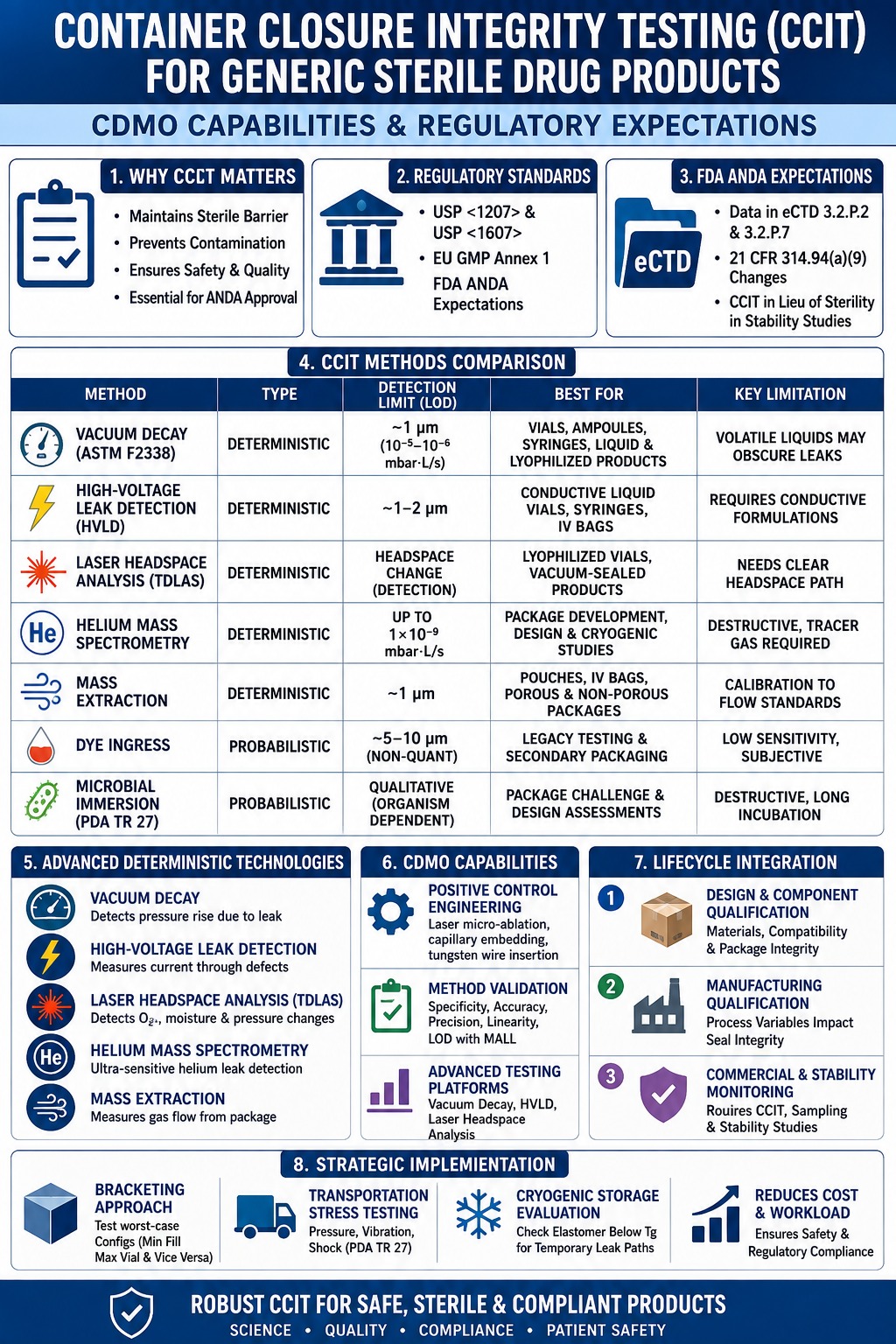
| CCIT Method | Method Category | Operating Physical Mechanism | Lower Limit of Detection (LOD) | Primary Drug Package Suitability | Main Interferences & Limitations |
|---|---|---|---|---|---|
| Vacuum Decay (ASTM F2338) | Deterministic | Differential pressure rise measurement within an evacuated test chamber | Approximately 1 µm defects (10⁻⁵ to 10⁻⁶ mbar·L/s) | Vials, ampoules, prefilled syringes, liquid and lyophilized products | Volatile liquids may obscure micro-leaks; container exterior must remain dry |
| High-Voltage Leak Detection (HVLD) | Deterministic | Measurement of electrical current flow through a package defect | Approximately 1–2 µm defects | Conductive liquid-filled glass vials, syringes, and IV bags | Requires electrically conductive formulations; unsuitable for dry products |
| Laser Headspace Analysis (TDLAS) | Deterministic | Optical measurement of oxygen, moisture, and pressure changes within headspace | Non-destructive detection of headspace composition changes | Lyophilized vials and vacuum-sealed liquid products | Requires an optically clear headspace path; unsuitable for opaque containers |
| Helium Mass Spectrometry | Deterministic | Detection of helium tracer gas leakage using mass spectrometry | Up to 1 × 10⁻⁹ mbar·L/s | Package development, design qualification, cryogenic validation studies | Destructive method requiring tracer gas exposure; susceptible to background helium interference |
| Mass Extraction | Deterministic | Measurement of gas flow escaping from a package under vacuum | Approximately 1 µm defects | Flexible pouches, IV bags, porous and non-porous rigid packages | Requires precise calibration against certified flow standards |
| Dye Ingress | Probabilistic | Visual or spectrophotometric detection of dye penetration | Approximately 5–10 µm defects; non-quantitative | Legacy testing programs and secondary packaging evaluations | Destructive, subjective, low sensitivity, and highly variable results |
| Microbial Immersion (PDA TR 27) | Probabilistic | Detection of microbial growth following immersion challenge | Qualitative and organism-dependent | Package challenge studies and design assessments | Destructive, lengthy incubation periods, and risk of false-positive outcomes |
Analytical Mechanics of Advanced Deterministic Technologies
Modern deterministic CCIT technologies identify microscopic defects by measuring measurable physical changes, including pressure variations, electrical conductivity shifts, gas flow behavior, and optical absorption changes. These technologies can identify defects at sub-micron levels and provide quantitative information that supports regulatory submissions and long-term product stability programs.
- Vacuum Decay Testing (ASTM F2338): In this method, the container is placed inside a specially designed chamber and exposed to a controlled vacuum environment. When a leak is present, gas from the container headspace or vapor from the product migrates into the chamber, causing a measurable pressure increase during the test cycle. Vacuum decay is a rapid, non-destructive technique that is particularly effective for lyophilized products, dry products, and non-volatile liquid formulations.
- High-Voltage Leak Detection (HVLD): HVLD uses a high-voltage, low-current electrical potential applied across a non-conductive container wall that contains a conductive liquid formulation. An intact package behaves as an insulator and allows minimal electrical current to pass. When a crack, pinhole, or seal defect exists, electrical current passes through the defect path and generates a measurable signal change that indicates loss of integrity.
- Laser-Based Headspace Analysis (TDLAS): Tunable Diode Laser Absorption Spectroscopy (TDLAS) measures absolute pressure and concentrations of oxygen and moisture inside a sealed package by directing a near-infrared laser beam through the container headspace. Any compromise in package integrity causes internal gas composition to gradually shift toward atmospheric conditions. TDLAS provides rapid, non-destructive analysis and is particularly useful for lyophilized products, vacuum-sealed containers, and oxygen-sensitive formulations.
- Helium Mass Spectrometry: Considered the benchmark technique for ultra-sensitive package integrity assessment, helium mass spectrometry involves filling or exposing the package to helium tracer gas and subsequently measuring helium escape under high-vacuum conditions using a mass spectrometer. The method can detect leak rates as low as 1 × 10⁻⁹ mbar·L/s, making it highly valuable for package development, component compatibility assessments, and cryogenic storage validation studies.
Evaluating characterization strategies for specialized formulations? Read our Peptide Characterization Case Study of Semaglutide
CDMO Capabilities in Container Closure Integrity Testing (CCIT) for Generic Sterile Drug Products
Contract Development and Manufacturing Organizations (CDMOs) play a central role in supporting CCIT programs through specialized capabilities such as positive control engineering, analytical method qualification, validation design, and lifecycle testing support. Advanced CDMO facilities provide the expertise and infrastructure needed to address complex regulatory expectations while enabling efficient method selection, validation, and routine testing activities.
Weighing organization models for your supply chain? Compare Peptide CDMO vs CMO Differences
Positive Control Engineering and Method Validation Metrics
Successful validation of a deterministic CCIT method requires the creation of calibrated positive controls containing known and measurable defects that closely correspond to the Maximum Allowable Leakage Limit (MALL) for the product. CDMOs develop these controls using sophisticated engineering techniques such as laser micro-machining, glass capillary insertion, and precision wire placement, followed by verification using certified flow measurement systems.
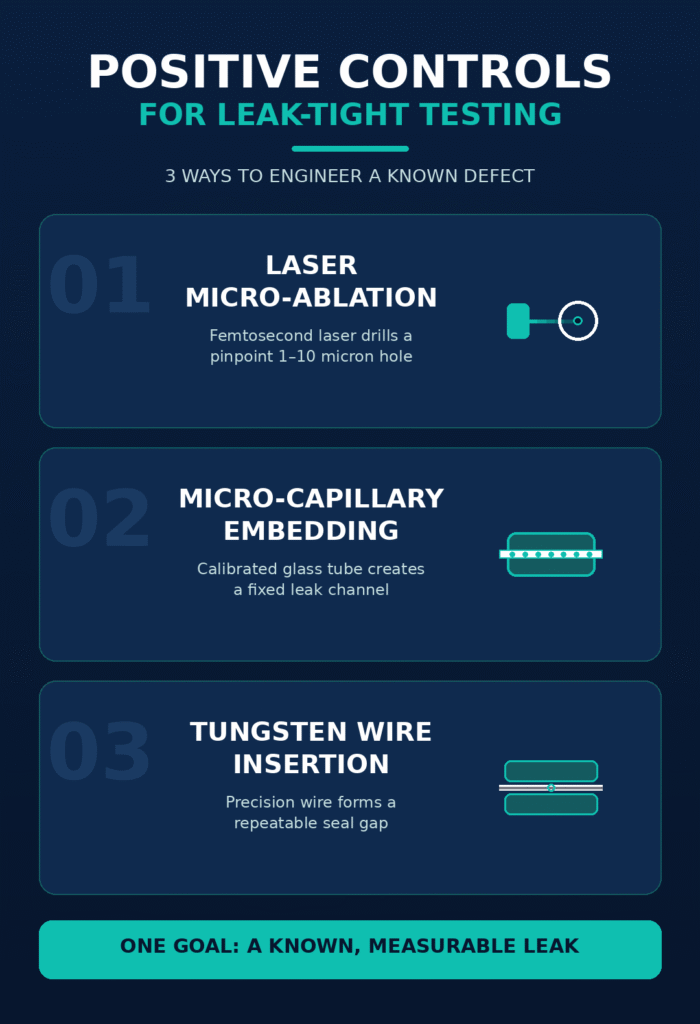
- Femtosecond Laser Micro-Ablation: Advanced laser systems create highly controlled circular defects ranging from approximately 1 µm to 10 µm in diameter through glass containers, polymer packaging materials, or metal closure systems.
- Micro-Capillary Embedding: Calibrated glass capillary tubes with traceable internal dimensions are incorporated into stoppers or package walls to create reproducible continuous leak channels.
- Tungsten Wire Insertion: Precision tungsten wires are positioned across elastomeric sealing interfaces, such as stopper-to-vial interfaces or syringe plunger seals, to generate consistent and repeatable channel leaks.
Prior to formal method validation, CDMOs confirm the leak characteristics of positive controls using calibrated helium mass flow instrumentation or pressure decay reference systems. This verification ensures that engineered defects accurately represent established MALL values. Validation studies then demonstrate analytical performance characteristics including specificity, accuracy, precision, linearity, and limit of detection (LOD) using both intact negative controls and calibrated positive controls.
Considering outsourcing manufacturing alongside analytical testing? Learn About Outsourcing Peptide Manufacturing to a CDMO
Analytical Rigor and Testing Architecture at ResolveMass Laboratories Inc.
ResolveMass Laboratories Inc. provides specialized analytical capabilities designed to support advanced deterministic container closure integrity programs for complex generic sterile drug products. Through the integration of multiple analytical technologies and standardized validation frameworks, ResolveMass Laboratories Inc. assists pharmaceutical manufacturers throughout product development, process validation, and commercial lifecycle management.
The analytical infrastructure at ResolveMass Laboratories Inc. includes advanced Vacuum Decay, High-Voltage Leak Detection, and Laser Headspace Analysis platforms capable of evaluating a wide range of dosage forms, including lyophilized products, highly viscous injectable formulations, and suspension-based drug products. By developing certified positive controls internally and implementing scientifically justified validation strategies, ResolveMass Laboratories Inc. generates eCTD-compliant data packages that support FDA ANDA submissions and compliance with EU GMP Annex 1 requirements.
Seeking specialized ophthalmic analytical solutions? Explore CDMO Services for Generic Ophthalmic Drug Products
Lifecycle Integration across Development, Validation, and Routine Testing
An effective container closure integrity strategy extends throughout the product lifecycle and encompasses three primary stages:
- Package Design and Component Qualification: Assessment of packaging materials, component compatibility, elastomer functionality, and inherent package integrity in accordance with USP <1207.1> and USP requirements to ensure performance equivalent to the Reference Listed Drug.
- Manufacturing Process Qualification: Evaluation of manufacturing variables such as stopper insertion force, capping and crimping parameters, sterilization cycles, autoclaving conditions, and lyophilization stresses to determine their impact on seal integrity.
- Commercial Release and Stability Monitoring: Application of validated deterministic methods for routine batch release testing, statistical sampling programs, and long-term stability studies as an alternative to traditional microbial sterility testing protocols.
Strategic Implementation for Generic Drug Lifecycle Management and Stability Protocols
Generic drug manufacturers can improve the efficiency of stability programs and portfolio management by implementing scientifically justified bracketing and matrixing approaches in accordance with ICH Q1A principles. Evaluating the most challenging packaging configurations, fill volumes, transportation conditions, and storage temperatures provides confidence in package performance while reducing unnecessary testing requirements.
Within a validated bracketing strategy, CCIT is conducted on the most extreme packaging configurations, such as the smallest fill volume contained within the largest vial and the largest fill volume contained within the smallest vial. Successful demonstration of package integrity under these worst-case conditions provides statistical confidence that all intermediate configurations will maintain comparable performance. This approach can significantly reduce analytical workload, sample consumption, and stability study costs.
Furthermore, stability programs should incorporate assessments of the physical stresses encountered during transportation and cold-chain distribution. Transportation simulation studies that include pressure fluctuations, vibration exposure, and mechanical shock testing in accordance with PDA Technical Report 27 help demonstrate that distribution conditions do not compromise closure integrity or induce temporary seal failures.
For sterile injectable products stored under ultra-low cryogenic conditions below -80°C, including storage on dry ice or in liquid nitrogen environments, CCIT evaluations should assess whether elastomeric components fall below their glass transition temperature (Tg). When elastomeric materials transition below Tg, they may temporarily lose elasticity and undergo dimensional shrinkage, potentially creating transient micro-gap leak pathways along the vial neck finish. Although these pathways may disappear after returning to ambient temperatures, their presence during storage must be carefully evaluated to ensure continued sterility assurance.
Ready to partner with a trusted US partner? Learn How to Choose a Peptide CDMO in the US
Conclusion
Developing a robust and fully compliant framework for Container Closure Integrity Testing (CCIT) for Generic Sterile Drug Products is essential for achieving successful ANDA approvals, maintaining sterility assurance, and supporting long-term product quality. Regulatory expectations established through USP, USP, and EU GMP Annex 1 have accelerated the transition away from traditional probabilistic methods such as dye ingress testing toward validated deterministic physical technologies that provide greater sensitivity, reproducibility, and scientific confidence.
To remain compliant with evolving regulatory expectations and safeguard patient safety, generic drug sponsors and CDMO partners must continue adopting advanced analytical platforms, engineered positive controls, and comprehensive lifecycle risk management strategies. Through scientifically rigorous CCIT programs, manufacturers can demonstrate package integrity, support regulatory submissions, and ensure the continued safety, efficacy, and stability of sterile drug products throughout their commercial lifecycle.
To discuss your generic sterile drug testing requirements or learn more about advanced CCIT validation services, please visit the ResolveMass Laboratories Inc. Contact Page:
Frequently Asked Questions (FAQs)
The Maximum Allowable Leakage Limit (MALL) represents the highest leak rate that a container closure system can exhibit without compromising product sterility, safety, or quality. It serves as a scientifically established acceptance criterion for package integrity testing. MALL values are determined based on product-specific characteristics and are used to demonstrate that the packaging system can effectively prevent microbial ingress and maintain product stability throughout its shelf life.
Deterministic CCIT methods are favored because they generate objective, quantitative, and highly reproducible results based on measurable physical principles. These methods can detect extremely small defects with greater sensitivity and consistency than traditional approaches. In contrast, probabilistic methods such as dye ingress and microbial immersion depend on visual interpretation or random events, making them less reliable and more susceptible to variability between operators and testing conditions.
EU GMP Annex 1 applies different testing expectations depending on the packaging format. Fusion-sealed containers, such as glass ampoules and certain Blow-Fill-Seal (BFS) systems, generally require comprehensive integrity verification using validated physical methods. For stoppered vials and other non-fusion-sealed systems, the guidance allows scientifically justified sampling plans based on Quality Risk Management principles while emphasizing that visual inspection alone is not sufficient to demonstrate container closure integrity.
USP places greater emphasis on demonstrating the functional suitability of elastomeric components within the finished drug product configuration rather than relying solely on supplier certifications. Pharmaceutical manufacturers must verify that stoppers, plungers, and seals maintain their intended performance throughout the product lifecycle. This approach ensures that elastomeric components contribute effectively to maintaining package integrity, sterility assurance, and product quality under actual use conditions.
Regulatory agencies increasingly recognize validated physical CCIT methods as a suitable alternative to routine sterility testing in certain stability programs. These methods directly assess the package’s ability to maintain a sterile barrier over time and can provide faster, more reliable data. In addition, physical integrity testing minimizes the risk of false-positive results that may occur due to accidental contamination during microbiological testing procedures.
Certified positive controls are created by introducing carefully characterized defects into packaging components to simulate known leak pathways. Common techniques include laser-generated micro-holes, embedded micro-capillary channels, and precision wire insertion across sealing interfaces. These engineered defects are then verified using calibrated analytical systems to ensure they accurately represent predetermined leakage conditions required for method validation.
The most appropriate deterministic method depends on the product formulation and packaging characteristics. High-Voltage Leak Detection (HVLD) is widely used for conductive liquid formulations because it can rapidly identify micro-defects without damaging the container. Vacuum Decay is another highly effective technique that provides sensitive, non-destructive leak detection for a broad range of liquid-filled and lyophilized parenteral products.
Prefilled syringe systems contain several potential locations where integrity failures can occur. Common leak pathways include the interface between the elastomeric plunger and syringe barrel, the tip cap or needle shield seal, microscopic defects within the barrel material, and temporary seal disruptions caused by transportation or processing stresses. Identifying and monitoring these areas is essential for maintaining product sterility and performance.
Exposure to extremely low temperatures can affect the physical properties of elastomeric sealing materials. As temperatures decrease, elastomers may become less flexible and experience dimensional changes that could influence sealing performance. Comprehensive CCIT evaluations conducted under cold-chain and cryogenic storage conditions help determine whether packaging systems can maintain adequate barrier protection throughout storage, transportation, and handling.
eCTD Section 3.2.P.7 typically contains detailed information regarding the container closure system used for the drug product. This includes material specifications, component descriptions, engineering details, compatibility assessments, and performance qualification data. Applicants are also expected to provide supporting evidence demonstrating that the proposed packaging system offers adequate protection and maintains product quality throughout the intended shelf life.
Reference:
- U.S. Food and Drug Administration. (2019). Container closure integrity testing in lieu of sterility testing as a component of the stability protocol for sterile products: Guidance for industry. U.S. Department of Health and Human Services, Food and Drug Administration. https://www.fda.gov/media/128127/download
- U.S. Food and Drug Administration. (2024). Container closure system and component changes: Glass vials and stoppers—Guidance for industry. U.S. Department of Health and Human Services, Food and Drug Administration. https://www.fda.gov/media/167925/download
- GMP Compliance. (2019). FDA guidance for industry: Container and closure system integrity testing in lieu of sterility testing as a component of the stability protocol for sterile products. GMP Compliance. https://www.gmp-compliance.org/guidelines/gmp-guideline/fda-guidance-for-industry-container-and-closure-system-integrity-testing-in-lieu-of-sterility-testing-as-a-component-of-the-stab
Get In Touch With Us
About The Author


