

Introduction
Controlling Epimerization and Aspartimide Formation during solid-phase peptide synthesis (SPPS) is essential for producing high-purity therapeutic peptides and preventing the accumulation of non-separable isobaric impurities. Suppressing base-catalyzed α-carbon enolization and base-promoted succinimide ring closure requires targeted chemical intervention, including sterically hindered protecting groups, acidic deprotection additives, and base-free activation protocols.
Epimerization at chiral centers, particularly in cysteine and histidine residues, and aspartimide cyclization at susceptible Asp-X motifs, where X represents Gly, Asn, Ser, Ala, or Cys, represent major degradation pathways in Fmoc/tBu chemistry. Uncontrolled degradation generates complex crude mixtures containing isobaric isomers, deletion sequences, and piperidide adducts. Because these by-products share physical and chromatographic properties with the target sequence, their presence creates severe purification bottlenecks and significantly lowers synthetic yields.
Suppressing these side reactions requires a precise understanding of reaction kinetics, side-chain electronics, and steric hindrance. Integrating advanced building blocks, such as sterically hindered aspartic acid esters, backbone-protected dipeptides, and buffered deprotection systems, enables peptide chemists to eliminate these side reactions and streamline peptide manufacturing.
Need support with sequence-specific peptide synthesis and optimization of challenging SPPS workflows? Explore our Custom Peptide Synthesis Services for specialized peptide development and synthesis support.
Share via:
Quick Summary:
- Epimerization and aspartimide formation are major side reactions in Fmoc-SPPS that can create difficult-to-separate impurities and reduce peptide yield and purity.
- Epimerization mainly occurs through oxazolone formation or direct base-mediated α-deprotonation, with histidine and cysteine being particularly vulnerable.
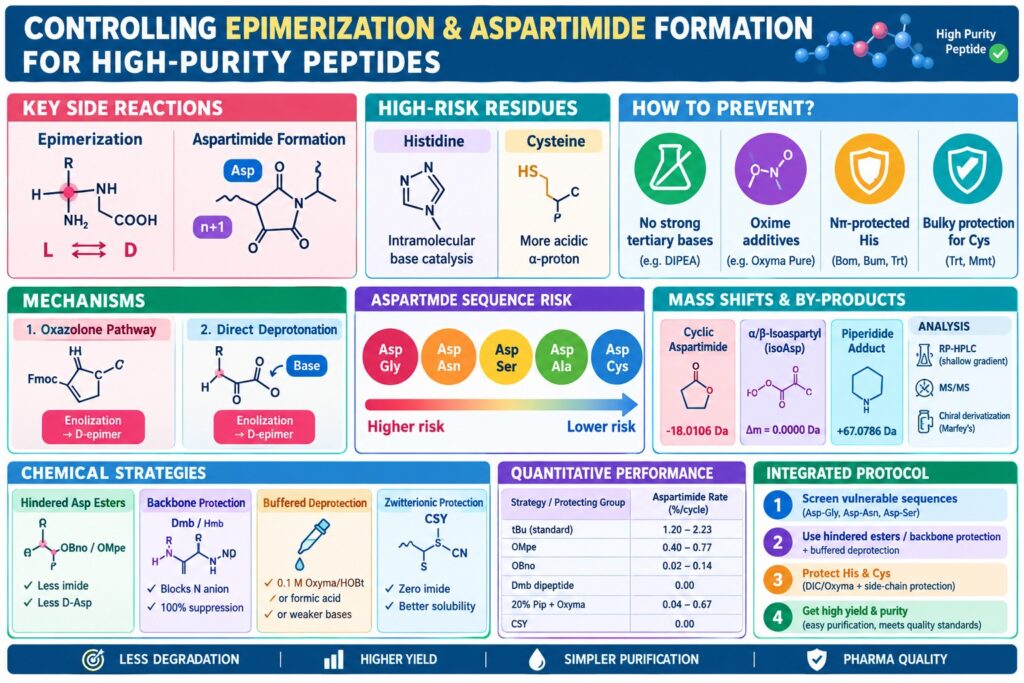
- Aspartimide formation is strongly sequence-dependent, with Asp-Gly > Asp-Asn > Asp-Ser > Asp-Ala > Asp-Cys showing decreasing susceptibility.
- Base-free DIC/Oxyma coupling, Nπ-protected histidine, and bulky cysteine protecting groups help minimize racemization and preserve stereochemical integrity.
- Sterically hindered Asp protecting groups such as OMpe and OBno, along with Dmb/Hmb backbone protection and CSY protection, can substantially suppress aspartimide formation.
- Buffered Fmoc deprotection using Oxyma, HOBt, formic acid, or weaker bases such as morpholine can reduce backbone amide deprotonation and succinimide formation.
- Advanced analytical methods including shallow-gradient RP-HPLC, MS/MS, neutral-pH LC, and Marfey’s chiral analysis are essential for identifying isobaric impurities and confirming peptide quality.
Mechanistic Pathways of Epimerization in Fmoc-SPPS
Epimerization during solid-phase peptide synthesis occurs primarily through two mechanisms during carboxyl activation: 5(4H)-oxazolone intermediate formation and direct base-mediated α-deprotonation. Both pathways generate a planar, achiral enolate intermediate that undergoes non-stereoselective reprotonation, leading to chiral inversion at the α-carbon.
In the direct enolization pathway, an external base abstracts the acidic α-proton from the activated amino acid, forming an achiral enolate intermediate that reprotonates from either face to yield a racemic mixture of L- and D-enantiomers. Alternatively, in the oxazolone pathway, the carbonyl oxygen of the Nα-Fmoc group performs an intramolecular attack on the activated carboxyl group, generating a 5(4H)-oxazolone intermediate. The α-proton of this cyclic intermediate is highly acidic and readily deprotonates to form a resonance-stabilized enolate, which undergoes non-stereoselective ring opening upon nucleophilic attack by the resin-bound amine.
Intramolecular Oxazolone Cyclization Route
The oxazolone pathway proceeds through the nucleophilic attack of the Nα-Fmoc carbamate carbonyl oxygen onto the activated carboxyl group, generating a cyclic 5(4H)-oxazolone intermediate. This five-membered ring structure possesses an unusually acidic α-proton that is rapidly abstracted by weak bases to form a resonance-stabilized planar enolate.
Nucleophilic capture of the oxazolone by the resin-bound amine can occur at either face of the planar system. Because the rate of oxazolone enolization often approaches or exceeds the rate of productive coupling, significant quantities of D-epimers accumulate prior to chain extension. Oxazolone formation is particularly pronounced when activation reagents generate long-lived reactive intermediates in the presence of free tertiary bases.
Direct Base-Mediated Deprotonation and Chiral Center Loss
Direct base-mediated α-deprotonation involves the direct abstraction of the α-proton from an activated amino acid ester by tertiary amine bases prior to amine coupling. This mechanism is driven by kinetic competition, where slow nucleophilic capture by the growing peptide chain allows base-promoted enolization to dominate.
Tertiary bases such as N,N-diisopropylethylamine (DIPEA) or N-methylmorpholine (NMM), which are commonly added to activate uronium reagents such as HATU and HBTU, increase the rate of direct α-deprotonation. Steric congestion surrounding either the activated carboxylate or the incoming terminal amine decreases the rate of productive coupling, extending the lifetime of the activated species and increasing chiral center inversion.
For peptide programs moving from laboratory synthesis toward controlled manufacturing, process optimization and technology transfer are critical. Learn more about our Technology Transfer to GMP CDMO capabilities for transferring optimized peptide processes into GMP manufacturing environments.
High-Risk Susceptibility in Histidine and Cysteine Residues
Histidine and cysteine are the most epimerization-prone amino acids due to side-chain electronic effects that accelerate α-proton abstraction. Histidine suffers from intramolecular basic catalysis by its unprotected imidazole ring, while cysteine experiences increased α-proton acidity caused by the inductive effect of its β-sulfur atom.
Histidine Epimerization
The basic Nπ (or Nδ1) nitrogen atom of the imidazole ring acts as an intramolecular base, abstracting the α-proton directly during carboxyl activation. This catalytic mechanism operates even under weak base conditions, causing significant racemization if Nπ remains unprotected.
Cysteine Epimerization
The strong electron-withdrawing inductive effect of the β-sulfur atom increases the acidity of the adjacent α-proton. Base-promoted abstraction occurs rapidly during coupling, particularly at elevated temperatures or when base pre-activation protocols are used.
Strategies for Controlling Epimerization and Aspartimide Formation During Carboxyl Activation
Controlling Epimerization and Aspartimide Formation during carboxyl activation requires substituting strong tertiary amine bases with oxime-based additives and utilizing Nπ-protected histidine building blocks. These measures suppress enolization kinetics and accelerate productive amide bond formation.
Coupling Reagents and Additives for Racemization Suppression
Carbodiimide activation paired with oxime additives like DIC/Oxyma Pure minimizes racemization by converting reactive O-acylisourea intermediates into highly active esters without requiring free tertiary amine bases. This combination significantly increases the rate of nucleophilic coupling relative to competing enolization pathways.
Using N,N′-diisopropylcarbodiimide (DIC) alongside ethyl cyanohydroxyiminoacetate (Oxyma Pure) or 1-hydroxy-7-azabenzotriazole (HOAt) avoids the need for basic additives like DIPEA. Oxyma Pure provides strong nucleophilicity, driving rapid conversion of the activated intermediate to the desired amide bond before oxazolone cyclization or direct α-deprotonation can occur.
If your peptide program requires controlled synthesis at development or manufacturing scale, explore our GMP Peptide API Manufacturing Services for support with peptide API production under GMP-oriented manufacturing conditions.
Side-Chain Protection Strategies for Histidine and Cysteine
Effective control of histidine and cysteine epimerization is achieved through specific side-chain protecting group architectures that deactivate catalytic moieties and provide steric shielding. Masking the histidine Nπ position with Bom, Bum, or Trt groups prevents intramolecular base catalysis, while bulkier trityl derivatives and moderate temperatures protect cysteine.
Histidine Protection
Masking the Nπ position using Nπ-benzyloxymethyl (Bom), Nπ-tert-butoxymethyl (Bum), or Nπ-trityl (Trt) protection electronically deactivates the nitrogen lone pair, blocking intramolecular proton abstraction. Nε-protection alone fails to prevent this pathway because the Nπ nitrogen remains unblocked.
Cysteine Protection
Cysteine residues should be protected with bulky, acid-labile groups such as trityl (Trt) or 4-methoxytrityl (Mmt). Coupling reactions involving cysteine should be conducted at ambient or moderate temperatures, 25 °C to 40 °C, using base-free DIC/Oxyma conditions to prevent thermally accelerated enolization.
Mechanistic Drivers of Aspartimide Formation and Isobaric By-Products
Aspartimide formation is a base-catalyzed side reaction in which the n+1 backbone amide nitrogen performs an intramolecular nucleophilic attack on the aspartic acid β-carboxyl ester, forming a cyclic aminosuccinimide intermediate. Subsequent ring opening yields complex mixtures of isobaric β-isoaspartyl peptides and piperidide adducts.
During standard Fmoc deprotection, exposure to piperidine deprotonates the backbone amide nitrogen (N-H) of the residue immediately following aspartic acid. The resulting nucleophilic nitrogen anion attacks the side-chain β-carbonyl carbon, displacing the tBu protecting group to form a cyclic aspartimide derivative. This cyclic intermediate is unstable and reopens upon nucleophilic attack by water or piperidine, generating multiple side products.
Sequence Dependence and Cyclic Succinimide Generation
The rate of aspartimide generation is highly sequence-dependent, occurring most rapidly in Asp-Gly, Asp-Asn, Asp-Ser, and Asp-Ala motifs. Minimal steric bulk on the adjacent n+1 amino acid residue allows unhindered access of the backbone amide nitrogen to the side-chain ester.
Steric and electronic factors dictate the rate of cyclization across different sequence contexts:
Relative Cyclization Propensity: Asp-Gly > Asp-Asn > Asp-Ser > Asp-Ala > Asp-Cys
In Asp-Gly motifs, the absence of an amino acid side chain at the n+1 position minimizes steric hindrance, maximizing the rate of base-promoted backbone deprotonation and subsequent cyclization.
Sequence-dependent degradation should be considered as part of a broader impurity-control strategy. See our Impurity Control Strategies Under ICH Q3A for additional information on identifying and controlling process-related impurities.
Mass Shifts and Structural Analysis of Aspartimide Derivatives
Aspartimide breakdown pathways produce three major class types: cyclic imides with a mass loss of -18.0106 Da, isobaric α-/β-isoaspartyl hydrolysis products (Δm = 0.0000 Da), and piperidide adducts with a mass shift of +67.0786 Da. High-resolution analytical techniques are required to differentiate these variants from the target sequence.
Cyclic Aspartimide Intermediate
The cyclic aspartimide intermediate is characterized by the loss of water, producing a mass shift of -18.0106 Da.
Isobaric Hydrolysis Impurities (α-Asp and β-Isoasp)
Ring opening by water can occur at either carbonyl carbon of the succinimide ring. Hydrolysis at the α-carbonyl restores the native sequence or its D-α-epimer, while attack at the β-carbonyl generates the β-isoaspartyl (isoAsp) peptide. Both products are isobaric to the desired peptide (Δm = 0.0000 Da). Insertion of the side-chain methylene group into the peptide backbone in β-isoAsp alters target secondary structure and biological function.
Piperidide Adducts
Nucleophilic attack by piperidine on the aspartimide intermediate during Fmoc cleavage yields stable α- and β-piperidides, resulting in a mass increase of +67.0786 Da.
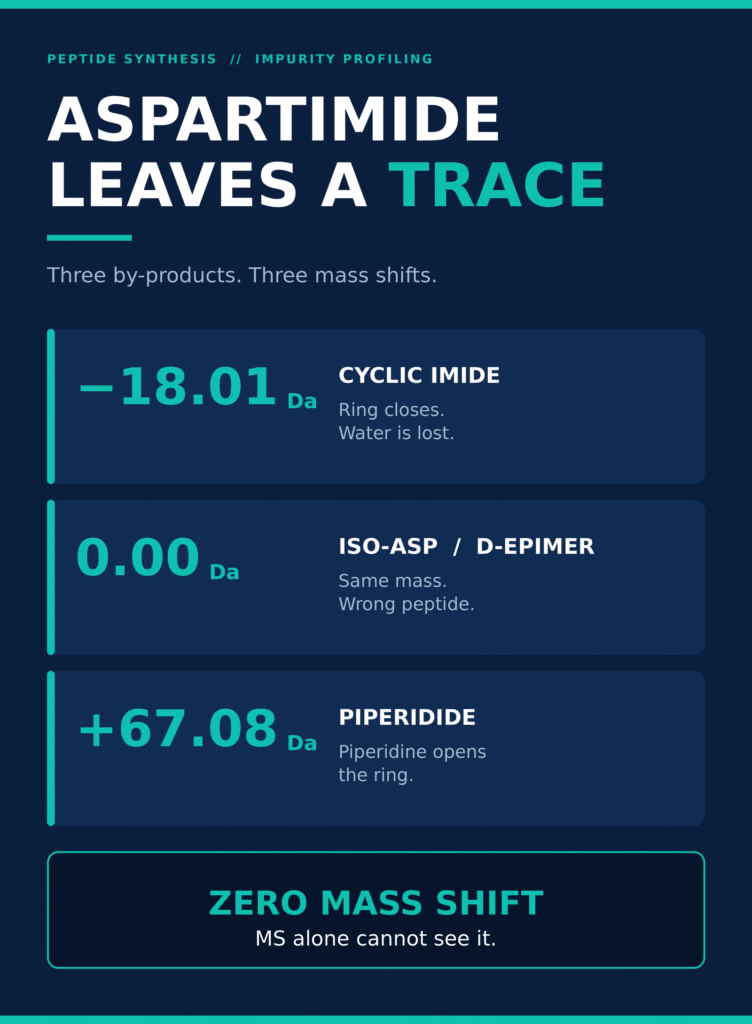
Differentiating closely related peptide impurities requires orthogonal analytical characterization rather than relying exclusively on mass data. Explore our Peptide Analytical Testing Services for support with peptide identity, purity, related substances, and structural variant characterization.
Chemical Innovations for Controlling Epimerization and Aspartimide Formation
Chemical methods for Controlling Epimerization and Aspartimide Formation include using sterically hindered side-chain esters, backbone-protected dipeptides, zwitterionic protecting groups, and buffered deprotection solutions. Integrating these chemical tools prevents succinimide cyclization across highly vulnerable peptide sequences.
Sterically Demanding Aspartic Acid Protecting Groups
Sterically hindered aspartic acid protecting groups, such as Fmoc-Asp(OBno)-OH and Fmoc-Asp(OMpe)-OH, reduce aspartimide formation by physically blocking the backbone amide nitrogen from attacking the β-carbonyl carbon. The 5-butylnonan-5-yl (OBno) ester reduces aspartimide formation to below 0.1% per cycle while suppressing D-Asp epimerization.
Replacing standard tBu protection with bulkier alkyl or branched aryl esters shields the β-ester.
Fmoc-Asp(OMpe)-OH
The 3-methylpent-3-yl (OMpe) ester introduces moderate steric bulk, decreasing aspartimide formation by 60–70% compared with tBu derivatives.
Fmoc-Asp(OBno)-OH
The 5-butylnonan-5-yl (OBno) derivative provides significant steric shielding. In difficult Asp-Gly sequences subjected to extended piperidine exposure, Fmoc-Asp(OBno)-OH suppresses cyclic imide formation to <0.1% per cycle without causing steric hindrance during coupling or producing alkylation by-products during TFA cleavage.
Fmoc-Asp(CSY)-OH
Cyanosulfurylide (CSY) protection utilizes a zwitterionic side-chain group that completely prevents succinimide ring closure while improving chain solubility. The CSY group is removed post-synthetically under mild aqueous conditions using electrophilic halogenating agents like N-chlorosuccinimide (NCS).
Amide Backbone Masking via Dmb and Hmb Auxiliaries
Backbone protection using N-(2,4-dimethoxybenzyl) (Dmb) or N-(2-hydroxy-4-methoxybenzyl) (Hmb) auxiliaries completely eliminates aspartimide formation by replacing the backbone amide proton with a protective group. Incorporating pre-formed dipeptides like Fmoc-Asp(OtBu)-(Dmb)Gly-OH prevents deprotonation of the n+1 nitrogen atom entirely.
Because the Dmb/Hmb group replaces the amide hydrogen, no nitrogen anion can form under basic conditions, completely blocking nucleophilic attack on the Asp β-ester. Due to potential steric hindrance when coupling individual amino acids onto a Dmb-protected amine, pre-synthesized dipeptides, such as Fmoc-Asp(tBu)-(Dmb)Gly-OH, are utilized during synthesis. The Dmb group is cleaved during final TFA deprotection.
Buffered Deprotection Protocols and Alternative Bases
Adding acidic additives such as 0.1 M Oxyma Pure, HOBt, or formic acid to piperidine deprotection solutions significantly reduces aspartimide formation by lowering the solution basicity and suppressing amide nitrogen anion formation. Alternatively, weaker bases such as morpholine or 4-methylpiperidine can be substituted to achieve complete Fmoc removal with minimal side reactions.
Modifying deprotection conditions provides a reliable approach when specialized protecting groups are unavailable.
Acidic Modifiers
Incorporating 0.1 M Oxyma Pure, 0.1 M HOBt, or 0.1 M formic acid into 20% piperidine/DMF buffers the reaction medium. This shift in pH minimizes backbone amide ionization while maintaining rapid Fmoc cleavage rates.
Alternative Cleavage Bases
Replacing piperidine (pKa = 11.2) with milder bases like morpholine (pKa = 8.4), piperazine, or 4-methylpiperidine lowers backbone amide deprotonation rates, suppressing succinimide formation in moderately sensitive sequences.
When a peptide process advances toward development and commercialization, stability assessment becomes important for evaluating product quality throughout storage and handling. Explore our Peptide Stability Testing Services for peptide stability evaluation and analytical support.
Quantitative Benchmarking of Aspartimide Suppression Strategies
Quantitative comparison of aspartimide suppression methods demonstrates that sterically hindered esters and backbone protection provide superior suppression compared with standard tBu protection. Experimental models using Asp-Gly sequences highlight the dramatic reduction in degradation kinetics achieved by these chemical strategies.
The table below outlines performance metrics, kinetic decay rates, and operational considerations across primary aspartimide suppression strategies during Fmoc-SPPS:
| Strategy / Protecting Group | Primary Mechanism of Action | Aspartimide Rate (%/cycle) | Key Synthetic Advantages | Primary Limitations |
|---|---|---|---|---|
| Fmoc-Asp(OtBu)-OH (Standard) | Standard ester; minimal steric shielding | 1.20%–2.23% | Low reagent cost; universal availability | High aspartimide, D-Asp, and piperidide formation |
| Fmoc-Asp(OMpe)-OH | Moderate steric shielding via 3-methylpent-3-yl | 0.40%–0.77% | Reduces imide formation by approximately 60% | Incomplete suppression in highly sensitive Asp-Gly motifs |
| Fmoc-Asp(OBno)-OH | High steric shielding via 5-butylnonan-5-yl | 0.02%–0.14% | Reduces aspartimide to <0.1%; suppresses D-Asp racemization | Higher building block unit cost |
| Fmoc-Asp(OtBu)-(Dmb)Gly-OH | Backbone amide nitrogen masking via Dmb group | 0.00% | 100% elimination of cyclization pathway | Higher cost; limited commercial dipeptide sequences |
| 20% Piperidine + 0.1 M Oxyma Pure | Protonation buffering of backbone amide | 0.04%–0.67% | Compatible with standard workflows | May produce minor oxime-derived chromatographic impurities |
| Fmoc-Asp(CSY)-OH | Zwitterionic cyanosulfurylide protection | 0.00% | Complete suppression; enhances solubility | Requires post-cleavage aqueous halogen treatment |
For peptide programs requiring integrated development, synthesis, analytical characterization, and manufacturing support, explore our North American Peptide CDMO Services for broader peptide development and manufacturing capabilities.
Analytical Identification and Quantification of Isobaric Impurities
Accurate detection and quantification of isobaric β-isoaspartyl and D-epimeric impurities require high-efficiency reverse-phase HPLC with shallow organic gradients, neutral mobile-phase pH, and tandem mass spectrometry. Standard MS alone cannot resolve isobaric species with zero mass delta, necessitating chromatographic separation or chiral hydrolysate derivatization.
Electrospray ionization mass spectrometry (ESI-MS) detects cyclic aspartimides (-18.0106 Da) and piperidide adducts (+67.0786 Da). However, differentiating native L-α-aspartyl peptides from L-β-isoaspartyl and D-α-epimeric variants (Δm = 0.0000 Da) requires specialized analytical techniques.
Shallow Reverse-Phase Gradients
Executing ultra-shallow organic solvent gradients, 0.1% to 0.5% acetonitrile per minute, across core-shell or 1.7 μm particle C18 columns resolves baseline separation between L-α, D-α, and L-β-isoaspartyl peak doublets.
Neutral Mobile-Phase Buffering
Operating liquid chromatography at neutral pH, pH 6.5–7.0 using 10 mM ammonium acetate buffers, alters the charge state of free carboxylic acids, expanding retention-time differences between α- and β-aspartyl backbones.
Chiral Hydrolysate Analysis
Absolute quantification of total D-amino acid content is performed by hydrolyzing the peptide in 6 M HCl, derivatizing the amino acid hydrolysates with Marfey’s reagent, Nα-(2,4-dinitro-5-fluorophenyl)-L-alaninamide, and analyzing the resulting diastereomers via LC-MS.
Need regulatory-ready documentation for a peptide API program? Explore our Peptide Drug Master File (DMF) Preparation services for support with technical CMC and API documentation.
Conclusion: Integrated Protocol for Controlling Epimerization and Aspartimide Formation
Successfully Controlling Epimerization and Aspartimide Formation in solid-phase peptide synthesis requires a comprehensive framework integrating sequence vulnerability screening, sterically hindered derivatives, and optimized reaction parameters. Adopting these advanced chemical protocols ensures maximum peptide yield, simplifies downstream purification, and satisfies rigorous pharmaceutical quality standards.
Preventing degradation pathways begins with sequence risk assessment. Sequences containing Asp-Gly, Asp-Asn, or Asp-Ser motifs should incorporate Fmoc-Asp(OBno)-OH or backbone-protected dipeptides paired with buffered deprotection solutions containing 0.1 M Oxyma Pure. Simultaneously, epimerization-prone residues such as histidine and cysteine must be coupled using DIC/Oxyma Pure alongside appropriate side-chain protection to eliminate oxazolone formation and base-catalyzed enolization.
Applying these chemical strategies eliminates major synthetic bottlenecks, increases process efficiency, and guarantees high-purity peptides.
For technical consultation, analytical services, and custom peptide synthesis optimization, visit the ResolveMass Laboratories Contact Page.
Frequently Asked Questions
During carboxyl activation, the Nα-Fmoc carbamate carbonyl oxygen can attack the activated carboxyl group and generate a cyclic 5(4H)-oxazolone intermediate. Its α-proton is highly acidic and can be removed under basic conditions, producing a planar, achiral enolate. Reprotonation from either face can then generate both L- and D-epimeric products.
Histidine can undergo racemization because its unprotected Nπ imidazole nitrogen can function as an intramolecular base and facilitate α-proton abstraction during activation. In cysteine, the β-sulfur atom exerts an electron-withdrawing inductive effect that increases α-proton acidity. These characteristics make both residues particularly vulnerable to base-catalyzed enolization.
Acidic additives such as 0.1 M Oxyma Pure, HOBt, or formic acid decrease the effective basicity of piperidine deprotection mixtures. This reduces the extent to which the backbone amide nitrogen at an Asp-X junction becomes deprotonated. As a result, formation of the nucleophilic nitrogen species required for attack on the Asp β-ester is suppressed.
Formation of the cyclic aspartimide intermediate involves water loss and produces a mass decrease of -18.0106 Da. Reaction of the intermediate with piperidine produces α- and β-piperidide adducts with a +67.0786 Da mass increase. Hydrolysis can instead generate α-aspartyl and β-isoaspartyl products that remain isobaric with the intended peptide, giving Δm = 0.0000 Da.
Fmoc-Asp(OBno)-OH contains a 5-butylnonan-5-yl ester that creates substantially greater steric protection around the Asp β-carbonyl region. This restricts the approach of the backbone amide nitrogen and markedly decreases cyclization. Reported formation can be reduced from levels exceeding 2% per cycle with standard protection to below 0.1% per cycle, while also reducing D-aspartate epimerization.
Backbone-protected dipeptides, including Fmoc-Asp(tBu)-(Dmb)Gly-OH, use a 2,4-dimethoxybenzyl (Dmb) auxiliary to protect the amide nitrogen of the adjacent residue. Because the Dmb group replaces the backbone amide proton, the nitrogen cannot undergo the required base-mediated deprotonation. This removes the nucleophilic species responsible for intramolecular attack on the Asp side-chain ester.
β-Isoaspartyl products have the same overall molecular mass as the intended peptide, with Δm = 0.0000 Da, making them difficult to distinguish by conventional MS alone. Their closely related physicochemical characteristics can also result in poor chromatographic resolution under standard reverse-phase HPLC conditions. Shallow organic gradients and adjusted mobile-phase pH may therefore be required to achieve effective separation.
Base-free carbodiimide activation using DIC together with oxime-based additives such as Oxyma Pure or HOAt can reduce epimerization during coupling. These systems generate reactive active esters without depending on tertiary amine bases such as DIPEA. Faster productive amide bond formation reduces the opportunity for oxazolone formation and direct α-deprotonation to occur.
Cyanosulfurylide (CSY) protection uses a zwitterionic protecting group on the aspartic acid side chain that prevents the structural conditions required for succinimide ring closure. This provides strong protection against intramolecular cyclization during basic Fmoc deprotection. After peptide assembly, the CSY group can be removed under mild aqueous conditions using electrophilic halogenating agents such as N-chlorosuccinimide (NCS).
Reference:
- Duengo, S., Muhajir, M. I., Hidayat, A. T., Musa, W. J. A., & Maharani, R. (2023). Epimerisation in peptide synthesis. Molecules, 28(24), 8017. https://doi.org/10.3390/molecules28248017
- Amblard, M., Fehrentz, J.-A., Martinez, J., & Subra, G. (2006). Methods and protocols of modern solid-phase peptide synthesis. Methods in Molecular Biology, 298, 3–24. https://doi.org/10.1385/1-59259-877-3:003
- Overby, C., Abraham, B., Adjei-Sowah, E., March, A., Ling, K., Basu, S., & Benoit, D. S. W. (2025). A rapid manual solid phase peptide synthesis method for high-throughput peptide production. Journal of Biomedical Materials Research Part A, 113(5), e37922. https://doi.org/10.1002/jbm.a.37922
Get In Touch With Us
About The Author


